Showing posts with label Carey Mulligan. Show all posts

Wednesday, May 29, 2013

The Great Gatsby (2013)

"Yours in Great Depression" During the Baz Age
or
I'm Half Crazy All for the Love of You....

"There are no second acts in American lives"
F. Scott Fitzgerald

There have been several versions of F. Scott Fitzgerald's Great American Novel that have hit the big screen since the novel was first published in 1925, and nobody seems to get it right, if "right" can be got at all.  There's a "lost" silent version with Warner Baxter, a 1949 version adapted by Richard Maibaum with Alan Ladd, that emphasized Gatsby's gangster roots, the Robert Evans vanity production of 1974 with Robert Redford and Mia Farrow, directed bloodlessly by Jack Clayton.  It's a challenge to produce such a tragedy that has a boisterous first act, and such a downer of a second, but that is what makes it so special, and so American.  In fact, the best version must be taken out of the novel, which was written in the midst of the period in which it was set, and take into account future events—the stock market crash in 1929 and the following "Great Depression," which sounded the death-knell for The Jazz Age with a long sustained flat note.  Fitzgerald's prescient, cautionary novel proved historically accurate with 20/20 foresight to the extent that you cannot make a movie of it unironically, given the past that was its future, and you cannot make a complete movie of it while remaining blind to what it did not foresee in reality, but captured artistically and thematically.

Baz Luhrman's version of The Great Gatsby jumps into that irony with both feet and splashes around in it, kicking and squealing like a child drunk with a secret.  It was a weird decision to film it in 3-D, but given the way Luhrman uses it, in vivid eye-popping colors, emphasizing the swoop of camera moves and the solidness of glass partitions, and the illusion of the reflections shimmering over it—and particularly in how he photographs our last views of East Egg, in a way that rather lovingly visualizes the novel's last line ("So we beat on, boats against the current, borne back ceaselessly into the past")—one begins to wonder any other way to do it.*  In a way, the movie feels like one big "Vertigo zoom" in three-dimensions, starting with an art-deco pattern that falls away to the production company logos and ending with an unfamiliar one—until you see it pop up again in Jay Gatsby's monograms.

Then, we begin the touchstones, green light on the dock, the Egg's, the parties, the shirts, the infidelities, "the man who fixed the 1919 World Series," Dr. T.J. Eckleburg, Oculist (correctly spelled this time), the fights, all done in Luhrman's hyper-speed (which is maintained throughout, as opposed to his previous film Australia, which flagged after the first 45 minutes), in a style somewhere between Preston Sturges, Sam Raimi, and Tex Avery, making the performances somewhat inconsistent (but more on that later).  The swooping, veering style allows for some fore-shadowing plummets down skyscrapers and serves as a visual counter-point to Jay-Z's thumping, pumping soundtrack, which is surprisingly synchronous, although slightly discordant and certainly anachronistic.


"One big 'Vertigo' zoom"
The neatest touch that the director throws into this Great Gatsby is the framing story paralleling F. Scott Fitzgerald, as Nick Carraway (Tobey McGuire), incarcerated in a sanatorium to dry out, composes the story at the behest of his psychiatrist (Jack Thompson), which allows Fitzgerald's words to flow out and become part of the story (the name of the sanatorium is Perkins Sanatorium, after Fitzgerald's editor, the brilliant Max Perkins, a nice little in-joke) and become part of the narrative, succinctly and effortlessly, providing a touch of elegance and perspective to the visual shenanigans.

Even that is a little problematic, as you can't believe those words and that phrasing is coming out of McGuire's googly-eyed Candide in this version—Sam Waterston's Nick in the '74 vintage and even Paul Rudd's in the 2000 BBC take, both have the mature feel for Carraway's observer/muse/co-dependent enabler.  It's a miscalculation, but not due to the casting of McGuire, so much as Luhrman's ADD approach to direction.  DiCaprio's Gatsby is prone to such inconsistency as well.  After establishing Gatsby as a figure of extravagant mystery and a certain false style, Luhrman has him marching up to Nick's cottage, servants in line behind, an image that recalls a parade.  It brings a laugh, but is far too comic for the character.  Sure, he's nervous, anticipating the forthcoming tea, and he's slightly out of his element.  But the effect takes away from all aspects of the character, even though it plays into Gatsby's too-romantic notions of reclaiming his past. Nor does it help that DiCaprio still looks like a boy-child here.


But where the casting falls off the most is Carey Mulligan as Gatsby's lost-love, Daisy Buchanan, the instrument of his downfall.  It's a tough character to cast, as difficult as Gone with the Wind's Scarlett O'Hara, seemingly worldly-wise (but actually sheltered), and fatally shallow, selfish in the moment, and murderously practical in the long run.  She needs to be someone who can dash all hopes by merely averting her gaze, and fascinating enough to attract it.  And she has to evoke some sympathy for her acts, despite her flaws.  As good an actress as Mulligan is (and has been) her Daisy comes across, finally, unknowable and not interesting enough to be an object of obsession, as she must be for the whole tale to work.  In fact, it would be tough to think of a modern actress who could be so cool in her actions, and attractive to risk everything for.  Stanwyck could do it, and Hepburn (Katherine), but it would take a full infusion of actorly personality to pull off.  With Mulligan, there's no spider's web of promise, only a longing weakness, around which the story can revolve.  And at the pace Luhrman spins the film, that character needs to have a substantial spine to keep it from flying apart.

It's not there.  There is substantial spectacle and evocation of the times, but the people caught in it cannot hold the thing together. It's just another variation of the theme.  As such, it's an interesting, but not a great "Gatsby."

The Great Gatsby (2013) is a Rental.


* The 3-D also helps the special effects, which, in Luhrman's vision of things have a distant postcard version of things and see quite a bit distanced from the real live action going on out front.  In fact, I imagine the film looking pretty crummy in 2-D, especially in the shots where the large estates look like models.

Thursday, October 6, 2011

Drive

"Flash Over Substance"
or
“I used to produce movies in the '80′s. Kind of action films, sexy stuff…one critic called them 'European.'  I thought they were shit”

In 1987, two movies of the same type came out and they could not be any more different, despite their similarities of plot—Martin Scorsese made After Hours and John Landis made Into the Night.  Both were movies about semi-clueless day-jobbers who had to negotiate the dark unknown (to them) underbelly of their cities in the wee small hours of the morning and somehow survive to the dawn.  What made them different were the sensibilities of the directors and their neighborhoods—Scorsese's took place in brownstone New York and Landis' took place in the high-styled concrete of Los Angeles. 

It's a similar trick here, it just took 36 years to make an L.A. counter-point to Scorsese's Taxi Driver, and that film is Drive, directed by Nicolas Winding Refn in the same cold blue-and-teal gloss of a 1980's era Michael Mann film or the similar cool veneer provided Risky Business' Paul Brickman.*

Like Scorsese's film, we have a restless professional driver (Ryan Gosling), but it's L.A. so he's a stunt-driver for the movies by day, and a for-hire getaway genius at night (demonstrated by two very nicely laid out chase sequences, one at night evading the police and one chase on the open road later in the film).  He's also a garage mechanic for mentor Shannon (Bryan Cranston), who has designs on a racetrack career with his young protégé behind the wheel.

The Driver—he is a typical "Man with No Name" with no discernible past and an "iffy" future—is utterly defined by his mechanical abilities under the hood and behind the wheel.  His words are spare,** never betraying the mind that is firing on all cylinders, his eyes taking everything in, without much expression to betray his heart or motivations, much like the visual style and minimal acting employed for Taxi Driver's Travis Bickle.  But with no name and no voice-over narration to provide motivation, the audience is always just a little behind what is being presented on-screen, which pays off in a couple of nifty ways early on as the director presents him in an environment without giving any clues as to what might be going on.  For instance, that first getaway sequence at night is followed by a day shot of Gosling in a policeman's uniform.  A moment of disorientation follows (he's a cop?...but...), which is then visually resolved in a way that makes one trust one's own abilities to find the answers (and the director to provide them), if not entirely trust The Driver.  That works well over the arc of the story, which, frankly, is not that special, despite the interesting way it is delivered.

For that character development is where Drive and the classic Scorsese film merge and go different paths, to the earlier film's advantage.  The Driver becomes involved with his neighbor—she does have a name, Irene, played by Carey Mulligan—who has a husband in prison and a son she's caring for herself.  The Driver takes an interest, helps out, becomes involved in their worlds, then, just as everybody is getting comfortable—quiet, yet comfortable—the husband gets released from prison, and becomes wrapped up in some bad goings-on.  Empathizing with Irene, fearing for the boy, he volunteers to be the driver on the Standard One Last Job for Irene's husband, where things do not go smoothly, putting everybody's life in jeopardy and making The Driver a one-man revenge squad to get to the bottom of what happened and keep the family safe.

And that's where Drive left me cold.  Taxi Driver was an urban fairy tale, the product of one man's romantic fantasy that didn't fit in with the real world.  And Paul Schrader's screenplay and Scorsese's direction spelled out that Travis Bickle's image of himself as a knight aboard a checkerboard steed was just as fanciful—and deluded—as Don Quixote's.  Drive takes it all very seriously, assured that the nurturing care-giver and the bloody names-taker can be contained in one self-contained package.  Taxi Driver had the smarts and the ironic cynicism to let the world at large buy into Bickle's fantasy and myth, despite him being, in truth, a psychopath.  But, Drive's hero, with veins running anti-freeze...and let us say "unique" ways of threatening people...is swathed in eyes-wide romanticism, without the distancing projection of myth...or even humor, ironic or otherwise.  His "Man with No Name," being in action more like one of Kurosawa's samurai or Leone's gun-slingers, moves through the landscape, but without the flaws that define character, a cypher, unknowable, unapologetic, unaccountable and ultimately adrift—something more spirit than human.

A note on the violence: as in Taxi Driver, it is surprising, shocking and unmerciful, a result of Refn's stylization—he splashes the color red in the cold colors of his landscape occasionally to attract the eye of the audience and the Driver and the blood of the violence, because it clashes so much in the color scheme of the film, is doubly grisly (just think how lurid the shooting spree in Taxi Driver would be if the colors weren't destaurated in order to secure an "R," rather than an "X," rating), to the point where it elicits uncomfortable laughter, rather than gasps.

The bottom line, then, is that the film becomes out-of-step with itself, a cool silver jacket with patches of red from wearing its heart on its sleeve, unsentimentally sentimental, tears falling amidst acid rain. However cleverly distilled from its cinematic but more cynical predecessors, with its un-tarnished knight in shining chrome, Drive is a fairy tale for the phony-tough.

Drive is a Rental.

* The similarity even extends to the soundtrack, which vibrates to Euro-buzz techno with lyrics that offer on-the-nose commentary to what's happening on-screen.

** One of the funniest lines in the film (to me, anyway) has Shannon's pre-introduction to investor Bernie Rose (Albert Brooks—also in Taxi Driver—and there isn't a trace of comedy in his performance, which is quite impressive) include the phrase "Don't say anything," as if his character wouldn't, anyway.


Lip service is paid to the Fable of the Scorpion in Drive.
Orson Welles explains it all for you (from Mr. Arkadin).

Tuesday, October 19, 2010

Never Let Me Go


"Ménage à Triage"
or
"My Clone Sleeps Alone"

Never Let Me Go, the film, makes you wonder what all the fuss was about.  A slight "Twilight Zone" bit of story, hinging on one theme—the central conceit being the showing of life from the point of view of sheltered, cloned organ donors who will live out their short lives being harvested for spare parts—but taking the concept and going nowhere with it, serving almost solely for the metaphorical revelation that "life is short."

I know that.  I read the papers.

The book the film is based on, written by Kazuo Ishiguro (who wrote "The Remains of the Day"), was nominated for the Booker Prize for fiction in 2005.  It is faint praise to say the film makes you want to read the book, as it must be Ishiguro's writing style that garnered the acclaim, and the majesties and mysteries of his prose and story-telling capabilities that inspired the making of this film that betrays those intentions.  Because other than that central conceit, and some interesting acting choices by the participants, the film fails to generate anything other than a melancholy malaise.  And whether one wants to use it as a tract against Britain's private school system, a cautionary tale of "science gone wrong," the ultimate pointlessness of Faith, or the horrific extensions of animal experimentation, the fact is that we're all one synaptic event away from becoming a squishy spare parts warehouse, as revealed on our own personal Id's, something done as an act of charity, the giving of our last full measure.

So, the mixed signals sent by the film of the book, and its clumsy way of revealing the particulars of the plot, do no service to its source, merely revealing the surface highlights, and not delving into more meaty psychological or motivational matters, turning the film into merely a digest, a palimpsest, or more appropriately, a cadaver of the book.

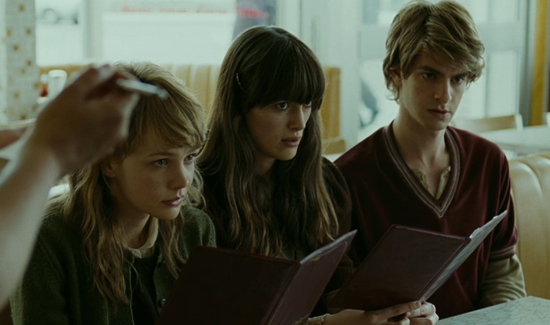
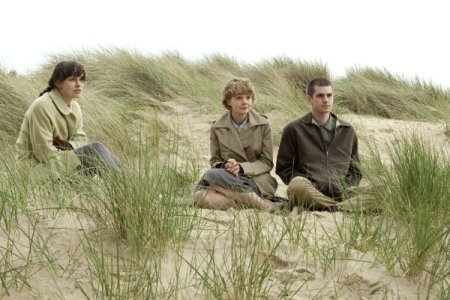
It focuses on a trio of children—Kathy (Carey Mulligan), Ruth (Keira Knightley) and Tommy (Andrew Garfield)—raised in a private boarding school, one of many, that is, in fact, more of a farm.  The children attending know nothing of the outside world, raised in a bubble of perfect manners, good health, docility, and fear of what lies beyond the fence surrounding the grounds.  There is no need to prepare them for life as we know it, because they won't be participating in it.  Only contributing to it.

They are carefully groomed and kept in the dark about their purpose, and within the cliques that inevitably occur there, rumors and speculation swirl among the kids about what happens when you go outside the fence (nothing good), and eventually, about ways to get deferments from donor status by proving their worth by displaying artistic skill...or, cruelly, falling in love.

They cling to these beliefs, like rosaries, with no basis in fact, but only the strength of their hopes, and in the absence of all evidence.  Kathy and Tommy grow close, become empathetic friends, but as they grow older, Ruth becomes the object of Tommy's affections, and Kathy goes her own path, choosing to become a "carer," in service of the donors on the short path of their careers, delaying her fate, watching as those less fortunate are taken away from her, piece by piece. 

It's frustrating watching.  Oh, the actors are fine, and actually more than fine, given the material.  Mulligan's crooked half-smile speaks volumes of a life only partially lived, and Knightley is completely unafraid of looking sadly decrepid.  But, it is still painful to watch these clueless kids, marginalized and compartmentalized, pursuing fruitless hopes in an effort to live a full life.  One would feel more sympathy if they would just be a bit more their own advocates, or even a bit more revolutionary.  It is extraordinarily facile to compare this one to other "low shelf-life" movies on the order of The Island, or Logan's Run, sci-fi action films on the theme.  Never Let Me Go has the same built-in planned obsolescence of adolescents conundrum—given the acquisition of some knowledge, wouldn't some of them choose to fight it?  It doesn't have to be with space-guns and chase scenes, but...something.  And despite their role in the food-chain, don't the administrators of these schools (Charlotte Rampling plays the main one here), especially the ones portrayed here, have some sort of empathetic identification with their charges, especially given the revelations they profess (rather hollowly)?  That these questions pop up during the viewing of the film, when one should be riveted to the screen and it's reflected situations, only points out that the film-makers haven't done their work perfecting their illusions, in pursuit of their allusions. 

To further extrapolate the somewhat cruel comparison of the film to a cadaver of the original piece, the spirit of the thing is missing, however ardently it is played.  Ultimately, one's appreciation of the film lies in its performances in the service of a flawed interpretation and one's own interest in the players, which is as superficial as this film feels.

Never Let Me Go is a Rental


Saturday, October 2, 2010

Wall Street: Money Never Sleeps

"Greed...(For Lack of a Better Movie)...is Good"

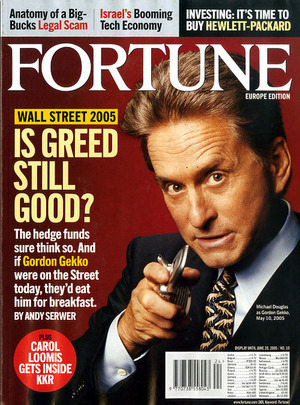
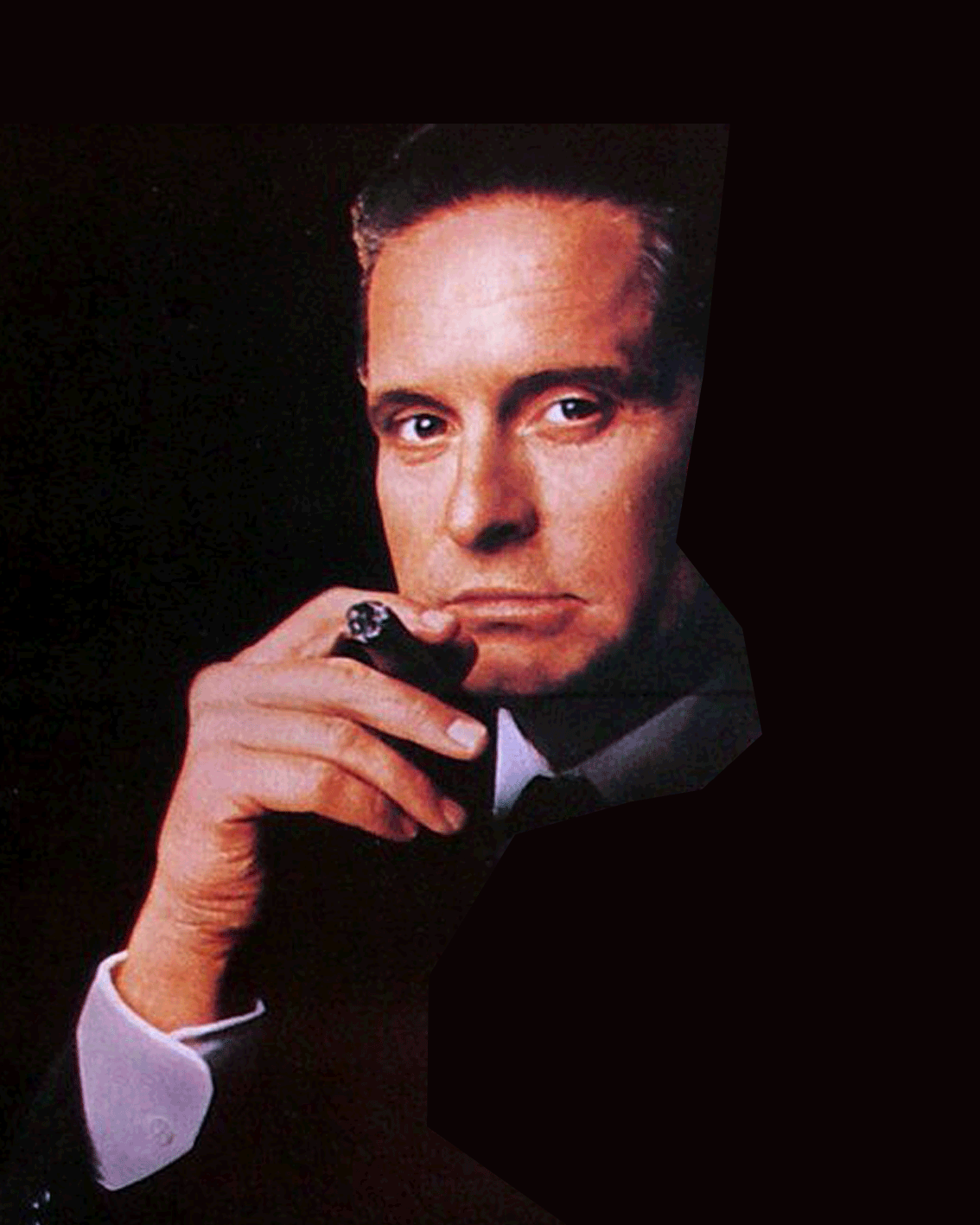
Entering into the third year of the Great Bank Swindle, it was only natural that someone in Hollywood would try and make hay off of it.  Enter Oliver Stone, with a sequel of sorts to his "Wall Street" film of 1987: "Wall Street: Money Never Sleeps" (a rather loopy title, in my eyes).  Wall Street high-roller Gordon Gekko (Michael Douglas) is released from prison to find himself alone, short of cash, and unable to get back into the game—the rules, such as they are, have changed, and prison never looks good on the resumé.

Seven years after Gekko is sprung, young Wall Street investment trader Jake Moore (Shia LaBoeuf) finds himself in the middle of the banking crisis, his company folding and his mentor (Frank Langella) commits suicide as a result.  The rootless Moore is then determined to avenge the death of both his Father Figure and livelihood by taking on the entities that led to his firm's collapse.  It was only a matter of time before he ran into Gekko, on a promotional tour for his new book, describing his life on top and behind bars.  Their stars are due to collide for another reason; is engaged to Gekko's daughter (Carey Mulligan), estranged from her father for his sociopathic wheeling-dealings and the subsequent overdose death of her brother.

Already it starts to feel icky.  Stone's original was, much like his "Platoon," less about their subjects (Vietnam, insider trading) and more about the writer-director's coming to terms with Daddy issues.  His protagonist in both films (played by Charlie Sheen) had to choose between good and bad fathers in both situations (Tom Berenger and Willem Dafoe in the first, and Douglas and Martin Sheen in the second), hovering about his shoulders like angel-demons, prodding him to go one way or the other, making him choose which Father Knows Best.

Everybody has Daddy problems in this one, to the point where that seems to be the only issue concerned.  Oh, there's some touching on of Green Energy and of the Banking conspiracy, but for the most part it is of the characters pin balling between Male Authority Figures, and the Mentor-Protegé thing (right down to Josh Brolin's character's favorite art-piece).  The only thing left is the kinda squeaky relationship between LaBoeuf and Mulligan, with Gecko acting like some Yojimbo playing all sides against each other.  It's a little disappointing to see Douglas' Gekko-monster being soft-pedalled in this manner—like finding out that Darth Vader (another Dark Father figure!) is merely Hayden Christensen in disguise.  Disappointing if one could get a handle on the character at all.  Douglas vacillates between being a tough-as-nails financier with all the answers and vulnerable Fair-Market Father trying to win back his little girl—that transformation gives Douglas and Mulligan a well-played if ultimately hollow scene in which they come to tearful terms.  He has never been better than that scene, and takes chances that recall his father Kirk's fearlessness in hitting for the bleachers.

If only that were true of Oliver Stone.

For the fact of the matter is, despite being one of our more (self-professed)radical film-makers, the once angry young man has made one of the most conventional of movies.  To be fair, he didn't write it, so the personal complications among the characters that one can see coming a mile away are not his fault.  And though he may trick the movie up with visual legerdemain (including a simple use of split-screen that he abandons fairly early on), pervasive songs by David Byrne and Brian Eno (that are banal), and "cuting" it up with several visual and aural "in-jokes," the film couldn't be more "safe," preaching to the choir, and goo-ing the whole thing up in a veneer of soap-scum. 

If one wants to be a truly innovative film-maker, to push the limits of visual story-telling, tell us something we don't already know.

"Wall Street: Money Never Sleeps" is a low-yield Cable-Watcher.