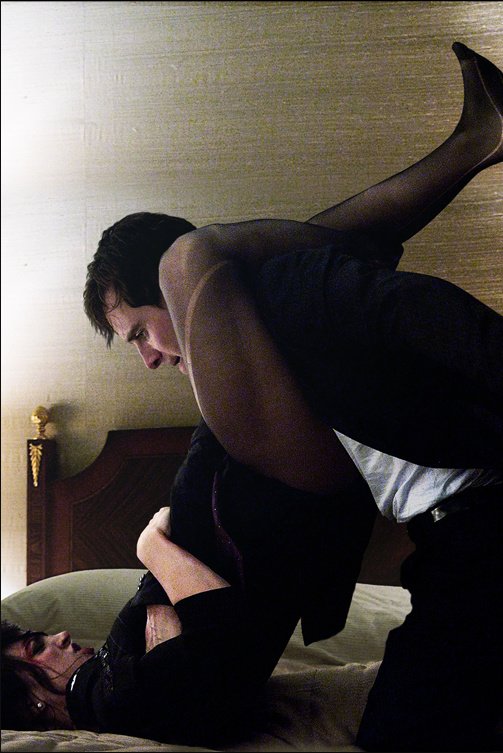
Haywire (Steve Soderbergh, 2011) Fairly standard actioner about a wet-ops unit for hire, and one particular freelancer who's beginning to suspect harmful links between gigs, directed by Soderbergh (written by past collaborator Lem Dobbs), with some unusual qualities of note. For one, the director stages his fights like they were dance sequences from an M-G-M musical—full-frame/full-figure (but without the Lion Studio's "stage" angle on the axis of the central figures). There are no tight shots, tight editing, it's all composed of mis-en-scene, rather than montage, just an angle/reverse angle one-two parrying between perspectives. It's tough, athletic, and the only real reason to cut away is if something goes wrong—a fluffed punch, or bad timing that creates a lull in the fight or a disconnect with "reality." There's no "lull" between hits because the way the altercations are staged you never see the connections, and there's no simulation of connection, because they're composed mostly of gymnastics, wrestling and fast action—the opposite of The Bourne Identity style of rapid cutting and implication of "hits." Soderbergh does something different with this style, while accomplishing the same intensity of the edit-dependent fisticuffs of the last few years. The most critical part, however, is who's doing the fighting, and that's where Haywire is really different and utterly dependent on its athletic lead.
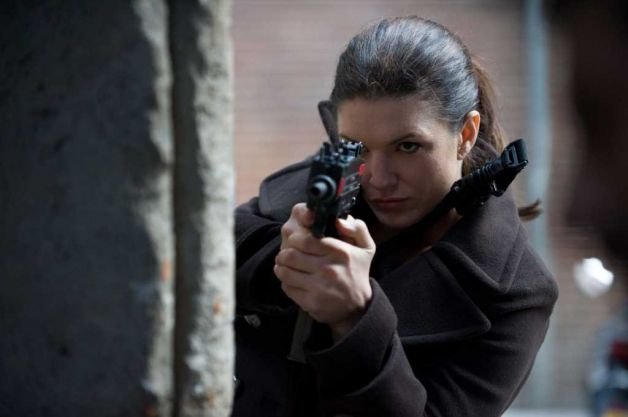
Gina Carano, mixed martial artist—and frequent participant in "American Gladiator"—plays Mallory Kane, and she is disciplined enough to pull off the fight sequences with a savage speed. Any actress can train to look convincing, but Carano has the moves down for her character who is supposed to be a berserker weapon of mass-destruction, so there's rarely a cut-away or an insert shot to betray the use of stunt-doubles. There aren't any. So, Soderbergh (who also shot the film) keeps his camera out of the way and keeps everything and everybody in frame as best he can. We've seen women in fights before—fights with men (Tarantino loves to do that)—but it's slightly unnerving to see these, knowing full well that everything was done in-camera, with few editing tricks. The speed makes it a bit more visual—there's no 1/4 second adjustment/orientation lag between cuts—and more upsetting initially, but one does, as the fighting continues for minutes unabated, used to it (except for the question of what kind of make-up she uses to hide the bruising).
Because Carano is largely unknown except for her MMA career—she's fine in her dramatic scenes, just not great (but then, have I ever complained about Jet Li or Jason Statham's acting?)—the cast is a little top-heavy with big-name victims...Ewan McGregor, Michael Douglas, Channing Tatum, Michael Fassbender (the latter doing a fine riff on Bond coolness—of course, he gets his ass kicked in the film's best fight), Bill Paxton and Antonio Banderas. Nobody is required to do anything beyond displaying detached coolness. But the internal logic is there, so at least this one is a better example for the experiment than, say, Salt.
 |
| The girl breaks bones and furniture. |

or
The Moon's Just a Cheap Shot Away
And what's good for the goose...
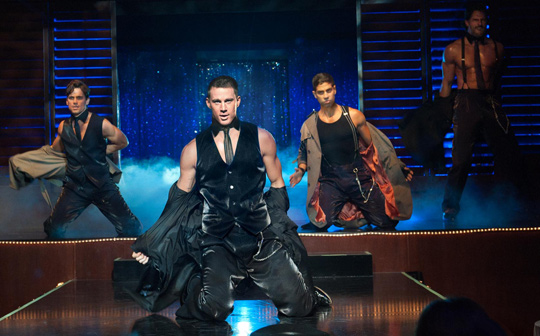
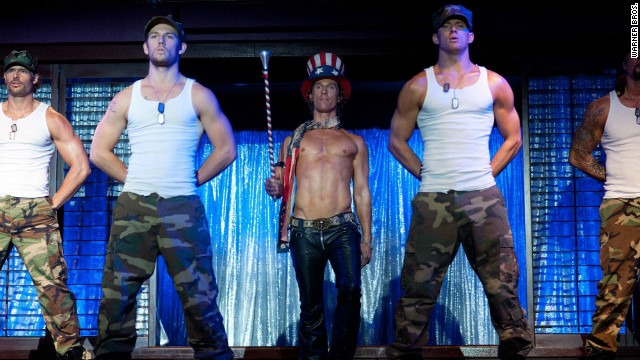
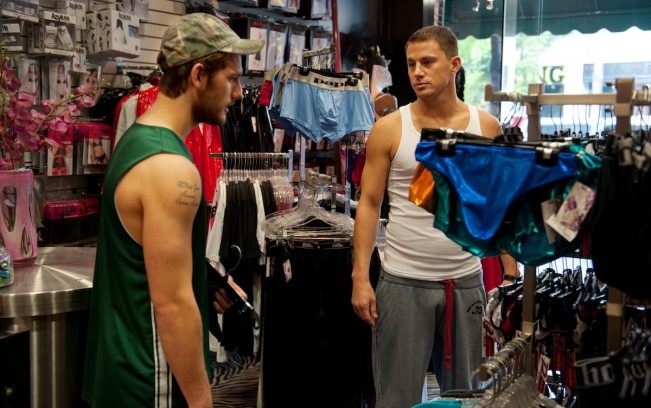
Soderbergh's next film after Haywire (if we don't count his second-unit work for The Hunger Games), also goes against the grain in the traditional genre/gender roles that we come to expect in movies—a dance/backstage drama movie, but with male leads. Magic Mike is Flashdance with testosterone, the only thing missing is the "if you give up your dreams, you die" line. Here, the basic dream is moving out of Tampa, Florida...to a bigger venue, or a better life. The clutch of male strippers each have their own motivations—mostly money—and for them, the gig is a better alternative than slogging through a 9 to 5 job, wearing a tie. So, at night, they dance, flirt, tease, and as club owner Dallas (Matthew McConaughey) "pry the cash out of their purses."
We're introduced to the skin-trade by Adam (Alex Pettyfer) irresponsible brother of Brooke (Cody Horn), who makes a good enough living for him to sponge off by having a steady job dealing with medical claims. At a construction job that he's ill-equipped for, he runs into Mike Lane (Channing Tatum), who, despite seeing Adam as a loser, takes him under his wing, giving him a job as a "gopher" for the Xquisite dance club, where Mike, he finds to his surprise, is a featured dancer. Well, you know how these backstage stories go: one of the performers can't go on-stage—he's passed out from a growth hormone overdose, and so Adam must make his stripper debut. Dallas and Mike watch from the wings and simultaneously offer an opinion: "Can't dance worth shit." "But..that..can..be..taught," replies Dallas.
Wish the rest of it could be. It'd save us all a bunch of time. Mike's the hero of the tale, the veteran, "the guy most-together," but Adam is the neophyte and must go through the unfulfilling one-nighters, the drug problems, the crack-ho relationship, the debts to the hood-pushers, the spiral down to the bottom. Mike just goes home to a brewsky and a night of uncrinkling his Benjamins on the edge of his self-designed furnishings (the establishment of such a business is his dream). He's the cleverest of the bunch—Tatum developed the story based on his own experiences dancing in Tampa, so naturally he's the cleverest—and he's the most romantic of the bunch, mooning over a past-patron (Olivia Munn*) and very interested in Adam's sister. He probably stays around being The Kid's Obi-Wan just to keep her in the picture, because there's only so many times you can say "You don't want that in your life, bro'" before it gets tiresome.
It does, but it could be a lot worse. It could be "Showboys," and in outline form it resembles it, but it avoids the smarmy camp quality of that film by having a sense of humor about itself** and what it is (and what it doesn't aspire to, which is anything with an overt message) and it stresses the economic times that drop the unskilled (but ripped) into such night-work (day-jobs being rather scarce, especially when you party until 4 am) without having any pretensions about suffering for your art. And the performances are fine, especially Tatum and McConaughey, who clearly relishes playing an out-and-out bad-boy with no shame. But, all the men throw themselves into the roles of buck-a-throw sex-objects, with a brio and swagger that's fun to watch—as long as nobody takes it for anything more.
It's the old "show-biz is a rough road, kids" movie, but with a "y" chromosome in the script of its DNA, a morality tale with enough immorality to make it worth watching. And it's a healthy thing for Soderbergh (or anybody) to be turning the tables on these themes with their built-in sexism—even if the tables have some dancing on them.
Magic Mike is an immodestly modest Rental.
 |
| The boys break rules (but not twenties) |
** Reviews and synopses are saying it's a comedy-drama, though. No. No, it's not. It's a light drama (with sprinkles of heaviness) and some clever writing here and there. Maybe that hyphenate was there to attract the ladies (as if all the beef-cake and pretty boys wasn't enough).