 "When The Music's Over (...And the Band Plays On)"
or
"Momma, There's Wolves in the House"
Margin Call begins like The Company Men and Up in the Air—in the midst of a corporate slaughter—people being fired from jobs they've held a long time. Cut-backs. "Generous" severance. Thanks for your service. Security will escort you out.
Eric Dale (Stanley Tucci) listens to it all, a little stunned, but tentative. "Uh, listen," he says in the middle of the administering of Last Rights, "I was working on something and I'm not finished yet." Doesn't matter. Go to your office. Empty your desk. Proprietary information. Your losing your phone, e-mail, etc. "No, really..." he says.
Doesn't matter. He's out. On the way to the elevator, he runs into two of his turks, Peter Sullivan (Zachary Quinto) and Seth Bregman (Penn Badgley). "Am I safe?" asks Seth (as Seth is wont to do). But Peter walks him to the elevator to tell him how much his mentorship meant to him. Dale cuts him off. "I know. I was working on something. They won't let me finish it," says Dale as he hands him a USB drive. And as the elevator doors shut, he has just enough time to say "Be careful."
Fwump.
It's the "be careful" that gets everybody's attention. "He said that?"
Sullivan begs off the traditional drinks for the battle survivors and takes a look at Dale's figures. Then he sees something. Digs, does some calculations and then stares at his projections screen. Over the next twelve hours, the world will go to Hell and he's the only one who sees the gate.
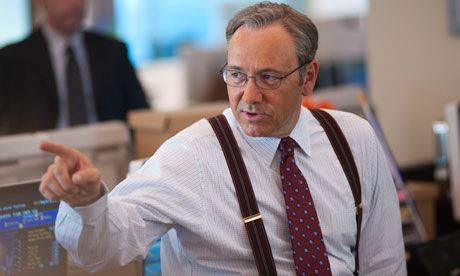
Margin Call is a boardroom thriller about our recent financial crisis, but its played like a mystery story. Everybody speaks in code. The night is dark and no one is betraying secrets. No one knows what's around the corner and everybody's looking behind them for the knife. Written and directed by J.C. Chandor (Who? This is his first film and it is an impressive debut), it plays out like a conspiracy—it is—and if so much of it didn't anticipate the dawn, one would be tempted to call it a film noir; there is a palpable air of organized evil, built of greed and self-interest, that hangs over the film, for what is being planned is the crime of the century.
The cast is uniformly superb—how could it not be with the likes of Kevin Spacey, Jeremy Irons, Simon Baker, Paul Bettany, Demi Moore, and Tucci?—but those performances depend on the great dialog generated by Chandor and the way he presents what should be dry material as drama and intrigue. These are gangsters in Gucci, cold-blooded, playing the long odds and the fast kill, but instead of "going to the mattresses" they are isolated in fancy cars and well-appointed high-rise board-rooms, their views of the world their actions are affecting armored by safety glass. There isn't much soul-searching (their businesspeople, so why look in a dry hole?) about what devastation their actions will bring, except for the immediate future and what it will do "for business." Even then, loyalty to the corporate mantra of "be first, be smarter or cheat" trumps conscience. That would make a hell of a slogan wouldn't it?
If one could gripe (and there is little to gripe about), one could argue that, if anything, this reverse "Godfather"—where businesspeople are gangsters, rather than gangsters as businesspeople—is heavily romanticized. There are no "Masters of the Universe" statements coming from these mortgage titans (as one heard from Wall Street bar-recordings on "This American Life," where these mavens crowed about deserving bonuses from bail-outs because "they're smarter than everybody else"), but, rather, short-term hedges about "dog-eat-dog" survival. No cynical betting against failure schemes, but merely making the best out of a bad situation before everyone else does.
As bad as Margin Call makes its protagonists, the truth is even worse—there were folks betting on things coming crashing down and profiting from it. It doesn't take a rocket scientist to see that a fix was in and that analysts saw it coming, not, suddenly, seeing it and going "Garsh, this looks bad." And the worst thing that's happened to these people is a little traffic congestion on Wall Street.
That is, if they're working at all.
Margin Call is a Full-Price Ticket.
Showing posts with label Demi Moore. Show all posts
Showing posts with label Demi Moore. Show all posts
Wednesday, October 26, 2011
Margin Call




Saturday, October 4, 2008
Disclosure
"Disclosure" (Barry Levinson, 1994) Handsome, but su-leeeeeeazy mounting of the Michael Crichton story about sexual politics in the work-place. With Michael Douglas heading the cast, the film could be confused for "Fatal Attraction II," and one wonders just how far the makers were going for that, what with Douglas toplining "...Attraction" and "Basic Instinct" and Demi Moore, late of "Indecent Proposal." Unfortunately, where those films whetted the national apetite for dangerous sex-capades, Crichton's cold-shower-of-an-idea seems tame.
At a cutting-edge Seattle software firm* experimenting in virtual reality, Tom Sanders (Douglas) thinks he's getting a promotion from his slick-as-shit boss (Donald Sutherland). He gets passed-over for Meredith Johnson (Demi Moore, all power-suit, push-up bra and stiletto heels), who's robotically quick with company-approved shpiel, with just a bit of predator to her. She's also an ex-girlfriend of the Douglas character.
Wuh-oh! Better watch out, Mike!
But because it's a two-hour movie, when Meredith invites him for an after-hours conference with some wine and her tongue in his ear, he goes--rather than saying, oh, I don't know--they've got e-mail at this high-tech Seattle firm?--"Hey, let me draw up a complete scenario of where we've been for that last three months with documentations and e-mail that to you, and then we can tackle it fresh in the morning." No, he doesn't do that, he's a little slow. Meredith, though, is pretty darn quick. When she starts unzipping his pants, what does he do? Stop her? Nooooo...When the simulated sex act begins? Noooooo. (I should mention that, at this point, Douglas does the patented Sharon Stone "pleasure" move from "Basic Instinct"--cock your head back so your neck is bent double and spasmodically open and close your mouth in a guppy fashion).
Finally, after the two are in a quasi-missionary position, the panting Douglas grows a conscience and decides to leave the office, after which Meredith follows him screaming "Get back and finish what you started, or you're dead, do you hear me?!" Since the office is in Pioneer Square, just about every bar-patron and driver on the Alaska Way Viaduct could hear her. As does the cleaning lady.
Anybody think this is a bit dumb?
It is. It gets dumber, when the Douglas character sues for sexual harassment, and she sues back. Crichton is making a point about sexual politics in a predatory environment in the work-place, but the message gets a bit dulled, and then the film-makers make a last-minute bid for political correctness that works as well as it did in "The Bonfire of the Vanities," that is, not at all.
Even the high-tech elements are a little suspect, with a virtual environment that evidently sucks so much CPU that it slows down the "Delete" process long enough to make it a race to amp up the drama.
"Disclosure" is a by-the-numbers package deal combining the movie-making cachet of Crichton, Douglas and Moore, in the hope it would translate to big bucks at the box-office. In that way, it resembles nothing so much as the fly-by-night computer companies that took a collective dive when the hi-tech bubble burst. Both had similar problems.
No one was buying.
*One of those very rare films set in Seattle that is actually filmed in Seattle rather than Vancouver, BC. Even "Battle in Seattle" about the WTO riots was filmed in Canada. Okay, they did come to town for a week-end to shoot pick-ups. I tell ya, the Seattle Film Commission's doin' a bang-up job!
 Handsome, but su-leeeeeeazy mounting of the Michael Crichton story about sexual politics in the work-place. With Michael Douglas heading the cast, the film could be confused for "Fatal Attraction II," and one wonders just how far the makers were going for that, what with Douglas toplining "...Attraction" and "Basic Instinct" and Demi Moore, late of "Indecent Proposal." Unfortunately, where those films whetted the national apetite for dangerous sex-capades, Crichton's cold-shower-of-an-idea seems tame.
At a cutting-edge Seattle software firm* experimenting in virtual reality, Tom Sanders (Douglas) thinks he's getting a promotion from his slick-as-shit boss (Donald Sutherland). He gets passed-over for Meredith Johnson (Demi Moore, all power-suit, push-up bra and stiletto heels), who's robotically quick with company-approved shpiel, with just a bit of predator to her. She's also an ex-girlfriend of the Douglas character.
Wuh-oh! Better watch out, Mike!
But because it's a two-hour movie, when Meredith invites him for an after-hours conference with some wine and her tongue in his ear, he goes--rather than saying, oh, I don't know--they've got e-mail at this high-tech Seattle firm?--"Hey, let me draw up a complete scenario of where we've been for that last three months with documentations and e-mail that to you, and then we can tackle it fresh in the morning." No, he doesn't do that, he's a little slow. Meredith, though, is pretty darn quick. When she starts unzipping his pants, what does he do? Stop her? Nooooo...When the simulated sex act begins? Noooooo. (I should mention that, at this point, Douglas does the patented Sharon Stone "pleasure" move from "Basic Instinct"--cock your head back so your neck is bent double and spasmodically open and close your mouth in a guppy fashion).
Finally, after the two are in a quasi-missionary position, the panting Douglas grows a conscience and decides to leave the office, after which Meredith follows him screaming "Get back and finish what you started, or you're dead, do you hear me?!" Since the office is in Pioneer Square, just about every bar-patron and driver on the Alaska Way Viaduct could hear her. As does the cleaning lady.
Anybody think this is a bit dumb?
It is. It gets dumber, when the Douglas character sues for sexual harassment, and she sues back. Crichton is making a point about sexual politics in a predatory environment in the work-place, but the message gets a bit dulled, and then the film-makers make a last-minute bid for political correctness that works as well as it did in "The Bonfire of the Vanities," that is, not at all.
Even the high-tech elements are a little suspect, with a virtual environment that evidently sucks so much CPU that it slows down the "Delete" process long enough to make it a race to amp up the drama.
"Disclosure" is a by-the-numbers package deal combining the movie-making cachet of Crichton, Douglas and Moore, in the hope it would translate to big bucks at the box-office. In that way, it resembles nothing so much as the fly-by-night computer companies that took a collective dive when the hi-tech bubble burst. Both had similar problems.
No one was buying.
*One of those very rare films set in Seattle that is actually filmed in Seattle rather than Vancouver, BC. Even "Battle in Seattle" about the WTO riots was filmed in Canada. Okay, they did come to town for a week-end to shoot pick-ups. I tell ya, the Seattle Film Commission's doin' a bang-up job!
Subscribe to:
Posts (Atom)