Showing posts with label Donald Sutherland. Show all posts

Tuesday, December 24, 2013

The Hunger Games: Catching Fire

Feeding the Beast
or
To Kill a Mocking-jay

I mocked The Hunger Games rather mercilessly when it came out (as if it would prevent a single sou from entering its coffers) , because even though it was a hot publishing phenom' and a breathlessly anticipated movie, the original concept was a bit derivative without being very divergent (yeah, that's a snark for a future film there).  So now, the second of The Hunger Games films (of four total) Catching Fire has come out (with a new director, Francis Lawrence, of Water for Elephants and I Am Legend as a bit of an improvement over Gary Ross, even with Steve Soderbergh assisting) and this one's a better film.  For one thing. "this time it's political," and the easy targets of reality TV and the excesses of the rich (with an eye towards the Roman Empire and its parallels of bread and circuses) are a bit less strident, although they haven't disappeared.  They're just presented a little better this time.  And the politico's of the Capitol are being a bit more cagey than they were previously.

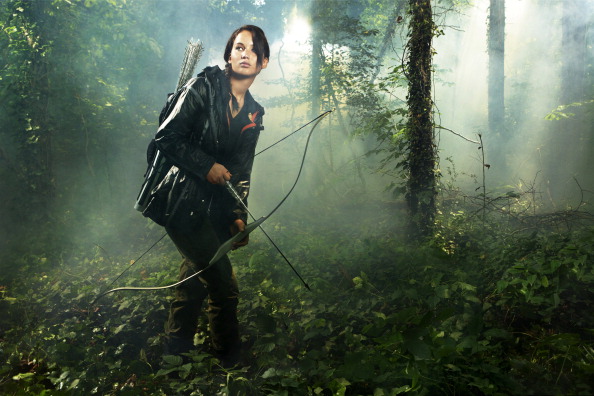
Katniss Everdeen (Jennifer Lawrence) now finds herself the most watched human in Panem.  Her victory in the 74th Hunger Games along with Peeta Mellark (Josh Hutcherson) has earned her and her family a cushy residence in Victor's Village and the vulture-like scrutiny of Panem's leader, President Snow (Donald Sutherland, as creepily confident as if he were selling you orange juice).  He sees the way that Katniss has reached out to Panem's people and now she's the centerpiece of a swelling revolutionary movement.  A personal presidential visit amounts to a threat that she'd better be convincing in her devotion to the State.  "I'll convince them." assures Katniss.  "No." replies Snow slowly.  "Convince me."


And with that, the stakes are raised.  A "Victory Tour" is planned for the remaining districts (the ones that haven't been nuked), but at each appearance of Katniss and Peeta something happens that brings out the riot police.  At the suggestion of the Capitol's new gamesmaster (check out this name) Plutarch Heavensbee (Philip Seymour Hoffman, keeping a straight face), who comes up with a plan to put more pressure on Katniss and speeding the inevitable moment when the public turns against her.  Then, with the next Hunger Games competition occurring (the 75th), it is decided that, rather than having a "Reaping" lottery among the populace, the competition will be between past Victors, considered by the State now to be potential inspirations and inciters to riot.

So now, the Games are between past champions (including Jeffrey Wright, Jena Malone, and Amanda Plummer), some of whom are just as determined to win, while others are angry at being targeted again, but there will be only one survivor.  


It's a better film with more tricks up its sleeve, and the media manipulation is played by all sides—it may be an illusion but Stanley Tucci's teeth actually look whiter this time—with a terrific set-up for the next films that comes out of left field...if you haven't read the books.  It's an entertaining change-up from the situations of the original, and promises to be even more intersting next time out.


The Hunger Games: Catching Fire is a Matinee. 


Wednesday, March 28, 2012

The Hunger Games

Killed in the Ratings
or
Welcome to Another Exciting Edition of Thunderdome!


I know all I need to know about The Hunger Games
So "young adult" is The Hunger Games
Like "Potter" before it (The "Twilight" books, too)
Recycling ideas to 'tweens and their peers
Who think that it's "new."

There have been a lot of books before "The Hunger Games"
A lot of "Running Man" in "The Hunger Games"
"The Lottery,""Logan...,"  
"The Most Dangerous Game"
A "Rollerball" theme and everything seems
Exactly the same.

I know all I need to know about The Hunger Games

(Crooned to the tune of "The Crying Game")


Yeah, yeah. I'm being "Joe Buzzkill" here. The Hunger Games is going to make a kajillion dollars (even in dystopian future money) in theaters, DVD's, books, magazines and "mockingjay" pins.  Nothing I say can stop that (nor should it).

But it's a fact that this is all recycled material* (just as "Harry Potter" was, just as "Twilight" was), just skewed young for the burgeoning youth book market (which is still thankfully strong).  The one interesting aspect to it is that this is "The Most Dangerous Game" for a generation having grown up on alleged "reality" TV programming.  An entire generation has happened since "Survivor," "Big Brother," "The Bachelor," "The Amazing Race," "Fear Factor," and "American Idol," all game shows rigged from the get-go,** manipulated for false drama in editing suites, ginned up with flase production values and glitz, and as genuine of enterprise and skill as a WWF wrestling match—think of it, there are people who pay good money to see that junk "live."

There's a sucker born every minute.

Or a saga.

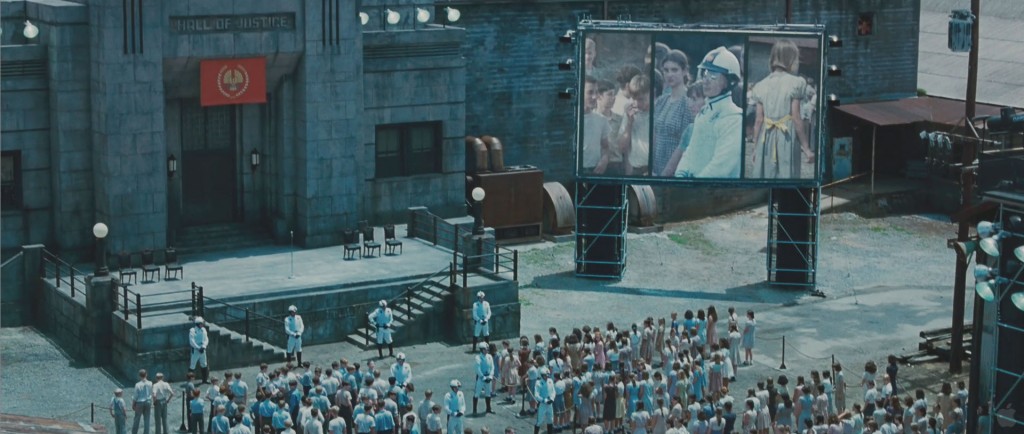
The story is, by now, well-known: In the future, America is now Panem, divided into 12 working districts governed by an all-controlling Capitol, run by President Snow (Donald Sutherland in the film, who might give the second best performance in it, a brutal paternalism, done with economy and implied malice—he's something of a breath of fresh air from some of the other performances, and his reading of the reply to "Everybody likes an underdog"—"I don't"—made me laugh out loud, while putting a chill down my spine).  Every year, two teens from each district are chosen by lottery for "the Hunger Games," a televised death match from which only one can survive.  It's The Olympics to the Death, complete with pomp, circumstance, and Roone Arledge style "up-close-and-personal" drama dredging.  It's "bread and circuses" for the Masses with mock sentimentality and district pride provided to cover the slaughterhouse aspects.
 
From the coal-mining district (12) comes Katniss Everdeen (Jennifer Lawrence, who's the best thing in the film, giving a performance cunning and tremulous) who volunteers for the Games when her 12 year old sister is chosen in the lottery.  Her co-warrior is Peeta Mellark (Josh Hutcherson, in a performance that could best be described as "uneven"), with whom she's had a past.  The two are sent by bullet-train to the Capitol, where they are prepped, buffed-up, coiffed and positioned for presentation to the national audience, their handlers being Effie Trinket (an unrecognizable Elizabeth Banks in an unsufferable performance), past winner Haymitch Abernathy (Woody Harrelson who has his moments—"Nice shooting, sweetheart" gets an appreciative audience response) and Cinna (Lenny Kravitz), their fashion designer.  This is easily the worst part of the film, the satire played broad (especially by Toby Jones and Stanley Tucci—both usually fine actors—who play the TV hosts for the broadcast) with a fashion-sense of the privileged Capitol  citizens that can best be described as "subtle clown"  (or is it "post-modern Gaga?") I suppose director Gary Ross (who co-wrote and brought in Steven Soderbergh as second unit director) wanted to make satirical points on Capitol decadence or enhance the futuristic "feel" of the film, but he's a rather dull director and when he "pushes" it, he takes it places that feel false.  At 2 hours, 20 minutes, if there are places that needed to be trimmed, it's in this section.  But, once the actual contest starts with its electronically domed barriers, constant video surveillance, and game "enhancements" (like fireballs and this movies's version of R.O.U.S.'s***), the film becomes slick, vicious fun.  And, appropriately, manipulative as Hell, in the foreground, background and throughout.

Why, after all, should the movie be any different from its inspirations?  And if it gets the kids to realize that everything—sports, video games, "reality" shows, fashion, political campaigns, whatever—is just distractions from the struggles of real life, used by government and corporations alike, to keep us satiated with bread and circuses, just like in those "boring" History lessons about Rome, then so much the better.

Of course, it would be nice, if instead of going to the theaters to see it, we might (I dunno) join a protest or something?  Jefferson said "A little revolution now and again is a good thing."  But it was never a spectator sport. 

The Hunger Games is a Rental.


* "The buzz" on IMDB is that The Hunger Games is a "rip-off" of Battle Royale (2000).   Sure.  Okay.  So, what is Battle Royale a rip-off of?

** My favorite comment about "reality" programming was Johnny Carson's about "Survivor:"  "I can't feel badly for these people when I know just out of camera range there are 20 Teamsters and a "catering table."

*** For anyone who isn't a fan of The Princess Bride, that would be "Rats Of Unusual Size."

Tuesday, May 5, 2009

Without Limits

"Without Limits" (Robert Towne, 1998) I've passed "Pre's Rock" a couple of times in my rare drives up to the peak of Laurel Hill in Eugene, Oregon. The shoes are always there. Running shoes cast off, like the ones Steve Prefontaine burned through in his short track career. And because it was a short career, with so many landmarks along the way, the story couldn't help but be a candidate for the "striving path" sub-genre of film that is meant to inspire. It couldn't help it so much that two "Prefontaine" movies made it to the screen in one year, one from Disney and one from Paramount* through Tom Cruise's production company with different authors and a different perspective on the man's life.**

Of the two, I wanted to tackle
Robert Towne's film first. I respect Towne's writing and he bats 50% directing--he's usually at his "Personal Best" doing sports films. There will be differences of style and performance, of course. Billy Crudup's Prefontaine is a bit of a prima donna in need of humility, and Donald Sutherland gives just the right sense of bat-shit menace that the coach Bowerman character would have to project just to get through the runner's inward-looking radar. Evidently, there are factual differences—the Disney film focusses less on Bowerman than another coach (who was involved in the production), and this film would have you believe that the character Monica Potter plays is Prefontaine's true love (despite her no-sex policy), even though he was dating someone else at the time (involved with the Disney production) of his death. And here, Prefontaine wasn't drinking at this party before he swerved out of control on that winding switch-back of a road that's difficult to negotiate under the best of circumstances.

Okay. Maybe.

But "
Without Limits" gets the story priorities right, because there are two fascinating characters in the Prefontaine story and it has nothing to do with his love-life and everything to do with his obsesion: the story has to be about Prefontaine's relationship with Bill Bowerman. Both men were obsessed with different aspects of running: Pre was all about "will" and the mind, while Bowerman was about inches of stride, good shoes and the politics of pace. In this story, these two guys need each other to realize their dreams—Prefontaine to win races beyong his brute force, and Bowerman to work on the perfect subject. Yes, Bowerman made his team's shoes for them with his own design, and his wife's waffle-iron—he is, after all, the corner-stone of the Nike Empire. Bowerman's calculations became a part of the Prefontaine running mind-set, and Prefontaine's take-no-prisoners attitude moves Bowerman from his porch into business. It's a cliche to say it, but the two completed each other, and makes the story more about growth and change than crossing the finish line.

If that's the only difference between the two movies,
"Without Limits" wins decidedly.


Pre-eminent runner and Bowerman-Nike dad

* Jared Leto played Prefontaine in that one, and R. Lee Ermey played Bowerman.

* Hollywood's predilection for stabbing itself in the foot by releasing competing films on the same subject is not new: a long-in-gestation article on the phenomenon has been in the hopper here for awhile. I'd be panicky about getting it out, but there's always another story of dueling projects--the latest being competing All-Star "King Lear's," one starring Anthony Hopkins and one starring Al Pacino. Every actor wants to play Lear, I can understand that. But, I just read that there are two movies in development about Luis Escobar. Really? Is he worth two movies? "When will they ever learn?"

Saturday, October 4, 2008

Disclosure

"Disclosure" (Barry Levinson, 1994) Handsome, but su-leeeeeeazy mounting of the Michael Crichton story about sexual politics in the work-place. With Michael Douglas heading the cast, the film could be confused for "Fatal Attraction II," and one wonders just how far the makers were going for that, what with Douglas toplining "...Attraction" and "Basic Instinct" and Demi Moore, late of "Indecent Proposal." Unfortunately, where those films whetted the national apetite for dangerous sex-capades, Crichton's cold-shower-of-an-idea seems tame.

At a cutting-edge Seattle software firm* experimenting in virtual reality, Tom Sanders (
Douglas) thinks he's getting a promotion from his slick-as-shit boss (Donald Sutherland). He gets passed-over for Meredith Johnson (Demi Moore, all power-suit, push-up bra and stiletto heels), who's robotically quick with company-approved shpiel, with just a bit of predator to her. She's also an ex-girlfriend of the Douglas character.

Wuh-oh! Better watch out, Mike!

But because it's a two-hour movie, when Meredith invites him for an after-hours conference with some wine and her tongue in his ear, he goes--rather than saying, oh, I don't know--they've got e-mail at this high-tech Seattle firm?--"Hey, let me draw up a complete scenario of where we've been for that last three months with documentations and e-mail that to you, and then we can tackle it fresh in the morning." No, he doesn't do that, he's a little slow. Meredith, though, is pretty darn quick. When she starts unzipping his pants, what does he do? Stop her? Nooooo...When the simulated sex act begins? Noooooo. (I should mention that, at this point, Douglas does the patented
Sharon Stone "pleasure" move from "Basic Instinct"--cock your head back so your neck is bent double and spasmodically open and close your mouth in a guppy fashion).

Finally, after the two are in a quasi-missionary position, the panting Douglas grows a conscience and decides to leave the office, after which Meredith follows him screaming "Get back and finish what you started, or you're dead, do you hear me?!" Since the office is in Pioneer Square, just about every bar-patron and driver on the Alaska Way Viaduct could hear her. As does the cleaning lady.

Anybody think this is a bit dumb?

It is. It gets dumber, when the Douglas character sues for sexual harassment, and she sues back. Crichton is making a point about sexual politics in a predatory environment in the work-place, but the message gets a bit dulled, and then the film-makers make a last-minute bid for political correctness that works as well as it did in "
The Bonfire of the Vanities," that is, not at all.

Even the high-tech elements are a little suspect, with a virtual environment that evidently sucks so much CPU that it slows down the "Delete" process long enough to make it a race to amp up the drama.

"
Disclosure" is a by-the-numbers package deal combining the movie-making cachet of Crichton, Douglas and Moore, in the hope it would translate to big bucks at the box-office. In that way, it resembles nothing so much as the fly-by-night computer companies that took a collective dive when the hi-tech bubble burst. Both had similar problems.

No one was buying.

*One of those very rare films set in Seattle that is actually filmed in Seattle rather than Vancouver, BC. Even "Battle in Seattle" about the WTO riots was filmed in Canada. Okay, they did come to town for a week-end to shoot pick-ups. I tell ya, the Seattle Film Commission's doin' a bang-up job!

Saturday, August 9, 2008

Olde Review: The Day of the Locust

Written October 22, 1975

"The Day of the Locust" (John Schlesinger, 1975) I saw "Day of the Locust," after seeing Scorsese's "Alice Doesn't Live Here Anymore" (which was such a personal film) was quite a shock. It is an impersonal film, as impersonal as one can get. Where Scorsese cared for his characters so much that he projected their feelings in the way he used his camera, Schlesinger paints his characters as grotesques. Faye Greener (Karen Black) is a pouty-mouthed, viper-tongued bitch. Her father (Burgess Meredith) is a pathetic wheezer, whose laugh that--like an itching powder--can create laughter is "communicated"--not successfully--by a distorted close-up of Harry's sweating, wrinkled face. Homer Simpson* (Donald Sutherland) is beaten mercilessly in this film, not only by the characters in it, but also by Schlesinger, whose failure in this film shows Simpson, not as an innocent, but a dullard, his brow constantly furrowed, but never thinking, his hands bothering him, but how? Schlesinger can't and won't elaborate, but goes on to show him, as he watches and embraces the trivial in his garden, a tear rolling down his cheek.

We ask "why?," but Schlesinger won't tell us.

Finally, there is Tod Hackett (
William Atherton), of whom we know that he's a set designer, that he lusts after Faye and who pastes a darker vision on his wall of his Hollywood environs--a vision he experiences as Schlesinger goes mad, seemingly, at the end and destroys Los Angeles in a cinematic orgy of attempted message-building with past-faced human beings on the sidewalks. Somehow, this whole sequence could have been done better. Horrible, yes it is, but obscure, as well. An obscurity that Schlesinger pounds into us. An obscurity that Schlesinger mixes with the obvious. It appeared to me to be the cinematic equivalent of vinegar and water.

I remember this film as being one of the more unpleasant experiences going to the movies. I was expecting some simpatico reactions to it as a recent trip to Hollywood seemed like a vacation to Sodom and Gomorrah on Piko and Sepulveda. Instead what the film achieved was a crass braying that passed as wit and a visual style that hit you over the head with obvious fish-eye lens shot to make Schlesinger's gallery of grotesques even more grotesque. I don't mind being a choir-member being preached to, but I don't think I have to buy all the sermon, do I, especially when it's so poorly done?

Plus, one has to be pretty insulated to think that a glimpse of Hell would be a klieg-lighted riot at a movie premiere. Surely there are other areas of the Earth where the worst in humanity occurs on a daily basis. Maybe it isn't so visually arresting...

Anyway, brownie points for a Hollywood film to point out Hollywood excess, even though it's based on a book that came out in '39, when the idea wasn't so self-evident. Swell. If you're that brave, go make something a bit more contemporary.

And the question comes up: if Paramount could fund and promote this little piece of self-excoriation at the height of their movie-churning glory, why hasn't anyone produced "What Makes Sammy Run?" Too political? Too true? Maybe it still stings a bit too much for contemporary Hollywood.

It was, after all, written in 1941--two years after "The Day of the Locust."

* D'oh!

Wednesday, March 26, 2008

Pride and Prejudice

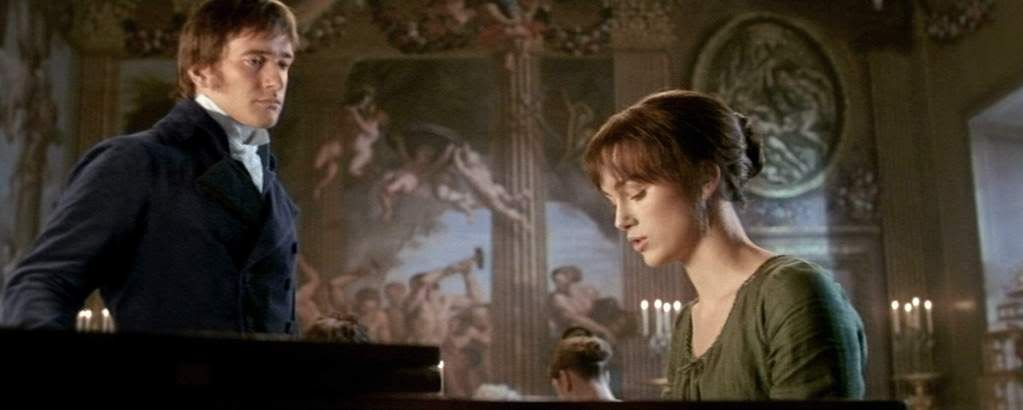
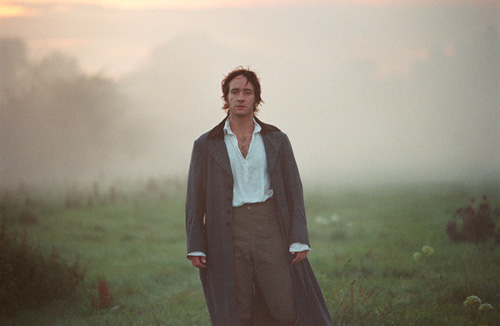
"Pride and Prejudice" (Joe Wright, 2006) Can there be anything more done with "Pride and Prejudice"--the jewel in the Jane Austen tiara? Turns out, yes, there can. Joe Wright takes some of the stuffing out of the novel and makes it move in its own frenetic dance for the first 3/4 of it. The dances and balls are choreographed and photographed to maximum effect, sometimes sublimely comic, and the ways the mating rituals and business marriages are carried out intersect with Wright's searching, shifting camera moves. And then, in moments that Austen would call "high dudgeon" the camera stops and Nature takes over, culminating in two eerie scenes--one, a confrontation between Elizabeth Bennet (Keira Knightley) and her object of obsession Mr. Darcy (Matthew Macfadyen) staged in an unyielding Greco-Roman pogoda during a thunderstorm, and later during a bizarre shot where Elizabeth, locked in emotional and physical paralysis, spends an uncertain day in one spot as the sun and Nature move around her, a fascinating way to pull off her receiving Darcy's letter of regret without really receiving him. Sometimes, Wright goes a bit too far blowing the dust off this classic--a spinning camera from Elizabeth's point of view on a swing seamlessly, and a little nauseatingly, shows the passing of time. And he can't resist a "money shot," a gorgeous, overly dramatic shot of Elizabeth on cliff-top, ensuring that her new perspective on things is in Panavision. But he's also aided immeasurably by extremely naturalistic performances (including Brenda Blethyn and Donald Sutherland) from an ensemble encouraged to stumble over each other's words to take the starch out, and from a mercurial performance by Keira Knightley, whose Elizabeth goes from apple-cheeked gushing teenager to stormy-eyed character assassin in hardly a blink.