This is a companion piece to the review of "The Sound of Trumpets" broadcast on KCMU-FM.
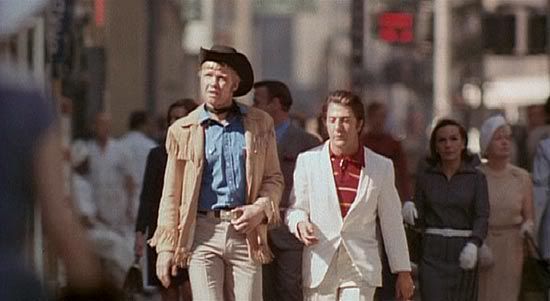
"Midnight Cowboy" (John Schlesinger, 1969) "Midnight Cowboy" is  a film that has been vastly over-rated over the years. So has its director, John Schlesinger. I haven't seen one film of his that has been consistent—content-wise, or quality. Admittedly, Schlesinger does do some great things in his films. but never for long, and that goes for "Far from the Madding Crowd," "Darling," his marathon sequence in "Visions of Eight," and especially last year's "The Day of the Locust." Schlesinger couldn't even pull off a simple thriller like "Marathon Man" without laying it over with unnecessary cross-cutting and lead-balloon pretensions.
The problem? Schlesinger is a cold director and this coldness of attitude combined with a certain heavy-handedness in technique bring movement, but not life, to the subject matter. Add to this Schlesinger's off-and-on fascination with grotesques—as in "Midnight Cowboy"—and the situation is nearly impossible.
"Midnight Cowboy" begins well enough, with a rather multi-layered shot of an empty drive-in movie screen overlapped by the sound of thundering hooves. But not from the screen. From a nearby corral. Joe Buck is leaving the farm to go to New York; putting himself out to stud, so to speak. And Joe Buck's bus-trip to New York is very enjoyable with the exception of some coy flashbacks. But once the Big Apple has been reached, Schlesinger begins to feel the need to be...satirical. And his satire has all the subtlety of a brick through a window, as opposed to the subtlety of "The Sound of Trumpets."
Jon Voight gives a fine performance. Dustin Hoffman is all right (but his limp keeps changing, and Schlesinger keeps drawing attention to it!) But, above all, the best thing about "Midnight Cowboy" is the music for the film by John Barry, whose scores include those for the James Bond films and "Born Free." His music provided the best satire, the most feeling, and the best humor in the film. One of these days, I'm going to have to do a tribute to him.
Broadcast on KCMU-FM December 5th and 6th, 1976That last bit referred to film score tributes, basically three minutes in length that I did for the station. Barry's still alive. His last score being for the Michael Apted film "Enigma." He didn't do the whole film, but he supervised the music, picking and producing the songs, and writing bits and pieces of score that worked gang-busters in the film.
Frequently, when typing up these elderly reviews from a kid I can't remember being, I've always resisted the urge to change them here. Or wished I could go back in time to tell this little twerp what exactly is wrong with his opinion, and I felt that urge this time when I started reading the review. After all, Schlesinger settled down and did some good things later in his career, and "Midnight Cowboy" remains to this day the only X-rated film to win the Best Picture Oscar, and it's still considered a "classic."
But have you sat through it lately? I mean, sat through all of it? It's a mess, jobbing about from one bit to another, and all those parts that are endlessly played on clip shows—"I'm walkin' heyah!," the final bus ride, Joe Buck's walk through the crowded streets of New York, including satire alert-satire alert the guy who's been assaulted (presumably) lying in the street and everybody's walkin' to the tune of "Everybody's Talkin'" (written by Fred Neil, sung by Nilsson) and....that's about it—are the parts that people remember. Maybe, just maybe, people have a better opinion of the film because they're expected to. It's a counter-culture classic, after all, like "Easy Rider" (and we all know what a masterpiece that is!) Reading through this review, I went from "You're being too harsh" to "Yeah, point taken." The things that bug me about "Midnight Cowboy" are the same things that bugged me then, and it had to do with direction, inconsistency, and just the gosh-awful look of some of those sequences. It's like Schlesinger took Mike Nichols' bag of tricks from "The Graduate" and decided to use them poorly. I'm surprised it won Best Picture, actually.
What was nominated for Best Picture that year? "Anne of the Thousand Days," "Butch Cassidy and the Sundance Kid," "Hello, Dolly," and "Z."
.............well, maybe I'm not surprised (though "Z" is a good film).
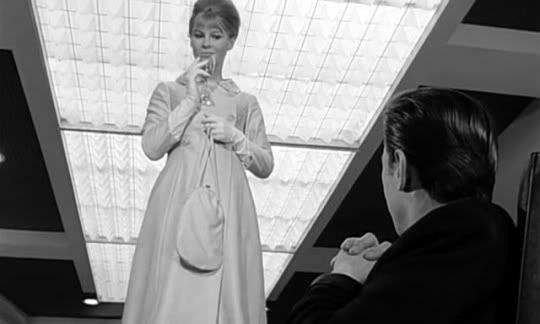
"Darling" (John Schlesinger, 1965) Posh, swinging 60's version  of a rags-to-riches story with a Chekhovian twist, it could be subtitled "Days of Cabiria," it's such an antithesis to Fellini's film about the travails of a "well-known night-bird." Diana Scott (Julie Christie, in her Oscar-winning performance) goes from vaguely dissatisfied London wife to jet-setting model/princess using a series of men as if they were rungs on the ladder. Dirk Bogarde plays a BBC journalist with whom she has her first affair that shatters her marriage ("Isn't it a shame that it's so hard to be happy?" she intones at one point) Then, when things start to get a bit perfunctory she becomes a plaything with a jaded playboy (Laurence Harvey, barely expressive). Soon, the sense of been there-done that completely eclipses her enjoyment of every current situation, and as she's completely incapable of being self-aware ("Is that really me?" she says in shock when a party-goer imitates her) that it's not simply a matter of imagining the grass in greener on the other side of the fence, so much as vaulting the fence and rolling in it for awhile.
It brings to mind the story Richard Harris told on "The Tonight Show" of driving home in Ireland after an extended pub-crawl and falling asleep at a stop-light. He was awakened with a tap at his window, and the driver behind him asked quietly, but pointedly, "Exactly what shade of green are ye waitin' fer?"
"Darling" is an artifact of the 60's, and has not aged well, although one can see its spawn every day in the natter-columns. Schlesinger's direction is not nearly so mannered as he could be, and Frederick Raphael's screenplay is at its best when no one's talking. But it is interesting, at least, as a cultural bell-weather to see what Madame Bovary's "cup of tea" is "in this day and age."
Written October 22, 1975"The Day of the Locust" (John Schlesinger, 1975) I saw "Day of the Locust," after seeing Scorsese's "Alice Doesn't Live Here Anymore" (which was such a personal film) was quite a shock. It is an impersonal film, as impersonal as one can get. Where Scorsese cared for his characters so much that he projected their feelings in the way he used his camera, Schlesinger paints his characters as grotesques. Faye Greener (Karen Black) is a pouty-mouthed, viper-tongued bitch. Her father (Burgess Meredith) is a pathetic wheezer, whose laugh that--like an itching powder--can create laughter is "communicated"--not successfully--by a distorted close-up of Harry's sweating, wrinkled face. Homer Simpson* (Donald Sutherland) is beaten mercilessly in this film, not only by the characters in it, but also by Schlesinger, whose failure in this film shows Simpson, not as an innocent, but a dullard, his brow constantly furrowed, but never thinking, his hands bothering him, but how? Schlesinger can't and won't elaborate, but goes on to show him, as he watches and embraces the trivial in his garden, a tear rolling down his cheek.
We ask "why?," but Schlesinger won't tell us.
Finally, there is Tod Hackett (William Atherton), of whom we know that he's a set designer, that he lusts after Faye and who pastes a darker vision on his wall of his Hollywood environs--a vision he experiences as Schlesinger goes mad, seemingly, at the end and destroys Los Angeles in a cinematic orgy of attempted message-building with past-faced human beings on the sidewalks. Somehow, this whole sequence could have been done better. Horrible, yes it is, but obscure, as well. An obscurity that Schlesinger pounds into us. An obscurity that Schlesinger mixes with the obvious. It appeared to me to be the cinematic equivalent of vinegar and water.
I remember this film as being one of the more unpleasant experiences going to the movies. I was expecting some simpatico reactions to it as a recent trip to Hollywood seemed like a vacation to Sodom and Gomorrah on Piko and Sepulveda. Instead what the film achieved was a crass braying that passed as wit and a visual style that hit you over the head with obvious fish-eye lens shot to make Schlesinger's gallery of grotesques even more grotesque. I don't mind being a choir-member being preached to, but I don't think I have to buy all the sermon, do I, especially when it's so poorly done?
Plus, one has to be pretty insulated to think that a glimpse of Hell would be a klieg-lighted riot at a movie premiere. Surely there are other areas of the Earth where the worst in humanity occurs on a daily basis. Maybe it isn't so visually arresting...
Anyway, brownie points for a Hollywood film to point out Hollywood excess, even though it's based on a book that came out in '39, when the idea wasn't so self-evident. Swell. If you're that brave, go make something a bit more contemporary.
And the question comes up: if Paramount could fund and promote this little piece of self-excoriation at the height of their movie-churning glory, why hasn't anyone produced "What Makes Sammy Run?" Too political? Too true? Maybe it still stings a bit too much for contemporary Hollywood.
It was, after all, written in 1941--two years after "The Day of the Locust."
* D'oh!
 a film that has been vastly over-rated over the years. So has its director, John Schlesinger. I haven't seen one film of his that has been consistent—content-wise, or quality. Admittedly, Schlesinger does do some great things in his films. but never for long, and that goes for "Far from the Madding Crowd," "Darling," his marathon sequence in "Visions of Eight," and especially last year's "The Day of the Locust." Schlesinger couldn't even pull off a simple thriller like "Marathon Man" without laying it over with unnecessary cross-cutting and lead-balloon pretensions.