 Last Chance Harvey (Joel Hopkins, 2008) Amiable, genial little semi-romantic semi-comedy with a fine casting of plucky players trying to make more of it than it is.
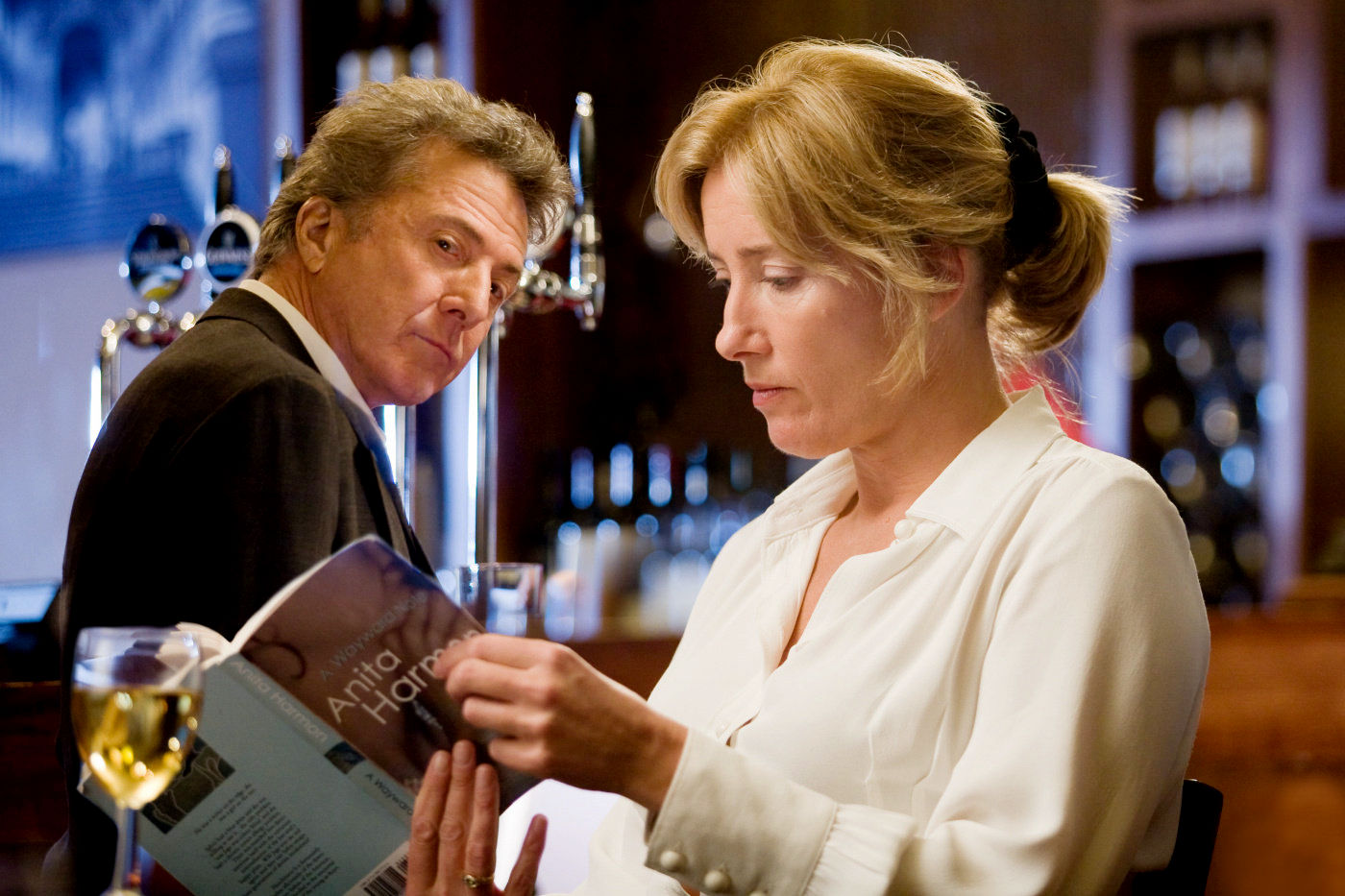
Harvey Shine (Dustin Hoffman) writes commercial jingles, but he's always wanted to be a jazz pianist. He's about to write yet another inoccuous ear-worm, but he's on his way to London for his daughter's wedding. He's told, rather cruelly by his boss (Richard Schiff) to take his time, enjoy himself...because he won't have a job when he gets back.
Hey...Mazel tov!
Add to that, his estrangement from his family, his awkwardness with social situations, and that dear daughter wants her step-dad (James Brolin) to give her away, Shine is having a verty bad time. Determined to skip the reception and head home, he finds his flight delayed with a long layover. Only thing to do is hit the bar, and once there, he has a strained conversation with Kate Walker (Emma Thompson, always exactly right), an airline worker he previously had blown off.
She wouldn't be there if a connection didn't happen...not back to the U.S., but between them...and as I said it's amiable and genial and you probably already know where it is heading. There is a complication or two of the An Affair to Remember variety—don't worry, no one gets hit by a bus—and we get to witness what may be the longest wedding reception in history. The slight storyline is fleshed out with Kate's eccentric mother (the wonderful Eileen Atkins) wo thinks that there's a Rear Window-style murderer living next door. Hilarity ensues.
Still, you could do worse than this one to kill a little time, especially with such a good cast.
Saturday, January 8, 2011
Last Chance Harvey




Wednesday, November 4, 2009
Post-"Graduate" Studies
 "The Graduate" (Mike Nichols, 1967) During the summer of 2009, the small rom/com "(500) Days of Summer" contained a line that hit home on many fronts. The romantic hero (says the police blotter-like narrator) formed his romantic ideas at an impressionable age due to "a mis-reading of 'The Graduate.'"
An easy thing to do.
Lots of young romantic kids grooving on the surface-tension of the movie, missed Mike Nichols' (and scenarist Calder Willingham and Buck Henry's) wise, dispassionate warning of a life led for instant gratification, something that went right over the heads of a clan preparing for "The Summer of Love." When we first find Benjamin Braddock (Dustin Hoffman) he's going nowhere mighty fast: first, stuck in a plane seat, then on an airport's "moving sidewalk"—life going by, him standing still. He'll spend his first summer out of college in much the same way. His first night home, he'll be hiding in his room (to avoid his parents' celebratory welcome home party) "worried about (his) future."
But the world will have none of it. Along with the free advice ("plastics...") and the pinched cheeks that will continue through his adulthood, Ben is coerced into driving the wife of Ben's father's partner home from the party. Once there, "things get a little weird." Dressed in her leopard-print coat,* Mrs. Robinson (Anne Bancroft) reveals herself to be quite the predator, as well as revealing that she's neurotic, alcoholic and...oh, by the way, Mr. Robinson (Murray Hamilton) won't be home for hours. Yes, as a matter of fact, she is trying to seduce him,** and Ben barely makes it home uncompromised by Mrs. and Mr. Robinson, who gets home sooner than expected.
But Ben is feeling pressure at home. Dad wants him to think about graduate school and is trying to hook him up the Robinson's daughter, Elaine (Katharine Ross). To an extent he does a little bit of both by spending time in post-graduate studies with Mrs. Robinson, who becomes fiercely adamant against Ben dating her daughter. He also finds out that the Robinsons have a marriage of convenience as she became pregnant with Elaine and that was the thing to do.
It's pretty apparent that after four years of schooling, Benjamin doesn't listen very well. Forced into a date with Elaine, he's determined to screw it up, succeeds all too well, then, having reduced her to tears, decides that he can't be that much of a heel and makes it good to her. A romance begins to take shape, but is quashed when Ben reveals to Elaine that he had an affair with her mother.
Against all odds (or reason) Benjamin begins pursuing Elaine, culminating in a rescue at the church of her wedding, where they famously escape on a bus, having defied convention, their parents, and get things their way.
Orson Welles has said any story can have a happy ending...depending where you end it. If Nichols had ended with Ben and Elaine flush with revolution bussing away to their future, it would have been a happy ending.
But he doesn't. He stays on his shot of the two rebels as their expressions change from elation to confusion to...what? Ben has been so focussed on the prize and Elaine, confused and pressured into marriage, that they don't have a plan...they don't even know where the bus is going. The story will go on, and Nichols doesn't cut away until the last moment—he lets us see their expressions change, her looking at Ben unsure, Ben just looking forward still in an adrenaline daze of what he's done.
And what he's done is risk something the whole movie has been warning against—becoming like his parents. Mrs. Robinson has aspirations and dreams that were exploded when she became pregnant with Elaine and she became dependent on a man for her well-being. Elaine, with no degree, is now dependent on the adrift Ben and the only thing on his mind is domestic bliss, although how he'll get there, he probably doesn't have a clue. Their impulsive act of rebellion is a trap to becoming their parents. A lot of people missed that message in the 60's, but it's always been there for anybody not blinded by the comedy and the attraction of its stars.
It occurred to me (after loving the movie for 30 years) when my wife professed to not liking it much because the character of Elaine is so ill-defined and confused. It's not a strong woman's part, despite its screen-time. And Ben is simply a mess—single-minded, shallow, without much motive other than selfish ones. He's very much his parents' son.
So, when "(500) Days of Summer" came out, with its shallow male pursuing a female through friendship and assuming forever is part of the bargain, and its female character who enjoys the friendship but doesn't see it "safe" enough to be permanent,*** the connection to "The Graduate" clicked, all too finally. It is a comedy (in the classical sense), as its protagonists don't even know that by pursuing their course of what they see as rebellion, they've condemned themselves to living the quietly desperate lives of their parents.


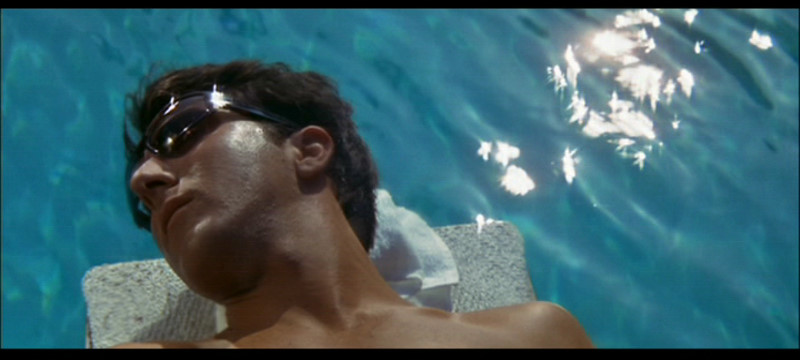


On the occesion of its 30th Anniversary, a lot of critics who could do so, re-evaluated "The Graduate," and down-graded it accordingly. Given the new "reading between the frames," I'd actually up-graded as being far more subtle and wise than the comedy aspects of the film would suggest. Perhaps it's time to pay a visit to Sam Mendes' "Revolutionary Road," as well.
What did "The Bard" say? "You say you want a revolution, well, you know/we'd all love to see the plan..."

"Everybody puts Benjy in the corner:" Dustin Hoffman and Anne Bancroft "Graduating"
* This was the 1960's—the term "cougar" would show up forty years later. Bancroft was only six years older than Hoffman at the time.
** We dissected this scene in "Don't Make a Scene: The Graduate.
*** "(500) Days of Summer" has a telling scene, he takes her to see "The Graduate" and she ends up sobbing; what he sees as romantic, she sees as frightening, terrifying...and her situation.
Saturday, November 22, 2008
Olde Review: Midnight Cowboy
"Midnight Cowboy" (John Schlesinger, 1969) "Midnight Cowboy" is
 a film that has been vastly over-rated over the years. So has its director, John Schlesinger. I haven't seen one film of his that has been consistent—content-wise, or quality. Admittedly, Schlesinger does do some great things in his films. but never for long, and that goes for "Far from the Madding Crowd," "Darling," his marathon sequence in "Visions of Eight," and especially last year's "The Day of the Locust." Schlesinger couldn't even pull off a simple thriller like "Marathon Man" without laying it over with unnecessary cross-cutting and lead-balloon pretensions.
The problem? Schlesinger is a cold director and this coldness of attitude combined with a certain heavy-handedness in technique bring movement, but not life, to the subject matter. Add to this Schlesinger's off-and-on fascination with grotesques—as in "Midnight Cowboy"—and the situation is nearly impossible.
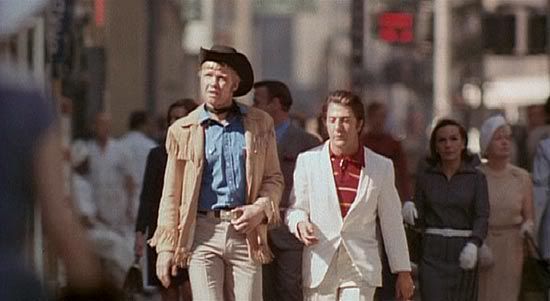
"Midnight Cowboy" begins well enough, with a rather multi-layered shot of an empty drive-in movie screen overlapped by the sound of thundering hooves. But not from the screen. From a nearby corral. Joe Buck is leaving the farm to go to New York; putting himself out to stud, so to speak. And Joe Buck's bus-trip to New York is very enjoyable with the exception of some coy flashbacks. But once the Big Apple has been reached, Schlesinger begins to feel the need to be...satirical. And his satire has all the subtlety of a brick through a window, as opposed to the subtlety of "The Sound of Trumpets."

Jon Voight gives a fine performance. Dustin Hoffman is all right (but his limp keeps changing, and Schlesinger keeps drawing attention to it!) But, above all, the best thing about "Midnight Cowboy" is the music for the film by John Barry, whose scores include those for the James Bond films and "Born Free." His music provided the best satire, the most feeling, and the best humor in the film. One of these days, I'm going to have to do a tribute to him.

Broadcast on KCMU-FM December 5th and 6th, 1976
That last bit referred to film score tributes, basically three minutes in length that I did for the station. Barry's still alive. His last score being for the Michael Apted film "Enigma." He didn't do the whole film, but he supervised the music, picking and producing the songs, and writing bits and pieces of score that worked gang-busters in the film.
Frequently, when typing up these elderly reviews from a kid I can't remember being, I've always resisted the urge to change them here. Or wished I could go back in time to tell this little twerp what exactly is wrong with his opinion, and I felt that urge this time when I started reading the review. After all, Schlesinger settled down and did some good things later in his career, and "Midnight Cowboy" remains to this day the only X-rated film to win the Best Picture Oscar, and it's still considered a "classic."
But have you sat through it lately? I mean, sat through all of it? It's a mess, jobbing about from one bit to another, and all those parts that are endlessly played on clip shows—"I'm walkin' heyah!," the final bus ride, Joe Buck's walk through the crowded streets of New York, including satire alert-satire alert the guy who's been assaulted (presumably) lying in the street and everybody's walkin' to the tune of "Everybody's Talkin'" (written by Fred Neil, sung by Nilsson) and....that's about it—are the parts that people remember. Maybe, just maybe, people have a better opinion of the film because they're expected to. It's a counter-culture classic, after all, like "Easy Rider" (and we all know what a masterpiece that is!) Reading through this review, I went from "You're being too harsh" to "Yeah, point taken." The things that bug me about "Midnight Cowboy" are the same things that bugged me then, and it had to do with direction, inconsistency, and just the gosh-awful look of some of those sequences. It's like Schlesinger took Mike Nichols' bag of tricks from "The Graduate" and decided to use them poorly. I'm surprised it won Best Picture, actually.


What was nominated for Best Picture that year? "Anne of the Thousand Days," "Butch Cassidy and the Sundance Kid," "Hello, Dolly," and "Z."
.............well, maybe I'm not surprised (though "Z" is a good film).
Sunday, June 8, 2008
Kung Fu Panda
 Kung Fu Panda (Osborne and Stevenson, 2008)
Yes, it is another vehicle for Jack Black to play the hapless hero who blunders his way to success in as crass a way as possible in a plot line that has been recycled more times than the air in a Boeing 747 but leave that all aside, for King Fu Panda is a visual feast that will have you rolling in the aisles like a drunken flight attendant. The opening credits are enough of a treat in themselves but the movie is well done enough to make you laugh out loud and to suffer through the oh so obvious story arc which is delivered pretty much with tongue firmly lodged in cheek anyway.
For me, it is the best Dreamworks Animation movie since Shrek*.
The voice talents include:
Dustin Hoffman
Angelina Jolie
Jackie Chan
David Cross
Ian McShane
Seth Rogen
Lucy Liu
Randall Duk Kim
James Hong
Kung Fu Panda is a eye-pleasing, side-splitting full price ticket.
*Like Shrek, it has its share of parodies, references and gags aimed at the parents in the audience.
Tuesday, April 29, 2008
Perfume: The Story of a Murderer
 and you get this monstrous little curiosity, with a role for Dustin Hoffman, yet. Unfortunately, Twyker can't meet the film's biggest challenge-communicating the sense of smell and doing it delicately, of course. The director can do little more than ecstatic shots of Ben Whishaw's Jean-Baptiste Grenouille huffing and puffing and sniffing the air--actually the other way around. And one just can't buy the novel and film's biggest conceit--that the young amateur perfumer can sense parts per million like a super-bloodhound, hours, even days after the source has passed. It's an idea at odds with the visual of a Paris in squalor that Tykwer has (quite rightly, I'd bet) presented. Young Grenouille has this incredibly sensitive snoot in a town of open sewers, outdoor markets and the thousand natural scents, both beautiful and repugnant, including the perfumery used by the citizenry to cover it all up. It doesn't read that he'd be so olfactorily fine-tuned.
That's the major hurdle. The other is the coarse rankness of the material, where women--it's always women--are killed serially, covered in animal fat to immediately preserve their scent, then the fat is scraped off and reduced down to its basic (one would presume) pheromone, and collected as an eau de copse. The plot all comes down to a...boil...when Alan Rickman's protective father suspects his daughter is being stalked by the little stinker, and highs her to the hinterlands at full gallop. Despite his precautions Grenouille is able to track them on-foot despite the dughter's intoxicating scent being mixed with that of a sweating horse. This is where Tykwer's inability to sell the scent works to his advantage. You're not supposed to think about that in the absence of evidence.


There are other troubling aspects to it, but let's come right to the nitty of the gritty. "Perfume" is just another in a series of serial killer movies which (sorry) boils down women to objects with an aspect to be coveted and destroyed for. It's not unlike "House of Wax" (whichever version) or the skin-suits of "The Silence of the Lambs." Despite being gussied up with period detail, sophistication of technique and aspects of subject matter, "Perfume: The Story of a Murderer" is just another horror movie with pretensions of grandeur. Despite all the attempts to cover it up, you can't hide the basic stink.

Wednesday, January 9, 2008
Mr. Magorium's Wonder Emporium
 "...and maybe avoid the slimey girl!"
I loved "Stranger Than Fiction." Marc Foster's direction gave depth and substance to the unique voice of Zach Helm's script. And every part was expertly cast and the peripherals presented in CGI gave a sprightly twist to the action on-screen. When I heard that Helm was directing his own script for "Mr. Magorium's Wonder Emporium," I thought "Great! Now we'll see what this Helm guy is capable of!"
Be careful what you wish for.
"Magorium" is such an insubstantial froth of a movie that before you get five minutes into it, you're saying "I'm not buying this!" And with good reason--it's "Stranger Than Fiction" all over again, but from another perspective and far more precious. When I say "far more" I'm saying "falling-into-a-vat-of-Krispy-Kreme-dough" precious. The kind of gooey sap that half an hour of scrubbing with Boraxo can't shake. The same way that cake frosting turns hard as a rock after five weeks in the desert sun. Despite some clever touches and the occasional funny line, it still makes you want to walk out and punch a nun.

What's it about? A magical toy store run by a 243 year old toy impressario, wonder efficianado (and avid shoe-wearer) Mr. Magorium who has decided that it's time to go. "You're dying?" wails Mahoney (Natalie Portman), the piano-prodigy, who at 23 has not lived up to her potential. "Light bulbs die, my sweet," he bubbles. "I will depart." To get his affairs in order, he hires an accountant ("Must be someone who counts and is a mutant," says Magorium, and thereafter Henry Westin is referred to simply as "Mutant"), who is so button-downed he doesn't play one whit, not even checkers (exactly like Will Farrell's character in "Stranger Than Fiction?" you say, and you're awarded a gold star). And what's worse, the toy store is starting to bubble underneath the velvet wall-paper and turn a tainted shade of gray.



It's all just icky--icky in the way a wet lollipop collects dog hair. Dustin Hoffman finds a pretty good balance for his twee little toy-maker, looking like he's been sticking his fingers in wall-sockets for years and elocuting like Bullwinkle. Natalie Portman is the film's biggest draw-back, tamping down any effervescence by screwing up her face and looking concerned. It's really bad when instead of carrying about what the character is going through, you wonder what kind of exfoliant the lead actress is using. Any glow she has is purely pharmaceutical. Jason Bateman plays the stick-up-his-sphincter accountant...like he has a real stick up his sphincter. He managed to make straight-laced funny in "Arrested Development" Wha' hoppened? And as the Narrator/Obligatory Little Kid, Zach Mills plays it with a seriousness and dignity that seems to say "I will rise above this." Attaway, kid. Hope you're not knocking over Winn-Dixies in ten years.


Now, see? This movie didn't enchant me or make me feel warm inside. It made me think bad thoughts. Cruel thoughts. There's a lot of surface detail to "Mr. Magorium's Wonder Emporium,"* but no depth. It needs some grit and sand beyond having the lead character kicking the Big Beach Bucket. As it stands, it's just a wad of cotton candy that you want to throw water on...just to see it disappear.
"Mr. Magorium's Wonder Emporium" is a cable-watcher
* Another thing: Who is the audience for this thing? Kids won't get it or be upset by it, and adults will find it just cloyingly annoying. But then a lot of kids won't get a lot of jokes. For example: there's a shot of a Buster Keaton marionette trying to untangle itslf from its own strings--a pretty funny reference, but little kids don't know Buster Keaton. The same goes for the bit where Zack starts buildings stuff out of Lincoln Logs and when he's finally finished, he's made...a life-size Lincoln! Funny, huh? But not if you don't know what the Lincoln Logs are, and nobody under 30 DOES!