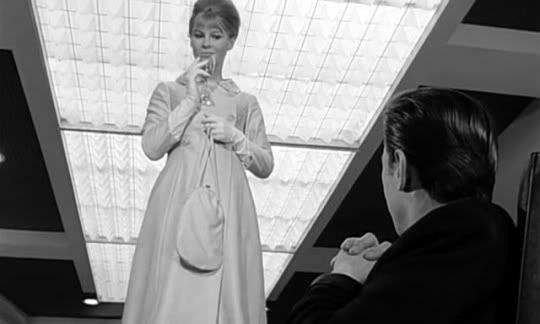
"Away From Her" (Sarah Polley, 2007) Julie Christie did her homework when it came to portraying early-stage Alzheimer's--the intense concentration, and the thousand yard stare, the polite smile to the intimate stranger. And the film does a remarkable job of putting the viewer into the "Alice-in-Wonderland" world of the Alzheimer's care-giver who must endure the pain of dealing with losing the relationship while still having to deal with the patient. The commitment is still there, even though the disease has severed the knowledge of it from patient to care-giver. Sacrifice without reward--makes you realize what being a nurse is like.*
And there's an aspect to Alzheimer's care-giving that's a bit like a lab experiment. Divorced from the ties that the disease has unpinned, one can observe the effect it has on the human being, given the prior knowledge of the sufferer. You can check off what goes, see the timeline disappear, the brain functions narrow and fluctuate, enjoy the false encouragement of "good days." For the Alzheimer's patient, it's a slow-motion float to death--at some stage they're not even aware of their condition. For the caregiver, it's a bit like watching a frog (a very dear frog) sitting in slowly heating water--you can only wait helplessly and steel yourself for the inevitable, as memory, identity, and life slips away. It's a slow death and a long good-bye.
"Away From Her" (Sarah Polley, 2007) Julie Christie did her homework when it came to portraying early-stage Alzheimer's--the intense concentration, and the thousand yard stare, the polite smile to the intimate stranger. And the film does a remarkable job of putting the viewer into the "Alice-in-Wonderland" world of the Alzheimer's care-giver who must endure the pain of dealing with losing the relationship while still having to deal with the patient. The commitment is still there, even though the disease has severed the knowledge of it from patient to care-giver. Sacrifice without reward--makes you realize what being a nurse is like.*
And there's an aspect to Alzheimer's care-giving that's a bit like a lab experiment. Divorced from the ties that the disease has unpinned, one can observe the effect it has on the human being, given the prior knowledge of the sufferer. You can check off what goes, see the timeline disappear, the brain functions narrow and fluctuate, enjoy the false encouragement of "good days." For the Alzheimer's patient, it's a slow-motion float to death--at some stage they're not even aware of their condition. For the caregiver, it's a bit like watching a frog (a very dear frog) sitting in slowly heating water--you can only wait helplessly and steel yourself for the inevitable, as memory, identity, and life slips away. It's a slow death and a long good-bye.
So, in that way, "Away from her" is a good primer for the best-case Alzheimer's scenario. Christie's character, Fiona Anderson, is aware of the onset, and in an act of unselfishness, rather than go into denial and paranoia makes the decision to place herself in an assisted living facility, voluntarily giving up the freedom that so many patients cling to, kicking and screaming.
Her husband of 40 years, Grant (Gordon Pinsett, he's wonderful, too) sees the relationship go away in an accelerated fashion when the facility insists on isolating the patient from family members for a required thirty days (I've never heard of such a rule, but then it takes place in Canada)
By the time of Grant's first visit--one he highly anticipates--Fiona has already separated from their relationship, and he struggles mightily to regain it, a combination of wanting to halt the progress of the disease and his own selfishness.
Where that yin and yang pulls him forms the crux of the story, and in my household it led to some pointed discussion about responsibility and relationships, but one must also look at the brutal reality of the disease and the unique way that it eviscerates normalcy.
As I've said "Away From Her" paints a best-case scenario that is still far from rosy, but as a toe-dip into the issues surrounding dementia and Alzheimer's, it's a pretty effective film, and actor/director/savant Sarah Polley has found a fascinating way of deriving a positive and interestingly nuanced life-lesson out of the experience. Like Orson Welles with "Citizen Kane," she was all of 25 when making it.
--------------------------------------------------------------------------
 Over the weekend, one of the most iconic stars of the silver screen left the stage. Charlton Heston died at the age of 84 from undisclosed circumstances, but as he announced in 2002 he had symptoms associated with Alzheimer's it's easy enough to put two and two together without the benefit of a Hollywood Press Release.
Born October 4, 1923, Charles Carter, who would take his step-father's name, Heston, and his mother's middle name, Charlton, for his stage name, was one of those actors whose careers straddled the old Hollywood and the "New" New York Stage, so he could be counted on to play larger-than-life characters, but with a humanity that made them relatable. He seemed less capable of playing modern-dress individuals than he was at playing stoic figures from another age, bringing them down to Earth or puffing them up to figures of Myth. One can't imagine too many actors playing Cecil B. DeMille's Moses and parting the Red Sea as Heston did when he bellowed "Behold, His Mighty Hand!" One got the impression Heston was doing it, all by himself.
Because he had that "stagey" air to him lines of Shakespeare keep floating up when considering Heston, so it may be a surprise to think of the guy from "The Omega Man" and "Soylent Green" as being so closely associated with the Bard, but he started out playing Shakespeare, and, indeed, in one of his last screen appearances, Kenneth Branagh chose Heston for The Player King in his full-length "Hamlet," and, of course, Heston played it like he owned the stage, his chiseled chin held high in imperiousness. He played Moses and John the Baptist. Michelangelo and Major Dundee and "El Cid" and Cardinal Richelieu and Sherlock Holmes (Jeremy Brett was his Watson onstage!) and Andrew Jackson. And he played Judah Ben-Hur.
Charlton Heston doing his own driving (and wondering when CGI will come along)
For that he won an Oscar, one of the 11 that elephantine production copped. But Heston had enough personal magnetism his character never got swamped in the chariots and the robes and the hokum. And he worked with Cecil B. DeMille, William Wyler, Orson Welles, Sam Peckinpah, Tim Burton and Jim Cameron--now there's a bumptious Guild meeting. He played both sides of the Darwinian divide in "Planet of the Apes" movies (His stipulation about going along with the sequel, the aptly-named "Beneath the Planet of the Apes" was that he got to blow the planet up at the end. He got his wish, but you couldn't keep those "damn, dirty apes" down!) That's another thing--only an actor of Heston's weight could keep the silliness of "Planet of the Apes" from spinning off its axis.
"The evil that men do lives after them, the good is oft-interred with their bones."
It's a sad thing, but Heston's political activity in his last few years may eclipse his life's body of esteemable work. Heston started out a very liberal activist, his being one of the few white faces in Dr. King's marches, and his work for charitable causes won him a Jean Hersholt Award. But, as the years progressed he became more and more curmudgeonly, He famously wrote a letter castigating NBC for the tone of "Saturday Night Live," then agreed to host it. Twice. He killed. As far as his politics, one can imagine in the competitive acting business Heston looking at Ronald Reagan's path to the White House and, with hubris and envy, wanting that part. And as the strain of conservatism grows rather virulently on "The Left Coast," he threw himself into increasingly conservative causes (What he didn't consider was that Reagan was a mediocre actor who needed a gig, whereas Heston's success never really waned).
One of his last appearances was in Michael Moore's "Bowling for Columbine" where Moore took him to task on-camera for his post-massacre activities as NRA president. Moore was typically bombastic and combative, and Heston, flummoxed and saying stupid inaccuracies--and realizing he was not doing well, just got up and left, trying to salvage some dignity. Neither man looked good in it (though it's amazing that Moore could go up to the intercom on Heston's gate, have Heston answer it, and later have him agree to meet with him--even Moore was taken aback).
Almost immediately after the film's release, Heston announced, as Reagan had before him, that he had symptoms of Alzheimer's. How long he'd had it, and how it'd affected his behavior and attitudes, no one can say. But anyone who's witnessed the Long Goodbye of Alzheimer's wouldn't be surprised at the change. One must blame the disease, not the afflicted. Lest any liberal be too self-satisfied at Heston's fate, "go and paint an inch thick, to this end you may come." Smirk at that.
Heston wrote four very good books: "The Actor's Life: Journals-1956-1976," "Beijing Diary," "In the Arena: An Autobiography," and "Charlton Heston's Hollywood: 50 years of American Film-making." He was married to the same woman for 64 years, his fellow actor Lydia Clarke. My thoughts are with her today.
I never met or worked with the man, but I have friends who did, and even when the job was merely as a favor, he would quickly drop any irritation he might have with doing it, and would lose himself in the work...and those voice-tracks were always...impressive. Another story a friend of mine tells is when setting a microphone up for a Heston voice-over, the actor made sure to shake his hand, and ask his name. "I'm Randy," said my friend. Heston grinned that wolfish, scary smile and said, "Me, too." It doesn't matter what team you play on, that's a little creepy.

My favorite Heston moment is a minuscule but fairly recent one in Richard Lester's "The Four Musketeers." Lester's "Musketeers" films are full of joys (such as Heston playing a scene with Spike Milligan!), but there is one scene towards the end, where Heston's power and ability to underplay is on display. His Cardinal Richelieu (a part Heston didn't want, but when Lester suggested it, Heston researched and snatched the part up to his everlasting joy), undone in his own machinations ("One must be careful what one writes"), sits back in his chair, an arm flung over the back to dismiss young D'Artagnan, which he does with a slight flip of the wrist. It's a concession of defeat to a lesser, and not another word is wasted on him. It's just one of his scenes I enjoy watching. Even at his most belligerently gun-toting, Heston's performances always evoked smiles...and admiration.
Oh, one last thing. You can take his guns now.
* The author lost his Mother to Alzheimer's in 2001, if one is so churlish to look for authority. The movie has received a lot of criticism from care-givers who think the movie soft-pedals the disease, and although it does present a best-case scenario and never goes further (actually) than early-stage Alzheimer's it does show, in a perfunctory way, the severing of emotional ties and history a patient can experience and the effect it can have on the care-giver.
 of a rags-to-riches story with a Chekhovian twist, it could be subtitled "Days of Cabiria," it's such an antithesis to Fellini's film about the travails of a "well-known night-bird." Diana Scott (Julie Christie, in her Oscar-winning performance) goes from vaguely dissatisfied London wife to jet-setting model/princess using a series of men as if they were rungs on the ladder. Dirk Bogarde plays a BBC journalist with whom she has her first affair that shatters her marriage ("Isn't it a shame that it's so hard to be happy?" she intones at one point) Then, when things start to get a bit perfunctory she becomes a plaything with a jaded playboy (Laurence Harvey, barely expressive). Soon, the sense of been there-done that completely eclipses her enjoyment of every current situation, and as she's completely incapable of being self-aware ("Is that really me?" she says in shock when a party-goer imitates her) that it's not simply a matter of imagining the grass in greener on the other side of the fence, so much as vaulting the fence and rolling in it for awhile.