 "When The Music's Over (...And the Band Plays On)"
or
"Momma, There's Wolves in the House"
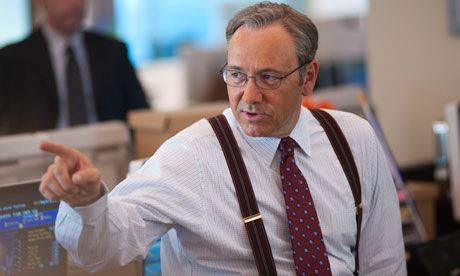
Margin Call begins like The Company Men and Up in the Air—in the midst of a corporate slaughter—people being fired from jobs they've held a long time. Cut-backs. "Generous" severance. Thanks for your service. Security will escort you out.
Eric Dale (Stanley Tucci) listens to it all, a little stunned, but tentative. "Uh, listen," he says in the middle of the administering of Last Rights, "I was working on something and I'm not finished yet." Doesn't matter. Go to your office. Empty your desk. Proprietary information. Your losing your phone, e-mail, etc. "No, really..." he says.
Doesn't matter. He's out. On the way to the elevator, he runs into two of his turks, Peter Sullivan (Zachary Quinto) and Seth Bregman (Penn Badgley). "Am I safe?" asks Seth (as Seth is wont to do). But Peter walks him to the elevator to tell him how much his mentorship meant to him. Dale cuts him off. "I know. I was working on something. They won't let me finish it," says Dale as he hands him a USB drive. And as the elevator doors shut, he has just enough time to say "Be careful."
Fwump.
It's the "be careful" that gets everybody's attention. "He said that?"
Sullivan begs off the traditional drinks for the battle survivors and takes a look at Dale's figures. Then he sees something. Digs, does some calculations and then stares at his projections screen. Over the next twelve hours, the world will go to Hell and he's the only one who sees the gate.
Margin Call is a boardroom thriller about our recent financial crisis, but its played like a mystery story. Everybody speaks in code. The night is dark and no one is betraying secrets. No one knows what's around the corner and everybody's looking behind them for the knife. Written and directed by J.C. Chandor (Who? This is his first film and it is an impressive debut), it plays out like a conspiracy—it is—and if so much of it didn't anticipate the dawn, one would be tempted to call it a film noir; there is a palpable air of organized evil, built of greed and self-interest, that hangs over the film, for what is being planned is the crime of the century.
The cast is uniformly superb—how could it not be with the likes of Kevin Spacey, Jeremy Irons, Simon Baker, Paul Bettany, Demi Moore, and Tucci?—but those performances depend on the great dialog generated by Chandor and the way he presents what should be dry material as drama and intrigue. These are gangsters in Gucci, cold-blooded, playing the long odds and the fast kill, but instead of "going to the mattresses" they are isolated in fancy cars and well-appointed high-rise board-rooms, their views of the world their actions are affecting armored by safety glass. There isn't much soul-searching (their businesspeople, so why look in a dry hole?) about what devastation their actions will bring, except for the immediate future and what it will do "for business." Even then, loyalty to the corporate mantra of "be first, be smarter or cheat" trumps conscience. That would make a hell of a slogan wouldn't it?
If one could gripe (and there is little to gripe about), one could argue that, if anything, this reverse "Godfather"—where businesspeople are gangsters, rather than gangsters as businesspeople—is heavily romanticized. There are no "Masters of the Universe" statements coming from these mortgage titans (as one heard from Wall Street bar-recordings on "This American Life," where these mavens crowed about deserving bonuses from bail-outs because "they're smarter than everybody else"), but, rather, short-term hedges about "dog-eat-dog" survival. No cynical betting against failure schemes, but merely making the best out of a bad situation before everyone else does.
As bad as Margin Call makes its protagonists, the truth is even worse—there were folks betting on things coming crashing down and profiting from it. It doesn't take a rocket scientist to see that a fix was in and that analysts saw it coming, not, suddenly, seeing it and going "Garsh, this looks bad." And the worst thing that's happened to these people is a little traffic congestion on Wall Street.
That is, if they're working at all.
Margin Call is a Full-Price Ticket.
Wednesday, October 26, 2011
Margin Call




Wednesday, December 15, 2010
The Tourist
 "Tourist Class"
or
"Just the Thing I Need...How Nice"
In between "Pink Panther" movies and his other comedies, director Blake Edwards used to make elegant truffles of movies with big stars, great locations, and high production values. But whatever the veneer of stylishness they showcased, there was always a kernel of truth to what he did. Edwards understood that even though the wrapping may be exquisite, the present it surrounded should be pretty special too.
So, I guess what I'm saying is The Tourist is a pretty lousy Christmas present.
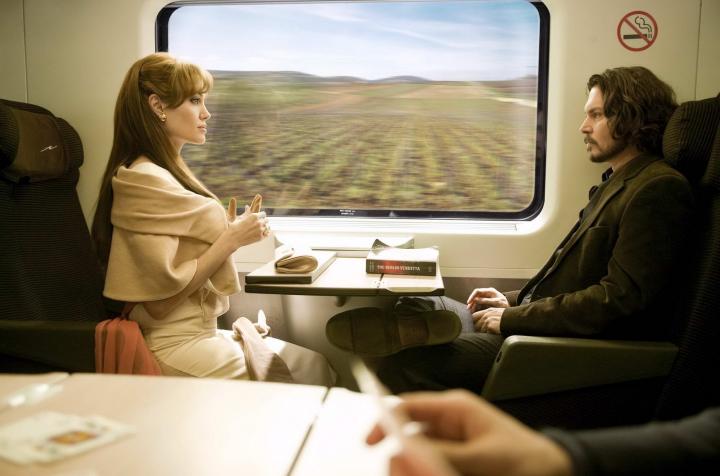
Oh, it looks spectacular, jetting (training and gondoling, actually) from Paris to Venice, all chi-chi and ritzy, but it falls flat as a caper, a romp, or even a good time.* Hell, it even falls flat in the half-hour review of its particulars with so many plot-holes and needless complications that, given the film's resolution, it makes little sense. Oh, you can see how it might work...but if it is what they say it is, then why....??? (Oh, don't ask why, oh, don't ask why....)
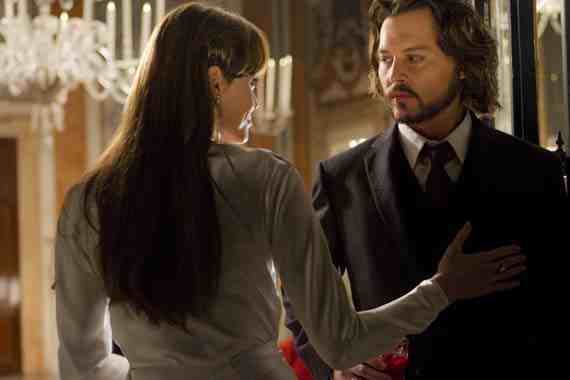
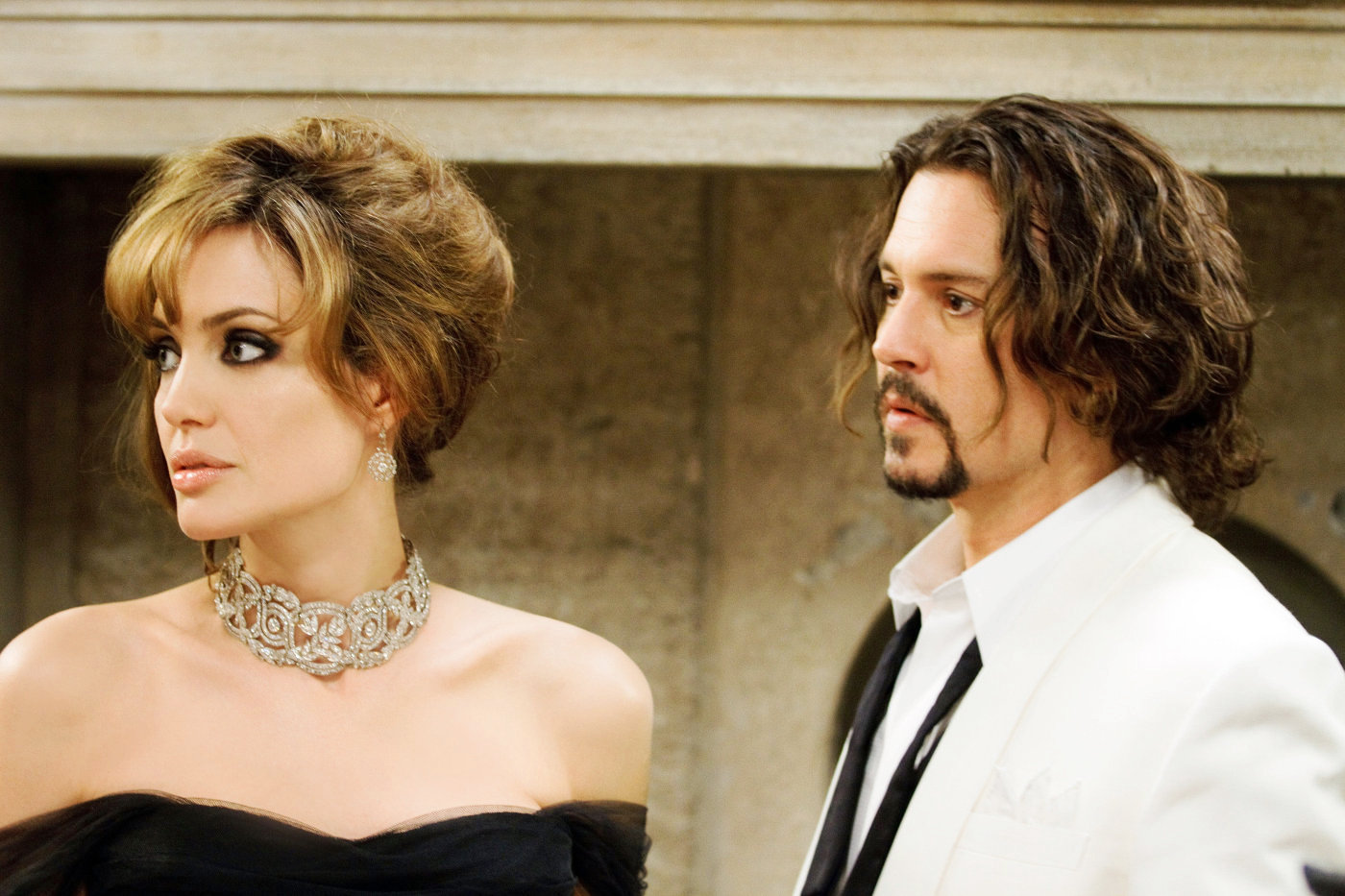
And when you start doing that analysis, you know that the thing hasn't really been thought through...they were just making it up as they were going along and hoping nobody would notice that the film only makes sense five minutes at a time. You're supposed to be distracted by the gorgeous decors, the elegant suits (and suites), Angelina Jolie's wardrobe (and how she fits in it**), and Johnny Depp's clowning*** to actually figure out that the movie is a shell-game, and a shell of a movie, as hollow as a chocolate bunny on Easter, and with as much nutritional value beyond being sugary.
Hard to believe, then, that the director—and co-scriptwriter, along with Christopher McQuarrie (The Usual Suspects, Valkyrie) and Julian Fellowes (Gosford Park, The Young Victoria)—is Florian Henckel von Donnersmarck, whose last film was the extraordinary Best Foreign Film Oscar winner The LIves of Others. That was a complex morality-play that moved across the demolition of the Berlin Wall, of how hunter and hunted can come to a mutual respect. But this can't even get its internal logic right. Even a finely-crafted Mercedes can fall apart if you don't throw some oil in it.
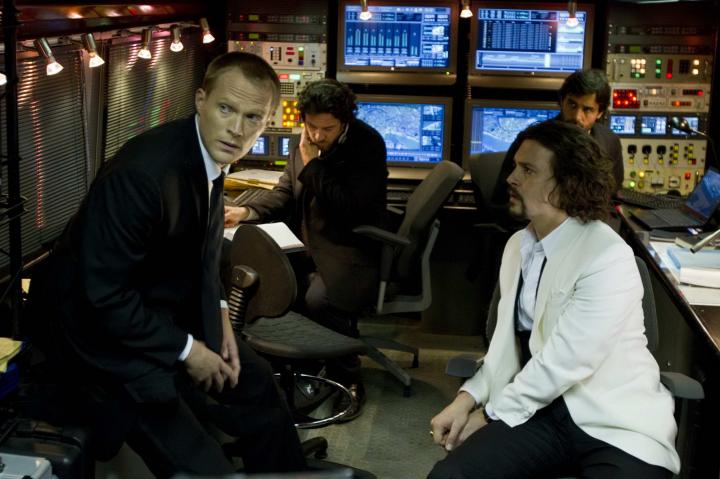
Add to the script problems the lack of any frisson between Jolie and Depp, both of their characters going through the motions acting as cool as cucumbers (him, comically; her, glacially). He tries to throw some bits of business around, but they're fairly subtle (and inconsistent)—like his language malapropisms (which will fly over most Americans' heads) and a tipsy act—that they get lost in the shuffle. Jolie has a tougher problem; she has to fight herself and her image. This is the second feature (after Salt) where Jolie is tasked with a poorly written role that requires no acting challenge, so much as present herself in an iconic way. In other words, she has reached the point in her career where she no longer has to be good, as she does to look good. This is a movie in Liz Taylor mode, Audrey Hepburn-style, the queen bee with drones hovering to do her bidding. But, she receives no help at all, not from the script, not from the cast (which includes Paul Bettany, Timothy Dalton, and Steven Berkoff—the latter two impressive, as always), the director lighting her well and showing her at her best. She is set apart—the only woman in the cast; she might be able to carry the box-office, but she can't carry the movie, poor as it is, and as enticing as it might look. She is a fine actress, as her awards-gathering early in her career demonstrated. But a few more of these vehicles and she may have to de-glam her career—as Charlize Theron (who left this project) did.
They should have called it "The Tourist Trap," instead.
The Tourist is a Cable-Watcher.
* I'm sure it wasn't the movie, but I started to develop chest pains during it, and I began to think that all this sumptuousness was starting to clog my arteries, maybe I was just distressed, so, I shut my eyes...oh, for about 20 minutes...just listening to the soundtrack, and when I opened them again...gosh, I hadn't missed anything.
** In one sequence, French police are tracking Jolie's Elise Ward with cameras as she glides down a Paris street. Two of the officers zoom in to see if they can see a pantie line, and their superior admonishes them "Be more professional, guys." And as if to show just how professional the filmmakers are, director Von Donnersmarck cuts to a tight shot of Jolie's ass. No VPL. They may have been going for self-deprecation there, but, actually, I think, they nailed the problem. "Be more professional, guys."
*** Okay, I am now calling "b.s." on Depp's maintaining an artist's pose. This and the "Pirates" sequels point to a man picking up a paycheck. I used to have a lot of respect for him...but now...(According to IMDB, Tom Cruise was supposed to play the part—he and Jolie have been circling each other for awhile, as he was supposed to, play Salt—then Sam Worthington, who left over "creative differences")









Wednesday, January 13, 2010
The Young Victoria
 "Her Serene Highness"
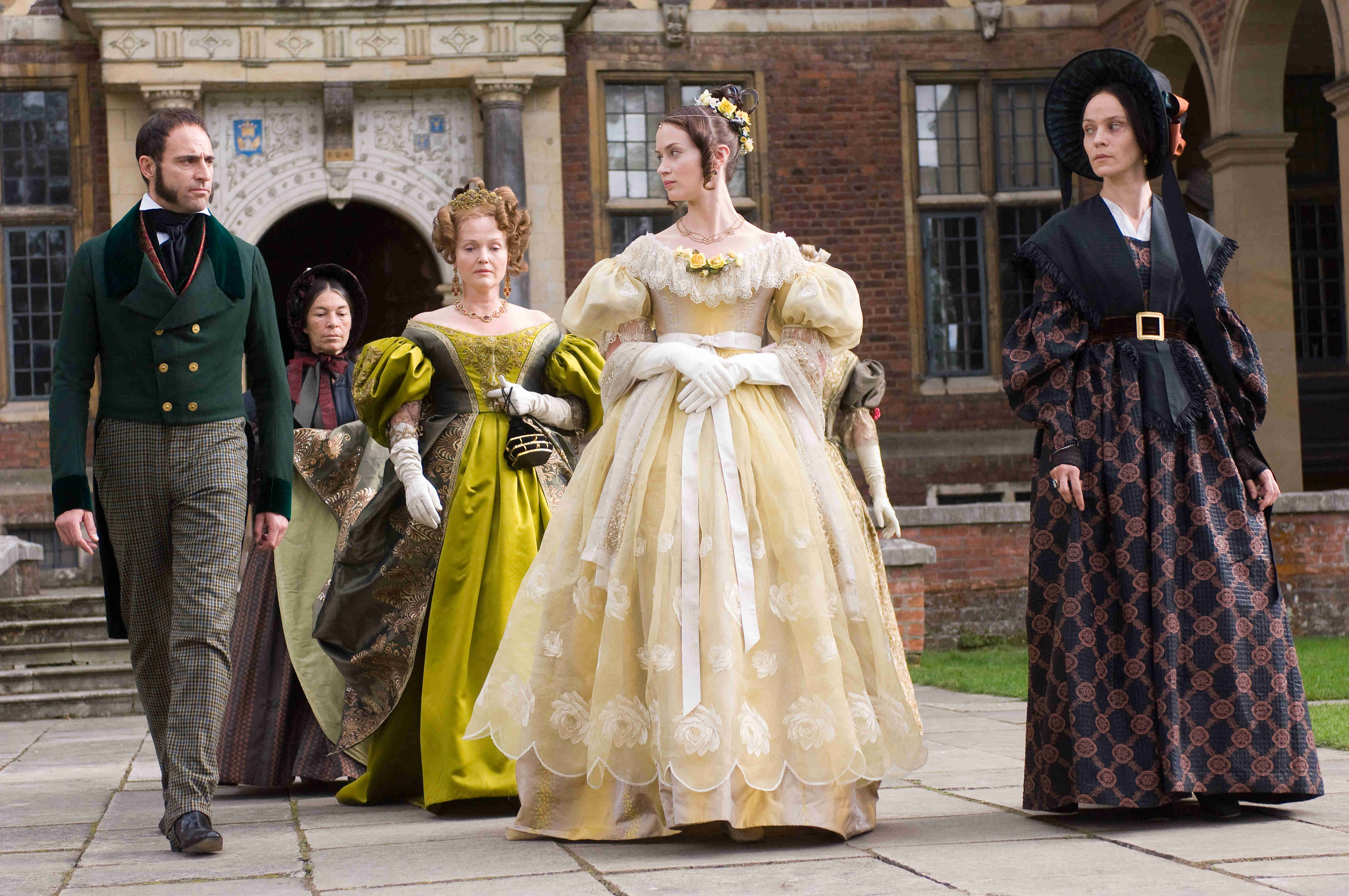
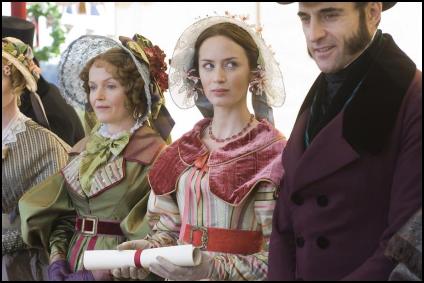
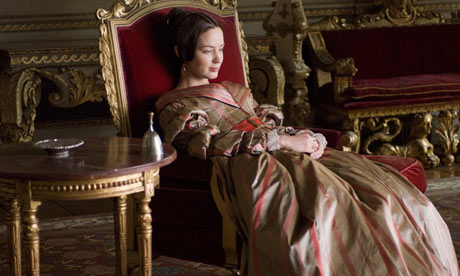
William Jefferson Clinton famously called The White House the crown jewel of the U.S. prison system. Young Queen Victoria (Emily Blunt) says early on in "The Young Victoria," "Even a palace can be a prison." As the only heir to England's throne in the Royal House of Hanover, the young princess is managed and controlled, ostensibly for her safety, but also for the power that an unprepared and naive queen can offer her advisers. The last image we see before the title of the film is a gate swinging towards us and slamming shut with a bang.
Go to black. Title up.
There are a lot of shuddering doors in "The Young Victoria," as the upstart princess, well aware of the red carpet ahead, defies her manipulaters and her mother (Miranda Richardson), who is cowed by their presence, especially that of Lord John Conroy (Mark Strong—his second villain role this year after "Sherlock Holmes"—risking typecasting, he'll be playing Sir Godfrey in the upcoming "Robin Hood" ) who viciously seeks to be made regent in case of the death of King William (Jim Broadbent). Ambition is on everyone's mind, except the one who will be getting the power. And ambition is what the young queen must learn, if only to be used as a weapon.
Director Jean-Marc Vallée (and his script-author Julian Fellowes, who wrote "Gosford Park") spend a lot of time concentrating on Victoria's noggin. It is focussed on, framed and discussed. "Look at that demure little head," says Lord Melbourne (Paul Bettany) at her coronation. "And all of us wondering what's inside it." He, like the rest of the court, really couldn't care less. If her mind can be changed, then it doesn't matter. But there is enough rebellion, and enough fighting the gold shackles binding her, that can be used to sway her.
It should be noted at this point that one of the producers of "The Young Victoria" is none other than Sarah Ferguson, the Duchess of York, who endured her own time of constraints while married to Prince Andrew. "Fergie" was known to be quite feisty, herself, and one looks at the movie and wonders how much of its editorial stance originated with her, as it is pretty sly in its view of the monarchy as being both a blessing and a curse. Whatever animosities Ferguson has incurred with the current Royal family, there seems to be an understanding of just what is asked of a monarch, and with "The Queen," it shares a similar visual touch—the Royal de-focussing of the eyes that appear to see nothing, but are merely providing a non-commital mask for the public to see, the eyes looking, instead, inward.*
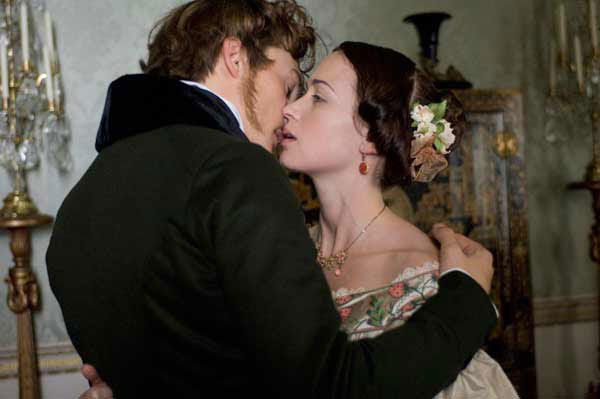
Given that, enter Prince Albert (Rupert Friend) of the Belgians. Groomed as a suitor by his father King Leopold (Thomas Kretschmann), the young Prince also resents being kept in a can, and upon meeting Victoria goes off-script, showing himself to be of equal mind. During a supervised chess game, they compare notes on their similar circumstances. "I know what it means to live inside your own head," he offers. "You must learn the rules of the game, so you can play it better than they can," and as if we don't get the point, he takes her Queen and sweeps it off the board, captured.
Vallée keeps things properly ornate and unfussy in his direction, save for some odd little rack-focuses interrupting the continual focus on Emily Blunt's head of restrained expression. At one point, though, he does indulge. At the Queen's entrance to a Royal Ball, upon seeing Albert, he keeps Blunt locked in position and then yanks her away from her party, as if pulled, floating to her paramour. A neat little trick that, and very dependent on Blunt keeping her muted expression while having her transport taken completely away. It's indicative of Vallée knowing that his best weapon in the movie is Blunt's subtle whisps of expression; one is drawn to her face to see how she'll react, even if, until the last frame, it is reluctant to reveal.
"The Young Victoria" is a Matinee.








* At the end, there is a title stating that Victoria was the longest reigning British monarch. And as if to tweak the ex-mother-in-law a bit, with a wink, a new title emerges below it—"To date." Elizabeth II is en route to surpass Victoria on September 10, 2015. She'll be 89.