Showing posts with label Johnny Depp. Show all posts

Thursday, July 11, 2013

Disney's The Lone Ranger

...A Cloud of Dust...
or
Depp in the Heart of Texas

The last time "The Lone Ranger" hit the big screen (1981's The Legend of the Lone Ranger, directed by cinematographer William A Fraker), it hit with a resounding thud.  It's not that the story wasn't any good, or that the basic idea isn't ripe for story-telling—it's just that the movie was dull, dull, dull, even as it was trying to be more "politically correct," giving John Reid's "Indian companion," Tonto, a bit more respect and hewing a little closer to a generically Native culture.

That was then.  This is now.  John Ford made the first modern Western in Stagecoach.  Sergio Leone and Sam Peckinpah made the "post-modern" Western in the 60's.  Then, after post-modernism came death.  People stopped making Westerns entirely, with hold-outs like Eastwood and Costner and Kasdan and Harris, the tropes of the genre falling into use in, cop movies and martial arts and space fantasy films.  But the form stayed pretty much dead and buried.  Given the history of the form, and with its emphasis on the spirit world, resurrection of dead men, and its manic quality (especially as its de rigeur for the creatures these days) maybe Gore Verbinski's film of The Lone Ranger (now Disney's) is the first zombie Western.

It fits.*  One of the themes galloping through this one is that "nature is out of balance," what with the "Wild" West being invaded by iron horses, the presence of "spirit horses," villains who will eat the hearts of their victims and manically carnivorous jack-rabbits out on the plains.  Zombies, okay.  But it's a bit of a Frankenstein monster, as well, made up of parts of what has gone before.  The final credits say that it was filmed "from Moab to Monument Valley," mostly Utah, and its true, with shots in Zion, Arches National Park, and the Monuments (looking slightly different from the time John Ford filmed them—the calved spires seem to have been digitally erased—although Verbinski has taken a lot of Ford's specific angles several times in the film). 


Verbinski's The Lone Ranger on the left; Ford's The Searchers on the right

But it seems like Nature isn't the only one with the problem.  The Lone Ranger is a Western out of balance, tipping from side to side and waving its arms frantically while standing on a line between olde Westerns and the post-modern varieties, with full-stops at the Leone era** and the silent era of comedic Westerns, specifically Buster Keaton's The General (not technically a Western, but go with me here) in the film's final bursts of energy.  The movie veers from queasy nastiness to whimsy to outright comedy and slapstick, without taking a break for water.  The villains are played absolutely straight, from Tom Wilkinson's rail baron to his nasty co-hort, Butch Cavendish  (a greasily unrecognizable David Fichtner), while the heroes are bumblers with good intentions, like Armie Hammer's rube of a Ranger,*** and top-billed (above the character and movie title) Johnny Depp's bizarre take on Tonto—well, it's bizarre for Tonto, but not for Depp, as this "Indian companion" would line up well with his other pasty-faced odd-balls like Edward Scissorhands and Barnabas Collins.  And, in action, his Tonto acts more like the Sam character in Benny & Joon, there's some Chaplin, but a lot of Buster Keaton in his stone-faced, article-challenged Tonto (the make-up for which is inspired by a painting by Kirby Sattler entitled "I Am Crow," which is neither authentic or historically accurate, but it looks distinctive, which suits Depp's purposes, I suppose). 

The movie runs on two parallel tracks of revenge—the Ranger, John Reid's, and Tonto's—as the two end up joining forces to deal with the guys who ambushed the Ranger's brother and posse, and the guys who wiped out Tonto's village, for which he feels responsible.  It's a little late in the game to plead weariness of the revenge scenario—it seems like every movie hero has to have a personal grudge as a pilot light, rather than to "do what they gotta do" through some sense of altruism.  Possibly that heroic quality is passé or considered foolish in today's culture, or maybe there's no sense of audience involvement if it isn't seen why the protagonists stand up for what's right.

But, it spends most of its running time moseying through origin stories and the whittling away at the uneasy alliance between Reid and Tonto.  Then, once things get going, there's an extended chase sequence featuring the two trains involved in the driving of the golden spike uniting the nation's railways, an "Indiana Jones" type of marathon that explores everything that you can possibly do with two trains running on occasionally parallel tracks (when did they find time to lay all that extra track, one wonders?).  The sequence would make the silent comedians gape, and propelled by variations of "The William Tell Overture," provides a lot of entertainment.  It's fun for quite awhile and Verbinski constructs some Rube Goldbergian scenarios that are, once or twice, ingenious.

But, instead of coming at the nick of time, it comes a might too late.  The focus there at the end comes after a lot of wandering aimlessly through the desert, looking for something to do.  Granted, its not as dull as the 80's attempt to put the spurs to the franchise, and in parts its entertaining, if one isn't looking for native axes to grind**** or is approaching the material with an already jaundiced eye.  One wonders if it was worth doing, or whether "The Lone Ranger" should be allowed to pass into legend, a relic of the thrilling days of yesteryear.

The Lone Ranger is a Rental.


My favorite appearance of Clayton Moore and Jay Silverheels as
The Lone Ranger and Tonto.
Kind of reminds me of how the movie plays them.*****


* Yeah, but one can see that as a strain running through Verbinski's work, especially considering the "Pirates" movies and Rango, where folks are coming back from the dead, or at least the crossing back from whatever spirit-world seems to fit the project.

** Composer Hans Zimmer does a lot of riffing off Ennio Morricone, the most notes taken from For a Few Dollars More (with its tinkling chime contrasting with a heavy-handed forward momentum theme), but also in the comedic grace notes that follow Tonto's shenanigans with a punctuating trill that Leone used for Eastwood's "Man with No Name" in A Fistful of Dollars.

*** Hammer is introduced like Jimmy Stewart's Ransom Stoddard in The Man Who Shot Liberty Valance, the "duded" pilgrim who stands out far too much in the rough West, in a suit so formal he's mistaken for a missionary...by a missionary.  It's one of his better performances, showing that he's at his best, comedically, despite (and maybe because of) his blandly handsome looks, in a way that's similar to Cary Elwes. 

**** Most of the talk is focused on Depp and his "white-face" portrayal of Tonto and how authentic it is (not very), which with the existing suspicions people have of the character as demeaned and inferior, has been mostly negative, because, like skin color, its very easy to see and remark upon with what one thinks of as authority.  One wonders if such a rehabilitation is possible, given the character's man-servant past, like Robinson Crusoe's "Friday," or The Green Hornet's "Kato" (although it certainly helped if Bruce Lee was in the role, bringing the character up several notches just on ability and charisma—should we mention that Brit "The Green Hornet" Reid is a descendant of The Lone Ranger?), and whether its even worth it to right the past's wrongs.  The alternative is to stay in place, and be content—although grousing—with the way things were and just leave it aside.  I think it says something that Depp thought Tonto was the more interesting character to play, as for authentic...is anything Depp does very authentic?  Short answer: No.  As for the whole racial thing, I thought the best line was Depp's Tonto griping about the ranger being a "stupid white man," and the Chinese railroad workers grinning and nodding in agreement at him—he's just another American...to them.  Now, that's some funny ethnic humor there.

**** It also is inherently racist as it paints Tonto in a bad light, obviously Natives are gluttonous. (*cough*)

Wednesday, May 16, 2012

Dark Shadows (2012)

Camping Vamps and Risible Damp
or
"What Strange Terrain is This?"

"Dark Shadows" has been a cult favorite for Baby-Boomers for 40 years (ouch!), long before it was fashionable to have vampires as fodder for young adults.  The ABC soap opera ran for several seasons of afternoons replacing the standard plot-lines of cheating spouses and long-lost family secrets with long-buried family relatives and a full range of gothic ghoulery that plundered every horror story in the crypt-library, including vampires, werewolves, Frankenstein-ish monsters, time-travel, parallel dimensions and ghost stories.

It was a TV habit of mine when I was a kid, timed perfectly to be the after-school tonic for a parochial school education, an occult chaser for the catechism, all those crucifixes I was surrounded by during the day being used for other purposes.  It was also a fixation for Tim Burton and Johnny Depp, Burton digging the horror genre and Depp grooving on the character of Barnabas Collins (played by the late—or is he?—Jonathan Frid, who puts in a very brief cameo here along with a couple of other cast-mates), the reluctant vampire who pursued hearts, rather than the blood that pumped through them.  The result of their dual obsessions is this version of Dark Shadows, produced by Depp, directed by Burton.

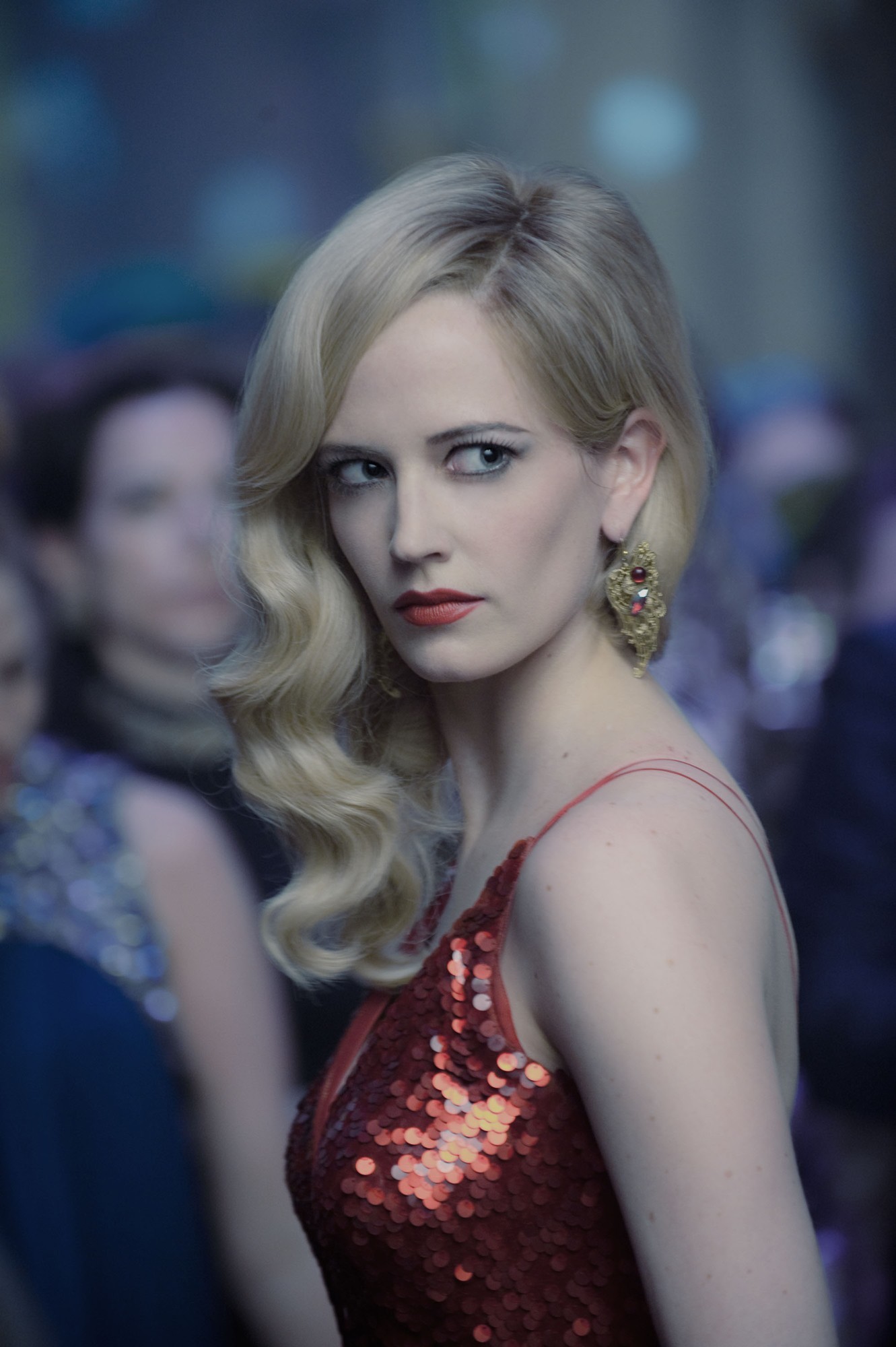
"It is said that blood is thicker than water," narrates Barnabas Collins (Depp), over the strains of Robert Colbert's alto flute-through-echoplex composition "The Secret Room" from the original series.  "It binds us, confines us, curses us."  For a moment, things are fairly serious as the 18th century story of young Collins scion Barnabas is unearthed, with his spurning of the witch Angelique Bouchard (Eva Green) and her subsequent dark revenge, killing the Collins elders, forcing the suicide of Barnabas' love Josette and turning him into an eternally cursed vampire.  She subsequently sets the townsfolk on the monster who chain him into a coffin and bury him for all eternity.

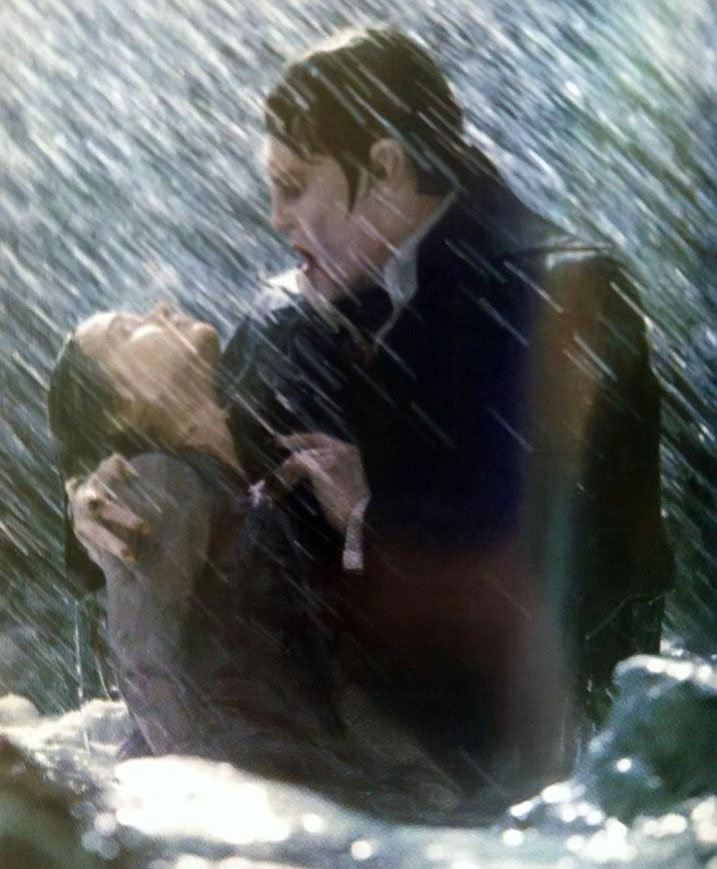
Depp and Burton get it right at the beginning: Barnabas learns his fate.
The worst-laid plans of mages and men...Eternity is cut short around 1972 as the construction of a new McDonald's in Collinswood unearths Barnabas and he lays waste to a construction crew (who must have been getting overtime working at night!) with an explanatory "You have no idea how thirsty I am!" 

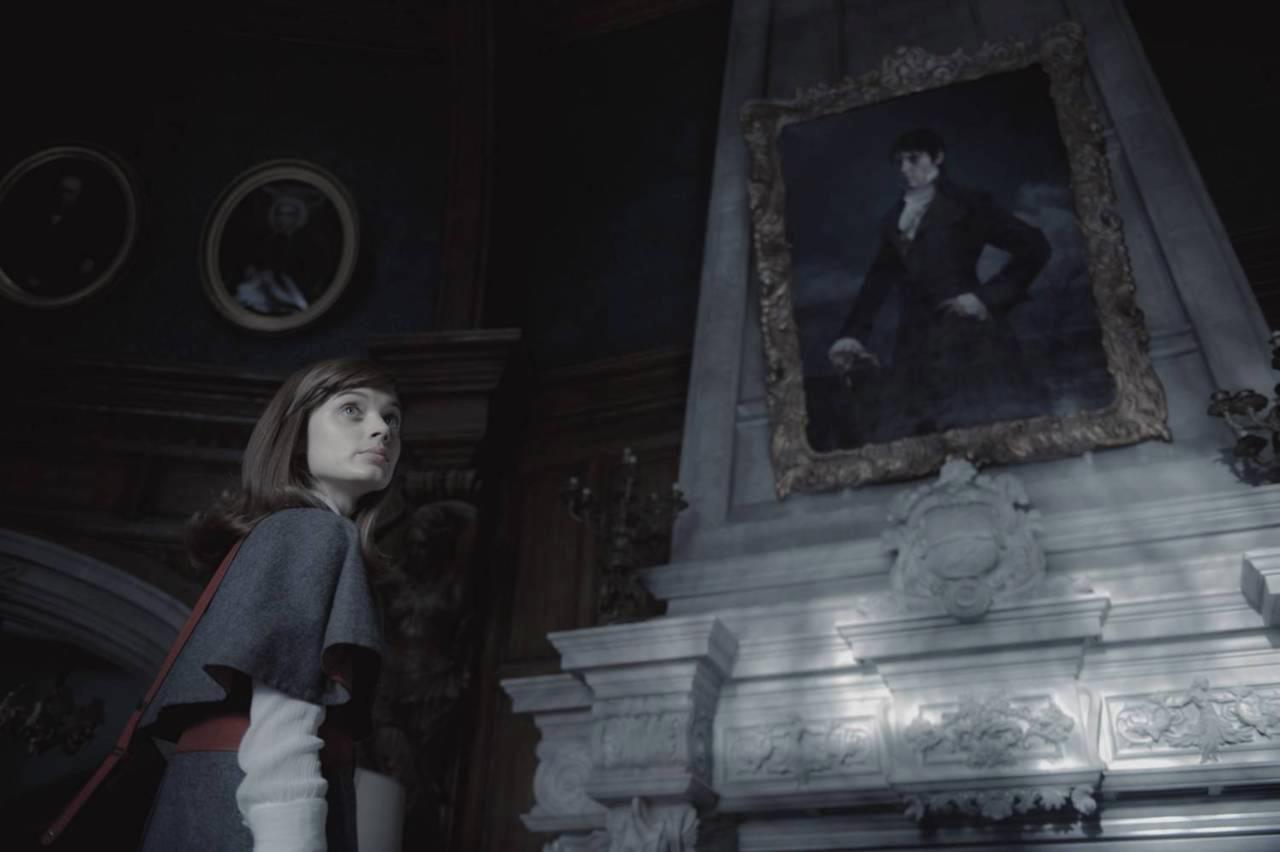
On a parallel course, Maggie Evans (Bella Heathcote, the latest in a long line of Burton ingenues with thin necks topped by big heads with huge eyes and "big" hair) is on a train to Collinswood where she has applied for a job as a governess to young David Collins (Gulliver McGrath), who is having psychological issues from the disappearance of his mother at sea.  Abruptly, she decides to change her name to Victoria Winters, indicating a past she wants to run away from, as The Moody Blues tune "Knights in White Satin" burbles over the soundtrack.  Hey, Burton may be onto something here.  The combining of '70's kitsch and some of its more mordant songs with the gothic mood of "Dark Shadows" works well, setting the tone of the series and the morbid fascination my generation had with it.  Can "Don't Fear the Reaper" be far behind?

Then, things get a little weird.  She's picked up by a VW van of hippies, and there's some stoned comedy about how they're so wasted, and Vicky is cool, man, and it's easy laughs and you wish it was more clever.  It becomes apparent quickly that Burton will be playing this for laughs, which is fine (he always does to a certain extent), but the original material is already so melodramatic and over-the-top that the humor undercuts the effectiveness of what drama there is that ekes through the dramatic stares and the vamping poses.  "Dark Shadows" was always "camp" entertainment in the broad sense, but to broaden it even further nullifies whatever chills and thrills can be drained from it.  This is why Frid's performance on the show was such an anchor for it—he played it absolutely straight, and in fact, ramrod-stiff; you didn't make fun of Barnabas for fear of his wrath—or his breaking down in tears.

Depp's Barnabas is tortured, of course, but risibly so (in a performance that's a combination of Frid's formality, some Max Schreck thrown in, and a bit of Ed Wood cast-mate Martin Landau's incarnation of Bela Lugosi).  And there's the "otherness" factor that Depp brings to so many of his roles, as if he's in a different movie from everybody else—he walks through it, and everybody reacts, usually comedically and derisively.  In part, that's the point: it ties in with Burton's feelings growing up as being an outsider-geek, looking on at the rest of the world that he found strange, while it found him odd (and there's a mirroring through-line of humor throughout the film of Barnabas, out of his time, observing to some horror the eccentricities of 1970's life, that reflects it).*

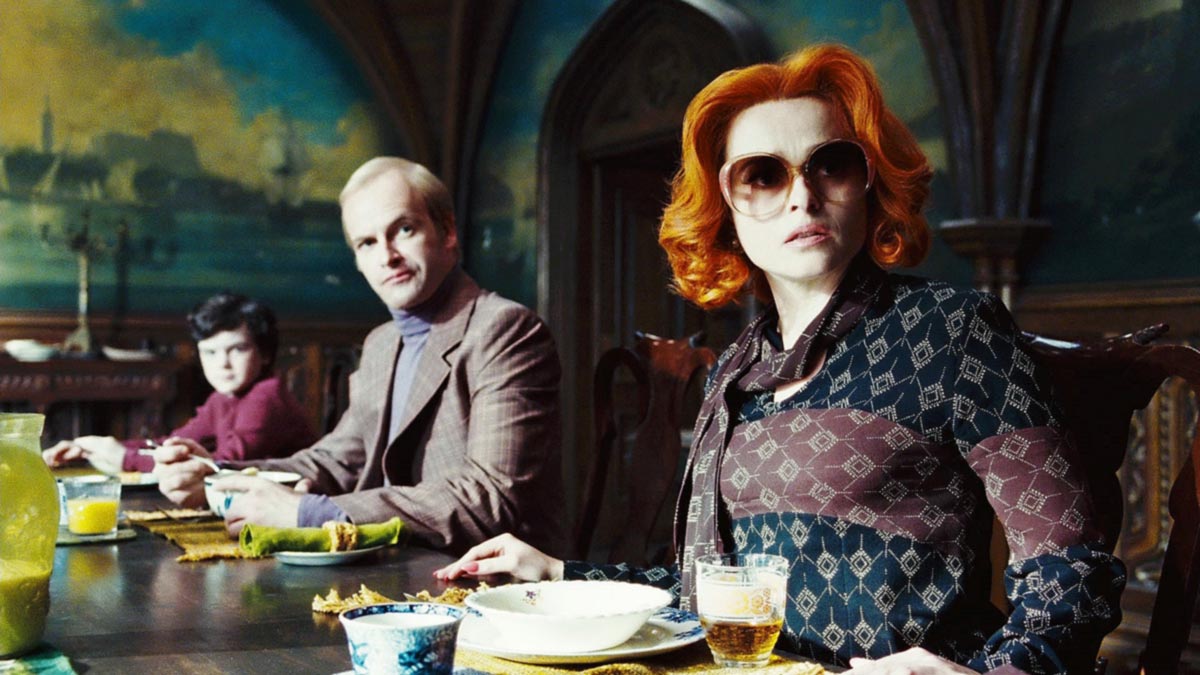
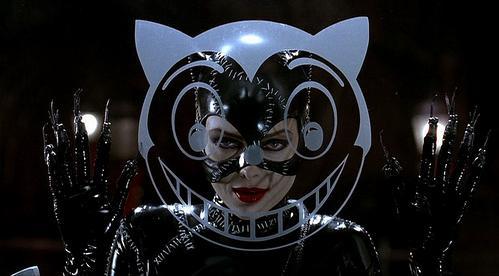
But Collinwood's odd family doesn't bat an eye when Victoria shows up and doesn't react to the disrepair of the gothic Collinwood mansion or to David's assertion that he speaks to his dead mother, and she follows quite readily when the ghost of Josette appears floating down the hallways, whispering "He's coming..."  Barnabas' arrival, in Victorian array and the palest of skin, and the oddest of manners only brings up temporary suspicions, but the matriarch of the house (Michelle Pfeiffer, who played Burton's Catwoman) readily accepts him as family, even after revealing his vampirism.  The cast is uniformly fine, gamely being archly camp throughout, but the one performer who's best at it is Green, who clearly relishes the villainess role and has fun with it, taking it in some very odd, even poignant places.

It looks great.  Burton's films always do, with a superb design sense and his knack for picking terrific, seemingly impossible angles to shoot from.  But, like a lot of Burton films, it tends to fall apart in story, snatching hasty explanations and deus ex machina to get out of trouble, or to provide the director with a bizarre concept that may seem right in retrospective sub-context, but that comes out of nowhere, randomly and jarringly.  One has to stop, back-track, only to realize that, no, this has never been mentioned before, and why now?

One suspects it's a whim, a passing "wouldn't-it-be-crazy-if" thought passed between Depp and Burton as they geek out, rocking in their corners, internal logic no longer mattering as much as a superficial entertaining notion.  As such, Dark Shadows accomplished their goals.  Yeah, it's entertaining, but highly insubstantial, a mere spirit of a movie.

Dark Shadows is a Rental.


The first Dark Shadows movie (left) and the original Barnabas Collins, Jonathan Frid


* This also sets up a series of sight-gags that are somewhat clever, as Barnabas never seems to be able to find appropriate sleeping arrangements at Collinwood.

Friday, May 27, 2011

Pirates of the Caribbean: On Stranger Tides

"Sinking to Lower Depps"
or
"PG-13? It Should Be Rated "Arrrrrrrrrrr."

I enjoyed the boisterous first Pirates of the Caribbean—who would have thought that even talented film-makers and writers could turn a ride at Disneyland into a good movie?  But, it had been awhile since there'd been a quality pirate pic, and POTC hearkened back to the giddy Saturday-matinee thrills of past sea-faring adventures, but with a nice, gritty frou-frou quality.  Yes, it was loud, and confusing, and piled on too many episodes of buckling swashes, so it was hard to separate the buccaneers from the privateers.  And it gave Johnny Depp a break-through role that saved him from the pit of despair that is Tim Burton's cob-webbed basement-rec room. 

It was just plain, simple fun.

I passed on the second and third films because I figured they'd run the formula for movie trilogies: the second one turns dark and complicated without the fresh feeling of the first, leaving cliff-hangers that could grow barnacles on any writer's knuckles; then the third complicates things more, and resolves everything quickly and rushes to a well-deserved finale where everything (*sigh*) turns out alright.

I gave them not so much as a hailing shot across my bow.  I'd sailed on.

But, I thought I'd give Pirates of the Caribbean: On Stranger Tides a chance.  For one thing, having resolved the Keira Knightley/Orlando Bloom romance (again), they're no longer present on this passage and the additions of Penélope Cruz and Ian McShane was an inducement.  Plus, the director is Rob Marshall and I wanted to see how he did with a project of a lesser pedigree than his previous work.  I liked Chicago, and parts of Memoirs of a Geisha.  But I thought Nine was an unmitigated disaster, occasionally brightened by performance (I was surprised to find numbers by Fergie and Kate Hudson the highlights).  Marshall needs a hit, and On Stranger Tides is just the ticket—an established franchise ($2.6 Billion in revenues?) with a built-in audience that doesn't care who directed it—all they care about is Depp's tipsy Keith Richards imitation and running like a girl from trouble.

Those sunken souls will be pleased; Depp does that schtick but with that silent-comedian's crack razor-sharp timing in the reactions.  It plays like It's a Mad, Mad, Mad, Mad World with three groups of sailors all after one thing: Ponce de León's fabled Fountain of Youth (it seems, all of a sudden, Spain, England and the Pirates are interested in the same thing).  After a brief sequence where Sparrow frees a member of his crew, he is arrested and brought before King George II (Richard Griffiths—when he sits there is a big musical fwump from Hans Zimmer's "Mickey-Mousing" score).  It seems that Spain's interest in the FOY has reached the King and he hires Captain Hector Barbossa (Geoffrey Rush, or most of him anyway) to lead the expedition.  Jack escapes...and then things get complicated.

In the meantime, there are McShane and Cruz, as the pirate Blackbeard and his daughter, Angelica, mermaids, a Jack Sparrow imposter, silver chalices to find, and the series' obligatory focus on the supernatural (while also having a missionary hero, despite all the disparagements of religion in the script).  Blackbeard knows his voodoo, has a "zombified" crew, a magic cutlass, and a fine collection of ships-in-bottles.  Plus, his vessel "Queen Anne's Revenge" has a few nifty tricks that other pirate ships do not.  McShane is terrific, playing the comedy for truth ("If I don't kill a man now and then, they forget who I am"—a line similar to one from The Princess Bride—is played absolutely straight and with a baleful disinterest that never leaves his face.  Cruz is fine, but it appears she's just along for the ride—as duplicitous as her character is, she doesn't register much range, or fire...as she can. 

Marshall keeps things moving, editing things a bit too quickly for continuity to rush the dialogue, eliminating any pauses, and he does a few cute things with the 3-D imaging, beyond the snakes and pointy swords and rolling barrels, moving his cameras over the heads of a court-room, giving a sailing shot of the sea actual depth, and making the split-screen Jaws water's edge shot work well.  And although he isn't that good framing the fights, which jerk along with the breezy calculation—and lack of zest—of a Roger Moore fight from a James Bond film,* and there really isn't much of an ending—although there are three of them—it's pretty sprightly, the highlight being an encounter with mermaids—portrayed as supermodels with the manners of piranhas**—that is genuinely exciting.  There are even a couple of charming, if brief, surprises along the way. 

There is another quality issue, though.  On Stranger Tides, shot in 3-D, has an opening that is pretty murky once you put on the dark glasses, the same kind of clarity issues you get at drive-in's when they would start a movie at dusk.  Even in 3-D and IMAX (which is how I saw it—I was splurging), it's a little difficult to determine precisely what is going on.  It's something of a toss-up just how one should see the latest Pirates of the Caribbeans. It might be worth it to see it in three dimensions, but I'd do it at home.

Pirates of the Caribbean: On Stranger Tides makes a fine Rental.


* Every once in awhile, sitting through this, I got the odd "formulaic" bustling feeling I get from the Bond films and the Indiana Jones movies (Zimmer's "Pirates of the Caribbean" dance-step has to accompany every bit of derring-do, like the "Indiana Jones Theme"), where the dialog is just not clever enough, but "it'll get by," if you don't mind a bit of eye-rolling (it does, after all, relieve some of the eye-strain produced by those glasses), and the action set-pieces just go on and on.  And one can set their watch by when action is timed in this thing.

** ...or is that redundant?


Tuesday, March 8, 2011

Rango

"A Fistful of Pixels"
or
"Draw!...The Gun, Not the Computer!!"

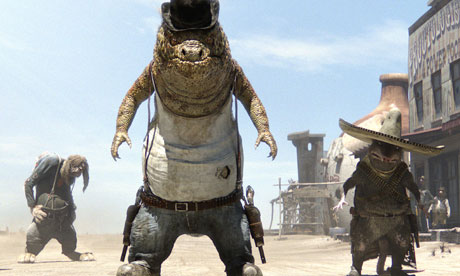
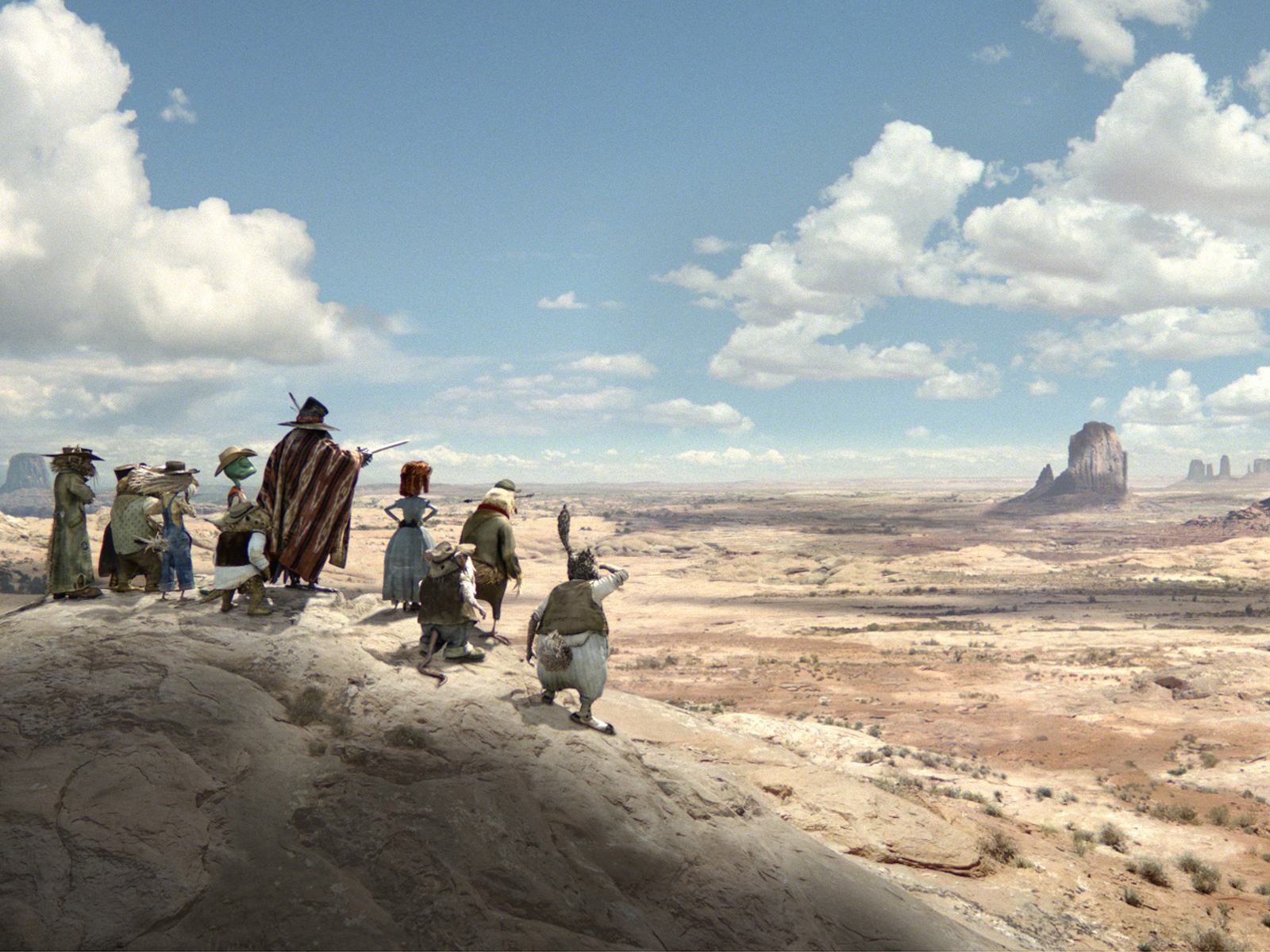
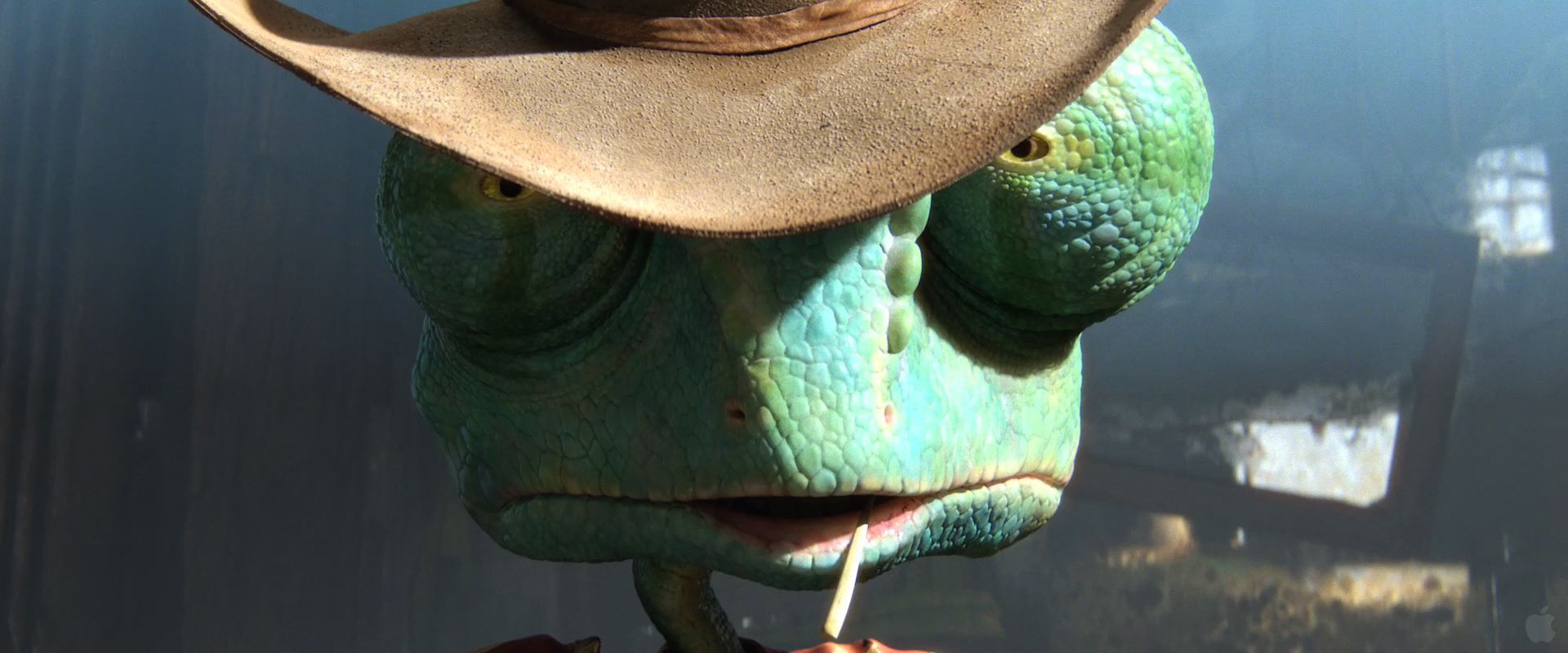
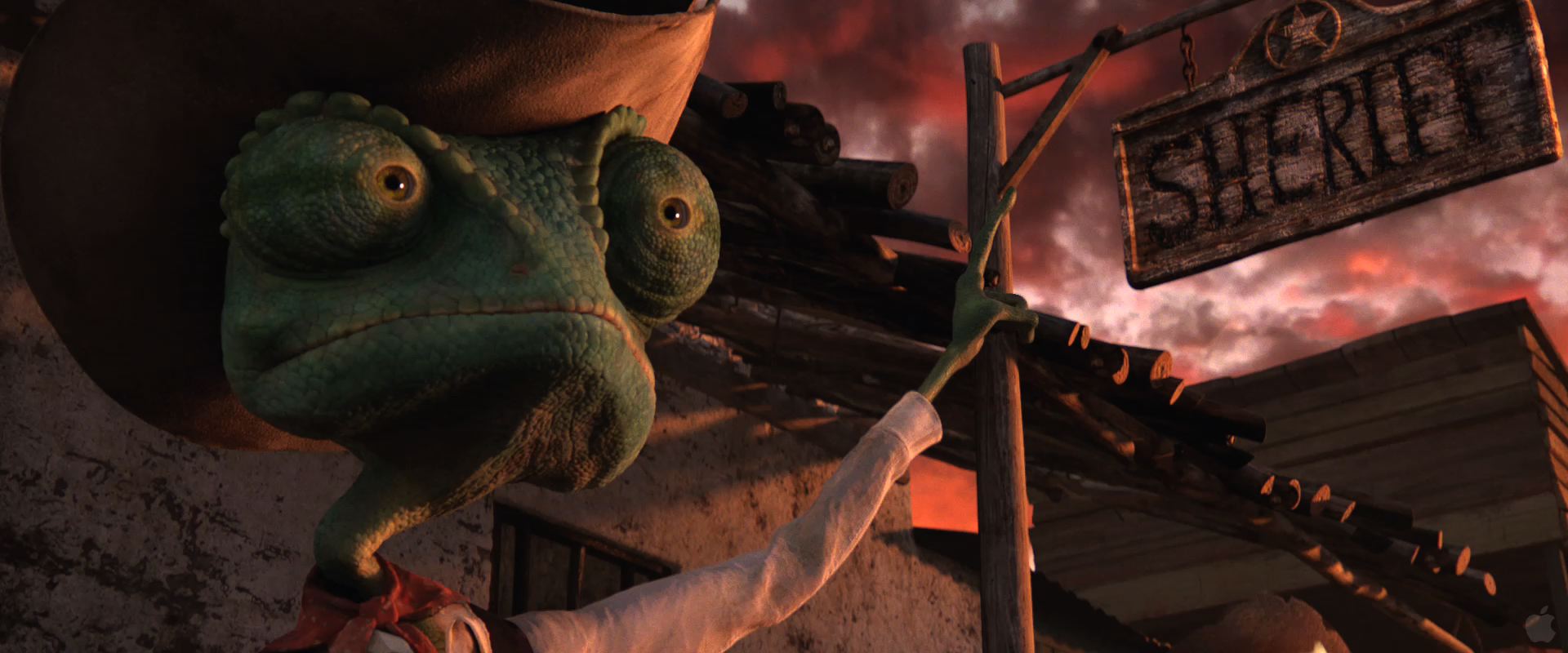
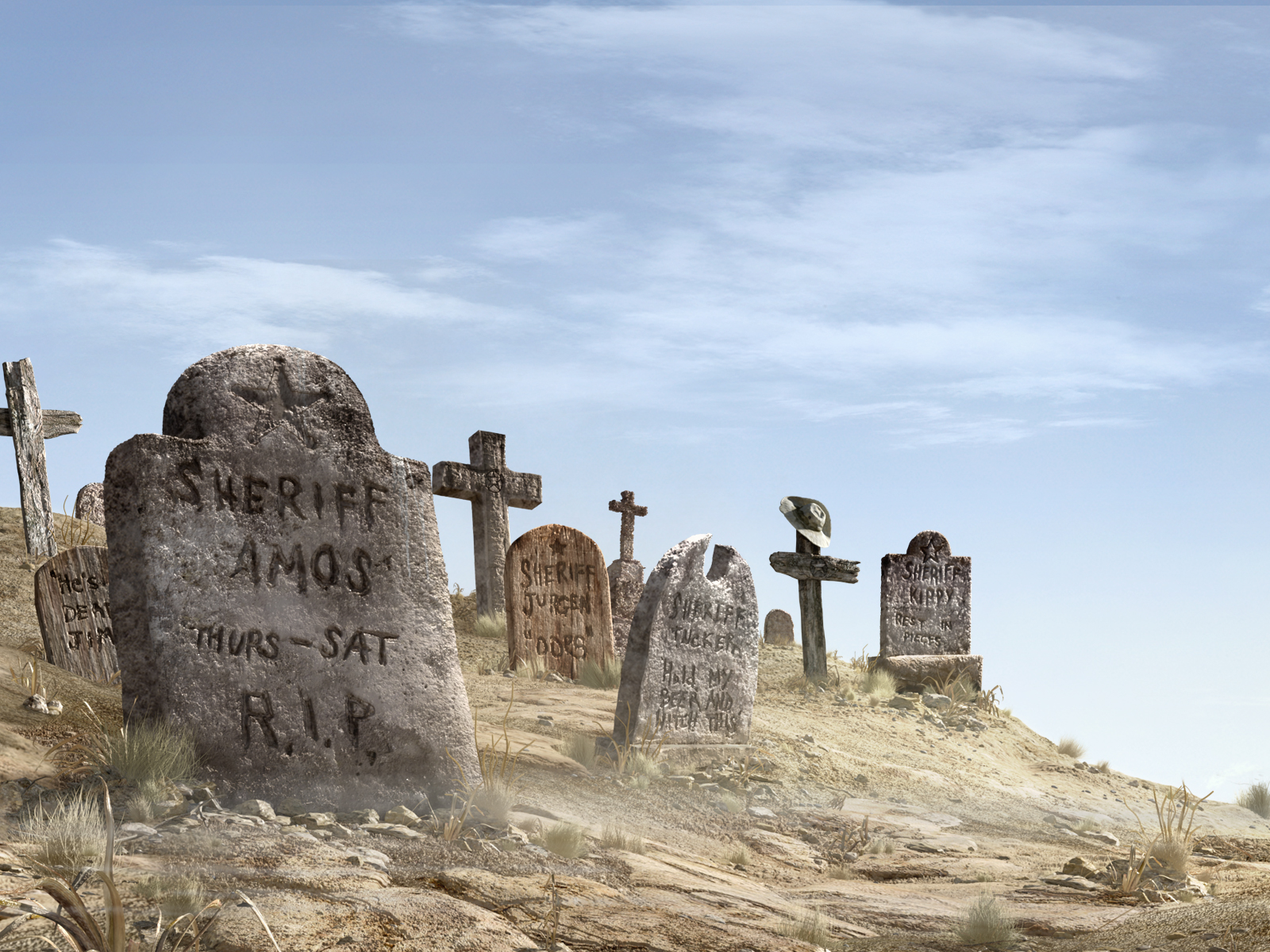
Rango is an amusing hybrid of animated feature and a rather encyclopedic mish-mash of stylized western themes, set in an animal kingdom that could only be imagined in a Ralph Steadman fever-dream.  Directed by Gore Verbinski (who manages to make interesting movies from least likely sources, like The Pirates of the  Caribbean*), it boasts a unique look, visually consulted by ace cinematographer Roger Deakins, while being the premiere animated feature to come out of George Lucas' FX house Industrial Light and Magic.

With such a background, the film should be technically interesting, and it is that, rich in detail and texture with a visual look unlike anything previously seen in computer animation.  Everything looks real and like it should exist in a real world, even though the physics of things could never, ever work.  It's a pixelated bizarro-world of funny animals just over the dunes from a mad civilization, a nightmare-world from inches off the ground.

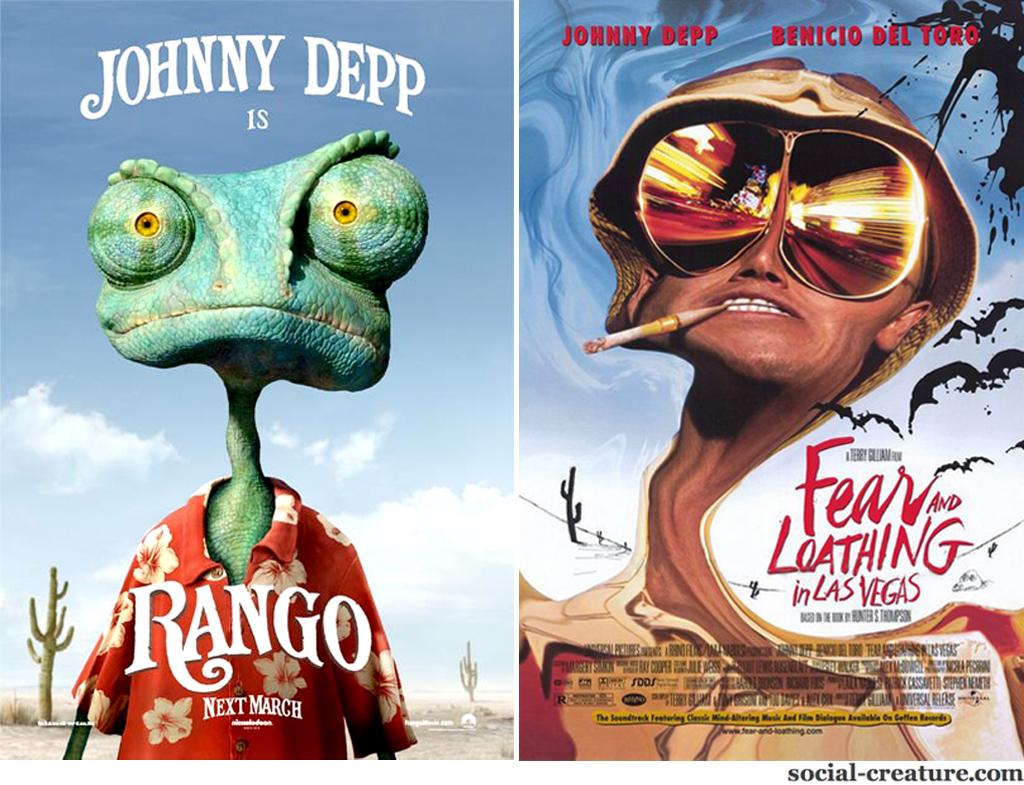
While on a cross-country trip, a small highway accident causes a major disaster for a family's pet chameleon (with neatly quick-silver voice work by Johnny Depp)—an apt choice as he must change his persona often at times in the story—who finds himself stranded in the crushing heat of the desert, where his life of comfort leaves him ill-prepared for survival.  Fortunately, he is befriended by a crusty armadillo (voiced by Alfred Molina), who seconds after meeting the lizard is run over by a truck and he's left lying prone on the asphalt with the impression of a Michelin bisecting his stomach...and he enjoins Lars (er, Rango...whatever) to go on a vision quest to face his destiny.  Immediately, you know that this one is going to be a little different...not only for the kiddies, but also for producing partner Nickelodeon, which usually plays it a little safer and a little younger for its audiences.

It's something different, but also extremely familiar.  I've had to gut-check this review because Rango is so stuffed to the shaded-texture sweat-band with movie references that I had to make sure geek-love didn't color my perceptions.  Culled (one hesitates to say "written") by John Logan,** the story does so much reference-rustling that it feels like a pop-culture scavenger hunt—The Shakiest Gun in the West (and thus, Bob Hope's "Paleface" movies), High Noon, Shane, the Sergio Leone "spaghetti westerns," "Looney Tunes" cartoons, and a large back-wash of Chinatown.  More like a tsunami, that last one, as the Mayor of the desert town of "Dirt" (clever) is a an ancient tortoise that looks, dresses, and speaks (sometimes verbatim, in the voice of Ned Beatty) like John Huston's Noah Cross from the latter.

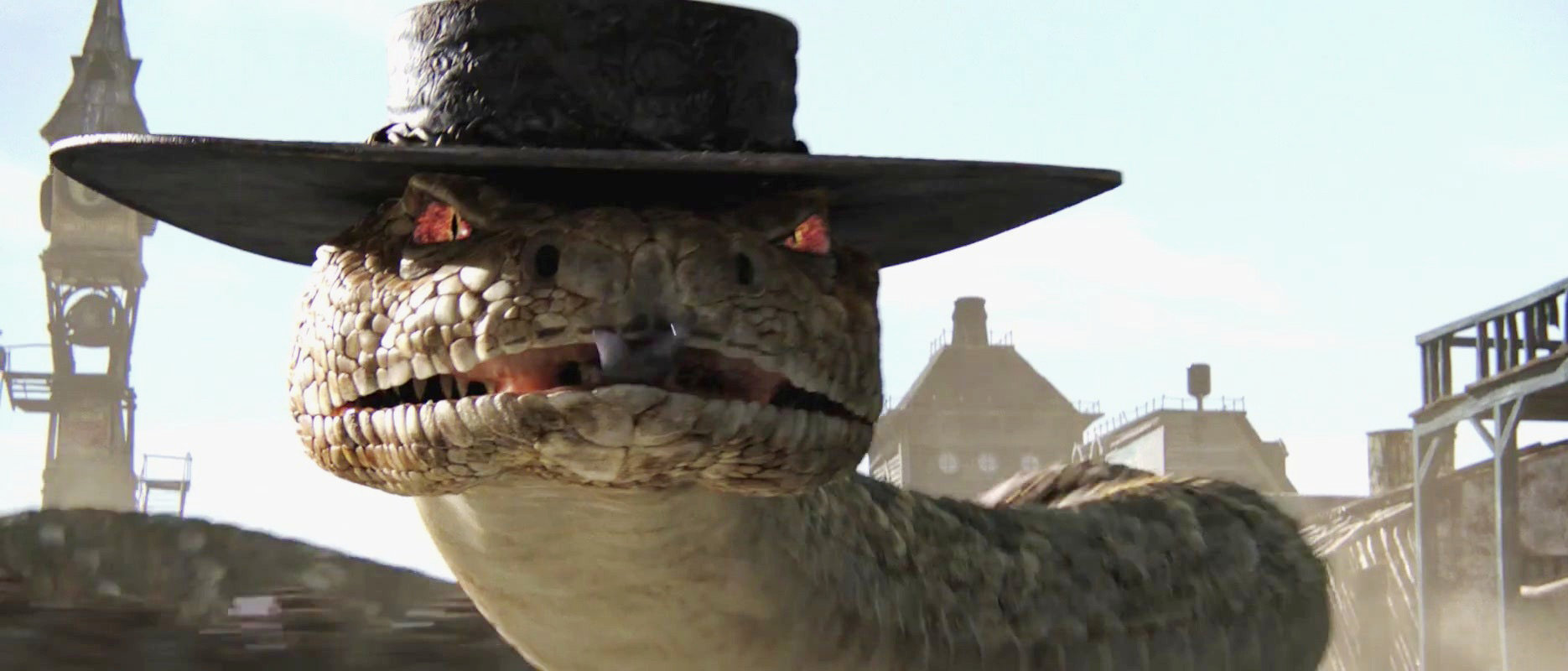
When the chameleon drags into town, the Mayor sees an opportunity to put a patsy into the vacant Sheriff's job (there is evidently a quick turn-around in the job), which also makes the movie resemble Mr. Smith Goes to Washington, thus keeping his claws in charge of the town's water supply, or lack of it.  Whatever his effectiveness in the job, one way or another "Rango" is going to be "over his head" in Dirt unless he stops concentrating on "blending in" and changes in ways more than appearance.  Along the way, he is threatened by bad-guys and helped by unlikely allies in a free-wheeling roller-coaster with enough hi-jinks for the kids and enough "inside jokiness" for adults, *** done at a speed that Verbinski can't achieve in live-action films (but aspires to).  This might give parents in the theater a little too much work to do, explaining things (like water-rights) while trying to deaden the "sugar-rush" the pace will give their kids.  And some of the images can be a little scary for the little ones, like big snakes (modeled after Jack Palance and Lee Van Cleef) voiced by Bill Nighy (shudder).

But, it is smart, clever and different, with good performances and that extra attention to detail that shows off the best of the art-form.

Rango is a Full-Price Ticket.


* My God, I'd forgotten that he directed Mousehunt, a film I got slapstick-happy chuckles over, but that I know annoys a LOT of people.  There are times when I see a bit of Mousehunt in Rango. 

** Maybe I'm being a little harsh there.  I liked this script by Logan and is the first of his that doesn't feel half-baked, and gives me hope that the guy might be able to bring substantial to the next Bond film, despite having replaced the more promising Peter Morgan.

*** For instance, as "Rango" is bounced around, caroming off the windshields of desert-highway traffic, he alights on one particularly relevant vehicle, and his meeting with an unnamed "Spirit of the West" (voiced so well by Timothy Olyphant  that I thought the real guy had come out of his announced retirement to do it—but he's keeping true to his word with his myth-busting coda performance.  Disciplined.)

Wednesday, December 15, 2010

The Tourist

"Tourist Class"
or
"Just the Thing I Need...How Nice"

In between "Pink Panther" movies and his other comedies, director Blake Edwards used to make elegant truffles of movies with big stars, great locations, and high production values.  But whatever the veneer of stylishness they showcased, there was always a kernel of truth to what he did.  Edwards understood that even though the wrapping may be exquisite, the present it surrounded should be pretty special too.

So, I guess what I'm saying is The Tourist is a pretty lousy Christmas present.

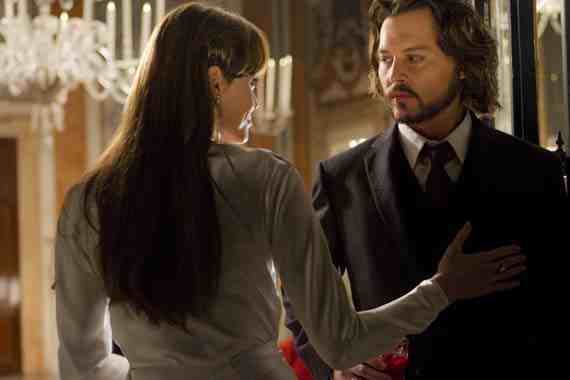
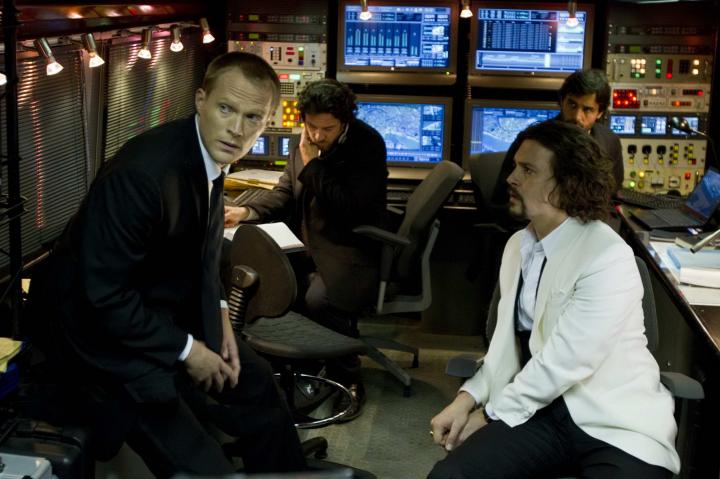
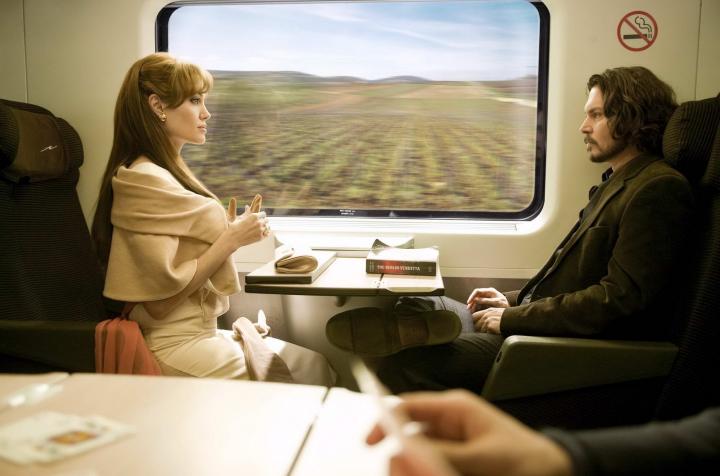
Oh, it looks spectacular, jetting (training and gondoling, actually) from Paris to Venice, all chi-chi and ritzy, but it falls flat as a caper, a romp, or even a good time.*  Hell, it even falls flat in the half-hour review of its particulars with so many plot-holes and needless complications that, given the film's resolution, it makes little sense.  Oh, you can see how it might work...but if it is what they say it is, then why....???  (Oh, don't ask why, oh, don't ask why....)

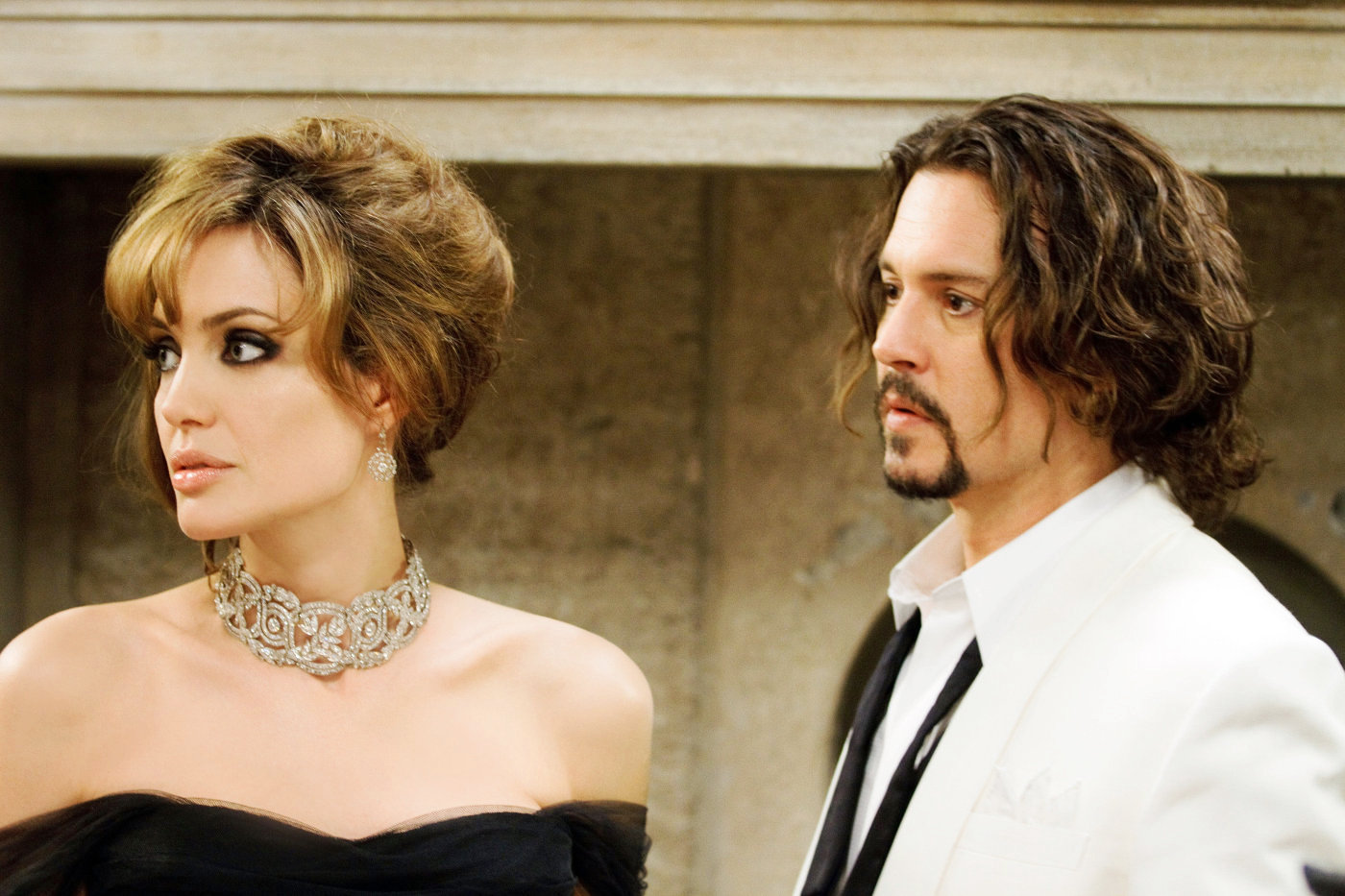
And when you start doing that analysis, you know that the thing hasn't really been thought through...they were just making it up as they were going along and hoping nobody would notice that the film only makes sense five minutes at a time.  You're supposed to be distracted by the gorgeous decors, the elegant suits (and suites), Angelina Jolie's wardrobe (and how she fits in it**), and Johnny Depp's clowning*** to actually figure out that the movie is a shell-game, and a shell of a movie, as hollow as a chocolate bunny on Easter, and with as much nutritional value beyond being sugary.

Hard to believe, then, that the director—and co-scriptwriter, along with Christopher McQuarrie (The Usual Suspects, Valkyrie) and Julian Fellowes (Gosford Park, The Young Victoria)—is Florian Henckel von Donnersmarck, whose last film was the extraordinary Best Foreign Film Oscar winner The LIves of Others.  That was a complex morality-play that moved across the demolition of the Berlin Wall, of how hunter and hunted can come to a mutual respect.  But this can't even get its internal logic right.  Even a finely-crafted Mercedes can fall apart if you don't throw some oil in it.


Add to the script problems the lack of any frisson between Jolie and Depp, both of their characters going through the motions acting as cool as cucumbers (him, comically; her, glacially).  He tries to throw some bits of business around, but they're fairly subtle (and inconsistent)—like his language malapropisms (which will fly over most Americans' heads) and a tipsy act—that they get lost in the shuffle.  Jolie has a tougher problem; she has to fight herself and her image.  This is the second feature (after Salt) where Jolie is tasked with a poorly written role that requires no acting challenge, so much as present herself in an iconic way.  In other words, she has reached the point in her career where she no longer has to be good, as she does to look good.  This is a movie in Liz Taylor mode, Audrey Hepburn-style, the queen bee with drones hovering to do her bidding. But, she receives no help at all, not from the script, not from the cast (which includes Paul Bettany, Timothy Dalton, and Steven Berkoff—the latter two impressive, as always), the director lighting her well and showing her at her best.  She is set apart—the only woman in the cast; she might be able to carry the box-office, but she can't carry the movie, poor as it is, and as enticing as it might look.  She is a fine actress, as her awards-gathering early in her career demonstrated.  But a few more of these vehicles and she may have to de-glam her career—as Charlize Theron (who left this project) did. 

They should have called it "The Tourist Trap," instead. 

The Tourist is a Cable-Watcher. 

* I'm sure it wasn't the movie, but I started to develop chest pains during it, and I began to think that all this sumptuousness was starting to clog my arteries, maybe I was just distressed, so, I shut my eyes...oh, for about 20 minutes...just listening to the soundtrack, and when I opened them again...gosh, I hadn't missed anything.

** In one sequence, French police are tracking Jolie's Elise Ward with cameras as she glides down a Paris street.  Two of the officers zoom in to see if they can see a pantie line, and their superior admonishes them "Be more professional, guys."  And as if to show just how professional the filmmakers are, director Von Donnersmarck cuts to a tight shot of Jolie's ass.  No VPL.  They may have been going for self-deprecation there, but, actually, I think, they nailed the problem.  "Be more professional, guys."

*** Okay, I am now calling "b.s." on Depp's maintaining an artist's pose.  This and the "Pirates" sequels point to a man picking up a paycheck.  I used to have a lot of respect for him...but now...(According to IMDB, Tom Cruise was supposed to play the part—he and Jolie have been circling each other for awhile, as he was supposed to, play Salt—then Sam Worthington, who left over "creative differences")

Friday, April 23, 2010

Benny and Joon

"Benny and Joon" (Jeremiah S. Chechik, 1993) When examining the career of Johnny Depp, one looks to the blockbusters: the "Pirates" movies, the many Tim Burton collaborations. But then there are the films that fall through the cracks—not unlike the characters in this film. For anyone doubting Depp's ability to not depend on his looks and create a compelling character, "Benny and Joon" is a revelation.

Filmed in
Spokane, Washinton, it tells the story of of an auto mechanic, the eponymous Benny (Aidan Quinn) taking care of his 1/3 eponymous but schizophrenic sister, Juniper (Mary Stuart Masterson). He's torn between his commitment to Joon and his desire to live a life, free of her responsibility. But, his sense of duty and brotherly protectiveness trap him into doing nothing else, even though he might be inadequate at the care-taking task.

By luck of the draw,
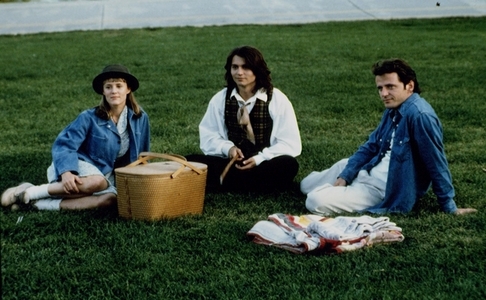
Sam (Depp) drops into their lives...literally; Joon wins him in a poker game. That plot development prat-falls "Benny and Joon" directly into "twee-ville," but Sam's addition to the cast arrives just in time to avoid it. Sam is a movie-freak, who knows every movie—the weirder the better—and models himself as the love-child of Buster Keaton and The Little Tramp. Eccentric, scruffy, but in a non-threatening way, Depp's head-tilting performance is just the right fizz to put in this Shirley Temple of a movie. You wonder what he's going to do next, and Depp is given enough ground to deliver a number of mute routines that are laugh-out-loud charming.

But, there are more joys to be had with guest-turns by
Julianne Moore, William H. Macy, CCH Pounder, Oliver Platt, and Dan Hedaya—the kind of movie where your attention is slapped every few minutes with a "They're in this?" It might get a little heavy for kids in the third act—"everybody's MAD at each other!"—but there's a satisfying resolve. And if you have a sister or daughter not in love with Johnny Depp yet, this one will do it.

"Benny and Joon" is a Chick-Flick that guys can enjoy.

Wednesday, March 10, 2010

Alice in Wonderland (2010)

"Beautiful Soup"

Hesitant, I am, these days. Hesitant, I says.

After rushing
the review for "Shutter Island" and dismissing it as "minor Scorsese," I found it had stuck like a bur in my hair and remained in my thoughts and my brain for a longish time. I went back and changed my rating—it's a "Matinee" now—but not the review, because my complaints are the same. But it's really good "Scorsese" and slots right into the body of his work, despite being unique in its qualities and unlike anything he's done before.

But, I can't tell you why. Curiously, this doesn't stop me from going on and on about it, because it's so rich, and after an essential second viewing, you realize what a dance it is with story-logic and the use of image to show you—and NOT show you—what's going on. It's a trip, and a breathless display of what a master of cinema can do with the form.

Which is why
Martin Scorsese should have directed "Alice in Wonderland" in 3-D. Sure, your kid's head would explode. But it'd be a great movie!

I've been looking forward to
Tim Burton's take on Lewis Carroll. Seems like a match made in anyplace but Heaven. Burton's lapses in story-logic and not playing by the rules in past movies make him the perfect Carroll adapter; he's the "just go with it" director, as he frog-jumps from set-piece to set-piece. If you have to ask questions, you're going to slow the tour-bus down. And his arrested art-student sensibility is so dark that it keeps Alice exactly where it should be—underground with the muck and the weevils and the roots tearing at your extremities.

So it's a MAJOR disappointment that
Disney's "Alice in Wonderland in 3-D" (A Film by Tim Burton) is such a wisp of a movie and—dare I say it—conventional, that it misses the mark of being a great movie (and a good representation of Lewis Carroll) by a hedgehog-croquet slice.*

Here's the problem. The "
Alice" stories are stuff-and-nonsense. Charming stuff-and-nonsense that can make little girls giggle and college professors scratch their heads. Buried deep in its purple marrow is the satire of the vagaries of Society, not of adults, necessarily, but of Society—of class distinctions and petty politics—the Games People Play (when they're not playing games).

It shouldn't make sense. It is full of new words and language that fire the synapses of minds, like when Mommy talks about something called pilates, or you have to find out why you can't steal a base before the pitcher throws. It's all bright and shiny and new and simply incomprehensible, and Carroll is just as fantastical for trussed-up adults as it is for children. The glory of it is children have the upper-hand in connecting with it—they don't have so far to fall down the rabbit-hole.

And Burton (and his screenwriter
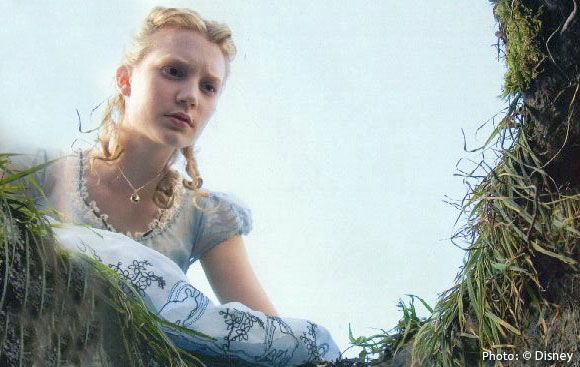
Linda Woolverton, who's worked on several Disney animations) know this to a point. When we first meet 19-year old Alice Kingsleigh (Mia Wasikowska, looking dark-eyed and sallow—a perfect Burton heroine), she has been invited to an engagement party—hers.** It's a surprise, but it's not, and it is not going well for the hostess, Lady Ascot (Geraldine James) the mother of the groom-to-be, as everything is not...perfect. And Alice has this annoying habit, besides being late, of being...unconventional...and distracted by anything. Alice likes to see the Nature of things. The party made by adults just uses Nature as a tightly-controlled back-drop. At the moment the question is popped, Alice excuses herself to the party (as they're all watching, and it's for their benefit more than hers) saying that she "needs a moment." (Did they "need moments" in the 19th?)

This is pretext to Alice wandering off from the party,
in her moment of highest risk of being cosseted, to follow a white rabbit and once more stumble down a rabbit-hole, returning to "Wonderland."***

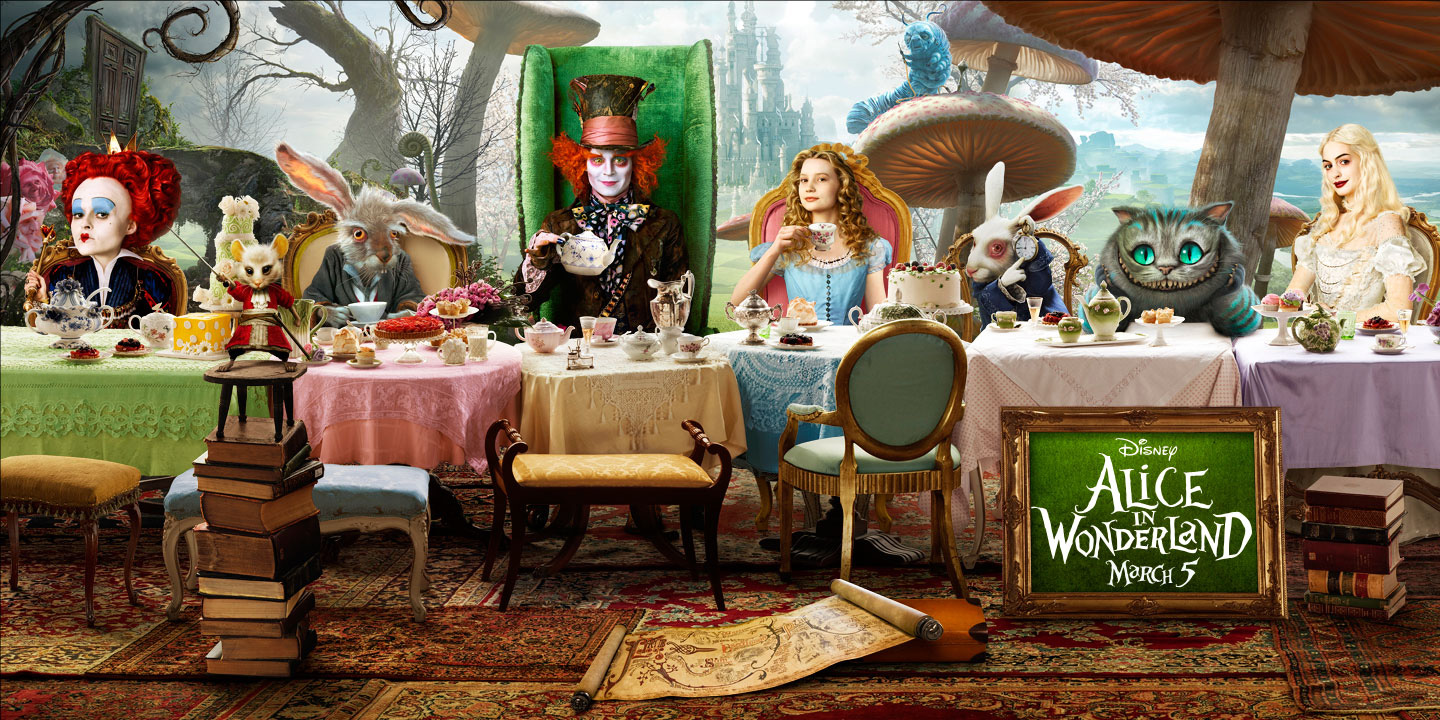
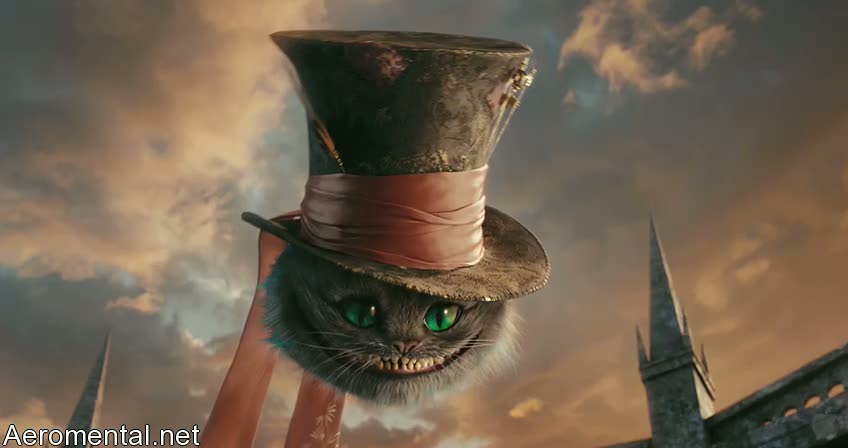
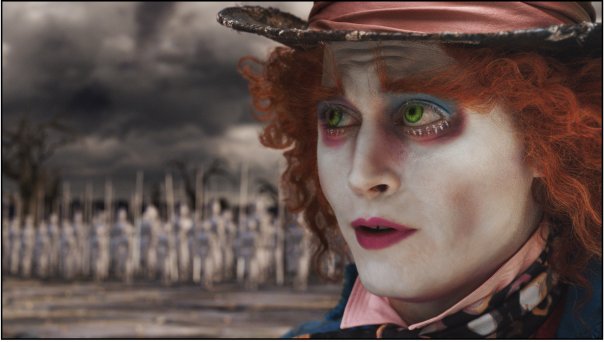
It's here, as you'd guess, that the movie takes off. The colors more vibrant, the effects-work (by four FX houses but primarily Sony) magical, even the 3-D has more depth. The characters adhere to a mixture of Burton and first edition illustrator John Tenniel, and more in that direction than the way the Disney animators drew the characters for their 1951 adaptation. The film is nicely cast with Burton's usual suspects (Johnny Depp—top-lined as The Mad Hatter, Helena Bonham Cartersimply delicious as The Red Queen, the voices of Alan Rickmanthe caterpiller, Timothy SpallBayard the hound, Christopher Lee—as the Jabberwock, Paul Whitehouse—as The March Hare, and Michael Gough—as the Dodo) New to Burton are Stephen Fry as the Cheshire Cat, Michael Sheen as the White Rabbit, Matt Lucas as Tweedles Dum and Dee, but most impressively, Crispin Glover as the evil knave Stayne, and Anne Hathaway as the White Queen. One wonders why Glover has never been in a Burton movie before—maybe Burton thought he was uncontrollable?—but he brings a hissing nastiness to what could have been a typical bad-guy role, and that Burton sets him up against Depp's Hatter is one of those movie match-up's you love to see. And Anne Hathaway proves once again that she's not afraid to explore her dark-side. Her creepy "Liza-Minelli-in-a-straight-jacket" White Queen evokes Burton's long-time exotic paramour Lisa Marie.

Quite the ingredients for a film,
and with Burton doing the stirring, one salivates at the possibilities. There are lots of laughs, moments of exquisite beauty—wispy seeds occasionally enter the frame and at one point, we park in front of a dew-drop hanging underneath a mushroom (Robert Zemeckis would have shoved us through it)—the whole movie is filled with beautiful images and nice ideas to keep you in your seat. But, it has no staying power, and it might be because this "Alice in Wonderland" has the parts, but not the non-sensical sinnew that has made "Alice" a classic.

Wolverton and Burton take the essential pieces and make a typical action-adventure story-line out of it. There is some half-sized satire about political squabbling, but mostly it's a cut-and-paste job, based on "
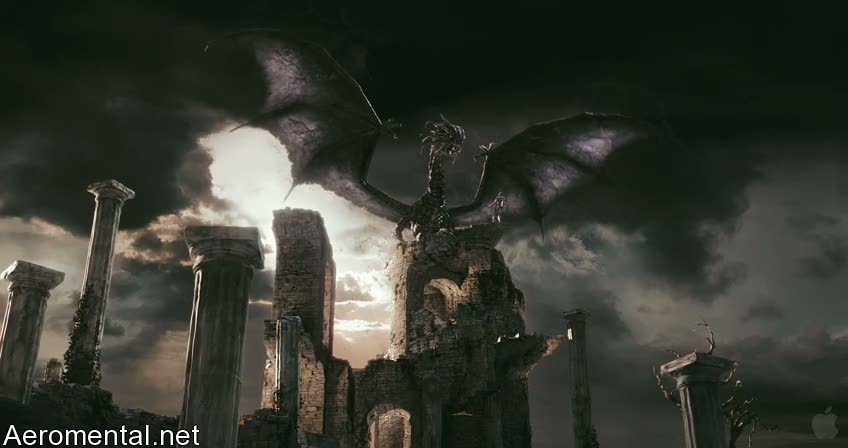
The Jabberwock Poem." That classic piece of nonsense turns into a fable "that will make everything alright." And it involves one of the characters defeating the Jabberwock in battle with "the vorpal sword" to invoke "the frabjous day" and blah, blah, blah. It's a silly poem, people, not a video-game scenario. By the time we get to the climax, there's a "Lord of the Rings" dark-sky battle between the characters, and we could just as well be in "Narnia" for all it matters. And it has an after-school special message to it, that is nice and all, but is a bit like cherry-flavored medicine.****

This is a lot of talk for a movie I'm only luke-warm about, but the bottom-line is, it's fun while it lasts, but it's like eating cotton candy in the rain. So, yeah, take the kids, it's imaginatively done (when it is), and they'll love it. But don't be surprised if they get sullen and whiny an hour after. Rich it may be, but it's mostly empty calories.
Disney's "Alice in Wonderland" in 3-D is a Matinee, but for the details.*****


* Here's the rub: "Alice in Wonderland" dropped out of my head very fast. One trip to the hardware store and *POOF!* it was gone like a puff of hookah-smoke (or was that diesel?). Now, I waited to write this, fearing another "Shutter Island" mis-take, and I found the movie shrinking away—shrinking, shrinking, shrinking, waiting for a cake to say "Eat me" to bring it back to size. Never showed up.

** There's a subtle joke there, as it's mentioned that the party has been in the works for twenty years...but Alice is only 19!

*** Woolverton and Burton add a nice touch that Alice is constantly questioned whether she's the "real" Alice—the Alice that showed up in "Underland" when she was six. She's grown up and the residents hardly recognize her as the strange child who changed the name of the place to "Wonderland." The original story's name was "Alice's Adventure Under Ground."

**** SPOILERS AHEAD: To show you how cookie-cutter this "Alice" is, somebody gets captured and has to be rescued, there's a last-minute save from an unexpected source, a character must claim an essential ingredient by facing danger, and a foe becomes an ally. Oh! And one character's actions provides the method for their eventual freedom. And there's no place like home. I may be a little harsh here, but "Pan's Labyrinth" showed that you could do something different with this sort of myth-weaving and still make a compelling movie.

***** See it in 3-D? I dunno. It will probably be brighter in 2-D, but betray the flatness of the images, and Burton has the same problem as James Cameron of bringing non-essential things on the frame-edge, like ferns and such, too close to prevent double-images. Zemeckis, Dreamworks and the Pixar folks are the champions of 3-D so far.