Showing posts with label Julianne Moore. Show all posts

Friday, October 25, 2013

Carrie (2013)

To Carrie Out the Lord's Vengeance
or 
"Mama, Don't Ruin it!"

I've been working on a review of Brian De Palma's latest film Passion the last couple of weeks (still working out how I feel about it—on a superficial enjoyment level it doesn't succeed very well, but if you appreciate craft and detail there is a lot to digest, and it makes you realize that a lot of older directors go through that shift where the details are more important than the Big Picture) and was watching an interview with De Palma* about the film (which I'll include again when I get around to finishing it) and at one point the subject of Kimberly Pierce making a new version of Carrie was broached.  

"We're friends", he said of Pierce, who made Boys Don't Cry and Stop-Loss. "I've seen some stuff and it looks good."  But the more telling comment from the talk is when someone brings up Piper Laurie (who played mother Margaret White in his version) and De Palma remarks: "Piper thought we were making a comedy."

As well she might have.  Stephen King's "Carrie" is a hoot to read (you can do so—textually—here), but it isn't if you take it too seriously.  Which is odd. King cackles and galumphs through his writing, something he also did when he took to acting and directing his films.  Which is why the best King adaptations have a surreal sense of giddy humor about them—they have to be a little over-the-edge, dangling their feet in the muddy waters of madness to be really, really good.  It's why George Romero made good King adaptations. And Kubrick (despite King's protestations).  And Carpenter.  And Reiner.  And De Palma.  But, if you get all solemn and reverential about them, they fall flat as pancakes.


Pierce gets precipitously close to that edge, but doesn't tumble over it.  She includes a couple of things that De Palma, and the screenwriter of both versions—and the musical version—Lawrence D. Cohen, left out of King's book, which are the opening scene of Carrie's birth (the harrowing circumstances alluded to in the first chapter) and a sub-plot involving Sue Snell.  Quite a few things are better—the kids...look like kids, not twenty-somethings from television sit-com's posing as teens.  The good of that is that the performances are more awkward and more vulnerable.  The downside is that they are all dewy lumps that don't have a lot of distinctiveness to them, so one is caught for a second wondering "which one is this, again?"  I mock the ages of the older Carrie cast-members, but they had the experience and chops (from those sit-coms, presumably) to make their characters known as soon as they entered a shot.  The 2013 kids are...awkward...looking like they're ready for a direction-cue in the middle of a take.  For example, as pretty and competent as Gabriella Wilde is (she plays this version's Sue Snell, the "remorseful" girl played first by Amy Irving), most of the time she's blandly waiting for her next line with a concerned furrow and not much else behind it.


One essential thing (given the times, making this Carrie somewhat relevant) is the inclusion of the evil genie of new media into the mix.  Every kid here has a cell-phone.  Every kid is documenting their lives like would-be film-makers (and Pierce throws in random samples of such stuff for bridging sequences, showing "normal" high school activity). But, the most innovative use of it comes when Carrie has a "period" in school that isn't scheduled and the girls in her high school gym class viciously taunt her, there's the added inevitability that some goonish lout will whip out their I-phone (usually banned from bathrooms for this very reason) to record the event.  At that point, the truly bad-bad girl of Kris Hargenson (a brunetted Portia Doubleday here, future Mrs. de Palma Nancy Allen then) decides to go one step further, post it on YouTube, and it's then that punishment is meted out to the class. For Kris, this is unfair—she doesn't want to be an out-cast as she sees Carrie is and lashes out, digging herself deeper and deeper into detention, punishment and malicious revenge—and that video is used to twist the knife during the horrific prom sequence.  It raises the stink of public media being thrown into the mix of private bullying and how it has escalated the trauma of humiliation by bringing mob mentality into the pecking order, empowering the mean-spirited far beyond their reach, and narrowing the victim of options for safe zones that might bring light (and perspective) to their situation.  At that point, humiliation becomes torture and isolation becomes impenetrable.


As I said, if you take this stuff too seriously, it becomes no fun at all.  And while Pierce's heart is in the right place, standing up for the repressed outcast and removing the puerile nudity of De Palma's version, she also goes a bit too far, making things less horror-ific, and more disturbingly real.  For example, taking the loony ecstasy that Laurie brought to her fundamentalist (no fun; all mental) mother—Julianne Moore's version is seriously deranged, scratching herself to bleeding at the slightest provocation—and making Moretz's Carrie a very active revenge-seeker (where Spacek's interpretation was all evil-eye and mannequin-stiff, Moretz directs the carnage like a magician), the changes make her much less sympathetic as a character.  Even though both movies show Carrie "learning her craft" by checking out resources in the library (I thought schools were banning books right and left—heck, they even ban "Carrie!"), the new Carrie seems to have more control than Spacek's, whose bursts of revenge felt like an id monster that would combust things with a look.  This one concocts tortures and lingers over them like a cat playing with a mouse.  Hey, control is great, but at what point does the tortured become the torturer?  At what point do we lose sympathy for her and see her as just another maniac terrorizing a school?  At what point does that earnestness work against the intent?


So.  Good attempt.  Maybe even worth the effort.  But, at some point, this new Carrie manages to undermine the reason it was generated in the first place—to give us a really good scare.  Perhaps real life events have just caught up and overwhelmed the perspective of seeing entertainment in this, or, to make debating points, the filmmakers just eked out some of that entertainment value.  But, I remember leaving the first Carrie feeling sympathy for the devil, seeing it as a tragedy.  This time, it seemed everything was a natural consequence of tinkering with forces beyond one's control, especially if self-control is in short supply.  There was no catharsis, and at that point, Carrie just stands for nothing, a nihilistic bloody mess. 

Carrie is a Rental.


*


Friday, October 4, 2013

Don Jon

Know Thyself
or
The Tissue of Lies in Fantasy-land

Don Jon is going to piss so many people off and throw a wedge into so many relationships it's not even funny.  Don Jon is, fortunately (funny, that is), and that's what makes its nasty streak in saying "There ain't no Santa Claus" to movie audiences palatable.

Written, directed and starring Joseph Gordon-Levitt (guess Lake Bell's In a World isn't a lock for The Orson Welles Award for over-achievement), it's about all sorts of things, but we'll let the show's protagonist, Jon Martello explain the crux of it.

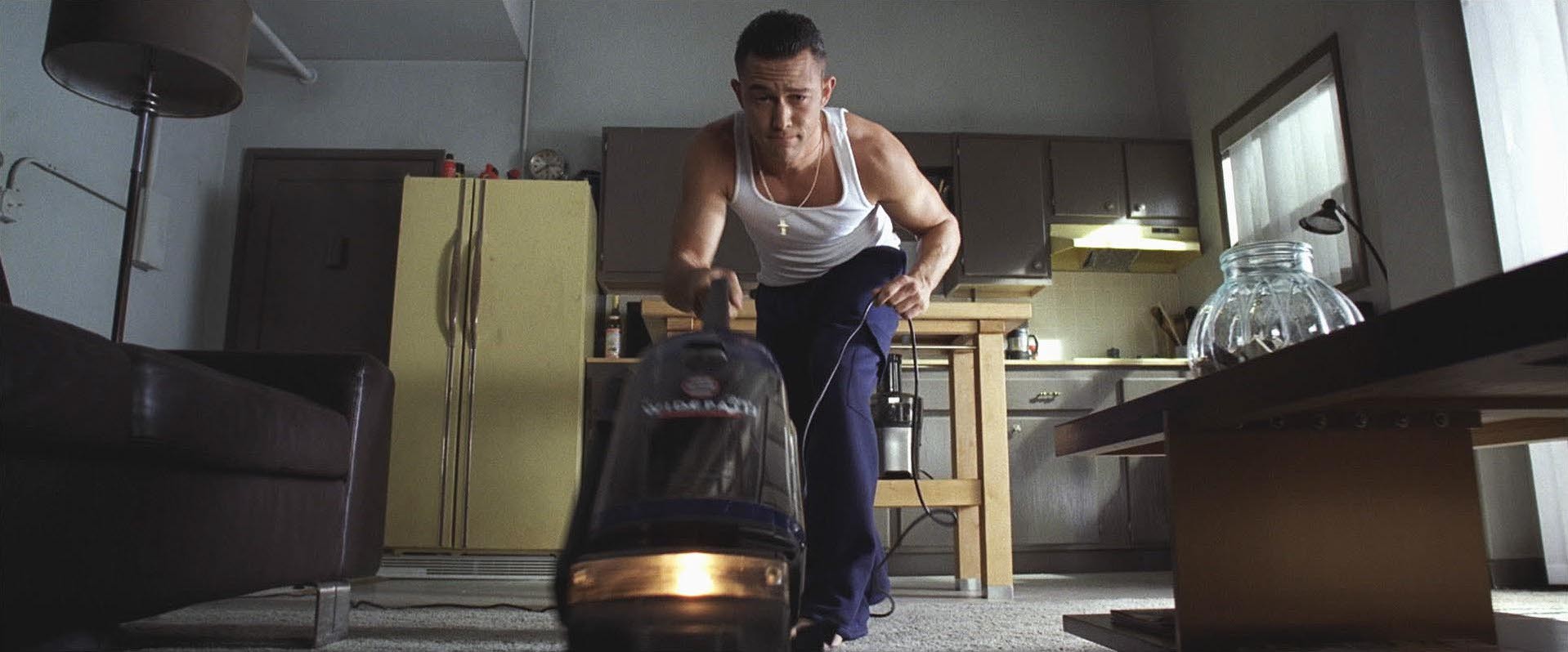
Very early on in the movie he explains himself by voice-over: "There's only a few things I really care about in life. My body. My pad. My ride. My family. My church. My boys. My girls. My porn."

Okay, I know, but hold on, despite the elephant in the room—that last one—look at that description. "My" is the word repeated most often.  How do you spell "narcissism" in New Jersey?  Same way you spell it in the rest of the world, but Jon has nothing to do with the rest of the world, as his sphere is finite.  His work-life is devoted to two shots.  Everything else—the workouts, the church—they're all shot the same, with the same set-up, different clothes, the implication being a comic sameness.  There's not an awful lot of growth here (and the film is just that much more economical by having all the different time-frames throughout the film being covered by the same camera set-up—nice).


His family is a Jersey comic stereotype.  Father and son sit around the table in wife-beaters, Mom flutters around the table, Sister only has I's for her I-phone.  Everybody shouts a lot, and the feeling is you're watching a "Nature" documentary on pecking order and dominance rituals.  His "boys" (who give him the "Don" moniker), are club syncophants or beards or plovers to pick up The Don's rejects.  The club prospects are on the traditional 10 scale, with the unattainable perfect being "a dime," but he'll settle for an 8 or 9 and it's a matter of some cursory chatting up, pre-lim making out and then catching a cab home.

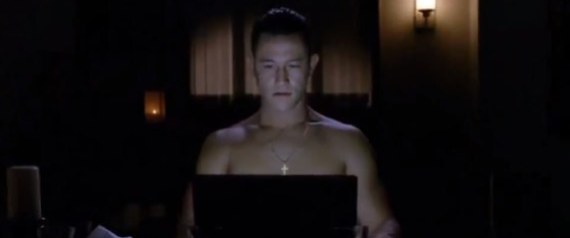
Now, here's where it gets sticky.  Jon's hook-ups are always temporary, and the sex is never satisfying.  Why?  Because it's nothing like what he can find on the Internet on the porn-sites.  For him, that's ultimate, and, just like his lap-top, all it takes for him to turn on is to hear the Apple "chime."  He's hooked, and there's no one in real life who can live up to the fantasy bimbos he can watch on his lap-top. Of course, the odds are stacked here—porn performers are going off script and we're all just winging it, but Jon is waiting for "the one" who is everything he could want in the...flash...in the flesh.


Really, this is just to increase my Internet "hits."
And then he meets Barbara Sugarman (Scarlett Johannson), gum-chewing, Joysey-speakin' "dime" who doesn't roll over as fast as other girls do, and, in fact, can't believe that Jon would think that she would...evah...evah...go home with him from the club.  So, Jon changes the plan of attack.  Meet for coffee, go out a couple times, yadda-yadda....  But, no.  Barbara keeps him on a very tight leash.  Always tell her "the trooth," go back to school, maybe, learn a trade, get a better job than his bar-tending, and maybe...

Jon is going insane over this.  He's made Barbara a project that he wants to conquer, but there is so much "pro quo" before getting to the "quid" and the penance at the confessional he goes to every week is really starting to add up.  But, it's here that Don Jon (the movie, not the guy) gets interesting rather than just prurient.  Barbara likes to go to the movies...

When you're ready...*


End scene.

"Everybody knows it's fake but they watch it like it's real f@#&ing life."  See what Gordon-Levitt is doing there?  He's drawing a parallel between porn and romance movies, and he's right (even if he fails miserably at making a completely "anti-movie" movie).  They're both nearly perfect fantasy-worlds (because you only achieve "perfection" in commercials) in which the dreams and desires of the audience so captivated are achieved and their expectations of real life are fulfilled, while also subsequently raising said expectations impossibly high to the point of nearly science-fiction levels.  I mean, "Bachelorette"-high (after all, that movie they watched—"Someone Special"—stars Channing Tatum and Anne Hathaway**) How can anything (within this economy) match those romantic expectations of "perfect situational love?" And what woman, outside of monetary gain, would ever run the gauntlet of porn?  (One does, after all, have to be able to walk, eventually).  There's got to be a morning after, and nothing can be sustained over time, and may grow tiresome and old with enough rapidity.  With porn and romance movies, you switch partners and the quest for fulfillment and innovation (if we can call it that) begins anew.


Really, this is just to increase my Internet "hits."

Where the humor, sad as it is, comes in Don Jon*** is that he is so insular he sees that quality right off the bat in everybody else, but it takes forever to see it in himself.  And that brings us right to the problem of Don Jon, entertaining as it might be.  Gordon-Levitt spends an awful lot of screen-time presenting the problem (not that the title character ever sees it as anything but a sometimes annoying irritant), but the fairly standard relationship the character has with Julianne Moore's normally neurotic character, Esther**** is barely explored at all.  One can speculate until next Friday why, but the relationship between Jon and Esther is given short shrift, making it feel sketchy and a little desperate to resolve the movie.  It may have something to do with the broad theme of objectification in the fantasy-world, or it illustrates that a relationship should be easier to achieve than the Jon/Barbara example (but that seems rather unnecessary given that we've seen lots of very easy relationships that last one night and that's it) but by JG-L's "hurry-up-and-let's-get-through-with-this" approach, it undercuts the point somewhat.  If there's that point to be made.  And if the film-maker is adept enough to to know that he might be sending mixed signals between form and content.

I don't know.  Maybe he just had to edit in a hurry to get the movie out.

So, as much as one might want to gush about Gordon-Levitt's hat-trick here, and how he's being edgy and honest, one has to wonder if he really knows what he's doing, and if he'll improve the next film out.

Don Jon is a Matinee.


* NSFW!

** Personally, I'd have gone with Ashley Judd or Katherine Heigl.  And I would have used a familiar rock-song title for the movie's title, but hey, it's close enough to the truth....

*** Ya know something?  I gave up on everything sounding like a dirty joke about five paragraphs ago.

**** Am I spoiling this here?  I think not, because for all Gordon-Levitt's honesty about the crock of romantic movies, he still is privy to following the "happily-ever-after" arc, as the film's poster is quick to reveal.

Tuesday, August 23, 2011

Crazy, Stupid, Love

"Love Sucks (A Cautionary Tale)"
or
"It Takes a Village (To Make a Divorce)"

The sad thing about romantic-comedies, circa the 21st Century, is their dependence on formula: Boy Meets Girl/Boy Loses Girl/Complications Ensue/Boy Wises Up/Happy Ending; or Girl Meets Boy/Girl Loses Boy/Girl's Self-Worth Depends on Boy/Romantic Rival Meets Terrible Demise/Happy Ending (of a sorts).  The last few I've seen of the genre have depended on hitting these plot-points, no matter what city, what occupation, or what sex the film centers around.  Even Bridesmaids, for all its wit and wildness, still ended with the assumption that everything will be alright if "the girl" gets "a man." The "by-the numbers" dance steps that most rom-coms boogie to have the ability to regress me back to the five-year old boy I was who hated "kissing scenes;" the final rosy fade-out inevitably spoils the most romantic of comedies for me, failing to warm my the cockles of my heart or make me feel all-gooey-fuzzy.  Instead, I walk away cheerlessly cynical.  Been there.  Done that.  A fish needs a bicycle.


So, it's a nice surprise, bordering on the revolutionary, when a romantic-comedy turns the formula on its ear enough that I enjoy it.  Don't get me wrong, Crazy, Stupid, Love* has a "happy ending," but there is also a nice glowing lack of resolution.  This is a movie that dares to say that Love is hard work, and, yeah, it sucks, but it could be worth it, because, like Life, it beats the alternative.

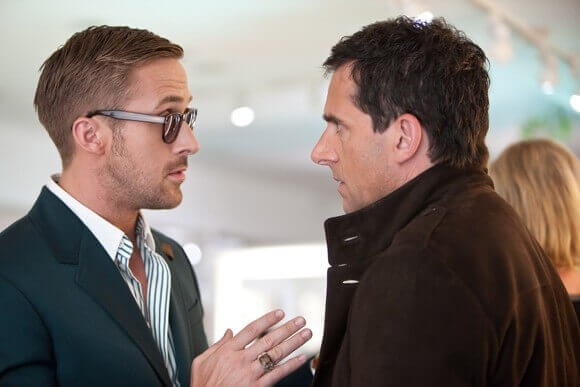
This is not where it starts, but where it starts to get interesting: Chick-magnet Jacob (Ryan Gosling,** he has a nicely subtle double-take for comedy) is in a bar in mid-closer with his latest fling when he takes the time to call over a half-stewed Cal Weaver (Steve Carell, showing exactly why he deserves to be out of TV and in films, something that doesn't happen nearly enough).  The reason?  Cal's moaning is throwing off Jacob's technique.  Cal's been doing that a lot lately (at the office he's told: "Amy heard you crying in the bathroom - we all thought it was cancer.") No, it's not cancer.  After 25 years of marriage, Cal's wife (Julianne Mooreshe's great) has revealed she wants a divorce AND she's slept with another man (Kevin Bacon, he's also great).  This offends Jacob's self-absorbed sensibilities: "Seriously, I don't know whether to help you or euthanize you."

So, Jacob helps Cal to "man up"a younger "Obi-Wan" to the elder's bowl-cut Luke with credit cards as lightsabers, and this, if not turning Cal's life around, at least making it busierAnd complicated.

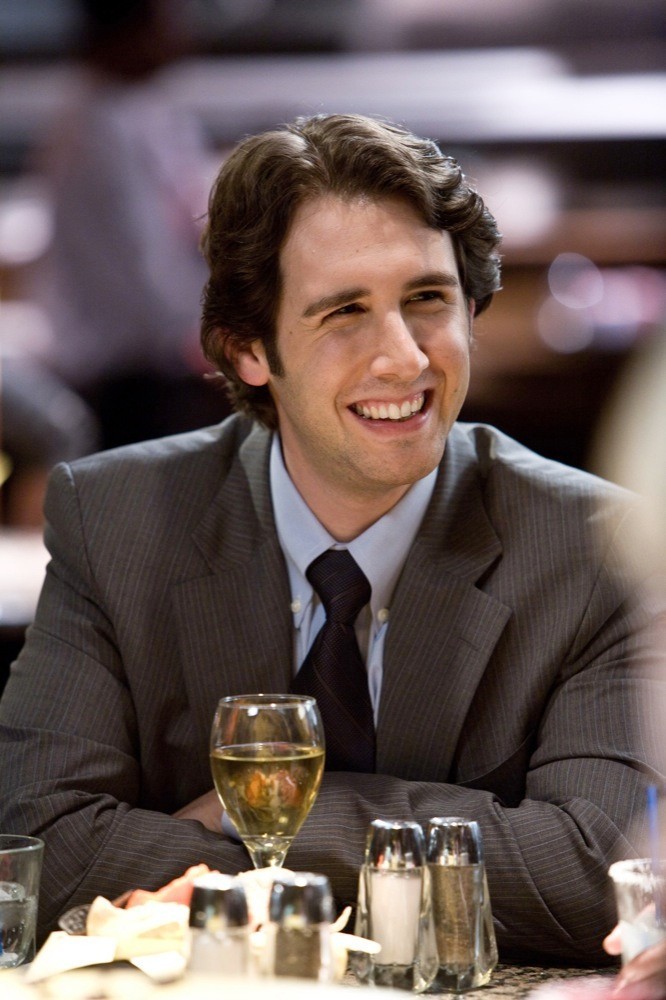
Running parallel to the story is Hannah's (Emma Stone, big-eyed waif) relationship problems ("You're life is so PG-13!" says her token-Asian friend, Liz).  That's because she wants to be engaged to office co-worker Richard (Josh Grobanrather risky of him to look so bad in this movie) and is focused on that, so much so that she plays ignorant to Jacob's innuendos when he approaches her while trolling in a bar.

And, at this point, to say anything more would be saying too much, spoiling the fun and sending the whole Jenga-construction of the film crashing to the rec-room floor (In fact, I've probably said too much already).  Just when you think everything is going as smooth as satin sheets, the film-makers throw you an extra wrinkle, and it's been a log, long while since a rom-com has done that.  The dialogue is fresh though the situations seem familiar—everyone's conceptions of Love and Romance seem to be based on The Movies and directors Glenn Ficarra and John Requa *** and writer Dan Fogelman **** are only too happy to skewer them, while paying some respect—the complications teetering on the sit-comish, then resolving with the most graceless of dismounts.  Applaud anyway because if they're not the best of executions (the performances help here), there are extra points for "artistic" and "difficulty."

Adding to the fray are the effects all this confusion have on "the kids" (Jonah Bobo, Joey King) and the friends (John Carroll Lynchhe's becoming one of my favorite character actors—and Analeigh Tipton).  It, after all, takes a village to make a divorce...very uncomfortable.  And special mention should be made to the movies' best utility player, Marisa Tomei, who surprises with just about every performance these days (Okay, okay, Marisa, you DESERVED that Oscar, okay?).

Highly enjoyable.  Bravo.

Stupid, Crazy, Love is a Full-Price Ticket.

* Yes, it has the superfluous comma, you English Majors, but if you see the title as a list rather than "adverb, adjective, subject," it makes a bit of sense, and the film actually earns the charity for considering the possibility. 

** Gosling is an odd bird.  It's taken awhile for me to warm to him (I'm one of the few people to have seen his awful work in Fracture, but he has a nice laid-back dead-pan style of comedy—as displayed in Lars and the Real Girl—that hews closely to his dramatic work.  Just a nudge, either way determines comedy or tragedy.  He's dangerously good.

*** Okay, this is scary, but hear me out: Ficarra and Requa have written such films as the remake of Bad News Bears, Cats & Dogs, Bad Santa (a bit raw, but actually rather sweet) and...wrote and directed the little seen gay romance, I Love You Phillip Morris—as subversive and weirdly sweet movies to be seen in a long time.  Forgive the early credits—these guys are good.

**** Okay, now REALLY hear me out: Fogelman wrote the screenplay for Cars and the screen-story for Cars 2, wrote Fred Claus...but did fine work on both Bolt and Tangled for Disney.  Seems he can write for real people, too, and not just 'toons.

Friday, August 5, 2011

Psycho (1998)

Psycho (Gus Van Sant — after Alfred Hitchcock, 1998) What is good about Gus Van Sant's color version of the original can be laid at the feet of that film's creator, Alfred Hitchcock: the relentless pace, the choreography of the camera (matched by Van Sant and his cinematographer—the great Christopher Doyle), the various set-pieces that alternately tease and deepen the mystery manipulating the audience's needs and tensions "like an orchestra," and that the film maker breaks the director-audience "trust" by the film's mid-point.  Danny Elfman, Bernard Herrmann's No. 1 fan, lovingly recreates his score in stereo. And modern film techniques allow Van Sant to make that opening pan across Phoenix, Arizona (2:48 pm), seamlessly locate the apartment where Marion Crane (Anne Heche) and Sam Loomis (Viggo Mortensen) play out their melancholy nooner and then crawl (with no cuts) through the window.


*


Van Sant's semi-scrupulous recreation (right) of Hitchcock's original shot-plan (left).

Everything that's wrong with Psycho '98 can be blamed on Van Sant: the kitschy color schemes, the bizarre inserts (see below) and the casting. Vince Vaughn had his hands full having to follow in Anthony Perkins' sashaying foot-steps as Norman Bates, so kudos to him for even showing up on-set, although he's lousy. What's surprising is how poorly Anne Heche and Julianne Moore step in for Janet Leigh and Vera Miles, even though both seem to be working harder. And it's that way down the line, including—startlingly, Viggo Mortenson's poor standing next to John Gavin (??!) and Robert Forster's shrink monologue next to...Simon Oakland? Where there is parity (or is it parody, it's hard to say how much Van Sant is taking this seriously...did Hitchcock?) is William H. Macy's Detective Arbogast compared to Martin Balsam's original, and Philip Baker Hall for John McIntire.


So, why even do it? Van Sant, in his commentary, cites several reasons: today's generation of movie-goers don't know from Psycho...or Hitchcock, making this a sort of a remedial version—Hitchcock for Dummies; some movie-goers don't like black and white films, hence the move to color; changes in movie technology allow the sorts of things that Hitchcock wanted to achieve technically with Psycho but could not (and the ratings system allows for a post-censor version—lines cut by Hitchcock are re-inserted, and there is a bit more blood-and-gore); and, the most compelling reason for Van Sant—nobody'd ever done it before—at least as scrupulously.  He basically follows Hitchcock's story-boards (and carried a portable DVD player with the film for reference while shooting on-set), so it is mostly a matter of interpretation, which is not that radical a concept.  After all, how many different interpretations of "Hamlet" have there been?  And as Hollywood seems to be running out of ideas (or continues its policy of playing it safe) we've seen remakes, re-boots and re-imaginings of Planet of the Apes, True Grit, Solaris, The Taking of Pelham 1-2-3, any book by Jane Austen or the Brontë sisters, and we've seen movie versions of teleplays, such as Traffic, State of Play, Edge of Darkness, and we'll see one of The Girl With the Dragon Tattoo and Tinker, Tailor, Soldier Spy in December.  Is this necessarily a bad thing?  NoThe Maltese Falcon had been filmed twice before when John Huston made his classic version in 1941.  It is interesting that Van Sant not only remade Psycho, but also made it in Hitchcock's style using his shooting plan, acknowledging that the movie and the man who made it are inseparable.

What's different?  Van Sant follows Hitchcock's ideas pretty well...but does a sort of skewed version of them in terms of color, angle and performance. Some scenes have a more modern spin on then—for example, Lila and Sam wait for word from Arbogast (Martin Balsam in Hitchcock's version, William Macy in Van Sant's) at Sam's business, a hardware store in the 1960 version, but a flea-market in 1998, notice Sam reading the liner notes on a Judy Garland record.


In 1960, while investigating the Bates house, Lila finds children's books in Norman's room, but in 1998, it's porn.


And Mrs. Bates is found sitting in the dull basement, but in 1998, she's seen sitting in front of a diorama with live birds.


The biggest difference has a more feminist slant: rather than sitting back and watching the final fight, 1998's Lila takes part kicking her assailant.


But, Van Sant's entirely new additions are, frankly, unnecessary.  Sure, the first shot of the fly might have suggestions of bringing things full-circle, but the other shots—quick cut-aways (no pun intended—??) during the murders are merely distractions taking us out of "the moment" of the victims' deaths, and seem pretty frivolous.  Hitchcock does establish a "mind's eye" kind of cinema with his "voices in my head" sound overlays, and his "see that I look"/"see what I look at"/"see my reaction to it" style of silent story-telling might allow it, but it seems superfluous, and more than that, confusing, especially when we're having a shocking thing happening on-screen.


During the opening scene in the hotel room, an image of a fly on a half-eaten sandwich is inserted, paralleling the lucky fly who won't be killed in the prison cell at the end of the film.
During the first murder, a shot of a dilating pupil (presumably in the victim's eye) and a quickly moving storm-scape which presumably was witnessed previously.  
The second murder victim's flash-frames are (given that person's profession) a sleazy vice scene...
...As well as a stray cow in the middle of a road (A memory?  A potential victim?)

As well as a quick, obfuscating shot of the murderer approaching.

So...the Van Sant version of Psycho is an interesting experiment, Hitchock through the sensibilities of Van Sant, respectful but different.  Does it do harm to the original? 

Well, no.  Interesting story: the pulp novelist James M. Cain was told once by a person "too bad what Hollywood has done to your books," and Cain took them into his library and pointed to his own novels. "Hollywood hasn't done anything to my books. They're right there on the shelf." 


The original—Alfred Hitchcock's Psycho—will always be there.


Cameo's: Hitchcock on the left (1960) and a portly Hitchcock stand-in points at Gus Van Sant (1998).

The final card of Van Sant's Psycho—taking us beyond Hitchcock's raising of a car from the bog for a bit of perspective: all that horror has gone on just off the highway.  The distant traffic sails by, indifferent and unsuspecting of what lies out of their attention.  There's an element of that in all of Van Sant's movies—horror and secret lives occur just out of sight of normalcy.


*  In-joke (there are lots) here: The sign on The Bates Motel says "newly renovated" (a cutting remark)