Showing posts with label Scarlett Johansson. Show all posts

Friday, October 4, 2013

Don Jon

Know Thyself
or
The Tissue of Lies in Fantasy-land

Don Jon is going to piss so many people off and throw a wedge into so many relationships it's not even funny.  Don Jon is, fortunately (funny, that is), and that's what makes its nasty streak in saying "There ain't no Santa Claus" to movie audiences palatable.

Written, directed and starring Joseph Gordon-Levitt (guess Lake Bell's In a World isn't a lock for The Orson Welles Award for over-achievement), it's about all sorts of things, but we'll let the show's protagonist, Jon Martello explain the crux of it.

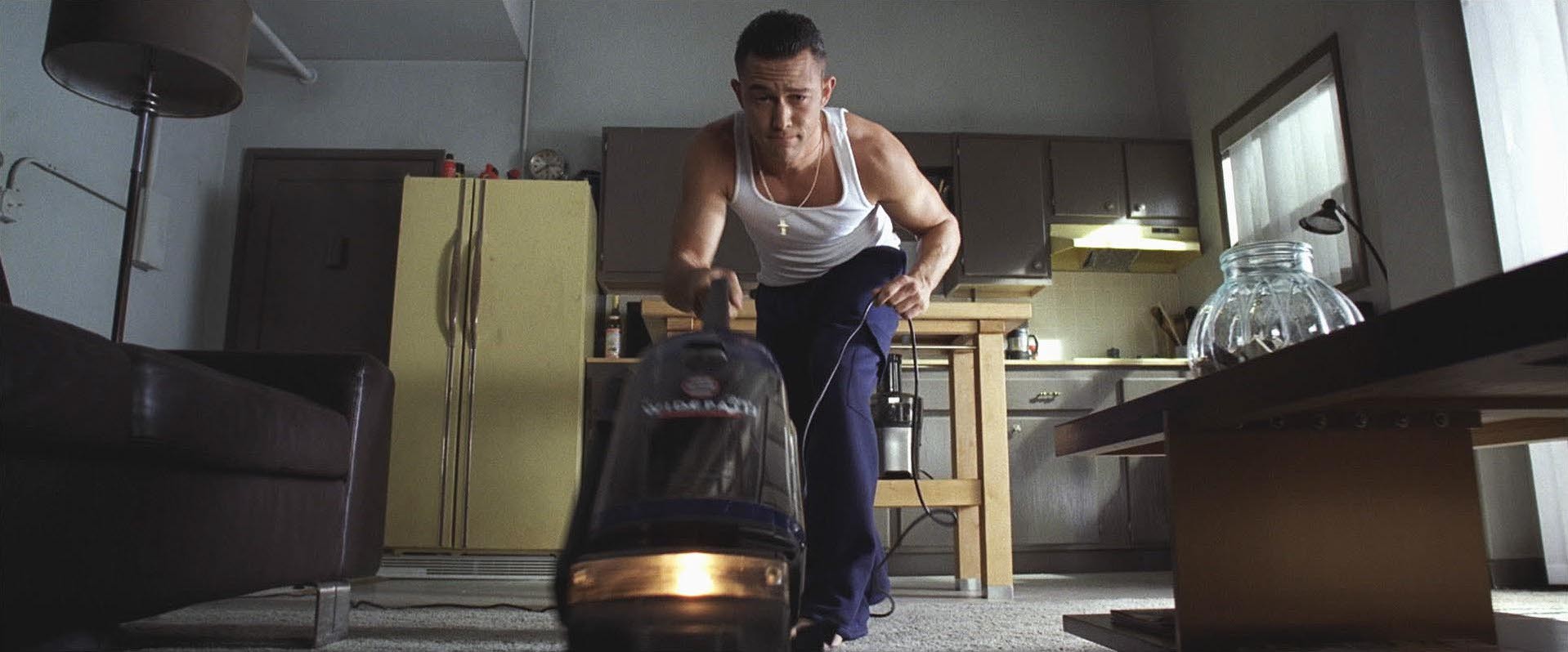
Very early on in the movie he explains himself by voice-over: "There's only a few things I really care about in life. My body. My pad. My ride. My family. My church. My boys. My girls. My porn."

Okay, I know, but hold on, despite the elephant in the room—that last one—look at that description. "My" is the word repeated most often.  How do you spell "narcissism" in New Jersey?  Same way you spell it in the rest of the world, but Jon has nothing to do with the rest of the world, as his sphere is finite.  His work-life is devoted to two shots.  Everything else—the workouts, the church—they're all shot the same, with the same set-up, different clothes, the implication being a comic sameness.  There's not an awful lot of growth here (and the film is just that much more economical by having all the different time-frames throughout the film being covered by the same camera set-up—nice).


His family is a Jersey comic stereotype.  Father and son sit around the table in wife-beaters, Mom flutters around the table, Sister only has I's for her I-phone.  Everybody shouts a lot, and the feeling is you're watching a "Nature" documentary on pecking order and dominance rituals.  His "boys" (who give him the "Don" moniker), are club syncophants or beards or plovers to pick up The Don's rejects.  The club prospects are on the traditional 10 scale, with the unattainable perfect being "a dime," but he'll settle for an 8 or 9 and it's a matter of some cursory chatting up, pre-lim making out and then catching a cab home.

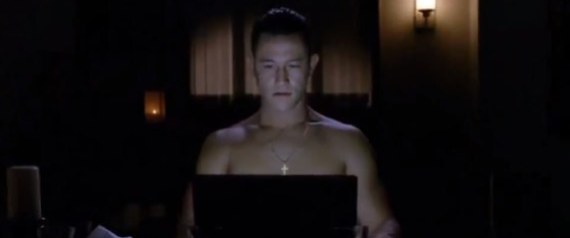
Now, here's where it gets sticky.  Jon's hook-ups are always temporary, and the sex is never satisfying.  Why?  Because it's nothing like what he can find on the Internet on the porn-sites.  For him, that's ultimate, and, just like his lap-top, all it takes for him to turn on is to hear the Apple "chime."  He's hooked, and there's no one in real life who can live up to the fantasy bimbos he can watch on his lap-top. Of course, the odds are stacked here—porn performers are going off script and we're all just winging it, but Jon is waiting for "the one" who is everything he could want in the...flash...in the flesh.


Really, this is just to increase my Internet "hits."
And then he meets Barbara Sugarman (Scarlett Johannson), gum-chewing, Joysey-speakin' "dime" who doesn't roll over as fast as other girls do, and, in fact, can't believe that Jon would think that she would...evah...evah...go home with him from the club.  So, Jon changes the plan of attack.  Meet for coffee, go out a couple times, yadda-yadda....  But, no.  Barbara keeps him on a very tight leash.  Always tell her "the trooth," go back to school, maybe, learn a trade, get a better job than his bar-tending, and maybe...

Jon is going insane over this.  He's made Barbara a project that he wants to conquer, but there is so much "pro quo" before getting to the "quid" and the penance at the confessional he goes to every week is really starting to add up.  But, it's here that Don Jon (the movie, not the guy) gets interesting rather than just prurient.  Barbara likes to go to the movies...

When you're ready...*


End scene.

"Everybody knows it's fake but they watch it like it's real f@#&ing life."  See what Gordon-Levitt is doing there?  He's drawing a parallel between porn and romance movies, and he's right (even if he fails miserably at making a completely "anti-movie" movie).  They're both nearly perfect fantasy-worlds (because you only achieve "perfection" in commercials) in which the dreams and desires of the audience so captivated are achieved and their expectations of real life are fulfilled, while also subsequently raising said expectations impossibly high to the point of nearly science-fiction levels.  I mean, "Bachelorette"-high (after all, that movie they watched—"Someone Special"—stars Channing Tatum and Anne Hathaway**) How can anything (within this economy) match those romantic expectations of "perfect situational love?" And what woman, outside of monetary gain, would ever run the gauntlet of porn?  (One does, after all, have to be able to walk, eventually).  There's got to be a morning after, and nothing can be sustained over time, and may grow tiresome and old with enough rapidity.  With porn and romance movies, you switch partners and the quest for fulfillment and innovation (if we can call it that) begins anew.


Really, this is just to increase my Internet "hits."

Where the humor, sad as it is, comes in Don Jon*** is that he is so insular he sees that quality right off the bat in everybody else, but it takes forever to see it in himself.  And that brings us right to the problem of Don Jon, entertaining as it might be.  Gordon-Levitt spends an awful lot of screen-time presenting the problem (not that the title character ever sees it as anything but a sometimes annoying irritant), but the fairly standard relationship the character has with Julianne Moore's normally neurotic character, Esther**** is barely explored at all.  One can speculate until next Friday why, but the relationship between Jon and Esther is given short shrift, making it feel sketchy and a little desperate to resolve the movie.  It may have something to do with the broad theme of objectification in the fantasy-world, or it illustrates that a relationship should be easier to achieve than the Jon/Barbara example (but that seems rather unnecessary given that we've seen lots of very easy relationships that last one night and that's it) but by JG-L's "hurry-up-and-let's-get-through-with-this" approach, it undercuts the point somewhat.  If there's that point to be made.  And if the film-maker is adept enough to to know that he might be sending mixed signals between form and content.

I don't know.  Maybe he just had to edit in a hurry to get the movie out.

So, as much as one might want to gush about Gordon-Levitt's hat-trick here, and how he's being edgy and honest, one has to wonder if he really knows what he's doing, and if he'll improve the next film out.

Don Jon is a Matinee.


* NSFW!

** Personally, I'd have gone with Ashley Judd or Katherine Heigl.  And I would have used a familiar rock-song title for the movie's title, but hey, it's close enough to the truth....

*** Ya know something?  I gave up on everything sounding like a dirty joke about five paragraphs ago.

**** Am I spoiling this here?  I think not, because for all Gordon-Levitt's honesty about the crock of romantic movies, he still is privy to following the "happily-ever-after" arc, as the film's poster is quick to reveal.

Sunday, December 16, 2012

Hitchcock

Hack-job
or 
Making Everyone a little Psycho

Making a movie is a boring enterprise.  Boring and thrilling at the same time.  Lots of sitting around, wasting time, waiting for the crew to be ready for that moment when you can't waste any time, the adrenaline is pumping, and things have to go right...over and over and over again until they do.

For Alfred Hitchcock, the thrill of movies wasn't in the filming (which lots of directors like because it's so social and a "rush"), or in the editing (where so many directors "find" their films), it was in the planning, the story-writing and the story-boarding—making the blueprint for the film that could be followed easily and by-the-numbers.  The best parts of his movies were not in performances (although they could be great*), but in the ideas that shape the film and make it worth watching...and worth watching again.  Watching that process, however, would probably not make a very compelling movie.

The trials and tribulations of the making of his landmark horror film Psycho was detailed in Steven Rebello's fun little read "Alfred Hitchcock and the Making of Psycho," and are now derailed in Hitchcock, a fictional adaptation of the book, which has as much to do with the events of making Psycho, as the film Psycho has to do with the book it was based on, which, truth to tell, Hitchcock never read.**

Well, few people have read Rebello's book, either (which is a shame, really) and so the chief "scenarist" James McLaughlin (who wrote Man of the House and co-wrote Black Swan...hmmm) and director Sacha Gervasi (who co-wrote The Terminal for Spielberg and whose only previous film was the documentary Anvil! The Story of Anvil!) have "written to silence"—as so may of the actual participants are dead—relying on "conventional wisdom" rather than facts to make their odd little combination of docu-fantasy.  Partially, this is because when it comes to movie-making (as opposed to life) truth is duller than fiction, but it is also more complicated and takes longer to explain and so we depend on a futzy short-hand to get to the point faster.  "Conventional Wisdom" in Hollywood is the same as "Based on a True Story."

Oh, don't get me wrong.  There are instances where the facts are there: Hitchcock's wife and collaborator Alma Reville did spot the "blink" (actually it was a throat swallow) in the pull-out from Janet Leigh's face after the murder (requiring a cut to the shower-head) and the "nudity" (which was solved with a black bar at the bottom of the screen); resistance was high to Psycho which Hitchcock chose to fulfill his contract for Paramount Studios—they did want something like North By Northwest, which made a lot of money for M-G-M—but not so much when Hitchcock revealed he was going to do it "for cheap" with his television crew—it's always about return for investment; he did come up with the brilliant advertising campaign for the film (like he'd previously done with his other films); much is made of the financial failure of Vertigo*** (ironic as it's—this year—considered "the greatest film ever made") as well as Hitchcock's insecurities and frailties (which were legion and they're all up there on the screen in his movies) and there are dribs and drabs of trivia sprinkled throughout the film.  But, they are far out-weighed by what is wrong.

What's wrong with this picture?  Oh, where to start?
What it gets wrong would fill another book by Rebello.  The film's obsession with Ed Gein—that is more attributable to author Robert Bloch than Hitchcock—feels wrong and wrong-headed, more to do with the screenwriter's issues than the subject's (I doubt that Hitchcock had the elaborate Gein fantasies that are imagined here).  The emphasis of Alma's collaboration with writer Whitfield Cook (Danny Huston)—who contributed to one good Hitchcock adaptation, Strangers on a Train, and one bad one, Stage Fright—is blown completely out of proportion from a mere consulting gig.  And the twist of the knife is the Hitchcock pathology, especially his treatment of women (the "Hitchcock Blondes," the grey suits, the make-overs, the favorites—Kelly and Bergman) despite the fact that Hitchcock always gave the more interesting parts and special attention to his actresses ("Hitch always threw the picture towards the girls" was Cary Grant's summation), not only for himself...but also his audience.

But what Hitchcock valued was loyalty. So he'd work with the same craftsmen over and over again out of loyalty, out of trust, out of convenience—past collaborators were one less complication to worry about.  And if they failed to deliver, he wouldn't work with them again, without a word of explanation as he hated confrontation.  "He was a coward," as Suzanne Pleshette opined.  Of course, he was.  His movies are naked displays of his phobias, foibles and fantasies.


And the films endure, because his frailties are just like ours.


Hitch is no longer alive to defend himself, but quite a few collaborators are. One wonders why Pat Hitchcock, Alfred and Alma's daughter, who usually runs defense for the Hitchcock Family Legacy, is silent while so many the current gaggle of films—this one and HBO's "The Girl"—are starting to piss on his grave.  But, then, the evil that men do lives after them, the good is oft interred with their bones.  So, let it be with Hitchcock.  His films are a testament to both good and evil, and our ability to rise above.  The films have lived on, decades after the man, and show no signs of falling out of fashion.  That's his lasting legacy.

 
For fans of the director, there is no such thing as bad news, but this movie truly is.  The performances are winning, though, as Scarlett Johansson occasionally convinces you she's studied up on Janet Leigh's mannerisms, although James D'Arcy plays Anthony Perkins as if he was playing Norman Bates and there was more to the man than that (reflecting the film's focus on rumor and gossip, rather than facts), we don't know what Alma Reville was like, as she stayed mostly behind the camera, but Helen Mirren's performance is fun and winning.  Anthony Hopkins' Hitchcock, however, is problematic—although it's not entirely his fault.  Hopkins is a brilliant mimic, and his own rich voice disappears in the deliberate cadence and sibilance of Hitchcock's own.  But (like much of the film), the portrayal is a bit too dependent on Hitchcock's public persona as a droll dead-pan.  This Hitchcock never smiles—perhaps it would have cracked the elaborate make-up Hopkins must wear to even resemble the director—and is entirely too mordant and lines up with "conventional wisdom" about the man, a view that, as Hitchcock himself cultivated it, he's a little responsible for.  As such, the portrayal comes across as a bit one dimensional, and one-sided.


One could get exercised about these things (and I obviously have), but as Hitchcock himself would say, "...it's only a mooo-vie."


Just not a very good one.  The best that can be said about Hitchcock (the movie) is that Alma's influence and great work is now a part of conventional wisdom, instead of the director's best-kept secret.


Hitchcock is a Cable-Watcher.


Yeah, that Hitchcock could be a tyrant on the set, alright...
Hitchcock's Best-Kept Secret: the incomparable Alma Reville


 * Hitchcock was often misquoted as saying "Actors were cattle" as if they were just a commodity to be "herded," when what he SAYS he said was that actors "should be treated like cattle."  Friend and Hollywood cut-up Carole Lombard responded by setting up two bovine pens on the set of Mr. and Mrs. Smith (1941), one for her and another for her co-star Robert Montgomery.

** In his near-definitive interview book "Hitchcock/Truffaut," Francois Truffaut spends a lot of time—too much time, really—going on about how lousy Robert Bloch's novel, "Psycho," is, and Hitchcock dismisses his comments by saying "I never read it.  I read the studio synopsis (the plot summary by studio "readers"), and the only thing I was interested in was the shower sequence and killing off the star half-way through the movie..."  

*** Funny thing.  Tippi Hedren has made what my father used to call "a big stink" about Hitchcock destroying her career after the financial failure of Marnie—never working with her again—and supposedly bad-mouthing her to other directors, producers, and all of Hollywood.  But, after Vertigo "tanked" at the box-office, Hitchcock never worked with James Stewart again, feeling like it was partially Stewart's presence in the film that caused the poor turn-out.  Stewart very much wanted to work on North By Northwest, but Hitchcock made every effort to lure his old collaborator Cary Grant out of his on again/off-again retirement to star in the film.  It was all part of Hitchcock's own ambivalence about hiring "name" actors for "his" projects, as often the dictates of producers and studios did not match the needs of the part.  But, again, that takes a long time to explain...and so we get stuck with "conventional wisdom."

Wednesday, May 9, 2012

Marvel's The Avengers

"We've Got a Hulk..."
or
Playing Your "A" Game


This one is The Big Pay-Off.

Back in the day (around about Iron Man) when they started doing teasers at the end of Marvel movies for the idea of an "Avengers" event, one hoped that they could pull it off.  Captain America needed to work (and it did). Iron Man II integrated other characters successfully.  They even managed to make Thor somewhat interesting.  And even though two "Hulk" movies under-performed at the box-office, there was still potential there.  Given the scenario of the "Ultimate Avengers" storyline (a revamp in the Marvel line that started everything over from Origin Story Square One with a decidedly more adult, realistic attitude...and a Nick Fury that looked like Samuel L. Jackson) a case could be made for a good old fashioned Marvel Jam story of the "When Titans Clash!" school.

The problem is all those heroes. It could turn into a mighty cluster, if there isn't a compelling story that slots heroes into appropriate scenarios, a problem with some of the "X-Men" films.  And one also hopes that there's a compelling reason for these guys to be here, that there is some character function going on, even though they have plenty of screen-time in their own series to work on those.

Will The Avengers "assemble" into a well-functioning superhero romp, and make Joss Whedon (who excels at ensembles) an A-list director that fans have been hoping for?

"Yes" to the former and "Maybe" to the latter, although pulling off this one is not an easy feat—so many particular and persnickety stars, so many owned and exploitable characters that corporations (and opposing film studios) want to manage, and so many potential minefields that it would take a superhero (with levitating powers) to rise above and negotiate them.  But Marvel's The Avengers (what they're calling this one to avoid any confusion) manages to be fast-paced, quick-witted, and, although slightly derivative (mostly of Jack Kirby's "Fourth World" series, with hints of The Andromeda Strain in sub-text, and, let's face it, most mythology and comic book tropes), and is, as one character analogizes, "a bag full of cats," fulfills its basic tenet: to be consistently entertaining, with crises every few minutes, wonders to behold (some of the sets are simply amazing), interesting pair-ups in terms of fights (Marvel heroes are always fighting each otherthey're very turf-oriented, which is bad because they're all in New York) and dialogue.  

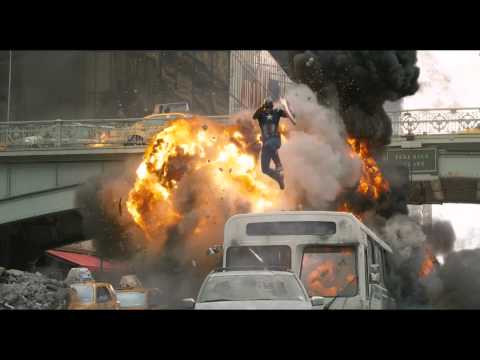
And it does two essential things: keep each individual hero definable in tone and action, and make those fights "followable"—this isn't a hodge-podge of pictures of punches, muzzle-flares and explosions, there is breathing room between sequences and shots, so an audience is allowed to register action and result, something missing from a lot of action movies, where there is either bad direction or a style-disconnect between various "units" filming.  It feels "of a piece," despite the subject of the film being about extraordinary outcasts aligning uneasily.*

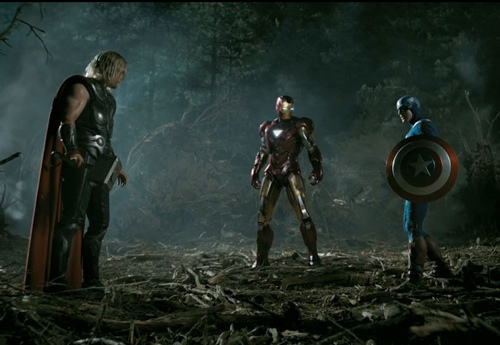
In a pithy line of dialogue between "Iron Man" Tony Stark (Robert Downey, Jr. riffing brilliantly) and villain Loki (Tom Hiddlestone, registering far more than he did in the Thor movie)—everybody gets their Loki scene, The Hulk's being the best—the entire movie is summed up in an adamantium-encased nut-shell: "Yeah, takes us a while to get any traction, I'll give you that one but, let's do a head count here. Your brother, the demi-god; a super soldier, a living legend who kind of lives up to the legend; a man with breath-taking anger management issues; a couple of master assassins, and you, big fella, you've managed to piss off every single one of them."  

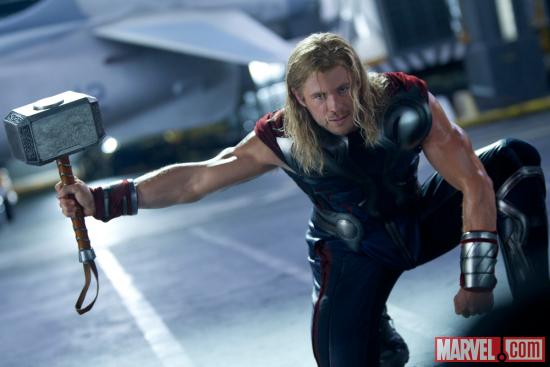
Motivation enough to form a coalition of the willing.  And the disparate styles of the players is well-evidenced-six degrees of declaration: Chris Evans is all un-ironic directness (even though he is perfectly capable of matching Downey snark-for-snark);  Chris Hemsworth is all stentorian brio done with Shakespearean force (he's so much more effective here than in his own movie); Jeremy Renner is as taut as his crossbow wire, Scarlett Johnasson's blank-stared Black Widow is well-suited for her position as a lethal scam-artist, Samuel L. Jackson manages to make even original lines sound like oft-quoted cliches; and Downey, quick and mercurial, dances around the dialogue, adding his own steps.  Each actor has their own way of working with Whedon's words, and Downey's pace has everyone playing their "A" game.

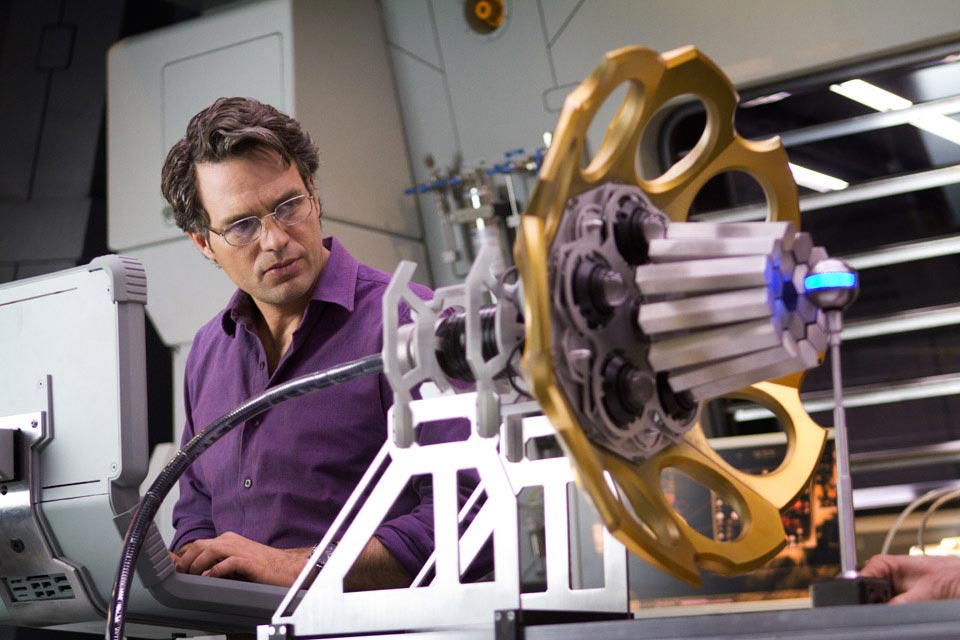
But the best here is Mark Ruffalo, playing Dr. Bruce Banner and (the first time an actor is allowed to, via motion-capture) his altered super-ego, The Hulk.  Two movies and two different actors (Eric Bana and Edward Norton, no slouches) tried to do something with the limited premise and came up short.  However, here, with less screen-time, Ruffalo manages to make Banner as interesting as his comically destructive "Other Guy," his physicist not guarded or fearful or weak (as has been the norm), but ironically bitter, resignedly haunted, the most mysterious of Marvel's "Mystery-Men."  "You really have got a lid on it, haven't you?" says Stark at one point, referring to the Doctor's self-control and the monstrous result of any lack of it.  "What's your secret? Mellow jazz? Bongo drums? Huge bag of weed?"  Maybe The Hulk is such a one-smash pony that he's at his best as a supporting character, rather than the star of a movie series.  One could argue that about all the characters here with the exception of Downey's Iron Man, who is, due to the actor's efforts, a one-man circus.

But, here it's all in the group, nobody's around long enough to drag it down, and it's the interactions that count.  The plot is MacGuffin-oriented in the Marvel-style of "I-don't-know-what-it-is-but-it-sure-is-big:" the doohickey from Captain America and the whatsit from Thor are involved so that a race of advanced aliens can take over l'il old us.  Not sure of the motivation, but who cares? Marvel's The Avengers is big, bold, brassy and breezy, and has the feel and crazy zeal of those Japanese monster movies that combined a lot of characters and smashed them together.

I don't know what it is, but it sure is fun.**


Marvel's The Avengers is a Full Price Ticket.  (Go ahead, see it in 3-D)

All the potential Avengers, assembled by George (every little detail) Perez

* Whedon shows the eventual alliance solidifying in two nicely planned shots, one—used in all the commercials—orbiting the heroes as they "circle the wagons," and a meticulously planned CGI sequence in mid-battle that is the super-hero equivalent of "going around the horn."

** There are TWO codas this time: one after the initial credits (before they get into the detail stuff) and another one that was filmed right after the Hollywood premiere that's odd...but fun.

Tuesday, May 11, 2010

Iron Man 2

"Stark-Raving Mad"

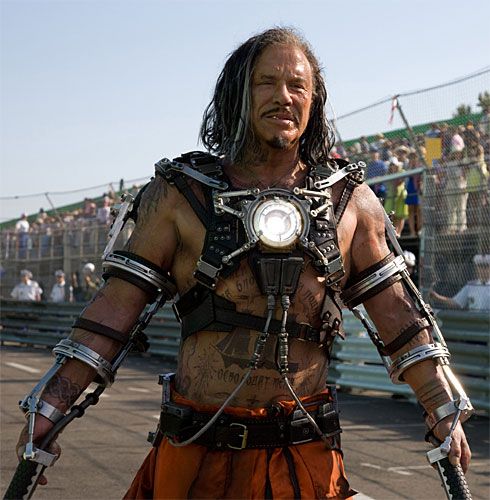
It seems like everybody wants a piece of Iron Man/Tony Stark (Robert Downey Jr.). Beyond the usual mindless herd of groupies and hangers-on, a Senate sub-committee led by Sen. Stern (Gary Shandling) wants Stark Industries to turn over the metal suit to the government, rival defense contractor Justin Hammer (Sam Rockwell) wants the intellectual property for his own devices, Stark friend Col. James Rhodes (Don Cheadle) has been ordered to procure a suit for the Military, S.H.I.E.L.D head Nicky Fury (Samuel L. Jackson) wants Stark’s expertise, and discredited physicist Ivan Vanko (Mickey Rourke) wants Stark’s head, sans ideas or chrome helmet.

And poor
“Pepper” Potts (Gwyneth Paltrow)? She just wants a little of Tony’s time and attention…strictly business, of course.

That’s easier said than done.
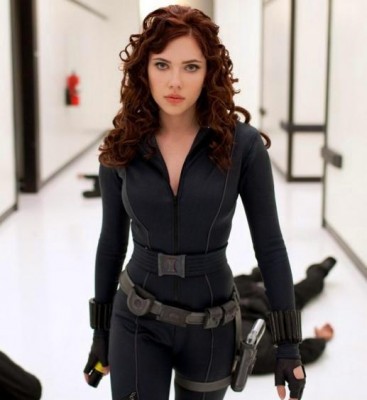
Time is in short supply for Tonythe Palladium-powered pacemaker keeping his heart going is killing him, throwing him into a jet-powered tail-spin of narcissistic self-pity and hedonism. And it’s hard to get any elbow-room for all the people trying to set-up an intervention, tough-love or no. The one person who seems to seek nothing from the head of Stark Industries is voluptuous Natalie Rushman (Scarlett Johansson) from legal, who’s a whiz at business transition components, but can also take down Stark’s driver/bodyman “Happy” Hogan (director Jon Favreau) in the tightest skirt possible. Tony’s watching her, but not the way he should.

At this point, one should be aware that “
Iron Man 2” is suffering from some serious character bloat, a traditional problem with super-hero sequels that decide to take their eyes off the hero and onto the guest-villains. Fortunately, scenarist Justin Theroux takes a story breakdown from “The Dark Knight” and integrates all the conflicts into a single story…of Tony Stark, used up and spent, finding his worth despite a life of increasingly attention-deficited indulgence, and, instead of using and being used, getting something from an unexpected source in an unlikely way that re-charges his batteries.

It's all about Tony, you see.
He's always been selfish and self-absorbed, but with a ticker that's counting down his limited moments, he becomes even more internal and narcissistic, deciding to use that time in pursuit of new thrills and new highs, though they may be increasingly self-destructive. Those jets in his feet and pulse generators in his hands only show that he's burning his candle at both ends. A celebration of all things Stark at the StarkExpo in Flushing, New York provides a backdrop for his inner struggle. A "city of the future," it was the brain-child of Tony's father, Howard ("Mad Men's" John Slattery, seen in archive footage), a combination of Hughes and DisneyStarkExpo, amusingly, has a theme written by Disney-musical scribe Richard Sherman—father and son are seen in Stark contrast: Howard was a giver and Tony, a taker. And Tony's understanding of their differences is the major character arc of the movie. It takes Tony out of the self-imposed metal bubble (represented by the Iron Man suit) that he has placed himself in. It also gives him a second chance at life.

That arc, and the movie, also provide plenty of opportunities to see some of the quirkiest and quickest actors in the business sparking off each other. One of the problems with the first “
Iron Man” was that no one could match Robert Downey’s energy and ability to riff in a scene. In “Iron Man 2,” almost everybody can, and it’s a particular joy to see Downey playing “Can You Top This?” with the likes of Rourke and Rockwell (at his smarmy salesman best), but also Clark Gregg (returning as S.H.I.E.L.D. Agent Coulson) and Don Cheadle. Even Gwyneth Paltrow brings her best game, never once succumbing to Downey-inspired giggle-fits (as she did often in the first film), and matching his speed. Johansson and Jackson, in a completely different tactic, merely have to dead-pan their way through their scenes with him to register. They’re supposed to be mysterious, anyway.

Are there problems? Sure. The action scenes are best when Rourke and Downey’s antagonists are spitting sparks at each other—Ivan Vanko’s energy-whips have the same animated fierceness of the
Id-Monster from “Forbidden Planet”—but most of the fights are swooping flame-trails and orange explosions in their wake (not very involving). And despite starting the film fast out of the gate under the Paramount logo, Favreau indulges in some long set-ups to punch-lines with little pay-off—one of them involving his character in an extended fist-fight that drags along, increasing his screen-time. There are too many times when the film is one big TV monitor for full-frame large graphics of news reports, and there may be a couple of cameos too many.

But, quibbles aside, “
Iron Man 2” might be a bit better than its predecessor, which managed to make a nice breezy transition to the screen, and sparked the imagination of its audience. A lot of the credit must go to Downey, who brought more energy than any number of “Transformers”-like Rock’em Sock’em Robot fights could muster. The stakes are raised performance-wise (and robot-wise) here, but this sequel continues to soar, fueled primarily by its lead actor.

"Iron Man 2" is a Matinee.

A shorter version of this review appears at BSCReview.

Tuesday, March 10, 2009

Match Point

"Match Point" (Woody Allen, 2005) The box office was good for "Match Point," Allen's first hit in years, and one wonders why. The film is accomplished and assured, simple in execution but morally complex, one of those little Woody Allen morality puzzles that update the classics (in this case, "Crime and Punishment," as well as any number of "bad-boy makes good" novels, where all you need is a compromised conscience to make it in the world). The BBC put in money, so the locations are in Great Britain (it's good to get out of New York once in awhile). The actors are young and skew to a lower movie-going demographic (although except for Scarlett Johansson, the actors are not box-office draws)--but there are no "tunes" on the soundtrack, merely ironically chosen opera extracts sung by Caruso (complete with vinyl surface noise).

Allen considers it one of his best films.

Despite the accents and strange new territory, it's undeniably Allen-town with its chilly empty spaces pointedly deliberately composed, its couples colliding and splintering, an act of insanity out of the blue, and a late touch of magic that chills.

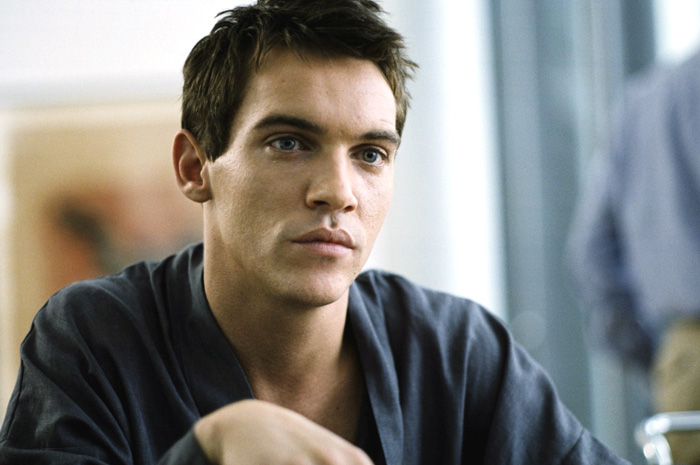
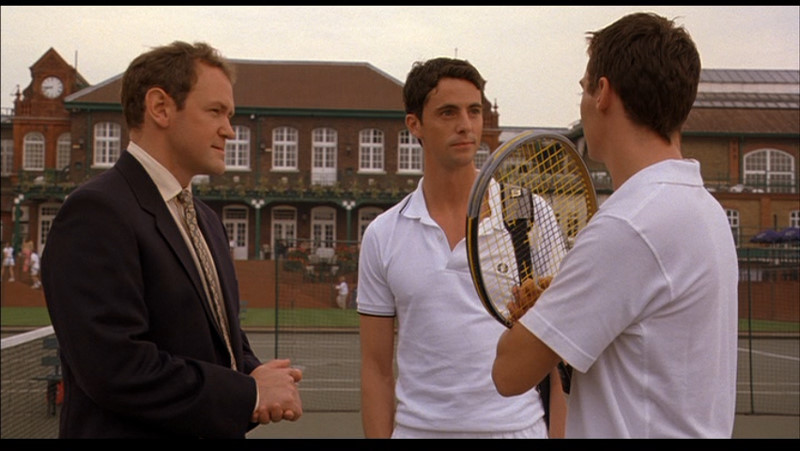
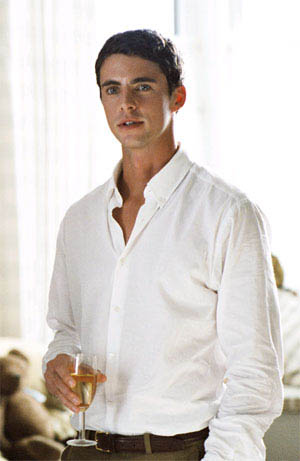
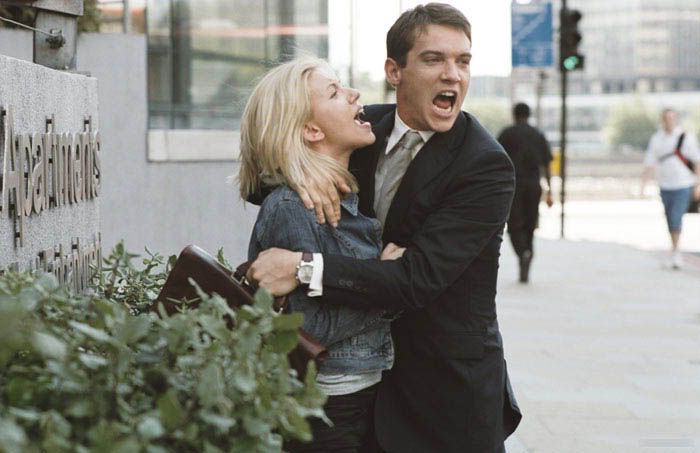
But it's one of those Allen movies where the literary seams show, his long empty corridors reverberating with the classics of the past informing his movie, with some of the echoes coming from his old Brooklyn haunts; I kept thinking that Chris Wilton, the slippery tennis pro (the only thing that's true about him is, surprisingly, he is a tennis pro!) reminded me of Leonard Zelig, the "human chameleon," who, in his insecurity, would conform to whatever group he was with, even physically changing to accomplish it. But more than the literary seams show. Jonathan Rhys Meyers, who plays Wilton, isn't a fast enough actor to make his sudden shifts of tone and snap-excuses sound credible; there needs to be an ad-libbed looseness to his answers, rather than the studied RADA responses Meyers provides. The rest of the cast play their parts as required: Brian Cox (always good), as Wilton's chief enabler; Matthew Goode (interesting to see him in this role after "Watchmen"--in this part, he's much snappier playing a member of the effete elite); Emily Mortimer, thanklessly perfect in a thankless role; Scarlett Johansson as the Victim of Fate, smart enough to know herself, but not know her role in the world.


So, what's different? Why this Woody Allen movie doing well, when the previous ones hadn't? Allen had been, piece by piece, removing the musty-Woody-Allen-tropes from his movies to no effect at the box office. What made this one different?

Then, it hit me.


There's no "Woody Allen" character in it. No stand-in's with comically stuttering neuroses. No "fools" that make a point. No sad clowns in the corner. This time, Woody Allen is behind the camera. For good.

Saturday, January 17, 2009

The Spirit

"The Spirit is Willing, but the Film is Weak..."

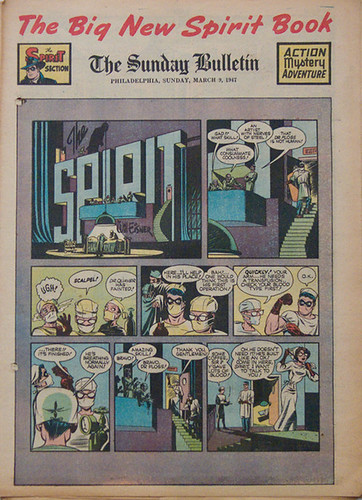
"The Spirit" is one of those "pure" super-hero concepts from the '40's, like Superman and Batman. Created by Will Eisner in 1940, "The Spirit" combined film-noir with masked vigilantes and "Terry and the Pirates" femme-fatales. His origins were always a little murky, but "The Spirit" was the born-again/ reincarnated/ revived corpse of policeman Denny Colt, "killed" in the line of duty. He wore a blue business suit, hat and gloves, a red tie, and (to appease editors' requests for a "super-hero") a mask.

He had no special powers other than being good in a brawl and irresistable to women. Eisner's artwork and story-telling sensibilities were innovative and is credited with being one of the great creators of comics "language" in much the same way that D. W. Griffith established film language.

One of Eisner's "disciples" and students is Frank Miller, whose ground-breaking work on Marvel's "Daredevil," and DC's "Batman" made him a super-star in the field of comics. Miller began his own series of ultra-violent neo-noir black-and-white comics under the banner "Sin City." The stories could have been a bare-bones story-board for a film, and Robert Rodriguez (with Miller as co-director) made a well-received film of a clutch of the Miller stories for his "Sin City" film.*

Given Miller's status as co-director (and his obvious influence in the design of the film) it was only a matter of time before he was given his own directing job, and naturally, in this super-hero season of the movies, it was going to be "The Spirit" as the subject of his debut.

Will Eisner must be trying to emerge from the grave Denny Colt-style to strangle him.

For instead of Eisner's creation, Miller has made a Frankenstein monster of a film that tries to update "The Spirit," making him an indestructible fighting machine with mysterious revivification powers, and the ability to run across telephone wires. In additon the film is...stacked with an assortment of prominent female stars in subsidiary roles—
Eva Mendes as villainess Sand Saref, Scarlett Johansson(terrible!) as Silken Floss, assistant to "The Octopus" (we're saving him for last), Paz Vega as Plaster (of Paris), Sarah Paulson ("Studio 60 on the Sunset Strip") as Ellen Dolan, daughter of the police commisioner; all of these fine actors are capable of doing better work, but you'd never know from the lack-luster performances and awkward timing of the scenes. It's all meant to be sexy, hip and edgy, but rather than re-create Eisner's light-hearted mix of comic and noir, it falls back on the same "camp" qualities evident in the third and worst season of the "Batman" television series, as well as Joel Schumacher's troubling "Batman" films.

Frequently you'll watch a scene with awkward staging, bad timing, knowing full-well it was done in front of a "green-screen" to put in some background that, if they'd thought about it, might have helped the lumbering quality of the foreground actors. Either Miller didn't know how to make it work, or just assumed that it would work, given his expertise with the material. After working in two dimensions for so long, three seems to be beyong him. As it is, it feels like lazy directing--kinf of like Miller's last "Dark Knight" comic where he drew in the foreground figures and let his colorist wife, Lynn Varley, provide the backgrounds. The results look just as cheap and unprofessional in both mediums.

Now, let's save the worst for last: Most egregious of all the performances is Samuel L. Jackson as "The Spirit's" nemesis "The Octopus." Limited to shots of his gloves in the comics, Jackson is all out-front and comic-satirical in this which doesn't work, although he does manage to mine some laughs out of his material. "The Octopus" is saddled with goons, evidently cloned from Curly of "The Three Stooges." They're all morons, but disposable at a moment's notice. At one point, "Sprit" and "Octopus" engage in a mud-pit death-match that has all the sensibilities (and realism) of a "Tom and Jerry" cartoon—at one point "Spirit" is hit over the head with a lead pipe that comes away with a head-shaped U-indentation. Unfortunately, that's what passes for humor in this train-wreck. In fact, a train-wreck would probably pass for humor in it, too.

All in all, for all its creative advancements in "getting it all up there," the "green screen" type of film environment has managed to confound some accomplished film-makers (ie. George Lucas, Robert Rodriguez, hell, even Kerry Conran is more accomplished!) creating impressive computer wall-papers but leeching the drama right out of their movies. Instead of taking movies forward, they've taken them backwards in terms of performance and film-language. If those guys couldn't overcome the awkwardness of the rootless film with no sets, what made Miller think he could? One suspects its the same flaw that plagues so many of the cartoonist's creations: hubris.

"The Spirit" is a Waste of Time. "My Wallet Screams."

One of Will Eisner's block-titled "splash" pages: Now that's "The Spirit"

* Well-received by everybody but me. I thought the literal translation of "Sin City" the comic to "Sin City" the movie showed just how much different information specificity permeates both mediums. And never the twain shall meet. "Sin City" (the movie) didn't work because once you fill in the 23 frames of action that Miller didn't provide in his drawings, the super-human heroics of ordinary people takes on ludicrous overtones. And, conversely, "Sin City" (the movie) exposed just how weak, snuff-pornish, and lunk-headed Miller's original material ("Sin City" the comic) was in the first place. There are some things the "strobed highlights" of comics and graphic novels do very well, that don't work in the movies (and vice versa). Movies based on comics have to be able to translate the four-color flash-cards that comics represent from static two dimensions to moving three-dimensions--which is why "the Dark Knight" for all its plot-holes, conceits and cheats manages to be a good "real-world" representation of the freak-show aspects of Gotham City.

Tuesday, September 9, 2008

Vicky Christina Barcelona

"Juan is the Loneliest Number That You'll Ever Do"
or
"To Javier and Javier Not"

"Vicky Christina Barcelona" (Woody Allen, 2008) The latest film in what will, no doubt, be called Woody Allen's "Scarlett" period, "Vicky Christina Barcelona" was shot almost totally in Spain, and benefits from the change of location. It's a large part of what drives the plot and the two women who vacation in Spain for different purposes.

Vicky (Christina Hall) is studying Catalan architecture (particularly Gaudi), and spends the time in Spain as a prelude to getting married to staid, reliable Doug (Chris Messina). Christina (Scarlett Johansson) has just written and directed an 18 minute film starring herself, and broken up with the latest in a series of men in impetuous affairs. She has no business in Spain, but goes to spend time with Vicky and get away. Vicky values the safe and dependable. Christina is searching, "certain only of what she doesn't want," as explained by a ubiquitous Narrator (Christopher Welch), whose constant comments make the film feel less a visual experience than a story with pictures.
While in Spain, the two women are approached by darkly handsome artist Juan Antonio (Javier Bardem) who offers to fly the women to the town of Oviedo for the weekend to view the Gaudi works, drink wine, and make love. Vicky thinks Juan is a creep. Christina is intrigued, but both women end up going, Vicky to protect her impetuous friend.

Juan is soulful, attentive, but it is obvious he is in love with his ex-wife Maria Elena (
Penelope Cruz), despite the fact a) they couldn't make it work, and b) she stabbed him in a rage. ("Oh, that..." she says dismissively when it's brought up)
Things get complicated, but never enough for the Narrator to be lost for words or explanations, and when Maria Elena shows up again in Juan Antonio's life, the movie turns, at equal turns poetic, and dangerous. Despite the mannered ways that Allen's films can frequently turn out, this group of actors is particularly well-suited to working outside of Allen's tic's and rhythms. The closest any of the characters come to the Allen neurotic persona (a staple in Allen's films, either played by Allen or a stand-in) is Vicky, but she's much more sure of herself, if not her situation.

Bardem is sadly, relaxed in the film, but Penelope Cruz is a force of nature, this generation's Sophia Loren. After being stuck in some unmemorable films with some straight-jacketed performances, the last few years and films have displayed a bravura presence, and she runs a gamut of emotions in this one to full effect. It's a tough role to pull off--she's held up as an icon until she appears, and when she shows up later in the film, arriving bedraggled from the hospital after a suicide attempt, Cruz more than fills the bill, with her extremes of behavior never seeming contrived or phony. And Johansson has rarely been better represented on-screen--one close-up in particular of Christina listening to Juan Antonio explaining his love for his ex-wife fairly burns on the screen with resentment.

It may ultimately prove to be a minor Allen film, but as a change of pace and an expansion of style it couldn't be more successful.

"Vicky Christina Barcelona" is a matinee.