"The Spirit is Willing, but the Film is Weak..."
"The Spirit" is one of those "pure" super-hero concepts from the '40's, like Superman and Batman. Created by Will Eisner in 1940, "The Spirit" combined film-noir with masked vigilantes and "Terry and the Pirates" femme-fatales. His origins were always a little murky, but "The Spirit" was the born-again/ reincarnated/ revived corpse of policeman Denny Colt, "killed" in the line of duty. He wore a blue business suit, hat and gloves, a red tie, and (to appease editors' requests for a "super-hero") a mask.
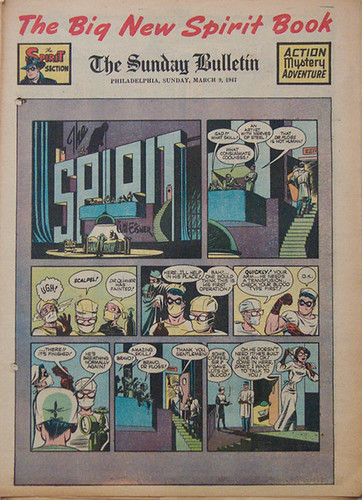
He had no special powers other than being good in a brawl and irresistable to women. Eisner's artwork and story-telling sensibilities were innovative and is credited with being one of the great creators of comics "language" in much the same way that D. W. Griffith established film language.
Given Miller's status as co-director (and his obvious influence in the design of the film) it was only a matter of time before he was given his own directing job, and naturally, in this super-hero season of the movies, it was going to be "The Spirit" as the subject of his debut.
Will Eisner must be trying to emerge from the grave Denny Colt-style to strangle him.
For instead of Eisner's creation, Miller has made a Frankenstein monster of a film that tries to update "The Spirit," making him an indestructible fighting machine with mysterious revivification powers, and the ability to run across telephone wires. In additon the film is...stacked with an assortment of prominent female stars in subsidiary roles—Eva Mendes as villainess Sand Saref, Scarlett Johansson(terrible!) as Silken Floss, assistant to "The Octopus" (we're saving him for last), Paz Vega as Plaster (of Paris), Sarah Paulson ("Studio 60 on the Sunset Strip") as Ellen Dolan, daughter of the police commisioner; all of these fine actors are capable of doing better work, but you'd never know from the lack-luster performances and awkward timing of the scenes. It's all meant to be sexy, hip and edgy, but rather than re-create Eisner's light-hearted mix of comic and noir, it falls back on the same "camp" qualities evident in the third and worst season of the "Batman" television series, as well as Joel Schumacher's troubling "Batman" films.
Frequently you'll watch a scene with awkward staging, bad timing, knowing full-well it was done in front of a "green-screen" to put in some background that, if they'd thought about it, might have helped the lumbering quality of the foreground actors. Either Miller didn't know how to make it work, or just assumed that it would work, given his expertise with the material. After working in two dimensions for so long, three seems to be beyong him. As it is, it feels like lazy directing--kinf of like Miller's last "Dark Knight" comic where he drew in the foreground figures and let his colorist wife, Lynn Varley, provide the backgrounds. The results look just as cheap and unprofessional in both mediums.
Now, let's save the worst for last: Most egregious of all the performances is Samuel L. Jackson as "The Spirit's" nemesis "The Octopus." Limited to shots of his gloves in the comics, Jackson is all out-front and comic-satirical in this which doesn't work, although he does manage to mine some laughs out of his material. "The Octopus" is saddled with goons, evidently cloned from Curly of "The Three Stooges." They're all morons, but disposable at a moment's notice. At one point, "Sprit" and "Octopus" engage in a mud-pit death-match that has all the sensibilities (and realism) of a "Tom and Jerry" cartoon—at one point "Spirit" is hit over the head with a lead pipe that comes away with a head-shaped U-indentation. Unfortunately, that's what passes for humor in this train-wreck. In fact, a train-wreck would probably pass for humor in it, too.
All in all, for all its creative advancements in "getting it all up there," the "green screen" type of film environment has managed to confound some accomplished film-makers (ie. George Lucas, Robert Rodriguez, hell, even Kerry Conran is more accomplished!) creating impressive computer wall-papers but leeching the drama right out of their movies. Instead of taking movies forward, they've taken them backwards in terms of performance and film-language. If those guys couldn't overcome the awkwardness of the rootless film with no sets, what made Miller think he could? One suspects its the same flaw that plagues so many of the cartoonist's creations: hubris.
"The Spirit" is a Waste of Time. "My Wallet Screams."
 One of Will Eisner's block-titled "splash" pages: Now that's "The Spirit"
* Well-received by everybody but me. I thought the literal translation of "Sin City" the comic to "Sin City" the movie showed just how much different information specificity permeates both mediums. And never the twain shall meet. "Sin City" (the movie) didn't work because once you fill in the 23 frames of action that Miller didn't provide in his drawings, the super-human heroics of ordinary people takes on ludicrous overtones. And, conversely, "Sin City" (the movie) exposed just how weak, snuff-pornish, and lunk-headed Miller's original material ("Sin City" the comic) was in the first place. There are some things the "strobed highlights" of comics and graphic novels do very well, that don't work in the movies (and vice versa). Movies based on comics have to be able to translate the four-color flash-cards that comics represent from static two dimensions to moving three-dimensions--which is why "the Dark Knight" for all its plot-holes, conceits and cheats manages to be a good "real-world" representation of the freak-show aspects of Gotham City.