Showing posts with label Joss Whedon. Show all posts

Tuesday, June 25, 2013

Much Ado About Nothing (2013)

"...a Giddy Thing."
or
The Party @ Joss' House

Joss Whedon is a fine writer and a great director.  His output in movies is slim (in TV, of course, it's prodigious)—Serenity, Dr. Horrible's Sing-along Blog, and Marvel's The Avengers, meaning he's got range and he's no slouch—but there's a high-standard operating there whether budget is low or high, and there's an artistic determination to make "pop" that matters.  The story is that for a long time he's been staging readings of Shakespeare plays at his house with friends and acquaintances, just because he loves Shakespeare. That must have been the impetus to make this movie—Much Ado About Nothing—filmed in 14 days during the long arduous post-production of The Avengers.* 

Must have seemed like a lark during so much Hulking pixilation.

The story's virtually unaltered from the text.  It's just transformed to modern day at Joss' house, where a weekend long party is being thrown for...not so much returning soldiers, but captains of industry—hosted by Leonato (Clark Gregg) and daughter Hero (Jillian Morgese) and cousin Beatrice (Amy Acker).  The chief guests are Don Pedro (Reed Diamond), Claudio (Fran Kranz), the Don's nefarious brother John (Sean Maher), and Benedick (Alexis Denisof).  Now, this is one of Shakespeare's comedies, so pay attention: Benedick and Beatrice have history, which didn't go well and they're still equally bitter about it, protesting too much that they're both above it all.  Claudio becomes entranced with Hero, and is wooed on his behalf by Don Pedro.  Things get complicated with two household conspiracies: Don John conspires to way-lay the lightning-fast nuptials of Hero and Claudio, and seemingly the entire party  has it in to throw the two grousers, Benedick and Beatrice, together.  Both plans work all too well, splintering one and making the other a matter of necessity.  In the meantime, the local constabulary, led by Dogberry (Nathan Fillion) are working overtime, trying to discover what all the skulking and whispering is about. 

The play may be the thing, but it is in Whedon's presentation that it shines.  It is something of a revelation to see how well the early scenes play when everybody is a little bit liquored up, and the performances are surprisingly smooth, belying the pigeon-holing that these mostly television actors have had to suffer, when they can do deftly handle the meatier material—Acker, particularly, is amazingly versatile, and is the clear stand-out in the performances—you could actually believe she thinks in blank-verse—and is nearly note-perfect making the words her own.  And Fillion plays his relatively small part in a cagily puffed-up manner the way you'd think William Shatner would (seriously or no) in order to squeeze every drop of comedy out of it.  In fact, everybody's good, as there's only a couple minor roles that seem a little dodgy, but not for want of trying.  Whedon is very adept at throwing in puckishly physical comedy into the background at a moment's notice to make the play three-dimensional, and sometimes laugh-out-loud hilarious.
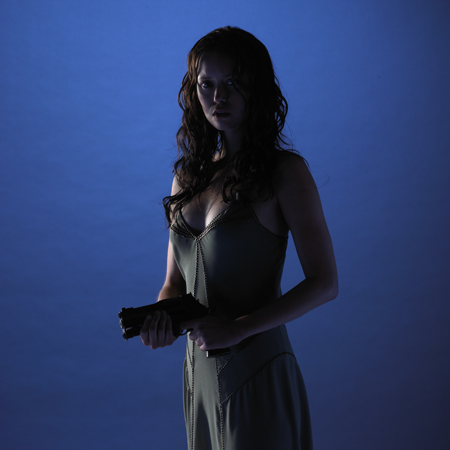
Interestingly, if Whedon made this as a detox from The Avengers, it had the same effect here; after suffering through so many over-blown-up and bloated blockbusters, it was a delight to see this quick, brisk little film, with few pretensions and very high gains.  It's really something, well worth seeing, and one looks forward to another party at Joss' house.

Much Ado About Nothing (2013) is a Matinee.

* Danny Boyle took the opportunity of down-time planning the British Olympics to make Trance.  A few years ago, Robert Zemeckis took the delay-time for Tom Hanks to lose weight for Cast Away to make What Lies Beneath, and Barry Levinson took advantage of down time on Sphere to make Wag the Dog

Wednesday, May 9, 2012

Marvel's The Avengers

"We've Got a Hulk..."
or
Playing Your "A" Game


This one is The Big Pay-Off.

Back in the day (around about Iron Man) when they started doing teasers at the end of Marvel movies for the idea of an "Avengers" event, one hoped that they could pull it off.  Captain America needed to work (and it did). Iron Man II integrated other characters successfully.  They even managed to make Thor somewhat interesting.  And even though two "Hulk" movies under-performed at the box-office, there was still potential there.  Given the scenario of the "Ultimate Avengers" storyline (a revamp in the Marvel line that started everything over from Origin Story Square One with a decidedly more adult, realistic attitude...and a Nick Fury that looked like Samuel L. Jackson) a case could be made for a good old fashioned Marvel Jam story of the "When Titans Clash!" school.

The problem is all those heroes. It could turn into a mighty cluster, if there isn't a compelling story that slots heroes into appropriate scenarios, a problem with some of the "X-Men" films.  And one also hopes that there's a compelling reason for these guys to be here, that there is some character function going on, even though they have plenty of screen-time in their own series to work on those.

Will The Avengers "assemble" into a well-functioning superhero romp, and make Joss Whedon (who excels at ensembles) an A-list director that fans have been hoping for?

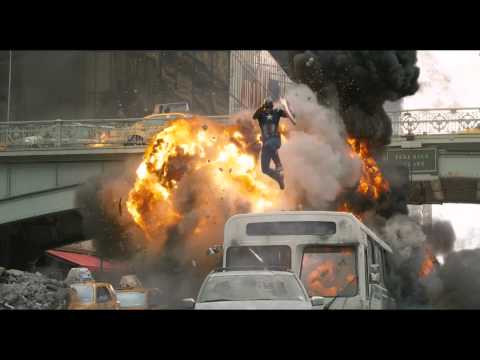
"Yes" to the former and "Maybe" to the latter, although pulling off this one is not an easy feat—so many particular and persnickety stars, so many owned and exploitable characters that corporations (and opposing film studios) want to manage, and so many potential minefields that it would take a superhero (with levitating powers) to rise above and negotiate them.  But Marvel's The Avengers (what they're calling this one to avoid any confusion) manages to be fast-paced, quick-witted, and, although slightly derivative (mostly of Jack Kirby's "Fourth World" series, with hints of The Andromeda Strain in sub-text, and, let's face it, most mythology and comic book tropes), and is, as one character analogizes, "a bag full of cats," fulfills its basic tenet: to be consistently entertaining, with crises every few minutes, wonders to behold (some of the sets are simply amazing), interesting pair-ups in terms of fights (Marvel heroes are always fighting each otherthey're very turf-oriented, which is bad because they're all in New York) and dialogue.  

And it does two essential things: keep each individual hero definable in tone and action, and make those fights "followable"—this isn't a hodge-podge of pictures of punches, muzzle-flares and explosions, there is breathing room between sequences and shots, so an audience is allowed to register action and result, something missing from a lot of action movies, where there is either bad direction or a style-disconnect between various "units" filming.  It feels "of a piece," despite the subject of the film being about extraordinary outcasts aligning uneasily.*

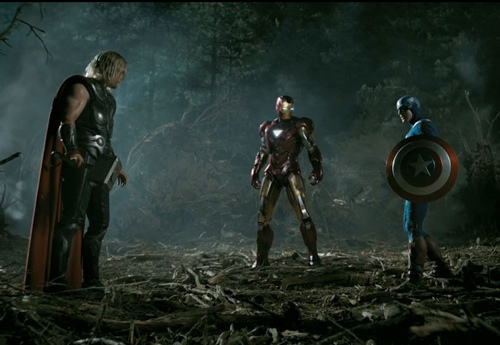
In a pithy line of dialogue between "Iron Man" Tony Stark (Robert Downey, Jr. riffing brilliantly) and villain Loki (Tom Hiddlestone, registering far more than he did in the Thor movie)—everybody gets their Loki scene, The Hulk's being the best—the entire movie is summed up in an adamantium-encased nut-shell: "Yeah, takes us a while to get any traction, I'll give you that one but, let's do a head count here. Your brother, the demi-god; a super soldier, a living legend who kind of lives up to the legend; a man with breath-taking anger management issues; a couple of master assassins, and you, big fella, you've managed to piss off every single one of them."  

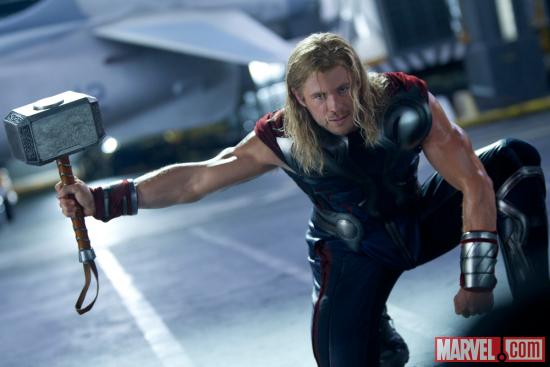
Motivation enough to form a coalition of the willing.  And the disparate styles of the players is well-evidenced-six degrees of declaration: Chris Evans is all un-ironic directness (even though he is perfectly capable of matching Downey snark-for-snark);  Chris Hemsworth is all stentorian brio done with Shakespearean force (he's so much more effective here than in his own movie); Jeremy Renner is as taut as his crossbow wire, Scarlett Johnasson's blank-stared Black Widow is well-suited for her position as a lethal scam-artist, Samuel L. Jackson manages to make even original lines sound like oft-quoted cliches; and Downey, quick and mercurial, dances around the dialogue, adding his own steps.  Each actor has their own way of working with Whedon's words, and Downey's pace has everyone playing their "A" game.

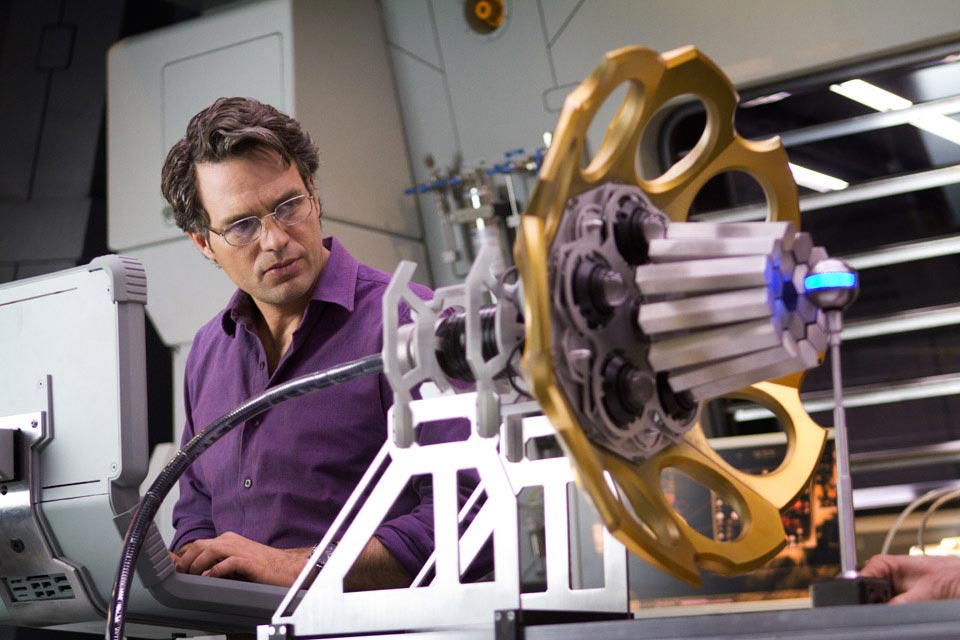
But the best here is Mark Ruffalo, playing Dr. Bruce Banner and (the first time an actor is allowed to, via motion-capture) his altered super-ego, The Hulk.  Two movies and two different actors (Eric Bana and Edward Norton, no slouches) tried to do something with the limited premise and came up short.  However, here, with less screen-time, Ruffalo manages to make Banner as interesting as his comically destructive "Other Guy," his physicist not guarded or fearful or weak (as has been the norm), but ironically bitter, resignedly haunted, the most mysterious of Marvel's "Mystery-Men."  "You really have got a lid on it, haven't you?" says Stark at one point, referring to the Doctor's self-control and the monstrous result of any lack of it.  "What's your secret? Mellow jazz? Bongo drums? Huge bag of weed?"  Maybe The Hulk is such a one-smash pony that he's at his best as a supporting character, rather than the star of a movie series.  One could argue that about all the characters here with the exception of Downey's Iron Man, who is, due to the actor's efforts, a one-man circus.

But, here it's all in the group, nobody's around long enough to drag it down, and it's the interactions that count.  The plot is MacGuffin-oriented in the Marvel-style of "I-don't-know-what-it-is-but-it-sure-is-big:" the doohickey from Captain America and the whatsit from Thor are involved so that a race of advanced aliens can take over l'il old us.  Not sure of the motivation, but who cares? Marvel's The Avengers is big, bold, brassy and breezy, and has the feel and crazy zeal of those Japanese monster movies that combined a lot of characters and smashed them together.

I don't know what it is, but it sure is fun.**


Marvel's The Avengers is a Full Price Ticket.  (Go ahead, see it in 3-D)

All the potential Avengers, assembled by George (every little detail) Perez

* Whedon shows the eventual alliance solidifying in two nicely planned shots, one—used in all the commercials—orbiting the heroes as they "circle the wagons," and a meticulously planned CGI sequence in mid-battle that is the super-hero equivalent of "going around the horn."

** There are TWO codas this time: one after the initial credits (before they get into the detail stuff) and another one that was filmed right after the Hollywood premiere that's odd...but fun.

Tuesday, November 18, 2008

Serenity

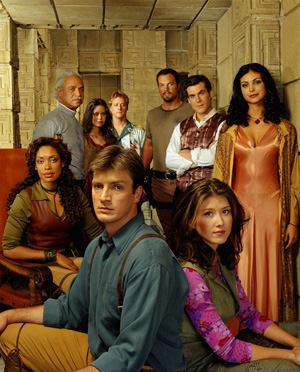
"Serenity" (Joss Whedon, 2005) Enjoyable, if violent, genre-bendin' space-farin' Western spinning off from the one season wonder "Firefly." But "Serenity" (that's the name of the ship) passes the crucial test of movies that make the leap from small to big screen--you don't need to have seen the series to "get" the concept and enjoy the film (probably because the concepts are so familiar). Sharply written and directed by series creator Whedon, and played by the regular cast, it boasts an intensely underplaying Chiwetel Ejiofor as a government operative who ritualistically silences outliers.

And outliers are exactly what the crew of the "Firefly"-class "Serenity" is comprised of; pirates, soldiers of fortune, outlaws, the scrappy veterans of the Galaxy's last civil war, who bounce from system to system dodging government entanglements and making a living by lying, cheating and stealing. Plus, they do good while doing bad.

The conceit of staging a Western in the infinitely wide-open spaces isn't new. "Star Trek" was sold to NBC as being "Wagon Train to the Stars"--not exactly true, but the suits got the point, "Star Wars" used Han Solo as a space cowboy ala Hondo (which Chewbacca as his faithful dog...or horse), and the "Wars" rip-off "Battle Beyond the Stars" was "The Magnificent 7 in Space." There isn't that much of a light-speed leap from horse-opera to space-opera. After all, the umbrella-genres of westerns and sci-fi can encompass all sorts of story-themes from Shakespeare to cleverly disguised issues of the day.

The plot for "Serenity" back-tracks a bit* to catch movie-goers up with the story of fugitives River Tam and her doctor-brother Simon and then resolves the conflicts their paid passage aboard Captain Mal Reynolds' ship of fools has created, and turns River from loose cannon on deck to a reliable asset. Along the way the crew stumbles on a gone-wrong planet-wide government experiment being kept under wraps. And since they're being pursued by "the op," anyway, they "aim to misbehave."

The characters are broadly drawn, easily discerned, and everyone is given significan plot-time (with the exception of Morena Boccarin's space-zen-hooker Inara, whose role was edited for time). Though not a success at the box office, it did spur interest in the series and kicked its box-set collection into hyper-drive. Though Whedon constantly discounts it, the crew of "Serenity" may fly again.

* In a film-starting series of illusions that nest together like Matryoshka dolls.