Showing posts with label Chris Hemsworth. Show all posts

Wednesday, November 20, 2013

Thor: the Dark World (and the Comic-Book Movie Matrix)

"I Really Don't Understand What All the Fuss is About"
or
"Is There a Point to All This, Because There Needs to be a Point!"

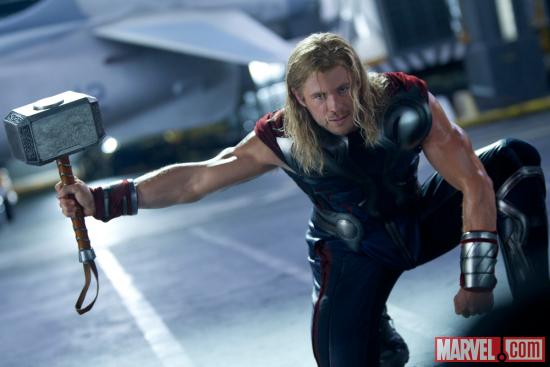
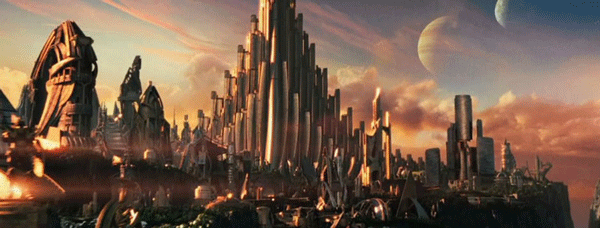
Marvel's Thor was a necessary part of The Avengers puzzle—the Norse God is a little minor-ish when compared to A-listers like "Spider-man" or "Captain America" (in the comic world, anyway, where the same could be said for Iron Man) and is usually relegated to second row in group shots.   That first movie was a bit "iffy" despite a Shakesperean director (Kenneth Branagh) and a rather breath-taking conceptualization of Vanaheim.  It took Joss Whedon, though, to throw a couple of good lines into Thor's mouth (without him turning into a jokey punster) and making a grand villain out of Tom Hiddleston's Loki—so grand, in fact, that they brought him back for the second Thor movie, Thor: the Dark World.

This film is part of the "Marvel: Phase Two," which I translate to "We take advantage of The Avengers success by trying to make hay on individual characters until The Avengers 2 comes along."  Good strategy, that.  But there's the danger of watering down anticipation of that next film if they don't show some promise in the second installments, which already showed signs of rust in Iron Man 3.  Even if you're Thor, lightning doesn't always strike twice in the same franchise.

Thor 2 (if we can call it that) is quite a bit lighter in tone than the first film, the first one being rather stuffy, as if there was any humor it would blow the Norse mythology segments away in a puff of whimsy.  No, it was taking its playbook from Jackson's The Lord of the Rings trilogy where the heroes are rustic and the villains are really vile looking and the violence is over-the-top, but not so over the top as to risk an "R" rating.


In lieu of a program, clip and save this
 handy diagram of the Thor Universe
It also compares to TLOTR by sharing the propensity for using the first six minutes or so of the film to shoe-horn as much detailed exposition intoned with doomed gravitas as can be wedged in before the title card.  "Long before the birth of Light," Anthony Hopkins' Odin informs us, "there was darkness. From the darkness, came the dark elves."  That's quite a jump, but then, we have to find out about the Aether (everything in the Marvel Universe seems to be a common term spelled wrong), the Kursed on Svartalfheim, and the 5,000 year configuration of the nine Realms, at which point evil with a capital "E" can take out all nine of them with having to make it a bank-shot.  Malekith (because everybody needs to have a name that sounds like a lisp) and who is played by an unrecognizable Christopher Ecclestonis the leader of the Dark Elves and wants the Aether all for himself, so that he can destroy the nine Realms because...well, I don't know why, it seems like a really dumb thing to do, akin to crapping where you eat.

And at that point, I didn't care.  I just wanted something familiar so that I could stand any chance of following the movie.  Now, the last time I saw Thor, he was in The Avengers movie, and some mention is made of "New York," especially by gal-pal Jane Foster (Natalie Portman), who uses it 1) as part of a "why didn't you write me for two years?" hectoring of Thor (Chris Hemsworth, not so stodgy this time) and 2) a chance to lash out at Loki (Hiddleston) as if he personally took out her favorite pizza cart on Fifth (and he gets a chance to do his version of the line from The Dark Knight: "[She's got some fight in her]. I like that.").  Plus, Dr. Erik Selvig (Stellan Skarsgaard) has been acting strangely—making international news by stripping naked with some sort of stick-devices at Stonehenge that are supposed to do some sort of astral plane alignment or something, or maybe nothing as he's a bit of a raving lunatic at this point (His excuse: "I've had a God in my head.  I don't recommend it" Geez, Doc have you watched TBN lately?).


Meantime, the already-mentioned Loki is imprisoned in As-Gitmo, where, when he isn't using his quick-change ability, he's sulking and throwing illusory daggers at people, babbling contradictory dialogue ("You know, I've always loved our little talks because...actually I haven't").  That's some trickster. As with Hensworth's Thor, Hiddleston's Loki actually had become an interesting character in The Avengers movie, and although he's still a little devil, you begin to think that his motivations, if not his brains, are a little scrambled. He does provide a couple of little quick-changes in a walk-and-talk out of Asgard, one of which might be considered a cameo appearance.  He also provides the big "question mark" of the film, that is one of those things that the film-makers will either resolve, or, if they have bigger flounder to fry, will just dismiss with a line somewhere down the road.

Speaking of which, there could be considered three "stingers"—the convention of mid and post-credit "tags" in the Marvel super-hero films—in Thor: the Dark World that have decreasing importance, but increasing complexity (how many of these things are they going to have, not that Brian Tyler's score isn't rather fun to listen to, but sometimes I have better things to do than watch all the credits).  There is the "stinger" that ends the film, and confuses the issue of what was going on; there is the second "stinger," after Blur Studio's main credits, that serves as a preview for another Marvel production**—in this case, Guardians of the Galaxy with a look at Benicio del Toro's "Collector" (and we'll just say two words: "tonal shift"); finally, a third stinger at the very end of the movie that's purely for "shippers" and has an "after-thought" joke, much like the "shawarma" scene from The Avengers.  There's nothing essential to wait for, if you have a ride waiting.


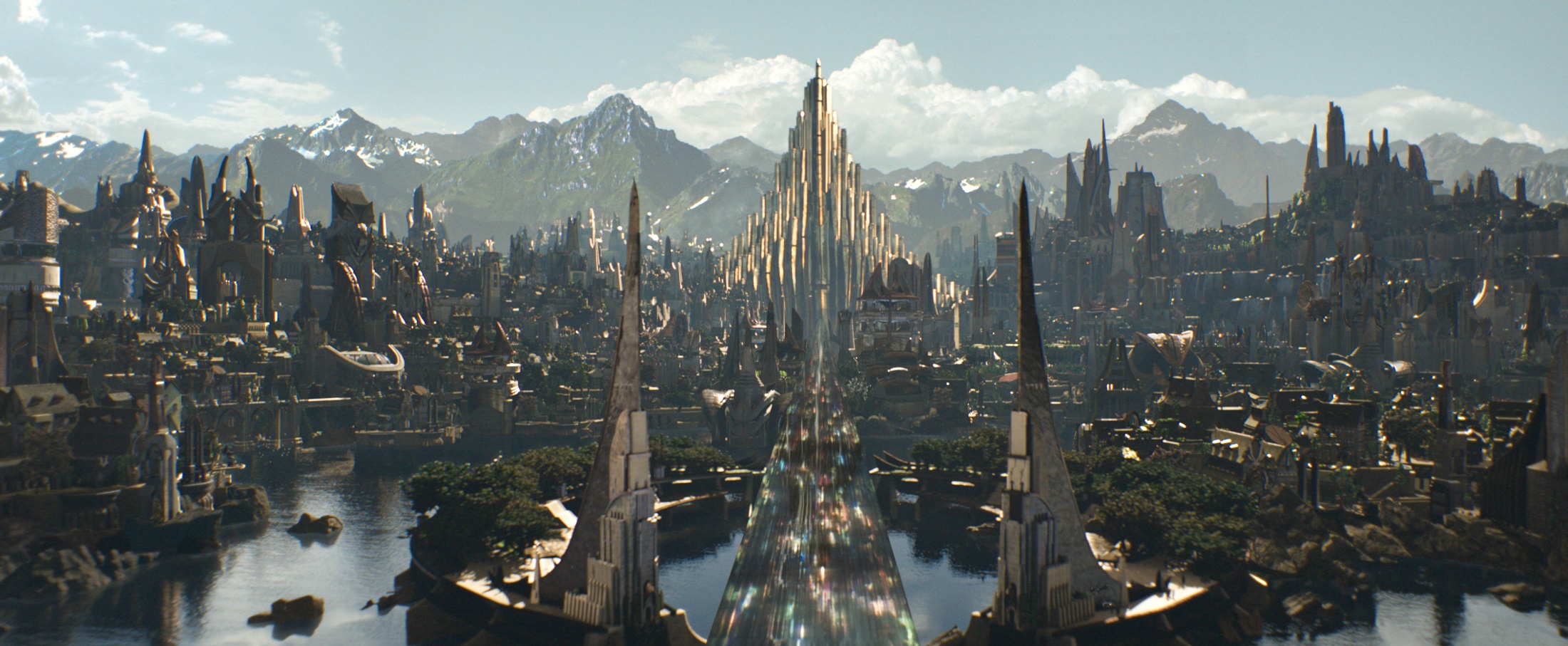
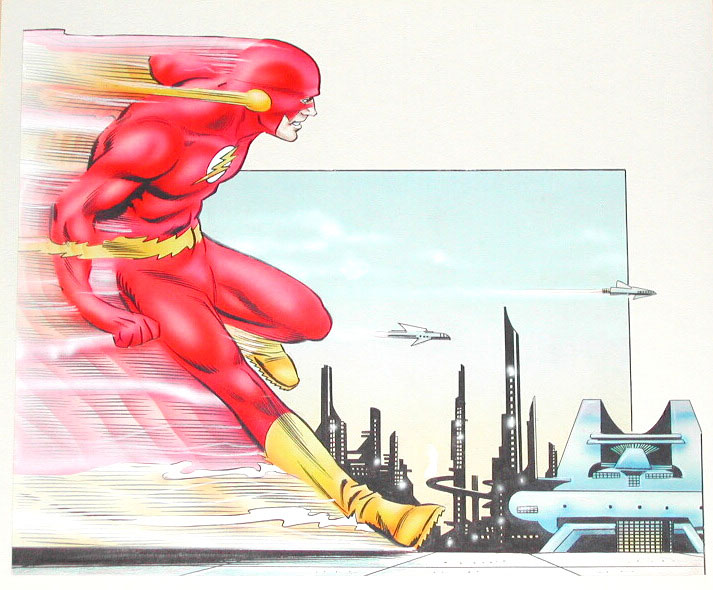
Throw in some ramps and Asgard could look like one of Carmine Infantino's futuristic cities.

So, summing up, Thor: the Dark World is generally more entertaining than the last one, but not entertaining, realm-changing, or artistic enough to make it rise above the Rental category.  Characters are born, characters die, and the Universe is returned to the same point it was at in the beginning of the movie, not unlike episodic TV.  Nothing major is going to happen until somebody's contract runs out.  In the meantime, it looks good, fulfills the action quotient, without going over the line (Hello, Man of Steel) to the point where you think it might be better not to have superheroes "saving the day" but destroying the infrastructure.  It does suffers from the Marvel "I-don't-know-but-it-sure-is-big" syndrome, where there are no rules, and merely randomness in phenomena that just show up, make a big noise and then *poof* go away, leaving us to mull over our shawarma or bowl of "Shreddies." There is no order to the Marvel Universe (as much as the tick-tock clockwork of the art direction says there is), and it's easier to take a page from "The X-Files" and just leave it unexplained.  Or come up with a convenient new super-power like "amnesia kiss" to take care of it.   Sometimes, rather than thinking through a problem, it's just better to hit it with a hammer to make you think it's getting better.

Thor: the Dark World is a Rental. 

"I've won an Oscar; why am I in this Moooo-viiiiie?"

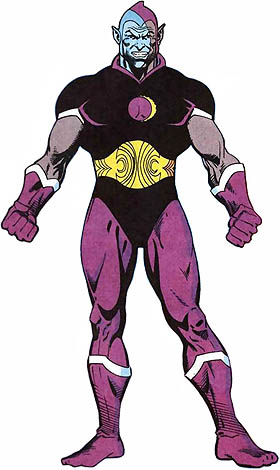
The comics Malekith


* Actually, I recognized him as Eclipso, a character from the DC Universe.  And you'd never recognize him as the Ninth Doctor. "Doctor who?" you ask.  "Exactly," I say.

** Although that's completely arbitrary, nothing is set in celluloid stone, and the solar wind is more stable than the tides of movie marketing—the cosmic villain Thanos appeared in The Avengers, may appear in Guardians in the Galaxy and definitely won't be in Avengers 2.


----------------------------------------------------------------------------------------------------
Now that that's done, one is worried about how to write about super-hero movies in the future.  There is a sameness to them that creeps from film to film—the mythos, the "givens" of selfless good and illogical (and often impractical) evil, the unquestioning quest for revenge, the brooding sky-scapes, the heavy air of portent, and the elaborate CGI.  One feels like they're in the process of grading different brands of chocolate.  They may be bitter or sweet, but they're all chocolate.

So, in the future, as the tent-poles of the franchise circus increase in number, we're going to do reviews of super-hero movies with a basic form—a Comic-Book Movie Matrix, that should distill what the movie's about, where it fits in its own little universe, and how successful it is—as a movie-movie, and maybe as a representative of that character.

Take a look at the list, and if you have any suggestions for what might be a critical consideration, drop a comment.


1) Is the movie version of the character recognizable from the graphic/comics version?

2) Is the plot something that someone who doesn't know the comic can come in and still understand?

3) If not, how complicated is the back-story that is provided in the movie?

4) What's wrong this time, plot-wise?

5) Is the story important enough to deserve its own movie, or is this one just "marking time?"

6) In relation to 5): Major villain or minor villain?

7) Is the back-story and motivation the same as in the graphic/comics version?

8) How radically different is the setting of the movie version to the graphic/comics version?

9) What compromises have been made to the comics version to make it "play" on-screen?

10) Is there a "Noooooooo!" moment? Yes? No?

11) Any easter-eggs for the true fans?

12) Is there a stinger? Is it worth waiting for?  Where does it occur?


Really, this is just to increase my Internet "hits"
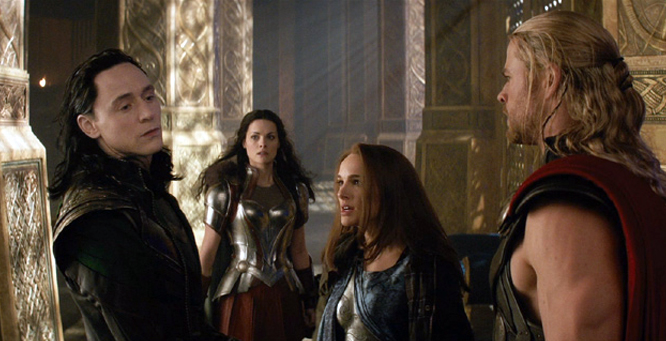
Jaimie Alexander as Sif in Thor: The Dark World

Tuesday, October 15, 2013

Rush (2013)

Winning Isn't Everything...
or
Keep Your Friends Close, But Your Enemies in the Rear-View Mirror (They May be Closer Than They Appear)

The main reason I wanted to see Rush was that it has a script by Peter Morgan, whose work from The Queen, The Last King of Scotland, Frost/Nixon, The Damned United, Hereafter* have all been thought-provoking, literate screenplays and one wondered how he could provide that in a racing film, a sub-genre focused more on visceral momentum and the visual and where the weakest sections have always been those outside of the cars and off-track.

This one, though, it completely opposite in the tradition of Howard Hawks' race-track movies. And it's all true (except for a lie or two).  It tells the story of two (eventual) Formula 1 drivers, Niki Lauda (Daniel Brühl), Austrian, teutonic, disciplined, engineer and James Hunt (Chris Hemsworth), British, louge, seat-of-your-pants, tactician. They couldn't be more different except that both want to be the best and will do anything, risk anything to get there.


And they're both damned good drivers.**

Both are bad boys in their own ways.  Lauda comes from a prominent Austrian family, but does not want to go into the family business, which disowns any acceptance of Niki's ambitions to drive professionally.  So, he finds a race-team going bankrupt, buys it cheap by cashing in his life insurance policy, and takes over, re-building the car's engine from scratch.  Hunt knows a rich boy, Lord Hesketh (Christian McKay) with money to throw away and a party every hour.  In the film, the two despise each other immediately.  The first time Hunt sees Lauda at a Formula Two race (one of those examples of "a lie or two"), director Ron Howard throws a rainbow refraction from Hunt's POV, bringing a mysticism over the moment that might be a bit too much.


That first race, they bump and spin.  Hunt can't pull himself back into the race, his engine conks out, but Lauda, with some difficulty, throws himself the right way and is able to race his way to victory.  Hunt starts to berate Lauda about it, but the Austrian is dismissive—it was the car, not the driver, Lauda had the better car and was able to get back in.  Hunt's still pissed, insults Lauda by saying he looks like a rat, then goes off and parties with Hesketh, the crew and any woman within arm's length, as is his habit.  It's the start of a rivalry that will have its up's and down's, but that is the character-arc that both drivers have, and will have throughout the entire movie.  Their focused competition will push each of them to doing crazy things on and off the track.

It makes a good story.  Except for a lie or two.

It may not seem like much, but it's the Ron Howard way to make movies. Like a good race-track, eliminate any bumps in the road that might add dimension, nuance, or raise a question in the mind that might distract.  If you set up a joke, show the pay-off at the next cut.  If there's a building-up montage, make sure you show the results first thing.  If you want to show the treadmill of being famous, put David Bowie's "Fame" on the soundtrack (released in 1975, it fits the period). 


A shot like this is used quite a bit: it makes you go "hmmm."

In Rush, there's no ambiguity, no wasted shot, not a moment of contemplation or self-doubt.  It runs the rule of every Howard movie (that I've seen, at least, which is all except two) of being so audience friendly that it barely needs an audience, as there is no room for interpretation. At all.

It's not manipulation (all movies are manipulative, even documentaries), so much as keeping it very, very simple—least-common-denominator simple.  It makes a better movie to have Hunt and Lauda just despise each other throughout the movie until the crisis of Lauda's accident.  And even then, the bantering between them has a nice nasty streak running through it.  It would have completely messed up that story through-line if (say) Hunt and Lauda were closer than Morgan and Howard impress...which they were—they were flat-mates for awhile, and enough that Rush would have resembled The Odd Racing Couple if they had shown it—but that would have ruined the all or nothing, go for broke, all-in, simple kind of impression the film-makers are trying to evoke.  If it feels good, why complicate it?  And Howard's films, even the depressing ones, are feel-good movies (I mean, A Beautiful Mind is about schizophrenia and he still managed to bring forth a teary-smile at the end...and won an Oscar for it!).


Really, this is just to increase my Internet "hits."
Olivia Wilde as model Suzy Miller—she's in the film for as long as you're looking at this picture.

So, what am I saying, that it isn't "arty" enough?  No.  It's plenty arty, with a humorous set design and costuming that will make anyone under 30 think we were all mad (and we were, hey, but don't linger at the mirror, yourself). Howard and his cinematographer Anthony Dod Mantle (he bounces between Lars von Trier and Danny Boyle, so of course it's arty), manage to shoot making left turns repeatedly interesting to look at, without becoming fetishistic about it (more Grand Prix than Le Mans, more Frankenheimer, less Katzin), and they have a tendency to repeat a lot of good shots, rather than trying to find every possible angle with which you can photograph a moving car.  So, there's a consistency there of quality over quantity.  And the core of the story—of these two outliers, both unlikable but admirable, racing to the drumming of their own pistons, finding inspiration in each other and realizing it, makes it an interesting movie, and worth seeing.

Rush is a Matinee.


Niki and James, when Lauda came back to racing six weeks after his accident.


*  He was also involved in the early stages of Tinker, Tailor, Soldier, Spy and Skyfall.

** Here's a Lauda quote (a real one) about Hunt:"We were big rivals, especially at the end of the [1976] season, but I respected him because you could drive next to him—2 centimeters, wheel-by-wheel, for 300 kilometers or more—and nothing would happen. He was a real top driver at the time."  That's the sort of admiration Lauda would allow himself—an appreciation of undeniable skill.

Wednesday, May 9, 2012

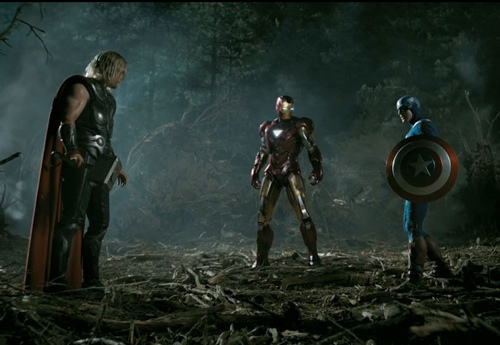
Marvel's The Avengers

"We've Got a Hulk..."
or
Playing Your "A" Game


This one is The Big Pay-Off.

Back in the day (around about Iron Man) when they started doing teasers at the end of Marvel movies for the idea of an "Avengers" event, one hoped that they could pull it off.  Captain America needed to work (and it did). Iron Man II integrated other characters successfully.  They even managed to make Thor somewhat interesting.  And even though two "Hulk" movies under-performed at the box-office, there was still potential there.  Given the scenario of the "Ultimate Avengers" storyline (a revamp in the Marvel line that started everything over from Origin Story Square One with a decidedly more adult, realistic attitude...and a Nick Fury that looked like Samuel L. Jackson) a case could be made for a good old fashioned Marvel Jam story of the "When Titans Clash!" school.

The problem is all those heroes. It could turn into a mighty cluster, if there isn't a compelling story that slots heroes into appropriate scenarios, a problem with some of the "X-Men" films.  And one also hopes that there's a compelling reason for these guys to be here, that there is some character function going on, even though they have plenty of screen-time in their own series to work on those.

Will The Avengers "assemble" into a well-functioning superhero romp, and make Joss Whedon (who excels at ensembles) an A-list director that fans have been hoping for?

"Yes" to the former and "Maybe" to the latter, although pulling off this one is not an easy feat—so many particular and persnickety stars, so many owned and exploitable characters that corporations (and opposing film studios) want to manage, and so many potential minefields that it would take a superhero (with levitating powers) to rise above and negotiate them.  But Marvel's The Avengers (what they're calling this one to avoid any confusion) manages to be fast-paced, quick-witted, and, although slightly derivative (mostly of Jack Kirby's "Fourth World" series, with hints of The Andromeda Strain in sub-text, and, let's face it, most mythology and comic book tropes), and is, as one character analogizes, "a bag full of cats," fulfills its basic tenet: to be consistently entertaining, with crises every few minutes, wonders to behold (some of the sets are simply amazing), interesting pair-ups in terms of fights (Marvel heroes are always fighting each otherthey're very turf-oriented, which is bad because they're all in New York) and dialogue.  

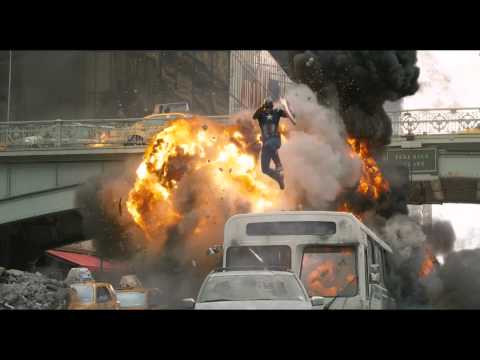
And it does two essential things: keep each individual hero definable in tone and action, and make those fights "followable"—this isn't a hodge-podge of pictures of punches, muzzle-flares and explosions, there is breathing room between sequences and shots, so an audience is allowed to register action and result, something missing from a lot of action movies, where there is either bad direction or a style-disconnect between various "units" filming.  It feels "of a piece," despite the subject of the film being about extraordinary outcasts aligning uneasily.*

In a pithy line of dialogue between "Iron Man" Tony Stark (Robert Downey, Jr. riffing brilliantly) and villain Loki (Tom Hiddlestone, registering far more than he did in the Thor movie)—everybody gets their Loki scene, The Hulk's being the best—the entire movie is summed up in an adamantium-encased nut-shell: "Yeah, takes us a while to get any traction, I'll give you that one but, let's do a head count here. Your brother, the demi-god; a super soldier, a living legend who kind of lives up to the legend; a man with breath-taking anger management issues; a couple of master assassins, and you, big fella, you've managed to piss off every single one of them."  

Motivation enough to form a coalition of the willing.  And the disparate styles of the players is well-evidenced-six degrees of declaration: Chris Evans is all un-ironic directness (even though he is perfectly capable of matching Downey snark-for-snark);  Chris Hemsworth is all stentorian brio done with Shakespearean force (he's so much more effective here than in his own movie); Jeremy Renner is as taut as his crossbow wire, Scarlett Johnasson's blank-stared Black Widow is well-suited for her position as a lethal scam-artist, Samuel L. Jackson manages to make even original lines sound like oft-quoted cliches; and Downey, quick and mercurial, dances around the dialogue, adding his own steps.  Each actor has their own way of working with Whedon's words, and Downey's pace has everyone playing their "A" game.

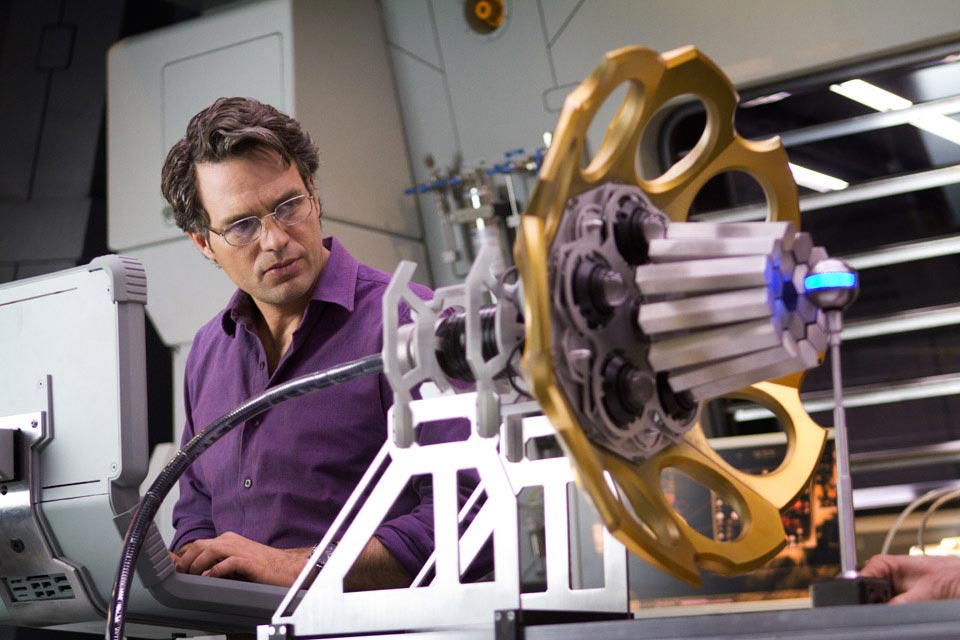
But the best here is Mark Ruffalo, playing Dr. Bruce Banner and (the first time an actor is allowed to, via motion-capture) his altered super-ego, The Hulk.  Two movies and two different actors (Eric Bana and Edward Norton, no slouches) tried to do something with the limited premise and came up short.  However, here, with less screen-time, Ruffalo manages to make Banner as interesting as his comically destructive "Other Guy," his physicist not guarded or fearful or weak (as has been the norm), but ironically bitter, resignedly haunted, the most mysterious of Marvel's "Mystery-Men."  "You really have got a lid on it, haven't you?" says Stark at one point, referring to the Doctor's self-control and the monstrous result of any lack of it.  "What's your secret? Mellow jazz? Bongo drums? Huge bag of weed?"  Maybe The Hulk is such a one-smash pony that he's at his best as a supporting character, rather than the star of a movie series.  One could argue that about all the characters here with the exception of Downey's Iron Man, who is, due to the actor's efforts, a one-man circus.

But, here it's all in the group, nobody's around long enough to drag it down, and it's the interactions that count.  The plot is MacGuffin-oriented in the Marvel-style of "I-don't-know-what-it-is-but-it-sure-is-big:" the doohickey from Captain America and the whatsit from Thor are involved so that a race of advanced aliens can take over l'il old us.  Not sure of the motivation, but who cares? Marvel's The Avengers is big, bold, brassy and breezy, and has the feel and crazy zeal of those Japanese monster movies that combined a lot of characters and smashed them together.

I don't know what it is, but it sure is fun.**


Marvel's The Avengers is a Full Price Ticket.  (Go ahead, see it in 3-D)

All the potential Avengers, assembled by George (every little detail) Perez

* Whedon shows the eventual alliance solidifying in two nicely planned shots, one—used in all the commercials—orbiting the heroes as they "circle the wagons," and a meticulously planned CGI sequence in mid-battle that is the super-hero equivalent of "going around the horn."

** There are TWO codas this time: one after the initial credits (before they get into the detail stuff) and another one that was filmed right after the Hollywood premiere that's odd...but fun.

Saturday, May 7, 2011

Thor


"Thor Thubject  (It's Hammerin' Time!)"
or
"Natalie Portman's Post-Oscar Slump, Part 2"

Never having been a fan of the comic, I could approach Thor without bias—I couldn't argue about the graphics on the hammer, or whether they followed the comics-mythology well, whether the casting was appropriate (they do well with what they got for material, and star Chris Hemsworth does a fine bellow just this side of Brian Blessed in his early, primal days).

But, as a movie, there's nothing too fresh about Thor, in fact, it reminded me a lot of Superman II, but with better architecture (designed by Bo Welch) with its super-beings walking through a hick-burgh doing derring deeds (in this case, a Gort like robot with a furnace grate for a face-plate—it's one of the genuinely cool things about this one), some dicey flying sequences that look a little flat and the big plot-holes in story-logic (if he could do that THEN, why couldn't he do it before?), and a little too much Unexplainium in how things happen and why.

By now, the Marvel films have become formulaic, let me count the ways: 1) love interest—which feels a bit tacked onto Thor (shouldn't there be a demi-goddess he should be attached to?); Stan Lee cameo (mercifully short); cross-characterizations and Marvel Universe details (S.H.I.E.L.D. is back with Agent Coulson (Clark Gregg) and a post-credits sneak with Samuel L. Jackson as Nick Fury (which doesn't amount to much, there aren't any other super-heroes in it, and seems bottled up as it involves Stellan Skarsgård's research scientist and Loki, played by Tom Hiddleston), Stark Industries is mentioned a couple times and there's an intriguing sneak peak of another Avenger in the film, (played by an Oscar nominee) and three action set-pieces that involve a lot of hammering, lots of ice-giants who all seem instantly shatterable and not much of a threat, despite some gratuitous growling (Colm Feore is pretty much unrecognizable as the King of the giants), and leaping with single bounds.

Kenneth Branagh directs with a lot of emphasis on swoops over spires for 3-D effects, ornate throne rooms full of pixelated somethings or other, and a curious propensity for dutch angles (I don't believe there's such a thing as Norse angles).  When Thor is at his most boastful, there is a tinge of Branagh's own Shakespearean projection, and Thor's brother Loki serves as an Iago-like presence throughout

But, it ain't Shakespeare.  The script wheels between the flat-nothing desert of New Mexico that seems to attract a lot of things falling from the Heavens (make that "The Seven Realms"—one of which is called "Anaheim") and the castles built on nothingness of the Asgardians, ruled over by Odin Allfather (played by Anthony Hopkins in "elderly King" mode, although he has flashes of interestingness here and there).  Natalie Portman tries her best with the romantic sub-plot, but it's a "nothing-girl-friend" role and her sections have a slight "blah-ness" to them, though they punch it up with some wacky banter from a wacky intern (Kat Dennings).  Thor feels like a second-rate Marvel movie, like the "Hulk" movies or the "Fantastic Four" films (but several steps above Howard the Duck*).  Try as they might to make it relatable, the scale just fails to register as something that humans have an business being a part of...or even caring about.  I found myself uninvolved and not caring.  Thor might be a hit this weekend, but it's more of a myth.

Thor is a Rental.  Thorry.


* Ya know, I'm amazed that George Lucas hasn't done a CG overhaul of HTD.  Yeah, it wouldn't make it any better, but at least it wouldn't look so clunky.