or
"Is There a Point to All This, Because There Needs to be a Point!"
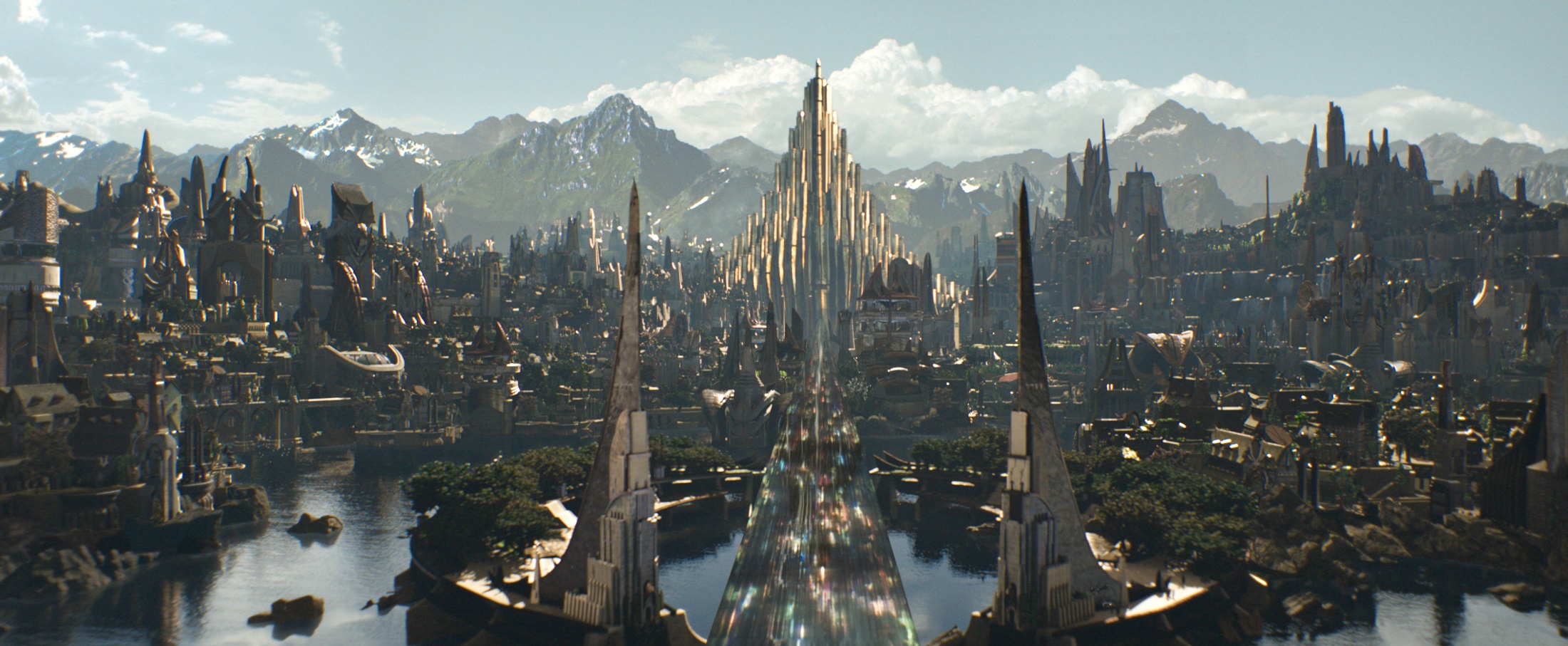
Marvel's Thor was a necessary part of The Avengers puzzle—the Norse God is a little minor-ish when compared to A-listers like "Spider-man" or "Captain America" (in the comic world, anyway, where the same could be said for Iron Man) and is usually relegated to second row in group shots. That first movie was a bit "iffy" despite a Shakesperean director (Kenneth Branagh) and a rather breath-taking conceptualization of Vanaheim. It took Joss Whedon, though, to throw a couple of good lines into Thor's mouth (without him turning into a jokey punster) and making a grand villain out of Tom Hiddleston's Loki—so grand, in fact, that they brought him back for the second Thor movie, Thor: the Dark World.
This film is part of the "Marvel: Phase Two," which I translate to "We take advantage of The Avengers success by trying to make hay on individual characters until The Avengers 2 comes along." Good strategy, that. But there's the danger of watering down anticipation of that next film if they don't show some promise in the second installments, which already showed signs of rust in Iron Man 3. Even if you're Thor, lightning doesn't always strike twice in the same franchise.
Thor 2 (if we can call it that) is quite a bit lighter in tone than the first film, the first one being rather stuffy, as if there was any humor it would blow the Norse mythology segments away in a puff of whimsy. No, it was taking its playbook from Jackson's The Lord of the Rings trilogy where the heroes are rustic and the villains are really vile looking and the violence is over-the-top, but not so over the top as to risk an "R" rating.
 |
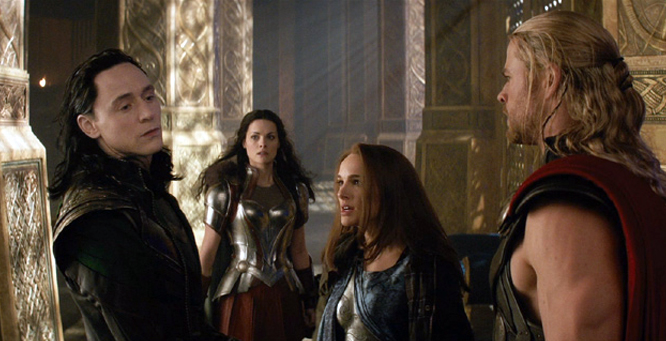
| In lieu of a program, clip and save this handy diagram of the Thor Universe |
And at that point, I didn't care. I just wanted something familiar so that I could stand any chance of following the movie. Now, the last time I saw Thor, he was in The Avengers movie, and some mention is made of "New York," especially by gal-pal Jane Foster (Natalie Portman), who uses it 1) as part of a "why didn't you write me for two years?" hectoring of Thor (Chris Hemsworth, not so stodgy this time) and 2) a chance to lash out at Loki (Hiddleston) as if he personally took out her favorite pizza cart on Fifth (and he gets a chance to do his version of the line from The Dark Knight: "[She's got some fight in her]. I like that."). Plus, Dr. Erik Selvig (Stellan Skarsgaard) has been acting strangely—making international news by stripping naked with some sort of stick-devices at Stonehenge that are supposed to do some sort of astral plane alignment or something, or maybe nothing as he's a bit of a raving lunatic at this point (His excuse: "I've had a God in my head. I don't recommend it" Geez, Doc have you watched TBN lately?).

Meantime, the already-mentioned Loki is imprisoned in As-Gitmo, where, when he isn't using his quick-change ability, he's sulking and throwing illusory daggers at people, babbling contradictory dialogue ("You know, I've always loved our little talks because...actually I haven't"). That's some trickster. As with Hensworth's Thor, Hiddleston's Loki actually had become an interesting character in The Avengers movie, and although he's still a little devil, you begin to think that his motivations, if not his brains, are a little scrambled. He does provide a couple of little quick-changes in a walk-and-talk out of Asgard, one of which might be considered a cameo appearance. He also provides the big "question mark" of the film, that is one of those things that the film-makers will either resolve, or, if they have bigger flounder to fry, will just dismiss with a line somewhere down the road.
Speaking of which, there could be considered three "stingers"—the convention of mid and post-credit "tags" in the Marvel super-hero films—in Thor: the Dark World that have decreasing importance, but increasing complexity (how many of these things are they going to have, not that Brian Tyler's score isn't rather fun to listen to, but sometimes I have better things to do than watch all the credits). There is the "stinger" that ends the film, and confuses the issue of what was going on; there is the second "stinger," after Blur Studio's main credits, that serves as a preview for another Marvel production**—in this case, Guardians of the Galaxy with a look at Benicio del Toro's "Collector" (and we'll just say two words: "tonal shift"); finally, a third stinger at the very end of the movie that's purely for "shippers" and has an "after-thought" joke, much like the "shawarma" scene from The Avengers. There's nothing essential to wait for, if you have a ride waiting.
 |
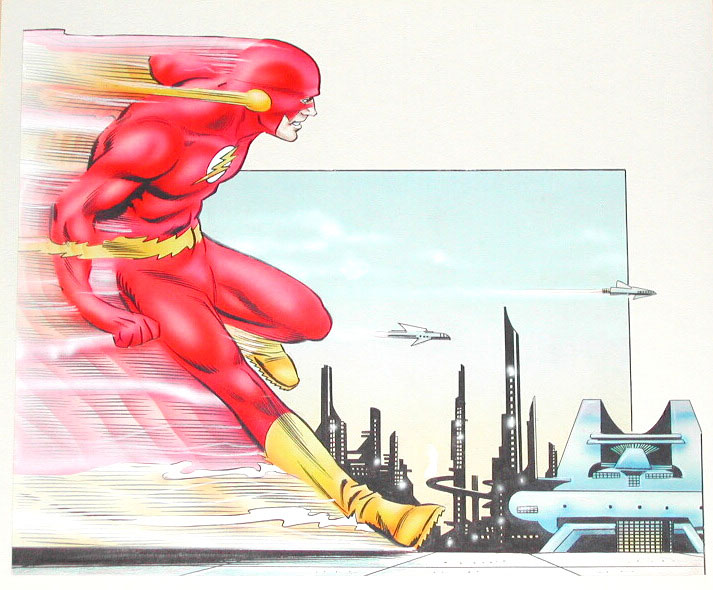
| Throw in some ramps and Asgard could look like one of Carmine Infantino's futuristic cities. |
So, summing up, Thor: the Dark World is generally more entertaining than the last one, but not entertaining, realm-changing, or artistic enough to make it rise above the Rental category. Characters are born, characters die, and the Universe is returned to the same point it was at in the beginning of the movie, not unlike episodic TV. Nothing major is going to happen until somebody's contract runs out. In the meantime, it looks good, fulfills the action quotient, without going over the line (Hello, Man of Steel) to the point where you think it might be better not to have superheroes "saving the day" but destroying the infrastructure. It does suffers from the Marvel "I-don't-know-but-it-sure-is-big" syndrome, where there are no rules, and merely randomness in phenomena that just show up, make a big noise and then *poof* go away, leaving us to mull over our shawarma or bowl of "Shreddies." There is no order to the Marvel Universe (as much as the tick-tock clockwork of the art direction says there is), and it's easier to take a page from "The X-Files" and just leave it unexplained. Or come up with a convenient new super-power like "amnesia kiss" to take care of it. Sometimes, rather than thinking through a problem, it's just better to hit it with a hammer to make you think it's getting better.
Thor: the Dark World is a Rental.
 |
| "I've won an Oscar; why am I in this Moooo-viiiiie?" |
 |
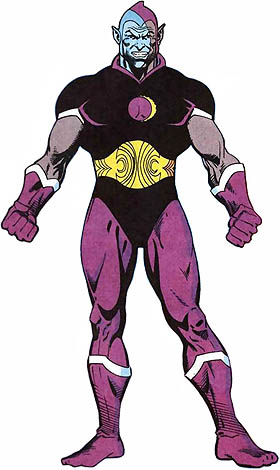
| The comics Malekith |
* Actually, I recognized him as Eclipso, a character from the DC Universe. And you'd never recognize him as the Ninth Doctor. "Doctor who?" you ask. "Exactly," I say.
** Although that's completely arbitrary, nothing is set in celluloid stone, and the solar wind is more stable than the tides of movie marketing—the cosmic villain Thanos appeared in The Avengers, may appear in Guardians in the Galaxy and definitely won't be in Avengers 2.
----------------------------------------------------------------------------------------------------
Now that that's done, one is worried about how to write about super-hero movies in the future. There is a sameness to them that creeps from film to film—the mythos, the "givens" of selfless good and illogical (and often impractical) evil, the unquestioning quest for revenge, the brooding sky-scapes, the heavy air of portent, and the elaborate CGI. One feels like they're in the process of grading different brands of chocolate. They may be bitter or sweet, but they're all chocolate.So, in the future, as the tent-poles of the franchise circus increase in number, we're going to do reviews of super-hero movies with a basic form—a Comic-Book Movie Matrix, that should distill what the movie's about, where it fits in its own little universe, and how successful it is—as a movie-movie, and maybe as a representative of that character.
Take a look at the list, and if you have any suggestions for what might be a critical consideration, drop a comment.
1) Is the movie version of the character recognizable from the graphic/comics version?
2) Is the plot something that someone who doesn't know the comic can come in and still understand?
3) If not, how complicated is the back-story that is provided in the movie?
4) What's wrong this time, plot-wise?
5) Is the story important enough to deserve its own movie, or is this one just "marking time?"
6) In relation to 5): Major villain or minor villain?
7) Is the back-story and motivation the same as in the graphic/comics version?
8) How radically different is the setting of the movie version to the graphic/comics version?
9) What compromises have been made to the comics version to make it "play" on-screen?

10) Is there a "Noooooooo!" moment? Yes? No?
11) Any easter-eggs for the true fans?
12) Is there a stinger? Is it worth waiting for? Where does it occur?
 |
| Really, this is just to increase my Internet "hits" Jaimie Alexander as Sif in Thor: The Dark World |


.jpg)