Showing posts with label Guillermo del Toro. Show all posts

Tuesday, August 27, 2013

Pacific Rim


"Jaeger-Meisters of the Universe"
or
Gigantor versus Godzilla

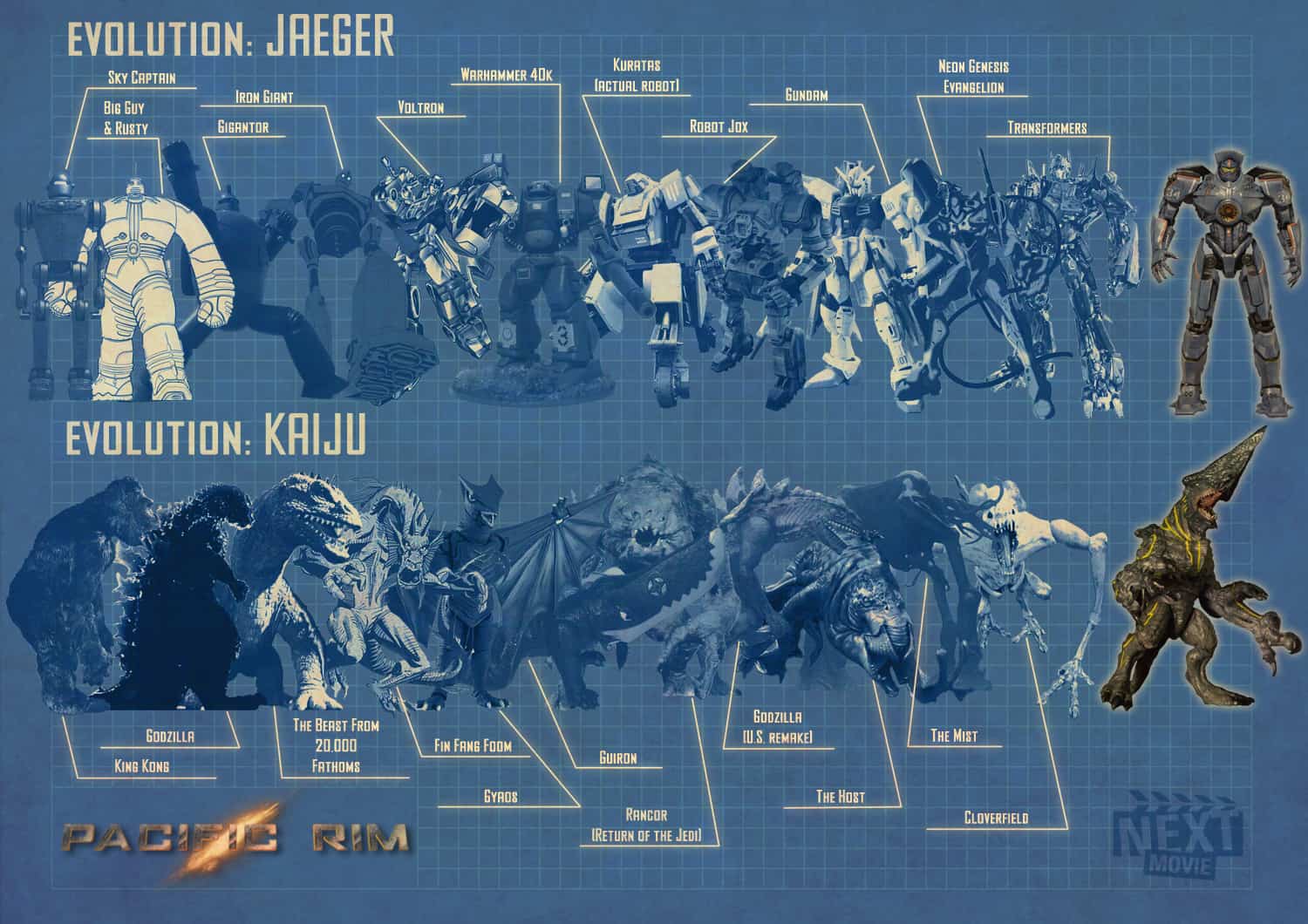
Oh, man.  Guillermo del Toro's Pacific Rim may be the smartest dumb movie ever made, a direct descendant of the Japanese monster movies that became increasingly inane and family-friendly...but were not without their charms...and cultish admirers.  Del Toro is obviously one of the latter, expanding from the menagerie of Big Creature Movies of the 1950's and '60's to posit "if we're getting so many of these things in our midst," what would the World do to combat them?

Build really big, hurkin' robots to beat 'em up, of course!  


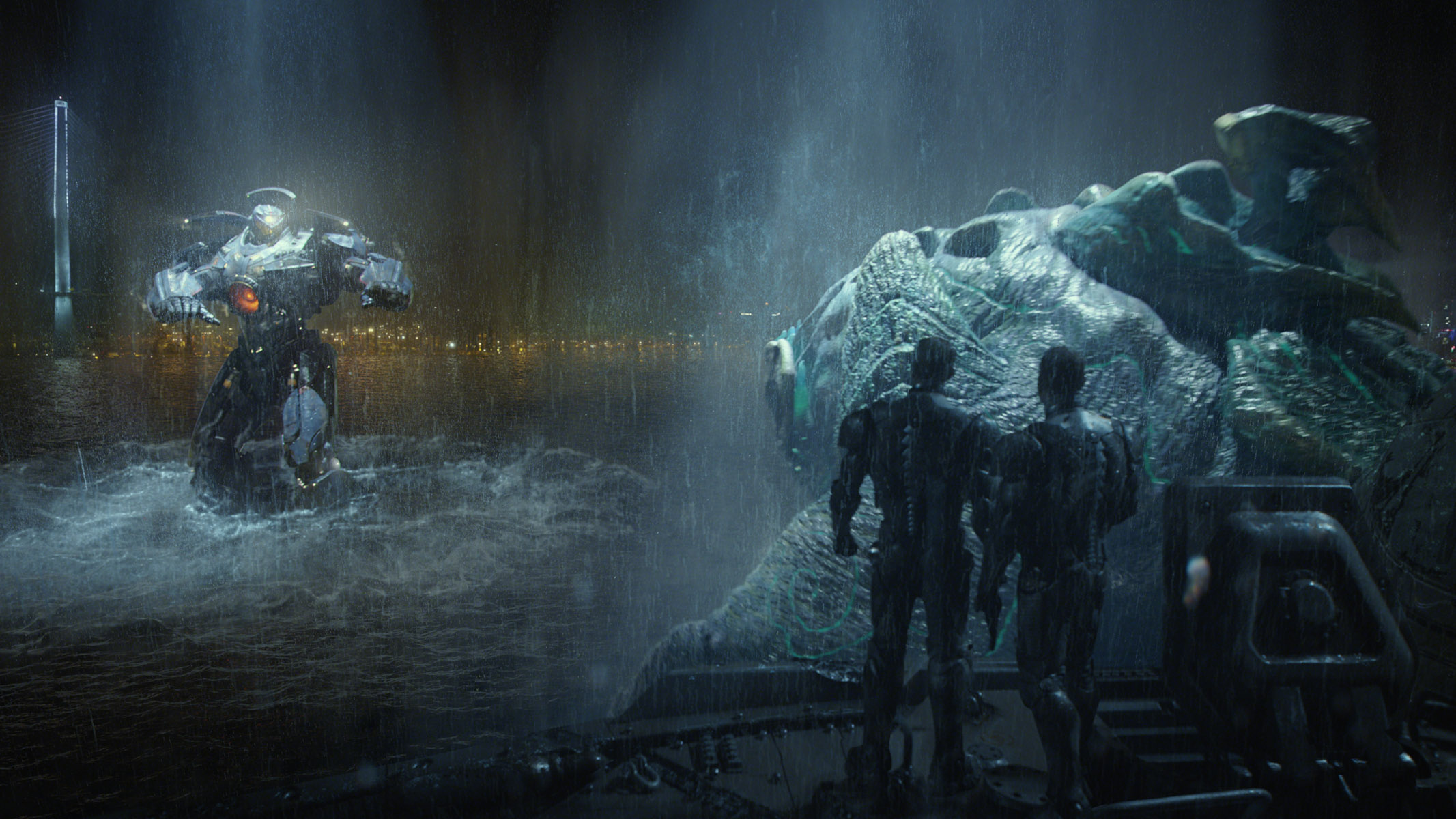
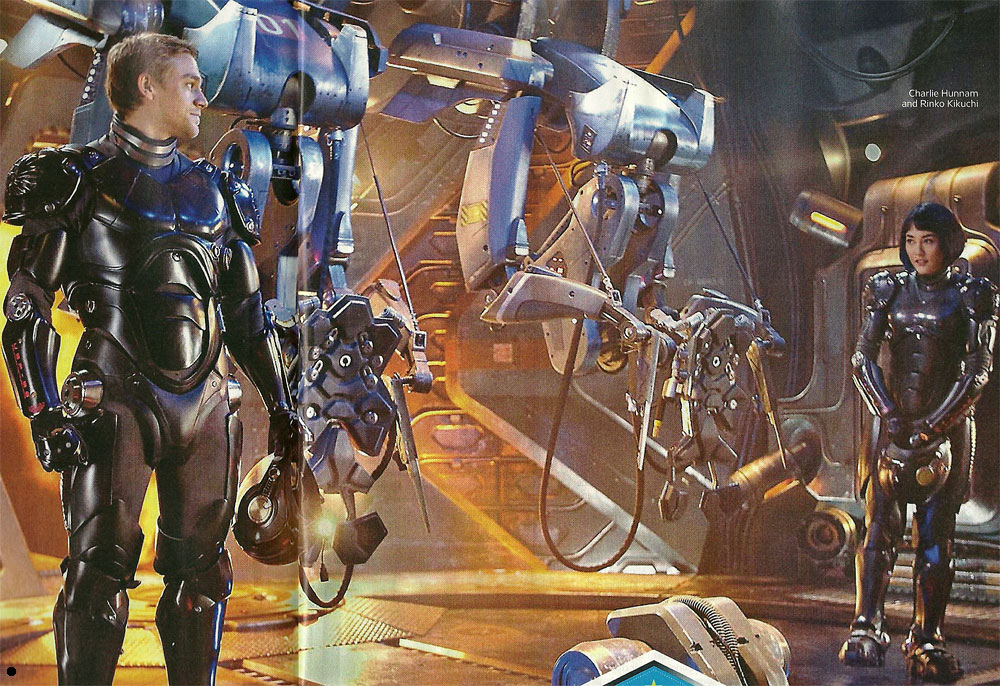
In a short explanation at the beginning, pilot Raleigh Beckett (Charlie Hunnam) says, "Whenever I felt lonely I looked at the stars. I was looking in the wrong direction." It turns out that we're not alone; there's a rift in the Marianas Trench in the Pacific Ocean that serves as an inter-dimensional portal for creatures that attack coastal cities, starting in 2013.  The devastation wreaked by the increasing monster attacks compels the Pacific Rim nations—U.S., Russia, China, Australia, New Zealand, Japan, Indonesia—to form their own anti-giant lizard NATO against the "Kaiju," as they're dubbed, by using skyscraper-tall "Jaegers," huge piloted robot warriors to take on the huge lumbering monsters.


For awhile, the system works, the pilots becoming heroes, but the Kaiju get bigger and more resistant to Jaeger attacks and more sophisticated in their assaults, and Jaeger up-keep gets expensive.  World leaders start leaning towards defensive measures—thick walls to keep the invaders out—which, given the increasing abilities of the Kaiju, will eventually be a losing proposition.


Australians comment: "Funny, you don't look Kaijuish"

Parallels to current issues abound, and the film is a bit more subtle tackling other questions than one might expect in a robo-critter slug-a-thon: what are the Kaiju?  Where do they come from?  How does one fight an increasingly sophisticated enemy with the weapons you have?

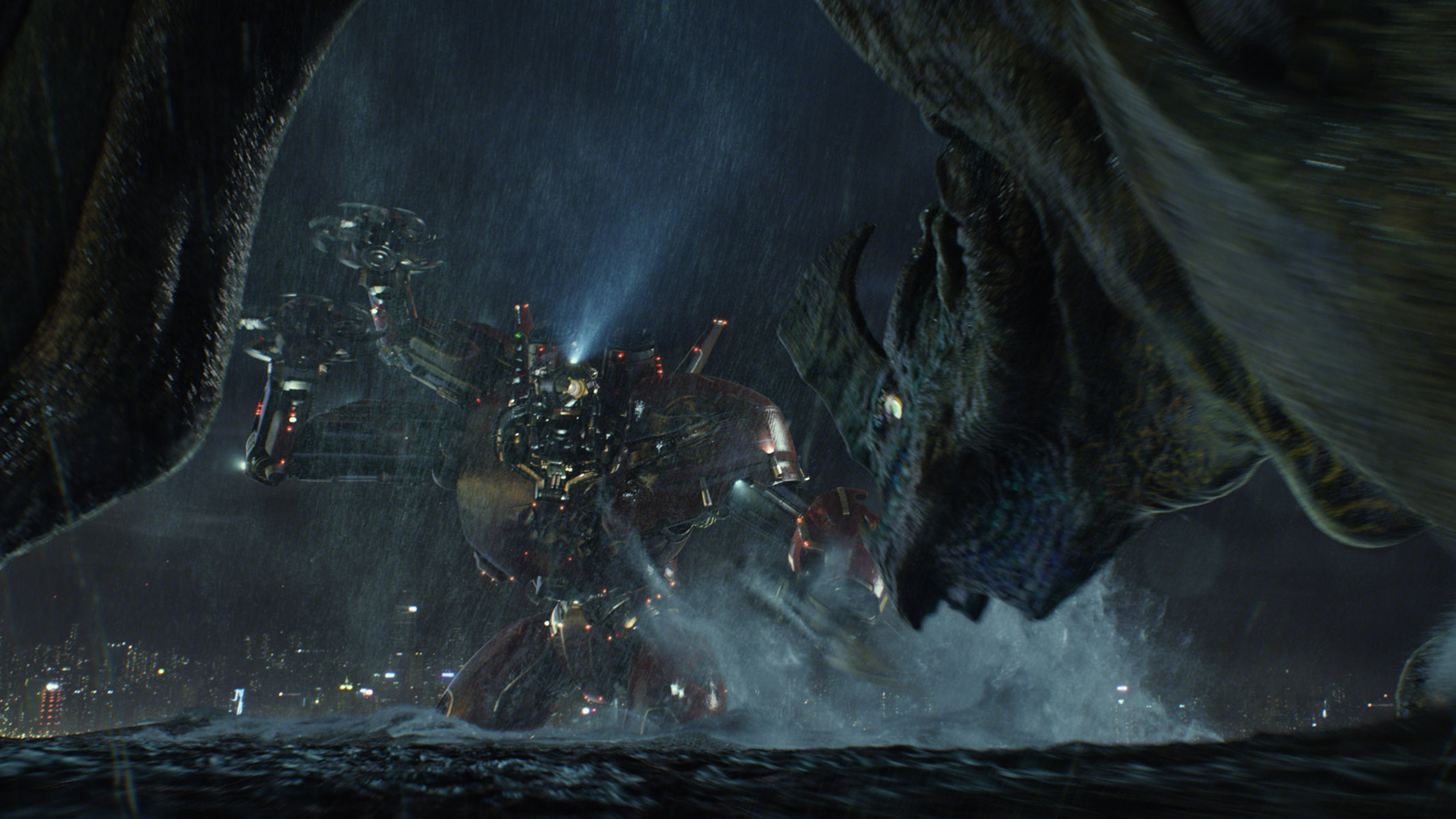
Those are answered in the peripheries of the smack-downs that are the Jaeger-Kaiju battles, which have a giddy "Alley Oop!" quality to them.  There's an inherent goofy quality to seeing these lumbering mecha's—each with their own distinctive movement and swagger—planting hay-makers on assorted carapaces, using WWF moves on the monsters when it comes to close combat.  There's also something innately funny that these robots are so huge, as if they were walking Chrysler Buildings seeking revenge for past attacks.  It takes awhile for the Kaiju to figure out that they should go for the head (where the pilots are), but the Jaeger are so absurdly top-heavy one wonders why they don't just go for the knees in the first place.  Or double-team them by one sneaking up behind one (they have enormous blind-spots, being humanoid-inspired), and kneeling down, so that a front-attacking Kaiju can just push them over backwards—the fighting is that level of sophistication. But overlook that, and the basic concept of two people working in tandem for the movements—explained away by a hokum concept called "The Drift" that allows minds to merge—so that the minuscule puppet-masters can operate the stories tall rod-puppets.


That's in the foreground, but the basic concepts are deep and detailed, with the various Rim stations and individual fighter designs being incredibly complex.  There's also an optimistic "we're all in this together" spirit, despite all the expected competition and squabbling between the teams for most effective skills.


It's weird, inherently silly, but rather thrilling in conceptualization and realization.  And even though the Kaiju are not distinctive enough to be able to quickly ascertain who's who and what's what on first viewing, del Toro manages to keep all things clear—a bit like pulling off his own Jaeger juggling act.  

It's Kaiju-clobberin' time
Now, one would think that after a Summer of mounting indiscriminate screen carnage that has become increasingly boring to watch and numbing to the senses, that any more apocalypse would continue the trend of providing less bang for your buck.  But del Toro has managed to create a movie that has some impact, includes some awe-inspiring moments, and considerable humor to balance the package out, and one has to applaud the "togetherness" factor of individuals and nations forming a Corps of the Clobbering to take on the global threat (did I mention this movie is a complete fantasy?), in a way that doesn't feel militaristic, but is inclusive in spirit.  Hell, yeah, it's goofy, but it is also entertaining and points to how a particular vision can rise above pedestrian material to make something so enjoyable.

Pacific Rim is a Matinee.


Monday, July 14, 2008

Hellboy II: The Golden Army

"Hellboy in a Handbasket"

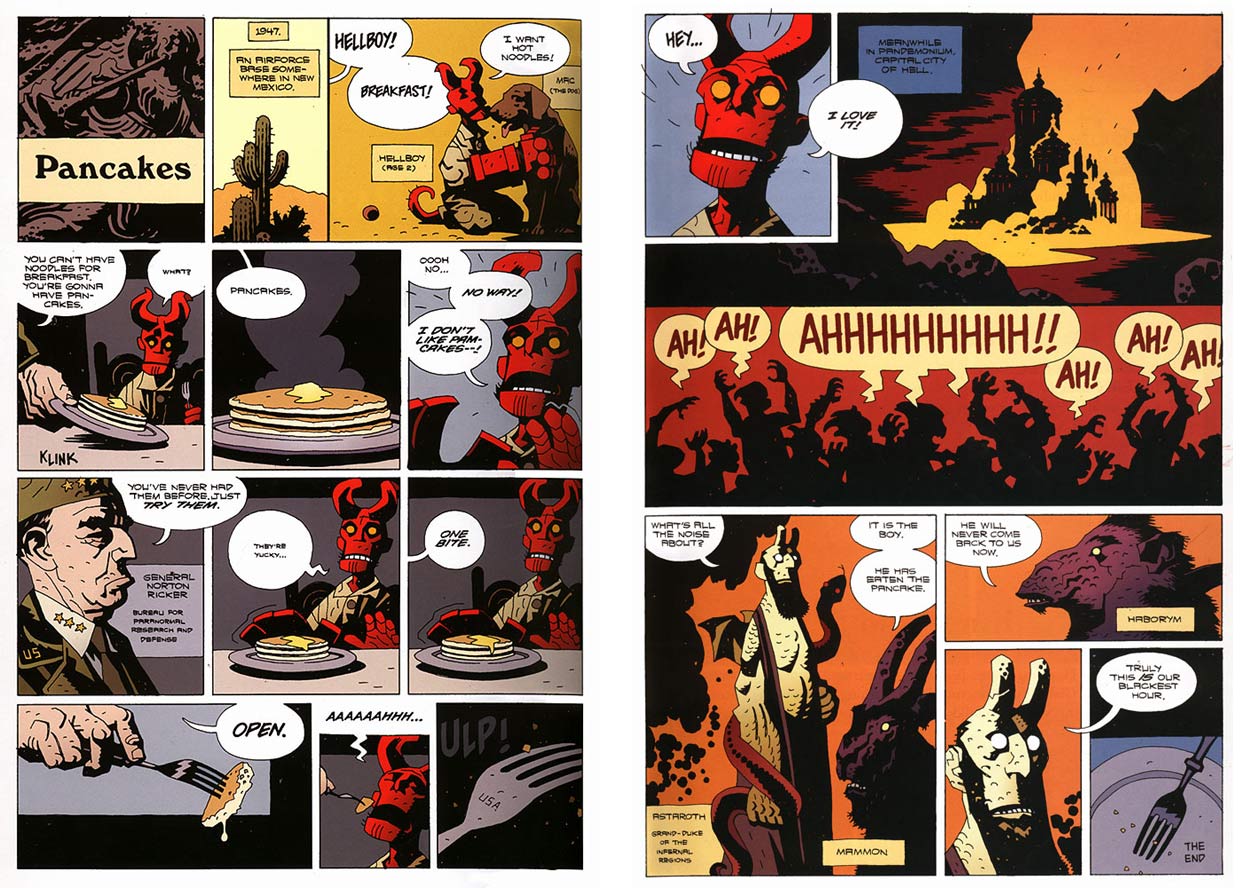
I'm a big fan of Mike Mignola's "Hellboy" comics. His blocky, basic-black approach to illustrating accentuating the shadows, and his austere story-telling that takes six or seven atmospheric issues to tell a 20 minute story, tickle me. And the character is a hoot--a demon's son who is brought to this plane by Allied interference with a Nazi plot to bring a fighting demon to Earth, has grown up to be a cigar-chomping, booze-swilling jamoke who battles paranormal evil--while not buying the über-seriousness of its practitioners, and who, in moments of extreme duress (like having the ground crumble underneath you), utters the basic, "Aw, crap!"

When Mignola and director
Guillermo del Toro brought "Hellboy" to the screen for Columbia Pictures, they did a fine job. First, they selected Ron Perlman, who's never griped about doing a role with a lot of make-up, to play the title character. I had quibbles with the movie--it felt like those early Marvel shows that stream-lined the comics creations to make them go down a bit easier with the public. "Hellboy" provided a lot of comic-book action--I was happy just to hear the character say "Aw, crap!" (which he did three times, perhaps gilding the lily), but they inserted a token white guy (Rupert Evans) for "audience-identification purposes," and created a rather conventional "beauty and the beast" story arc* between Hellboy and "fire-starter" hot-chick Liz Sherman (Selma Blair)--completely unnecessary, I thought, and further diluted Mignola's concept, making The Right Hand of Doom a big softy inside.

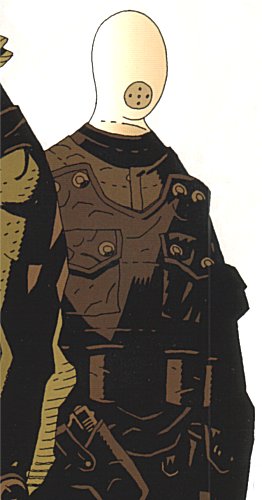
Four years later in this Universal release, "Red" and the rest of the BPRD gang are back (except for the token--he's supposedly been shipped off to Antarctica), and what made the first movie good, makes this one fun to watch at times, as well--Mignola's design sense, brought to steam-punk life by del Toro's artists (Agent Johann Kraus is introduced in this one--he's basically a bubble-headed suit filled with the spirit of a medium, but del Toro turns him into a clattering, hissing contraption), and the occassional bursts of action that don't go on for too long and manage to have a ferocious poetry to them. Particularly gleeful is an opening segment with Young Hellboy and some back-story that is intriguingly and imaginatively presented. Plus, once in the third act there's a surprising Mignola-like occurrence of out-sized proportions when our heroes get to Ireland for the Big Stand-off.

Danny Elfman provides the schizy score; sometimes it's big-band jazzy for a call to action, and sometimes it's just tub-thumping to get the adrenaline up. That, and a jokey walk-through of the BPRD HQ call to mind "Men in Black" territory.

And that love story between HB and Liz--it's more complicated than before and not much fun at all and, frankly, drags this movie down to the basement with chains. Then, gill-head Abe Sapien (Doug Jones is back, with his own voice) falls in love with a nether-world princess, and before long Abe and HB are getting tanked on Tecate (pretty obscure product placement there) and singing along to Barry Manilow (so help me, it's true!). Even Kraus turns misty. I found my demon-sized smile disappearing the farther along the movie went. Occassionally an intricate set-piece would boost my spirits**, but by the end any good feelings I had for this movie had gone to Hell.

I'll stick to the comics.

"Hellboy II: The Golden Army" is a rental. Crap!

Number of times "Aw, crap!" was said: 4

"Wilhelm" Moment: Right before Hellboy falls onto the police car

* I'm still mystified as to why this was necessary as it never appeared in the source material, and Perlman had already been down this road before. Perhaps it's something to attract the ladies. I don't know, but it's completely counter to the original character, and he's quirky and funny enough that this added business dilutes the whole concept.

** The end-set-piece--on a completely illogical stage composed of Mignola-out-sized tech-head gears that seems to be something ripped out of a Disney stage-show--is a fine piece of quick denouement. Then the exit music is Manilow agan...GAAH! It might take an exorcism of Hellboy proportions to get it out of my head.


Coming up: Olde reviews of very violent genre pictures, and we do some historical prep work for "The Dark Knight."

Monday, January 14, 2008

Pan's Labyrinth

Childhood's End

There are some films about childhood and children that should never be seen by them. "To Kill a Mockingbird." "Night of the Hunter." "Lord of the Flies."

And this one.


"Pan's Labyrinth" is in the grand traditon of "fantasy worlds within worlds" stories ala Oz and Narnia and the others that have been dusted off and are in various stages of film-production since "The Lord of the Rings" hit the big time.

But "Pan's Labyrinth" is an original story by its director Guillermo Del Toro and is deeply rooted in his dark-gothic sensibilities.


It is Spain in 1944 and Ofelia and her very pregnant mother are going to live with Spain's version of an evil step-parent--an autocratic fascist captain smoking out a small cadre of rebels in the hills. Though his wife is frail and sick, Capitán Vidal has demanded she give birth to their son at his command post, owing to some generational obsession. Little Ofelia hates him, hates moving and is forthright about her feelings, that is when she isn't retreating to her fairy-tale stories. Along the way in a road alive with floating seed-fluff she finds a piece of masonry that is the eye of a weathered totem. When she replaces it, she releases...a creature, a shape-shifter, a familiar that follows her to the dank, depressing castle of her evil step-father and plunges her into the dark underworld where she is welcomed as a prodigal banished princess who must complete three tasks to return home.

Sound familiar? Of course it is. It's a fairy-tale. And Del Toro excavates deep into our collective subconscious to present the episodes in the two worlds and decorates them in his distinctive chiaroscuro designs that are gross and horrifying but also startlingly beautiful.

Would that children could see this film without fear and that, as in the film, reality could be transposed with fantasy and disbelief in one could be interchanged with the other. For in the deep recesses of Del Toro's darkness is a damned good story with a denoument that is earned in triumph even while it tears at your heart.

Del Toro has always dredged through the creepy shoals of fantasy and horror, scoring hits with "Blade II" and "Hellboy," but those films, like so much of the horror genre, depended on an audience's perverse charity to overlook lapses in logic as well as taste, and he's often taken advantage of that to achieve his effects. This film is not so lax. It earns its shocks with a discipline of story-logic and makes his fantasy elements an integral part of its real-world story. For fantasy to reflect reality has long been a staple of this genre of film. Here, Del Toro has gathered his elements of horror and fantasy and made them reflect a world-view where it is justified.

It is his first perfect film.*

It may well be his masterpiece.**

But it's not for the faint of heart. It's not for the innocent.

"Pan's Labyrinth" is a full-price ticket.

* Well, almost perfect. The sound design is too much (especially in the squishy squinchy sounds of the Captain), too obvious and mixed far too loudly, but I'll give that a pass.

** Also, you should be warned--do NOT walk in late to this movie. The first shot is a crucial and haunting one. It provides a context that resonates and expands the film.