Showing posts with label Olivia Wilde. Show all posts

Tuesday, October 15, 2013

Rush (2013)

Winning Isn't Everything...
or
Keep Your Friends Close, But Your Enemies in the Rear-View Mirror (They May be Closer Than They Appear)

The main reason I wanted to see Rush was that it has a script by Peter Morgan, whose work from The Queen, The Last King of Scotland, Frost/Nixon, The Damned United, Hereafter* have all been thought-provoking, literate screenplays and one wondered how he could provide that in a racing film, a sub-genre focused more on visceral momentum and the visual and where the weakest sections have always been those outside of the cars and off-track.

This one, though, it completely opposite in the tradition of Howard Hawks' race-track movies. And it's all true (except for a lie or two).  It tells the story of two (eventual) Formula 1 drivers, Niki Lauda (Daniel Brühl), Austrian, teutonic, disciplined, engineer and James Hunt (Chris Hemsworth), British, louge, seat-of-your-pants, tactician. They couldn't be more different except that both want to be the best and will do anything, risk anything to get there.


And they're both damned good drivers.**

Both are bad boys in their own ways.  Lauda comes from a prominent Austrian family, but does not want to go into the family business, which disowns any acceptance of Niki's ambitions to drive professionally.  So, he finds a race-team going bankrupt, buys it cheap by cashing in his life insurance policy, and takes over, re-building the car's engine from scratch.  Hunt knows a rich boy, Lord Hesketh (Christian McKay) with money to throw away and a party every hour.  In the film, the two despise each other immediately.  The first time Hunt sees Lauda at a Formula Two race (one of those examples of "a lie or two"), director Ron Howard throws a rainbow refraction from Hunt's POV, bringing a mysticism over the moment that might be a bit too much.


That first race, they bump and spin.  Hunt can't pull himself back into the race, his engine conks out, but Lauda, with some difficulty, throws himself the right way and is able to race his way to victory.  Hunt starts to berate Lauda about it, but the Austrian is dismissive—it was the car, not the driver, Lauda had the better car and was able to get back in.  Hunt's still pissed, insults Lauda by saying he looks like a rat, then goes off and parties with Hesketh, the crew and any woman within arm's length, as is his habit.  It's the start of a rivalry that will have its up's and down's, but that is the character-arc that both drivers have, and will have throughout the entire movie.  Their focused competition will push each of them to doing crazy things on and off the track.

It makes a good story.  Except for a lie or two.

It may not seem like much, but it's the Ron Howard way to make movies. Like a good race-track, eliminate any bumps in the road that might add dimension, nuance, or raise a question in the mind that might distract.  If you set up a joke, show the pay-off at the next cut.  If there's a building-up montage, make sure you show the results first thing.  If you want to show the treadmill of being famous, put David Bowie's "Fame" on the soundtrack (released in 1975, it fits the period). 


A shot like this is used quite a bit: it makes you go "hmmm."

In Rush, there's no ambiguity, no wasted shot, not a moment of contemplation or self-doubt.  It runs the rule of every Howard movie (that I've seen, at least, which is all except two) of being so audience friendly that it barely needs an audience, as there is no room for interpretation. At all.

It's not manipulation (all movies are manipulative, even documentaries), so much as keeping it very, very simple—least-common-denominator simple.  It makes a better movie to have Hunt and Lauda just despise each other throughout the movie until the crisis of Lauda's accident.  And even then, the bantering between them has a nice nasty streak running through it.  It would have completely messed up that story through-line if (say) Hunt and Lauda were closer than Morgan and Howard impress...which they were—they were flat-mates for awhile, and enough that Rush would have resembled The Odd Racing Couple if they had shown it—but that would have ruined the all or nothing, go for broke, all-in, simple kind of impression the film-makers are trying to evoke.  If it feels good, why complicate it?  And Howard's films, even the depressing ones, are feel-good movies (I mean, A Beautiful Mind is about schizophrenia and he still managed to bring forth a teary-smile at the end...and won an Oscar for it!).


Really, this is just to increase my Internet "hits."
Olivia Wilde as model Suzy Miller—she's in the film for as long as you're looking at this picture.

So, what am I saying, that it isn't "arty" enough?  No.  It's plenty arty, with a humorous set design and costuming that will make anyone under 30 think we were all mad (and we were, hey, but don't linger at the mirror, yourself). Howard and his cinematographer Anthony Dod Mantle (he bounces between Lars von Trier and Danny Boyle, so of course it's arty), manage to shoot making left turns repeatedly interesting to look at, without becoming fetishistic about it (more Grand Prix than Le Mans, more Frankenheimer, less Katzin), and they have a tendency to repeat a lot of good shots, rather than trying to find every possible angle with which you can photograph a moving car.  So, there's a consistency there of quality over quantity.  And the core of the story—of these two outliers, both unlikable but admirable, racing to the drumming of their own pistons, finding inspiration in each other and realizing it, makes it an interesting movie, and worth seeing.

Rush is a Matinee.


Niki and James, when Lauda came back to racing six weeks after his accident.


*  He was also involved in the early stages of Tinker, Tailor, Soldier, Spy and Skyfall.

** Here's a Lauda quote (a real one) about Hunt:"We were big rivals, especially at the end of the [1976] season, but I respected him because you could drive next to him—2 centimeters, wheel-by-wheel, for 300 kilometers or more—and nothing would happen. He was a real top driver at the time."  That's the sort of admiration Lauda would allow himself—an appreciation of undeniable skill.

Saturday, June 1, 2013

The Incredible Burt Wonderstone

"Sometimes the Magic Works...."
or 
"Wanna See it Again?"

Repetition, repetition, repetition.  It is the secret to prestidigitation.  Do it over and over and over again, honing the skill, making it more fluid, perfecting the illusion, increasing the speed, so you leave the audience dazzled by the pixie dust of distraction.  Then, once perfected, you do it again and again and again in performance, producing a jaded hardening of the artistry, the audience becoming s revolving series of marks you hit over and over again.  You lose respect of the audience and the skills and the gig.  The magic goes away.

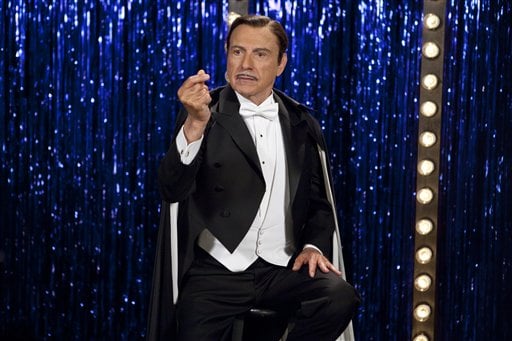
Repetition is the key to The Incredible Burt Wonderstone, too.  One of its major themes is the drudgery of performing the same tricks over and over and over again, a process that turns the titular magician (Steve Carell) into a zombie with a spray-tan, barely able to speak to his partner Anton Marvelton (Steve Buscemi) as they perform the umpteenth repetition of their standard Vegas act.  Not even the addition of a new assistant, Jane (Olivia Wilde) can stop the ennui, as the self-absorbed Wonderstone keeps calling her "Nicole" for some reason.  Probably because he can, she looks more like a "Nicole" than a "Jane," and he doesn't care.  At all.  So, he always calls her "Nicole."  "Jane" she immediately corrects, but he doesn't get it.

Repetition is also the key to Burt Wonderstone's comedy.  They throw out that "Nicole"/"Jane" joke a half-dozen times throughout the movie, and a good many others, too, usually to expose the shallowness and perpetual myopia of the characters as well as the flatness of their learning curves.


That flatness, that lethargy or lack of magic, is the starting point of the character arcs.  Burt is at the top of his game, successful, bored, settled into the day-to-day—the romantic encounters he engineers (if you can call them romantic) are one-night stands he pulls from the audience, provides a quick tour of his pad, a complimentary memento arranged for the evening, the signing of a non-disclosure agreement, and it all ends when he pulls a disappearing act.  Whatever happens in Vegas, stays in Vegas.  Except the magic.  It left a long time ago. 


Burt (Carell) and Anton (Buscemi)—Pure Magic

Because success isn't very funny, Burt and Anton stagnate, especially when there are newer, edgier, geekier magicians with reality shows—like the masochistic, egotistic Steve Gray (Jim Carrey) who bills himself as "the brain rapist." The owner of Bally's (James Gandolfini), where the two have performed to sell-out crowds for years, sees the attendance softening, and demands something more "street" than his regulars can provide, and so they get canned, split up, try to rebuild, crack up, and then the story can actually begin.  

As typical romantic comedies go, this one is by the numbers: Burt's career set-back is completely unprepared for, and he finds that without the safety net of Anton, and the routine of their act, that he can't start over, or reclaim his former glory, so before long he finds himself sinking to rock bottom (performing magic at an old folks home), where, by the prestidigitation of convenient screen-writing, he finds his magic mojo again in the form of Rance Holloway (Alan Arkin), mentor and Obi-Wan Kenobi-figure who critiques Burt's work and attitude ("What, magic makes you feel 80 again?" cracks Burt).  Anybody knows, if they've taken a screenwriting class, or seen any Tom Cruise movie from the '70's-'80's knows how it will run in its course (success kills your soul, there's a rival/villain, and one must have a sage elder to find the proper path), but at least the thing maintains an entertainment value throughout and right up to the end.  Thanks to the mixture of the personalities—Carell, Buscemi, Wilde, Arkin (I'll see anything with him in it), and especially Carrey, who makes the most of his small screen-time—there's always a sprinkling of surprise, a detail, a quirk to appreciate among the over-arching familiarity of it.  There's something magical about that.

The Incredible Burt Wonderstone is a rental.


Saturday, July 30, 2011

Cowboys & Aliens


"This Galaxy Ain't Big Enough for the Both of Us"
or
"Just My Ray-Gun, Pony and Me..."

Good idea, this.  Two genres that have been around as long as there've been movies* and have served the same purpose—taking a theme that might be controversial if played in modern street-clothes, but dress it in rawhide or spandex and it takes some of the "edge" off.  You'd think the two would go together as well as Zero-G and sawdust, but there have been already some tentative steps in anti-gravity cowboy boots: There have been westerns with a touch of fantasy—The Valley of Gwangi—and Sci-Fi with a western foundation (Outland was High Noon in space suits) but the two haven't really been combined as equal parts as in Cowboys & Aliens (the ampersand is required).

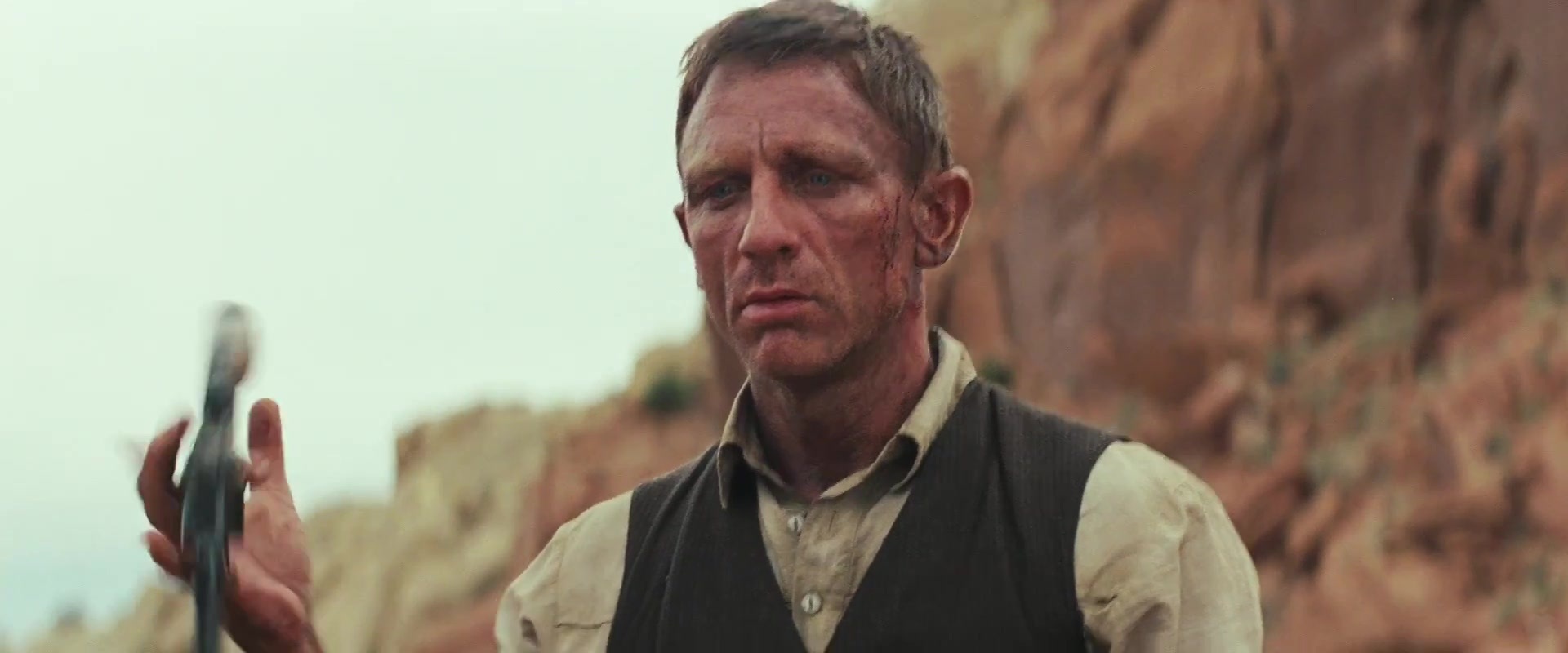
Loosely based on its comic source, it starts in familiar territory—a desert landscape, ancient river-beds long-since dried up and now sun-blasted bluffs and scrub.  Suddenly, a Man With No Name (Daniel Craig) lurches up into frame, sun-burned, bootless, bloodied with a wound in his side.**  He has no memory of who he is, where he is or why he's there (at one point a townie asks him "What DO you know?" "English" is the laconic reply).  One odd thing—a thick manacle from wrist to forearm on his left arm.  Smashing it with a rock would work with hand-cuffs, but this thing won't budge.  He's set upon by riff-raff that he dispatches in a whirlwind of flying fists and gun-fire.  So much for outfitting.  With newly acquired boots, shirt, vest and hat, he climbs on top of a pilfered horse and rides to a nearby town...with a loyal dog in tow.  All the elements are in place.

A stranger in town (and everywhere, one assumes), he gets noticed and in trouble—mussing up the son (Paul Dano, really good) of the requisite town rich-guy-fascist (Harrison Ford, low and husky), and getting landed in the hoosegow by Sheriff John Taggart (Keith Carradine, whose Daddy appeared as a gambler in the granddaddy of Westerns, John Ford's Stagecoach).  That's sounding like Howard Hawks' Rio Bravo, but about the time Ford's Colonel Dolarhyde (nice name for a rancher) arrives with some hired rough-necks to spring his boy, new arrivals appear in town—blue lights in the sky, which turn into flying ships—they recall fighter-jets in the daylight—that start blowing things up and (in a neat touch) lasso people and yanking them into the sky.  The attack sets off The Stranger's fancy bracelet, which starts to "queep," pops up a sight, and knocks one of the ships out of the sky.

Suddenly, The Stranger gets a lot more interesting.

Because the invaders have been nicely particular about who they took—Dolarhyde's son, the Sheriff, the wife of the town's doc/bar-keep (Sam Rockwell, not used well enough, sadly), a posse is formed to find the kidnapees and at this point the movie turns decidedly conventional.  It should.  It's The Searchers, which begat Close Encounters of the Third Kind.  And along the way, the posse manages to accumulate allies in a criminal gang, a tribe of Apaches (who are polite enough not to mention that "an invasion by strange aliens with weapons to take our resources" sounds vaguely familiar), and, for all I know, The Outlaw Josey Wales—who also accumulated an unlikely army that turned into family.  This is useful, because for the big battles with the Invaders,*** there needs to be a large number of red-shirts and red-bandanas to eliminate, so we don't lose the strays that make up the posse, which include a dog, the Sheriff's grand-son (Noah Ringer), and as Clancy Brown's Preacher (gotta have one of those, too) grouses, "We gotta dog and a kid, we might as well have a woman, too"   That woman is Olivia Wilde, who spends most of the movie looking enigmatically sultry, while doing things that make you go "eh?" throughout the movie, beyond just the fact that as Craig gets more and more beat-up, her make-up never gets smudged.  As welcome as Wilde's presence is in all this testosterone, her character is the most problematic, running inconsistently throughout the film—she's either "capable" or she isn't, and ultimately you realize that she's just a "device" that gets the screenwriters (a squad of them including the two that wrote Star Trek and the "Transformers" films—as opposed to the two who wrote the "Pirates of the Caribbean" movies) out of trouble.  Mention should also be made of Adam Beach, who keeps getting better every movie, and Craig who does "the Eastwood thang" real good.  Director Favreau (he of Iron Man fame, his chief skill seems to be impeccable casting), manages to direct it absolutely straight, with just enough of a hitch in the standard cliches to make things interesting, rather than well-trod.

Nothing is made of the irony of these new aliens making life difficult for "the natives," save for some terse nods of collaboration between members of the extended posse.  That doesn't sadden me too much as most movies these days seem to want to beat you over the head with their "message," in case you don't get it.  But, in so doing, Cowboys & Aliens manages to fulfill both the Western and Sci-Fi genre's abilities to put things in unique perspectives to throw a light onto our world. 

As I said, good idea.  A bit fun, too. 

Cowboys & Aliens is a very cheap Matinee.


* As in The Great Train Robbery (1903) and A Trip to the Moon (1902). 

** It's not too unlike the beginning of Silverado where Paden (Kevin Kline) is found by Emmett (Scott Glenn), alone in the desert, robbed of everything but his skivvies.

*** The Extra-terrestrials are nasty looking brutes, who run like apes, and have a physiognomy that makes me wonder if the design is based on some of the designs of director Jon Favreau's planned film of John Carter of Mars (which is now being filmed by Disney-Pixar, directed by Andrew Stanton—the trailer is out now).

Wednesday, December 22, 2010

Tron: Legacy

"A Shaggy God Story"
or
"Rebel Without a CLU"

A sequel to Tron seems unnecessary: the first film was not that good.*  A simple story of corporate (analog) white-collar crime that is resolved and revenged in the digital realm of computers, it only came to life in the (at the time**) high-tech sequences that were computer-generated with simple high-contrast wire animations.  But, given the advances in techniques since 1982, it seems inevitable that a more sophisticated sequel be envisioned and given the green neon light.

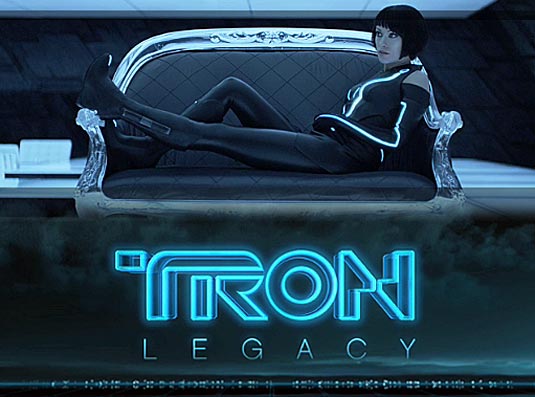
Tron: Legacy, set 28 years later (and directed by Joseph Kosinski), is a better film in construction and underlying story-line—it has to be.  The Matrix films, which resemble Tron in a tesseracted inside-out way, raised the stakes, so audiences are no longer satusfied with cycle-chases and neon-frisbee duels.  Gladiator games are no longer enough.  The story must matter, and be relatable, tap into a collective story...mean something.

The movie tries hard.  At times you see glimpses of Matrix, Terminator, and The Dark Knight, "Frankenstein," the Star Wars prequels, with an underlying "Daddy" conflict out of Oliver Stone.  But, to their credit, there's some Despero there, too.  The Jeff Bridges character Kevin Flynn, CEO of ENCOM (as a result of events in the first film) turns into a messianic figure, part Steve Jobs, part Steve Ballmer, whose vision of life under his brave new cyber-world, promises much—but only if you're not related to him.  He's gone missing, with only grandparents to raise his entitled son, Sam (who grows up to be Garrett Hedlund).  Sam lives a solitary life (although he is a majority stakeholder in ENCOM) wanting nothing to do with the family business—maybe some Godfather in there too?—except for a yearly prank to keep the board from getting complacent.  Alan Bradley (Bruce Boxleitner) is still around,*** and a stray page from the old Flynn's arcade compels Sam to visit, and (wouldn't you know it?) he gets zapped to Tronleyland, which has had some extensive renovation done.

With the help of his digi-gangers to his analog counterparts, Tron, Clu and the others, Flynn has constructed a civilization in his cyberworld, until life, finding its way, is generated on its own.  The ISO's, as they're called, are a new lifeform, that could bring new possibilities to life outside the grid in Flynn's vision.  But every Creator must have his serpent, and Flynn's counterpart visionary, CLU, has his own designs for the future, which includes the invasion and occupation of territory—our world.  The stage is set for a confrontation between Flynn and his monstrous creation over their mutual goal, with Flynn's son, Sam, as the ghost in the machine, the spanner in the works.

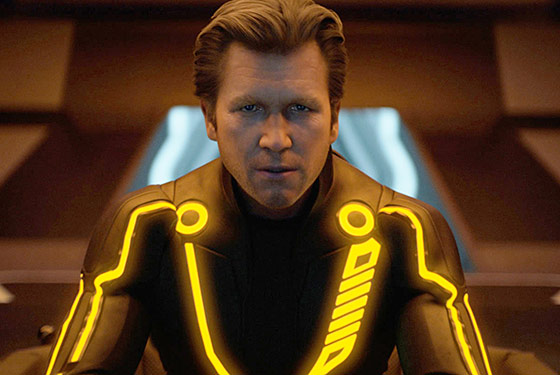
The actors do fairly good work, given that they all performed in a green-screen purgatory, and Hedlund, with the biggest role, is okay, sometimes even engaging.  But it's Jeff Bridges' film.  Playing two roles, Flynn as his scruffy self, and CLU in a digitized de-aged '80's version of himself—pretty darned good, if the mouth movement is a little dodgy at times—he manages to push through two versions of the same personality, one that has grown older and wiser, the other that just stayed locked in his decades-old fantasy.  Every once in awhile, Bridges' Flynn will say something "Dude-ish" that seems more clever than it is, merely for the fact that it provides a refreshing touch of analog in a digital construct. 

A construct, and very derivative.  But with so many bits and megabits from so many sources, it does add up to some genuine sparks of ingenuity there, far beyond the original's "parallel wars" equation, and certainly moving beyond merely the highlight of the first film, the gladiatorial games theme.  Tron: Legacy is a bit like taking code from different sources to make new, more sophisticated functions.  The key element being: you have to go with the program.

Tron: Legacy is a Rental.  

* My opinion, of course.  There are lots of folks who've been influenced by Tron, including John Lasseter of Pixar/Disney, and Roger Ebert, who booked Tron into his first Overlooked Film Festival. 

** Okay.  A factoid: the computer they did the FX on had 2MB of memory.

*** Look for Cillian Murphy in an uncredited cameo as ENCOM's chief programmer.


The original light-cycle sequence from Tron (1982)
How far we've come.