Showing posts with label Jeff Bridges. Show all posts

Friday, June 29, 2012

Fat City

Fat City (John Huston, 1972) Fat City got a lot of positive critical attention when it came out in '72 and one sees why.  It must have been surprising for a lot of critics that, after a couple of movies (The Kremlin Letter, Sinful Davey, A Walk with Love and Death) that seemed to be desperate to reach a youth market or cater to the looser restrictions on subject matter, that the veteran director could still pull off a gritty down-on-your-heels story and make something new out of it—the old dog still had some tricks up his sleeve, and could do a change-up of genre and tone and come up with something as impressive as the young turks starting to enter the field, like Friedkin and Coppola.  

But it shouldn't have surprised anybody.  Huston was a gambler by trade and by hobby, and was never afraid of taking on different approaches to telling a story.  Sure, he could take a mis-step here and there, especially when he tried to do somthing "of the times," rather than in his own perenneal classicism.  It was always story for Huston, and he was never afraid to take things in complex directions.


Fat City is a tale of two boxers—Tully (Stacy Keach) and Ernie (Jeff Bridges) one on the way up and one on the way down, but the only difference between the two, career-wise, is in the timing.  Ernie is in the early rounds of the bout, all pupptish energy and vigor.  Keach's Tully is in the later stages of the fight, battered, bruised, and tired, having known defeat and the ocassional victory, always just out of reach of a right jab.  When we first encounter them, Ernie has yet to have his first professional fight.  Tully is a couple years out of the ring, barely subsisting.  He's scarred over, but that hardening of tissue, mostly keeps the sense-memory of past victories ringing in his head.  Both mean are trying to get into the ring, one with no way of knowing what will come when he's in it, and the other all too aware of the toll it will take...but, anything is better than his current situation.  As it's said in The Shawshank Redemption, you either gotta get busy living or get busy dying.  In this case, living is fighting.  And for the older pugilist, there's still some fighting to be done, rounds to go before he sleeps.

Huston has had many great male performances under his direction, from such as Bogart, Gable, Clift, Brando, Connery, Finney, but I don't think I've ever seen a better performance in one of Huston's films than Stacy Keach in this.* In whatever you've seen him in, nothing prepares you for the internalized pain that Keach conveys in every aspect of his performance. And there's one moment that will stay with me for the rest of my life. During the fight-centerpiece of the film, when Tully makes his comeback, he's knocked to the canvas, but never counted out. He spends an interminable nine seconds on his knees and elbows, head hanging—and there's a moment, a long moment, when you wonder if he's going to get up—if he even wants to get up. Then, he rolls up into a rickety stance to complete the last few seconds of the round. The fighters retreat to their corners and Keach sprawls on his stool, as the cut-men treat a bleeding gash over his left eye.

Huston stays on Keach's face, and there is no expression on it—none.  So, you go to his eyes, which are dead, betraying no light and no spark.  There may be nothing going on in his mind except the most primal reptile instincts to survive; his head is a black hole, nothing leaves, and there may be nothing to leave.  He's a shell, hollow and broken.  That look will show up again in the film, as a final note, lacking in grace, the soundtrack empty, giving a brief glimpse of death, a living one, yes, but a death that still haunts.


Keach in Huston's Fat City
* Everybody is good in this, but one should also note Susan Tyrrell's feisty, free-wheeling performance of a drunk bar-fly that is on par with Keach's and  feels so real you want to throw up your hands and give up.

Friday, December 24, 2010

True Grit (2010)

"Revenge in a Minor Key"

or
"Hoo-raw'd by a Little Girl"


Someone had to save "True Grit" and that the Coen Brothers are in charge of posse is reason to be appreciative.  After their rather opaque film A Serious Man tanked seriously at the box-office (I thought it was last year's best movie), they needed a more accessible property to bring in audiences, and the well-known property (whether by book or previous film) is a good match.

Sure, I love the original 1969 version.  But, over time legend has overcome its considerable gifts, overshadowing the story, as John Wayne's performance overshadowed the movie.  True Grit (1969) is an adventure story, where the book is a post-modern comic drubbing of Old West myths.  The first film has a lot of those myths intact, those being the myths from Hollywood's westerns, including such at-the-end-of-an-era things as Strother Martin, Jeff Corey, Hank Worden, the opening song, Elmer Bernstein's  Copland-with-brass score, clean streets and available light.  The first True Grit is a sun-dappled western romp more pretty than gritty, with Kim Darby (good as she is) having to play young rather than the character, and Glen Campbell (out of his depth) as the Texas Ranger LaBoeuf.  It's just so clean, and the enterprise at its core so self-congratulatory that the point of the book gets a bit swamped in the process. 

The Coens take True Grit back to its roots.  Keeping in Mattie Ross' arch narration, and casting 14 year old Hailee Steinfeld as the young protagonist is a shift that greatly improves this adaptationSteinfeld is just severe enough, and, as opposed to the earlier film's Darby, spends her time acting more adult, as opposed to being an older actress acting young.  She's a bit arresting, bossing around Cogburn (Jeff Bridges) and horse-trader Hollister (Dakin Matthews), not having to sell the "young" aspect, but merely rise above it.

Like Steinfeld, the rest of the casting is superb.  Matt Damon's LaBoeuf is still a glory-hound, but of such fool-hardy self-assurance and puffery that you actually feel a bit sorry when it doesn't pan out to his vision.  Josh Brolin does a fine job as Tom Chaney, the initial object of the man-hunt, bigger in myth than he is in real life, and something of a whiner.  And Barry Pepper is nearly unrecognizable as Lucky Ned Pepper (I'm sure, no relation), who reveals a gift for rolling around the stilted dialogue he's been saddled with, and who (bless him) acknowledges in his performance the work of the fine actor who preceded him in the role.*

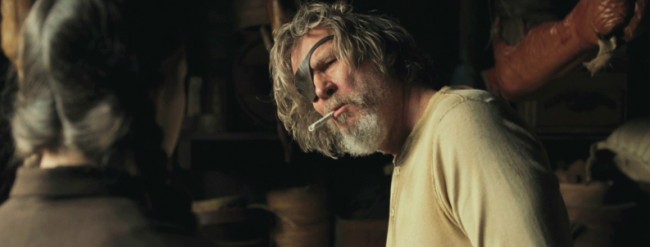
And everyone will be watching Jeff Bridges, because he has small boots to fill—Wayne had little feet—His "Rooster" Cogburn has his eye-patch on the other side (Wayne kept his left eye covered, Bridges his right—that a political statement?), and his deputy Marshall is more dissolute, less jolly, growlier and more willing to admit his infirmities.  His drunk is a bit more dangerous and cantankerous (the Coens keep the corn-dodger shooting match between Cogburn and LaBoeuf), although Bridges always tries to invest some dignity in the stumbling, playing it less for laughs than for character.  The role has little of Wayne's "star" presence, but a nice sunken lived-in quality.  His "Fill your hands, you son-of-a-bitch" is not said as a challenge, but in genuine anger, without Hollywood quotation marks.  He's superb, and by the time he confronts a Choctaw body-snatcher on the hunt, Wayne's version is cheerfully merely remembered.

But, it goes beyond that for the Coens' version.  Their True Grit is steeped in atmosphere, acknowledging racial differences and feeling less like a scout outing on a beautiful spring day.  Confrontations are held in pitch-black night, during snow-flurries, and inclement weatherNature in its beauty played a big part in the appeal of the 60's Grit, here it is nature in its ambivalence—one gut-wrenching scene taking place in the pitch of night under a dwarfing sky of shining stars.  The struggles of the individuals, man and beast, under that canopy are thrown into stark relief with those indifferent points of light.  It haunts, and throw one more sharpening aspect of this version that the previous lacked.

For, after the deeds have been done, this Mattie Ross, confidently bossy 14 year old, is given a sight of the carnage her single-minded quest has left in its wake.  There are moments, under that clear sky, of regret that the first film didn't dare preach, and of the destruction such obstinance can wreak.  A further coda follows the book's conclusion, that such lessons may not keep, under so strict a host.

It's lovely.  It's the book, done in a minor key in an overcast light, not dressed-up and gussied-up, but bittersweet, full of sand, and a lot of grit.

True Grit (2010) is a Full-Price Ticket


* Okay, I can't keep it a secret, it is so delicious: Robert Duvall played Pepper in the first film, and in a key-scene (with Pepper in close-up) giving instructions to stay with Mattie Ross, Pepper gives a two-fingered hand-signal that was a running gesture of Duvall's iconic (and beloved) Augustus McRae in the "Lonesome Dove" mini-series.  That move calls to mind another gesture echo in classic westerns: John Wayne's grabbing his arm in the last shot of The Searchers in a quiet tribute to the habit of another star of John Ford westerns, Harry Carey.  Lovely, and nearly invisible.

Wednesday, December 22, 2010

Tron: Legacy

"A Shaggy God Story"
or
"Rebel Without a CLU"

A sequel to Tron seems unnecessary: the first film was not that good.*  A simple story of corporate (analog) white-collar crime that is resolved and revenged in the digital realm of computers, it only came to life in the (at the time**) high-tech sequences that were computer-generated with simple high-contrast wire animations.  But, given the advances in techniques since 1982, it seems inevitable that a more sophisticated sequel be envisioned and given the green neon light.

Tron: Legacy, set 28 years later (and directed by Joseph Kosinski), is a better film in construction and underlying story-line—it has to be.  The Matrix films, which resemble Tron in a tesseracted inside-out way, raised the stakes, so audiences are no longer satusfied with cycle-chases and neon-frisbee duels.  Gladiator games are no longer enough.  The story must matter, and be relatable, tap into a collective story...mean something.

The movie tries hard.  At times you see glimpses of Matrix, Terminator, and The Dark Knight, "Frankenstein," the Star Wars prequels, with an underlying "Daddy" conflict out of Oliver StoneBut, to their credit, there's some Despero there, too.  The Jeff Bridges character Kevin Flynn, CEO of ENCOM (as a result of events in the first film) turns into a messianic figure, part Steve Jobs, part Steve Ballmer, whose vision of life under his brave new cyber-world, promises much—but only if you're not related to him.  He's gone missing, with only grandparents to raise his entitled son, Sam (who grows up to be Garrett Hedlund).  Sam lives a solitary life (although he is a majority stakeholder in ENCOM) wanting nothing to do with the family business—maybe some Godfather in there too?—except for a yearly prank to keep the board from getting complacent.  Alan Bradley (Bruce Boxleitner) is still around,*** and a stray page from the old Flynn's arcade compels Sam to visit, and (wouldn't you know it?) he gets zapped to Tronleyland, which has had some extensive renovation done.

With the help of his digi-gangers to his analog counterparts, Tron, Clu and the others, Flynn has constructed a civilization in his cyberworld, until life, finding its way, is generated on its own.  The ISO's, as they're called, are a new lifeform, that could bring new possibilities to life outside the grid in Flynn's vision.  But every Creator must have his serpent, and Flynn's counterpart visionary, CLU, has his own designs for the future, which includes the invasion and occupation of territory—our world.  The stage is set for a confrontation between Flynn and his monstrous creation over their mutual goal, with Flynn's son, Sam, as the ghost in the machine, the spanner in the works.

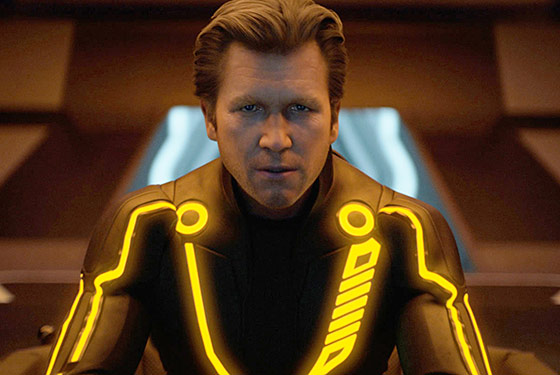
The actors do fairly good work, given that they all performed in a green-screen purgatory, and Hedlund, with the biggest role, is okay, sometimes even engaging.  But it's Jeff Bridges' film.  Playing two roles, Flynn as his scruffy self, and CLU in a digitized de-aged '80's version of himselfpretty darned good, if the mouth movement is a little dodgy at timeshe manages to push through two versions of the same personality, one that has grown older and wiser, the other that just stayed locked in his decades-old fantasy.  Every once in awhile, Bridges' Flynn will say something "Dude-ish" that seems more clever than it is, merely for the fact that it provides a refreshing touch of analog in a digital construct. 

A construct, and very derivative.  But with so many bits and megabits from so many sources, it does add up to some genuine sparks of ingenuity there, far beyond the original's "parallel wars" equation, and certainly moving beyond merely the highlight of the first film, the gladiatorial games themeTron: Legacy is a bit like taking code from different sources to make new, more sophisticated functions.  The key element being: you have to go with the program.

Tron: Legacy is a Rental.  

* My opinion, of course.  There are lots of folks who've been influenced by Tron, including John Lasseter of Pixar/Disney, and Roger Ebert, who booked Tron into his first Overlooked Film Festival

** Okay.  A factoid: the computer they did the FX on had 2MB of memory.

*** Look for Cillian Murphy in an uncredited cameo as ENCOM's chief programmer.


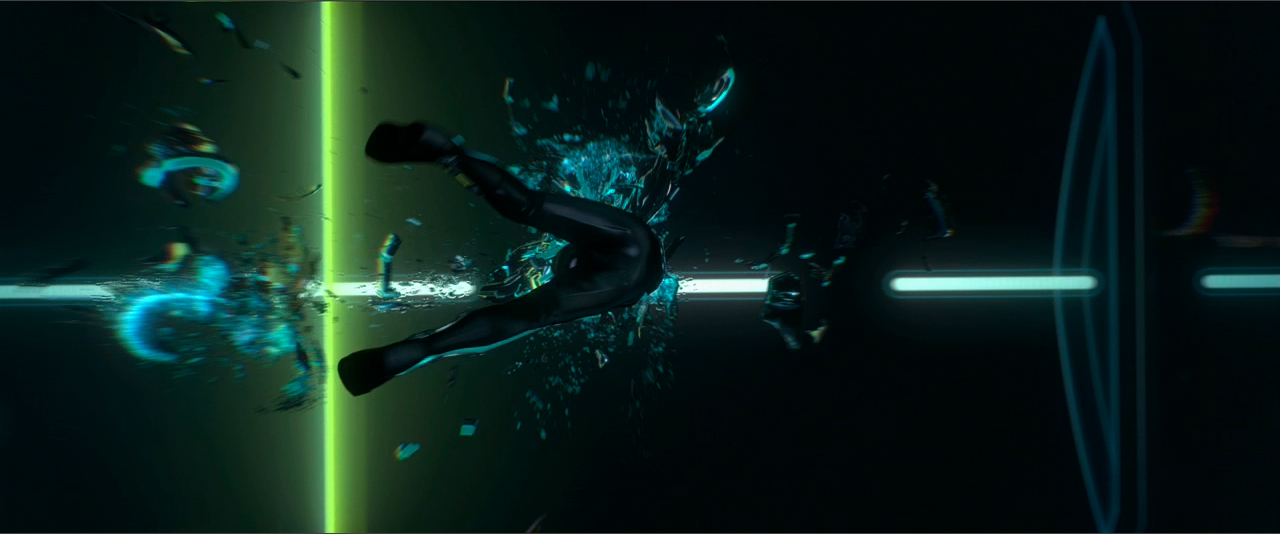
The original light-cycle sequence from Tron (1982)
How far we've come.

Tuesday, January 26, 2010

Crazy Heart

"Breaking Bad" (I Used to Be Somebody, Now I'm Somebody Else)

At the end of each filmic year, theaters are filled to their google-plexes with all sorts of movies. Because of the Holidays, there's plenty of people wandering around major areas of assembly with the occasional two hours to kill, so Christmas is as profitable a time to the studios as Summer. Every conglomerate pushes and shoves to squeeze in one more blockbusting crowd-pleaser to blacken the year-end red ink.

Then there are the films that have been positioned to impress the critics' societies and are launched into Los Angeles and New York, so they can be eligible for awards, most pointedly The Oscars. And in that sub-category, there are the waifs—the ones that open in those markets and take a little longer to reach Biloxi, because, frankly, the studios would rather launch heavier weights during the Holiday Crunch, then release the films they feel will have only a niche market, that might have a respectable run in the projection booth, before reaching a more sizable audience in the rental market. The reason they're there is for the Awards, and usually for an acting honor to someone who does consummately good work, but has never played a "disease" role, or worn heavy make-up to win.

I'm talking about films like, recently, "
Venus" with Peter O'Toole, "Being Julia" with Annette Bening, even last year's "The Wrestler" with Mickey Rourke. Earnest films with Oscar "buzz" for their stars, the kind that were mocked by Christopher Guest's "For Your Consideration."

This year's it's "Crazy Heart."

The story of
an alcoholic country singer-songwriter, on a Southwest tour of what they call (in the biz) "toilets," merely reflects the downward spiral "Bad" Blake (Jeff Bridges) has put himself into. Perpetually boozed up, touring in the same old station wagon (old "Bessie") he used in the early days when he was more successful, his life is comprised of using things up and tossing them away—cigarettes, bottles of booze, ex-wives (five of them, maybe four, he can't seem to remember), he still has the talenthis reporter-inquisitor, a single mother (Maggie Gyllenhaal) from a Santa Fe newspaper that he begins a relationship with, says he can still toss off a song instantaneously that most people would struggle years to write—hasn't completely left him. But, that may be the last thing to go. He hasn't written a new song in years—the writing skills are there, but the inspiration has long ago moved on. It's one more thing taken for granted in a career that brought easy success that couldn't be maintained in the living of it.

The fur-bellied snark in me would say I'd been to this rodeo before in a fine film two decades back called "Tender Mercies," which spotlighted Robert Duvall (and in a mirror reflection, he has a small role in, and executive produced, this feature), and had more of a spiritual nature to it. There's no God in "Crazy Heart" (scripted and directed low key by Scott Cooper), as reality and responsibility is tough enough to fathom for Bad.

But it's a good movie for
Jeff Bridges, who is always so good—his small part in "The Men Who Stare at Goats" was a comedic and dramatic gem, he being the only actor in it to quietly evoke deep sympathy, let alone belief—that he's always in danger of being taken for granted in the periphery of other folks' vehicles. This time, though, the spot-light's on him, and he's buttressed by a solid cast of actors lending their own mega-wattage to the brightness surrounding him. That includes Colin Farrell, buried deep in the credits to not attract attention, in a terrific performance that reflects kindly on his "mentor." Another nice thing is that T Bone Burnett and the late Stephen Bruton have composed clever, old-style country songs in the keys of both Farrell and Bridges, so they never seem less than authentic on-stage.

That extends to the story, too, which resists the epiphany lesser hands might have constructed. But like an old country song, the emphasis is on transitioning, rather than succeeding, maintaining rather than overcoming, in being rather than having dreams come true.
Sometimes the triumph is in recognizing what one's taken for granted for so long.

Hope he gets that Oscar.
*

"Crazy Heart" is a Rental.

* I say that with some caution because I know the "entertainment press" won't be able to resist saying that Bridges won for a "Bad" or "Crazy" performance.

Wednesday, November 11, 2009

The Men Who Stare at Goats

"If Looks Could Kill"

An odd choice for Veteran's Day, but timing is... everything.

Despite an opening graphic that cautions "More of this is true than you might believe" "The Men Who Stare at Goats" is more of a fantasia based on the reporting of
Jon Ronson than an actual true story. Yes, the truth is in the details; during the 1980's there was an army troop training as psychic warriors tasked with perfecting ways of defeating the enemy beyond fighting. These included perfectly legitimate examples of psychological disciplines, like moving past one's fears and one's predilections (it's pointed out that 15 to 20% of "fresh" soldiers usually shot above the heads of enemy combatants—not wanting to kill anybody), heightening one's powers of observation, gaining a psychological advantage over one's adversary by one's actions and thoughts, and moved beyond that into training that was anything but basic.

Ultimately the goal of the so-called "
First Earth Battalion" was to make "super-soldiers," "psychic warriors," or "Jedi knights"* who could intuit answers from prisoners, psychically deflect attacks, become invisible, "phase" through objects, and, most diabolically, stop the hearts of their opponents by staring at them.

In the movie,
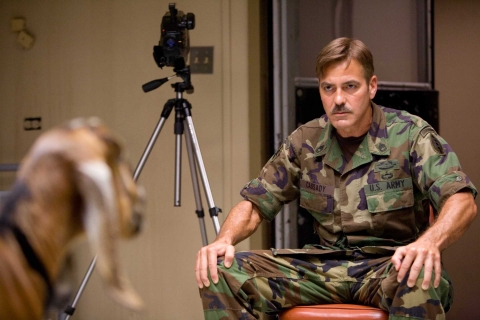
McGregor's Ronson stand-in, Bob Wilton, gets wind of a "New Earth Army" doing some feature work for his local newspaper, but it isn't until he's in Iraq—trying to impress his estranged wife—that "the circle becomes complete" and he meets the closest thing to an adept among the psy-warriors, Lyn Cassidy (George Clooney, looking remarkably like Dennis Farina) who's "been re-activated" on a secret mission to find his former commanding officer and creator of the First Earth Army, Bill Django (Jeff Bridges, who perfects his Leibowskish "bubble-off-plumb" hippie personification and manages to make it poignant). Cassidy appears to be legit, capable of cloud bursting and the one Earher who could drop a goat with a look. He's less than expert in the "sparkley eyes" technique, despite being played by George Clooney (who manages to play it completely straight while pulling off some of the strangest actions of his career).

Director
Grant Heslov, Clooney's production partner and script-writer for "Good Night, and Good Luck," keeps things moving at a good clip, moving fast enough to avoid analysis or deep thinking. The story is slight, owing much to, of all things, "Ishtar" (two clueless guys, out of their depth in a Middle East war-zone) while waving an anti-establishment freak-flag that reeks of "M*A*S*H" (with Kevin Spacey as Frank Burns). The story, of remnants of the original NEA operating in Iraq and Afghanistan, seems plausible (given the way those wars have been run), but the story merely exploits true concepts to spin the gauziest of screenplays from, while poking fun at the "Be All That You Can Be" gozo-ness of an Army that's trying "to be wonderful."

Semi-satirical movies are rarely more than semi-amusing. "
The Men Who Stare at Goats," however, delivers quite a few belly-laughs.

"The Men Who Stare at Goats" is a Matinee.


* The movie earns many—too many—knowing audience laughs by casting Ewan McGregor (the post/pre-Guiness Obi-Wan Kenobi) as the Ronson-surrogate reporter who is more of a "Doubting Thomas" than a "Padewan Apprentice." It's a little too "on the nose" and is, frankly, done to death, like some of the more winkingly obvious in-jokes in the "Ocean's Eleven" series.


Saturday, July 19, 2008

Olde Review: Hearts of the West

Caution: there is spoilerage ahead!

"Hearts of the West" (Howard Zieff, 1975) You've gotta have some kinda admiration for a movie that starts out with dialog you always think of yelling when a movie starts in a jabbering theater: "Allright, people, settle down, please, please!" And then, when we're all settled we are given a screen-test--the illusion (it's all acted, after all) of a reality (screen-tests are "real" world versions of movie illusion) of an illsuion (the movie-world that we see on screen).

Through it all stumbles Lewis Tater (
Jeff Bridges), but he does it both in 16mm black and white for the screen-test, but also through the 35mm color for the movie-movie that we, the audience, see. Lewis keeps plunging himself through reality and illusion and multiple layers of the two. Lewis is shown to be a writer writing illusions (his western stories), acts them out (which is also an illusion/delusion, but a reality that they are acted out, but that's also an illusion). He is sent a letter from a Nevada correspondence college (reality) to which he goes to attend classes and hang around campus. His brothers are yokking it up as he tells of his plan because they can't adjust so easily as Lewis to crossing between reality and illusion (if they call the college a "ranch" and use all sorts of western jargon, then it has to be able to teach western writing--it's gotta be for real--but the western jargon is idiotic and hype to the brothers).

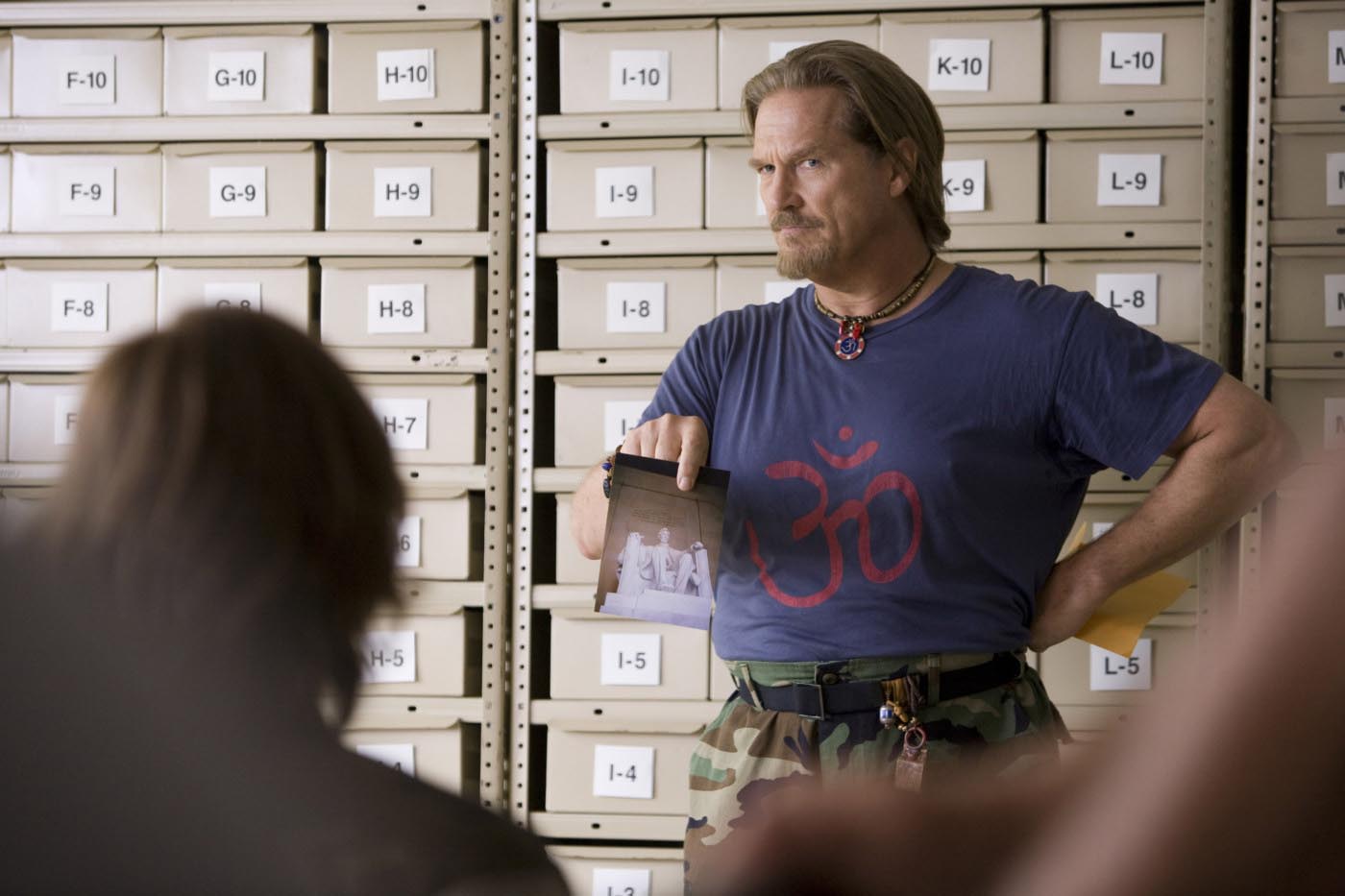
So Lewis goes to college. It ain't there. The college is an illusion, but not really, it's there in the form of the real post office boxes ticket agent
Dub Taylor points at. The college is an illusion, but it's there in the reality of the boxes. And Taylot talks about it as though it were really there. Tater is thrown out of his funk by a landlady who sets him up for the night. There he can start professing his abilities ("I'm a writer!--also an illusion if you take the words of Howard Pike (Andy Griffith), "You're not a writer 'til somebody tells ya ya are," for reality--but still Tater writes--he is a writer, whatever his talent) and acting out his illusions of battling desperadoes with an imaginary whip. Then, suddenly illusion becomes reality as he must fight and flee flea-bag desperadoes. He "wanders through thedesert, parched and thirsty" turning the reality of his situation into the fantasy of his novels. Who should he wander upon, or who should wander upon him? Real cowboys.

But not real cowboys--movie cowboys. They are, but they are not. Lewis becomes one himself, living out his fantasies on a movie set in anillusion of the West, while (in reality) he is being stalked by the two con-men he has inadvertently robbed. The conflict of reality and illusions abound: Lewis, overcome by his fantasies, going berserk, charging the leading man, extending a "bullet-tearin'-his-gut" death, generally screwing up a scene; the improbably scene where Lewis must pose as a young businessman to get some cash from the bank-notes of the two swindlers at the bank (improbable, but...what is a more interesting situation where a young actor must act a role to gain something, ala
Hitchcock's "Stage-Fright"); Howard pike's "in-the-nick" entrance as he shoots one of the swindlers full of lead--he only shoots imaginary bullets--blanks--which are enough to convince the crook, and us, that he has been shot, especially after Lewis really has been shot (his disbelief that such a thing could really happen exemplified in his "there's a hole in my leg...a round little hole" My God! It isn't pointing your finger and whistling air through your mouth, it's real!), and the final confusion as Tater, led into the ambulance, tells Pike, "What a story this'll be...independent wealth." Reality turned into Fantasy. A complete turn-around from the beginning of the film when Lewis' fantasies became true. Now, the truth will become a story--a fantasy. Lewis' life is now enough to fulfill his need of fantasy and illusion.


Howard Zieff directed "Hearts of the West" very simply and economically, a habit handed over from his commercial-making days. His "Slither," to me, was a vacancy--I can't remember much of it, except that it was paired* with "Scarecrow," which at least has Gene Hackman, Al Pacino and Vilmos Zsigmond going for it. And if i've dwelled too long on Rob Thompson's script a bitt too much (a bit?), it is because I found Zieff's direction of this story a trifle pedestrian. Zieff can direct a fine picture for writers, for he doesn't let his direction get too flashy and hurt the story. That's good if ya got a good story like "Hearts...," but it you've got an "El Goose-egg" like "Slither" his direction can't help.

Written December 1, 1975

I had to re-read this several times (and again, even as I was typing this out), and had trouble following it each time. So rather than re-review the movie, I feel like using this space to review the review. It's all too much "theme-paper" analysis assuming that the reader has already seen the film (and that's not a safe assumption, given this particular film) as opposed to being a good summation/review of the particulars for people who, it is assumed, have not seen it, and are making a decision to do so. For example, I give away far too much of the plot, and, again, as this film is not often seen, or even known about (undeservedly so, I think) that's not a good thing. Not a very good review, and notvery well-written. An "off" day.

So, perhaps a little summary is in order. "Hearts of the West" was a fairly-low budget film written by Seattle-based writer Rob Thompson, who, after a long time seeing B-westerns, wrote a screen-play about the early days of film-making--not too long after the time of the cowboy era, really--and of an aspiring writer who lived and dreamed the Old West, or rather the Old West portrayed in pulp-novels and the silent westerns. It was light-hearted, with some dark spots, and a unique voice that set it apart from most other movies being made at the time.

What I remember of "Hearts of the West" are the performances of Jeff Bridges and Blythe Danner, but especially Andy Griffith (playing a morally ambiguously character after years of squeaky-clean "Mayberry" television work) and more especially Alan Arkin--all riding-cropped egomania as the director. And I remember the bits of dialog--those sited in the review, like "a ROUND little hole," and "You're not a writer 'til someone says you are" (a favorite of mine), but also his screen-test line "This ain't a ca-tillion!" Rob Thompson the script-writer moved from films to television, and from writing to directing, and his quirky brand of each breathed that atypical freshness to such quirky shows as "Northern Exposure," "Ed," "Monk," and "The Book of Daniel."

It's nice to find entertainment outside of the cookie-cutter.

* This was in the day of double-bills (R.I.P.)

Thursday, May 29, 2008

Olde Review: Bad Company

This was part of a series of reviews of the ASUW Film series back in the '70's. Except for some punctuation, I haven't changed anything from the way it was presented, giving the kid I was back in the '70's a break. Any stray thoughts and updates I've included with the inevitable asterisked post-scripts.


"Bad Company" (Robert Benton, 1972) "Bad Company" is a wonderful movie. It is wise, it is funny as hell, and it combines death and terror in its comedy. Everyone I know who has seen it has extolled it as a minor masterpiece.

Why, then, wasn't it popular?

Why wasn't it seen by many people?

Well, its stars, although fine actors giving perfect performances weren't "names"--Barry Brown, Jeff Bridges (this film was made soon after he completed "The Last Picture Show"), John Savage (now on TV),* Jerry Houser (who was an acting dynamo in "The Summer of '42"), Geoffrey Lewis (the rabbitty Western character actor), and David Huddleston (an all-too-ignored character actor). Gordon Willis, the brilliant photographer of "The Godfather" and "Klute" photographed it. And Harvey Schmidt's piano music seems almost a part of the image.

Why didn't it make money? Because it was a modest little production with good ideas and had no Dino deLaurentiis shelling out $24 million on publicity and gimmicks.**

No, the only things "Bad Company" had were great unsung performances, an unpretentious direction, and a good story. It is at the time of the Civil War, and a bunch of lads get together to rob, and steal...and survive. They are already outlaws for have refused induction into the military. Drew Dixon decides that it would be best for him to hitch onto a wagon train to the westward territories that are still wild and, more important, are not States of the Union. He falls in with some "rough types" led by Bert Rumsey, and, like Benton-Newman's "Bonnie and Clyde," their subsequent partnership results in laughter and death. It was rough out there in the Old West. In the less-than-accomplished hands of one of its own screenwriters, "Bad Company" became the best adaptation of one of their scripts, better than "Bonnie and Clyde." "Bad Company" will appear first on the program. Go early and don't miss anything.

And incidentally, Benton and Newman's new movie with Lily Tomlin and Art Carney will be out fairly soon thanks to producer Robert Altman who saw something special in their extra-special little movie and gave them a second film four years after their auspicious debut.***

This was broadcast on KCMU-FM on January 20th, 1977

* Not sure what this is referring to, although the IMDB has him appearing in a show called "Gibbsville" around the time of this review. Savage would appear shortly in "The Deer Hunter."

** Not sure what this means, but I suspect I was making a slam at the new Dino-produced version of "King Kong." Dino opened it despite my protests.

*** That would be "The Late Show" which didn't do very well at the box-office as I recall, although Benton would use the old private-eye theme of that film in other movies. And weep no tears for Benton-Newman: they went on to write the first two "Superman" movies. Benton made "Kramer vs. Kramer," won the Oscar, and made one of my favorite films "Places in the Heart." He's still directing and writing.

As of this writing, "Bad Company" (1972) has not been released on DVD. More's the pity, as I'd like to re-acquaint myself with this one. You can buy it on VHS, however.
Since the movie opened, a rock band took the name (inspired by this very movie), and two other films using that title have been released--the latest being a lousy Anthony Hopkins-Chris Rock spy comedy directed by Joel Schumacher. It is available on DVD.

Good news. "Bad Company" (1972) IS available on DVD--in a stripped-down presentation from Paramount Home Video from 2002. Here is the link to it on Amazon.com.

Monday, May 12, 2008

Iron Man

Iron Man, Iron Man
Does whatever an iron can.
Presses pants very fine
Keeps that crease right in line
Hey there, there goes the Iron Man!
Marvel comics writer-artist John Byrne's parody of the "Spider-man" song

"Iron Man" - the first superhero film to be produced by an off-shoot of the company creating the material (Rival DC Comics' out-put is produced by Warner Brothers, whose parent company also owns DC) manages to not fall into the Inescapable Doom-Trap that plagues so many comic-book adaptations--turgid respect for the material. It seems like so many of these films ("Spider-man," "Superman Returns," "Batman Begins," "Hulk," "Sin City") think they're creating "The Song of Bernadette," instead of adapting a comic-book whose target audience is somewhere between five years old and arrested development. Kids (and adults) enjoyed these highly-derivative adventures* because of their swash-buckling derring-do and "can-do" attitude, but so many of their filmed adaptations feel that they have to encased in welschmertz two inches thick (an unhappy consequence of the Marvel "soap-opera/romance comics" style of writing in the 60's), as if the makers were incapable of transferring the joy of the source, or were ashamed of the movies' origins. "Iron Man," though it has some elements of that, neatly skirts around the heavy moments with a happy combination of Robert Downey, jr.'s manic performance and Jon Favreau's taking advantage of Downey's quirky rhythms to make the thing breezy, fast-paced and fun, despite the amount of collateral damage inflicted on the surroundings and the people in front of them. There is just enough action here to give you a taste of the "When Titans Clash!" atmosphere of the Marvel paradigm, and for once, one of those fights convinced me that comic book action could be pulled off and made just as dynamic on the big-screen (Superman's saving of a damaged 747 in "Superman Returns" is another). Fortunately, the slug-fests never last too long so that it turns into a "Transformers"-style overkill sequence. The film-makers know when enough is enough, and make the most of it.

How's the story? Well, it updates it to the present-day where munitions billionaire Anthony Stark (Downey) finds himself blown up by his own weaponry and is taken captive by a "terrorist cell" (The "Ten Rings"--which means they're twice as corrupt as the International Olympic Committee) living in the hills of Afghanistan, with only an electromagnet, engineered by his fellow captive Yensin, keeping the Stark shrapnel in his body from going to his heart (what there is of it). He is instructed to create a prototype of the "shoot-and-forget" Jericho missile that he was demonstrating to the military at the time of his capture. As the Ten Rings have a hefty supply of Stark munitions, he starts to cannibalize them for work on the missile. But, because the Kunar Province isn't really that far from Damascus, he has a change of heart (oh...heh) and creates, Macgyver-like, a suit of armor to use against his captors in a desperate escape attempt. If you haven't already suspended disbelief, the rest of the movie won't improve things. But let's just say, things get worse after they get better.

There's a lot of heavy stuff being thrown at the audience throughout the movie, the plight of refugees, the complicity of arms manufacturers who don't take sides but will take a check, and the "with great responsibility, comes not-too-great pontificating," but Favreau, taking his cue from Downey, keeps all this heavy stuff light and frothy and brushes it away to get to the fun stuff. Downey's Tony Stark is a heavy-metal Bruce Wayne, a PHD/MA with OCD and ADD, and his higher-brain power makes him the smartest smart-ass in the room and the actor's physical comedy work during the R&D, stateside, of Stark's "IronMan" armour is consistently funny, and for all the CGI supporting it, it's Downey's performance that holds your interest, reminiscent of his incredible work impersonating "Chaplin." He is so good, and so in command, that it takes Terrence Howard and Jeff Bridges everything they have to try and match him and not get blown off the screen by him (Bridges, yes, Howard, no), while Gwyneth Paltrow (with the worst name ever given a character in comics-"Pepper" Potts!) can only collapse in giggles, which given the love-sick "girl Friday" character foisted on her, seems appropriate (although more than once she gives off a "Kirsten Dunst vibe" that seems derivative).

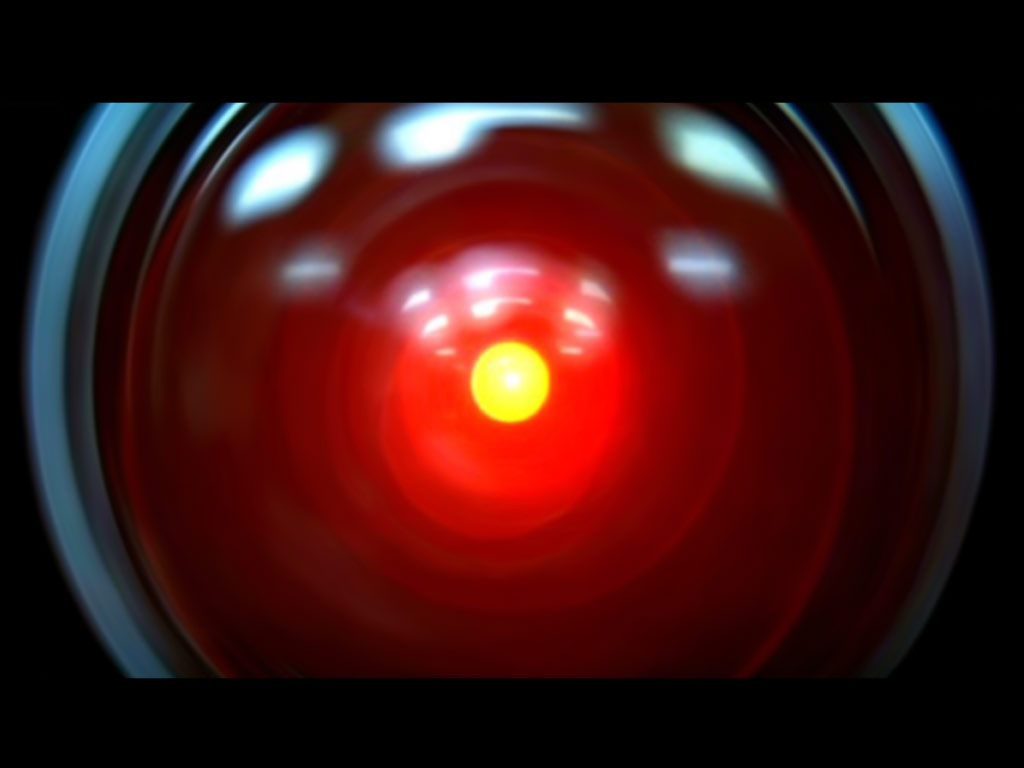
Favreau's work is consistently good, although he betrays fan-boy roots by basing sequences on "2001," "Star Wars," and "Alien,"** and not diverging "Iron Man's " flying scenes too far from "The Rocketeer." In fact, much of the slapstick humor of getting used to your rocket-pack derives from that film. The persistent calling to mind of the "Black Sabbath" song tends to outwear its welcome as well. The folks I saw it with brought up the fact that that armour wouldn't have quite so easy a time dealing with the modern weaponry of the Iraq War on display, considering that armored Humvees (the kind seen in the first sequence of the film) don't stand up well at all. But that didn't faze the fan-boys in the audience (one of whom sitting down the aisle from me who could have been the model for "The Simpsons' "comic book guy" guffawed, stamped his foot and yelled his encouragement at the screen--he, sadly, left before the the End-Credits that finished with an Ultimate sequence that would have blown his tiny little mind). Nor did it faze them that Tony Stark was continuing to party and live the high-life while the conflict in Afghanistan continued on. Nobody found that ironic.

Some hero.

"Iron Man" is a Matinee, but only because it should be seen on the big screen.

* (Although Stan Lee--who has another cameo in this one, though it's mercifully short--will tell you otherwise, Iron-Man's steely roots can be traced back to Dumas, and some cribbed elements from the Distinguished Competition)

** "Prove it" you says, defensively. Fine. The POV shots inside Stark's and Stane's robot helmets recall the shots of the Discovery astronauts in their pods, the read-outs reflecting off their faces, and "Jarvis" is no longer the Stark butler--how very "Alfred" that would be--but now is a voice-provided computer, ala HAL. For "Star Wars," Yinsen pulls a "Han Solo" early on , running , screaming down a cave-corridor after a couple of guards, only to have PRECISELY the same outcome, and Favreau includes a POV of the "IronMan" mask aproaching Stark's face ala "Revenge of the Sith." And for no other reason to acknowledge and crib the same creepy feeling it evokes, he has the same "singing chains" sequence from the first "Alien" movie. These are NOT coincidences.