or
There's Just One Hitch...
There is such an air of oppression in Chan-wook Park's Stoker ("from the acclaimed director of Oldboy") that it completely tractors over any pretensions of accomplishing what the intent is...to make a film in the style of Alfred Hitchcock.
Well, to do that you have to have an understanding of what Alfred Hitchcock did as a director...and you also have to have an understanding of what "style" is. Not the stylization of what we see here—all oblique angles and off-kilter cutting, movie-making that "suggests" a story rather than just coming right out and saying it in movie terms. But, also you have to know that Hitchcock's "thrillers," when he made them, took the opposite tack of Stoker, presenting "normal" life invaded by aberration, rather than making it the norm. Hitchcock might have been obsessed with the creepy, but the gourmand in him knew that a steady diet of it would make it dull.
Which is what Stoker is.
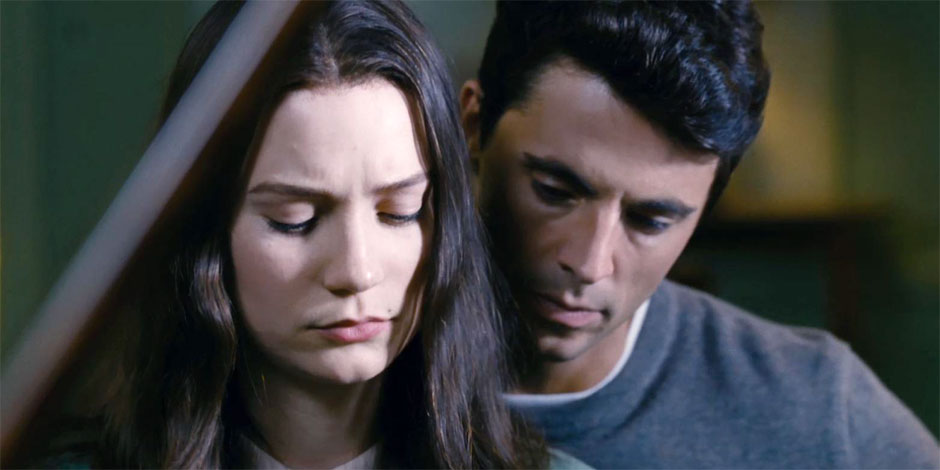
On her 18th birthday, the father of India Stoker (Mia Wasikowska) is killed in an automobile accident, devastating her family, and introducing to them her father's brother "Uncle Charlie" (Matthew Goode) at the funeral. Charlie stays with the family inserting himself into every aspect of the Stoker household, still in shock over Richard Stoker's (Dermot Mulroney) death, taking a particular interest in gardening, the servants, and mother Evelyn (Nicole Kidman). Soon, the head caretaker goes missing, as does great-aunt Gwendolyn (Jacki Weaver), explained away by Charlie, who then turns his laser-like gaze on India. As is the trait of Uncle Charlies, he sees a kindred spirit in his brother's daughter, and if the man had any sense, he'd be afraid of that, which is the only aspect of Stoker that doesn't pay homage to the Master of Suspense—this is a movie that has no redemption and no hope.
There's a child's primer of Hitchcock throughout: bad "mother" relationships, a creepy "Uncle Charlie," odd dispassionate deaths, the callow, uncomfortable-making young man, the swinging light, the "secret" basement, the masquerading gardening activities, the imposing staircase (circular), the rather irrelevant but "convenient" ability of India. It's a Hitchcock movie for those who've only seen Psycho, and are stuck in that film's deliberate pace and motivation. It's designed to shock, but not to move (and not even out of one's seat...unless of course, it's to walk out).
And there's no humor. Not even a nervous titter. Oh, sure, there is dark "irony" scattered hither and yon with all the subtlety of a hammer swing, but there is no lightness of touch anywhere, not even as an antidote to all the mock serious portent that shrouds the thing, that makes it travel the dead man's walk from too-heavy seriousness to unintended self-parody. It's as if Alan Ball had written Shadow of a Doubt, directed by a too-eager-too-please director who knows nothing about sub-text, and the fun ways that one can infuse the abnormal into normal, or what passes for it.
Stoker is a Cable-Watcher.
It's all in the trailer, kids.