Showing posts with label Dermot Mulroney. Show all posts

Saturday, June 29, 2013

Stoker

"Creepy Carrie, Creepy Carrie"
or
There's Just One Hitch...

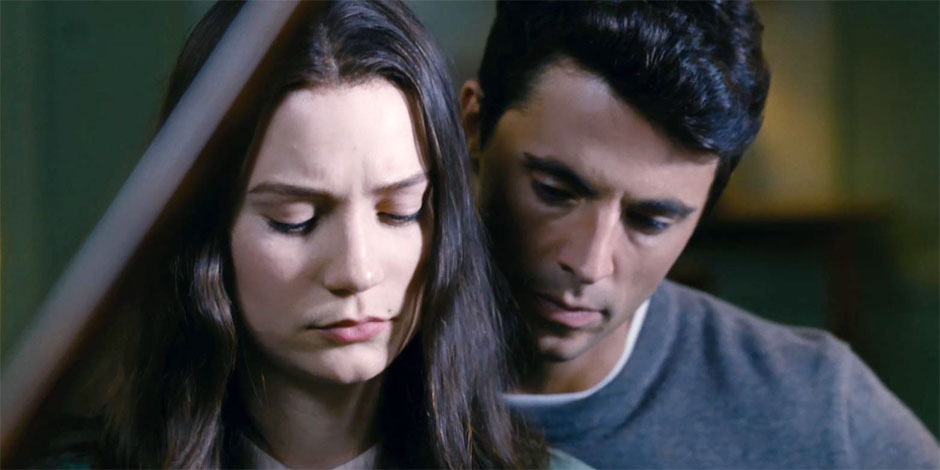
There is such an air of oppression in Chan-wook Park's Stoker ("from the acclaimed director of Oldboy") that it completely tractors over any pretensions of accomplishing what the intent is...to make a film in the style of Alfred Hitchcock.

Well, to do that you have to have an understanding of what Alfred Hitchcock did as a director...and you also have to have an understanding of what "style" is.  Not the stylization of what we see here—all oblique angles  and off-kilter cutting, movie-making that "suggests" a story rather than just coming right out and saying it in movie terms.  But, also you have to know that Hitchcock's "thrillers," when he made them, took the opposite tack of Stoker, presenting "normal" life invaded by aberration, rather than making it the norm.  Hitchcock might have been obsessed with the creepy, but the gourmand in him knew that a steady diet of it would make it dull.


Which is what Stoker is.


On her 18th birthday, the father of India Stoker (Mia Wasikowska) is killed in an automobile accident, devastating her family, and introducing to them her father's brother "Uncle Charlie" (Matthew Goode) at the funeral.  Charlie stays with the family inserting himself into every aspect of the Stoker household, still in shock over Richard Stoker's (Dermot Mulroney) death, taking a particular interest in gardening, the servants, and mother Evelyn (Nicole Kidman).  Soon, the head caretaker goes missing, as does great-aunt Gwendolyn (Jacki Weaver), explained away by Charlie, who then turns his laser-like gaze on India.  As is the trait of Uncle Charlies, he sees a kindred spirit in his brother's daughter, and if the man had any sense, he'd be afraid of that, which is the only aspect of Stoker that doesn't pay homage to the Master of Suspense—this is a movie that has no redemption and no hope.


There's a child's primer of Hitchcock throughout: bad "mother" relationships, a creepy "Uncle Charlie," odd dispassionate deaths, the callow, uncomfortable-making young man, the swinging light, the "secret" basement, the masquerading gardening activities, the imposing staircase (circular), the rather irrelevant but "convenient" ability of India.  It's a Hitchcock movie for those who've only seen Psycho, and are stuck in that film's deliberate pace and motivation.  It's designed to shock, but not to move (and not even out of one's seat...unless of course, it's to walk out).

And there's no humor.  Not even a nervous titter.  Oh, sure, there is dark "irony" scattered hither and yon with all the subtlety of a hammer swing, but there is no lightness of touch anywhere, not even as an antidote to all the mock serious portent that shrouds the thing, that makes it travel the dead man's walk from too-heavy seriousness to unintended self-parody.  It's as if Alan Ball had written Shadow of a Doubt, directed by a too-eager-too-please director who knows nothing about sub-text, and the fun ways that one can infuse the abnormal into normal, or what passes for it.

Stoker is a Cable-Watcher.


It's all in the trailer, kids.

Wednesday, November 14, 2012

The Perks of Being a Wallflower

Something from Nothing
or
No Man is an Island of Misfit Toys 

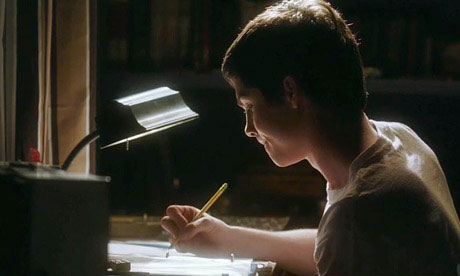
Charlie (Logan Lerman) is starting his first year in High School as a freshman and he has a lot to learn.  He's shy, introverted, and fragile the result of some trauma we know not what going in.  He walks the corridors friendless, a punching bag for the cool kids and their posses.  His parents (Dylan McDermott and Kate Walsh) are lightly caring, and his English teacher (Paul Rudd) reassures—"If you make one friend on your first day, you'll do good."  "If my English professor is the only friend I make today, that'll be sorta depressing."
But Charlie does have one friend, writing to him about his experiences, pouring out his frustrations and observations in letter after letter about his "trying not to be a loser."  The friend is anonymous, may not even exist, or once existed, but those letters keep Charlie going and serve as his avenue of expression, rather than having his day pulled out of him at the family dinner table.   It's an uphill battle from some valley that isn't discussed, but Charlie is self-aware enough to know some perspective.  "My life is officially an after-school special," he grouses.


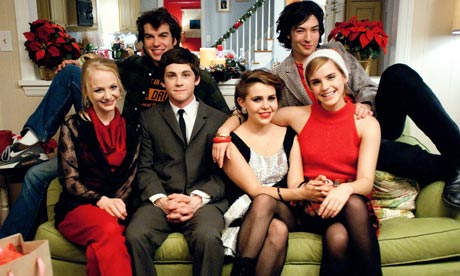
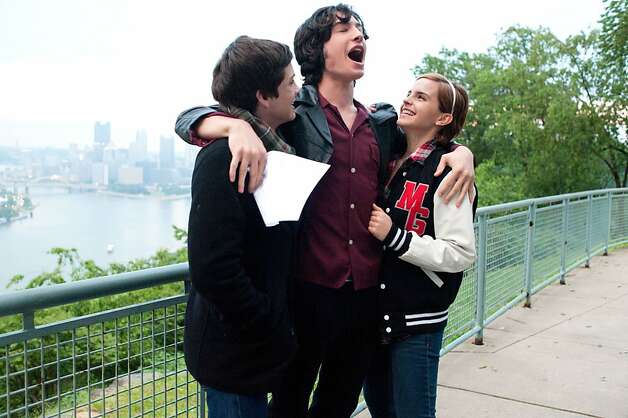
At a football game, he meets Patrick (Ezra Miller), a senior and the subject of some casual bullying, but Patrick has a wicked sense of humor that he throws out with no hesitancy as a shield.  Charlie gravitates to him, and meets Patrick's step-sister Sam (Emma Watson), also a Senior, but who is coming back from "having a reputation."  After the football game, the three hang out at a diner and compare notes of commonality, which involve a distinct lack of fitting in with the high school social structure, and Charlie is introduced to more of the group, who hold fast, hang out, and provide safety in numbers and a fresh perspective on the puerile benefits of normalcy.


The Perks of Being a Wallflower (written and directed by Steven Chbosky  from his own novel) is a fine quirky example of a "Coming of Age" movie, that sub-set of the teen flick where lessons are learned (his life really is an after-school special) and is not so much a film about growing up, as growing out.  Growing out of the insular self-inspection, narcissism and selfishness that is comfortable and has no risk, it's dark and warm and safe in that little "black cave of the psyche."  But is it?  That cave only echoes one's own thoughts back to us, providing no perspective and no horizon to reach to or for.

Yeah, it's pretty safe in there...if there aren't any demons or other creatures of the nightmare lying in wait to strike when you're most vulnerable.  And we all have those.  And even if we don't, the echoes of our own thoughts are only phantoms and zephyrs, not sustaining, and if that's all we cling to, they become echoes of echoes, distorting, becoming less clear, and often impenetrably undecipherable—a feedback loop. 


And feedback loops, uninterrupted, can become weapons.

Charlie is scared.  And ashamed.  And that limits his choices, when he does make a choice.  Most of the time, things are just foisted on him and he has to make a decision: like this, or don't?  Comfortable or not?  Aware, or comatose?  And by the time, he makes a decision, it's usually too late, putting him a tail-spin, and another trap.   His fellow wallflowers are in traps, too (isn't that what High School is all about?), but one thing he learns is that they're not the only ones and the traps, self-made or imposed are universal.

It's a good film, with good imagery, but a neophyte director's tendency to hit things a little too square—the shot from the communion wafer to the LSD tab, please—but the performances feel real, Emma Watson is a helluva dancer, and it's a good trip down memory lane, now that it's gone and out of our lives.  "See ya, wouldn't wanna be ya"

For the truth of the matter is, we all grow out.  We couldn't survive if we didn't.  Yes, "we are infinite" as the movie's tag line wants to be sure we know.  

But not individually.

And not by ourselves.

The Perks of Being a Wallflower is an After-school Special Matinee.


Out of the black cave and into the light


Friday, August 20, 2010

Flash of Genius

"Flash of Genius" (Marc Abraham, 2008) The things we take for granted.


Everyday things.  Post-it Notes.  I've made thousands of notations on them.  Little scraps of paper that have contained scribbled things of importance, however temporary, that they should be kept, stuck—squirrelled away—and when no longer needed, when they are  transferred or kept in a more permanent record, are discarded without heed.  How many Post-it Notes have I thrown away?  I probably couldn't count how many.

But the man who invented the Post-it Note—his name is Art Fry—was an employee of the 3-M Corporation, and when that particular entry in the office supply/stationary field produced them millions in profits, the corporation awarded the team its "Golden Step" Award, a "gold watch" of recognition.


At least, he got an award.*  Dr. Robert Kearns merely got screwed. 


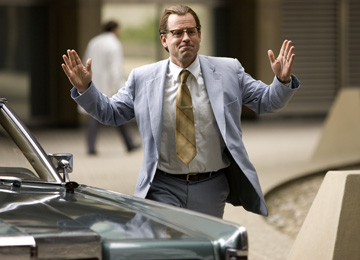
Portrayed by Greg Kinnear (in a muted "odd-duck" fashion), Kearns was the inventor of the intermittent windshield wiper that you (if it's an option in your car) can adjust to the precise rhythm to whisk away the occluding inclement weather in varying conditions from light mist to "pissing down."


It's a small luxury—probably not worth having in a car—but, it's nice to have when you don't need the wipers much.  Just a "smoosh" every ten seconds or so is good enough to keep the visibility clear and to keep you on the road, as opposed to having the constant "thwop-thwop" unnecessarily, or (God forbid!) just turning the wipers on once, yourself, to go the trick.


But, it was a big deal to car companies who were trying to develop the idea, but couldn't hack it.  Kearns patented his solution in 1964 and shopped it around the Big 3 car companies, only to find dismissive attitudes...until Ford saw it work.  A tentative deal was struck with Ford, who requested specs so they could do testing to meet national safety requirements, and subsequently, Kearns research was turned over to the car company.


At which point, they said, "Thanks but no thanks!"  And Kearns' fledgling "blinking eye" wiper manufacturing dream was scraped aside.  That ended that.


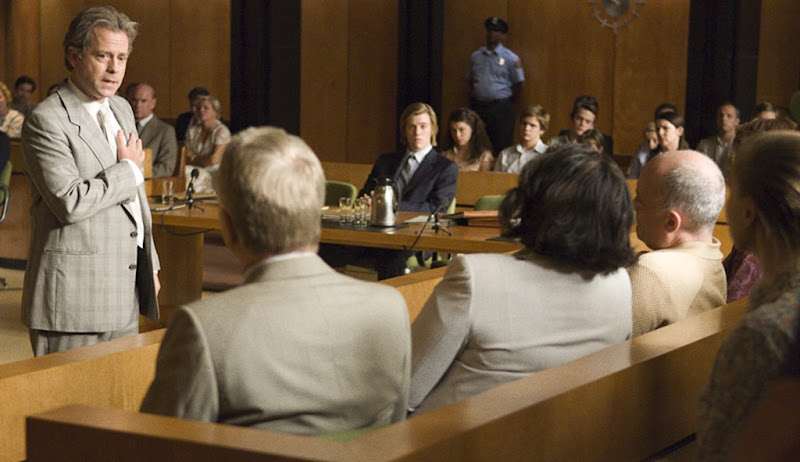
That is, until Ford came out with an intermittent wiper blade in 1969, followed soon by other car manufacturers.  Smelling an 8-cylinder rat, Kearns began researching and subsequently sued Ford for patent infringement.  The travails on Kearns' psyche and home-life (and any subsequent work from his home-town car manufacturers in Detroit) are well-documented in "Flash of Genius," though the facts are hedged a bit—the landmark Ford suit was not argued by Kearns himself as portrayed in the film and a settlement was reached, and it was the subsequent Chrysler law-suit that Kearns, with the aid of his children, argued themselves in court.


Still, it's a suitable David vs. Goliath story, of the little guy taking on The Big Dogs and emerging chewed but triumphant, achieving his goals, but—bucking the trend of most Hollywood happy endings—not achieving his heart's desires.


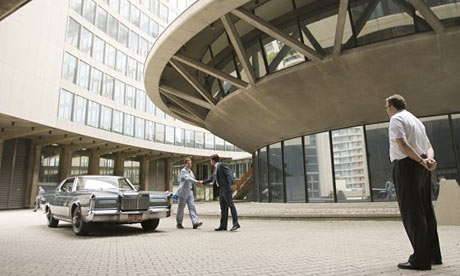
Good intention that, but it subsequently leaves the film feeling a little hollow, like the somewhat cold camera set-ups that Abraham and cinematographer Dante Spinotti use to portray the halls and spaces inhabited by Kearns' nemeses.

An interesting little film about a man who refused to be taken for granted.


Dr. Robert Kearns (1927-2005)


* And a better job in the company with presumably higher salary.