This week, we're re-publishing some reviews of the films from the post 9-11 environment.
 "Weapons of Myth Destruction"
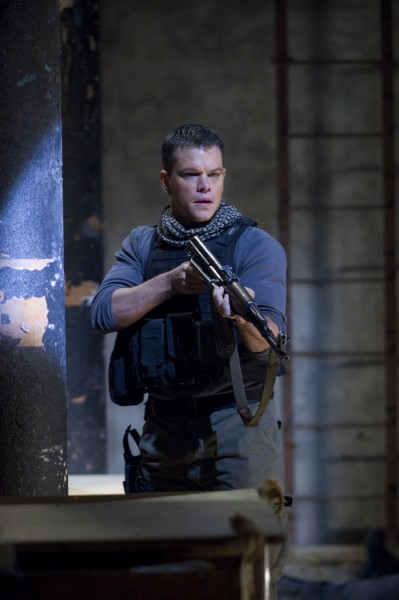
The team that brought you the more popular of the "Bourne" movies (Paul Greengrass, stunt coordinator Dan Bradley and star Matt Damon) basically take the same "run-and-shoot" scenario into the Iraq War in Green Zone—a government operative goes rogue and takes on the higher-ups with something to hide, who are willing to kill him in order to silence him. And just as The Bourne Ultimatum felt like a re-tread of The Bourne Supremacy, Green Zone has the same worn been-there, fragged-that quality, owing more to tracts like Body of Lies (which this one closely resembles, despite having an "original" screenplay by Brian Helgeland) and the earlier collaborations of this particular action troika. It's the Iraq War, but without the "shock-and-awe," unless the awe comes from a stifled yawn.
The same issues—the manufacture of intelligence to promote a "sellable" war scenario—are at play in both the Greengrass and Ridley Scott films. The main difference being that this one lands square in the middle of the early "dazed and confused" days of the Iraq War (having just passed its seventh Anniversary) with the first crews of Army inspectors coming up trumps in their search for the legendary Weapons of Mass-Destruction, the Holy Grail of this Crusade. Adapted freely—very freely—from the book "Imperial Life in the Emerald City" (which reads like a book version of the documentary No End in Sight), the screenplay posits American efforts to steam-roll a provisional government into Iraq by propping up their own Iraq partisan (based on Ahmed Chalabi) who hadn't set foot in Iraq for thirty years and was of dubious integrity, and the double-blind of an Iraqi general (played by Yigal Naor), whose reports of destroyed WMD's are falsified by the White House, and the promised assurances of participation in any new government for cooperating are ignored in the process of "De-Ba'athification."* Helgeland took the strategic failings of the Coalition Provisional Authority and used them as background for the cut-and-paste screenplay, constructing an "Army rebel" scenario in which Damon's "Roy Miller" is disgruntled with how his squad is continually sent on bogus WMD searches, chasing wild geese rather than chemical weapons. It becomes clear to the acronym-spewing MOP'd op that something is SNAFU, as the sites they fight to raid appear free of ordinance of any kind...and haven't for a very long time. Miller's investigation with the help of a frustrated CIA agent (Brendan Gleeson) becomes an effort to keep the SNAFU's from becoming FUBAR before he goes Tango Unicorn. Besides the angry and destabilized citizenry, they also have to fight a CPA op hard-wired to the White House (represented reprehensibly by Greg Kinnear) and the Special Forces commander who doesn't ask and doesn't tell, but merely re-loads (the terrific Jason Isaacs, nearly unrecognizable, looking like Bono in fatigues). You can't swing an HD camera (in simulated field-documentary fashion) without coming into conflict with somebody. **
It's one of those trope-heavy screenplays heavy on the "table-turning" dialogue ironically bantered back-and-forth during different stages of the screenplay—the big ones (delivered with the required dripping sarcasm) are "don't be naive," and "you didn't ask to confirm?" Ho-ho! Gotcha. You are so "occupied." These are the small PR victories lost in the cluster of the Iraq War.
It's not that Green Zone is bad. It is quite competent. But it is tired, and tired at its reckless pace feels silly and unnecessary...and a waste of time. Still, far more people will see Green Zone than No End in Sight, so if the message has to be "Damonized" at least it's doing some good, though in 20/20 hindsight.
Now...about the next one...
Green Zone is a Rental.
* Although the process is a matter of public record as is the Coalition Provisional Authority's dissolving of the Iraqi Army, the "playing" of the general is more akin to President Bush's tactics in dealing with Democratic senators while he was governor of Texas—he'd make promises to get a crucial vote and renege on those promises.
** Like the "Bourne" films and Greengrass' United 93, the film doesn't have a still shot in it, or a held shot of more than four seconds, making Kathryn Bigelow's The Hurt Locker look serene by comparison, but it's not as bad as second-unit director Dan Bradley's work on. Quantum of Solace, which looked like it was filmed from the POV of a Mixmaster set to "discombobulate." The guy's who's turned this sort of stuff into a science is J.J. Abrams, who's designed a personal system for hitting the camera—actually whacking it—in a certain rhythm to give it a "shaky-cam" stutter while letting you follow the action and still identify the participants.
Wednesday, September 14, 2011
Green Zone



Friday, August 20, 2010
Flash of Genius

"Flash of Genius" (Marc Abraham, 2008) The things we take for granted.
At least, he got an award.* Dr. Robert Kearns merely got screwed.
Portrayed by Greg Kinnear (in a muted "odd-duck" fashion), Kearns was the inventor of the intermittent windshield wiper that you (if it's an option in your car) can adjust to the precise rhythm to whisk away the occluding inclement weather in varying conditions from light mist to "pissing down."
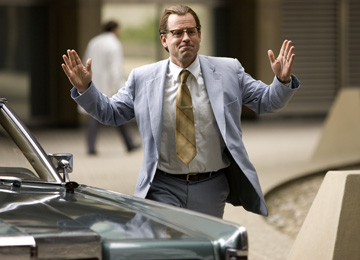


It's a small luxury—probably not worth having in a car—but, it's nice to have when you don't need the wipers much. Just a "smoosh" every ten seconds or so is good enough to keep the visibility clear and to keep you on the road, as opposed to having the constant "thwop-thwop" unnecessarily, or (God forbid!) just turning the wipers on once, yourself, to go the trick.
But, it was a big deal to car companies who were trying to develop the idea, but couldn't hack it. Kearns patented his solution in 1964 and shopped it around the Big 3 car companies, only to find dismissive attitudes...until Ford saw it work. A tentative deal was struck with Ford, who requested specs so they could do testing to meet national safety requirements, and subsequently, Kearns research was turned over to the car company.


At which point, they said, "Thanks but no thanks!" And Kearns' fledgling "blinking eye" wiper manufacturing dream was scraped aside. That ended that.
That is, until Ford came out with an intermittent wiper blade in 1969, followed soon by other car manufacturers. Smelling an 8-cylinder rat, Kearns began researching and subsequently sued Ford for patent infringement. The travails on Kearns' psyche and home-life (and any subsequent work from his home-town car manufacturers in Detroit) are well-documented in "Flash of Genius," though the facts are hedged a bit—the landmark Ford suit was not argued by Kearns himself as portrayed in the film and a settlement was reached, and it was the subsequent Chrysler law-suit that Kearns, with the aid of his children, argued themselves in court.

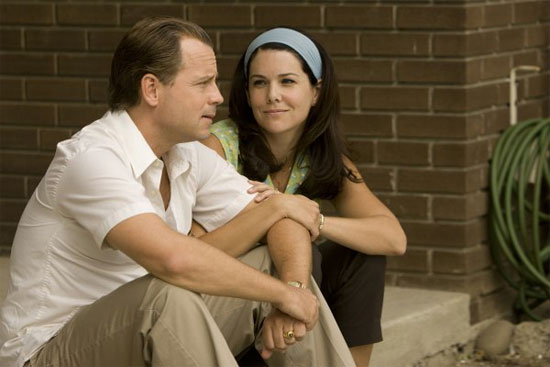

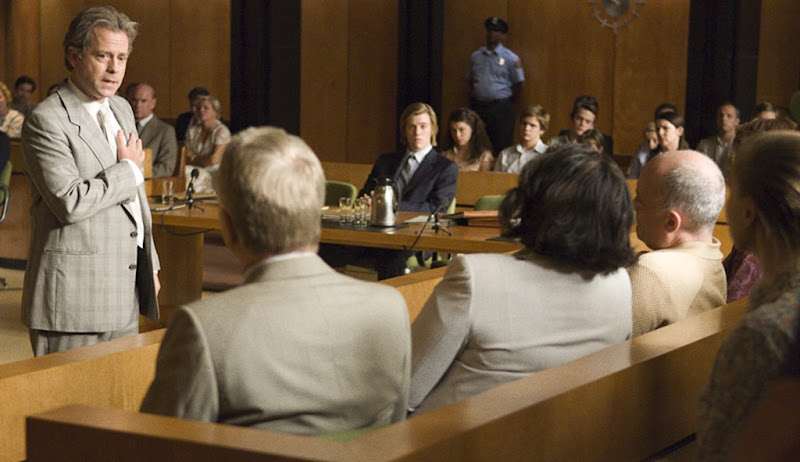

Still, it's a suitable David vs. Goliath story, of the little guy taking on The Big Dogs and emerging chewed but triumphant, achieving his goals, but—bucking the trend of most Hollywood happy endings—not achieving his heart's desires.
Good intention that, but it subsequently leaves the film feeling a little hollow, like the somewhat cold camera set-ups that Abraham and cinematographer Dante Spinotti use to portray the halls and spaces inhabited by Kearns' nemeses.
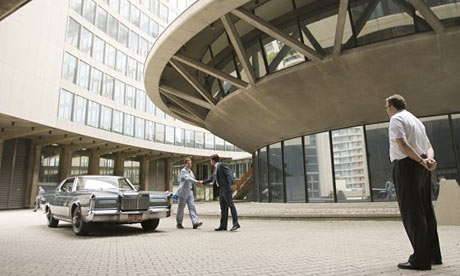
 |
| Dr. Robert Kearns (1927-2005) |
* And a better job in the company with presumably higher salary.
Tuesday, March 23, 2010
Green Zone
"Weapons of Myth Destruction"
The team that brought you the more popular of the "Bourne" movies (Paul Greengrass, stunt coordinator Dan Bradley and star Matt Damon) basically take the same "run-and-shoot" scenario into the Iraq War in "Green Zone"—a government operative goes rogue and takes on the higher-ups with something to hide, who are willing to kill him in order to silence him. And just as "The Bourne Ultimatum" felt like a re-tread of "The Bourne Supremacy, "Green Zone" has the same worn been-there, fragged-that quality, owing more to tracts like "Body of Lies" (which this one closely resembles, despite having an "original" screenplay by Brian Helgeland) and the earlier collaborations of this particular action troika. It's the Iraq War, but without the "shock-and-awe," unless the awe comes from a stifled yawn.
The same issues—the manufacture of intelligence to promote a "sellable" war scenario—are at play in both the Greengrass and Ridley Scott films. The main difference being that this one lands square in the middle of the early "dazed and confused" days of the Iraq War (having just passed its seventh Anniversary) with the first crews of Army inspectors coming up trumps in their search for the legendary Weapons of Mass-Destruction, the Holy Grail of this Crusade. Adapted freely—very freely—from the book "Imperial Life in the Emerald City" (which reads like a book version of the documentary "No End in Sight"), the screenplay posits American efforts to steam-roll a provisional government into Iraq by propping up their own Iraq partisan (based on Ahmed Chalabi) who hadn't set foot in Iraq for thirty years and was of dubious integrity, and the double-blind of an Iraqi general (played by Yigal Naor), whose reports of destroyed WMD's are falsified by the White House, and the promised assurances of participation in any new government for cooperating are ignored in the process of "De-Ba'athification."* Helgeland took the strategic failings of the Coalition Provisional Authority and used them as background for the cut-and-paste screenplay, constructing an "Army rebel" scenario in which Damon's "Roy Miller" is disgruntled with how his squad is continually sent on bogus WMD searches, chasing wild geese rather than chemical weapons. It becomes clear to the acronym-spewing MOP'd op that something is SNAFU, as the sites they fight to raid appear free of ordinance of any kind...and haven't for a very long time. Miller's investigation with the help of a frustrated CIA agent (Brendan Gleeson) becomes an effort to keep the SNAFU's from becoming FUBAR before he goes Tango Unicorn. Besides the angry and destabilized citizenry, they also have to fight a CPA op hard-wired to the White House (represented reprehensibly by Greg Kinnear) and the Special Forces commander who doesn't ask and doesn't tell, but merely re-loads (the terrific Jason Isaacs, nearly unrecognizable, looking like Bono in fatigues). You can't swing an HD camera (in simulated field-documentary fashion) without coming into conflict with somebody. **
It's one of those trope-heavy screenplays heavy on the "table-turning" dialogue ironically bantered back-and-forth during different stages of the screenplay—the big ones (delivered with the required dripping sarcasm) are "don't be naive," and "you didn't ask to confirm?" Ho-ho! Gotcha. You are so "occupied." These are the small PR victories lost in the cluster of the Iraq War.
It's not that "Green Zone" is bad. It is quite competent. But it is tired, and tired at its reckless pace feels silly and unnecessary...and a waste of time. Still, far more people will see "Green Zone" than "No End in Sight," so if the message has to be "Damonized" at least it's doing some good, though in 20/20 hindsight.
Now...about the next one...
"Green Zone" is a Rental.
* Although the process is a matter of public record as is the Coalition Provisional Authority's dissolving of the Iraqi Army, the "playing" of the general is more akin to President Bush's tactics in dealing with Democratic senators while he was governor of Texas—he'd make promises to get a crucial vote and renege on those promises.
** Like the "Bourne" films and Greengrass' "United 93," the film doesn't have a still shot in it, or a held shot of more than four seconds, making Kathryn Bigelow's "The Hurt Locker" look serene by comparison, but it's not as bad as second-unit director Dan Bradley's work on "Quantum of Solace," which looked like it was filmed from the POV of a Mixmaster set to "discombobulate." The guy's who's turned this sort of stuff into a science is J.J. Abrams, who's designed a personal system for hitting the camera—actually whacking it—in a certain rhythm to give it a "shaky-cam" stutter while letting you follow the action and still identify the participants.
Sunday, May 11, 2008
Fast Food Nation

Fast Food Nation, (Linklater, 2006)
Harry Rydell: It is a sad fact of life, Don, but the truth is we all have to eat a little shit from time to time
Scene 1: We are in a brightly-lit fast food restaurant. Two men are sitting in a garishly-upholstered booth. One is an overweight man with wild, uncombed hair and a three-day growth on his face. He is wearing a faded t-shirt underneath a corduroy jacket with missing elbow patches. The legend on his t-shirt says, ' Roll cameras, action, cut' and he may or may not be a film director. The other is a thin-faced nervous man with stringy long hair and thick glasses. He is wearing a buttoned-down striped shirt and in his top pocket are a collection of pens and pencils. Some of the pens have leaked onto his shirt leaving a multi-colored stain on the front. He is tapping his hands nervously on the table; he may or may not be a writer.
Overweight man: The way I see it, it's all about conscience and free will. You know, whether you really care about this stuff and whether you care enough to actually, you know, like, do something about it.
Nervous man: Right.
Overweight man: So, we need to show it all, the whole enchilada, you know what I mean, the guys that sell this stuff, the schmucks that work in the restaurant, all the crap, how we are all part of this big machine and we don't even know it.
Nervous man: O.K. ...
Overweight man: Could I get another cup of coffee over here?
He directs his question at a young woman dressed in the uniform of the fast food chain. Her name tag says Amber and she looks like she is a high school senior.
Young woman: Sorry sir, we don't do refills.
Overweight man: See what I mean. They just want to screw you over, get your money and get you out the door. Goddammit.
Nervous man: So, how far you want to go back with this?
Overweight man: What do you mean 'how far back?"
Nervous man: Well, it's not just the fast food companies, is it? I mean, where does all this shit come from? You got your meat packers and your ranchers. They're all part of it too, man.
Overweight man: Right, yeah. Then there's the illegals too. We could get a whole angle on the illegals. Show the mules bringing them over and handing them over to these places that don't have no unions, no safety regs. Yeah we could do a whole slant on that.
Nervous man: O.K so now you got your problem but what about your solution? What about this stuff about conscience? How are you going to work that in?
Overweight man: How about this? Let's take your average guy, stuck working for one of these corporations, you know, a family man just like that guy over there.
He points to a man sitting in a booth with a woman and two kids. The kids are eating their meals while the woman is staring out the window. The man is watching a certain area of Amber's anatomy as she bends over to wipe down a table for an older man who looks like he's auditioning for a Marlboro commercial. Or maybe he's a rancher.
Nervous man: Yeah, let's say he used to work for some cable company and now he's got a job thinking up marketing schemes for this burger chain. Only the more he finds out about the product, the more he thinks he's being asked to peddle crap.
Overweight man: So how about if he has to go and look at one of those meat packing places they have around here. And then we could show how those kinds of places are just bending all the rules to make the big bucks, trucking in illegals from Mexico, screwing them over, you know, no contracts, no safety regs, just giving it to them in the ass. But he doesn't see it at first because he just believes what he sees.
Nervous man: Yeah, literally screwing them in the ass. So what happens?
Overweight man: He's gotta find out about what really goes on but who's going tell him? Who's not benefiting from all this?
Nervous man: What about Marlboro man over there. Maybe he's one of those ranchers that doesn't buy into all this. He's got developers leaning on him on the one side and the meat packers on the other.
Overweight man: OK I like it. So we got to find a way to put them together.
His gaze wanders outside to the motel parking lot opposite. He watches as a red pick up truck pulls up and a tall, well-built man gets out and goes up to one of the doors. It opens and a few moments later, he comes back out followed by two Hispanic looking men who get back into the truck bed. He is just able to see the faces of a woman as the motel door closes. It's the face of a thousand women he has seen before, cleaning his hotel room or standing behind the counter of a restaurant like this.
Overweight man: Then, there's people like her.
He points over to Amber who has come off shift and is now sitting at a booth opposite a woman and a man. The two adults look as if they could be sister and brother. The woman is wearing a uniform with a badge shaped like a dog. The man looks like he hasn't changed his style of clothes since he was a stoner at Berkeley in the 60's.
Nervous man: What do you mean?
Overweight man: Well, you think she gets more than minimum wage? You think she likes selling this crap? Maybe she just wants to go out and party or maybe she's one of those animal activists.
Nervous man: What would someone like that be doing working in a place like this?
Overweight man: That's my point. All these people - they are all caught up in the same freaking mess - it gets us all and no one can do anything about it. I mean, even if you went right up to one of those packing plants, cut the freaking fence and let the cows out they probably wouldn't even be smart enough to escape. And we're just the same, man. We're like those cattle stuck in the pens. Sticking together until it's time for someone to blow a freaking hole in our head.
Nervous man: I don't know, man. Seems like an awful lot to get in one movie.
Cast of characters
Overweight man: Richard Linklater
Nervous man: Eric Schlosser
Amber: Ashley Johnson
Man in the booth: Greg Kinnear
Marlboro man: Kris Kristofferson
Pick-up driver: Bobby Cannavale
Hispanic man 1: Wilmer Valderrama
Hispanic man 2: Armando Hernàndez
Woman in the doorway: Catalina Sandino Moreno
Woman with the dog badge: Patricia Arquette
Stoner guy: Ethan Hawke
Fast Food Nation also features:
Bruce Willis
Paul Dano
Ana Claudia Talancón
It is available on DVD from 20th Century Fox.
Monday, April 28, 2008
Baby Mama
 "I can't stand her! It's like living with a child!"
We've been trying to remember when was the last American produced "chick/buddy" movie. Not like the one's we saw previews for here, like "Sex in the City" or the "Travelling Pants" girls--for some reason, the recent women films have had gangs of four, like "Sex" and "Pants" and the Tyler Perry films, or "Waiting to Exhale," as if four keeps you from getting too in-depth, you can gloss over the whole cast and maybe concentrate on one. But I think you have to go all the way back to Shelley Long's movie career to find a movie about two women, and have it be a comedy. Either that or its a foursome, or Kate Hudson and a guy, or its "Thelma and Louise" or a party like "Steel Magnolias" or the upcoming "The Women."
That aside, for once Lorne Michaels isn't exploiting a thin sketch concept from "Saturday Night Live" and merely exploiting the talents of two of his most effective players of late--the ubiquitous Tina Fey (her breakout success of "30 Rock" has put her in the fore-front of the culture and there's rumblings of a backlash...already? Jeez, at least give her time to get over her surprise and enjoy it!) and Amy Poehler, who is among the bravest of female comediennes to come down the pike. Ferociously dedicated to get a laugh, Poehler rivals Lucille Ball in her ability to risk dignity. She has a lot of those moments here but the highlight is a wheel-chair trip down a long corridor screaming from labor pains at the top of her longs and trying to hijack any IV drip along the way that might give her relief. That writer-director (and Saturday Night Live alum) Mike McCullers choses that moment to do it all in one shot watching her disappear down the hall, rather than in television sized snippets of close-ups is one of the few instances where he doesn't try to hammer the joke home by making it obvious. As a director he doesn't have much respect for his audience.
As a writer he fares better, finding the humor in a fairly basic concept (Successful career woman Kate Holbrook--Fey--wants a baby but feels that marriage is a "high-risk proposition," so must hire a surrogate carrier, the trashy Angie Ostriwiski--Poehler) moving the two women in together, "Odd Couple"-style, to experience the joys of pregnancy and the irritation of each other. Poehler's the one doing the physical comedy, while Fey plays the neurotically-together sensible one, basically her Liz Lemon character on "30 Rock," right down to the way she is casually insulted every step of the way, and continually accepts it. Rounding out the cast are such folks as Sigourney Weaver--Mary Tyler Moore-scary as surrogate-entrpreneur Chaffee Bignell--Greg Kinnear as a very convenient boy-friend for Fey, a short appearance by John Hodgman as a fertility specialist, Maura Tierney as Kate's sister, and Steve Martin as her cluelessly zen boss, a developer of whole foods markets. There's a lot of nice skewering of careful dietary habits, and of how rapacious the industry is. Towards the end, the movie starts going serious and ends with a too pat and altogether predictable ending, but it's a comedy, not Pinter.
I've been resisting the urge to toss out good lines from the movie, but I'll leave it at two: "Why's my avatar dressed like a whore?"
and this exchange:
"When's the best time to tell someone you've been lying to them?" "Yesterday."
"Baby Mama," is a Rental.
Tuesday, January 22, 2008
Little Miss Sunshine
 "Little Miss Sunshine" fulfills all the traditions of the indie film (Eccentrice characters, check. Road trip, check. Pervasive streak of dark humor, check), and has a terrific cast (Alan Arkin is always worth seeing, Greg Kinnear, Toni Collette, and utility player Steve Carell), there is some terrifically off-hand writing which is the only reason the various outcomes of the story aren't immediately telegraphed once each character is introduced. But it's a fine diversion, but one has to ask--"Best Picture nominee? Really? Really?"