Showing posts with label Paul Greengrass. Show all posts

Friday, October 18, 2013

Captain Philips

Shakin' the Cam/Rockin' the Boat
or
"Everything's Going to Be Okay"

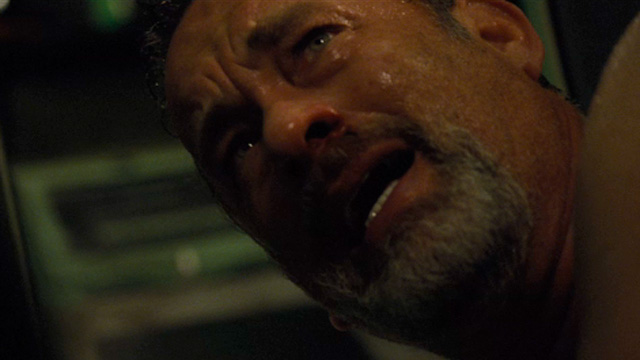
Paul Greengrass, who has succeeded in bringing a visceral documentary feel to even his fiction films (The Bourne Supremacy/Ultimatum, The Green Zone) is back in "Based on a True Story" territory with Captain Phillips, which is about the 2009 cargo ship taken over by Somali pirates, which, in the course of events, resulted in its titular captain being taken hostage for ransom.

Currently, some of the crew of the hijacked cargo ship are in the midst of a multi-million dollar lawsuit with the Maersk line over the events and "in the press" are disparaging the movie's events and the character of Phillips ("anonymously" for legal reasons—as most heroes would do it) now that the movie is released.  Their peril was stopped hours after it began.  At that point, their safety was assured and the drama stopped. Phillips was stuck in a lifeboat with the pirates for a few days more, and faced an untenable situation that only seemed to worsen as the hours went on.*

Anyway, a lot of bad-mouthing about Phillips being portrayed as a hero in this situation.  He's not (although the resulting PR feeding-frenzy-makers like to bandy the word "hero" about at the slightest positive act).  He's a victim, more passive than aggressive, trying to survive the situation as much as possible. That much is clear.  Earlier this week, we'd did a review about truth and fiction and the compromises film-makers make to save time, money and confusion.  We're not willing to go over the same territory twice in one week.

So, how's the movie?


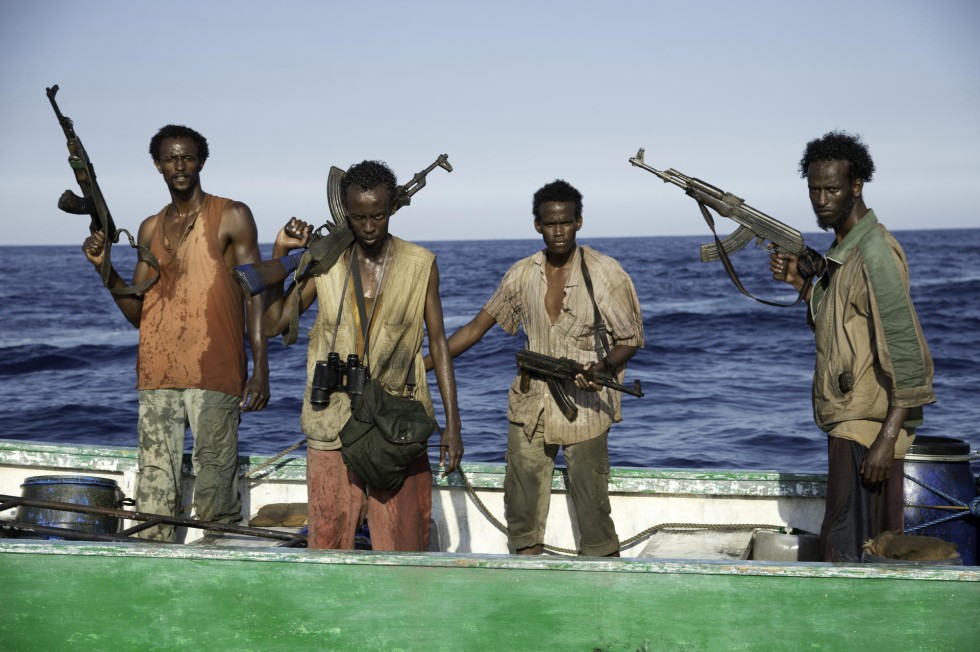
Quite good, in that edge-of-your-seat uneasiness way. The drama—and melodrama—comes from the "unknown" factors and the "wild card" desperation of the pirates themselves (they're portrayed as excitable, drug-addled** child-men with no other options), simmering at the boiling-popint that only intensifies when the scene shifts from the vast cargo ship to the tiny lifeboat that Phillips and the hijackers occupy for the next few days, while the ship's crewmen, the shipping company, and the Navy get their respective acts together. Those expecting a quick-cutting flying fistifest ala "Bourne" are going to slunk away with pouty-mouths—there ain't that much action here, and when the film gets really good, there's no room for any.  No, most of the movie is a waiting game, everybody waiting for an opportunity to make a killing, one way or another.  And if something doesn't go anybody's way, there's an escalation of a few seconds until things calm down, then there's a lag where we're waiting for something to go wrong again, and it does...so that the film is an emotional roller-coaster ride for the audience (other than the evidence that Capt. Rich Phillips has his picture all over the place seeming very much alive).


So much of the film depends on the presence of Hanks in the starring role; we spend the most time with him and the actors portraying the Somali's, who have the same sense of menace throughout (although some pains are made to make sure that Barkhad Abdi's ring-leader, Muse, is set apart from the others—the others come down to "the driver," "the injured kid," and "the wild-eyed crazy one").  

It recalls a story about the marketing of Apollo 13, which originally had a poster of the perilous situation—the spacecraft leaking oxygen going around the dark side of the Moon—but fearing for their investment, the producers opted for one that had Tom Hanks front and center in a claustrophobic layout.  The reason for this being that audiences might not care for the situation depicted in the earlier poster, but if there's a poster where Tom Hanks is worried that he's in trouble, that might bring a sympathetic audience in, hoping that the popular actor would attract a crowd.  And so the actor-specific poster (despite an all-star cast) was substituted. One wonders if it might be the same reason that Executive Producer Kevin Spacey is not portraying Phillips; maybe folks wouldn't worry about Spacey so much, but Hanks' every-man persona might make a monetary difference at the box office.  In any case, Hanks does a fairly good job at maintaining a veneer of calm while an undercurrent of panic roils through him.  But where he really shines—to the point where it's amazing to see—is the way he projects the character's shock at the end of the film, and one has to applaud Hanks for displaying a total break-down without once making us recall his crying for a volleyball.*** Despite his reputation as a male version of America's sweetheart, he is a good enough actor to still surprise and move, over one's objections.

Captain Phillips is a Matinee.


* My first question to those union sailors would be "If Phillips died, would you still be pursuing the lawsuit?" They're damned if they would, and damned if they wouldn't.

** In the film, they're constantly chewing khat.

*** That would be his loony-toons turn in Cast Away.  If I had a nickel...

Tuesday, September 11, 2012

United 93

United 93 (Paul Greengrass, 2006) "The War on Terror" turned the tide before it was even declared.  The efforts of the crew and passengers of United flight 93 insured that, as they assessed the situation quickly, made decisive plans and executed them unselfishly, in the process saving an unimaginable number of lives.  Who knows, besides the dishonored dead, what the target was?  We don't know.  We can't know.  But, after that, every airline passenger became more vigilant, and everybody who didn't put their seats in an upright position (or try to light their shoes) was seen with suspicion.  Anyone who attempted anything—short of hogging the overhead compartments, blocking the aisles in conversation, stealing somebody else's honey-nuts, or (god forbid) talking incessantly about themselves THE ENTIRE FLIGHT—against the common good, would be taken down and taken down hard, if not by security officers, then by the passengers themselves (and you had better luck with the security officers).  Flight 93 was when the terrorists started losing 55 minutes after the battles had begun.

Greengrass' ingenious attempt to recreate the events on 9-11 leading up to and during that horrific flight (in real time, one might add) crackles and pops with a cinema verite energy that makes the most mundane of the circumstances take on an ironic heft.  We all know how the story went-only if merely how it ends—and it makes all the participants victims and their every action and utterance weighted with irony, their moments, being finite, that much more important.  The dawning realization that their rudimentary transport had become part of an organized plot to turn their flight into a weapon of targetted destruction is both horrific and inspiring, moving fast through the stages of grief, they decide to make the best of the situation in which they suspected they would not survive, and acted unselfishly to at least stop any further loss of life wherever they were heading, and, maybe, doubtfully, save their own.  In an unfolding world of uncertainty, they acted for the greater good.  


It's an amazing story—civilians becoming warriors, victims not settling for that role.  And Greengrass' version is done without stars, no grand-standing, just the director's insistence on verisimilitude and energy, not enhancing the story with false heroics, but only the genuine ones, enhanced by its own choice not to editorialize.


Wednesday, September 14, 2011

Green Zone

This week, we're re-publishing some reviews of the films from the post 9-11 environment.

"Weapons of Myth Destruction"

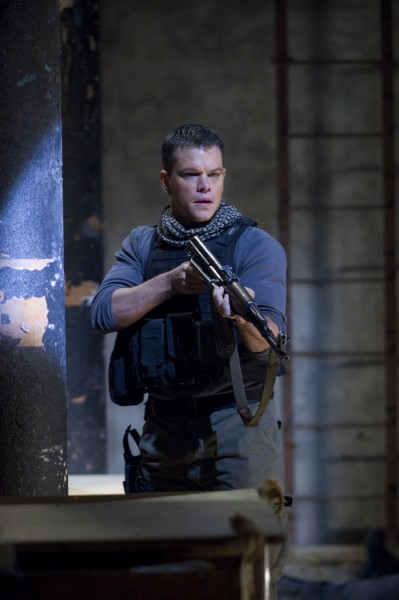
The team that brought you the more popular of the "Bourne" movies (Paul Greengrass, stunt coordinator Dan Bradley and star Matt Damon) basically take the same "run-and-shoot" scenario into the Iraq War in Green Zone—a government operative goes rogue and takes on the higher-ups with something to hide, who are willing to kill him in order to silence him. And just as The Bourne Ultimatum felt like a re-tread of The Bourne Supremacy,  Green Zone has the same worn been-there, fragged-that quality, owing more to tracts like  Body of Lies (which this one closely resembles, despite having an "original" screenplay by Brian Helgeland) and the earlier collaborations of this particular action troika. It's the Iraq War, but without the "shock-and-awe," unless the awe comes from a stifled yawn.
The same issues—the manufacture of intelligence to promote a "sellable" war scenario—are at play in both the Greengrass and Ridley Scott films. The main difference being that this one lands square in the middle of the early "dazed and confused" days of the Iraq War (having just passed its seventh Anniversary) with the first crews of Army inspectors coming up trumps in their search for the legendary Weapons of Mass-Destruction, the Holy Grail of this Crusade. Adapted freely—very freely—from the book "Imperial Life in the Emerald City" (which reads like a book version of the documentary No End in Sight), the screenplay posits American efforts to steam-roll a provisional government into Iraq by propping up their own Iraq partisan (based on Ahmed Chalabi) who hadn't set foot in Iraq for thirty years and was of dubious integrity, and the double-blind of an Iraqi general (played by Yigal Naor), whose reports of destroyed WMD's are falsified by the White House, and the promised assurances of participation in any new government for cooperating are ignored in the process of "De-Ba'athification."* Helgeland took the strategic failings of the Coalition Provisional Authority and used them as background for the cut-and-paste screenplay, constructing an "Army rebel" scenario in which Damon's "Roy Miller" is disgruntled with how his squad is continually sent on bogus WMD searches, chasing wild geese rather than chemical weapons. It becomes clear to the acronym-spewing MOP'd op that something is SNAFU, as the sites they fight to raid appear free of ordinance of any kind...and haven't for a very long time. Miller's investigation with the help of a frustrated CIA agent (Brendan Gleeson) becomes an effort to keep the SNAFU's from becoming FUBAR before he goes Tango Unicorn. Besides the angry and destabilized citizenry, they also have to fight a CPA op hard-wired to the White House (represented reprehensibly by Greg Kinnear) and the Special Forces commander who doesn't ask and doesn't tell, but merely re-loads (the terrific Jason Isaacs, nearly unrecognizable, looking like Bono in fatigues). You can't swing an HD camera (in simulated field-documentary fashion) without coming into conflict with somebody. **

It's one of those trope-heavy screenplays heavy on the "table-turning" dialogue ironically bantered back-and-forth during different stages of the screenplay—the big ones (delivered with the required dripping sarcasm) are "don't be naive," and "you didn't ask to confirm?" Ho-ho! Gotcha. You are so "occupied." These are the small PR victories lost in the cluster of the Iraq War.

It's not that Green Zone is bad. It is quite competent. But it is tired, and tired at its reckless pace feels silly and unnecessary...and a waste of time. Still, far more people will see Green Zone than
No End in Sight, so if the message has to be "Damonized" at least it's doing some good, though in 20/20 hindsight.

Now...about the next one...


Green Zone is a Rental.


* Although the process is a matter of public record as is the Coalition Provisional Authority's dissolving of the Iraqi Army, the "playing" of the general is more akin to President Bush's tactics in dealing with Democratic senators while he was governor of Texas—he'd make promises to get a crucial vote and renege on those promises.

** Like the "Bourne" films and Greengrass' United 93, the film doesn't have a still shot in it, or a held shot of more than four seconds, making Kathryn Bigelow's The Hurt Locker look serene by comparison, but it's not as bad as second-unit director Dan Bradley's work on. Quantum of Solace, which looked like it was filmed from the POV of a Mixmaster set to "discombobulate." The guy's who's turned this sort of stuff into a science is J.J. Abrams, who's designed a personal system for hitting the camera—actually whacking it—in a certain rhythm to give it a "shaky-cam" stutter while letting you follow the action and still identify the participants.


Tuesday, March 23, 2010

Green Zone

"Weapons of Myth Destruction"

The team that brought you the more popular of the "Bourne" movies (Paul Greengrass, stunt coordinator Dan Bradley and star Matt Damon) basically take the same "run-and-shoot" scenario into the Iraq War in "Green Zone"—a government operative goes rogue and takes on the higher-ups with something to hide, who are willing to kill him in order to silence him. And just as "The Bourne Ultimatum" felt like a re-tread of "The Bourne Supremacy, "Green Zone" has the same worn been-there, fragged-that quality, owing more to tracts like "Body of Lies" (which this one closely resembles, despite having an "original" screenplay by Brian Helgeland) and the earlier collaborations of this particular action troika. It's the Iraq War, but without the "shock-and-awe," unless the awe comes from a stifled yawn.

The same issues—the manufacture of intelligence to promote a "sellable" war scenario—are at play in both the Greengrass and Ridley Scott films. The main difference being that this one lands square in the middle of the early "dazed and confused" days of the Iraq War (having just passed its seventh Anniversary) with the first crews of Army inspectors coming up trumps in their search for the legendary Weapons of Mass-Destruction, the Holy Grail of this Crusade. Adapted freely—very freely—from the book "Imperial Life in the Emerald City" (which reads like a book version of the documentary "No End in Sight"), the screenplay posits American efforts to steam-roll a provisional government into Iraq by propping up their own Iraq partisan (based on Ahmed Chalabi) who hadn't set foot in Iraq for thirty years and was of dubious integrity, and the double-blind of an Iraqi general (played by Yigal Naor), whose reports of destroyed WMD's are falsified by the White House, and the promised assurances of participation in any new government for cooperating are ignored in the process of "De-Ba'athification."* Helgeland took the strategic failings of the Coalition Provisional Authority and used them as background for the cut-and-paste screenplay, constructing an "Army rebel" scenario in which Damon's "Roy Miller" is disgruntled with how his squad is continually sent on bogus WMD searches, chasing wild geese rather than chemical weapons. It becomes clear to the acronym-spewing MOP'd op that something is SNAFU, as the sites they fight to raid appear free of ordinance of any kind...and haven't for a very long time. Miller's investigation with the help of a frustrated CIA agent (Brendan Gleeson) becomes an effort to keep the SNAFU's from becoming FUBAR before he goes Tango Unicorn. Besides the angry and destabilized citizenry, they also have to fight a CPA op hard-wired to the White House (represented reprehensibly by Greg Kinnear) and the Special Forces commander who doesn't ask and doesn't tell, but merely re-loads (the terrific Jason Isaacs, nearly unrecognizable, looking like Bono in fatigues). You can't swing an HD camera (in simulated field-documentary fashion) without coming into conflict with somebody. **

It's one of those trope-heavy screenplays heavy on the "table-turning" dialogue ironically bantered back-and-forth during different stages of the screenplay—the big ones (delivered with the required dripping sarcasm) are "don't be naive," and "you didn't ask to confirm?" Ho-ho! Gotcha. You are so "occupied." These are the small PR victories lost in the cluster of the Iraq War.

It's not that "Green Zone" is bad. It is quite competent. But it is tired, and tired at its reckless pace feels silly and unnecessary...and a waste of time. Still, far more people will see "Green Zone" than "
No End in Sight," so if the message has to be "Damonized" at least it's doing some good, though in 20/20 hindsight.

Now...about the next one...


"Green Zone" is a Rental.

* Although the process is a matter of public record as is the Coalition Provisional Authority's dissolving of the Iraqi Army, the "playing" of the general is more akin to President Bush's tactics in dealing with Democratic senators while he was governor of Texas—he'd make promises to get a crucial vote and renege on those promises.

** Like the "Bourne" films and Greengrass' "United 93," the film doesn't have a still shot in it, or a held shot of more than four seconds, making Kathryn Bigelow's "The Hurt Locker" look serene by comparison, but it's not as bad as second-unit director Dan Bradley's work on "Quantum of Solace," which looked like it was filmed from the POV of a Mixmaster set to "discombobulate." The guy's who's turned this sort of stuff into a science is J.J. Abrams, who's designed a personal system for hitting the camera—actually whacking it—in a certain rhythm to give it a "shaky-cam" stutter while letting you follow the action and still identify the participants.