Showing posts with label Tom Hanks. Show all posts

Tuesday, December 31, 2013

Saving Mr. Banks

"Just Because It's Fiction Doesn't Make it a Lie"*
or
"Cavorting, Twinkling, and Prancing to a Happy Ending Like a Kamikaze"

Mary Poppins was a bitch.  That's been my joke for a long time, especially given the reputation that Disney's film of Mary Poppins (this year voted to the National Film Registry) has of being just as sugar-gooey as cotton candy in an Orange County heat wave.  It isn't.  And I've gotten several startled looks from adults who then see the film and, yes, they do see that aspect of it, despite the step-in-timing chimney-sweeps, the dancing penguins, and the moments of larkiness. It's not all a jolly 'oliday with Mary. In the end, it's a little bittersweet, and she ascends into a Peter Ellenshaw matte painting of London that isn't dabbled in sunlight, but is a melancholy smearing of smoke and darkening skies.

That's probably due more to Travers' own stipulations to the Disney crew than to anything.  Disney could be dark—dinosaurs died and there was "Night on Bald Mountain" in Fantasia, Pinocchio had its moments jack-assery and Monstro swallowing, Bambi's mother died, and 101 Dalmations almost got skinned—and provided moments of terror and threat in its films, as long as everything turned out all right as the final song paraded people up the aisles. But, Mary Poppins would have been a slightly different movie if it hadn't been for Travers' nannying the scripters and Disney with her chalk-lines drawn in the sand.  For that, we should be grateful.


Maybe less so for Saving Mr. Banks, the Disneyfication of the Disneyfication of "Mary Poppins."  It's "based on a true story," which means (as Blake Edwards coined the phrase) it's "true except for a lie or two," and in the western parlance of John Ford, "when the truth becomes legend, print the legend."  They couldn't have made this movie without Disney and "the Disney version," so, obviously the filmmakers are going to take a charitable stand on the studio's side of things (for example, Richard Sherman, who's played by Jason Schwartzman in the film, says that, rather than, as in the film, taking a personal approach when Travers came to work with the film-makers, Disney took off for Palm Springs and didn't come back until she left).  But, the more you find out about P.L. Travers (her nom de plume), the more you realize that they're taking the edges off her, as well.  Travers was a fantasist, and her largest work was the construction of her life, ever-changing, malleable, inconsistent and to her specifications as the mood and the myth suited her. "Mary Poppins" suited her just fine, and her demands for what was and was not acceptable are well documented in the many scripts versions filled with the word "No" in the margins, and the audio tape of the back-and-forth's between her and the scripters and song-writing team (which she insisted on, and which is played as coda over the end-credits).  Emma Thompson, who listened to them all in her preparation for the role, called her "vile."**


"Two artists at the height of their powers-like two gorillas fighting:"*** 
A study in contrasts between Disney (Hanks) and Travers (Thompson)
Fascinating, complicated, but vile in the instance.  And understandable in her concerns for what she considered "family," and that is where the film is at its most charitable and lovely.  Where Saving Mr. Banks shines is in the film's presentation of Travers' carefully hidden back-story, of her growing up in Australia to a charming, but erratic alcoholic father (played by Colin Farrell...think about that, Colin Farrell in a Disney movie), a frail mother (Ruth Wilson), and a precariousness to the family that, until her father is demoted from his bank managership, she had not previously known existed.  The movie goes back and forth between the disappointing assaults on her stipulations at Disney and her memories, some of which inspired the work she fights so egregiously to defend.  Meanwhile, Disney (Tom Hanks, who pushes "folksy" mighty hard to play a role almost too familiar to play), with theme parks to build and other movies in the pipeline, is left vexed and perplexed that the "Disney magic" isn't working at all well on "Pamela."

How could it?  I remember one writer describing the movie adaptation business for one of his works as "holding the coat for the man who's assaulting your child."  Disdainful of animation and films in general and Disney's work in particular, the movie's Travers reluctantly comes to Hollywood, where she is inundated by welcoming gifts in the form of "all things Mickey" in her hotel room to the point where she feels under siege. Any pleasantries are seen with suspicion for agendas, hidden.  And for the Disney dwarves, the task is mining anthracite because they're playing to a vision of Travers from her books, but not from her history and will always come up short until they know the origin story...which she'll never tell.  

The process, by which the movie-makers back-and-forth to keep the starched corners of the character, and the tone from being perpetually giddy, would be long and tedious to sit in a movie, and so compromises have to be made. Let's just say things didn't happen the way they happen in the movie—there was no meeting of the minds and no sharing of histories; Disney was a businessman and entrepreneur who knew a good thing when his daughters saw it and Travers wanted to keep her house.  Battles were chosen; compromises were made...in Mary Poppins and Saving Mr. Banks.  That same give and take, that same grace under fire, to produce the best work regardless of the truth, permeates both films in their way.  The truth is just one more hurdle to a good story.

So, one can gripe—although Thompson is the very definition of "practically perfect in every way" here and should cause no consternation—but if one does, they're being a little bit intransigent and dealing with their own "issues," reflecting, again, the issues of the film.  It's a film that ultimately charms.  Anyone immune to it can, as everyone on both sides of the conundrum seemed to agree, "go fly a kite."

Saving Mr. Banks is a Matinee.  I'm not so sure I'd take the kids.


Julie Andrews, Uncle Walt, and Dr. Travers on best behavior

* P.L. Travers

** In one of those perfect symmetry moments, Thompson, in her satiric acceptance speech winning the Golden Globe for her adaptation of Jane Austen's "Sense and Sensibility" imagined Austen's own disregard for her just-awarded work: "P.S. Managed to avoid the hoiden, Emily Thompkinson, who has purloined my creation and added things of her own. Nefarious creature."

*** Thompson, in an interview, describing why she was drawn to the script and the story.  

Friday, October 18, 2013

Captain Philips

Shakin' the Cam/Rockin' the Boat
or
"Everything's Going to Be Okay"

Paul Greengrass, who has succeeded in bringing a visceral documentary feel to even his fiction films (The Bourne Supremacy/UltimatumThe Green Zone) is back in "Based on a True Story" territory with Captain Phillips, which is about the 2009 cargo ship taken over by Somali pirates, which, in the course of events, resulted in its titular captain being taken hostage for ransom.

Currently, some of the crew of the hijacked cargo ship are in the midst of a multi-million dollar lawsuit with the Maersk line over the events and "in the press" are disparaging the movie's events and the character of Phillips ("anonymously" for legal reasons—as most heroes would do it) now that the movie is released.  Their peril was stopped hours after it began.  At that point, their safety was assured and the drama stopped. Phillips was stuck in a lifeboat with the pirates for a few days more, and faced an untenable situation that only seemed to worsen as the hours went on.*

Anyway, a lot of bad-mouthing about Phillips being portrayed as a hero in this situation.  He's not (although the resulting PR feeding-frenzy-makers like to bandy the word "hero" about at the slightest positive act).  He's a victim, more passive than aggressive, trying to survive the situation as much as possible. That much is clear.  Earlier this week, we'd did a review about truth and fiction and the compromises film-makers make to save time, money and confusion.  We're not willing to go over the same territory twice in one week.

So, how's the movie?


Quite good, in that edge-of-your-seat uneasiness way. The drama—and melodrama—comes from the "unknown" factors and the "wild card" desperation of the pirates themselves (they're portrayed as excitable, drug-addled** child-men with no other options), simmering at the boiling-popint that only intensifies when the scene shifts from the vast cargo ship to the tiny lifeboat that Phillips and the hijackers occupy for the next few days, while the ship's crewmen, the shipping company, and the Navy get their respective acts together. Those expecting a quick-cutting flying fistifest ala "Bourne" are going to slunk away with pouty-mouths—there ain't that much action here, and when the film gets really good, there's no room for any.  No, most of the movie is a waiting game, everybody waiting for an opportunity to make a killing, one way or another.  And if something doesn't go anybody's way, there's an escalation of a few seconds until things calm down, then there's a lag where we're waiting for something to go wrong again, and it does...so that the film is an emotional roller-coaster ride for the audience (other than the evidence that Capt. Rich Phillips has his picture all over the place seeming very much alive).


So much of the film depends on the presence of Hanks in the starring role; we spend the most time with him and the actors portraying the Somali's, who have the same sense of menace throughout (although some pains are made to make sure that Barkhad Abdi's ring-leader, Muse, is set apart from the others—the others come down to "the driver," "the injured kid," and "the wild-eyed crazy one").  

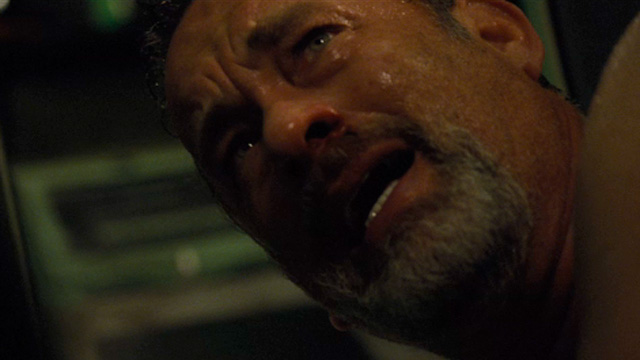
It recalls a story about the marketing of Apollo 13, which originally had a poster of the perilous situation—the spacecraft leaking oxygen going around the dark side of the Moon—but fearing for their investment, the producers opted for one that had Tom Hanks front and center in a claustrophobic layout.  The reason for this being that audiences might not care for the situation depicted in the earlier poster, but if there's a poster where Tom Hanks is worried that he's in trouble, that might bring a sympathetic audience in, hoping that the popular actor would attract a crowd.  And so the actor-specific poster (despite an all-star cast) was substituted. One wonders if it might be the same reason that Executive Producer Kevin Spacey is not portraying Phillips; maybe folks wouldn't worry about Spacey so much, but Hanks' every-man persona might make a monetary difference at the box office.  In any case, Hanks does a fairly good job at maintaining a veneer of calm while an undercurrent of panic roils through him.  But where he really shines—to the point where it's amazing to see—is the way he projects the character's shock at the end of the film, and one has to applaud Hanks for displaying a total break-down without once making us recall his crying for a volleyball.*** Despite his reputation as a male version of America's sweetheart, he is a good enough actor to still surprise and move, over one's objections.

Captain Phillips is a Matinee.


* My first question to those union sailors would be "If Phillips died, would you still be pursuing the lawsuit?" They're damned if they would, and damned if they wouldn't.

** In the film, they're constantly chewing khat.

*** That would be his loony-toons turn in Cast Away.  If I had a nickel...

Saturday, September 14, 2013

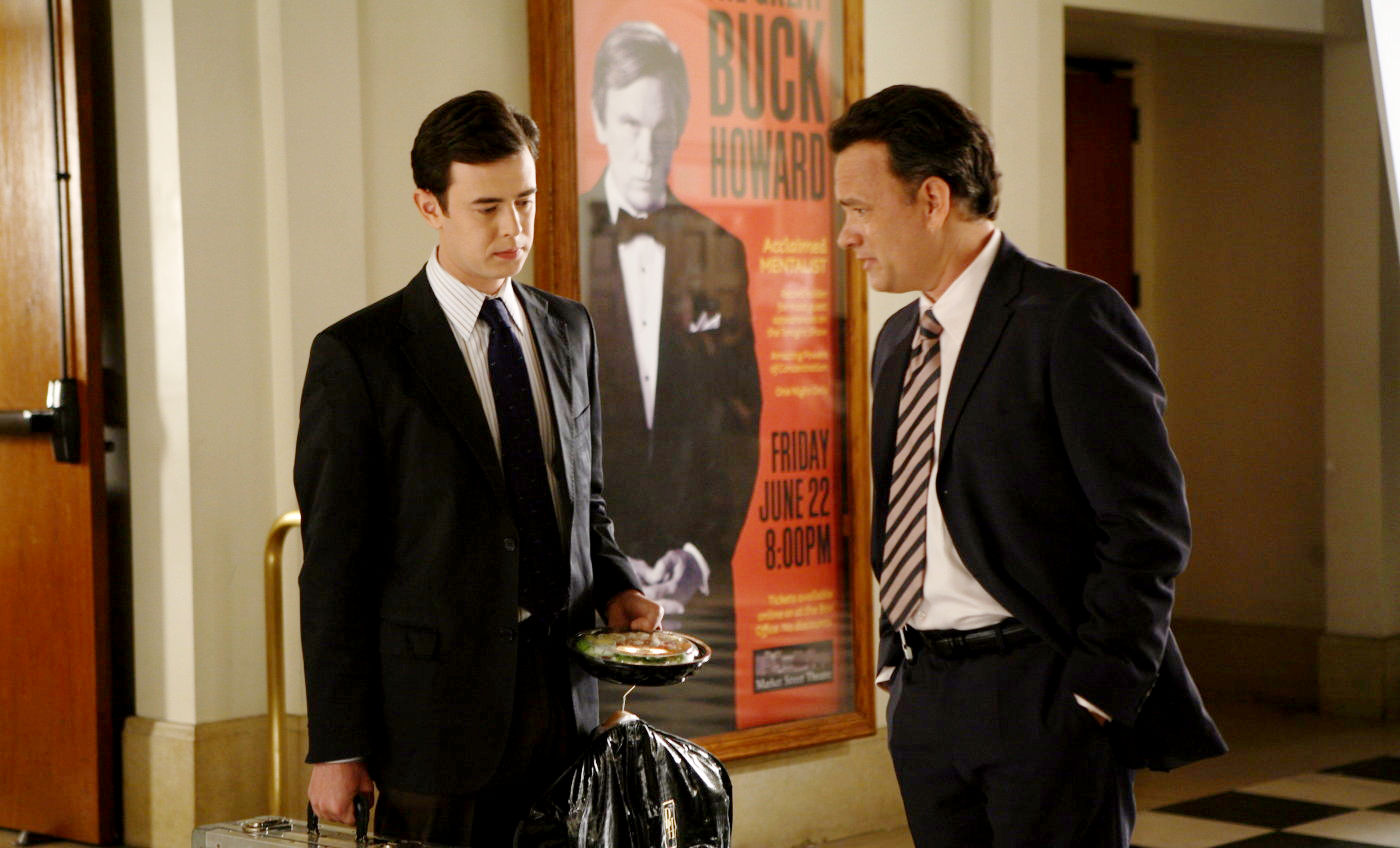
The Great Buck Howard

The Great Buck Howard (Sean McGinley, 2008) Writer-director McGinley spent some time as the road-manager to The Amazing Kreskin and that formed the basis for his script for this, a production of Tom Hanks' Playtone Pictures.

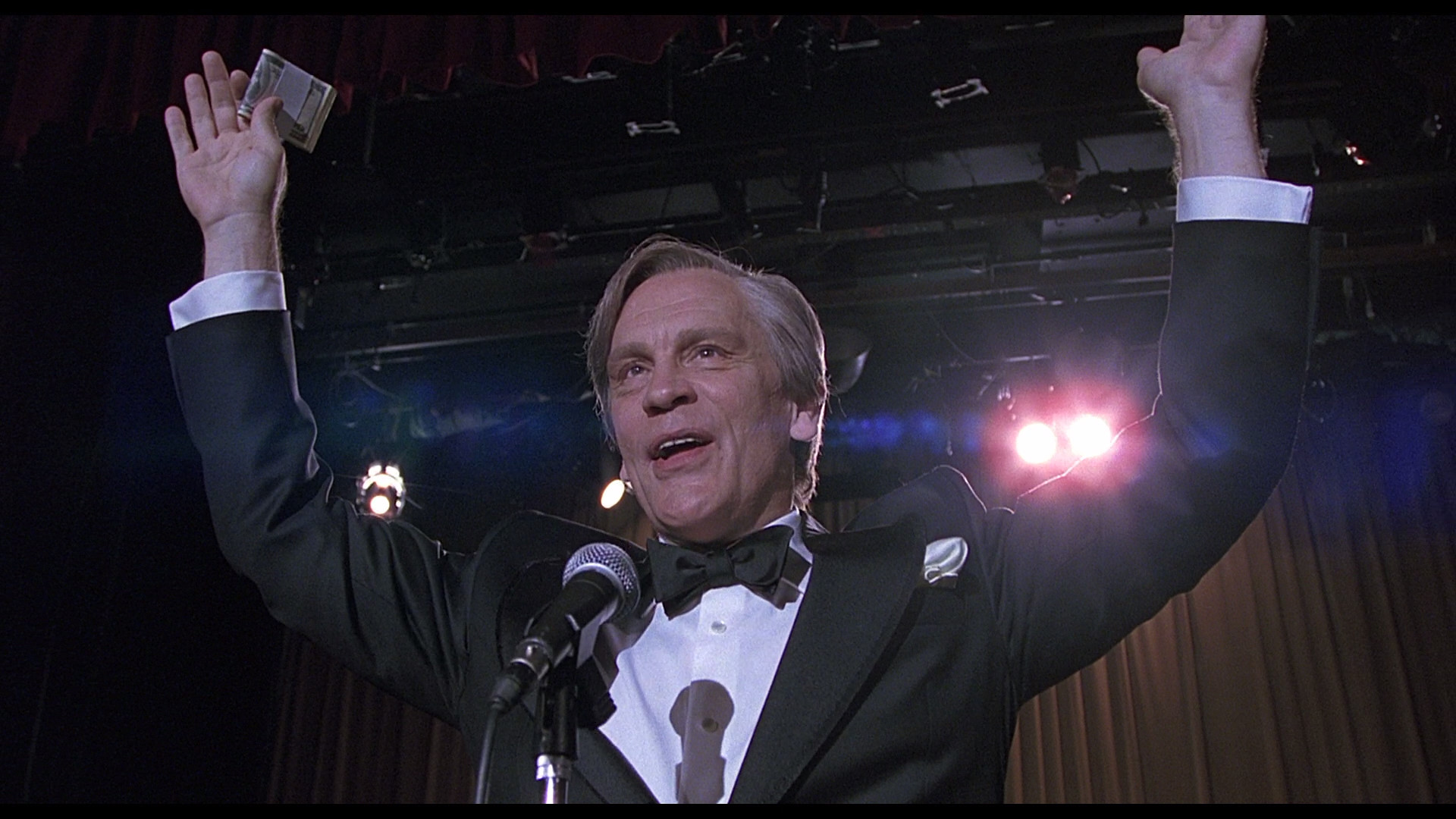
Looking at the promotional videos associated with the DVD, it would appear that Kreskin is fine with this, even though, in details, McGinley strikes rather close to the psychic bone here—yes, Kreskin in his hey-day appeared 61 times on "The Tonight Show with Johnny Carson."  Yes, he would close his shows by guessing where an audience member had hidden his pay-check (and he always got paid). That's all duly served up as quirks of "The Great Buck Howard," played somewhat petulantly by John Malkovich.  But are the other things in the movie like this—the grandiose ego, the out-sized self-importance, the schticky "I love this town" facile platitudes, the dismissive photo distribution, the intolerance for deviation from formula, and the truculence that borders on vengefulness.  Oh, Buck can be a good guy...on occasion...but mostly he's in one big perpetual snit that you don't need a mentalist to see coming.  Which makes one wonder why someone would take the job in the first place.


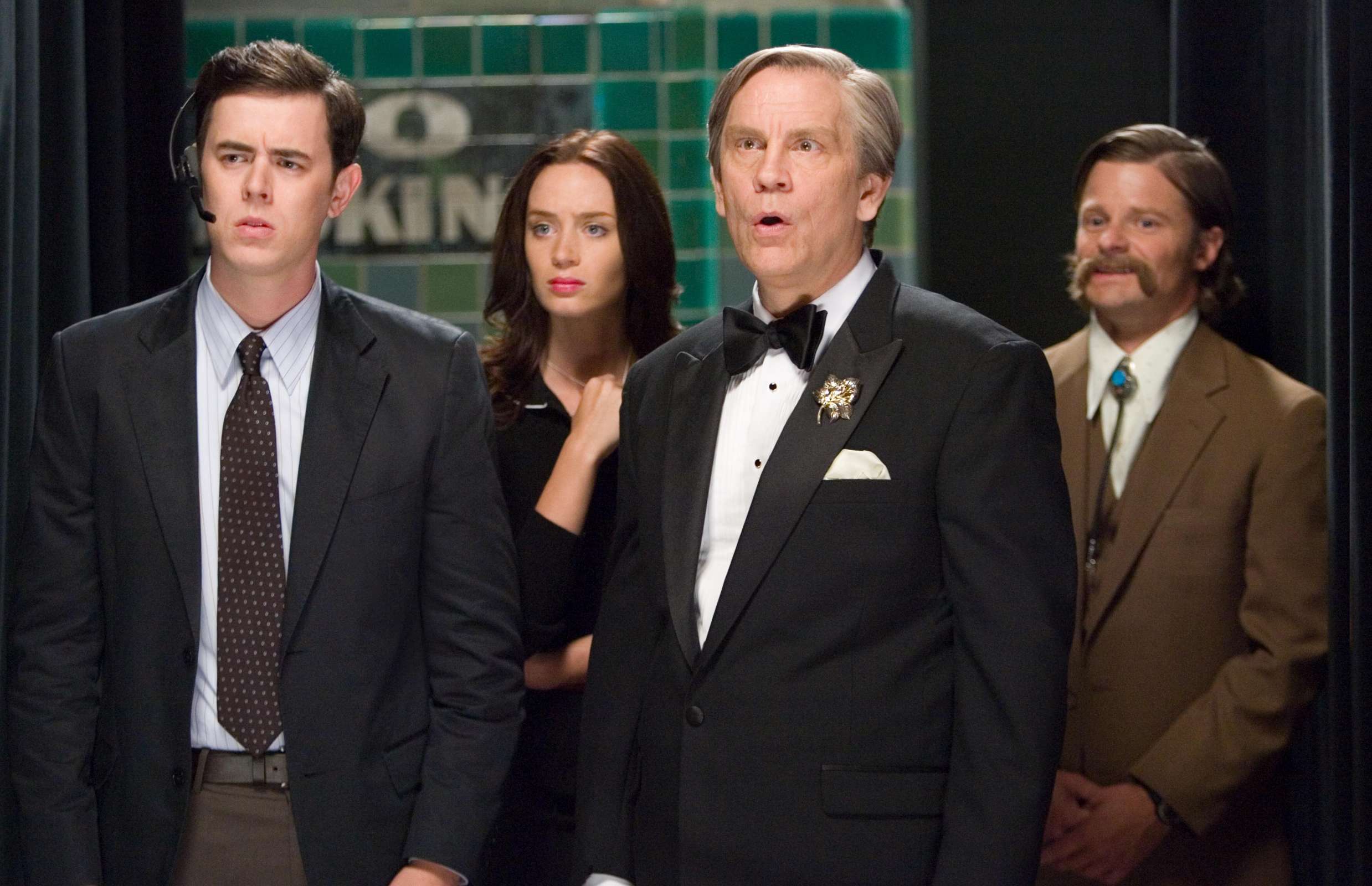
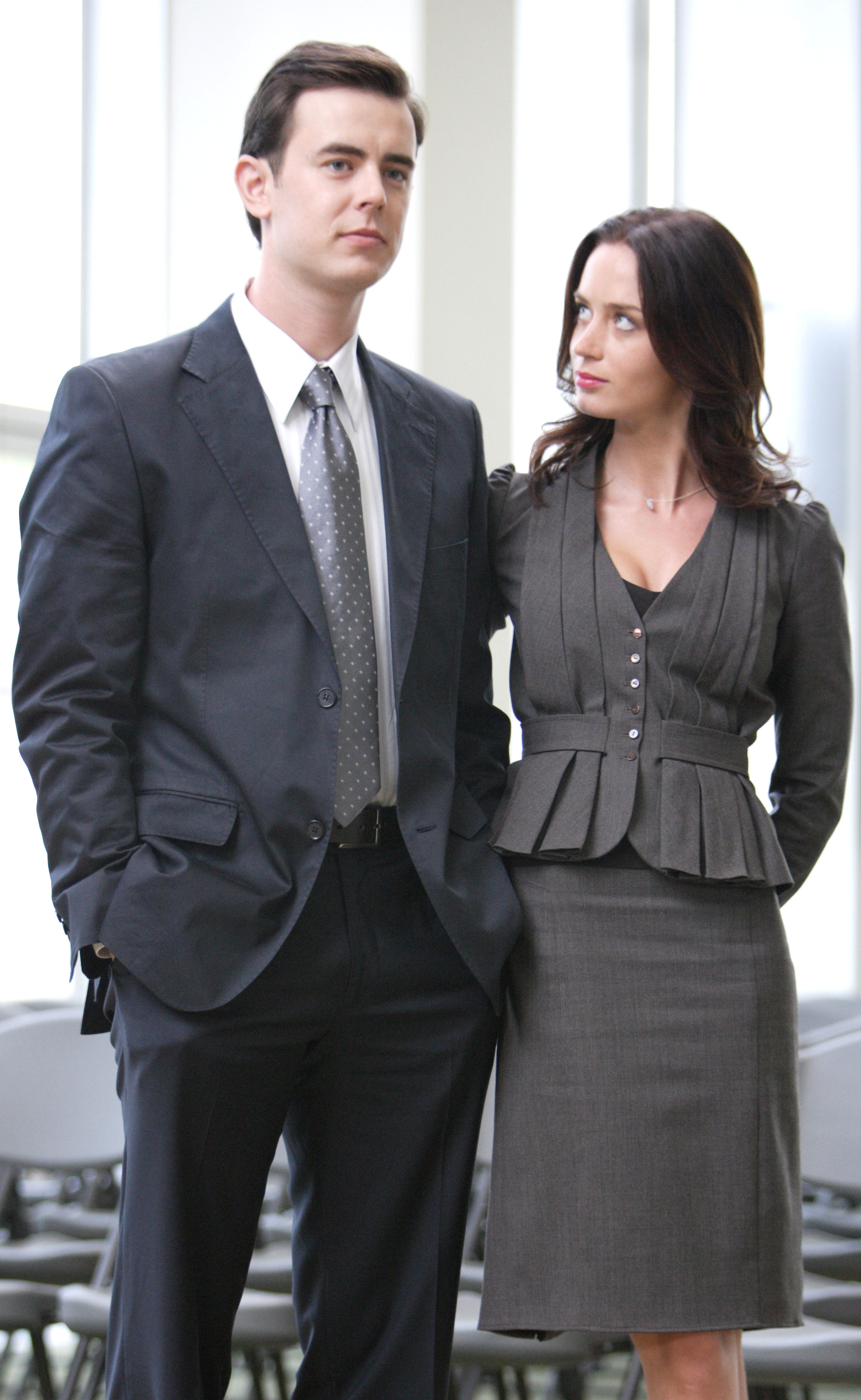
Troy Gable (Colin Hanks) drops out of law-school to be the personal assistant for "The Great Buck Howard," who is doing a cross-country tour of small town America, hoping to re-kindle some of the old magic of his mentalist show, when he was more famous...or famous at all.  A publicity agent (Emily Blunt) is hired as point-person for interviews and "events" that tend to fizzle out, but she's only as effective as her sorcerous subject and he works best in a controlled environment, one under his control and can anticipate, and any deviation might throw him off.


The film has its charms for a one-sided coming-of-age story, mostly in the casting with Hanks the younger (Hanks the older plays his skeptical father in a nicely subdued and flinty cameo) as a fine, callow presence (most of his performance has to be done in the eyes in the course of observing the shenanigans, and, appropriately, Troy never takes his eyes off Howard, when the job might more appropriately call for his attention to be elsewhere.  Blunt is great, as always, even if she isn't doing much more than 'love interest," and Malkovich does a tender walk between comedy and psychosis, cruel and entertaining in one flow.  There's also some nice touches by Steve Zahn (a favorite of mine) and Ricky Jay, as bumps on the road-trip.


Still, the Kreskin connection bothers me, especially as the movie's mentalist is a bit of a jerk, never himself coming of age.  I remember the film coming out and listening to Hanks (the younger) and McGinley do "press" and never once mentioning Kreskin.  Nor did I hear anything else about the man through the film's admittedly short run.  To see him come up so specifically and directly on the DVD was a bit of a surprise.

In fact, I don't remember him ever mentioning it, before I saw that supplemental feature.

Hmmm.  Perhaps he is a clairvoyant, after all.


Wednesday, February 15, 2012

Extremely Loud and Incredibly Close

The Schell Game
or
An Irrational Fear of the Irrational

Not sure what the problem with young Oskar Schell (Thomas Horn) is: it could be borderline autism, or as is brought up, Asperger Syndrome ("the tests were inconclusive," he deadpans).  It could be "mean world syndrome" or "fusion paranoia," or something as simple as shock or grief, maybe even survivor's guilt.  But, coached by his father (Tom Hanks) who died in the Twin Towers on 9/11, he is on a mission to find answers by the same empirical methods Dad used to create scavengers' hunts throughout the city of New York.

To the young Schell, the events that took his father, literally before his eyes, yet in an abstract undefinable way (he literally vanishes, but there is no body to bury), it is all horrifyingly absurd, and the only way to wrap his mind around it is a quest, in the same way that his father distracted him from his fears, which are plentiful (closed spaces, crowded places, tubes and tunnels, things that fly, things that are loud, bridges that could collapse) all things that keep his logical, compartmentalized fact-file of a mind focussed on the task at hand, to the rhythm of the tamborine that he shakes to keep his own mind from being rattled by anything else.

One day, after visiting the shrine he's constructed for his father, he confronts for the first time his father's room and closet kept undisturbed since the Al Qaida attacks, smelling his clothes, trying to recall the sense-memory of him, when by happenstance, he finds an envelope (marked "Black") containing a single key.  Thinking it to be the ultimate of one of his father's challenges, he embarks to find the one lock in all of New York mated to that key.

It's a tortured, torturing metaphor.  What he's really looking for is something...anything...that might give him solace for his loss, an answer to why his beloved, obliquely protecting father might vanish so completely, without even the cold reality of a corpse to ground him to reality.  In the process, he neglects his mother (Sandra Bullock), his schooling, his life...for the ultimate answer of purpose, and thereby complete the education cut short by the death of his father.  It's a risky premise, one that, ultimately, can have no real resolution, but only absolve him of any complicity in the events of his father's death. 

What Oskar is actually looking for is his own penance.

Movies come in cycles, not only because of the economic consequences of box-office (nothing in Hollywood succeeds like excess), but also with the nation's zeitgeist.  Is it any coincidence that Extremely Loud and Incredibly Close is a modern day version of New York film-maker Martin Scorsese's Hugo...about another boy's father-quest involving a key and finding something else more than himself?  Hard to say...anymore than that Hugo and The Artist are both explorations and celebrations of the era of visual story-telling displayed by the dawn of moving pictures.  But, EL&IC has the disadvantage of being a little too close to the theme without the benefit of artistic distance, while being a little too obvious about what it's trying to say...which, as it turns out, isn't much...other than "what are you worried about, kid, when you might be hit by a bus tomorrow."  Or dharma works, when runaway karma runs over your dogma.   Thanks, but I'd rather have Méliès be a cure for my malaise.

But, what a cast...Hanks, Bullock (basically in the background for most of the movie but allowed to shine at the film's resolution), John Goodman, Viola Davis, Jeffrey Wright and a steady stream of fine character actors as Oskar's many encounters and tough-stones on his journey.  But, the finest of the bunch is Max von Sydow as the Campbellian "helper by the side of the road" that he plays mutely without a word of dialog.  Again, the part is a little obvious and a little tortured, but von Sydow once again provides an actor's master class in taking a role os lightness and making it breathe with life and truth.

Extremely Loud and Incredibly Close is a Matinee.


Does Max Vo Sydow stand a chance of taking the "Best Supporting Actor" Oscar from Christopher Plummer?

Tuesday, July 12, 2011

Larry Crowne


T. Hanks for the Mediocrity
or
My Big Fat Career Mistake

I'm sure the intentions were better (aren't they always?), possibly saying something about the displacement of late baby-boomers in the job market, and how "it's never too late to learn" belying the "old dogs/new tricks" canard.  Maybe Hanks just wanted to make something hopeful and sunny in bad economic times...a flare in the night-sky...the proverbial single candle rather than curse the darkness.

Well, it's more like a candle in the wind, and this blows.  Formulaic, with an implied "wah-wah" comedy goose at the end of every scene, Larry Crowne has a "made-for-TV" movie feel that gets under your skin like intravenous sand-paper.  Larry (Tom Hanks) is in his early fifties, divorced, a twenty-year Navy vet working at a box-store, where he's received "Employee of the Month" fetes nine times.  He's one of those guys who owns everything he does, taking a certain pride in all aspects of his job, even picking up and disposing the stray trash he finds in the parking lot.  The implication is already there: while the rest of the world goes on its self-absorbed way, Larry "cares."  And that can't come to any good.

Called in for what he thinks is his tenth EOTM award, he is fired instead; corporate has crunched the numbers and sees him, as never having gone to college, as not being "advancement" material—he's already been passed over for promotions by duller, but degreed, employees.  Adrift, Larry finds no work, and so goes to community college in his '50's, with similar outcasts (though dissimilar aspects) most younger, but without the team-player skills that Larry has acquired.

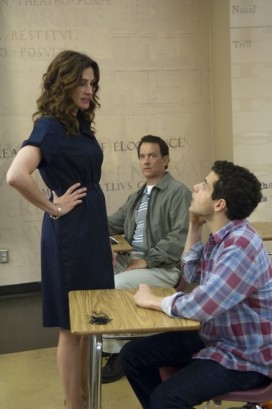
Teaching one of those classes—Speech 217—is Mercedes Tainot (Julia Roberts), bored, tired, unmotivated, with a dead-beat author-husband (the wonderful Bryan Cranston), who, like Larry at the beginning of the film, doesn't know she's in the process of transitioning, so cynical is her world-view.  Her students are an odd collection of rabbits, that she's just trying to keep awake and inspire the one thing she can't seem to muster up—giving a rip.  And Crowne is the oddest rabbit in the bunch.  She glowers, as she sees him slowly change under the influence of younger students—particularly women, and particularly one student who has it in mind to completely "make-over" Larry to his puzzlement and the vexation of her boyfriendThis area of the movie has more than its share of "wah-wah" moments, and as much fun as Roberts' slow-burn is (and she's great at it), they have the feel of sit-com situations that might be fun for the matinee crowd.  It's there that the writing hand of Nia Vardalos, she of My Big Fat Greek Wedding, is the most evident.  Hanks and his wife, Rita Wilson (who is also in this with a small, rather frightening part) were the ones who took Vardalos' one-woman show and shepherded the development of it into a Big Fat Success.  The demographic for Larry Crowne skews a little bit to the same age, with the same toothless observational satire that never offends, even when it tries to be a little "naughty."  It's all for naught.

And yet.  And yet...

"Take it from an 'old guy:' never regret being delightful," I told a clerk who thought she was being "too forward" approaching me in a store aisle.  Twenty-four hours after "grumping" my way through Larry Crowne, the sugar had dissolved in my mind and the "good stuff" remained...Larry's unexpected, all-inclusive, concise and perfect final project in class that nicely ties a bow around the movie, a cast of great people getting to be charming (Cedric the Entertainer, Taraji P. Henson—a favorite of mine, Wilmer Valderrama—!!, George Takei!!!, a little spitfire named Gugu Mbatha-Raw—late of "Dr. Who," "MI-5", and "Undercovers"—that you just want to hug, and...almost too good to be true...the always-welcome, never-failing Pam Grier).  The thing is for as saccharine as the movie feels going down, it leaves a pretty good after-taste.  One forgets just how much one is suffering through it, and how unsufferable it can be, and is left remembering the good parts.  Meaning that Larry Crowne is a similar experience to childbirth.

Not a ringing endorsement...but it could be worse.  It could have had The Fockers, guest starring Kevin James.  

Larry Crowne is a Rental.

Friday, June 18, 2010

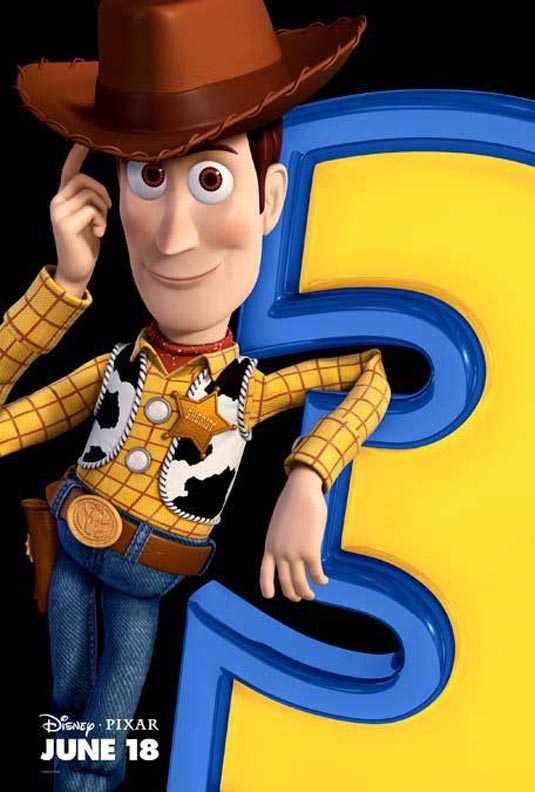
Toy Story 3

"And if You Can't Be with the One You Love, Honey..."

One has suspected a subtle sub-text in the "Toy Story" series—every Pixar film has evoked that feeling (which is why they tower over Dreamworks and every other animation supplier and make even their rivals' three-dimensional films seem more two-dimensional) since the first film premiered (what was it?) fifteen years ago.

"Toy Story 3" is no less rich in sub-text.

Sub-texts like the given that the toys have stayed the same, but their little owner Andy has grown up and is on his way to college by the time we hit "3;" First sub-text: Change or be passed over. Any one looking for a job in these troubled times has had to be confronted with their inadequacy in some department while they're winning the daily bread.  And like the toys of "Toy Story," time may be their enemy, staying consistent while the world evolves too quickly.

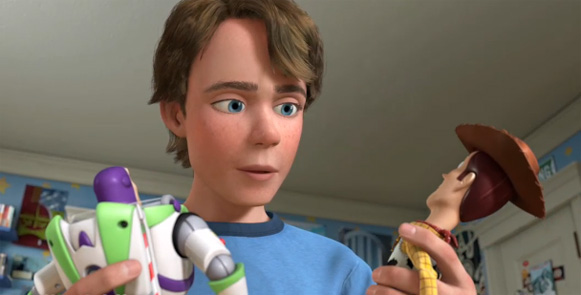
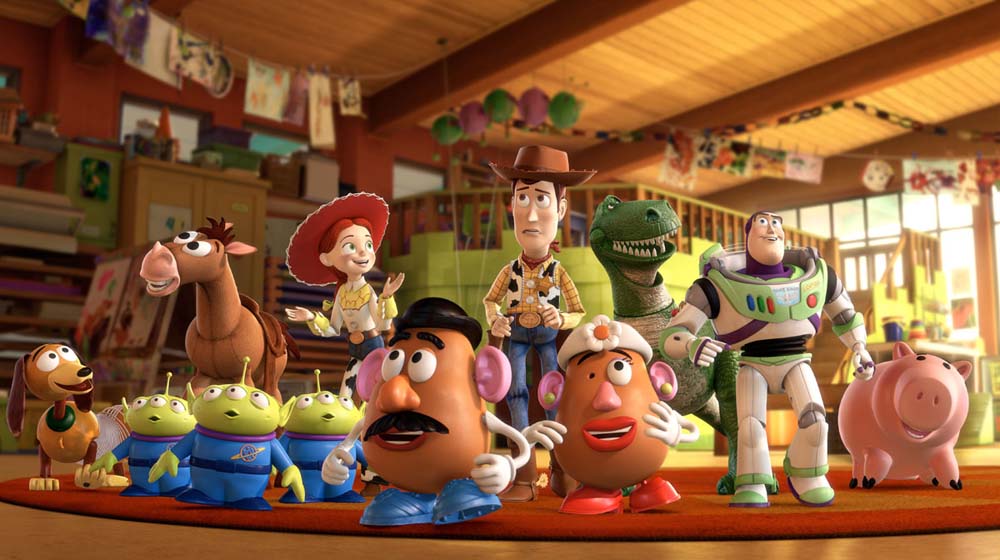
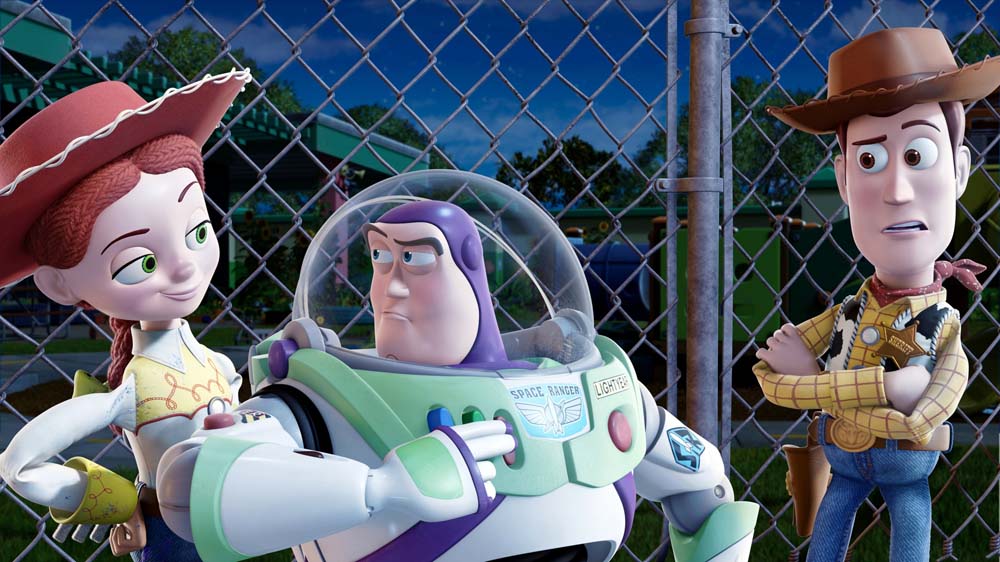
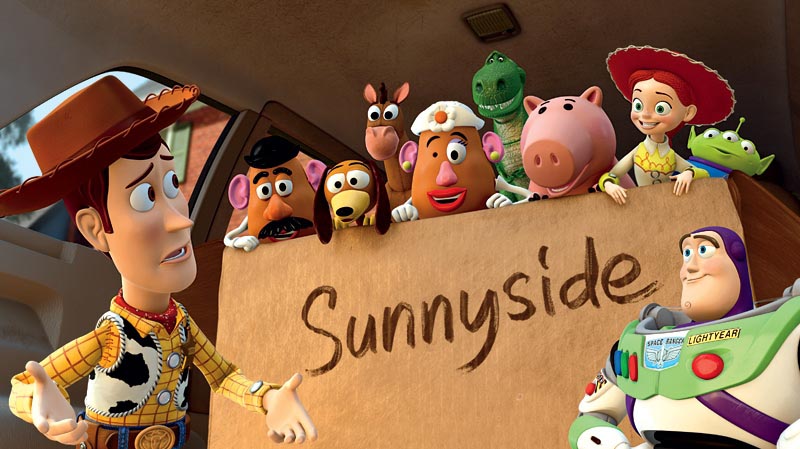
But, at the pace-making heart of the "Toy Story" movies has been one constant, and that is its contemplation of the nature of Love, which puts it in the same movie-case with such seminal works as "Vertigo" and "A.I."  In the first "Toy Story," cowboy-doll Woody (voiced by Tom Hanks) watched in horror as the affection of his beloved Andy was supplanted by the new space-age toy Buzz Lightyear (voiced by Tim Allen).  The stakes doubled in "Toy Story 2" when we witnessed the discarding of cow-girl Jessie (voiced by Joan Cusack) as her owner grew up and put away childish things (see the video below).  And we witnessed Woody turned from an object of play to a rarified objet collectionner, the very definition of a "trophy love."  "Toy Story 3" takes Jesse's plight and applies it to the entire toy corps, facing abandonment (the attic) and, worse, discarding (at the sidewalk on garbage day).  The toy soldiers take action and evacuate the premises first: "Once the garbage bags come out, the army men are the first to go" barks the commander (R. Lee Ermey) before para-sailing out of Andy's bedroom window.  The others are left to contemplate their fate. 

Play-time's over.*

There is one axiom I've held to my heart from the moment I first recognized its truth—I'm sure it originates elsewhere, but I first read it from thriller writer John D. MacDonald: "Love is not the opposite of Hate; love and hate are merely two sides of the same coin.  The opposite of love is indifference."

There are a lot of instances of indifference on display in "Toy Story 3" (though certainly not at the hands of the creative team behind it, who have filled it with pithy circumstance and finely-wrought detail in a cartoonish 3-D photo-realism**).  But, so is love, in the through-line from the first movie, first warbled in Randy Newman's opening song "You've Got a Friend in Me." It is the banding together of the community, standing stuffed shirt to plasticene shell through adversity, the toys' answer to "Can't We All Just Get Along?" All the movies have centered around the toys—diverse as they are—keeping the group together, and welcoming the new.  That reaches its dramatic climax here as the team locks hands as they face absolute destruction in a truly frightening version of Hell.

The forging of the community has been a theme running throughout the history of film (especially Westerns) since Edison, certainly John Ford, and we've all seen those films where the protagonist loses a family in order to gain another, sometimes not by choice.  Those bonds are infused with strength to take on all comers and all challenges, but the heart of that coming-together has always been the one unofficial but over-arching Commandment: Love thy Neighbor.

I mentioned putting away childish things earlier.  That's from The Bible (1 Corinthians 13), and looking over that verse again, I saw images spring up from "Toy Story 3"—"And though I bestow all my goods to feed the poor, and though I give my body to be burned, and have not love, it profiteth me nothing," particularly.  But especially its last devastating quality in its check-list of Love's qualities, which always makes me tear up a little when I contemplate it, and I contemplate love and loss.  For toys break, batteries fade, fabric burns and plastic will melt.  But Love "never faileth."

Love never dies.

To Infinity.

And Beyond.

"Toy Story 3 is a Full-Price Ticket."


* How many times have we said that, as adults, mourning the loss of childhood from adult responsibilities?

** But, man, you want to see Pixar push the envelope?  Check out the sophisticated opening short "Day & Night," a wordless combination of 2-D and 3-D, line animation and computer graphics, filled with rich imaginative ideas and a brilliant sound design.  The work of animator Teddy Newton, this little gem, puts him at the top of exciting animators to watch.

Thursday, March 27, 2008

Charlie Wilson's War

I walked out of Charlie Wilson's War feeling fully entertained. It had flaws, but also strokes of genius. I quickly pegged it as a 4 stars out of 5 film. But something kept bugging me about CWW. The more I thought about it, the less comfortable I felt with its glibness.

Aaron Sorkin, also the engine behind The West Wing, wrote a smart, sexy script. It's full of political intrigue, back door dealings, and power plays settled more by wit than brute strength. We get the thrill ride of imagining a world where the history of the Cold War was being written by a drunken, womanizing Texan. And the film coaxes better than average performances from a host of better than average actors (except Philip Seymour Hoffman who I will not damn with such faint praise; the man is outstanding.) Overall, there's a lot of fun to be had with this recipe.

This film suffers from an agonizing fatal flaw however. It does concede the point that America screwed up by not helping the Afghanis rebuild after their successful war against the Soviets... and even tries to tack on a touching ending where we see an increasingly red-eyed Charlie trying to convince political allies to spend a few million on building schools for the survivors in Afghanistan. But this is crap. Not because it isn't true... it IS true that 9/11 could have been avoided with an ounce of prevention in parts of the world that we exploit. And it's probably even true that Charlie Wilson advocated for those programs. It's crap because the film just spent two hours showing us how sexy and exciting warmongering can be. It just gave you an adrenaline ride about how deft political maneuvers lead to shooting down Russian assault helicopters... all while watching a rippling American flag in the background and feeling secure in the knowledge that the Russians were the evil empire.

This sort of tactic reminds me of Ridley Scott's "Kingdom of Heaven"... an epic warfare film that tries to make the point that war is bad. This feels hypocritical to me... don't try to tell me war is bad after titillating me with two hours of exciting battle footage. Similarly, Mr. Sorkin, don't try to tell me we should have a kinder, gentler foreign policy after showing me how exciting it is to engage the gears of war. You're a liar Mr. Sorkin, and I will destroy your movie by taking back one star. You reached for meaning without believing in that meaning yourself. Now your film can rot with all of Tom Hank's other films: In three star oblivion.

Still worth a rental. :)

Wednesday, February 27, 2008

Charlie Wilson's War

From the Folks That Brought you the Taliban and 9-11

I'll say it, because the film-makers obviously couldn't. Or wouldn't. Or felt they shouldn't.

But look at these film-makers: A trio of top-stars (Tom Hanks--who also produced, Julia Roberts, and Philip Seymour Hoffman), screenwriter Aaron Sorkin (he of "The West Wing") and director Mike Nichols, who excels at bringing the best out of good material.

How did they all fail so miserably with "Charlie Wilson's War?"

It seems like a slam-dunk (if you'll excuse the term)for a knock-about satire about the excesses and low-lifes of the government, where they spell "class" with a capitol "K" street, and prove daily that they haven't dredged enough muck out of the swamp-land that was Washington, D.C. And it couldn't be a better story, because, by and large, this story really happened.

A Texas Congressman named Charlie Wilson, the definition of what Sorkin used to call "an empty suit" on television, presides over a district that doesn't want much, so he's free to wheel and deal, doling out favors and votes to his fellow congressmen, drinking like a fish, "canvassing" all sorts of female constituents, facing questions of ethics violations, and staffing his office with bimbos ("Charlie says you can teach 'em to type, but you can't teach 'em how to grow tits," says his receptionist, cheerily). One day he looks up from his hot-tub of Playmates to see Dan Rather on the news wondering why no one will send the Mujahadin weapons to fight the Russians in Afghanistan. So, with the the help of a schlumpfy CIA Agent with impulse-control problems (Phillip Seymour Hoffman) and a dragon-lady of a Republican anti-communist lobbyist (Julia Roberts), Wilson wrangles his way through various walk-and-talks securing surface-to-air missiles for the Afghanis. His efforts drive the Soviets out of Afghanistan, and (in a gross oversimplification of the precariousness of the Soviet State), bring an end to the Evil Empire.

This is great satirical fodder, but it's peddled by Sorkin and Nichols for the occasional one-liner, but no outrage--bunts, but no home-runs--and it's presented as if it's just one more day in that wacky viper-pit that is Our Government at Work. More offensive is the sequences of combat, with Russian helicopters strafing civilians like its a video-game, and footage of Russian helicopters being blasted out of the sky with a rousing boo-yah score, cross-cut with the celebrating politico's slapping each other on the back. And it's all presented without the bat of an outraged eye or the wink of conspiracy.

These guys (the film-makers) seem to think the trafficking of arms through Congressional channels is a Good Thing, as long as the Right Guys are being aimed at, and the only attempt to link the ending of the Afghanistan War with the rise of the Taliban and the harboring of Al Qaida is a veiled reference to not providing funding for schools after the conflict that in Wilson's words "fuck(ed) up the endgame." The REAL Wilson (pictured right) has also expressed worry that one day one of those missiles will be used against American planes (if they haven't already been used in our own Afghan conflict). But Nichols and Sorkin won't go there. Instead, they'll book-end their movie with Wilson recieving an award for the "Most Successful Covert Operation in History," staged in a cavernous airplane hangar with the applause of the many co-conspirators in the plan. It all sounds so neat and self-congratulatory, when the story is so up-to-its-eyeballs in chicanery, wheeler-dealing, and compromised ethics and principals.

Imagine if the story was told with the same savage wit of a "Dr. Strangelove," or "Wag the Dog" instead of the cynical "shucks, ain't they bastards" attitude of Sorkin (and let's face it, judging from "Studio 60 on the Sunset Strip," he sucks at satire), but I suppose to even get the story filmed, it had to meet the approval of the participants, who are all very much still alive. Given that stipulation, I guess one should be grateful they weren't all outfitted with halos. In the end for all its slickness and hipness, its still a cowardly movie.

I remember when "West Wing" was on the air, a Republican Congressman explained why he loved the show--"Everybody is smart, funny, and semi-effectual, instead of the truth." Sums up "Charlie Wilson's War," too.

"Charlie Wilson's War" is a rental.