Showing posts with label Aaron Sorkin. Show all posts

Friday, October 7, 2011

Moneyball

"Re-Inventing the Game/Enjoying the Show"
or
"...Like an Island of Misfit Toys"

"It is played everywhere...in parks and playgrounds and prison-yards.  In back alleys and farmers fields. By small boys and old men.  Raw amateurs and millionaire professionals. It is a leisurely game that demands blinding speed. The only game in which the defense has the ball. It follows the seasons, beginning each year with the fond expectancy of Spring-time and ending with the hard facts of Autumn. Americans have played baseball for more than 200 years, while they conquered a continent, warred with one another and with enemies abroad, struggled over labor and civil rights and the meaning of freedom.  It is an American Odyssey that links sons and daughters to fathers and grandfathers.  And it reflects a host of age-old American tensions: between workers and owners; scandal and reform; the individual and the collective.  It is a haunted game in which every player is measured against the ghosts of all who have gone before. Most of all, it is about time and timelessness, speed and grace, failure and loss, imperishable hope and coming home.  At its heart lie mythic contradictions: a pastoral game born in crowded cities;  an exhilarating democratic sport that tolerates cheating and has excluded as many as it has included; a profoundly conservative game that often manages to be years ahead of its time. And...the men who fail seven times out of ten are considered the game's greatest heroes."      Geoffrey C. Ward and Ken Burns, "Baseball"

Baseball is my favorite sport.  I've played that and soccer (never well) but baseball has always seemed to fascinate me as an observer as no other sport can.  Yes, it depends on athleticism, but it also has an intricate strategy, a formula that can be tossed out in favor of an improvised gambit—baseball can go for long stretches with nothing happening except anticipation, which will snap into frenetic activity, going from 0 to 60 at speeds that NASCAR fans can only dream about.  It can create long-term loyalties but crush your heart in an instant.  It is a cruel mistress, inspiring love but at the cost of your spirit.

There's never been a movie about baseball that has satisfied me.  Often,  the game is ignored for personality, or uses it has a metaphor, wrapping it in myth (The Natural) or legend (Eight Men Out).  But the game is lost in the melodrama, serving only as backstop or stage.

This is why Bennett Miller's film of Moneyball grabbed me so intensely.  Written brilliantly by Steven Zaillian and Aaron Sorkin, it manages to tell the story of the game—as it is now, where budget and salaries have as much to do with a winning season as the efforts on the field, the front office strategy (or lack thereof), team dynamics and its construction, the reliance between old ways of doing things and the boiling down of what it takes to win, its joys and failings in one film, created by filmmakers all playing their A-game.

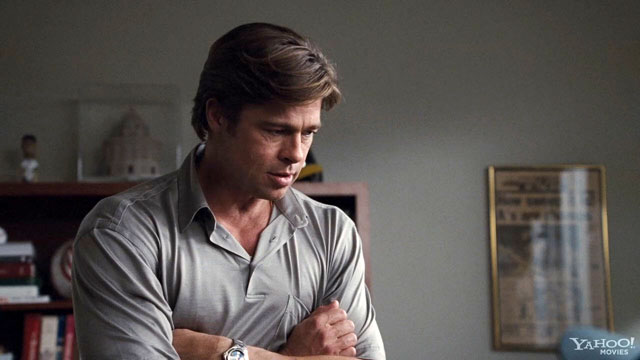
The Oakland Athletics have just lost another chance to make it to The World Series and their general manager, former washout-as-a-player Billy Beane (Brad Pitt) faces a long winter trying to re-build a winning team after losing his three key players while his budget for salaries is capped.  He can't compete with money-pits like the Yankees ("It's like a farm system for the New York Yankees," he gripes to his scouts at one point. "We're organ donors for the rich!").  Convinced that the economics of the game, as it stands, is unfair, he tries unsuccessfully to make headway, until he meets Peter Brand (Jonah Hill—never better), former Yale student in economics, who is working his first job as an adviser to the Cleveland Indians.  The nonathletic portly kid has a unique way of working, matching stats against potential, finding a niche of talent that is undervalued by the old-school way of judging talent ("He's got an ugly girlfriend—means he lacks confidence") Beane's first recruit is Brand as Assistant GM, who can look past the "conventional wisdom" and see the best advantages of the worst paid players.  The strategy is to abandon the "home run hitters" and find the guys who can get on base, make plays and score in-field runs.  The top-dollar guys can have their home run derbies, Beane wants to win, and find a way to win that doesn't depend on the size of the purse-strings.

But, the conventional wisdom still runs the A's.  Beane clashes with the vet scouts and with the coach (Philip Seymour Hoffman, who starred in Bennett's Capote), whose traditional ways tend to hamper the efforts rather than enhance them.  The A's start the season at the bottom of the ALWest, and the traditional empty-air of sports opinion turns against Beane. 

The story is in the record-books, but that's just a collection of stats.  Moneyball, as with "Moneyball," depends on what you do with them.  The nicely streamlined script is smart, subtly funny, and performed by all involved, especially by Pitt, whose never seemed so relaxed in front of the camera, can be caught in nary "a pose," and even manages to do some nifty tricks with delivery that seem beyond casual. Hill is a performer I've always seen as comic stunt-casting, but here, playing a character perpetually on the verge of a peptic ulcer, he gives a performance of such restraint, that when he does break out it's a bit of a revelation.  And Hoffman, playing the A's "seen-it-all" cynical coach, barely lifts an eyebrow playing smug defianceThere are pieces of this film that I already know will be showing up in my "Best Moments of 2011" at the end of the year.

The film does hedge the timeline a bit.  "The system" didn't pay off quite so immediately for Beane, but it did pay off—enough that the "level playing field" he dreamed of, is even leveler while more askew, thanks to other teams adapting his methods. The "mythic contradictions" of baseball never seem to cease.  

Moneyball is one for the record books and (yes) the best film about sports I have ever seen.

Moneyball is worth a Full-Price Ticket—right behind home plate.


Friday, October 8, 2010

The Social Network

"Saving Facebook" ("Every Creation-Myth Needs a Devil")
or
"There's Somethin' Happenin' Here (What It Is Ain't Exactly Clear)"

"O wonder!
How many goodly creatures are there here!
How beautious mankind is!
O brave new world,
That has such people in't!" (The Tempest, Act V, Scene 1)

Maybe it is too early to make a movie about Facebook (out of MySpace and Friendster) and the ramifications of our Brave New World of cyber-relationships.*  Maybe it is a little too "street-corner sage" to predict The End of the World As We are Sorta Familiar With it (But Not Really...More Acquaintances, Really).  But, it is interesting to see a story about the Frankenstein behind the Monster, if only to see how each reflects the other.

And even though we're secretly rooting for The Monster.

And, at this point in time, there isn't a better team to make "The Social Network" than Aaron Sorkin and David Fincher.  Sorkin, the mad savant behind some of the better TV shows of the past decade and a half, has always written about people and their "issues," and how personality impacts policy.  Fincher has matured from an ILM tech (who was happy to fly cameras through coffee-maker grips**) to an intricate observer of societal pressures on the psyche.  For the two of them to make this particular story is a Friend Invitation made in Hollywood Heaven.  "Accept" it.  But, you can't "Ignore" it.

The movie begins with a date going badly between Jeff Zuckerberg (Jesse Eisenberg, late of many movies with "...land" in the title) Harvard wall-flower, and Erica Albright (Rooney Mara—she'll play Lisbeth Salander opposite Daniel Craig in Fincher's big-budget version of "The Girl with the Dragon Tattoo"), an acquaintance.  Anyone familiar with the machine-gun dialogue that writer Sorkin is known for, had better duck for cover—or wait for this on DVD so you can...play...it...slooooowly—for he now has an automatic weapon for a word-processor, and a co-conspirator in Eisenberg who can milk every nuance out of a line, despite hyperventilating it at debate-competition speed.  His Zuckerberg is a "no Dolby/no squelch" type of unreadable conscience, and Eisenberg plays it with a deadness behind the eyes that interprets the world as a problem, if not necessarily a challenge.  He's a bit too candid for a first date, and she stomps off, which sends him on a mission, simultaneously trashing her on his blog (LiveJournal) and culling the pictures of every woman on campus to create a "Who's Hotter" web-competition that becomes so popular so instantly that it crashes Harvard's web-infrastructure.  He becomes both famous and infamous for the stunt, guaranteeing he'll never get a date in college, and attracting the wrath of the college's board, and the interest of two preppies attempting to create an exclusionary social network on the web.  He goes them several steps better, making a system open to everyone on campus that trumps their attempts, and as it gains "friends," expands throughout the college system.

Hindsight is 20/20, and Sorkin constructs the film as a series of depositions after the fact (of Facebook's success) as everyone who thinks they've been burned by Zuckerberg testifies to his vague promises and dealings under the table. *** Of course, they have every right to sue—but they'd only sue if "The Facebook" was a success—and the underpinnings and double-dealings don't resemble a fight for satisfaction, or a Noble Quest, so much as resembling a snake eating its own tail. ****

Which brings us back to Frankenstein and his Monster.  The film itself is expertly done—it is a complicated story of hidden motivations and the presentation of masks before public faces—and Sorkin and Fincher manage to navigate us through the maze of the story, even though one feels there is no cheese at the end.  The experience is a bit hollow, which may be a part of the point.

Because the Facebook experience is hollow, as well.  As hollow as Zuckerberg, as portrayed in this film, is.  While it is nice that one has the opportunity to "re-connect" with old friends in a virtual environment and satisfy everyone's need to (as one friend commented on blogging) "talk about what you had for lunch," one wonders why one has to re-connect at all...especially if the relationship wasn't maintained in the first place.  Not enough time in the world to meet?  Because a "real" relationship takes time, takes effort, "gets messy?"  Facebook provides the illusion of "staying in touch," without actually touching.  Like Zuckerberg's abortive "date," a lot of time is spent broadcasting, but not interacting.  There are, of course, exceptions.  But the fact of the matter is Facebook's cyber-community is not a "Brave New World" at all.  Just the opposite.  It provides a substitute in lieu of commitment.  A panacea in a life thought to be full to bursting and without risk.  The most precious commodity we can give is time—slices of our lives and our selves.  Facebook is a pacifier—a mass-Hallmark card that we can spend a few heart-beats picking out, and send away without a thought and not even sweat the cost of a stamp.

It soon becomes a numbers game—a collection, like the celebration of the 1,000,000th friend portrayed in the film.  But who are those million people?  Facebook doesn't know or care.  It's just a number.  A number of casual relationships, that may lead to something else, but probably won't.  A collection, nice to look at, but more often, ignored.  Trophies, and ones that don't need to be polished or buffed up.

It's a new world of blithely arrested development, in the image of its creator, where love and commitment do not compute, and the only thing close to it is "hope"—translatable as keystroke F5.

"The Social Network" is a self-fulfilling Matinee.  Take a date. *****


* And by the way, Aria, Ridley Scott does bloody well "bury the lead" in "Blade Runner" by insisting that Deckard is a replicant! Nyeeeah! :P

** Except for some dodgy freezing breath-work, the biggest special effect will be invisibe to you until the closing credits.  Nice.

*** Personally, I'd like to get back all those hours spent on "ZooWorld."

**** An image that kept coming to mind every time I thought of writing this review, where it would subsequently be published...on LNTAM's Facebook page.

***** You won't have to interact during it, either.  

Thursday, March 27, 2008

Charlie Wilson's War

I walked out of Charlie Wilson's War feeling fully entertained. It had flaws, but also strokes of genius. I quickly pegged it as a 4 stars out of 5 film. But something kept bugging me about CWW. The more I thought about it, the less comfortable I felt with its glibness.

Aaron Sorkin, also the engine behind The West Wing, wrote a smart, sexy script. It's full of political intrigue, back door dealings, and power plays settled more by wit than brute strength. We get the thrill ride of imagining a world where the history of the Cold War was being written by a drunken, womanizing Texan. And the film coaxes better than average performances from a host of better than average actors (except Philip Seymour Hoffman who I will not damn with such faint praise; the man is outstanding.) Overall, there's a lot of fun to be had with this recipe.

This film suffers from an agonizing fatal flaw however. It does concede the point that America screwed up by not helping the Afghanis rebuild after their successful war against the Soviets... and even tries to tack on a touching ending where we see an increasingly red-eyed Charlie trying to convince political allies to spend a few million on building schools for the survivors in Afghanistan. But this is crap. Not because it isn't true... it IS true that 9/11 could have been avoided with an ounce of prevention in parts of the world that we exploit. And it's probably even true that Charlie Wilson advocated for those programs. It's crap because the film just spent two hours showing us how sexy and exciting warmongering can be. It just gave you an adrenaline ride about how deft political maneuvers lead to shooting down Russian assault helicopters... all while watching a rippling American flag in the background and feeling secure in the knowledge that the Russians were the evil empire.

This sort of tactic reminds me of Ridley Scott's "Kingdom of Heaven"... an epic warfare film that tries to make the point that war is bad. This feels hypocritical to me... don't try to tell me war is bad after titillating me with two hours of exciting battle footage. Similarly, Mr. Sorkin, don't try to tell me we should have a kinder, gentler foreign policy after showing me how exciting it is to engage the gears of war. You're a liar Mr. Sorkin, and I will destroy your movie by taking back one star. You reached for meaning without believing in that meaning yourself. Now your film can rot with all of Tom Hank's other films: In three star oblivion.

Still worth a rental. :)