or
"There's Somethin' Happenin' Here (What It Is Ain't Exactly Clear)"
"O wonder!
How many goodly creatures are there here!
How beautious mankind is!
O brave new world,
That has such people in't!" (The Tempest, Act V, Scene 1)
Maybe it is too early to make a movie about Facebook (out of MySpace and Friendster) and the ramifications of our Brave New World of cyber-relationships.* Maybe it is a little too "street-corner sage" to predict The End of the World As We are Sorta Familiar With it (But Not Really...More Acquaintances, Really). But, it is interesting to see a story about the Frankenstein behind the Monster, if only to see how each reflects the other.
And even though we're secretly rooting for The Monster.
And, at this point in time, there isn't a better team to make "The Social Network" than Aaron Sorkin and David Fincher. Sorkin, the mad savant behind some of the better TV shows of the past decade and a half, has always written about people and their "issues," and how personality impacts policy. Fincher has matured from an ILM tech (who was happy to fly cameras through coffee-maker grips**) to an intricate observer of societal pressures on the psyche. For the two of them to make this particular story is a Friend Invitation made in Hollywood Heaven. "Accept" it. But, you can't "Ignore" it.
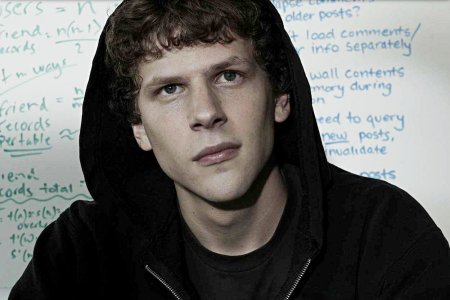
The movie begins with a date going badly between Jeff Zuckerberg (Jesse Eisenberg, late of many movies with "...land" in the title) Harvard wall-flower, and Erica Albright (Rooney Mara—she'll play Lisbeth Salander opposite Daniel Craig in Fincher's big-budget version of "The Girl with the Dragon Tattoo"), an acquaintance. Anyone familiar with the machine-gun dialogue that writer Sorkin is known for, had better duck for cover—or wait for this on DVD so you can...play...it...slooooowly—for he now has an automatic weapon for a word-processor, and a co-conspirator in Eisenberg who can milk every nuance out of a line, despite hyperventilating it at debate-competition speed. His Zuckerberg is a "no Dolby/no squelch" type of unreadable conscience, and Eisenberg plays it with a deadness behind the eyes that interprets the world as a problem, if not necessarily a challenge. He's a bit too candid for a first date, and she stomps off, which sends him on a mission, simultaneously trashing her on his blog (LiveJournal) and culling the pictures of every woman on campus to create a "Who's Hotter" web-competition that becomes so popular so instantly that it crashes Harvard's web-infrastructure. He becomes both famous and infamous for the stunt, guaranteeing he'll never get a date in college, and attracting the wrath of the college's board, and the interest of two preppies attempting to create an exclusionary social network on the web. He goes them several steps better, making a system open to everyone on campus that trumps their attempts, and as it gains "friends," expands throughout the college system.
Hindsight is 20/20, and Sorkin constructs the film as a series of depositions after the fact (of Facebook's success) as everyone who thinks they've been burned by Zuckerberg testifies to his vague promises and dealings under the table. *** Of course, they have every right to sue—but they'd only sue if "The Facebook" was a success—and the underpinnings and double-dealings don't resemble a fight for satisfaction, or a Noble Quest, so much as resembling a snake eating its own tail. ****
Which brings us back to Frankenstein and his Monster. The film itself is expertly done—it is a complicated story of hidden motivations and the presentation of masks before public faces—and Sorkin and Fincher manage to navigate us through the maze of the story, even though one feels there is no cheese at the end. The experience is a bit hollow, which may be a part of the point.
Because the Facebook experience is hollow, as well. As hollow as Zuckerberg, as portrayed in this film, is. While it is nice that one has the opportunity to "re-connect" with old friends in a virtual environment and satisfy everyone's need to (as one friend commented on blogging) "talk about what you had for lunch," one wonders why one has to re-connect at all...especially if the relationship wasn't maintained in the first place. Not enough time in the world to meet? Because a "real" relationship takes time, takes effort, "gets messy?" Facebook provides the illusion of "staying in touch," without actually touching. Like Zuckerberg's abortive "date," a lot of time is spent broadcasting, but not interacting. There are, of course, exceptions. But the fact of the matter is Facebook's cyber-community is not a "Brave New World" at all. Just the opposite. It provides a substitute in lieu of commitment. A panacea in a life thought to be full to bursting and without risk. The most precious commodity we can give is time—slices of our lives and our selves. Facebook is a pacifier—a mass-Hallmark card that we can spend a few heart-beats picking out, and send away without a thought and not even sweat the cost of a stamp.
It soon becomes a numbers game—a collection, like the celebration of the 1,000,000th friend portrayed in the film. But who are those million people? Facebook doesn't know or care. It's just a number. A number of casual relationships, that may lead to something else, but probably won't. A collection, nice to look at, but more often, ignored. Trophies, and ones that don't need to be polished or buffed up.
It's a new world of blithely arrested development, in the image of its creator, where love and commitment do not compute, and the only thing close to it is "hope"—translatable as keystroke F5.
"The Social Network" is a self-fulfilling Matinee. Take a date. *****

* And by the way, Aria, Ridley Scott does bloody well "bury the lead" in "Blade Runner" by insisting that Deckard is a replicant! Nyeeeah! :P
** Except for some dodgy freezing breath-work, the biggest special effect will be invisibe to you until the closing credits. Nice.
*** Personally, I'd like to get back all those hours spent on "ZooWorld."
**** An image that kept coming to mind every time I thought of writing this review, where it would subsequently be published...on LNTAM's Facebook page.
***** You won't have to interact during it, either.