Showing posts with label Julia Roberts. Show all posts

Wednesday, April 4, 2012

Mirror Mirror

Don't Trust Anyone Over Four Feet
or
"No, Snow!  Don't Mess with Traditional Story-Telling!  It's Been Focus-Grouped, and It Works!!"

I approached Mirror Mirror with some trepidation.  It's the sort of movie that curdles my gray matter—taking a traditional fairy-tale and updating it for modern audiences, with anachronisms, modern slang and catch-phrases, a fractured fairy-tale denying its origins and playing "hip."  Also, it's a  Julia Roberts vehicle and I don't "buy" Roberts in anything but comedic roles (which this one is).

But the other choice was to see Wrath of the Titans, for which I had no desire (Really? They're trying to make a franchise out of that one?) and so it was the "Snow White" knock-off, even though the prospect seemed rather Grimm.

It did have one thing going for it, however.  Even though produced by Brett Ratner, it was being directed by an inspired choice—Tarsem, who vaulted from R.E.M. music videos to The Cell,* then rebounded with a fine film no one bothered to see, The Fall.  I'd passed on his Immortals last year (though I plan to watch it on video sometime soon, now that it's out), but, as Tarsem can do some visionary work, he just might be able to pull it off.

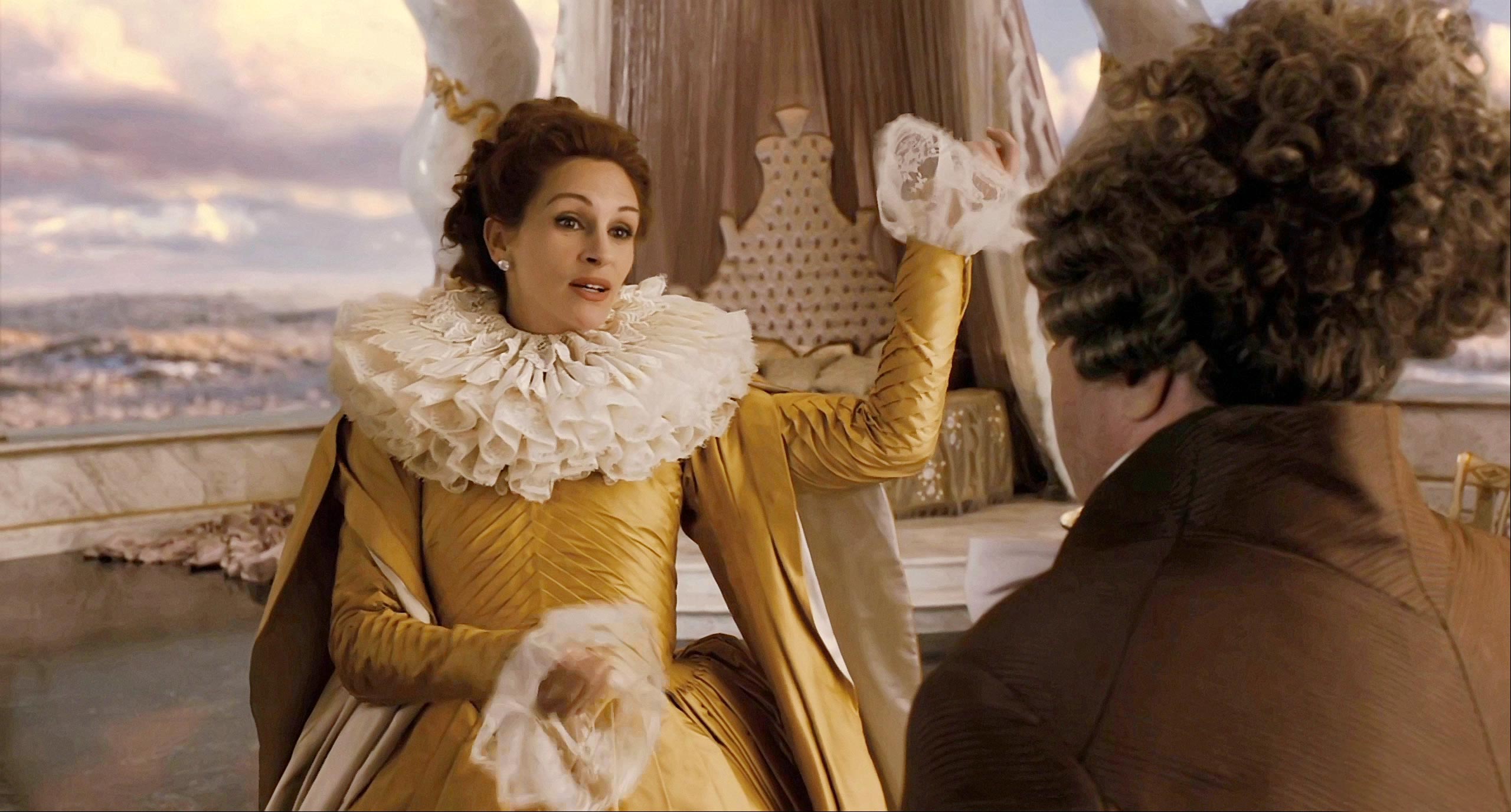
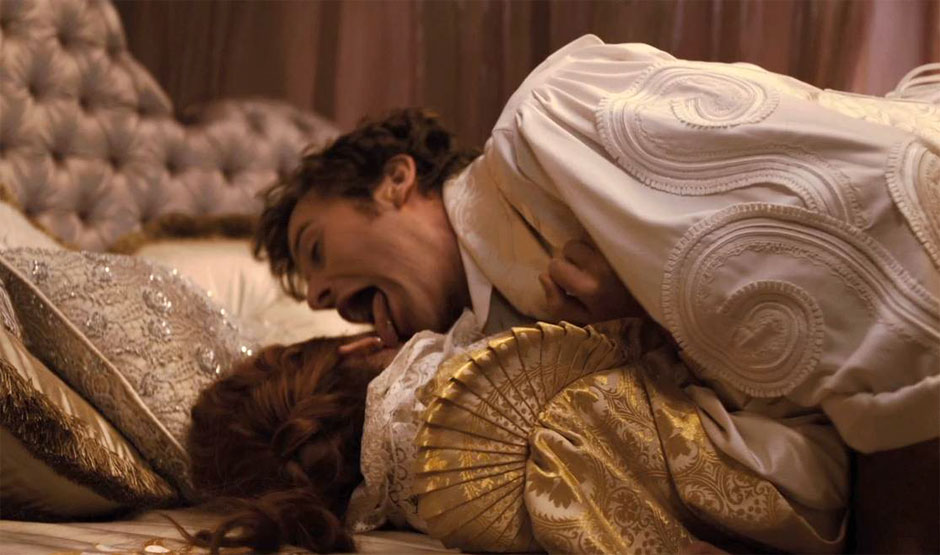
It might well have been lame in any other hands, but the director's spectacular design sense, not only for sets and costumes, but also how to frame them for maximum effect is combined with a breezy comedy style that is never idle, and never hangs for a laugh, so that not only is the frame full, but the soundtrack as well, with one overhanging punch-line that crowds through before each cut.

And yes, it's anachronistic, with such a polyglot of styles that it goes beyond, say, Terry Gilliam-madness into a Moulin Rouge!-ish goofy slap-dashery in which nothing is sacred except the movie's own internal rules of play, stopping just short of the Python-line of anarchy.  There is no single accent in place to latch onto geographically, except for some Anglo-Saxonisms—indeed, Arnie Hammer's Prince Alcott of Valencia, is pure American, but does it with such Ivy-League bravado that you accept he's a prince.

And this variation of the story has just enough "Hamlet" mixed in—Ms. White (an Audrey Hepburn-esque Lily Collins) is the daughter of The King, who is murdered (unbeknownst to all) by his new step-wife The Queen (Roberts), who then rules the Kingdom into the ground, while White awaits taking the throne on her 18th birthday (that is, if the Queen ever permits it).  Instead, she spends it going out to see what's become of her Father's legacy and is distressed to learn there's no singing and dancing in the streets (as she remembers) but begging and poverty instead.  This causes a political debate in the family, leading to Snow being banished by The Queen to be dispatched by her lackey Brighton (played with Costello-ish consternation by Nathan Lane).

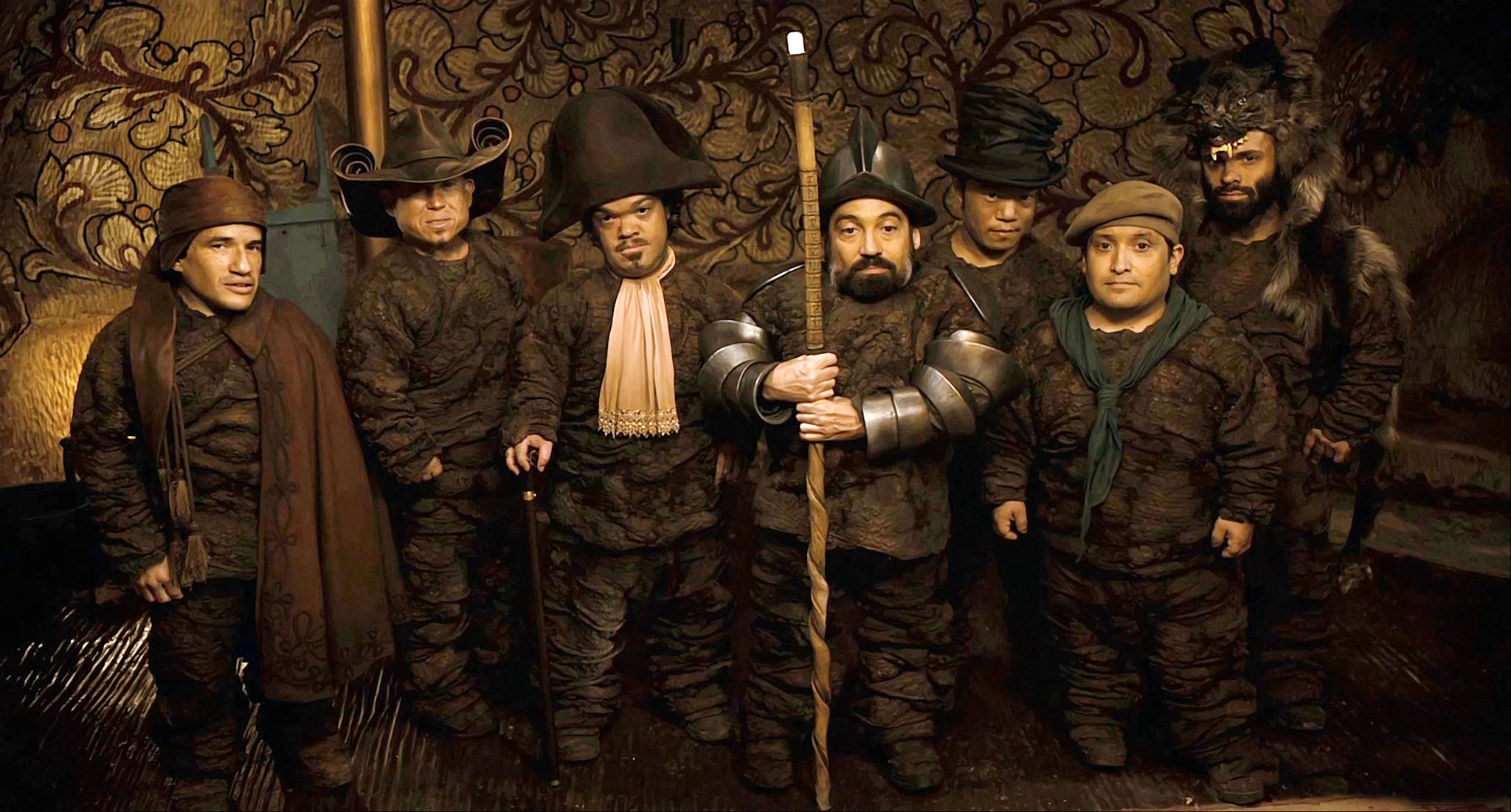
Along the way, we meet the handsome Prince (Hammer, who is aggressively great here, better than his Winklevoss twins in The Social Network, and decidedly better than being cocooned in make-up for J. Edgar, one thinks though that he is doomed to play scions), who is accosted by highwaymen...who just happen to be The Seven Dwarves (Napoleon, Half-pint, Grub, Grimm, Wolf, Butcher, and...Chuck, played with gruff zeal distinctively, by Jordan Prentice,Mark Povinelli, Joe Gnoffo, Danny Woodburn, Sebastian Saraceno, Martin Klebba,and...Ronald Lee Clark, all threatening to steal the show, as well—"beats workin' in a mine," as one of them says).  Before long, everybody's path is crossed once or twice, along with swords and stars in lovers' eyes.

Thing is, in its cartoonish way, it works in live-action, as well as when Disney goes sassy these days with classic tales, and, given the edge by Tarsem's crack sense of timing and way of knowing no bounds in design and camera moves (and Alan Menken's Mickey-Mousing** score doesn't hurt in that regard, either) the effect is somewhat the same.

Walked in loathing the idea and walked out kinda lovin' it.  Pretty happy about that, given the Grimm prospects.  Seems fair, if not the fairest of them all.


Mirror Mirror is a Matinee.


The music video in the End Credits, which shows how Tarsem throws things in from left field, as in this "Bollywood" style sequence.


*
Another example of Tarsem's work—a cheeky gladiator themed Pepsi commercial, featuring Enrique Eglesias, Beyonce, Britney Spears and Pink, with the music of Queen.


** © Disney Corporation.  I use this in the musical definition of the term (not in its "common, inferior" usage) where the music follows the action on-screen precisely, as in notes that follow foot-steps, say.

Tuesday, July 12, 2011

Larry Crowne


T. Hanks for the Mediocrity
or
My Big Fat Career Mistake

I'm sure the intentions were better (aren't they always?), possibly saying something about the displacement of late baby-boomers in the job market, and how "it's never too late to learn" belying the "old dogs/new tricks" canard.  Maybe Hanks just wanted to make something hopeful and sunny in bad economic times...a flare in the night-sky...the proverbial single candle rather than curse the darkness.

Well, it's more like a candle in the wind, and this blows.  Formulaic, with an implied "wah-wah" comedy goose at the end of every scene, Larry Crowne has a "made-for-TV" movie feel that gets under your skin like intravenous sand-paper.  Larry (Tom Hanks) is in his early fifties, divorced, a twenty-year Navy vet working at a box-store, where he's received "Employee of the Month" fetes nine times.  He's one of those guys who owns everything he does, taking a certain pride in all aspects of his job, even picking up and disposing the stray trash he finds in the parking lot.  The implication is already there: while the rest of the world goes on its self-absorbed way, Larry "cares."  And that can't come to any good.

Called in for what he thinks is his tenth EOTM award, he is fired instead; corporate has crunched the numbers and sees him, as never having gone to college, as not being "advancement" material—he's already been passed over for promotions by duller, but degreed, employees.  Adrift, Larry finds no work, and so goes to community college in his '50's, with similar outcasts (though dissimilar aspects) most younger, but without the team-player skills that Larry has acquired.

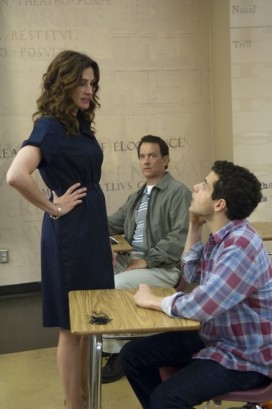
Teaching one of those classes—Speech 217—is Mercedes Tainot (Julia Roberts), bored, tired, unmotivated, with a dead-beat author-husband (the wonderful Bryan Cranston), who, like Larry at the beginning of the film, doesn't know she's in the process of transitioning, so cynical is her world-view.  Her students are an odd collection of rabbits, that she's just trying to keep awake and inspire the one thing she can't seem to muster up—giving a rip.  And Crowne is the oddest rabbit in the bunch.  She glowers, as she sees him slowly change under the influence of younger students—particularly women, and particularly one student who has it in mind to completely "make-over" Larry to his puzzlement and the vexation of her boyfriendThis area of the movie has more than its share of "wah-wah" moments, and as much fun as Roberts' slow-burn is (and she's great at it), they have the feel of sit-com situations that might be fun for the matinee crowd.  It's there that the writing hand of Nia Vardalos, she of My Big Fat Greek Wedding, is the most evident.  Hanks and his wife, Rita Wilson (who is also in this with a small, rather frightening part) were the ones who took Vardalos' one-woman show and shepherded the development of it into a Big Fat Success.  The demographic for Larry Crowne skews a little bit to the same age, with the same toothless observational satire that never offends, even when it tries to be a little "naughty."  It's all for naught.

And yet.  And yet...

"Take it from an 'old guy:' never regret being delightful," I told a clerk who thought she was being "too forward" approaching me in a store aisle.  Twenty-four hours after "grumping" my way through Larry Crowne, the sugar had dissolved in my mind and the "good stuff" remained...Larry's unexpected, all-inclusive, concise and perfect final project in class that nicely ties a bow around the movie, a cast of great people getting to be charming (Cedric the Entertainer, Taraji P. Henson—a favorite of mine, Wilmer Valderrama—!!, George Takei!!!, a little spitfire named Gugu Mbatha-Raw—late of "Dr. Who," "MI-5", and "Undercovers"—that you just want to hug, and...almost too good to be true...the always-welcome, never-failing Pam Grier).  The thing is for as saccharine as the movie feels going down, it leaves a pretty good after-taste.  One forgets just how much one is suffering through it, and how unsufferable it can be, and is left remembering the good parts.  Meaning that Larry Crowne is a similar experience to childbirth.

Not a ringing endorsement...but it could be worse.  It could have had The Fockers, guest starring Kevin James.  

Larry Crowne is a Rental.

Wednesday, March 16, 2011

Eat Pray Love


Eat Pray Love (Ryan Murphy, 2010) Eat Pray Love wants to be unconventional—it practically begs to be seen as revolutionary in its philosophy and presentation—but it is so thoroughly conventional that one wonders why they didn't just bother re-running another chick-travel film, about "finding oneself" only to turn the idea on its ear and make it about finding "the right man."  Three Coins in the Fountain, anyone?

I need another one of those like a fish needs a bicycle.

Don't get me wrong.  I'm glad author Elizabeth Gilbert (played here by Julia Roberts) had her little adventure after a divorce from her peacock of a husband (Billy Crudup) and an affair with an actor (James Franco...gee, both good life-choices picking the self-absorbed—Does that say anything?).  It's tough to work up any real sympathy for her as she has the funds, the time and the wherewithal to spend a year in Italy ("Eat"), India ("Pray"), and Bali ("Loooove").  Good on ya, Liz.  Hope you do a lot of charity work.  Because a lot of the folks who took care of your needs during the trip couldn't afford a journey like that, and, frankly, don't have the time and luxury to "find oneself, " they're too busy just trying to "deal."

I know; bad attitude.  I should go in "open" and "ready to receive."  Fact is, I'd be buying it if the author were trying to go from self-absorbed to self-actualizing, but she can't seem to construct a sentence (when she thinks long enough to not just "pop off") that doesn't have the word "I" in it.*  I suppose I should be happy that she goes to these places, rather than just having the world revolve around her to get there.

But the damned thing is such a cheat.  She escapes two failed relationships only to plunge into one at the end (Ooooh...big "spoiler" alert!), as if that is what is needed in her life, and it doesn't occur to her observing the arranged marriages and the servile populaces that her ability to have a choice is the best thing she has going for her, and that the ability to say "no"—to high calorie meals, to collective brain-washing, to pushy men—does "no" good unless it is actually utilized, rather than ignored for indulgence.  All she lost was a year of her time.  What she found...well, that's a good question.

Murphy also does some indulging—in over-editing this travelogue—you can't pick up a menu and order without unnecessarily seeing the food being prepared in the next shot, item by item—although Robert Richardson's photography manages to make it all blend seamlessly together despite the various styles he uses.  And the performances are heart-felt, especially Franco and Richard Jenkins and Javier Bardemfunny, that she doesn't get romantically involved with Jenkins' brashly wise Texan (who is the most moving person in the piece), could it be that he isn't attractive enough?  It's one of the things that makes you suspect how facile this movie is,** and that the protagonist only swims in the shallow end of the pool.

Ultimately, it's a movie that makes you go "how nice for you," while thinking that it's wasted two hours of your own valuable life.  That's right.  The world doesn't revolve around her.  It revolves around me.


Elizabeth Gilbert, enjoying her residuals.  Lesson learned.


* At a "Thanksgiving Dinner" in Italy, the table goes 'round counting their blessings, which involve other people and they are nice and heart-felt, then it goes to Liz, who thanks that she's surrounded by a table full of wonderful people (Good start, Liz), then finishes by saying "she's the luckiest girl in the world."  It's all about her.


** Other things that annoyed me: the Theme from "Last Tango in Paris" is a signature theme for Italy.  Really?  In fact, the whole soundtrack is chock-a-block with songs of western culture that nullify any depth of feeling for the places.

Friday, April 3, 2009

Duplicity

"All's Fair in Love and War"

After screenwriter Tony Gilroy's powerful directing debut with "Michael Clayton," one looked forward to what the talented triple-threat would come up with next, considering that film's street-smarts, sharp characterizations and deft direction. What we got is "Duplicity" and it's a wisp of a movie, a comedy without laughs, and a drama without weight; a shell-game; much ado about nothing; more in keeping with Gilroy's in-name-only association with the "Ocean's Eleven" series than his better efforts.

As with "
Michael Clayton," the playing field is the backrooms of corporate America, where warring CEO's protect their fiefdoms from interlopers and pitch pre-emptive strikes to keep them at bay. Their knights: a string of white-ops intelligence teams who spy on the competition, using the techniques once used in political battle-fields. That back-drop is nothing new: John le Carré's been using the "corporate espionage is every bit as sordid as political espionage" gambit in his works since the fall of Russia. le Carré even went so far as to suppose spy agencies ginning up threats to justify their budgets and existence, just as they do in the business world. Need a purchase order? Create a threat, and the money rolls right in.

Gilroy sets the tone early by beginning his film with a lo-mo credit crawl where Corporate heads
Tom Wilkinson and Paul Giamatti grapple at each other like pawing animals in a zoo. The silliness of these two going at each other in artfully composed tableau should be funnier than it is, but the whole thing feels like such a surreal con that you don't buy it for a second. Hence, the stakes in the story seem minor, even the McGuffin* is tame, as the two adversaries are pharmaceutical companies. In the middle of it are two ex-spies Ray Koval (Clive Owen, nattily rumpled) and Claire Stenwick (Julia Roberts), who know each other only too well, she having stolen some Air Force secrets from him during a one-night stand at a Dubai fete years ago.** The encounter stings Koval, and now, years later, he's realizing that Stenwick is the Player on the Other Side in their current Corporate Wars. It's an interesting study of two people so locked in strategic thought that they might drown standing in quick-sand, so pre-occupied are they with motivation and nuance and who might try to move first. Interesting, but not always entertaining. At times, the mind-games approach "Get Smart!" absurdities, as both sides play the "I'm thinking they're thinking I'm thinking that they're thinking" game. A little of that goes a long way, especially if the protagonists don't have a smile on their faces when they're saying it. And the humor is only of the clever variety in "Duplicity," not particularly the amusing kind.

Still, it's one of those movies that travels well: to Rome, New York, London and the Bahamas, the costumes are fine, but the whole thing has all the zing of champagne left open overnight (composer
James Newton Howard tries to add some zip by tossing in some Spanish dance music). It all seems too familiar and a bit too flat.

"Duplicity" is a cable-watcher.

* After Hitchcock's name for "the secret" that parties try to retrieve in a suspense film, usually it doesn't matter what it is—after the story of the man who inquired to another man what was in his suitcase: "It's a McGuffin, for trapping lions in the Scottish Highlands." "But there aren't any lions in the Scottish Highlands!" "Then, that's no McGuffin!"

** This also seems overly familiar with "Prizzi's Honor," "Undercover Blues," and "Mr. & Mrs. Smith" as previous warring spy-couple films.


Tuesday, December 2, 2008

Everyone Says I Love You

"Everyone Says I Love You" (Woody Allen, 1996) First off, the title of Woody Allen's attempted musical should read "Everyone...Says I Love You" because the meter is essential. It comes from the song that takes a large junk of time-spanning narrative from the Marx Brothers comedy "Horse Feathers." That haunting and addicting song by Bert Kalmar and Harry Ruby** stays in the mind a long time. And the songs Allen employs, a mix of 20's/ 30's standards ("Makin' Whoopee," "My Baby Just Cares For Me") drop the narrative to a dead stop in a way that the musicals being emulated never did.* The musical pieces feel like an interruption rather than an extension of the story, or a poetic expression of the character's thoughts, though brief attempts are made to do so. The song that works best is the first one ("Just You, Just Me") that starts without warning, out of Allen's standard white-on-black opening credits (in silence). Then Boom! We're singing...actually Edward Norton is singing in a gentle, reedy pleasant voice. Norton comes off best, genuinely attempting to "sell" the song and sentiment (and it's fun to see a joyful Norton--early in his career--galumphing out of the way of dancers, and doing a better version of the Woody Allen stammering switch-backs than the director can manage***). Everyone--save Drew Barrymore--sang their own songs, and they do pretty well, though Julia Roberts is very off-key, and Tim Roth, playing a recently paroled con, sings inconsistently sweetly. The biggest disappointment is Allen's number sung in a barely-there voice. His song is not so much plaintive, as shy and non-committal...and wrong.

The plot is as slim as anything Allen's done: a series of brief encounters with the engagement of Holden Spence (Norton) and Skylar Dandridge (Barrymore) at its hub. But Allen undercuts the effervescence of the musical format by basing the main story on the efficacy of inspired love, or love-at-first-sight. Love is an illusion he says, just like breaking into song with a full orchestra backing you up in a movie. Great. It's a bit like being inspired to song by reading The Wall Street Journal. The cast is the usual first-rate one: Alan Alda, Goldie Hawn, Lukas Haas, a young Natalie Portman and Billy Crudup, Julia Roberts, Gaby Hoffmann, and Tim Roth

Besides that opening plunge into musical-land, the charm of it all is only sporadically amusing, if warm-hearted--Allen, during instrumental portions of the songs, intercuts beautifully shot (by
Carlo Di Palma) landscapes ala Fox musicals. But, there seems a long, dry spell before further joys, and, as it does so often in Allen's films, the best is saved for last--a dance between Hawn and Allen by the river Seine, which nearly matches in grace what Astaire and Rogers achieved by mixing dance and story through the use of movie-magic--the one kind of magic Allen does believe in. Although the two are far, far less capable dancers, Allen compensates by putting Hawn on a wire-rig, and she, seemingly effortlessly, floats high into the air with a natural gracefulness, and alights to earth as if weightless. It is pulled off with such suddenness and beauty that one is caught off-guard, and stunned, like that sudden drop into song at the film's beginning. It's one of the most charming...and surreal moments in the body of Allen's work. ****

*But the elephantine musicals of the 60's and 70's--that's another story.

**
Groucho: Everyone says I love you
but just what they say it for I never knew
it’s just inviting trouble for the poor sucker who
says I love you

Take a pair of rabbits who
get stuck on each other and begin to woo
and pretty soon you’ll find a million more rabbits who
say I love you

When the lion gets feeling frisky and begins to roar
there’s another lion who knows just what he’s roaring for

Everything that ever grew
the goose and the gander and the gosling too
the duck upon the water when he feels that way too
says quack quack quack

Chico: Everyone says I love you
the great big mosquito when-a-he sting you
the fly when he get stuck on the fly paper too
says I love you

Every time the cow says moo
she’s a-make the bull-a very happy too
and the rooster when he holler cock-a-doodle-doodle-doo
says I love you

Christopher Columbo he write the queen of Spain a very nice a-little note
and he’s a-write I love you, babee and then he get himself a great a-big a-boat
he’s a wise-a-guy

What do you think Columbo do
when he’s a-come here in 1492?
he said to Pocahontas achi vachi vachi voo
that means you little son of a gun, I love you

Zeppo: Everyone says I love you
the cop on the corner and the burglar too
the preacher in the pulpit and the man in the pew
says I love you

Every one, no matter who
the folks over eighty and the kid of two
the captain and the sailor and the rest of the crew
says I love you

There are only eight little letters in this phrase you’ll find
but they mean a lot more than all the other words combined

Everywhere the whole world through
the king in the palace and the peasant too
the tiger in the jungle and the monk in the zoo
says I love you


***

****

Wednesday, February 27, 2008

Charlie Wilson's War

From the Folks That Brought you the Taliban and 9-11

I'll say it, because the film-makers obviously couldn't. Or wouldn't. Or felt they shouldn't.

But look at these film-makers: A trio of top-stars (Tom Hanks--who also produced, Julia Roberts, and Philip Seymour Hoffman), screenwriter Aaron Sorkin (he of "The West Wing") and director Mike Nichols, who excels at bringing the best out of good material.

How did they all fail so miserably with "Charlie Wilson's War?"

It seems like a slam-dunk (if you'll excuse the term)for a knock-about satire about the excesses and low-lifes of the government, where they spell "class" with a capitol "K" street, and prove daily that they haven't dredged enough muck out of the swamp-land that was Washington, D.C. And it couldn't be a better story, because, by and large, this story really happened.

A Texas Congressman named Charlie Wilson, the definition of what Sorkin used to call "an empty suit" on television, presides over a district that doesn't want much, so he's free to wheel and deal, doling out favors and votes to his fellow congressmen, drinking like a fish, "canvassing" all sorts of female constituents, facing questions of ethics violations, and staffing his office with bimbos ("Charlie says you can teach 'em to type, but you can't teach 'em how to grow tits," says his receptionist, cheerily). One day he looks up from his hot-tub of Playmates to see Dan Rather on the news wondering why no one will send the Mujahadin weapons to fight the Russians in Afghanistan. So, with the the help of a schlumpfy CIA Agent with impulse-control problems (Phillip Seymour Hoffman) and a dragon-lady of a Republican anti-communist lobbyist (Julia Roberts), Wilson wrangles his way through various walk-and-talks securing surface-to-air missiles for the Afghanis. His efforts drive the Soviets out of Afghanistan, and (in a gross oversimplification of the precariousness of the Soviet State), bring an end to the Evil Empire.

This is great satirical fodder, but it's peddled by Sorkin and Nichols for the occasional one-liner, but no outrage--bunts, but no home-runs--and it's presented as if it's just one more day in that wacky viper-pit that is Our Government at Work. More offensive is the sequences of combat, with Russian helicopters strafing civilians like its a video-game, and footage of Russian helicopters being blasted out of the sky with a rousing boo-yah score, cross-cut with the celebrating politico's slapping each other on the back. And it's all presented without the bat of an outraged eye or the wink of conspiracy.

These guys (the film-makers) seem to think the trafficking of arms through Congressional channels is a Good Thing, as long as the Right Guys are being aimed at, and the only attempt to link the ending of the Afghanistan War with the rise of the Taliban and the harboring of Al Qaida is a veiled reference to not providing funding for schools after the conflict that in Wilson's words "fuck(ed) up the endgame." The REAL Wilson (pictured right) has also expressed worry that one day one of those missiles will be used against American planes (if they haven't already been used in our own Afghan conflict). But Nichols and Sorkin won't go there. Instead, they'll book-end their movie with Wilson recieving an award for the "Most Successful Covert Operation in History," staged in a cavernous airplane hangar with the applause of the many co-conspirators in the plan. It all sounds so neat and self-congratulatory, when the story is so up-to-its-eyeballs in chicanery, wheeler-dealing, and compromised ethics and principals.

Imagine if the story was told with the same savage wit of a "Dr. Strangelove," or "Wag the Dog" instead of the cynical "shucks, ain't they bastards" attitude of Sorkin (and let's face it, judging from "Studio 60 on the Sunset Strip," he sucks at satire), but I suppose to even get the story filmed, it had to meet the approval of the participants, who are all very much still alive. Given that stipulation, I guess one should be grateful they weren't all outfitted with halos. In the end for all its slickness and hipness, its still a cowardly movie.

I remember when "West Wing" was on the air, a Republican Congressman explained why he loved the show--"Everybody is smart, funny, and semi-effectual, instead of the truth." Sums up "Charlie Wilson's War," too.

"Charlie Wilson's War" is a rental.

Tuesday, January 22, 2008

Charlotte's Web

Charlotte's Web (Gary Winick, 2006) E.B. White's children's classic comes out in a live action version (there was an animated musical in 1973 with Debbie Reynolds as Charlotte the spider, Paul Lynde as Templeton the rat, and Henry Gibson as Wilbur the pig--Rex Allen narrated), which could just as well be called "Babe II," if there's wasn't already one. Not to worry, though. As movies of children's classics go, this one's really good--a bit awash in celebrity voices, but the kids won't care, and it does give the parents something to do ("Who's doing the cows do you think?") Since I've given you the '73 version, I'll tell you who does the same for 2006--a very sober Julia Roberts as Charlotte, Steve Buscemi as Templeton, and kid-actor Dominic Scott Kay as Wilbur--Sam Shepard narrates. Dakota Fanning ably shoulders the role of Fern, and while she's not as scarily real in this one, she's not annoyingly sugar-coated , either. Director Winick keeps the special effects unflashy, although there are some intricate CGI spider-web moves (left over from Sam Raimi story-boards, no doubt) that are over quickly. It feels properly home-spun, and Danny Elfman's score, though it brings on the "Edward Scissorhands" Choir, still manages to evoke the joys of simple gifts without beating you over the head with them. I remember one of my grade-school teachers reading "Charlotte" in class, and at one pivotal point, the entire class weeping. That point in the movie brought tears to K., so it did its job. The bonus is you get to hear Robert Redford doing an out and out comedy turn. How rare is that?