or
"No, Snow! Don't Mess with Traditional Story-Telling! It's Been Focus-Grouped, and It Works!!"
I approached Mirror Mirror with some trepidation. It's the sort of movie that curdles my gray matter—taking a traditional fairy-tale and updating it for modern audiences, with anachronisms, modern slang and catch-phrases, a fractured fairy-tale denying its origins and playing "hip." Also, it's a Julia Roberts vehicle and I don't "buy" Roberts in anything but comedic roles (which this one is).
But the other choice was to see Wrath of the Titans, for which I had no desire (Really? They're trying to make a franchise out of that one?) and so it was the "Snow White" knock-off, even though the prospect seemed rather Grimm.
It did have one thing going for it, however. Even though produced by Brett Ratner, it was being directed by an inspired choice—Tarsem, who vaulted from R.E.M. music videos to The Cell,* then rebounded with a fine film no one bothered to see, The Fall. I'd passed on his Immortals last year (though I plan to watch it on video sometime soon, now that it's out), but, as Tarsem can do some visionary work, he just might be able to pull it off.
It might well have been lame in any other hands, but the director's spectacular design sense, not only for sets and costumes, but also how to frame them for maximum effect is combined with a breezy comedy style that is never idle, and never hangs for a laugh, so that not only is the frame full, but the soundtrack as well, with one overhanging punch-line that crowds through before each cut.
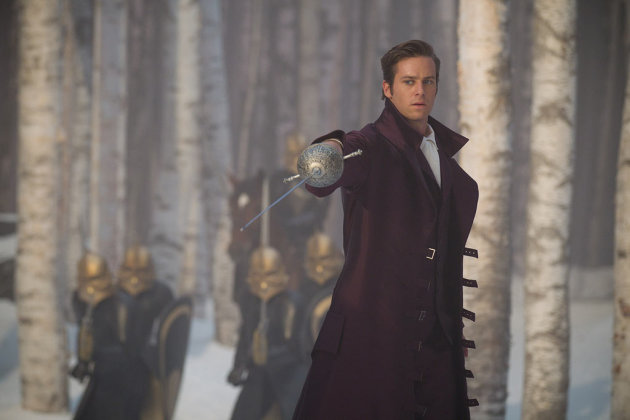
And yes, it's anachronistic, with such a polyglot of styles that it goes beyond, say, Terry Gilliam-madness into a Moulin Rouge!-ish goofy slap-dashery in which nothing is sacred except the movie's own internal rules of play, stopping just short of the Python-line of anarchy. There is no single accent in place to latch onto geographically, except for some Anglo-Saxonisms—indeed, Arnie Hammer's Prince Alcott of Valencia, is pure American, but does it with such Ivy-League bravado that you accept he's a prince.
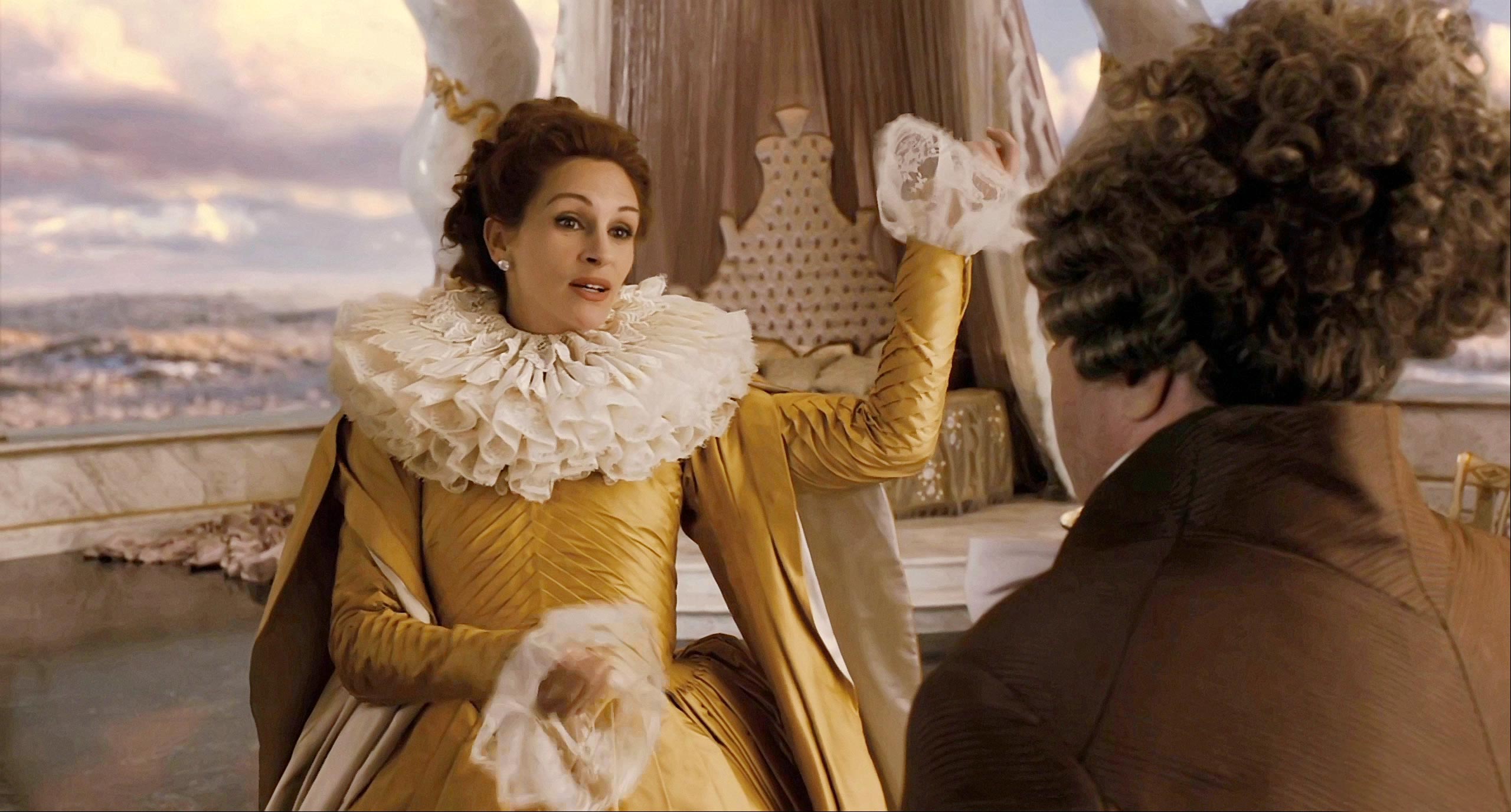
And this variation of the story has just enough "Hamlet" mixed in—Ms. White (an Audrey Hepburn-esque Lily Collins) is the daughter of The King, who is murdered (unbeknownst to all) by his new step-wife The Queen (Roberts), who then rules the Kingdom into the ground, while White awaits taking the throne on her 18th birthday (that is, if the Queen ever permits it). Instead, she spends it going out to see what's become of her Father's legacy and is distressed to learn there's no singing and dancing in the streets (as she remembers) but begging and poverty instead. This causes a political debate in the family, leading to Snow being banished by The Queen to be dispatched by her lackey Brighton (played with Costello-ish consternation by Nathan Lane).
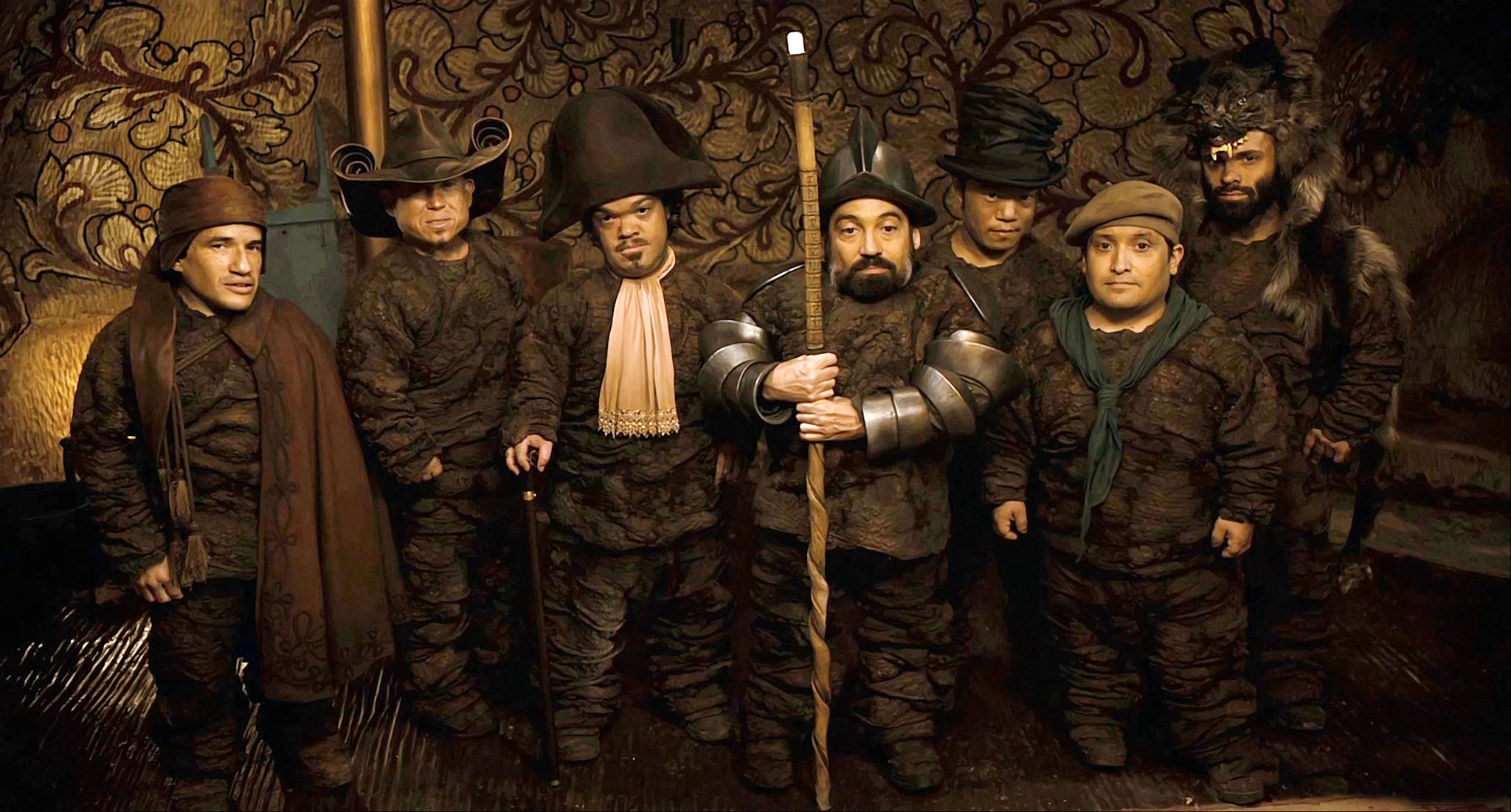
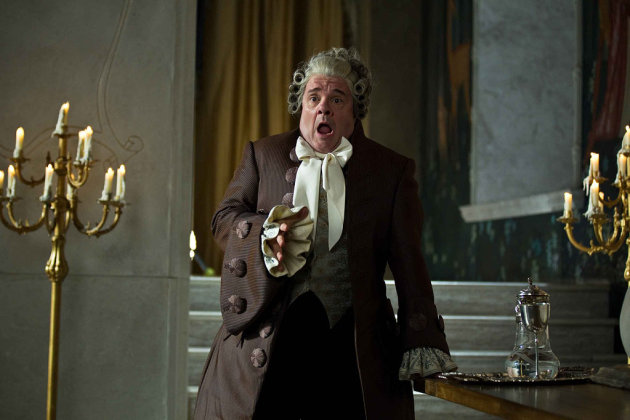
Along the way, we meet the handsome Prince (Hammer, who is aggressively great here, better than his Winklevoss twins in The Social Network, and decidedly better than being cocooned in make-up for J. Edgar, one thinks though that he is doomed to play scions), who is accosted by highwaymen...who just happen to be The Seven Dwarves (Napoleon, Half-pint, Grub, Grimm, Wolf, Butcher, and...Chuck, played with gruff zeal distinctively, by Jordan Prentice,Mark Povinelli, Joe Gnoffo, Danny Woodburn, Sebastian Saraceno, Martin Klebba,and...Ronald Lee Clark, all threatening to steal the show, as well—"beats workin' in a mine," as one of them says). Before long, everybody's path is crossed once or twice, along with swords and stars in lovers' eyes.
Thing is, in its cartoonish way, it works in live-action, as well as when Disney goes sassy these days with classic tales, and, given the edge by Tarsem's crack sense of timing and way of knowing no bounds in design and camera moves (and Alan Menken's Mickey-Mousing** score doesn't hurt in that regard, either) the effect is somewhat the same.
Walked in loathing the idea and walked out kinda lovin' it. Pretty happy about that, given the Grimm prospects. Seems fair, if not the fairest of them all.
Mirror Mirror is a Matinee.
The music video in the End Credits, which shows how Tarsem throws things in from left field, as in this "Bollywood" style sequence.
*
Another example of Tarsem's work—a cheeky gladiator themed Pepsi commercial, featuring Enrique Eglesias, Beyonce, Britney Spears and Pink, with the music of Queen.
** © Disney Corporation. I use this in the musical definition of the term (not in its "common, inferior" usage) where the music follows the action on-screen precisely, as in notes that follow foot-steps, say.