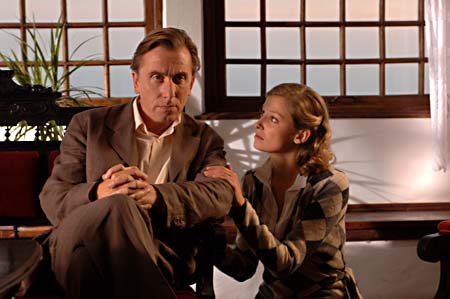
 "Youth Without Youth" (Francis Ford Coppola, 2007) There are two Francis Ford Coppola's: the good director, who made the first two "Godfather" movies, "The Conversation," "Tucker: The Man and His Dream," and "The Outsiders," and the bad one, who made "Dracula," "Peggy Sue Got Married," "Apocalypse Now," and "Rumble Fish." The good Coppola maintains a strict storyline, and finds interesting ways to chronicle it with a rich sub-text. The bad one sees the weakness in his story and rather than improve it, obfuscates and hides it behind film-making technique and effects. Both directors are on display in "Youth After Youth."
It's an interesting story that takes a while to get going, like a good novel. Dominic Matei (Tim Roth) is an elderly scholar of language, not yet gifted, frustrated that time is growing short and his life's work has come to naught. Crossing the street, he is struck by lightning, but survives, burned to a crisp. Under the care of Dr. Stanciulescu (Bruno Ganz), Matei begins to recover, growing new teeth, the burned skin sloughing off to expose a new epidermis—he is young again, rejuvenated, and may even be growing younger than his appearance. Plus, he is gifted with strange electromagnetic powers, able to scan books with a touch, and able to form an odd prescience.
And he seems to have grown another soul.
Well, there's another Dominic in his mind, a wiser more assured entity, a guide, a guardian, who's not omniscient, but provides perspective. And Matei, has become something of a medical sensation for his new butterfly existence—he's come under the watchful of the growing Nazi party, trying to improve the race with horrific experiments in electricity.
"Youth After Youth" is complicated just at that point, part horror movie, part sci-fi, part spy movie, part war film. It defies classification, which is good. But to get through that muddle, Coppola tries some desperate acts to communicate it all, and doesn't quite pull it off, with inverted dream-sequences, picture-fades within fades, reversed film exposures. It's nice to see he's having fun (and some of that could be exhilarating as his tricks in "Dracula" were), but they're not "saying" anything. They're empty grace-notes without purpose other than to evoke, rather than communicate. It's a rich banquet of cinematic tricks, but the caloric content is nill.
Where the movie takes off is in its third act, where Matei's "gifts" become relevant, and he is singularly in a position to solve a mystery of another lightning accident, one that holds personal consequences and sacrifice. It is at that point Coppola settles down and provides a clean, uncluttered narrative, just as rich in detail, but focused on expression rather than film-tricks.
Where Coppola excels, usually, is casting, and now, with his own money and a more frugal sensibility, he can cast as he sees fit, rather than for marketability, and Tim Roth is given a suitable starring role, where he can stretch those acting muscles. It's a multi-layered performance of quiet maturity that navigates well through the Coppola gears and is far more valuable than the digital manipulation Coppola employs.
Saturday, July 11, 2009
Youth Without Youth




Tuesday, December 2, 2008
Everyone Says I Love You
 First off, the title of Woody Allen's attempted musical should read "Everyone...Says I Love You" because the meter is essential. It comes from the song that takes a large junk of time-spanning narrative from the Marx Brothers comedy "Horse Feathers." That haunting and addicting song by Bert Kalmar and Harry Ruby** stays in the mind a long time. And the songs Allen employs, a mix of 20's/ 30's standards ("Makin' Whoopee," "My Baby Just Cares For Me") drop the narrative to a dead stop in a way that the musicals being emulated never did.* The musical pieces feel like an interruption rather than an extension of the story, or a poetic expression of the character's thoughts, though brief attempts are made to do so. The song that works best is the first one ("Just You, Just Me") that starts without warning, out of Allen's standard white-on-black opening credits (in silence). Then Boom! We're singing...actually Edward Norton is singing in a gentle, reedy pleasant voice. Norton comes off best, genuinely attempting to "sell" the song and sentiment (and it's fun to see a joyful Norton--early in his career--galumphing out of the way of dancers, and doing a better version of the Woody Allen stammering switch-backs than the director can manage***). Everyone--save Drew Barrymore--sang their own songs, and they do pretty well, though Julia Roberts is very off-key, and Tim Roth, playing a recently paroled con, sings inconsistently sweetly. The biggest disappointment is Allen's number sung in a barely-there voice. His song is not so much plaintive, as shy and non-committal...and wrong.


The plot is as slim as anything Allen's done: a series of brief encounters with the engagement of Holden Spence (Norton) and Skylar Dandridge (Barrymore) at its hub. But Allen undercuts the effervescence of the musical format by basing the main story on the efficacy of inspired love, or love-at-first-sight. Love is an illusion he says, just like breaking into song with a full orchestra backing you up in a movie. Great. It's a bit like being inspired to song by reading The Wall Street Journal. The cast is the usual first-rate one: Alan Alda, Goldie Hawn, Lukas Haas, a young Natalie Portman and Billy Crudup, Julia Roberts, Gaby Hoffmann, and Tim Roth
Besides that opening plunge into musical-land, the charm of it all is only sporadically amusing, if warm-hearted--Allen, during instrumental portions of the songs, intercuts beautifully shot (by Carlo Di Palma) landscapes ala Fox musicals. But, there seems a long, dry spell before further joys, and, as it does so often in Allen's films, the best is saved for last--a dance between Hawn and Allen by the river Seine, which nearly matches in grace what Astaire and Rogers achieved by mixing dance and story through the use of movie-magic--the one kind of magic Allen does believe in. Although the two are far, far less capable dancers, Allen compensates by putting Hawn on a wire-rig, and she, seemingly effortlessly, floats high into the air with a natural gracefulness, and alights to earth as if weightless. It is pulled off with such suddenness and beauty that one is caught off-guard, and stunned, like that sudden drop into song at the film's beginning. It's one of the most charming...and surreal moments in the body of Allen's work. ****
*But the elephantine musicals of the 60's and 70's--that's another story.
**
Groucho: Everyone says I love you
but just what they say it for I never knew
it’s just inviting trouble for the poor sucker who
says I love you
Take a pair of rabbits who
get stuck on each other and begin to woo
and pretty soon you’ll find a million more rabbits who
say I love you
When the lion gets feeling frisky and begins to roar
there’s another lion who knows just what he’s roaring for
Everything that ever grew
the goose and the gander and the gosling too
the duck upon the water when he feels that way too
says quack quack quack
Chico: Everyone says I love you
the great big mosquito when-a-he sting you
the fly when he get stuck on the fly paper too
says I love you
Every time the cow says moo
she’s a-make the bull-a very happy too
and the rooster when he holler cock-a-doodle-doodle-doo
says I love you
Christopher Columbo he write the queen of Spain a very nice a-little note
and he’s a-write I love you, babee and then he get himself a great a-big a-boat
he’s a wise-a-guy
What do you think Columbo do
when he’s a-come here in 1492?
he said to Pocahontas achi vachi vachi voo
that means you little son of a gun, I love you
Zeppo: Everyone says I love you
the cop on the corner and the burglar too
the preacher in the pulpit and the man in the pew
says I love you
Every one, no matter who
the folks over eighty and the kid of two
the captain and the sailor and the rest of the crew
says I love you
There are only eight little letters in this phrase you’ll find
but they mean a lot more than all the other words combined
Everywhere the whole world through
the king in the palace and the peasant too
the tiger in the jungle and the monk in the zoo
says I love you
***
****
Wednesday, August 27, 2008
Rosencrantz and Guilderstern are Dead (1990)
Rosencrantz and Guilderstern are Dead (1990, Stoppard) For a film director, Tom Stoppard makes a good playwright and for a movie, Rosencrantz and Guilderstern are Dead makes a good play. If you have seen the stage version you will probably either love or hate this as a reworking of the theatrical original. Though Stoppard utilizes some cinematic tricks in the first reel, once we get to the palace of Elsinore, this is a pretty static piece. One of the problems is that Stoppard has a wonderful way with witty philosophical word-play that works well on the bare stage but don't translate to the cinematic medium. Another of the problems is with the piece itself which doesn't really do much to illuminate Hamlet as much as feed off it. He takes the central thesis of the Prince of Denmark's dilemma and puts it in the hands of two minor characters who though they have a crucial and deadly role to play are really only pawns. They don't have enough majesty or heft to be dealing with lofty philosophical matters. In the end, it comes across as too much wit and not enough weight.
And, what was Stoppard thinking of when he cast Richard Dreyfuss? - you don't have to be Kenneth Branagh or Larry Olivier to play Shakespeare on film but you do have to have some sense of the period.
Rosencrantz and Guilderstern are Dead stars Gary Oldman and Tim Roth and is available on DVD from Image Entertainment.