Showing posts with label 1990. Show all posts

Wednesday, August 1, 2012

Misery

Misery (Rob Reiner, 1990) A return to Stephen King territory for Reiner after adapting King's novella "The Body" into Stand By Me.  That one was an unexpected hit for Reiner, who'd only achieved a certain cult following with This is Spinal Tap and The Sure Thing.  Stand By Me changed all that, and Reiner had his pick of projects. 

The story is every creator's worst nightmare: meeting critics and fans.  As adapted by William Goldman, Writer Paul Sheldon (James Caan) goes to his mountain writing-retreat to put the finishing touches on his latest novel—a departure from the successful historical potboilers he has been churning out.  Trouble starts when a traffic accident leaves him injured and in the care of nurse Annie Wilkes (Kathy Bates, who won a Best Actress Oscar for this), who declares herself his "number one fan."  The care she gives him is fine—of course, he's helpless, bed-ridden, incapacitated with two broken legs, and there is the usual paranoia that comes from being in the care of a stranger.  But his condition goes from "stable" to "critical" when Annie reads his manuscript, and doesn't like it as it's not the same thing he's been writing.  But, he's down-graded from "critical" when she gets ahold of his latest "Misery" book and discovers her favorite character is killed in it.  At this point, Annie down-grades from "stable" to "street-rat crazy." 

She restrains Sheldon to his recovery bed, burns his manuscrpt, then breaks his ankles—"hobbling" him—to keep him captive to write the next "Misery" novel bringing the character back to miraculous life.

Meanwhile, Sheldon's publisher (played by Lauren Bacall) reports him missing—he's missed his manuscript delivery date—and a search begins for Sheldon in the local area, spear-headed by Sheriff Buster (the late great Richard Farnsworth, aided by his dispatch, Frances Sternhagen), circling around the area around the vicinity of Annie, who may have been responsible for some mysterious hospital deaths in the past.

King was writing in his basic fear wheelhouse with this one.  A cult-figure for his contemporary horror novels, his fan-base must have been a little weird, inspiring nightmares of what they might do to him if they ever got ahold of him.  Metaphorically, he was also writing about his own feelings of helplessness dealing with drug addiction—Annie keeps Paul addicted to painkillers throughout his stay, witholding them from him when he becomes "bad," in her estimation.

This might fall into the thriller category, but I find it a horror film, just as much as Psycho is a horror film.   

And the most interesting aspect, for me, is the aspect of the creator's view of the "fans"—not all of them, just the most dedicated, the ones who see every work as a love-letter to themselves.  And an idea stuck in my head wondering if George Lucas ever had nightmares about fans dressed as stormtroopers, each one carrying a sledge-hammer, and their own ideas of what a "Star Wars" movie should look like. I wonder if he's ever seen this movie.

Thursday, February 4, 2010

Men Don't Leave

"Men Don't Leave" (Paul Brickman, 1990) More significant than what a film-maker produces after they win "Best Picture" is what they create after they've had enormous box-office success. "Men Don't Leave" is the film Paul Brickman made after the mega-successful "Risky Business," which made a star of Tom Cruise. An Americanized version of "La vie continue," written by Hollywood insider Barbara Benedek, it tells the story of the Macauley family (Jessica Lange, Chris O'Donnell, Charlie Korsmo), set adrift after the sudden death of the father, leaving them with debts and an unfinished house.

They pull up stakes and move from their idyllic (though incomplete) home in the woods to urban Baltimore, where the three must cope as best they can with their grief and their circumstances, grief not only for the father, around whom the family seemed to revolve, but also for the life that his death, scatters to the four (or, I should say the three) winds. The family fractures in their three different attempts to create a new life that resembles the old. Beth (Lange) takes on the father's all-controlling mode and goes to work at a bakery
with a monster-boss (Kathy Bates, right on the cusp of stardom in a tough, unsentimental role), son Chris (O'Donnell) tries to be the man of the house but is pulled away, beginning a relationship with an older nurse, Jody (Joan Cusack), and young Matt (Korsmo, showing what a natural, affecting actor he could be in the first role of his short career) takes to stealing VCR's to buy lottery tickets in an scheme to win enough money to try and buy the family's house back.

As a film, it is a complete turn-around from "Risky Business," which was cold, cynical, and shot with a clinical eye for composition. "Men Don't Leave," is warmer, more desperate, and feels more real despite some contrivances in plot—I'm not sure a hot air balloon ride could snap one out of a "stuck-in-bed" depression, but having taken one, I know that it couldn't hurt, putting into reality a perspective change that's cathartic. Brickman still manages to produce arresting images that grab your attention and produce an odd counter-point to the comedy. The film also benefits from a quirky, textured Thomas Newman score. I suppose what I like most about it is the view that catastrophes come and catastrophes go, but life—not the same life, but a life—does goes on and, however you approach it, standing still or expecting the world to change your circumstances for you is futile.

And the performances are spot on—sometimes frustrating, sometimes inexplicable—make the characters human beings and not a collection of personality ticks. My memories of the one time I saw it are vivid (it didn't last long in theaters and only was released to DVD in late 2009 through Warner Brothers Archives site), so it's on a short list of films I want to re-view to see if my first impressions have held up over time, or if the film merely touched my individual buttons. Jessica Lange says that more people talk to her about "Men Don't Leave" than any of her other films, so I suspect it's the former.

Thursday, October 29, 2009

The Exorcist III

"The Exorcist III" (William Peter Blatty, 1990) An odd little experiment in horror, more compelling than William Friedkin's chest-thumping original,* with more humor—Blatty had written some 60's screenplays for Blake Edwards—and some genuinely unnerving moments that may not make one jump out of one's seat (well, one thing will), but will certainly creep one out.

It begins with a little bit of catch-up and two fine actors who did not appear as these characters in the original "Exorcist"—but probably should have. Lieutenant Kinderman (
George C. Scott) is meeting up with old friend Father Dyer (Ed Flanders). It has been 15 years since the events of the original "Exorcist," and the two men have had a steady friendship with shared lunches and grousing about their work-lives—Scott and Flanders are so good that they milk laughs out of lines that are as dry as a dessicated bone. When we see them, they're both trying to cheer each other up, remembering their mutual friend, Father Damian Karras (Jason Miller). It's an off-kilter, unnerving way to start a horror movie, a little bit like starting a speech laying off your employees with a joke. And that odd humor occurs often, with stray one-liners and the bizarre visual touch, sometimes lurched into the foreground, sometimes folded into the cracks of a frame. It walks arm and arm with Blatty's atmospherics of weighted...pauses in conversations, shifting shadows, slight zephyrs of wind, and the occasional breath of laughter. Odd and unnerving are the two words that best describe "The Exorcist III."
Kinderman is investigating a bizarre series of murders that has ties to the exorcism of Regan McNeil, that bear the un-publicized M.O. of "The Gemini Killer" executed 15 years before. As if that wasn't bizarre enough, the murderer leaves behind a different set of finger-prints each time. There is more than one killer with secret knowledge, and the investigation soon zeroes in on Georgetown's Catholic hospital, where in the bowels of the psych ward sits a chained amnesiac, named "Patient X." When Kinderman's investigation takes him to this room, he finds his friend, Fr. Damian Karras.

The film was compromised somewhat by t
he studio's insistence that there be an actual exorcism (by Nicol Williamson's cameo priest), thereby muddling up the finale, but the film up to then is disquieting and in a far less bluntly hammering way than Friedkin's head-revolving original. Blatty's direction makes you not trust the film, and to be wary of what awaits on the other side of every edit of the film (and just when you think you have his pattern figured out, Blatty will do something different).
He's not afraid to exploit Scott's penchant for showing untethered behavior, but the kudo's for the best performance of the film belong to Brad Dourif. Quick as mercury, quirky as Hell, his performance as "Patient X" (a role shared by Miller and the voice of Colleen Dewhurst, the former Mrs. Scott), is a tour de force played mostly to the camera in long unbroken takes, with the odd touch of a tear that slides down the left side of his face, and the electronic manipulation of his voice to drop it into the lower depths. The movie starts to fall apart once Dourif departs, but for most of its running time, it manages to rise above the other films in the series.

If you think you can take it, you can watch "The Exorcist III" (in 11 parts) on YouTube, starting here.

* And miles ahead of John Boorman's "sexy beast" movie, the deservedly reviled spawn of satan: "The Exorcist II: The Heretic."

Saturday, October 10, 2009

The Godfather, Part III

"The Godfather, Part III" (Francis Ford Coppola, 1990) Francis Ford Coppola defied the Rule of Thumb when his The Godfather, Part II turned out better than the (at the time) all-time box-office champ, The Godfather. But, flush with the success of those two films, Coppola moved on to chart his own course, famously saying that mobsters bored him and that he had said everything that he wanted to say on the subject.

Time and pressure, though. It's not mere coincidence that at one point in "
Part III" Michael Corleone says of his mobster ties: "Just when I thought I was out...they pull me back in." Coppola was tempted by Paramount Pictures to come back for one more go for the same reasons he took on the first film—he was in financial trouble and needed the money. Al Pacino's star was again on the ascendant (after expensive flops like Cruising and Revolution) and Coppola was the one man who could pull the original talent together and make a "legitimate" Godfather sequel, with no compromises.* The story takes place with Michael Corleone, now 60, with all the appearances of economic legitimacy although still with long ties to his family's Mafia roots. The old Corleone business is in the hands of Joe Zaza (Joe Mantegna—a rare chance to see Mantegna being "florid"). Now the aging Don, debilitated with diabetes, in the twilight of his life, must come to terms with what he lost in his battle to protect his Family: his family.

All the "Godfather" films start with ceremony and end with blood-baths, and "Part III" begins with Michael Corleone accepting a papal honor for his charity work (actually a quid pro quo for bailing out
the Vatican Bank, which is in financial trouble, as always in "The Godfather" films, money is the root of all evil). That theme must have hit close to home for Coppola, having to compromise for cash. Money corrupts everything here, even the Church, and doing deals with God's representatives on Earth, may be as close to heaven as Michael thinks he'll ever get. And that is the major theme of this movie: what Michael will do to save his soul.

How many movies are about that?

As a recovering Catholic I may be a bit more sensitive to it, knowing the arcana of the Church, but I found myself watching "Godfather III" ticking off the moments that Michael might be in a state of Grace to go to Heaven. For the length of the "Godfather" series, Coppola distilled
Mario Puzo's original best-selling novel to core themes: the immigrant's American experience and the role crime plays in it; how business is brokered so similarly between criminal organizations and Big Business; how a steadfast paternalism can descend into destruction; how good intentions can be corrupted.

But there is one theme that never made it from the cutting room floor in the theater released films, but is apparent if you've ever seen some of the expanded "Godfather" films, and that is the efficacy of the corrupted soul and how it still can be redeemed. That's Catholic Catechism 101, but in the real world of movie audiences (and mafia hoods) it may not have seemed pragmatic (and perhaps too hard to explain or fathom for non-Catholics). The evidence has always been there, however, from the first film's unused footage of Mama Corleone going to church to light candles for the soul of
Vito (Marlon Brando) and the accompanying original End-Titles which featured Kay Corleone (Diane Keaton) lighting them for Michael's.**

Pragmatism might have been the reason, but the characters had moved on from the original movie and Puzo's book. The scene of Kay lighting candles for her husband added an element to her character of still loving the new Don even while knowing he was a monster, complicit in his crimes. And it was particularly weird when Coppola put it at the end of more complete television presentation of "
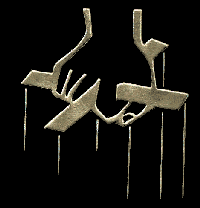
The Godfather Saga" after all the heinous crimes committed by Michael in "Part II" (including the one he finds the most unforgivable—the ultimate negation of his mission to save his family—as he says in "Part III" "I killed my mother's son. I killed my father's son."). But the Church, which presided over Connie's wedding and Anthony's first communion and Michael's papal decree at the beginning of each of the three films, as an instrument of God's Will on Earth, can forgive all sins and cleanse all souls, no matter the crime, no matter the evil. So, half-way through the film, when Michael Corleone is forgiven his sins by the cardinal (Raf Vallone) who will become Pope John Paul I (they needed a VERY holy man to forgive Michael), suddenly...in the eyes of God—or at least the Church—Michael's soul is clean. The marionette strings of the Corleone Family have been handed to his bastard nephew Vincent Mancini (Andy Garcia) who has the temper of father Sonny (James Caan), but is taught a Don's pragmatism under Michael's tutelage.

Big themes. Operatic themes. And "The Godfather, Part III" reaches its climax at an opera—"
Cavalleria rusticana" by Mascagni, a tale of a Sicilian soldier who comes home from war to find that his life has changed and seeks to corrupt the relationships of his past—where Michael's son Anthony who has rejected his father's path is debuting. It is a cause for celebration, but behind the curtain of happiness, vendettas are carried out, and the sprawling story-line comes to a tragedy's finale. Although Michael's soul is clean and pure in God's eyes, he can't escape Fate, and he pays dearly.

Much was made at the time of Coppola casting his daughter
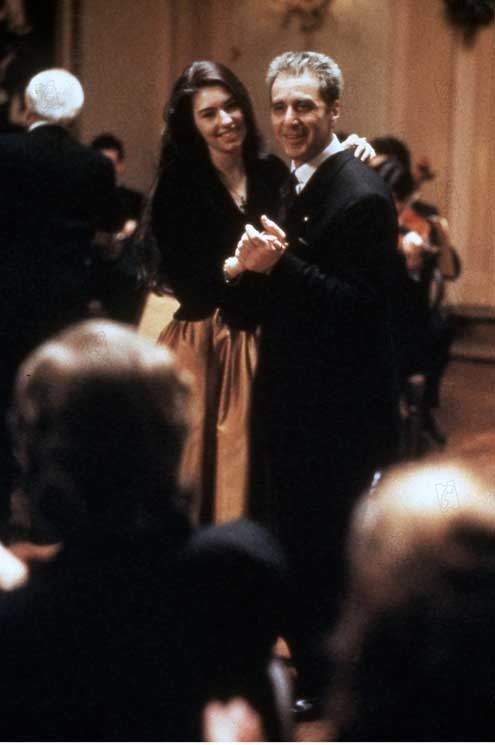
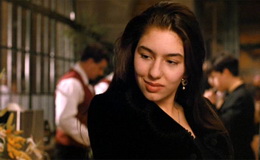
Sofia Coppola in the role of Michael's beloved daughter Mary (Winona Ryder was originally cast, but bowed out pleading exhaustion). It must have seemed natural for Coppola to do so, having cast sister Talia Shire as Michael's sister Connie (Shire has a much bigger role to play in "Part III"), and Sofia has always been a part of the "Godfather" films.*** The critics were cruelly savage in their denunciation of her performance, and, admittedly, it is a little weak. But, critics seemed to blame the daughter for any weaknesses in the father's work. That the third film does not meet the impossibly-high bar of the first two is not her fault. Blame Coppola's artistic ambitions, and forgetting that "The Godfather" has its true origin in crime-novels and gangster movies, not the opera house. But the daughter bore the brunt. As Michael says sagely in the film "When they come... they come at what you love." Sofia Coppola has more than had her own revenge by becoming a gifted director and Oscar-winning screenwriter, she has also won the critic's respect.

Her triumph, and the grace with which she achieved it, is the true ending of "The Godfather" story.

* Well, there are always compromises: Robert Duvall did not reprise his role as consigliere Tom Hagen, citing the difference in salaries between himself and Pacino. But Coppola has always been adept at writing around such problems.

**That scene is used as the End Credits for "The Godfather Saga"—Coppola's "too much information" re-shuffling of the first two films into a strict chronology. There are lots of little interesting tid-bits in that one, including the hospital visit with Don Vito's old consigliere Genco ("You blashpheme, Resign yourself."), more scenes with the undertaker from the first film, and the Corleone family paying a visit to the Coppola family

*** Mantegna remembers during a scene prep, of Coppola pointing to Sofia and telling him that she was the baby being christened at the end of the first film.

Saturday, October 3, 2009

The Two Jakes

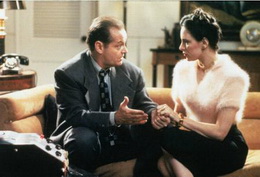
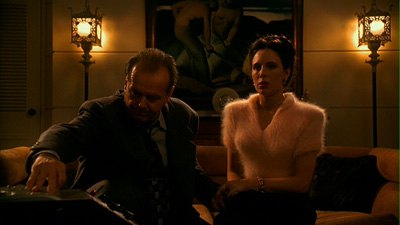
"The Two Jakes" (Jack Nicholson, 1990) The second part of a planned "Jake Gittes" L.A. trilogy (that had started with "Chinatown") was snake-bit almost from the start. Centered around the three great California swindles (water, oil, and transportation), the second film, to be entitled "The Two Jakes"—involving real estate and related oil grab—was set in the post-war 40's. Robert Towne, who wrote the original "Chinatown," was set to direct his old friend Jack Nicholson for the sequel, and for the real estate baron Jake Berman, it was agreed to cast executive producer Robert Evans, who hadn't appeared in a movie since 1959.

Something happened. The particulars are hazy, but the story is that
Towne was unhappy with Evans' performance, and Evans being the executive producer was unhappy with that (his autobiography is, of course, "The Kid Stays in the Picture"). The production was shelved until 1989 when Nicholson himself took the director's chair, Harvey Keitel in Evans' spot and a new production began, with a script that wasn't done to Nicholson's satisfaction and was being re-written while shooting.

What emerged was something of a mess. "Chinatown" was a complicated film, but "The Two Jakes" had the added burdens of a complicated plot and a carry-over theme from the previous film. Some sections seem well thought out and designed, and others rushed to the point of obtuseness. To patch the bare spots and try and salvage the dramatic flow, Nicholson wrote and recorded a narration—not an unusual thing to find in a detective movie—that had more to do with character points than clarity.

The other thing is casting:
Meg Tilly was a bit too young to be playing Berman's philandering wife, her acting makes her character something of a blank spot, and her motivations are never hinted at—and she's absolutely critical to the story. On top of that, her presence makes Gittes appear to be pretty stupid for not spotting what is revealed in the story, and the plot-machinations a bit contrived. This is apparent if you've seen "Chinatown." If you haven't, 'The Two Jakes" leaves you high and dry, it's plot about the diversion of water to the city an integral part of the information needed to get anything out of the film. It tries to do too much, introduce too many incidental characters, and ultimately fails to congeal as a coherent movie rather than a roughly assembled series of scenes and ideas. If Towne had been around to tighten the script, it might have been different. If he had directed it, rather than Nicholson, it might have been more cohesive as Towne is a fairly strict director. But the important part is that the three essentials for the project—Nicholson, Towne and Evans could not compromise, and so "The Two Jakes" was compromised, taking the third film in the trilogy—the much-rumored "Cloverleaf"—along with it. It's what happens when hubris replaces professionalism.

Friday, August 28, 2009

The Russia House

"The Russia House" (Fred Schepisi, 1990) "Nowadays, you have to think like a hero merely to behave like a decent human being!" Barley Scott Blair (Sean Connery), barely getting-by book publisher, deep in his cups at a Russian Book Fair, seals his fate with those words. He soon finds himself wanted by both British Intelligence and the Russians, both looking for a hero in a final End Game in the Cold War in John le Carré's indictment of spies who don't have the sense to come in from the cold.

Scott Blair is a hapless go-between for secrets, dispensed by a radical Russian scientist code-named "Dante"* (
Klaus Maria Brandauer) who is willing to betray his country for The Good Fight for World Peace. He's enlisted his lover Katya (Michelle Pfeiffer) to contact Blair—the one man "Dante" trusts to smuggle his journals into the West for the purpose of publishing them. But "The Russia House," that wing of the Intelligence Service looking East, gets wind of it first and enlists Barley in an effort to learn as much about Russian nuclear capabilities as they can. Soon, he's wired for sound, followed by surveillance by the Brits (working with U.S. Intelligence) and embarks for a Russia about to collapse in Sovier dis-Union. He's starting to fall himself—for Katya—but, constantly monitored and miked, he'll have to resort to whispering sweet nothings in her ear. It couldn't be more appropriate.

It's a master-stroke to get Connery to play this non-spy in John le Carré's literary world of "anti-Bond's." His long association with 007 is cast aside as
he approaches the role bearded, curley-haired and gray, crotchety...and vulnerable, set upon by the author's tweedy grey men smug in their patriotism but lacking in honor. Tom Stoppard's screenplay takes a few bends out le Carré's labyrinthine plot, but none of the complications in the ethics and politics of strange bedfellows in matters of the State and the heart. The production is top-notch, filmed in Portugal and the Soviet Union, with an eye-popping cast of character actors supporting the Connery, Pfeiffer, Brandauer troika. On the British side are James Fox, Michael Kitchen, Ian McNeice, and...Ken Russell! The Americans are Roy Scheider, J.T. Walsh, and John Mahoney, all salamander-cool and not to be trusted.

But the best part of "The Russia House" is the sub-text, which is all le Carré's. Distrustful of his brethren in the spy-hood, the author has always been able to forecast a new sin for them to exploit or fall prey to, and David Cornwell (le Carré's nom de réalité) could see the upcoming glasnost and perestroika and see the forsty battles continue unthawed. Nothing worse or nosier than a spy with nothing to do and not know it. So he looked forward and looked to the past and compared and contrasted.

Remember this, if you must: a bitter cad who sticks his neck out for nobody, a committed idealogue fighting impossible odds, and the woman who is caught in between them. It's "Casablanca." But the milieu is wrong. Where the 1945 film is about choosing "the cause" and "the good fight" in a "mixed up, crazy world," in the world of "The Russia House," lives are being lost in a quest for worthless secrets...worthless because the other side already has them. The only thing to be gained in the cat-and-mouse games being played are the budgets being authorized for the cat and the mouse. In such a compromised clime, the problems of two little people amount to much more than a hill of beans, they are a world-entire of pledges to be kept and sanctity to be upheld. They are the only ideals left amidst the corruption. In such a world, the fundamental things no longer apply. And by basing his story on that timeless tale of love and sacrifice, le Carré throws into stark relief the world of today and that world.
Of a "mature, grown-up love" held against a world playing games...no matter what the future brings, as time goes by.

* In the book, he was, more appropriately, "Goethe"—the man who wrote about making deals with the devil, rather than about his territory.

Wednesday, June 10, 2009

An Angel At My Table

"An Angel at My Table" (Jane Campion, 1990) Incredible tale of the New Zealand author who was institutionalized for schizophrenia, and narrowly avoided a leucotomy procedure* by winning a prestigious book award. Talk about your narrow escapes. But escapes were what Janet Frame specialized in, from her "magic realism" writing style to her globe-trotting adventures that took her to England and Spain, while keeping herself locked inside her own creative mind.

Partly due to her diagnostic history, and partly due to her "odd duckishness" Frame had a ying-yang non-relationship with Society. The film portrays her as "odd man out" in various capacities, the one Campion seems to relish most is that while she is being socially shunned by a group of boorishly egotistical literati, she is the only one of them that has been critically acclaimed...or, for that matter, even published, already achieving what the full-of-themselves coffee klatsches only hope to accomplish. They dismiss her for her dowdy clothes and chia-pet hairstyle out of hand, not bothering to consider that they couldn't tell a book (they hadn't written) by its cover.


Made for television, the film is more conventionally framed than most Campion films, known for their stark use of isolating empty space, and sometimes fractured story-telling style, but Campion gets compelling performances from the three women playing Frame—Karen Fergusson, Alexia Keogh, and finally, settling on Kerry Fox for the second half of the film exploring the author's wandering adulthood. As an introduction to Campion's work, this is a good start, with a compelling true story with a straight-forward approach to the aspects of magic-realism that infuse her work.

My favorite shot of "An Angel at My Table:" Janet "does the twist" by herself
in the dark by the light of her camper/writing-garret.

* A leucotomy was a specific form of lobotomy back in the dark ages when the practice was given enough medical credence to actually give a unique name to it rather than calling it what it was—hammering an ice-pick behind someone's eye-ball to sever neural connections in the brain. I'm wondering if insurance companies covered that.

Saturday, August 30, 2008

Hamlet (1990)

"Hamlet" (Franco Zeffirelli, 1990) So, the big question was: "Mel? Mel Gibson? Hamlet?" Zeffirelli was no slouch when directing Shakespeare with "The Taming of the Shrew" and "Romeo and Juliet" already in his film-list. But Mel Gibson? "Lethal Weapon"/"Mad Max" Mel Gibson? How can this come to any good?

Turns out it can.

Seeing
Zeffirelli's "Hamlet" for the first time is a film-long surprise at how good Gibson is in the role--his performance of the Elizabethan verse often inspired. He's backed by a stellar cast: Glenn Close (nine years older than Gibson) as Gertrude, Alan Bates as an on-guard Claudius, Ian Holm as a much more competent, even wily, Polonius, Paul Scofield, a brilliant ghost, Stephen Dillane as Horatio, and best of all, Helena Bonham Carter's Ophelia.

A second look at the film years later shows the seams.
Gibson's Hamlet is all open-mouthed "busy" acting, a bit too manic and protesting too much. But it does make the case that his Hamlet is Glenn Close's son for she does exactly the same thing, gaping for the loges in Zeffirelli's rough-hewn settings. Dillane's "trying-to-take-it-all-in" Horatio and Bates' slimy, wary Claudius come off the best. But they're blow off the screen by the radical turn of Bonham Carter:


Ophelia--From the get-go, Helena Bonham-Carter plays the daughter of Polonius (and object of Hamlet's affections/mental torture), not as a frail flower, but a practical girl, down-to-Earth and obedient to her father, and loving to her brother. Bonham-Carter's line readings of the verse are flat and conversational, not lilting. Her reaction to Hamlet's bi-polarism are confusion, and incomprehension, not histrionics, and when her psyche snaps, there's no poetry in it. You could find her Ophelia on a city street-corner--agitated, rattling, eyes darting and fingers flailing; it's a powerful performance--a radical interpretation, scary and threatening. When she hands out flowers to the royal couple and her brother, she hands them weeds...and bones.

No wonder Tim Burton fell in love with her. Bonham Carter has never steered clear of the dark waters of her characters, and, in fact, will jump into the deep-end and maybe--maybe--swim up to the light. There's never been an Ophelia like this one, and disappointingly, I haven't seen one since. This is a feminist interpretation of Ophelia, one of real power while not sacrificing Shakespeare's text or the role's tragedy. I don't know if the Bard would recognize his creation in this performance, but the actor in him would be amazed.
Here are this film's other "Hamlet" touchstones:
The Ghost--Portrayed by Paul Scofield deep in the shadows, it is a heart-breaking performance, as the grasping King begs for satisfaction from his son, damned as he is for his sins. His Old King Hamlet has all the fear of Hell in his eyes, and a quavering in his voice, a King broken by the tortures of perdition. He's not a formal apparition of the supernatural, but a ghost who is, himself, haunted, and seeks out his son for a last chance at salvation. That's quite a guilt-trip he lays of Hamlet--even more so than a revenge mission. No wonder Gibson's Hamlet looks panicky through the whole movie.

Polonius--verbose he may be, but he's no fool. In fact, as played by Ian Holm, he's a bit of a snake-in-the-grass, currying favor with a calculated duplicitousness. And quite capable of sacrificing his daughter in order to further the fortunes of his son Laertes. And he lets her know in no uncertain terms that she must perform her duties as bait for the good of her family, though not necessarily for her own. His fate seems particularly deserved, rather than an unfortunate ironic happenstance in Elsinore's machinations.

The "To Be Or Not To Be" speech--Gibson walks down stone stairs into the dark to contemplate action/inaction and life/death and does well with "the" speech. His Hamlet is usually at wit's end (heh), but here he is hushed and still, as if not to wake the dead. Apt, as the location he's chosen to do his ruminating is the burial site for old King Hamlet. That's the King's sarcophagous in the back-ground of the screen-cap. Hamlet might be in his own version of Hell during the speech.
Gritty, grimy, with the drama accentuated rather than the artifice of the verse, this "Hamlet" is a fine interpretation. Gibson might have been the star (and the chief draw), but the humanization of the ghost and the bodice-ripping interpretation of Ophelia make it one to remember in the further explorations of The Great Play.

Wednesday, August 27, 2008

Rosencrantz and Guilderstern are Dead (1990)

Rosencrantz and Guilderstern are Dead (1990, Stoppard)

For a film director,
Tom Stoppard makes a good playwright and for a movie, Rosencrantz and Guilderstern are Dead makes a good play. If you have seen the stage version you will probably either love or hate this as a reworking of the theatrical original. Though Stoppard utilizes some cinematic tricks in the first reel, once we get to the palace of Elsinore, this is a pretty static piece. One of the problems is that Stoppard has a wonderful way with witty philosophical word-play that works well on the bare stage but don't translate to the cinematic medium. Another of the problems is with the piece itself which doesn't really do much to illuminate Hamlet as much as feed off it. He takes the central thesis of the Prince of Denmark's dilemma and puts it in the hands of two minor characters who though they have a crucial and deadly role to play are really only pawns. They don't have enough majesty or heft to be dealing with lofty philosophical matters. In the end, it comes across as too much wit and not enough weight.

And, what was Stoppard thinking of when he cast
Richard Dreyfuss? - you don't have to be Kenneth Branagh or Larry Olivier to play Shakespeare on film but you do have to have some sense of the period.

Rosencrantz and Guilderstern are Dead stars Gary Oldman and Tim Roth and is available on DVD from Image Entertainment.