Showing posts with label Brad Dourif. Show all posts

Wednesday, May 4, 2011

Wise Blood

Wise Blood (Jhon Huston,* 1979) Flannery O'Connor's excoriating look at religion (in general) and Christianity (in particular) is one bitter chalice of wine, satirical, venomous, and with a savage wit that doesn't seem so comic as you see it playing out.  And the man who directed The Bible (and, rapscallion that he was, cast himself as Noah and The Voice of God), John Huston, takes O'Connor's fire-brand of a novel, and without being too showy, manages to dim the outrageousness and make it a little more real, and a little more relatable.

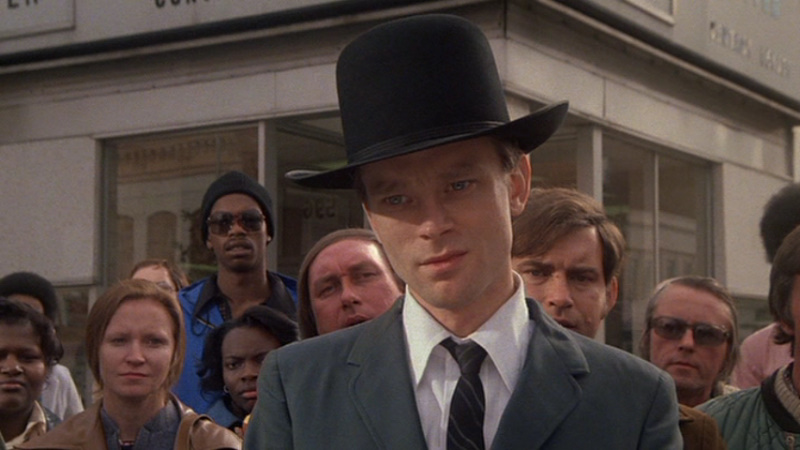
Brad Dourif (a sadly underused actor) heads the cast as Hazel Motes, just off the bus from the Army. He returns home to find the home of his preacher-father (played by Huston) abandoned. You never steer too far away from the family tree, and when Hazel buys himself a new black suit, more than one person says it makes him look like a preacher, which raises Hazel's ire. He intends to live his post-service life as unpreacherly as possible, despite appearances.

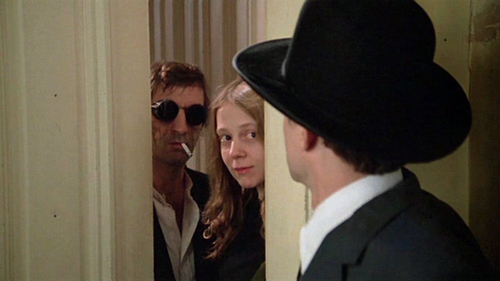
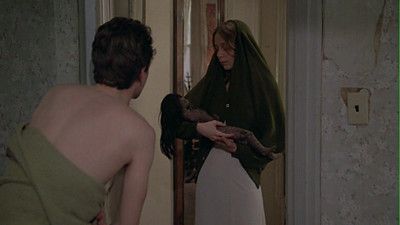
Going to town, he reluctantly gains one disciple, Enoch Emery (Dan Shor), not the most stable of followers, and has a run-in with the un-right Reverend Asa Hawks (Harry Dean Stanton) and his daughter Sabbath Lily (Amy Wright), which incenses Hazel, and shouts that he is going to create his own church, The Church Without Christ, just to show that he can do it, and to expose the chicanery of Hawks, who poses as blind and an interpreter of the word.  No one is what they seem: Sabbath Lily, while pretending to be virginal, is actually slatternly and pursues Hazel, something Asa approves of, as he wants to ditch her and travel light.

Hazel then has problems with another "preacher," Hoover Shoats (Ned Beatty), who creates his own church, The Holy Church without Christ (see the difference?), where its followers can interpret the Bible according to their own personal tastes.  That church takes off, with the help of its own direct interpreter of God's Word (played by William Hickey).  Hazel has lost control of his religious idea (such as it is), losing his Faith and his flock simultaneously, sending him into a murderous frenzy, then into a period of madness in which he rails against false gods, false relics and anything that smacks of devotion, then leading to an ascetic lifestyle that involves wrapping himself in barbed wire, before he can pay for his sins.  Creepy.  And harsh.

Huston keeps a lid on the blackness and bleakness, with an almost matter-of-fact presentation of all this, even being discrete at times.  Not to say the film isn't off-center, it is.  Obviously it is set in America, but one is hard-pressed to determine when.  Filmed in Macon, Georgia, it seems like it could be post-WWII with the attitudes and costumes, but the locals and vehicles are from the period before the filming—1979.  It gives you the sense of backwardness and a slight disorientation, like none of it is real.  Combine that Huston's clear-eyed direction and you begin to not know what to believe.

Apt.


* That's how it's spelled in the Main Titles, designed as a series of road signs with the credits scrawled in chalk on them by a child.  That particular child misspelled Huston's first name but the producers kept it for its childlike innocence.

Thursday, October 29, 2009

The Exorcist III

"The Exorcist III" (William Peter Blatty, 1990) An odd little experiment in horror, more compelling than William Friedkin's chest-thumping original,* with more humor—Blatty had written some 60's screenplays for Blake Edwards—and some genuinely unnerving moments that may not make one jump out of one's seat (well, one thing will), but will certainly creep one out.

It begins with a little bit of catch-up and two fine actors who did not appear as these characters in the original "Exorcist"—but probably should have. Lieutenant Kinderman (
George C. Scott) is meeting up with old friend Father Dyer (Ed Flanders). It has been 15 years since the events of the original "Exorcist," and the two men have had a steady friendship with shared lunches and grousing about their work-lives—Scott and Flanders are so good that they milk laughs out of lines that are as dry as a dessicated bone. When we see them, they're both trying to cheer each other up, remembering their mutual friend, Father Damian Karras (Jason Miller). It's an off-kilter, unnerving way to start a horror movie, a little bit like starting a speech laying off your employees with a joke. And that odd humor occurs often, with stray one-liners and the bizarre visual touch, sometimes lurched into the foreground, sometimes folded into the cracks of a frame. It walks arm and arm with Blatty's atmospherics of weighted...pauses in conversations, shifting shadows, slight zephyrs of wind, and the occasional breath of laughter. Odd and unnerving are the two words that best describe "The Exorcist III."
Kinderman is investigating a bizarre series of murders that has ties to the exorcism of Regan McNeil, that bear the un-publicized M.O. of "The Gemini Killer" executed 15 years before. As if that wasn't bizarre enough, the murderer leaves behind a different set of finger-prints each time. There is more than one killer with secret knowledge, and the investigation soon zeroes in on Georgetown's Catholic hospital, where in the bowels of the psych ward sits a chained amnesiac, named "Patient X." When Kinderman's investigation takes him to this room, he finds his friend, Fr. Damian Karras.

The film was compromised somewhat by t
he studio's insistence that there be an actual exorcism (by Nicol Williamson's cameo priest), thereby muddling up the finale, but the film up to then is disquieting and in a far less bluntly hammering way than Friedkin's head-revolving original. Blatty's direction makes you not trust the film, and to be wary of what awaits on the other side of every edit of the film (and just when you think you have his pattern figured out, Blatty will do something different).
He's not afraid to exploit Scott's penchant for showing untethered behavior, but the kudo's for the best performance of the film belong to Brad Dourif. Quick as mercury, quirky as Hell, his performance as "Patient X" (a role shared by Miller and the voice of Colleen Dewhurst, the former Mrs. Scott), is a tour de force played mostly to the camera in long unbroken takes, with the odd touch of a tear that slides down the left side of his face, and the electronic manipulation of his voice to drop it into the lower depths. The movie starts to fall apart once Dourif departs, but for most of its running time, it manages to rise above the other films in the series.

If you think you can take it, you can watch "The Exorcist III" (in 11 parts) on YouTube, starting here.

* And miles ahead of John Boorman's "sexy beast" movie, the deservedly reviled spawn of satan: "The Exorcist II: The Heretic."