Tuesday, February 12, 2013
Stand Up Guys
or
"...End of Story"
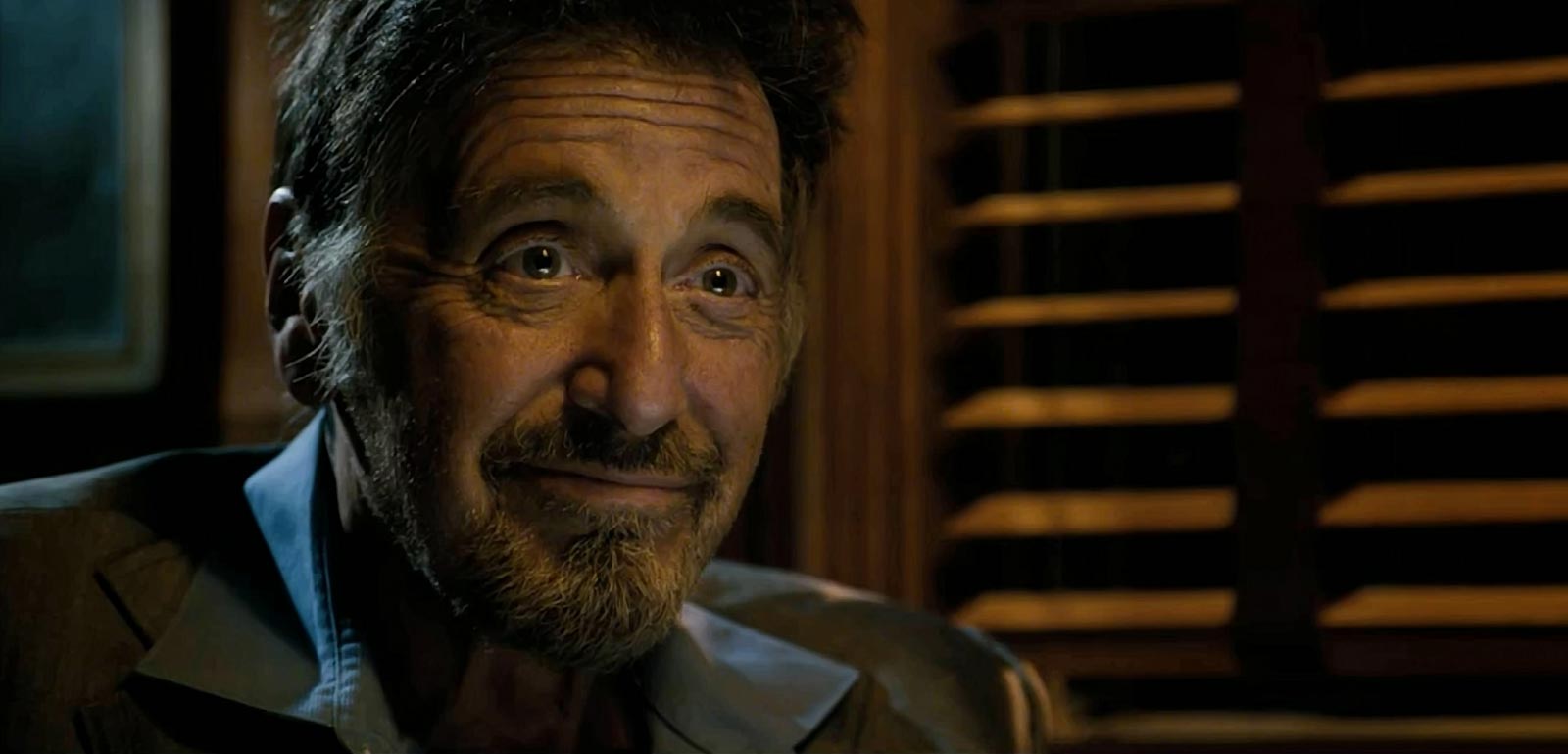
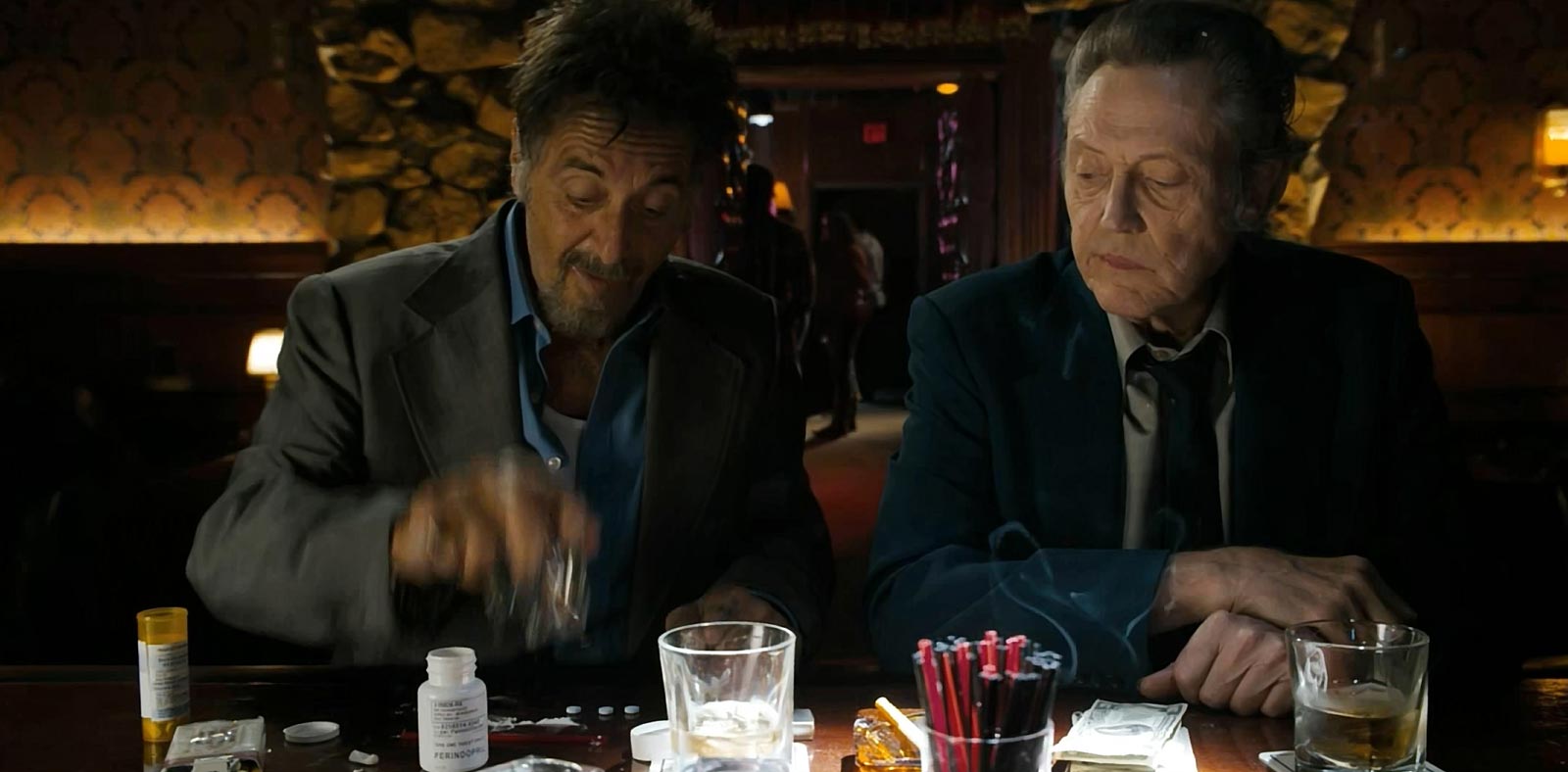
Oh, man, it's painful, the first few minutes of Stand Up Guys, the new gangster-with-gags film directed by Fisher Stevens. Valentine (Al Pacino) is being released from prison after 28 years, for his part in a robbery that turned deadly. On the outside, waiting for him, is Doc (Christopher Walken), who was also part of that robbery but managed to stay out of the gray-bar hotel for reasons unknown and is now "retired," spending his free time being a diner habitué and painting landscapes.
Doc takes Val home to his apartment, which the ex-con compares unfavorably to the accouterments he has recently vacated. At this point in the movie, Val announces that he wants "to party," at which point I resisted an urge to get up and get popcorn. It wasn't going to be pretty, whichever way it was played, comedy, bathos, or weirdness. The obligatory visit to a whorehouse is somewhat lightened by Lucy Punch (a Brit actress playing a longish Island accent) as the daughter of the madam these guys used to know in their and her prime.
Things don't go well (nyuk, nyuk) so Doc and Val rob a drug store (very easily)—Val gets little blue pills and proceeds to take too many of them, and Doc has some expensive prescriptions he needs to supplement—complications arise, so to speak, which requires a trip to the hospital, where Julianna Margulies provides an "E.R." flashback and informs the two about her father, their former getaway driver, who's stuck in a nursing home.
Alan Arkin plays that character, and it's at that point that the movie picks up with a couple quick chase sequences and a needed pivot point for the Pacino-Walken dynamic. The movie gets better with Arkin's presence, even though one can't say it improves. But Arkin's added energy manages to lift the movie over the speed-bumps that the script-cliché's drop in the path. Where Pacino is manic and Walken is passive, Arkin manages to bridge the gap (and their vocal pauses) with a complacent nervousness that bounces off both actors entertainingly.
It's unfortunate watching, really. To see these gold-standard actors (all Academy Award winners, not that that really matters) reduced to mining what they can out of a vein of tin is disheartening, no matter what smiles they can produce out of it. Something could have been done, recent examples of the story-form being In Bruges and Going in Style.* But just the casting of these young-now-aging turks can't make this one any more than it is, a faded half-hearted comedy about aging gangsters that might have been enough to re-team Jack Lemmon and Walter Matthau back in the day.
This is a minor, minor, minor film with major talent in it that eventually makes the most of the material, but can't elevate it into something worthwhile or even makes a statement. And, frankly, I'm getting too old for movies like this.
Stand Up Guys is a Rental.
* Martin Brest's 1979 comedy-drama about over-the-hill retired thieves trying to supplement their meager Social Security—Pacino surely knew about it, as it starred his mentor, Lee Strasberg.
Wednesday, July 13, 2011
The Merchant of Venice

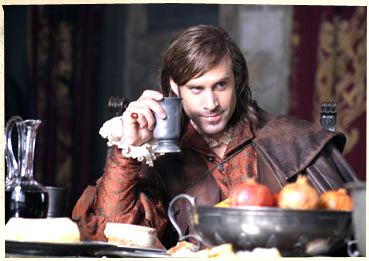
The Merchant of Venice (Michael Radford, 2004) Wm. Shakespeare's most problematic play for modern audiences gets a sumptuous presentation (without PC-intended cuts) in this production, the first sound version of this oft-quoted play; problematic in that, taken merely by folio content, it has a vitriolic anti-semitic tone that runs counter to its classification as a "comedie." But, director Radford, with one stroke—and, indeed, one shot—manages to restore some semblance of perspective, if not judicious balance to the piece.
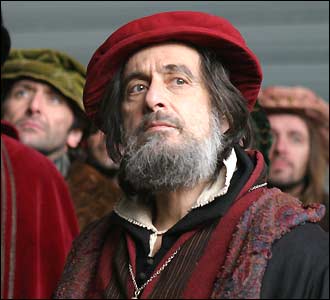
It is 14th century Venice and ardent Bassanio (Joseph Fiennes) is in love. The object of his desire is fair Portia (Lynn Collins, replacing—very well—Cate Blanchett), an heiress in the village of Belmont. But, a fool with money, he can ill afford to make the trip, and so turns to his frequent benefactor Antonio (Jeremy Irons) to lend him three thousand ducats to make the trip. Antonio, a wealthy merchant, is a bit strapped for cash at the moment—he has three ships in transit on a business venture that will surely reap great profits. So, the elder man agrees to guarantee a loan from whoever Bossanio can get one, and he does so from Shylock (Al Pacino), a money-lender in the Jewish ghetto of Venice. But, Shylock and Antonio have issues: the city is divided between Jew and Gentile with much tsuris and animosity between the two groups, the former frequent victims of abuse and scorn by the latter, and Shylock is miffed that Antonio undercuts his business by offering loans with no interest. So, the agreement comes with an odd rider—should Antonio default on the loan, Shylock will extract from him "a pound of flesh." Given the going rate of flesh in the meat and prostitution markets (both of which Radford sees fit to show), it seems like a pretty good rate, and with a deal in the works, Antonio, readily agrees to "the bond."
But, if there weren't complications, it wouldn't be Shakespeare: for Antonio, his ships go missing; for Shylock, his beloved daughter Jessica (Zuleikha Robinson) follows her heart, defying her father, running off with her suitor, a Gentile, and converts to Christianity. That news is devastating to Shylock, who, when the loan defaults, takes Antonio to court to get his due, and some measure of satisfaction for the wrongs that have been meted out upon his people.
It's extraordinarily well-done, with the context of Venician abuse of the Jewish community made explicit and evident, and the feelings displayed, especially during the hearing, angry and ugly. But, the players' interpretations are all-important here, especially Pacino's. His Shylock has hurt etched into his eyes, and the actor's power is never more evident as when he's displaying grief—Dustin Hoffman wanted this role, but one can't imagine Hoffman capable of the towering rage—especially when his voice reaches the upper registers—that Pacino can command. One never loses the context of past humiliations against Shylock here, and that, now, this time, he will exact his revenge. Pacino's Shylock is sympathetic, even, if, during the trial, he is cast in the role of "villain."
It is at the end, though, where Radford has his bond. While the citizens of Venice, wink and cajole and tease and wench, there is a single shot of Shylock, presumably in Temple, as his brethren leave him, and, in a cinematic move that seems to recall Pacino's Michael Corleone at the end of The Godfather, but more appropriately, John Wayne's racist Ethan Edwards in The Searchers, the doors of the Temple are shut on him, first one, then the other, isolating him. The message is clear. His own tribe is shunning him. The root of it is not that he is "The Jew," but that he is uniquely Shylock, and his own character, not his race, not his religion, not anything but himself is the cause of his implacability. And it is rejected by his community. The fault, dear Brutus, lies not in our stars (or our God) but ourselves. The quality of mercy certainly is not strained. It can be given, but if it is not offered in kind, it can be taken back.
And that, my friends, is a true bond, that no court can recognize.
I would be far more sanguine if some similar fate awaited if the spitters and sneerers and anti-semites among the goyim revellers received a harsher fate than some humiliation by their women-folk, but the play's the thing. And one brushes up their Shakespeare at their peril.
Saturday, May 14, 2011
Righteous Kill

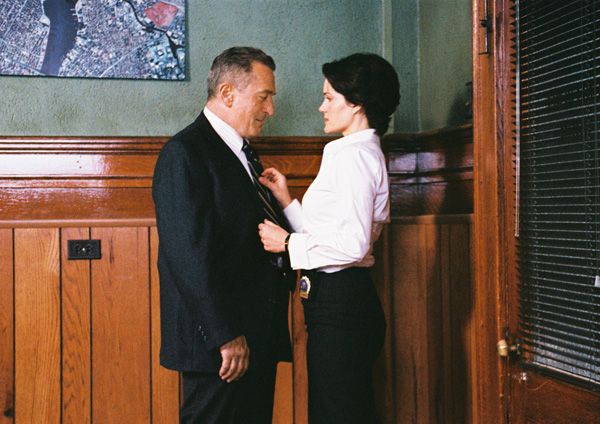
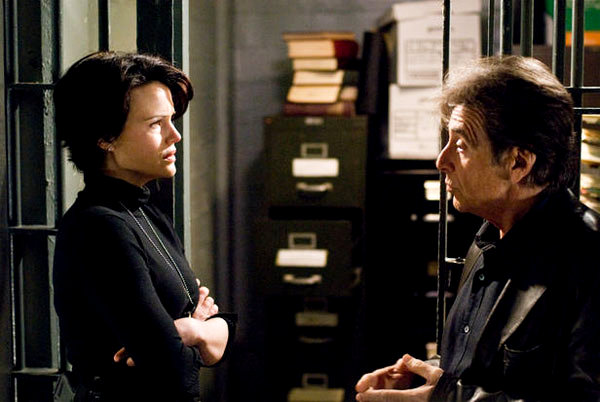
Righteous Kill (Jon Avnet, 2008) Someone is killing Scott Free's—those scum-bags that you just know are guilty but have some smooth-talking fancy-pants lawyer or some milque-toast judge who lets 'em walk, sneering, to prey on Society again...until they show up with a bullet-hole in the middle of their forehead. Two buddy cops, Turk (Robert De Niro) and Rooster (Al Pacino) start to add things up when one of the perps they arrested shows up deader than a Keanu Reeves performance. Looks like it's murder "and somebody's responsible." A vigilante? Certainly. But, if its revenge they're after, why are so many of these guys showing up dead? It's then that they think that the killer may be a cop.
But who?
Complicating matters is that most of the cops, including De Niro, Pacino, plus Carla Gugino, John Leguizamo, plus Donnie Wahlberg-o are creeps, so it could be any of 'em, except for the Captain of the squad (Brian Dennehy) but only because you couldn't believe Dennehy could sneak up on anybody but a bed-ridden quadriplegic.
So the question is: which of the crazy actors is playing the crazy character killing all these people?
The answer: who cares? With a movie this terrible, and victims painted so sneeringly evil they're cartoons it's hard to work up much sympathy or even interest in finding their killer. That's the problem of the writer. But director Avnet is so ham-fisted, he can't seem to hold a shot or light a set without sabotaging the drama of a scene. He's so busy "nuancing" things that you have trouble following the plot. He's not even talented enough to get out of the way of De Niro and Pacino (or, God forbid, rein them in) to make a scene play.
And, let's face it, having those two legends on the screen should be a treat: they didn't work together in The Godfather: Part II (obviously), but their scenes in Michael Mann's Heat were tantalizingly short. Here, they're in almost every scene together (although Avnet can't seem to find the wherewithal to keep them in the same shot), and you realize they're like oil and water, or Mumbles and Loudmouth—they're two actors who've known each other for years, but their characters don't seem to. Or else the movie would be over in five minutes. But no, the suspicions and subsequent doubts must be fully explored, the red herrings must stink up the joint, and the script-writer must throw in a couple of feints that make no sense once the movie is over—they're there just to con the audience.*
What a waste. The big mystery is given this script, how could it attract two of the most iconic, respected and (when paired) legendary actors? Sounds like the biggest con was going on behind the scenes. Righteous Kill is the last thing you would expect a film starring De Niro and Pacino would be—a very pedestrian run-of-the-mill movie.
* Now, movies are by nature, the manipulation of reality—and the audience—to tell a story. But, there's doing it well, and there's doing it the Righteous Kill way. This week, we'll look at a movie that stylishly—and very slyly—does it right.
Thursday, October 15, 2009
Serpico
"Serpico" (Sidney Lumet, 1973) Early on, Frank Serpico (Al Pacino, famously) fresh recruit in the NYPD, is asked what made him want to be a cop, (fergahdsake!). He tells the tale of an incident in his neighborhood when the cops arrived and the curious youngster kept looking at them asking himself, "They know! What do they know?"
Immediately, the NYPD is established as "the other,"* an elite fraternity apart from the common citizens. And Frank Serpico wants to be a part of that group apart. He wants to know what they know.
He'll be sorry when he finds out.
The film starts at the worst point in Serpico's career: in an ambulance, hovering between life and death after being shot in the face during a bust-gone-wrong, in which his partners stood by while his arm caught in a door, he must stand and wait for the bullet to come.**
We flash back to the start of his career—literally, his graduation from the police academy—fresh with accomplishment and theory and homilies about service, that become shattered as soon as he hits the streets for real. The shattering of illusions is what the story of "Serpico" is all about. The illusions of the streets, the illusions of the work, the illusions of honor, and the brasses' ability to do something about the bribe-taking that seemingly infests the entire NYPD. What starts out as a quest for Truth ends up being a continual confrontation with lies, and it is only at the point of death that the detective stops believing the best and taking actions against the worst. A naive belief in "The System" keeps his protests within the echo chamber of the Department. And it's only when The System tries to have him killed, that he turns to the outside agencies with the information.
For Serpico, it's a journey that comes full-circle, starting as an outsider who joins the elite group, only to find himself considered an outsider within it, even though he now knows "what they know."
In that search for truth, Lumet shot the film almost documentary-style in every borough of New York, excepting Staten Island. The character of Serpico was romanticized, somewhat, but the facts are fairly close to the truth as outlined by Peter Maas in his book, about Serpico's career and his cooperation with The Knapp Commission. Timelines were shuffled and people combined to simplify the story.
You can read Serpico's blog here.
* Part of Serpico's work as a detective involved breaking down that "otherness," by working in street-clothes, rather than a respectable suit and tie, tipping suspects off to their identity.
** It might seem unfair to say that the cops deliberately held back for Serpico to be shot, but consider: of the three cops on the bust with him, not one of them called in the shooting, or made the "officer down" call. A tenant in the apartment building made the emergency call, and Serpico was taken to the hospital by a second squad car of cops—who did not know his identity at the time they did it.
Saturday, October 10, 2009
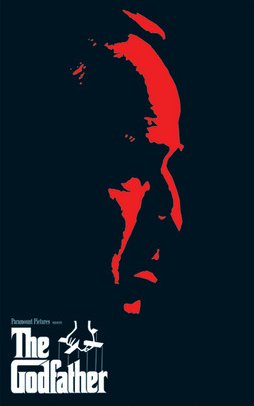
The Godfather, Part III
"The Godfather, Part III" (Francis Ford Coppola, 1990) Francis Ford Coppola defied the Rule of Thumb when his The Godfather, Part II turned out better than the (at the time) all-time box-office champ, The Godfather. But, flush with the success of those two films, Coppola moved on to chart his own course, famously saying that mobsters bored him and that he had said everything that he wanted to say on the subject.
Time and pressure, though. It's not mere coincidence that at one point in "Part III" Michael Corleone says of his mobster ties: "Just when I thought I was out...they pull me back in." Coppola was tempted by Paramount Pictures to come back for one more go for the same reasons he took on the first film—he was in financial trouble and needed the money. Al Pacino's star was again on the ascendant (after expensive flops like Cruising and Revolution) and Coppola was the one man who could pull the original talent together and make a "legitimate" Godfather sequel, with no compromises.* The story takes place with Michael Corleone, now 60, with all the appearances of economic legitimacy although still with long ties to his family's Mafia roots. The old Corleone business is in the hands of Joe Zaza (Joe Mantegna—a rare chance to see Mantegna being "florid"). Now the aging Don, debilitated with diabetes, in the twilight of his life, must come to terms with what he lost in his battle to protect his Family: his family.
All the "Godfather" films start with ceremony and end with blood-baths, and "Part III" begins with Michael Corleone accepting a papal honor for his charity work (actually a quid pro quo for bailing out the Vatican Bank, which is in financial trouble, as always in "The Godfather" films, money is the root of all evil). That theme must have hit close to home for Coppola, having to compromise for cash. Money corrupts everything here, even the Church, and doing deals with God's representatives on Earth, may be as close to heaven as Michael thinks he'll ever get. And that is the major theme of this movie: what Michael will do to save his soul.
How many movies are about that?
As a recovering Catholic I may be a bit more sensitive to it, knowing the arcana of the Church, but I found myself watching "Godfather III" ticking off the moments that Michael might be in a state of Grace to go to Heaven. For the length of the "Godfather" series, Coppola distilled Mario Puzo's original best-selling novel to core themes: the immigrant's American experience and the role crime plays in it; how business is brokered so similarly between criminal organizations and Big Business; how a steadfast paternalism can descend into destruction; how good intentions can be corrupted.
But there is one theme that never made it from the cutting room floor in the theater released films, but is apparent if you've ever seen some of the expanded "Godfather" films, and that is the efficacy of the corrupted soul and how it still can be redeemed. That's Catholic Catechism 101, but in the real world of movie audiences (and mafia hoods) it may not have seemed pragmatic (and perhaps too hard to explain or fathom for non-Catholics). The evidence has always been there, however, from the first film's unused footage of Mama Corleone going to church to light candles for the soul of Vito (Marlon Brando) and the accompanying original End-Titles which featured Kay Corleone (Diane Keaton) lighting them for Michael's.**
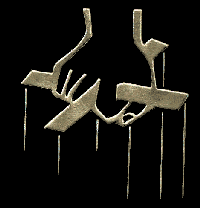
Pragmatism might have been the reason, but the characters had moved on from the original movie and Puzo's book. The scene of Kay lighting candles for her husband added an element to her character of still loving the new Don even while knowing he was a monster, complicit in his crimes. And it was particularly weird when Coppola put it at the end of more complete television presentation of "The Godfather Saga" after all the heinous crimes committed by Michael in "Part II" (including the one he finds the most unforgivable—the ultimate negation of his mission to save his family—as he says in "Part III" "I killed my mother's son. I killed my father's son."). But the Church, which presided over Connie's wedding and Anthony's first communion and Michael's papal decree at the beginning of each of the three films, as an instrument of God's Will on Earth, can forgive all sins and cleanse all souls, no matter the crime, no matter the evil. So, half-way through the film, when Michael Corleone is forgiven his sins by the cardinal (Raf Vallone) who will become Pope John Paul I (they needed a VERY holy man to forgive Michael), suddenly...in the eyes of God—or at least the Church—Michael's soul is clean. The marionette strings of the Corleone Family have been handed to his bastard nephew Vincent Mancini (Andy Garcia) who has the temper of father Sonny (James Caan), but is taught a Don's pragmatism under Michael's tutelage.
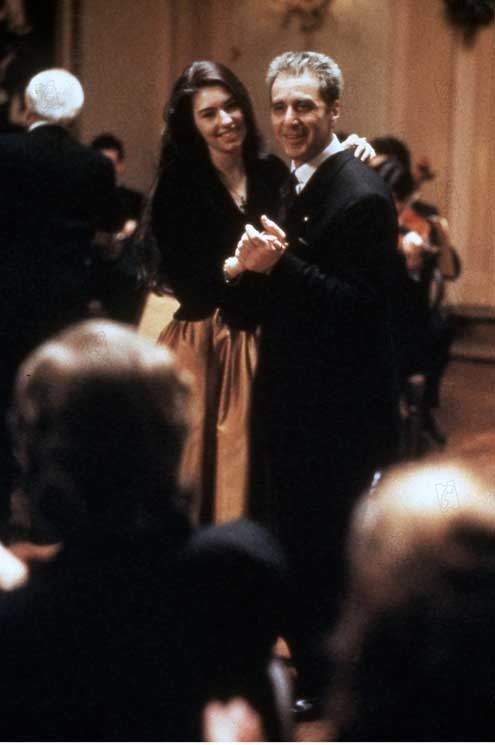
Big themes. Operatic themes. And "The Godfather, Part III" reaches its climax at an opera—"Cavalleria rusticana" by Mascagni, a tale of a Sicilian soldier who comes home from war to find that his life has changed and seeks to corrupt the relationships of his past—where Michael's son Anthony who has rejected his father's path is debuting. It is a cause for celebration, but behind the curtain of happiness, vendettas are carried out, and the sprawling story-line comes to a tragedy's finale. Although Michael's soul is clean and pure in God's eyes, he can't escape Fate, and he pays dearly.
Much was made at the time of Coppola casting his daughter Sofia Coppola in the role of Michael's beloved daughter Mary (Winona Ryder was originally cast, but bowed out pleading exhaustion). It must have seemed natural for Coppola to do so, having cast sister Talia Shire as Michael's sister Connie (Shire has a much bigger role to play in "Part III"), and Sofia has always been a part of the "Godfather" films.*** The critics were cruelly savage in their denunciation of her performance, and, admittedly, it is a little weak. But, critics seemed to blame the daughter for any weaknesses in the father's work. That the third film does not meet the impossibly-high bar of the first two is not her fault. Blame Coppola's artistic ambitions, and forgetting that "The Godfather" has its true origin in crime-novels and gangster movies, not the opera house. But the daughter bore the brunt. As Michael says sagely in the film "When they come... they come at what you love." Sofia Coppola has more than had her own revenge by becoming a gifted director and Oscar-winning screenwriter, she has also won the critic's respect.
Her triumph, and the grace with which she achieved it, is the true ending of "The Godfather" story.
* Well, there are always compromises: Robert Duvall did not reprise his role as consigliere Tom Hagen, citing the difference in salaries between himself and Pacino. But Coppola has always been adept at writing around such problems.
**That scene is used as the End Credits for "The Godfather Saga"—Coppola's "too much information" re-shuffling of the first two films into a strict chronology. There are lots of little interesting tid-bits in that one, including the hospital visit with Don Vito's old consigliere Genco ("You blashpheme, Resign yourself."), more scenes with the undertaker from the first film, and the Corleone family paying a visit to the Coppola family
*** Mantegna remembers during a scene prep, of Coppola pointing to Sofia and telling him that she was the baby being christened at the end of the first film.
Friday, August 29, 2008
Looking for Richard (1996)
Looking for Richard (1996, Pacino)
As fascinating and frustrating to watch as it must have been for Al Pacino to make this documentary. It charts his four-year quest to explore Shakespeare's Richard III, initially with the ambition to find a way to make it more accessible to contemporary American audiences. The film is a mixture of rehearsal and performances (though there was never a full-length production) interviews with actors and academics, and footage of Pacino and his collaborator, Frederic Kimball prowling the streets on both sides of the Atlantic, collecting vox populi, arguing and discussing with each other and at one point, setting off the fire alarm inside Shakepeare's birth-place as they attempt to make sense of the play and sense of Pacino's obsession with it. Whether intended or not, what comes through at the end is how much Pacino resembles his main character in so many ways: single-mindedness, manipulativeness though for very different ends. It makes you appreciate the power of Shakespeare and admire the talent and drive of Pacino, as well as the stars he gathers around him in his quest.
Looking for Richard is available on DVD from Fox and also features John Geilgud (interview), Vanessa Redgrave (interview), Kevin Kline (interview), Kevin Spacey, Alec Baldwin, Estelle Parsons, Winona Ryder, Penelope Allen, Kevin Conway, F. Murray Abraham, Aidan Quinn, Kenneth Branagh (interview), James Earl Jones (interview), Rosemary Harris (interview), Derek Jacobi (interview)
Thursday, June 19, 2008
Olde Review: The Godfather Part II
"The Godfather Part II" (Francis Ford Coppola, 1974)
Seanator Geary: "I despise your masquerade. The dishonest way
you pose yourself. Yourself and your whole fucking family."
Michael Corleone: "Senator, we're both part of the same hypocrisy,
but never think it applies to my family"
This Saturday's ASUW film in 130 Kane is Francis Ford Coppola's production of "The Godfather Part II."
Imagine the plight of Francis Ford Coppola. He is hired out of relative obscurity in the movie industry to direct "The Godfather" which becomes the #1 box office draw in history. Not being prone to attempt originality, Paramount Studios asked Coppola to make a sequel. Coppola agreed, stipulating that it be a more ambitious project, but above all else, it had to be necessary to "The Godfather" story.
Incredibly, it is. Part II needed to be told. And it is a better film than the original.
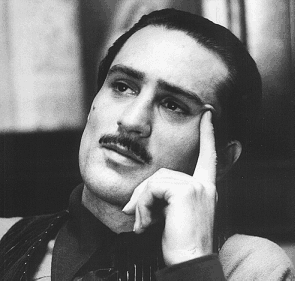
Part II tells two stories, the ones on either side of "The Godfather" time-wise: Before (between 1900 and 1940) when Vito Corleone (Robert DeNiro, played by Marlon Brando in the original) comes to America and rises to power; and After (between 1958 and 1963) when his son Michael Corleone (Al Pacino) is attempting to expand his empire, while, at the same time, losing his family. It is possible to enjoy Part II without seeing the original, but I don't think it would be as rich an experience. But don't worry about it. If you do, you might miss what is on the screen, which is considerable.
Vito Andolini (named Corleone by an uncaring immigration official) comes to America to escape a family-wide vendetta by the Don of Corleone, Sicily. He is only eight years old at the time. A vendetta of this type--the very strong against the very weak was never present in "The Godfather." All wars were between strong men, young and old. But in "The Godfather Part II," the differences between stalker and prey are more apparent, the difference between stalkers less so, for Vito Corleone in avenging his family's death, takes that revenge on the same Don, who has grown old and infirm and helpless.
Coppola perfectly captures the look and feel of New York's Little Italy in this section (which is almost completely subtitled so, again, go early if you want to read them, and understand what's going on)* In the Italian ghetto, families are kept close together, in fact, the community is kept close together by the conditions, and it is upon this unity that Vito Corleone builds his dynasty. He already has a family (an unquestioning wife, and sons who will follow in his footsteps) and friends, for whom he uses his power. Don Vito rises to power for the benefit of his family, his friends and for himself.
It is not that way for Michael Corleone, Don Vito's favorite son, onto whose shoulders the reign of his father has fallen. It is interesting to note that first Michael became Godfather, and then established his family, as opposed to his father, for the two men, as Coppola wishes to show, are completely different.
Above all else, Michael is a businessman in this film, manipulating everyone in his business dealings. The turnings and twistings of plot in Michael's sequences are subtle, very convoluted, so try to keep the names straight if you want to understand what is happening.
But the main point in Michael's story is that while he may continue his brilliant business career, he does so at a cost. Though he may be able to protect his family from outside forces, he cannot control the forces attacking his family from within. So that, at the end, Michael, though still powerful, probably the most powerful Mafia chieftain, is left alone, to brood over his success...and failure. Coppola who wrote and directed "Godfather II" said this soon after the film was made:
"One of the reasons I wanted to make 'Godfather II' is that I wanted to take Michael to what I felt was the logical conclusion. He wins every battle; his brilliance and his resources enable him to defeat all his enemies. I didn't want Michael to die. I didn't want Michael to be put into prison. I didn't want him to be assassinated by his rivals. But in a bigger sense, I also wanted to destroy Michael. There's no doubt that, by the end of the picture, Michael Corleone, having beaten everyone, is sitting there, slone, a living corpse...I admit I considered some upbeat touch at the end, like having his son turn against him to indicate he wouldn't follow in that tradition, but honesty...wouldn't let me do it. Michael is doomed.
I think we can be thankful that Coppola chose to elevate this film from what it might have been in other hands to tell us something extra about those two men--father and son--about our times, our country, and ourselves.
I wish I could talk more abou this film, but time prevents me. I will say that it is a beautiful fim, visually; done with genuine feeling and just a touch of spectacle. It is also very violent, though not as much as the original, that Pacino and DeNiro, in their respective parts are brilliant...and that it is being shown Saturday, October 9th at 7:30pm.
Broadcast on KCMU-FM October 8th and 9th, 1976
* Though it sounds smarmy and somewhat condescending, I think the issue was the seating at 130 Kane. Sitting in the balcony made it an eye-strain to read sub-titles, so getting a seat on the main floor was preferable.
In a post-"Sopranos" world, it is necessary to re-inforce that the "Godfather" movies weren't supposed to celebrate the Mafia, but cast them in a Shakespearean sense of tragedy. Michael may win his battles, but his descent into his own private Hell, the complete refutation of everything that his father represented, and the annihlation of the life that both father and son envisioned for him. Coppola always wanted to put the screws to Michael; to make him a King with riches but no heirs, and for all his success to lose everything that he should be valuing.
But, a lot of people just saw him winning all his battles. The hell with his family. The hell with his dreams. He was livin' large, man!
So when Coppola was enticed to make "Godfather III," he presented a withered, frail Michael, and tempted him with a clean slate, the re-unification of his family, and maybe a chance at happiness--a pure soul--and snatched it away from him, and closed the book on Michael's life.
But nobody liked that.
It is our custom in this country to venerate our villains. I've noted before that Marlon Brando was appalled when his biker bad-ass in "The Wild One" was embraced by the youth culture. In "Star Wars," Darth Vader was the coolest; in the prequels, when Lucas deconstructed Vader as a tragic figure...and worse, a lackey, it was rejected. Pacino's mui-loco-in-the-cabeza Tony Montana from "Scarface" is an icon now.
We venerate our villains. We tear down our heroes.
What's up with that?
Monday, January 14, 2008
Olde Review Part 3 - "The Godfather"
Part 1Part 2
When last we left, we were discussing Coppola's editing, specifically during moments of suspense and violence. Up ahead there be more style, some sound, and...spoilers, so if you haven't seen this film and want to with some element of surprise, be warned. I have not fixed any errors (and there are far too many! *sob*) and the film professor's comments are in RED
(The Woltz bedroom scene) is the last sequence of its kind in the film, for although Coppola doesn't hedge on the rest of the comparable bloodshed, the rest of the violent scenes are done differently. In the Woltz sequence, Coppola slowly "fades in" to the gore, but once it has been shown, "cuts out" rapidly with a series of quick cuts. But, for the rest of the film he leads into the bloodshed with shows of rapid-fire editing. There is an aesthetic reason for this in that Woltz slowly discovers that bleeding head, whereas the rest of the violence happens all too quickly.
Good.
The people who are afflicted realize only at the last moment what is going to happen to them. For example: the Don buys fruit; we see approaching feet; then, the film cuts back to the Don, who begins to run; back again to the feet, which pick up speed; cut to an overhead shot as the thugs those feet belong to, fire on the Don; another scene is inserted of Fredo getting out of the car, fumbling with his gun; cut back to the overhead shot as the thugs fire and flee. The whole thing takes eighteen seconds. When Sonny is shot up, when Appolonia is killed in the car explosion, and, in an even more extreme example, during the baptism-murder sequence, when Coppola shows a detailed record of a baptism, and shows five intricate gangland killings from start to finish, rapid editing is used. But Coppola doesn't even need the horrifying images he uses in these sequences to create tension. When Michael is at the hospital, fearing an attack on his recuperating father, he hears footsteps echoing through the halls. Coppola, through a series of shots of the sterile hospital corridor and different-angled shots of its angled staircase, creates great tension in the viewer, which is relieved, finally, when it is found that it is Enzo, the baker, merely trying to visit the Don. For the aware viewer, Coppola gives suspense by showing minute reactions of the characters, as when Sollozzo notices Sonny's interest in the heroin racket whenthe Don meets with him, and also, during Luca Brasi's fatal meeting eith, again, Sollozzo,as the "Turk" looks beyond the mass of Luca Brasi, just before Brasi is strangled by an unseen attacker behind his back.
There is a lot of good cinema in "The Godfather," more than could be touched on in a paper of this length. Personally, I feel it's an excellent film, and there are many parts of it, that I haven't mentioned, that I truly love: when Michael stands beside his father's bed in the hospital, guarding him, pledging, "I'm with you now" with the Don's reply consisting of his labored breath, saddened smile, and a small tear running from his eye; the talk in the garden between Michael and the newly-retired Don, with Mafia strategy in between talk of family and the Don's rememberances and his regret-filled "I never meant this for you" ; and , of course, the scene of the Don's death while playing with his grandson, a scene of playful joy and mirth, and of peaceful termination. These are exceptional moments in the film that move me every time I see them. But my favorite scene, curiously, is at the end of the film, as Kay, now Michael's wife, prepares a drink for them after he has allowed her, just once, to ask him about his business. She is in the foreground of the shot, he is in the background, inside his office, framed in the doorway. As she looks on, Clemenza, Hagen, and Michael's bodyguard enter the door-frame. Coppola cuts to a closer view of that doorway as Clemenza kisses Michael's hand in the manner due to a Godfather, and respectfully calls him "Don Corleone." The music on the soundtrack swells, and as Hagen, in the same manner, kisses Michael's hand, the bodyguard moves towards the door. Coppola then cuts to a view from inside the room, looking out at Kay, as she looks worriedly at the camera. The blackness of the closing door moves across the frame and closes, cutting off the music, and Kay, leaving her separated and apart.* It is a melancholy scene: full of personal triumph and personal tragedy. As such, it reflects the film.
Ok. And much more than ok ----easily the best paper handed in. There is some very sensitive writing here, obviously preceded by even more sensitive observation. You make me want to see G1 again.
And that last line is the biggest compliment any person who writes about movies can get, especially considering the professor wasn't too keen on "The Godfather." As it was, later in the year, Coppola released his follow up, "The Godfather, Part II" and Jameson's review of it was laudatory, scattering many images from Part II throughout his "Moments Out of Time" series for that year.
Richard Jameson writes about movies for the Queen Anne News, MSN and Film Comment magazine, which he edited for many years. You owe it to yourself to seek out his reviews.
Me, I write about movies on this lousy blog...
Oh. I got a 4.0 for the class.
* Which links it with other outsiders left behind blackened doors, like in "The Searchers."
But, there was more. There were scenes filmed (to be inserted after the Don's shooting) of Mama Corleone hearing the news and stoically going to church to light candles for the Don's soul (there's a photo of it in the bi-fold of the soundtrack album).
At the end of "The Godfather" a scene of Kay lighting candles in a completely blackened church (for Michael's soul) was to run over the credits (and was used, interestingly enough, at the end of NBC's broadcast of "The Godfather Saga" that combined Parts I and II in chronological order. indicating that Kay was still lighting candles for him after their violent break-up...seems odd).
It's at least as interesting to wonder why it wasn't used...maybe it was too soon after the events of the ending to go to another scene of Kay...maybe because it was an indication that Kay is resigned to her husband's life, which wouldn't do...maybe they just wanted to leave it on an ambiguous note, which sounds like Coppola--after all he did that in "The Conversation," "Apocalypse Now"...but not "Godfather III," where the issue of Michael's soul is of such high importance. Anyway, the Kay scene is an "Extra" on "The Godfather DVD."
Olde Review, Part 2 - "The Godfather"
Part 1-Background, Foreground, and the Overview When last we left, we were discussing Coppola's visual style. Up ahead there be more style, some sound, and...spoilers, so if you haven't seen this film and want to with some element of surprise, be warned. I have not fixed any errors (and there are far too many! *sob*) and the film professor's comments are in RED
(Coppola's) conversations, of which there are many in the film to explain away the plot's complexities, are also done simply: Coppola shoots over the shoulders of the two partcipants, and cuts back and forth between them, with maybe a shot of another participant, edited in, as whern Coppola cuts to Tom Hagen when Sollozzo compliments him on his fact-finding, as he negotiates with the Don about his heroin deal, or when Captain McCluskey is shown, because he is a threat to Michael, in the Michael-Sollozzo negotiation, where the young Corleone has been sent to kill. Coppola runs against a problem, though, when an exchange of looks and words are required between the Don, Sonny and Sollozzo, when Sonny interrupts the discussion (Sonny: "Ah, you tellin' me the Tattaglias guarantee our investment?" The Don: "Wait a minute...") something that would require rather messy and complicated editing. Instead to keep things consistent, Coppola has Marlon Brando change his position in relation to Sollozzo and Sonny so that he sits between the two, in order that, now, the two shots include one of Sollozzo and one of the Don with Sonny behind him. Not only was some possible sloppiness stopped, bu Brando and James Caan were able to play off each other more effectively.
Coppola's treatment of the story is also straightforward: he just shows the important facts and lays them out one-by-one in their proper sequence, and only a coiple of times does he fiddle around with time, besides the essential squeezing of a decade into three hours. Once, at the exact middle of the film, coppola presents the war between the Five Families in an 85 second montage. Overlaid by a rinky-tink piano accompaniment, Coppola overlaps and fades in and out on newspaper articles about the various murders, and headlines of McCluskey's involvement with the Mob (michael suggested that Hagen tell the reporters on the Mob payroll to play up the story, in order to soften Family retribution), of pictures of slain mobsters with policemen (who are seen smiling over the bodies, in some of them), of Tessio reading a paper next to an arsenal-filled table, of Clemenza shacking up in a bared rom, of the fellow playing the piano, while, in the background, a table full of men pass around a large bowl of spaghetti, and of the spaghetti being spooned out into a garbage can. This whole montage is sandwiched in-between Michael's killing of Sollozzo and McCluskey and of the Don's return home from the hospital. It is an essential part of the film, and Coppola's filming the war in this way insures not only that that part of the story is told, but also, that it is told economically, time-wise. The other instance of Coppola playing with time is seen soon after the Woltz incident has been finished, and the Don, Sonny and Hagen hold a small briefing before their initial meeting with Sollozzo. Hagen explains certain aspects of the Sollozzo character: his preference for the knife as a weapon, of his narcotics business and any other useful information. As Hagen ticks off these facts, Coppola shoots forward in time and cuts to a placement shot of the extreior of the Don's office building, with Sollozzo waiting out on the side-walk, then cuts to Sollozzo climbing up the stairs to the actual meeting. Coppola then shifts back in time as the Don asks for opinions which Hagen expreesses like a businessman ("Narcotics is the thing of the future"). while Sonny expresses it simply: "There's a lotta money in that white powdah...So, what's your decision gonna be, Pop?" Coppola then cuts forward again to the meeting with Sollozzo. This action not only saves viewing time, and keeps the film from getting stagnant by remaining for too long on a single scene, especially one which is mostly talk, as this one is, but, also, identifies Sollozzo by placing him on the screen, while Hagen describes him on the soundtrack.
Coppola engages in many ironies in this film, concentrating specifically on the contrasts of innocence and guilt in the Mafia lifestyle and the joy and sadness that these people face in their lives. The whole wedding sequence is just such an irony: while the ritual of a wedding, something steeped in the glorification of innocence (the emphasis on white, for example) goes on outside, in the sunlight, the Don is inside the house, in his office's darkness (broken by the venetian blind that reflects the Don's mood, such that, it is almost close when he berates Bonasera, but it is fully open when he sees Johnny Fontaine arrive at the wedding, and yes, I know Fritz Lang did it before and it's a good idea!) makes illegal deals. Coppola has one pair of shots, the first of which has Kay and Michael Christmas-shopping, while some properly idyllic snow falls around them and the song "Have Yourself a Merry Little Christmas" booms over the New York shops. This contrasts deliciously with the next shot: Luca Brasi preparing for his meeting with Sollozzo, putting on a flak vest, and loading his revolver while the same damn song churns out over his radio. Of course, then there is the baptism-murder sequence where Coppola cuts between a baptism, a ritual for cleansing sin, while out in the city, all sorts of sins are being committed by the new Godfather. Coppola, in this sequence, goes as far as to match two of the shots with the same motion: a priest's arm swings from an urn of ashes to place some on a baby's chin, then in the next shot, a barber's arm swings from a lather dispenser to the cheek of one of Mike's gunmen. Clemenza, in one part of the film, teaches Mike how to cook spaghetti for a large group, then, a little later, he teaches him how to kill Sollozzo and McCluckey. When Carlo is beating his wife, Connie, over the soundtrack is heard hysterical crying, hers, which blends in with a baby crying in Mama Corleone's arms at the don'd home, where she is trying to calm the kid and also, an hysterical Connie on the phone. After the Don has shown undertaker Bonasera Sonny's bullet-ridden body, Coppola cuts from the Don silently grieving for his son, to the sound of Michael's Sicilian wife, Appolonia, laughing with delight as Michael tries to teach her how to drive. In one sequence, he cuts from michael's heavily-chaperoned, pre-marriage romance to Sonny's heavily-guarded (well, it's almost the same thing) tryst back home in New York. Coppola also cuts from Michael and Appolonia's wedding night to the girl Michael left behind, Kay, as she arrives at the Corleone house to try to contact him. These little touches of Coppola's tend to provide an added jolt to the audience, while it waits patiently for the next garrotting, or provide the many touches of black humor that he inserts into this film.
One of the best things about "The Godfather" is its use of sound, that, like the ironic cutting back and forth between two situations, enhances the film. It is these scenes, with their subliminal, audio trickery, that, personally, catch my attention. One of my favorite scenes in Welles' "Citizen Kane" is the picnic-tent fight between C.F.Kane and Susan, where the song "It Can't be Love" is sung and the frenzied screams of a woman outside coment on and enhance the confrontation inside. The only thing that interested me in Friedkin's "The Exorcist" was the liberal use of modern "concrete" music for the sounds of the natural world. There are .many minor uses of auditory trickery in "The Godfather," such as one of those ubiquitous babies crying when the Don slaps Johnny Fontaine around, or when the Don is shot down in the street. Of course, there's the previously mentioned "Have Yourself a merry little Christmas" as Brasi prepares for his Sollozzo meeting, and , as he walks through the office building to that meeting, a heavily-echoed, ominous-sounding whistling goes on through the halls. As Tom Hagen is kidnapped by Sollozzo, "Santa Claus is Coming to Town," ("Gonna find out who's naughty and nice") plays over a speaker. The sound of thunder magically appears as Captain McCluskey and his police enter the scene, outside the hospital, where Mike is guarding his stricken father. In the sequence at the toll plaza, before Sonny's death there, a bell rings once the toll is paid. After Sonny has been throughly mavhine-gunned to death, and his killers drive off, Coppola edits in several scenes of the aftermath, with nothing but the wind on the soundtrack, until a single shard of glass, which we never see, falls and makes a sound, just like the toll bell, saying, in effect, "Yes, the toll has been paid."
Nice.
One of the most effective scenes of this type is the one of Michael as he enters the deserted hospital to visit his father. In the distance, echoing through the hall, there is something low repeating over and over. When Michael gets nearer to the source, it becomes clearer and he and the audience hears what it is: a record of some singer that has become stuck and keeps repeating the same word-"tonight...tonight...tonight..." Its effect is absolutely eerie: it is a kind of supernatural warning and threat, and it gives Michael the fear that someone will kill his father, as the record says, tonight. This thing with the repeating record has all the earmarks of a man named Walter Murch. Murch has worked on most of the films coming out of Coppola's American Zoetrope Company and his work is, by now, identifiable. He engineered, with George Lucas, those wierd "sound montages" in Lucas' "THX-1138" which contributed so greatly to the mood of that film, especially the way in which human voices were distorted until they were so mechanical-sounding, it was hard to say if they had ever been human. He worked on Coppola's "The Conversation," where he did such things as turn the sound of a television program and muffled conversation from the next room into a paranoid audio nightmare. Also, in this film, he made the inconspicuous whirr of an elevator into a gigantic roar as Gene Hackman shares it with the "marked" Cindy Williams. Murch's work on Lucas' "American Graffiti," in my opinion, topped all of his previous work when he filled the Southern California air with reverberating "boss sounds" from the myriad cruising automobiles' radioes. The high-point of his work in that film was when he took the sounds of the night--a passing train, screeching brakes, a police squawk box, the sounds of a stationary and a moving radio, whose music approach, coincide and break-off--that made Richard Dreyfuss' crawl to attach the steel cable to the rear axle of Officer Holstein's squad car, such a nerve wracking ordeal to live through. Murch applies some typical technique in the sequence when Michael meets with Sollozzo and McCluskey. On the drive out to the restaurant-meeting place where they are to confer, Murch inserts two of his audio comments: the first when as McCluskey searches Michael for hidden weapons ("I guess I'm getting too old for my job, too grouchy," he says, referring to the hospital incident when he broke Michael's jaw. "Just can't stand the aggravation." And inreply to this hollow explanation, Coppola and Murch insert a passing car horn that sounds like a horse laugh); the second, when the car passes over the bridge to New Jersey, and Michael begins to fear that the meeting will not be held in the required place for the set-up to kill Sollozzo. This moment of fear is expressed when the car passes over a grating and the sound it emits resembles a heavenly choir or the shrieks emitted from Kubrick's monolith in "2001." More noticeable than these are the two "moments of truth." that Michael has before the two killings. Clemenza has told him to come out of the restaurant bathroom, shooting, and as Michael prepares to exit the bathroom, the sound of a truck comes through the wall,* like a roaring in his ears, as the fateful moment arrives. But he waits, and as he talks again to Sollozzo, the sound of another roaring truck grows on the soundtrack, but this time, it is followed by the squal of air brakes. That squeal is like a signal that triggers Michael to do what he must, and he stands and kills Sollozzo and McCluskey.
Coppola not only uses Walter Murch's ideas to create suspense, but uses many of his own. The first of these occurs in the Jack Woltz episode, when Woltz awakens to find the head of his prized race horse inside his bed for a warning. Coppola begins the sequence with a pleasant shot of Woltz's mansion, at sunrise. On the soundtrack, only the chirping of crickets is heard, then, as the first set-up fades into a shot of the mansion, the camera, rising, to the right. The sound of "The Godfather teme," that sad, funereal, horn music that started the film, echoes over the scene, only now its a little faster. That rightward moving shot fades into a leftward-moving shot, still rising, zigzagging over the mansion and its opulence, until it centers on some grillwork on the side of the house. This fades to a shot overlooking the grillwork into Woltz's bedroom, and the camera approaches Woltz's sleeping form. Now the music becomes almost pixieish as piccolos pick up the tune. The camera pulls alongside the bed, as Woltz stirs, and we see,for the first time, that there is blood on his covers. The msuic now becomes more complicated as different instruments play the tune at different speeds, and at different times until it becomes dizzying. Woltz is now hurriedly unravelling his covers, more and more blood showing up, until the head, itself, is uncovered and the music abruptly stops. On Woltz's first scream, Coppola shock-cuts to a view of the grisly-head holds on it for the second scream, then, as Woltz screams again and again, on each scream, Coppola cuts farther away. Back to the shot looking into the room over the grillwork, back to the grill on the side of the house,, and back to the placement shot, which fades to the aforementioned "signature" shot of the Don's face. Coppola takes us in, and shows us out the same way, but in deference to our feelings, takes us out faster than we went in.
Tomorrow: We reach some conclusions....finally...and they will, no doubt, be punctuated, by far too many comma's, probably!
* It's actually an elevated train.
Olde Review, Part 1 - "The Godfather"
"So, why'd I get an 'incomplete?'"I was standing in the office of Richard T. Jameson. I had taken a film class from him, and written what I thought was a pretty good final paper on "The Godfather." But in looking at the posted grades on the bulletin board I saw that I had been given an "incomplete."
"So, why'd I get an 'incomplete?'"
Jameson surmised me cooly. "I think you know why..."
I gave him a look. "Uh...no-o, I don't."
He looked at me. "You bought that paper, didn't you?"
"What?!!"
"C'mon! You bought it from a mill. This thing reads like Pauline Kael!"
(It should be noted that Jameson didn't like Pauline Kael)
"Honestly, I wrote it myself!"
"Well, how'd you get the quotes right?"
"I taped it off NBC!"
"Okay. How'd you get the camera angles?"
"When I hear the audio track, I can remember what the visuals are..." "Oh....okay. Sorry. Given that, maybe you did write it, after all."
Here's what I wrote, warts and all, painful though that proved to be to recreate. Richard Jameson's comments are in RED.
"The Godfather" begins with a black screen, behind which a single horn wails out a series of rising and falling notes, evoking a feeling of desperate sadness, as if some tragedy were taking place. The music would be appropriate for a funeral. And with that in mind, the first sentance is spoken in the film: "I believe in America." the man who says this, Bonasera, an Italian immigrant, has a daughter who has been ravaged and beaten by a pair of American toughs. He does not go to Don Vito Corleone, the Godfather, who gives assistance when it is asked, because, as the Don, himself, says, "You found paradise in America, you had a good trade, made a good living, the police protected you and there were courts of law. You didn't need a friend like me." But the police and courts have failed Bonasera and sent the thugs free. For him, Justice and America have not worked. "She was a beatiful girl," says Bonasera of his beaten daughter. "Now she will never be beautiful again." Socan be said of his view of America. The Don, himself, says, later in the film, "I refused to be a fool dancing on a string held by those big-shots. I don't apologize, that's my life." So it is with so many of the characters in "The Godfather." If something does not go to their liking, they cross the criminal line and go to the darker side of America, represented by director Francis Ford Coppola, in the first few minutes of the film, by the blackness of the Don's office.
Good. However, the blackness is also associated, it seems, with an Old World sense of honor, of self sustained by the family and The Family. Of course this does not contradict what you have said--merely enlarges on it. (Darkness in the cinema is worthy of a whole book in which to discuss it.)
Coppola begins the movie proper focused on a single person, the bitter Bonasera. Then, as he goes along, he expands the viewers' view of the world he has set up, of the people, and the world of crime they inhabit. Coppola's camera pulls back (expanding our view even then)from Bonasera until the Godfather is seen, brings an unseen eavesdropper into this personal conversation when an arm enters the frame offering a comforting glass of wine. Then Coppola shows us more--the entire room, and in it, the Don's sons. After the Bonasera incident, he cuts to a wedding party outside in the sun, contrasting nicely with the office darkness. After the wedding sequence, Coppola moves from New York to Los Angeles to show how the Corleone business strategy works, and then, later shows the others of the five Mafia "families" and how they operate. Hetakes us through slowly, and expands the film throughout, until, towards the end, the strategies involved in the story take on the complexities of a World War II battle plan.
"The Godfather," which Coppola, and maybe a quarter of the people who say did (?), adapted from Mario Puzo's trashy novel, runs in a circular pattern: a master circle in which smaller circles of lives and deaths, favors and rewards, and war tactics intersect. Favors are given out and paid back (Bonasera is revenged, then repays by trying to make Sonny's bullet-ridden body less hideous; the Don helps Enzo, the baker's assistant, stay in America, then, by chance, Enzo helps Michael pull off his hospital ruse to protect the Don from "hit" men; Johnny Fontaine gets his motion picture part, then helps attract other stars for the Corleone's Las Vegas business), traitors conspire and are paid back (Tessio arranges to kill Michael and is, himself, killed; Paulie Gatto, the Don's chauffeur, is "sick" when the Don is gunned down, and Sonny has has him killed in a field of reeds, overlooked by the Statue of Liberty; Carlo sets up Sonny's murder, and Michael has him killed, as well as Moe Green, Barzini and the other "Family" heads). The film is separated into three main sections: the wedding, Tom Hagen's bsusiness with Jack Woltz, and, finally, the war between the "Families." Throughout these stands the main story of "The Godfather:" the metamorphosis of Michael Corleone from a young man who rejects his family't way of life to becoming, himself, Don of the Corleone Family. His reign as Godfather and his father's reign before him are two circles that overlap, so that the film begins with Vito Corleone running the show, moves into a point where the father and son rule together, the father teaching the son, and ends with Michael's first "roar," as it were, as he systematically kills his business rivals, while he overlooks his nephew's baptism, becoming a Godfather, both literally and in Mafia tradition. He has replaced his father. The circle is complete.* And yet, it continues. During Vito Corleone's death scene, Michael's oldest boy, Anthony, who is just a toddler, childishly picks up a water can and with a machine-gun-like "AH-ah-ah-ah" sprays his stricken grandfather with it. As the original Godfather dies, another, still a child, is being "born," who will replace Michael. It's a chilling moment in the film, one that seems to confirm the suspicion that these people are locked into their fates, soon after they are born.
What with so many Paramount fingers in the pie, "The Godfather" cannot really be called an auteur film. Puzo contributed to the screenplay, as did Robert Towne, supposedly, and there are a few auditory touches that belong unmistakably to the film's "Post Production Consultant," Walter Murch. But still, there are so many consistencies in style throughout the film that one can tell that it is mostly Coppola's work. For example, Coppola, when shifting scenes, will set up a single placement shot of, say, Jack Wolz's(sic) mansion or some obscure office building in New York and then cut to what is going on inside. The movie takes place in the late 40's and early 50's and Coppola has strewn old posters on walls (defaced posters of presidential candidate, Tom Dewey, an avid mob fighter, can be seen as he beats up his brother-in-law, Carlo) and vintage automobiles on the streets to provide some period recognition, but also, to evoke the time, he has used 1940's-style movie techniques and set-ups, so that there are no zoom shots, high-on-the-roof-top-vantage-point-shots, split-screens, or slow motion violence, things that have popped up during the last eighteen years.And he uses fades! (Remember them?) More important, he uses them effectively as in the Woltz section, after Woltz has been rudely awakened by a severed horse head bleeding on him, Coppola shows a placement shot of Woltz's mansion, where it has taken place and then fades to the Godfather's face which is tilted in such a manner that he is looking up a Woltz's bedroom. That fade is like a signature for the deed. Another example of this is when the Godfather lies recupearting at home, and Coppola fades to Michael, hiding out in Sicily. You know what the ailing Don is thinking about: his son.** In another instance, when Tom Hagen is walking through Woltz's studio, another director might have shot from a studio roof as he amkes his way along the alleys and studios. But Coppola shoots at street level for these shots, one from the side, and one from the back. Then, when Hagen enters a studio, the camera is elevated up in the studio rafters, just the sort of fancy shot you'd expect in such a studio.
This seems a bit far-fetched as rationale for the shot. ***
* It should be pointed out this was written in 1974, three years before another "circle is now complete" movie-"Star Wars" and just before the premiere of "The Godfather, Part II"
** Murch provides an auditory compliment to those fades. Woltz's screams echo over the dissolve onto the Don's face, disappearing only at the next cut. On the shot of the Don in his hospital bed, before the shot fades, Murch inserts a distant church bell--a church bell that is actually tolling in that scene in Sicily. Echoes and the thoughts that follow them...
*** And it is. You'll find that Jameson's comments are cogent, thoughtful and helpful beyond just the obvious re-direction that he could have written. If you've never read any of his film-criticism, you're missing a body of scholarship that goes far beyond the simple snarky reportage you'd find in your local newspaper. Jameson capital "L" Loves movies, and he especially loves movies that reflect life in an artful way, and shines a light into the corners of life that don't see the light of day. On every film-lovers book-shelf there should be a library of his writing on Ford, Hawks and Welles. At the very least, there should be a published book of his (and Kathleen Murphy's) "Moments Out of Time" series that points out moments of brilliance no matter where in that year's films.
Tomorrow: More of Coppola's shooting set-ups...and set-ups of shootings.