 "The Formula" (John G. Avildsen, 1980) Fairly lousy movie, done in the clunky Avildsen style, of a police detective (George C. Scott) following a series of murders that involves the MacGuffin of a synthetic substitute for petroleum. Avildsen is the perfect director for thudding cartoons like the "Rocky" series and "The Karate Kid." But when having to provide any subtlety or style, as he attempted to do with "Slow Dancing in the Big City," it's a miserable failure. And one has to say that he didn't add anything to the thriller or detective genres (or even the "paranoid thrillers" established in the 70's) with "The Formula."
There is one joy, however, and that is to see the meeting of two of the better actors of the American stage square off, and really, it's probably the only reason the film got made (except for a tenuous tie-in to the then-dissolving energy crisis). They have one scene together of any consequence. Both men are a bit over-weight—Marlon Brando playing the fattest of oil-cats—and the two meet for a semi-perfunctory sizing up of each other.* One anticipates sparks flying between two titans.
And they don't. It's a genial little walk in the sun and the two banter back and forth—Scott's Lt. Barney Caine probing gently and Brando's Adam Steiffel waxing folksy and feigning detachment. But it's fun to watch. Brando's off in his "method" world—if he seems distracted it's because an assistant is feeding his lines through a hearing aid, and Scott observes the performance with an odd amusement, completely out of character.** What you're seeing is a fellow thespian (and fellow Oscar refuser) do his thing and barely suppressing his amusement...and bemusement.
It happens sometimes in movies, when very talented people with nothing to prove collide in a scene. As when Meryl Streep and Vanessa Redgrave play old friends in "Evening," or Al Pacino just sits back and revels in Jack Lemmon's shop-talking in "Glengarry Glen Ross." It doesn't help a bad movie. It can't help "Evening" or "The Formula." But it's one of those magical moments when artifice is usurped by genuineness and the joy of creation is reflected off the screen to the audience.
* Come to think of it, Brando's character would have been more effective if he were an insular baron.
** Apparently, the rueful shakes of Scott's head during the scene are his reaction to Brando doing a completely different "read" of his lines than previous takes.
Saturday, December 19, 2009
The Formula

Tuesday, September 2, 2008
Olde Review: One-Eyed Jacks
This Saturday's films in 130 Kane Are Marlon Brando's "One-Eyed Jacks" and Robert Altman's "McCabe and Mrs. Miller."
"One-Eyed Jacks" (Marlon Brando, 1961)
 This one's something of an oddity--it's the only film directed by the greatest "method" actor, Marlon Brando. But what you will see on the screen is really not the film that Brando made. You see, it's one of those stories where nothing really works right. Brando and a number of script-writers worked onthe screenplay for a couple of years. Stanley Kubrick was signed to direct and pulled out.* Then, Brando decided to direct it himself and shot a quarter of a million feet of film over a six month period at a cost of five million dollars. Supposedly, there was about 35 hours of film to edit down to a watchable size. Brando's cut was five hours long, but with some noticeable studio shooting, plot summaries were accomplished and got it down to its current two hours and twenty minutes. So it isn't totally Brando's concept.
What is there in those two hours and twenty minutes? A superbly acted film, based on a script that at times is intriguing and at times is dull cliche. It's a very wierd movie. It's wierd, but it does show that Brando certainly had an artistic eye for shots, camera angles, sequences that sometimes take the breath away. You'll also see excellent performances from a cast of Brando, Karl Malden (before TV neutered him),** Katy Jurado, Slim Pickens, Pina Pellicer, Elisha Cook, and Ben Johnson..especially Ben Johnson.
Johnson first worked for John Ford in his westerns and evolved into more than a great actor, but one of those genuine screen presences working in film today. When Johnson and another screen presence, Brando, play off each other in a scene, sparks fly across the screen. Those sparks were expected to fly between Brando and Jack Nicholson in "The Missouri Breaks," and never appeared. To see these two greats square off is one of the joys I had watching this film, and also, this film contains my favorite epitheit in all of cinema....
They just don't write 'em like they used to."Get up, you scum-suckin' pig!"
Broadcast on KCMU-FM on November 19th and 20th, 1975
Or over-write them. The parts that you can glean from the current cut of "One Eyed Jacks" (and no one is rushing to restore the full length version, certainly not Paramount Studios) suggest an idiosyncratic western with a gritty, grimy feel, which would have made it unique in the western-glut that was happening across theater and televison screens across America. Brando's fights were inelegant, and people looked like they got hurt. But the film is a cliche about Authority Figures and Oedipal Conflicts--Karl Malden plays a once-friend-turned-lawman named..."Dad." At one point, Brando's character is whipped in the street before a crowd of on-lookers, and if that doesn't convince you he's a Christ-figure, his tied outstretched arms just might.
Ulp! It starts to get so thick with things like that, you need hip-waders out in that desert.
* Kubrick says he quit because Brando was wasting a lot of time, and really wanted to direct it himself, so he moved on to a more worthwhile project.
** Malden was appearing in an American cop series called "The Streets of San Francisco," with a young actor of good parentage named Michael Douglas.
"Get up, you scum-sucking pig!" occurs at 3:55 in this video
Wednesday, June 4, 2008
Superman II: The Richard Donner Cut
 Lester, Michael Thau, 2006) Call it "The Richard Donner Cut" in name only. Donner had nothing to do with it, except give it his tacit approval--and express amazement that anyone cared so much to find the lost footage that he had shot (simultaneously directing "Superman: the Movie" and "Superman II") and assemble it to make some semblance of the film that Donner and final script-writer Tom Mankiewicz had in mind from the beginning.
 But a lot of fan-boys did, noting a slight change of tone in the three years between I and II. A lot had happened: the firing of Richard Donner over "creative differences"(those being he spent too much money, he cared too much about the movie to worry about the budget, and he wasn't a toadie to the producers), and the replacement with Richard Lester, no slouch as a director, but who didn't give a rat's ass about superhero movies. Web-sites had for years been acrueing sightings of bits and pieces of "Donner" grail from International versions and "Expanded" television showings, and Michael Thau who assembled this thing, created new effects (a bit crude), re-edited John Williams' original score and Ken Thorne's work on "II,", and grabbed whatever footage he could (including for one crucial scene only available from Margot Kidder's and Christopher Reeve's auditions) to create this dog's breakfast of a "movie."* It is incomplete with big holes in the narrative, and with only crucial Lester-directed scenes grudgingly included--Donner and Mankiewicz grouse and complain about the changes made to "their" movie in the commentary but do give Lester (never named) and the re-writers some credit once. It makes a one-on-one comparison dodgy and a bit unfair, in both movies' favors.
The first thing one misses (after goggling over alternate takes and a wealth of new Marlon Brando and Gene Hackman footage--all shot by Donner, he only had them for a limited amount of time) is the cracker-jack/spin-on-a-dime editing of Stuart Baird, who cut the first Chris Reeve "Superman" film. The relative pace of this film, by comparison, is slack, alarmingly so. Donner and Baird in the first were far more brutal in their cutting and it made for a dynamic experience.
But I have to give the nod to the Donner cut, first, because they remained faithful to the source, and, second, because they made a far-more interesting two-movie arc than combining the first with Lester's Version. Let me explain.
Whatever money the Salkinds made, they blew it artistically, because "Superman"/"Superman II" as Donner/Mankiewicz intended, was one of those rare things--a "religious film without Jesus." Yes, there are those direct parallels that Bryan Singer picked up on (and made too much out of in his "Superman Returns") of the Father who bequeaths his Only Son for Mankind. But it goes further. It also makes a direct, dramatic use of that ambiguous phrase Jor-El line "The Son becomes the Father, and The Father, the Son." It brings closure to Superman's ties to his home-planet and abandons him completely to Earth. It also shows why Kal-el deserves the name of "Superman." And it showed a much better performance by Christopher Reeve, than was ever displayed again in the series. The actor in Reeve played Part One, so he could sink his acting chops into Part Two. Not using the Donner segments robbed people of seeing a pretty incredible Reeve performance.
Jor-El, Superman's father--played by Marlon Brando, plays a critical role in Part II. When Lois Lane's movie-length attempt to unmask Clark Kent as Superman comes to fruition, they whisk away to his Fortess of Solitude for some alone-time, and Dad does not approve, chastising Kal-el for hubris and selfishness, telling him his reward is the happiness his good works provides. But Kal wants Lois ("this human," Jor-El dismisses her), and to do that, he must live as one of them, and have his powers removed permanently by a "red-sun generator,"** which will make him an ordinary man. Kal-El steps into the chamber and as the process strips him of his powers, Jor-El casts a disapproving look at Lois Lane.
 The human couple, Clark and Lois, leave the Fortress, the diner scene happens where Clark gets beat up, and learns about the Kryptonian villains taking over the U.S. government. Realizing what he's done, and there's no one but him who could stop them. he treks back to the empty Fortress, the crystal controls he used to communicate with Jor-El obliterated. Kal-El breaks down, acknowledges his weakness and mistake and hears nothing in reply. Finally, he cries out "Father!"
 Donner (and Thau) cuts to a far-shot as the cry echoes in the crossed beams of the Fortress. And one recalls the words of Christ on the Cross: "My God, My God, why have you abandoned me?"
But there is a shred of hope. Or a shard. Amidst the rubble, the original green, glowing crystal that Kal found in his Exodus-ship is still glowing, and with it, he is able to contact Jor-El one last time.
Jor-El admonishes Kal for his transgression, and tells him that there is only one way to get his powers back, and that is to transfer the final energies that allows them contact; for Superman to regain his powers will destroy the last vestiges of energy that is the Jor-El "program." Kal-El is reluctant, but Jor-El begins the process, appearing to him corporeally to touch as they say goodbye and to transfer his power to his son, destroying himself: The Son becomes the Father, and the Father becomes the Son.

 Kal is knocked unconscious, the other crystal conduits are destroyed. There's the battle with the Kryptonian villains (but without the expanding sticky "S"-shields and simulacrum tricks, per Newman and Lester--what? Superman's powers aren't enough?), Luthor is carted away, and then the coda: Superman flies Lois out of the Fortress, turns, gives it one last look, opens his eyes...wide, and destroys the Empty Fortress with his heat-vision. Here are frames from that sequence, without any further explanation--but one more Bible quote:


 "When I was a child, I spoke as a child, I felt as a child, I thought as a child. Now that I have become a man, I have put away childish things."
1 Corinthians 13:11
Yeah, I wouldn't call it "The Richard Donner Cut." I'd call it "The Last Temptation of Superman."
For all its patchwork quality, for its holes and inconsistent effects, I'd still have to say I prefer "The Donner Cut," as it maintains the consistent vision of the first movie and brings the story proper to a conclusion. The Lester Version let go of the internal logic for thirty pieces of silver, and undermined the biblical implications to replace it with slapstick and inconsistencies from out of left-field. One is left unsatisfied with both, and pining for the greatest super-hero film ever made.
------------------------------------------------------------------------------------------------
*Okay, some history: Between the first and second films, Donner was let go and Lester was hired. For financial reasons (the producers didn't want to pay him his full salary), all of Marlon Brando's scenes for the second film were scrapped and Susannah York brought in to play Lara, Kal-el's mother (who never appeared post-Krypton explosion in the first film) from beyond the grave. Gene Hackman's footage was used, but cut way down. Why? In order for Lester to recieve the director credit, he must have directed at least 50% of the movie, and so a lot of Donner footage was edited out to bring about that mathematical percentage, thus, Hackman's role of Lex Luthor was greatly reduced. A pity as Hackman is terrific in the movie.
** See, Krypton, Superman's home planet, had a red sun, so bathing him in "red solar energy" takes away all the powers that Earth's "yellow sun" gives him, and at this point everything breaks down because once Kal-el goes outside, he should get his powers back, but let's just go with it, because by the movie's internal logic, he should still have a "dense molecular structure" that makes him invulnerable, and he could still put up a fight with that. But why bring all this up, really? It's all dogma, which, I guess, is appropriate. Comic books, like a religion, require the faith of a child, willing to believe.
Monday, March 31, 2008
Superman Returns - Take Two
 Superman Returns (Bryan Singer, 2006) There have to be reasons other than money to film a remake of a very successful movie because, in some ways, it's a zero sum game: the audience is familiar with the product so you don't have to do so much to establish it, on the other hand, if you don't bring something new to the screen, there's not much incentive for people to come to see your movie. In the case of Superman Returns, I might guess that Bryan Singer wanted to take advantage of the advances in technology that could bring a whole new look and a desire to bring a new slant to a character that is embedded in our culture. In doing so, he has produced a much more somber movie than those of the Reeves franchise; less comic strip, more graphic novel.
He focuses on the allegorical nature of the Superman story and lays it on thick. It's like he is channeling C Day Lewis at times. We begin with the voice of Marlon Brando as Jor-El (from the first Richard Donner movie):
"They only lack the Light to show the way. I have sent you, my only Son".
 As the man himself says:
Singer: Well, yeah, that's true, so I guess it's going to come up! (Laughs) I think that it [Superman as Christ figure] is kind of a natural evolution, because he began as kind of a Moses figure, of the child sent by the parents down the river to fulfill a destiny.
And that, obviously, translates into these kinds of allegories, Christ being a natural one, because Superman's a savior. And even more so in my film, because he's gone for a period of time, and then he returns. For me to say that those messianic images don't exist in the movie would be absurd.
Christianity Today Movies
 In other words, if you want to, you can read all kinds of stuff into the movie. Superman (Brandon Routh) struggles with his role as savior:
Superman: Listen; what do you hear?
Lois Lane: Nothing.
Superman: I hear everything. You wrote that the world doesn't need a savior, but every day I hear people crying for one.
 He is captured, scourged and left to die.
 Some of the scenes seem almost shot to resemble a medieval painting:
 And then, guess what? He rises again.
But, maybe, it is not a Christian allegory, after all. Maybe it is a movie about father-son relationships, about inheritance. In this version of the story, Superman has returned to Earth to find that Lois Lane (Kate Bosworth) is now a mother though with a partner, Richard White (James Marsden), she feels ambivalent enough about not to have married. The movie teases us about the possibility that Richard is not the father of Lois's child, Jason (Tristan Lake Leabu). If not he, then who? You guessed it - however, this is one of the weakest parts of the movie - we get hints: coy glances between Clark Kent and Jason, a suggestion that Jason can see the resemblance to Superman that supposedly everyone else always misses, Lex Luthor (Kevin Spacey) suspects a reaction to green kryptonite, and then there is the matter of the grand piano. How could a child who we have been clearly told is not in great physical health to begin with and is now having an asthmatic attack as he watches his mother being threatened by one of Luthor's thugs, how could he have the strength to push a piano across the room unless ..? It's not like Singer doesn't know what he is doing here - otherwise why does he turn the whole idea into the best joke of the movie when Jason, trapped with Lois on board Lex's boat, moves ponderously to a locked door and pulls at the handle only for the door to open - because his father(?) is on the other side at that very moment unlocking it. Yet, he can't resist teasing us again with the kiss that supposedly resurrects Superman in the third reel. So is he or isn't he? Would it be the greatest irony that a son of Superman should be such a weak child? Or is his weakness because he is the union of a human and an alien?
Even Lex Luthor gets into the act with the father-son stuff:
Lex Luthor: Kitty, what did my father used to say to me?Much as he tries to meld the psychological themes into the action, it feels like the movie is made of two disconnected parts. On the one hand, we have all the stuff going on between Superman and Lois and then there is the small matter of Lex Luthor's plot to take over the world. There is little enough contact between Lex and Superman - one big scene really. Even when Superman defeats Lex, there is no face to face showdown. The effect of shoe-horning the family plot into the movie seems to be the crowding out of the other players. Whatever happened to Clark? OK, Singer makes the point that he has been away, that no-one really cares about him anymore but this is Clark Kent - star reporter for the Daily Planet. Would Perry White (Frank Langella) really only give him his job back because someone on the staff has died? And, talk about a lack of chemistry. There is zilch between Lois and Clark though maybe it's because of the way that Routh plays him. Clark has to be the counterpoint to Superman - he is the exaggeration of human weakness as Superman is the epitome of strength. To make him plausible, Reeves played up the goofiness and made him attractive in a Cary Grant kind of way (remember Bringing Up Baby?). Instead of Reeve's wry smile and practiced clumsiness, Routh's Kent is just bewildered and lost. No wonder Lois blows him off so easily. As for Perry White, what has happened to the cigar-chomping tyrant? Where is JJ Jameson when you need him? Langella plays White like an accountant - muted and reasonable. Jimmy Olsen (Sam Huntington) has grown up too and he seems to be in the movie more to provide exposition than anything else.
Kitty Kowalski: You're losing your hair.
Lex Luthor: Before that.
Kitty Kowalski: Get out.
Lex Luthor: He said: You can print money, manufacture diamonds, and people are a dime a dozen, but they'll always need land. It's the one thing they're not making anymore of.
and later:
Lex Luthor: Crystals inherit the traits of the minerals around them - kind of like the son inheriting the traits of his father.
This mutedness comes out in Superman too. He seems almost embarrassed to be a hero. He doesn't interact with anyone whose name isn't on the movie poster. When he emerges from the jetliner having saved the day, we don't even get a wave:

After saving Kittie (Parker Posey), the crowd just stand and watch, taking photos on their cellphones:

Many of the shots of Superman show him small against the background. Singer has gone big for the technology and sometimes, it seems more important than the Man of Steel. Yet, it is the subtle things that grabbed me - like hearing and seeing Superman's cloak rustle in the wind. To me, that is better than the supposed show-stoppers:


So if you are not in the mood for some 'up, up and away', then this might be the Superman movie for you. Maybe it captures the mood of the times more.

Monday, February 4, 2008
The Score
 "The Score" (Frank Oz, 2001) It's notable for being the last movie Marlon Brando was in, and his presence is probably why DeNiro and Norton and Bassett signed on, because, really, this is no great shakes as a film. It's a simple "heist movie," with some interesting switch-backs along the way, which works as an effective metaphor for a bunch of people generating a paycheck for themselves. But if you expect to see sparks fly between DeNiro and Brando (The Two Don Vito Corleones) the way they did between Pacino and DeNiro in "Heat," you're going to very disappointed. Bassett is completely wasted in the movie as "The Girlfriend," and Norton pulls off one of his "so-good-it's-scary" impersonations, this time as a retarded kid, which borders on the cruel. No, the only sparks are the ones that happened between Brando and director Oz. Brando didn't like the way he was being directed, so he decided he'd play games calling Oz "Miss Piggy" (of course, Oz played her in "The Muppets") It's just another indication of how far Brando was slipping--a perpetual jokester and lover of comedy, he couldn't even be charitable acknowledging Oz's gifts as a performer. "The Score" is not a great indicator of anyone's work (except the cinematographer's), but it's a shame that Brando went out on this one.
Monday, January 14, 2008
Olde Review Part 3 - "The Godfather"
 Part 1
Part 2
When last we left, we were discussing Coppola's editing, specifically during moments of suspense and violence. Up ahead there be more style, some sound, and...spoilers, so if you haven't seen this film and want to with some element of surprise, be warned. I have not fixed any errors (and there are far too many! *sob*) and the film professor's comments are in RED
(The Woltz bedroom scene) is the last sequence of its kind in the film, for although Coppola doesn't hedge on the rest of the comparable bloodshed, the rest of the violent scenes are done differently. In the Woltz sequence, Coppola slowly "fades in" to the gore, but once it has been shown, "cuts out" rapidly with a series of quick cuts. But, for the rest of the film he leads into the bloodshed with shows of rapid-fire editing. There is an aesthetic reason for this in that Woltz slowly discovers that bleeding head, whereas the rest of the violence happens all too quickly.
Good.
The people who are afflicted realize only at the last moment what is going to happen to them. For example: the Don buys fruit; we see approaching feet; then, the film cuts back to the Don, who begins to run; back again to the feet, which pick up speed; cut to an overhead shot as the thugs those feet belong to, fire on the Don; another scene is inserted of Fredo getting out of the car, fumbling with his gun; cut back to the overhead shot as the thugs fire and flee. The whole thing takes eighteen seconds. When Sonny is shot up, when Appolonia is killed in the car explosion, and, in an even more extreme example, during the baptism-murder sequence, when Coppola shows a detailed record of a baptism, and shows five intricate gangland killings from start to finish, rapid editing is used. But Coppola doesn't even need the horrifying images he uses in these sequences to create tension. When Michael is at the hospital, fearing an attack on his recuperating father, he hears footsteps echoing through the halls. Coppola, through a series of shots of the sterile hospital corridor and different-angled shots of its angled staircase, creates great tension in the viewer, which is relieved, finally, when it is found that it is Enzo, the baker, merely trying to visit the Don. For the aware viewer, Coppola gives suspense by showing minute reactions of the characters, as when Sollozzo notices Sonny's interest in the heroin racket whenthe Don meets with him, and also, during Luca Brasi's fatal meeting eith, again, Sollozzo,as the "Turk" looks beyond the mass of Luca Brasi, just before Brasi is strangled by an unseen attacker behind his back.
There is a lot of good cinema in "The Godfather," more than could be touched on in a paper of this length. Personally, I feel it's an excellent film, and there are many parts of it, that I haven't mentioned, that I truly love: when Michael stands beside his father's bed in the hospital, guarding him, pledging, "I'm with you now" with the Don's reply consisting of his labored breath, saddened smile, and a small tear running from his eye; the talk in the garden between Michael and the newly-retired Don, with Mafia strategy in between talk of family and the Don's rememberances and his regret-filled "I never meant this for you" ; and , of course, the scene of the Don's death while playing with his grandson, a scene of playful joy and mirth, and of peaceful termination. These are exceptional moments in the film that move me every time I see them. But my favorite scene, curiously, is at the end of the film, as Kay, now Michael's wife, prepares a drink for them after he has allowed her, just once, to ask him about his business. She is in the foreground of the shot, he is in the background, inside his office, framed in the doorway. As she looks on, Clemenza, Hagen, and Michael's bodyguard enter the door-frame. Coppola cuts to a closer view of that doorway as Clemenza kisses Michael's hand in the manner due to a Godfather, and respectfully calls him "Don Corleone." The music on the soundtrack swells, and as Hagen, in the same manner, kisses Michael's hand, the bodyguard moves towards the door. Coppola then cuts to a view from inside the room, looking out at Kay, as she looks worriedly at the camera. The blackness of the closing door moves across the frame and closes, cutting off the music, and Kay, leaving her separated and apart.* It is a melancholy scene: full of personal triumph and personal tragedy. As such, it reflects the film.
Ok. And much more than ok ----easily the best paper handed in. There is some very sensitive writing here, obviously preceded by even more sensitive observation. You make me want to see G1 again.
And that last line is the biggest compliment any person who writes about movies can get, especially considering the professor wasn't too keen on "The Godfather." As it was, later in the year, Coppola released his follow up, "The Godfather, Part II" and Jameson's review of it was laudatory, scattering many images from Part II throughout his "Moments Out of Time" series for that year.
Richard Jameson writes about movies for the Queen Anne News, MSN and Film Comment magazine, which he edited for many years. You owe it to yourself to seek out his reviews.
Me, I write about movies on this lousy blog...
Oh. I got a 4.0 for the class.
* Which links it with other outsiders left behind blackened doors, like in "The Searchers."
But, there was more. There were scenes filmed (to be inserted after the Don's shooting) of Mama Corleone hearing the news and stoically going to church to light candles for the Don's soul (there's a photo of it in the bi-fold of the soundtrack album).
At the end of "The Godfather" a scene of Kay lighting candles in a completely blackened church (for Michael's soul) was to run over the credits (and was used, interestingly enough, at the end of NBC's broadcast of "The Godfather Saga" that combined Parts I and II in chronological order. indicating that Kay was still lighting candles for him after their violent break-up...seems odd).
It's at least as interesting to wonder why it wasn't used...maybe it was too soon after the events of the ending to go to another scene of Kay...maybe because it was an indication that Kay is resigned to her husband's life, which wouldn't do...maybe they just wanted to leave it on an ambiguous note, which sounds like Coppola--after all he did that in "The Conversation," "Apocalypse Now"...but not "Godfather III," where the issue of Michael's soul is of such high importance. Anyway, the Kay scene is an "Extra" on "The Godfather DVD."
Olde Review, Part 2 - "The Godfather"
 Part 1-Background, Foreground, and the Overview
 When last we left, we were discussing Coppola's visual style. Up ahead there be more style, some sound, and...spoilers, so if you haven't seen this film and want to with some element of surprise, be warned. I have not fixed any errors (and there are far too many! *sob*) and the film professor's comments are in RED
(Coppola's) conversations, of which there are many in the film to explain away the plot's complexities, are also done simply: Coppola shoots over the shoulders of the two partcipants, and cuts back and forth between them, with maybe a shot of another participant, edited in, as whern Coppola cuts to Tom Hagen when Sollozzo compliments him on his fact-finding, as he negotiates with the Don about his heroin deal, or when Captain McCluskey is shown, because he is a threat to Michael, in the Michael-Sollozzo negotiation, where the young Corleone has been sent to kill. Coppola runs against a problem, though, when an exchange of looks and words are required between the Don, Sonny and Sollozzo, when Sonny interrupts the discussion (Sonny: "Ah, you tellin' me the Tattaglias guarantee our investment?" The Don: "Wait a minute...") something that would require rather messy and complicated editing. Instead to keep things consistent, Coppola has Marlon Brando change his position in relation to Sollozzo and Sonny so that he sits between the two, in order that, now, the two shots include one of Sollozzo and one of the Don with Sonny behind him. Not only was some possible sloppiness stopped, bu Brando and James Caan were able to play off each other more effectively.
Coppola's treatment of the story is also straightforward: he just shows the important facts and lays them out one-by-one in their proper sequence, and only a coiple of times does he fiddle around with time, besides the essential squeezing of a decade into three hours. Once, at the exact middle of the film, coppola presents the war between the Five Families in an 85 second montage. Overlaid by a rinky-tink piano accompaniment, Coppola overlaps and fades in and out on newspaper articles about the various murders, and headlines of McCluskey's involvement with the Mob (michael suggested that Hagen tell the reporters on the Mob payroll to play up the story, in order to soften Family retribution), of pictures of slain mobsters with policemen (who are seen smiling over the bodies, in some of them), of Tessio reading a paper next to an arsenal-filled table, of Clemenza shacking up in a bared rom, of the fellow playing the piano, while, in the background, a table full of men pass around a large bowl of spaghetti, and of the spaghetti being spooned out into a garbage can. This whole montage is sandwiched in-between Michael's killing of Sollozzo and McCluskey and of the Don's return home from the hospital. It is an essential part of the film, and Coppola's filming the war in this way insures not only that that part of the story is told, but also, that it is told economically, time-wise. The other instance of Coppola playing with time is seen soon after the Woltz incident has been finished, and the Don, Sonny and Hagen hold a small briefing before their initial meeting with Sollozzo. Hagen explains certain aspects of the Sollozzo character: his preference for the knife as a weapon, of his narcotics business and any other useful information. As Hagen ticks off these facts, Coppola shoots forward in time and cuts to a placement shot of the extreior of the Don's office building, with Sollozzo waiting out on the side-walk, then cuts to Sollozzo climbing up the stairs to the actual meeting. Coppola then shifts back in time as the Don asks for opinions which Hagen expreesses like a businessman ("Narcotics is the thing of the future"). while Sonny expresses it simply: "There's a lotta money in that white powdah...So, what's your decision gonna be, Pop?" Coppola then cuts forward again to the meeting with Sollozzo. This action not only saves viewing time, and keeps the film from getting stagnant by remaining for too long on a single scene, especially one which is mostly talk, as this one is, but, also, identifies Sollozzo by placing him on the screen, while Hagen describes him on the soundtrack.
Coppola engages in many ironies in this film, concentrating specifically on the contrasts of innocence and guilt in the Mafia lifestyle and the joy and sadness that these people face in their lives. The whole wedding sequence is just such an irony: while the ritual of a wedding, something steeped in the glorification of innocence (the emphasis on white, for example) goes on outside, in the sunlight, the Don is inside the house, in his office's darkness (broken by the venetian blind that reflects the Don's mood, such that, it is almost close when he berates Bonasera, but it is fully open when he sees Johnny Fontaine arrive at the wedding, and yes, I know Fritz Lang did it before and it's a good idea!) makes illegal deals. Coppola has one pair of shots, the first of which has Kay and Michael Christmas-shopping, while some properly idyllic snow falls around them and the song "Have Yourself a Merry Little Christmas" booms over the New York shops. This contrasts deliciously with the next shot: Luca Brasi preparing for his meeting with Sollozzo, putting on a flak vest, and loading his revolver while the same damn song churns out over his radio. Of course, then there is the baptism-murder sequence where Coppola cuts between a baptism, a ritual for cleansing sin, while out in the city, all sorts of sins are being committed by the new Godfather. Coppola, in this sequence, goes as far as to match two of the shots with the same motion: a priest's arm swings from an urn of ashes to place some on a baby's chin, then in the next shot, a barber's arm swings from a lather dispenser to the cheek of one of Mike's gunmen. Clemenza, in one part of the film, teaches Mike how to cook spaghetti for a large group, then, a little later, he teaches him how to kill Sollozzo and McCluckey. When Carlo is beating his wife, Connie, over the soundtrack is heard hysterical crying, hers, which blends in with a baby crying in Mama Corleone's arms at the don'd home, where she is trying to calm the kid and also, an hysterical Connie on the phone. After the Don has shown undertaker Bonasera Sonny's bullet-ridden body, Coppola cuts from the Don silently grieving for his son, to the sound of Michael's Sicilian wife, Appolonia, laughing with delight as Michael tries to teach her how to drive. In one sequence, he cuts from michael's heavily-chaperoned, pre-marriage romance to Sonny's heavily-guarded (well, it's almost the same thing) tryst back home in New York. Coppola also cuts from Michael and Appolonia's wedding night to the girl Michael left behind, Kay, as she arrives at the Corleone house to try to contact him. These little touches of Coppola's tend to provide an added jolt to the audience, while it waits patiently for the next garrotting, or provide the many touches of black humor that he inserts into this film.
One of the best things about "The Godfather" is its use of sound, that, like the ironic cutting back and forth between two situations, enhances the film. It is these scenes, with their subliminal, audio trickery, that, personally, catch my attention. One of my favorite scenes in Welles' "Citizen Kane" is the picnic-tent fight between C.F.Kane and Susan, where the song "It Can't be Love" is sung and the frenzied screams of a woman outside coment on and enhance the confrontation inside. The only thing that interested me in Friedkin's "The Exorcist" was the liberal use of modern "concrete" music for the sounds of the natural world. There are .many minor uses of auditory trickery in "The Godfather," such as one of those ubiquitous babies crying when the Don slaps Johnny Fontaine around, or when the Don is shot down in the street. Of course, there's the previously mentioned "Have Yourself a merry little Christmas" as Brasi prepares for his Sollozzo meeting, and , as he walks through the office building to that meeting, a heavily-echoed, ominous-sounding whistling goes on through the halls. As Tom Hagen is kidnapped by Sollozzo, "Santa Claus is Coming to Town," ("Gonna find out who's naughty and nice") plays over a speaker. The sound of thunder magically appears as Captain McCluskey and his police enter the scene, outside the hospital, where Mike is guarding his stricken father. In the sequence at the toll plaza, before Sonny's death there, a bell rings once the toll is paid. After Sonny has been throughly mavhine-gunned to death, and his killers drive off, Coppola edits in several scenes of the aftermath, with nothing but the wind on the soundtrack, until a single shard of glass, which we never see, falls and makes a sound, just like the toll bell, saying, in effect, "Yes, the toll has been paid."
Nice.
One of the most effective scenes of this type is the one of Michael as he enters the deserted hospital to visit his father. In the distance, echoing through the hall, there is something low repeating over and over. When Michael gets nearer to the source, it becomes clearer and he and the audience hears what it is: a record of some singer that has become stuck and keeps repeating the same word-"tonight...tonight...tonight..." Its effect is absolutely eerie: it is a kind of supernatural warning and threat, and it gives Michael the fear that someone will kill his father, as the record says, tonight. This thing with the repeating record has all the earmarks of a man named Walter Murch. Murch has worked on most of the films coming out of Coppola's American Zoetrope Company and his work is, by now, identifiable. He engineered, with George Lucas, those wierd "sound montages" in Lucas' "THX-1138" which contributed so greatly to the mood of that film, especially the way in which human voices were distorted until they were so mechanical-sounding, it was hard to say if they had ever been human. He worked on Coppola's "The Conversation," where he did such things as turn the sound of a television program and muffled conversation from the next room into a paranoid audio nightmare. Also, in this film, he made the inconspicuous whirr of an elevator into a gigantic roar as Gene Hackman shares it with the "marked" Cindy Williams. Murch's work on Lucas' "American Graffiti," in my opinion, topped all of his previous work when he filled the Southern California air with reverberating "boss sounds" from the myriad cruising automobiles' radioes. The high-point of his work in that film was when he took the sounds of the night--a passing train, screeching brakes, a police squawk box, the sounds of a stationary and a moving radio, whose music approach, coincide and break-off--that made Richard Dreyfuss' crawl to attach the steel cable to the rear axle of Officer Holstein's squad car, such a nerve wracking ordeal to live through. Murch applies some typical technique in the sequence when Michael meets with Sollozzo and McCluskey. On the drive out to the restaurant-meeting place where they are to confer, Murch inserts two of his audio comments: the first when as McCluskey searches Michael for hidden weapons ("I guess I'm getting too old for my job, too grouchy," he says, referring to the hospital incident when he broke Michael's jaw. "Just can't stand the aggravation." And inreply to this hollow explanation, Coppola and Murch insert a passing car horn that sounds like a horse laugh); the second, when the car passes over the bridge to New Jersey, and Michael begins to fear that the meeting will not be held in the required place for the set-up to kill Sollozzo. This moment of fear is expressed when the car passes over a grating and the sound it emits resembles a heavenly choir or the shrieks emitted from Kubrick's monolith in "2001." More noticeable than these are the two "moments of truth." that Michael has before the two killings. Clemenza has told him to come out of the restaurant bathroom, shooting, and as Michael prepares to exit the bathroom, the sound of a truck comes through the wall,* like a roaring in his ears, as the fateful moment arrives. But he waits, and as he talks again to Sollozzo, the sound of another roaring truck grows on the soundtrack, but this time, it is followed by the squal of air brakes. That squeal is like a signal that triggers Michael to do what he must, and he stands and kills Sollozzo and McCluskey.
Coppola not only uses Walter Murch's ideas to create suspense, but uses many of his own. The first of these occurs in the Jack Woltz episode, when Woltz awakens to find the head of his prized race horse inside his bed for a warning. Coppola begins the sequence with a pleasant shot of Woltz's mansion, at sunrise. On the soundtrack, only the chirping of crickets is heard, then, as the first set-up fades into a shot of the mansion, the camera, rising, to the right. The sound of "The Godfather teme," that sad, funereal, horn music that started the film, echoes over the scene, only now its a little faster. That rightward moving shot fades into a leftward-moving shot, still rising, zigzagging over the mansion and its opulence, until it centers on some grillwork on the side of the house. This fades to a shot overlooking the grillwork into Woltz's bedroom, and the camera approaches Woltz's sleeping form. Now the music becomes almost pixieish as piccolos pick up the tune. The camera pulls alongside the bed, as Woltz stirs, and we see,for the first time, that there is blood on his covers. The msuic now becomes more complicated as different instruments play the tune at different speeds, and at different times until it becomes dizzying. Woltz is now hurriedly unravelling his covers, more and more blood showing up, until the head, itself, is uncovered and the music abruptly stops. On Woltz's first scream, Coppola shock-cuts to a view of the grisly-head holds on it for the second scream, then, as Woltz screams again and again, on each scream, Coppola cuts farther away. Back to the shot looking into the room over the grillwork, back to the grill on the side of the house,, and back to the placement shot, which fades to the aforementioned "signature" shot of the Don's face. Coppola takes us in, and shows us out the same way, but in deference to our feelings, takes us out faster than we went in.
Tomorrow: We reach some conclusions....finally...and they will, no doubt, be punctuated, by far too many comma's, probably!
* It's actually an elevated train.
Olde Review, Part 1 - "The Godfather"
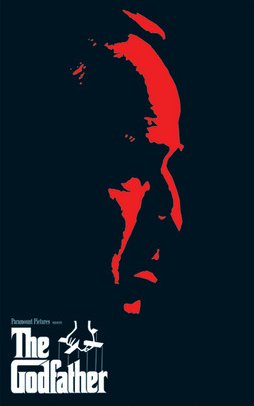 "So, why'd I get an 'incomplete?'"
I was standing in the office of Richard T. Jameson. I had taken a film class from him, and written what I thought was a pretty good final paper on "The Godfather." But in looking at the posted grades on the bulletin board I saw that I had been given an "incomplete."
"So, why'd I get an 'incomplete?'"
Jameson surmised me cooly. "I think you know why..."
I gave him a look. "Uh...no-o, I don't."
He looked at me. "You bought that paper, didn't you?"
"What?!!"
"C'mon! You bought it from a mill. This thing reads like Pauline Kael!"
(It should be noted that Jameson didn't like Pauline Kael)
"Honestly, I wrote it myself!"
"Well, how'd you get the quotes right?"
"I taped it off NBC!"
"Okay. How'd you get the camera angles?"
"When I hear the audio track, I can remember what the visuals are..." "Oh....okay. Sorry. Given that, maybe you did write it, after all."
Here's what I wrote, warts and all, painful though that proved to be to recreate. Richard Jameson's comments are in RED.
"The Godfather" begins with a black screen, behind which a single horn wails out a series of rising and falling notes, evoking a feeling of desperate sadness, as if some tragedy were taking place. The music would be appropriate for a funeral. And with that in mind, the first sentance is spoken in the film: "I believe in America." the man who says this, Bonasera, an Italian immigrant, has a daughter who has been ravaged and beaten by a pair of American toughs. He does not go to Don Vito Corleone, the Godfather, who gives assistance when it is asked, because, as the Don, himself, says, "You found paradise in America, you had a good trade, made a good living, the police protected you and there were courts of law. You didn't need a friend like me." But the police and courts have failed Bonasera and sent the thugs free. For him, Justice and America have not worked. "She was a beatiful girl," says Bonasera of his beaten daughter. "Now she will never be beautiful again." Socan be said of his view of America. The Don, himself, says, later in the film, "I refused to be a fool dancing on a string held by those big-shots. I don't apologize, that's my life." So it is with so many of the characters in "The Godfather." If something does not go to their liking, they cross the criminal line and go to the darker side of America, represented by director Francis Ford Coppola, in the first few minutes of the film, by the blackness of the Don's office.
Good. However, the blackness is also associated, it seems, with an Old World sense of honor, of self sustained by the family and The Family. Of course this does not contradict what you have said--merely enlarges on it. (Darkness in the cinema is worthy of a whole book in which to discuss it.)
Coppola begins the movie proper focused on a single person, the bitter Bonasera. Then, as he goes along, he expands the viewers' view of the world he has set up, of the people, and the world of crime they inhabit. Coppola's camera pulls back (expanding our view even then)from Bonasera until the Godfather is seen, brings an unseen eavesdropper into this personal conversation when an arm enters the frame offering a comforting glass of wine. Then Coppola shows us more--the entire room, and in it, the Don's sons. After the Bonasera incident, he cuts to a wedding party outside in the sun, contrasting nicely with the office darkness. After the wedding sequence, Coppola moves from New York to Los Angeles to show how the Corleone business strategy works, and then, later shows the others of the five Mafia "families" and how they operate. Hetakes us through slowly, and expands the film throughout, until, towards the end, the strategies involved in the story take on the complexities of a World War II battle plan.
"The Godfather," which Coppola, and maybe a quarter of the people who say did (?), adapted from Mario Puzo's trashy novel, runs in a circular pattern: a master circle in which smaller circles of lives and deaths, favors and rewards, and war tactics intersect. Favors are given out and paid back (Bonasera is revenged, then repays by trying to make Sonny's bullet-ridden body less hideous; the Don helps Enzo, the baker's assistant, stay in America, then, by chance, Enzo helps Michael pull off his hospital ruse to protect the Don from "hit" men; Johnny Fontaine gets his motion picture part, then helps attract other stars for the Corleone's Las Vegas business), traitors conspire and are paid back (Tessio arranges to kill Michael and is, himself, killed; Paulie Gatto, the Don's chauffeur, is "sick" when the Don is gunned down, and Sonny has has him killed in a field of reeds, overlooked by the Statue of Liberty; Carlo sets up Sonny's murder, and Michael has him killed, as well as Moe Green, Barzini and the other "Family" heads). The film is separated into three main sections: the wedding, Tom Hagen's bsusiness with Jack Woltz, and, finally, the war between the "Families." Throughout these stands the main story of "The Godfather:" the metamorphosis of Michael Corleone from a young man who rejects his family't way of life to becoming, himself, Don of the Corleone Family. His reign as Godfather and his father's reign before him are two circles that overlap, so that the film begins with Vito Corleone running the show, moves into a point where the father and son rule together, the father teaching the son, and ends with Michael's first "roar," as it were, as he systematically kills his business rivals, while he overlooks his nephew's baptism, becoming a Godfather, both literally and in Mafia tradition. He has replaced his father. The circle is complete.* And yet, it continues. During Vito Corleone's death scene, Michael's oldest boy, Anthony, who is just a toddler, childishly picks up a water can and with a machine-gun-like "AH-ah-ah-ah" sprays his stricken grandfather with it. As the original Godfather dies, another, still a child, is being "born," who will replace Michael. It's a chilling moment in the film, one that seems to confirm the suspicion that these people are locked into their fates, soon after they are born.
What with so many Paramount fingers in the pie, "The Godfather" cannot really be called an auteur film. Puzo contributed to the screenplay, as did Robert Towne, supposedly, and there are a few auditory touches that belong unmistakably to the film's "Post Production Consultant," Walter Murch. But still, there are so many consistencies in style throughout the film that one can tell that it is mostly Coppola's work. For example, Coppola, when shifting scenes, will set up a single placement shot of, say, Jack Wolz's(sic) mansion or some obscure office building in New York and then cut to what is going on inside. The movie takes place in the late 40's and early 50's and Coppola has strewn old posters on walls (defaced posters of presidential candidate, Tom Dewey, an avid mob fighter, can be seen as he beats up his brother-in-law, Carlo) and vintage automobiles on the streets to provide some period recognition, but also, to evoke the time, he has used 1940's-style movie techniques and set-ups, so that there are no zoom shots, high-on-the-roof-top-vantage-point-shots, split-screens, or slow motion violence, things that have popped up during the last eighteen years.And he uses fades! (Remember them?) More important, he uses them effectively as in the Woltz section, after Woltz has been rudely awakened by a severed horse head bleeding on him, Coppola shows a placement shot of Woltz's mansion, where it has taken place and then fades to the Godfather's face which is tilted in such a manner that he is looking up a Woltz's bedroom. That fade is like a signature for the deed. Another example of this is when the Godfather lies recupearting at home, and Coppola fades to Michael, hiding out in Sicily. You know what the ailing Don is thinking about: his son.** In another instance, when Tom Hagen is walking through Woltz's studio, another director might have shot from a studio roof as he amkes his way along the alleys and studios. But Coppola shoots at street level for these shots, one from the side, and one from the back. Then, when Hagen enters a studio, the camera is elevated up in the studio rafters, just the sort of fancy shot you'd expect in such a studio.
This seems a bit far-fetched as rationale for the shot. ***
* It should be pointed out this was written in 1974, three years before another "circle is now complete" movie-"Star Wars" and just before the premiere of "The Godfather, Part II"
** Murch provides an auditory compliment to those fades. Woltz's screams echo over the dissolve onto the Don's face, disappearing only at the next cut. On the shot of the Don in his hospital bed, before the shot fades, Murch inserts a distant church bell--a church bell that is actually tolling in that scene in Sicily. Echoes and the thoughts that follow them...
*** And it is. You'll find that Jameson's comments are cogent, thoughtful and helpful beyond just the obvious re-direction that he could have written. If you've never read any of his film-criticism, you're missing a body of scholarship that goes far beyond the simple snarky reportage you'd find in your local newspaper. Jameson capital "L" Loves movies, and he especially loves movies that reflect life in an artful way, and shines a light into the corners of life that don't see the light of day. On every film-lovers book-shelf there should be a library of his writing on Ford, Hawks and Welles. At the very least, there should be a published book of his (and Kathleen Murphy's) "Moments Out of Time" series that points out moments of brilliance no matter where in that year's films.
Tomorrow: More of Coppola's shooting set-ups...and set-ups of shootings.