Showing posts with label Richard Donner. Show all posts

Wednesday, June 4, 2008

Superman II: The Richard Donner Cut

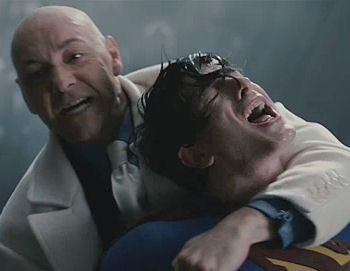
"Superman II: The Richard Donner Cut" (Richard Donner, Richard Lester, Michael Thau, 2006) Call it "The Richard Donner Cut" in name only. Donner had nothing to do with it, except give it his tacit approval--and express amazement that anyone cared so much to find the lost footage that he had shot (simultaneously directing "Superman: the Movie" and "Superman II") and assemble it to make some semblance of the film that Donner and final script-writer Tom Mankiewicz had in mind from the beginning.

But a lot of fan-boys did, noting a slight change of tone in the three years between I and II. A lot had happened: the firing of Richard Donner over "creative differences"(those being he spent too much money, he cared too much about the movie to worry about the budget, and he wasn't a toadie to the producers), and the replacement with Richard Lester, no slouch as a director, but who didn't give a rat's ass about superhero movies. Web-sites had for years been acrueing sightings of bits and pieces of "Donner" grail from International versions and "Expanded" television showings, and Michael Thau who assembled this thing, created new effects (a bit crude), re-edited John Williams' original score and Ken Thorne's work on "II,", and grabbed whatever footage he could (including for one crucial scene only available from Margot Kidder's and Christopher Reeve's auditions) to create this dog's breakfast of a "movie."* It is incomplete with big holes in the narrative, and with only crucial Lester-directed scenes grudgingly included--Donner and Mankiewicz grouse and complain about the changes made to "their" movie in the commentary but do give Lester (never named) and the re-writers some credit once. It makes a one-on-one comparison dodgy and a bit unfair, in both movies' favors.

The first thing one misses (after goggling over alternate takes and a wealth of new Marlon Brando and Gene Hackman footage--all shot by Donner, he only had them for a limited amount of time) is the cracker-jack/spin-on-a-dime editing of Stuart Baird, who cut the first Chris Reeve "Superman" film. The relative pace of this film, by comparison, is slack, alarmingly so. Donner and Baird in the first were far more brutal in their cutting and it made for a dynamic experience.
But I have to give the nod to the Donner cut, first, because they remained faithful to the source, and, second, because they made a far-more interesting two-movie arc than combining the first with
Lester's Version. Let me explain.


Whatever money the Salkinds made, they blew it artistically, because "Superman"/"Superman II" as Donner/Mankiewicz intended, was one of those rare things--a "religious film without Jesus." Yes, there are those direct parallels that Bryan Singer picked up on (and made too much out of in his "Superman Returns") of the Father who bequeaths his Only Son for Mankind. But it goes further. It also makes a direct, dramatic use of that ambiguous phrase Jor-El line "The Son becomes the Father, and The Father, the Son." It brings closure to Superman's ties to his home-planet and abandons him completely to Earth. It also shows why Kal-el deserves the name of "Superman." And it showed a much better performance by Christopher Reeve, than was ever displayed again in the series. The actor in Reeve played Part One, so he could sink his acting chops into Part Two. Not using the Donner segments robbed people of seeing a pretty incredible Reeve performance.

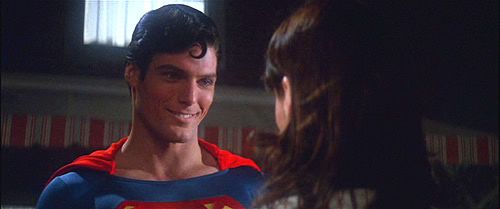
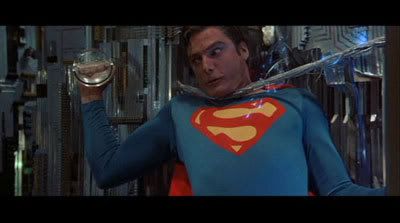
Jor-El, Superman's father--played by Marlon Brando, plays a critical role in Part II. When Lois Lane's movie-length attempt to unmask Clark Kent as Superman comes to fruition, they whisk away to his Fortess of Solitude for some alone-time, and Dad does not approve, chastising Kal-el for hubris and selfishness, telling him his reward is the happiness his good works provides. But Kal wants Lois ("this human," Jor-El dismisses her), and to do that, he must live as one of them, and have his powers removed permanently by a "red-sun generator,"** which will make him an ordinary man. Kal-El steps into the chamber and as the process strips him of his powers, Jor-El casts a disapproving look at Lois Lane.

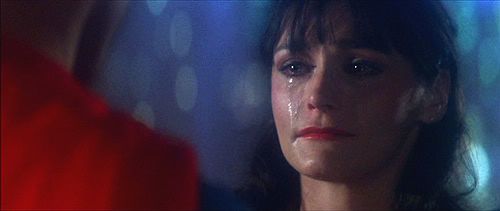
The human couple, Clark and Lois, leave the Fortress, the diner scene happens where Clark gets beat up, and learns about the Kryptonian villains taking over the U.S. government. Realizing what he's done, and there's no one but him who could stop them. he treks back to the empty Fortress, the crystal controls he used to communicate with Jor-El obliterated. Kal-El breaks down, acknowledges his weakness and mistake and hears nothing in reply. Finally, he cries out "Father!"

Donner (and Thau) cuts to a far-shot as the cry echoes in the crossed beams of the Fortress. And one recalls the words of Christ on the Cross: "My God, My God, why have you abandoned me?"

But there is a shred of hope. Or a shard. Amidst the rubble, the original green, glowing crystal that Kal found in his Exodus-ship is still glowing, and with it, he is able to contact Jor-El one last time.

Jor-El admonishes Kal for his transgression, and tells him that there is only one way to get his powers back, and that is to transfer the final energies that allows them contact; for Superman to regain his powers will destroy the last vestiges of energy that is the Jor-El "program." Kal-El is reluctant, but Jor-El begins the process, appearing to him corporeally to touch as they say goodbye and to transfer his power to his son, destroying himself: The Son becomes the Father, and the Father becomes the Son.

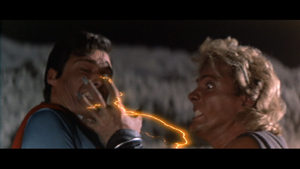
Kal is knocked unconscious, the other crystal conduits are destroyed. There's the battle with the Kryptonian villains (but without the expanding sticky "S"-shields and simulacrum tricks, per Newman and Lester--what? Superman's powers aren't enough?), Luthor is carted away, and then the coda: Superman flies Lois out of the Fortress, turns, gives it one last look, opens his eyes...wide, and destroys the Empty Fortress with his heat-vision. Here are frames from that sequence, without any further explanation--but one more Bible quote:

"When I was a child, I spoke as a child, I felt as a child, I thought as a child. Now that I have become a man, I have put away childish things."
1 Corinthians 13:11


Yeah, I wouldn't call it "The Richard Donner Cut." I'd call it "The Last Temptation of Superman."

For all its patchwork quality, for its holes and inconsistent effects, I'd still have to say I prefer "The Donner Cut," as it maintains the consistent vision of the first movie and brings the story proper to a conclusion. The Lester Version let go of the internal logic for thirty pieces of silver, and undermined the biblical implications to replace it with slapstick and inconsistencies from out of left-field. One is left unsatisfied with both, and pining for the greatest super-hero film ever made.
------------------------------------------------------------------------------------------------
*Okay, some history: Between the first and second films, Donner was let go and Lester was hired. For financial reasons (the producers didn't want to pay him his full salary), all of Marlon Brando's scenes for the second film were scrapped and Susannah York brought in to play Lara, Kal-el's mother (who never appeared post-Krypton explosion in the first film) from beyond the grave. Gene Hackman's footage was used, but cut way down. Why? In order for Lester to recieve the director credit, he must have directed at least 50% of the movie, and so a lot of Donner footage was edited out to bring about that mathematical percentage, thus, Hackman's role of Lex Luthor was greatly reduced. A pity as Hackman is terrific in the movie.

** See, Krypton, Superman's home planet, had a red sun, so bathing him in "red solar energy" takes away all the powers that Earth's "yellow sun" gives him, and at this point everything breaks down because once Kal-el goes outside, he should get his powers back, but let's just go with it, because by the movie's internal logic, he should still have a "dense molecular structure" that makes him invulnerable, and he could still put up a fight with that. But why bring all this up, really? It's all dogma, which, I guess, is appropriate. Comic books, like a religion, require the faith of a child, willing to believe.


Friday, March 28, 2008

16 Blocks

"16 Blocks" (Richard Donner, 2006) An odd, efficient little thriller about a broken down cop who gets the bad assignment of driving a police whistle-blower sixteen blocks to the courthouse to testify before the Grand Jury about police corruption. But first he has to run a gauntlet of New York's less-than-finest who all could be sent to the pokey if the kid talks. And after hearing Mos Def's high-pitched, cleft-pallet-patter-way of talking, you start feeling some sympathy for their thinking, too. Cop and whistle-blower have two things in their favor: a populace more suspicious of the police than those running from them, and director Richard Donner, who, though he may have problems with pacing, seems completely incapable of placing his camera in any place but the best position to convey action and meaning, no matter how claustrophobic the surroundings. Bruce Willis is the reliably unreliable cop drinking to retirement, who finds one last thing to fight for, although his persona tends to shift a bit from barely functioning to resembling an older John McClane without a sign of shakes as he draws down on a colleague. Willis is fine, though, as is David Morse as the crooked cop with the most to lose. Of the two endings shot, the one attached to the film is the most "blue sky," and it's not really satisfying. The better down-beat ending, unfortunately, depends on a character turning when he's shown no previous sign of doing so. Neither one works completely, but at least the "Happy" ending strains credulity a bit less. Over all, not bad, really.

Friday, February 29, 2008

Now I've Seen Everything Department: Superman

February 29th is leap-day, and with such a designation it's the perfect birthday for the most celebrated leaper (of tall buildings in a single bound).

Happy Birthday to Kal El. last son of the doomed planet Krypton, otherwise known as "Superman," The Man of Tomorrow.


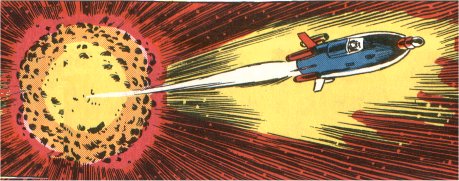
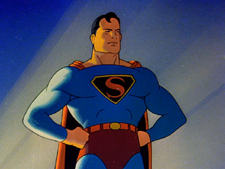
Nietzsche's concepts about the transcendent "Übermensch" simultaneously inspired the Nazi's to work towards their concept of an Aryan "Master Race," while also inspiring two weisenheimer Jewish kids from Cleveland to create their own "Super-man," set adrift like Moses among the stars to settle on a planet, which enabled him to "possess powers and abilities far beyond those of mortal men." The silver screen has chronicled his "never-ending battle for Truth, Justice and the American Way," starting in the 1940's with feature cartoons, moving into serials, and then landing on the silver screen in legitimate films. Here's a look at them.


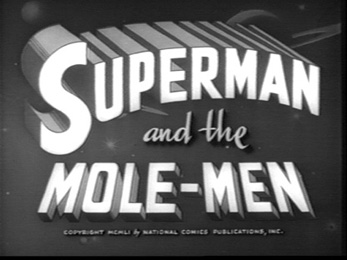
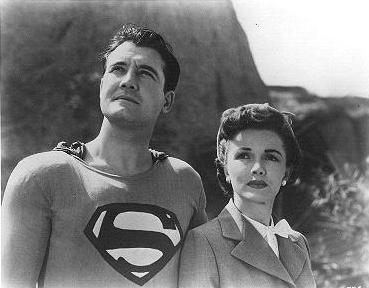
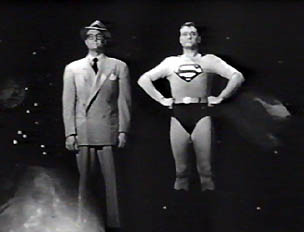
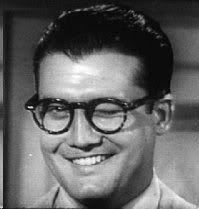
"Superman and the Mole-Men" (Lee Sholem, 1951) A black-and-white short film (running just under an hour), "Superman and the Mole Men" was a trial-run (a pilot, if you will) for the subsequent "Superman" television series starring George Reeves as the Man of Steel. Daily Planet reporters Clark Kent (Reeves) and Lois Lane (Phyllis Coates) are assigned to cover the world's deepest oil-well, and find that something or some "things" have come up through the well to see what's on the surface. It being the 50's (of course, we were so backward then!) the town's populace fears the Invaders, and set up a vigilante mob to deal with them. But Superman (being an unpapered alien, himself) pleads the case for tolerance--by turning the mob's guns into pretzels. Shot on a shoe-string budget (a ray-weapon carried by the Mole men was made from an Electrolux vacuum cleaner!), "Superman and the Mole Men" is long on exposition, but short on costly super-heroics. Still, given the material, the actors give it their all. Coates was always my favorite Lois Lane, tough as nails, and more prone to kicking an assailant in the shins than shrieking back in horror. And Reeves is all steel-jawed seriousness as Kent and Superman. There's none of the winking-at-the-audience that would come later in the series--Superman is all-business and Reeves plays the Man of Steel absolutely straight, like it's a mission. And because he believes in it, you have to take him at face value, even if the trappings that surround him aren't too convincing. Reeves would go on to play the Man of Steel until his death by gun-shot (ruled a suicide) in 1959.


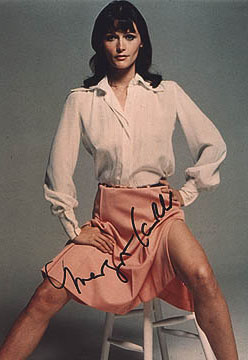
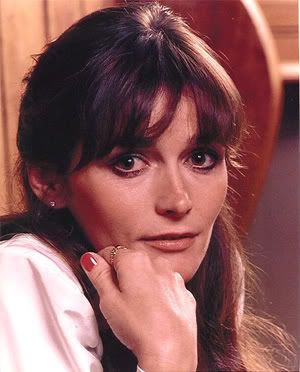
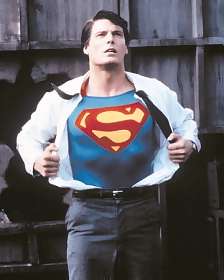
"Superman: The Movie" (Richard Donner, 1979) For a movie that promised "You'll believe a man can fly" it couldn't be more elephantine. The Salkind family of producers bought the movie rights to Superman, and in an orgiastic frenzy to garner investors hired "Godfather" scribe Mario Puzo to write the script (sure seems like a natural!) and hired Marlon Brando and Gene Hackman to star. They had a movie! Well, sort of....Puzo turned in a massive script, Brando had his usually odd ideas to avoid work, Hackman was getting a little nervous. Things started to gel when Richard Donner was hired to direct. First, he settled things down. The script, which had been worked on by the "Bonnie and Clyde" team of Benton and Newman, was hammered into shape by Tom Mankiewicz. Then they hired the big guns, Lois Lane and Superman. For Lois, they picked Margot Kidder--not a glamour-puss, but a dame, who could convincingly play the "goes-all-gooey" side of the Daily Planet reporter. And for Superman/Clark Kent, they picked a skinny up-and-comer named Christopher Reeve, who wasn't all that sure he wanted the job. But Christopher Reeve made a fine, slightly self-deprecating Superman, and Superman made him a star.

The movie's all over the map, but moves at such a clip, you're not allowed time to notice. There's the austere Krypton section that ladels on the tragedy with Marlon Brando playing it absolutely straight. There's the Smallville segment with Glenn Ford, and an America so archetypal that they had to film it in Canada. And then there's the loopy Metropolis section, as Superman (who seems to enjoy the effect he has on ordinary mortals) must battle the nefarious Lex Luthor (Gene Hackman, clearly enjoying playing comedy) and his curiously buffoonish aides-de-camp (Valerie Perrine and Ned Beatty). The thing should fly apart at the seams, but Donner's rock-solid direction, Stuart Baird's don't-blink editing and John Williams' anthem-pumping score keeps the momentum going so the thing never touches the ground. It's a little bit of a miracle.


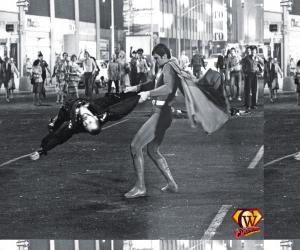
"Superman II" (Richard Lester & Richard Donner, 1980) "Superman: The Movie" was a miracle--a costly one. Financed to be two movies, Donner was forced to concentrate finishing the one at the sacrifice of the second--sequences were re-shuffled* to meet the Christmas release date. The movie was a flying success, and Donner was rewarded...by being fired. "Production consultant" Richard Lester--who directed the Salkind's near-perfect "Musketeers" movies--was brought in to finish Part II...with some provisos--to be considered the director of note, he had to have directed at least 50% of the picture. That meant scrapping some of the Donner footage. Hackman wasn't coming back, and Brando's already-shot footage was shelved, to relieve the producers of any financial burden. A lot of fans prefer II to the first one. But... they're crazy. Lester's touch is far more goofy and slap-stick than Donner's, to the point of silliness. Plus, Superman is given a whole roster of new powers to defeat the Kryptonian villains (and zap Lois into forgetting Clark is Superman). Some scenes like a super-brawl on Broadway are impressive, but others like the Krypton Trio in a poor-excuse-for-Mayberry not only don't play well but are insultingly juvenile. Plus, Superman sleeps with Lois. Hold that thought. You'll need it later.

After years of wondering what the Donner "Superman II" would have been like, the director was given unprecedented access to re-edit "Superman II" "his way," restoring long-abandoned scenes and even restoring Marlon Brando to the story! The result? Not very successful, but an interesting curiosity. The problems besetting "Superman II" were more than just digital editing could solve. It is neither a vindication for Donner, nor a smack-down of Lester. That would come later.


"Superman III" (Richard Lester, 1983) Like giving Superman extra powers he had never previously displayed or needed, at some point it was decided that Superman alone wouldn't draw crowds. The solution? Bring in another box-office star, and one of the most beloved at the time was Richard Pryor, who had a knack for bringing in audiences. His improvisational brilliance had rescued poor material in the past, but even Pryor had little to work with here. He plays a computer savant who is coerced by evil magnate Robert Vaughn (who doesn't have quite the comedic chops of Gene Hackman) to build an evil empire run by a super-computer that could even kill Superman. That's one part of the movie. Clark goes back to Smallville to attend a high school reunion and re-links with sweetheart Lana Lang (Annette O' Toole, trying vainly--she now plays Martha Kent on "Smallville"). Lois makes the briefest of appearances, either because her story had run its course--or Margot Kidder was in salary disputes with the producers, depending who you talk to. At one point, Pryor's Gus Gorman creates some half-baked synthetic kryptonite that turns Superman into a super-creep. As much as Reeve might have found it dramatically freeing to play Bad-assuperman, it's disheartening. The whole movie is.


"Superman IV: The Quest For Peace" (Sidney J. Furie, 1987 ) But it's better than this one. Produced by fire-sale film company The Cannon Group, the franchise was taken out of moth-balls with a story idea by Reeve where Superman becomes a one-man disarmament program, taking all of Earth's nuclear weapons and throwing them in the Sun. One problem: Gene Hackman is back as Lex Luthor, and he's got a plot to become the greatest arms manufacturer the world has ever seen. But first, he has to kill the Man of Steel, so he creates a Frankenstein's monster of a sun-powered strongman. Things get a bit hazy at this point, because prior to release, the film was edited by some 45 minutes making it unintelligible. Oh, well. Lois Lane appeared. Mariel Hemingway is there as a romantic rival for Clark for some reason...and Superman gets some even new powers--this time, Great-Wall-of-China-rebuilding-vision. Flying and squeezing diamonds from coal doesn't have the same thrill it once had, especially when the effects are as flat and badly thought out as they are here. "Superman IV: The Quest for Peace" pretty much killed off the series for close to twenty years.


"Superman Returns" (Bryan Singer, 2006) Years in development that saw rumors of a Tim Burton version starring Nicolas Cage, a Kevin Smith script, and other wild schemes were finally brought to a screeching halt when Bryan Singer jumped the "X-men" franchise to tackle his dream project--bringing back Superman. His Superman. The Superman from the earliest films. So "Superman Returns" has an oddly nostalgic feel to it--almost morosely nostalgic. By this time Brando was dead, and Christopher Reeve had finally succumbed to complications from his spinal injury. At times, "Superman Returns" feels like a wake. It doesn't help that Singer has so much love for the first two films that he can't treat it with anything less than an almost religious devotion. This Superman is treated like a tragic, lonely god, but it's tough to feel sorry for him when he's the most powerful guy on the planet. If Superman can get the Kryptonite blues, what hope do the rest of us have? Vintage Brando footage is restored for Kal-el's father. Kevin Spacey fills in Gene Hackman's shoes (inadequately) as Lex Luthor. And Kate Bosworth is a more mature, less fun Lois Lane (she lacks Kidder's almost-macho fire). The film only has a proper feel when Supes is doing some incredible stunt. Also SR takes up a few years after the timeline of "Superman II," so...that little Supes-Lois tryst. There's a little issue that goes with it. Brandon Routh looks and talks so much like Chris Reeve it's down-right haunting. Maybe the next one, Singer will let him have a little bit more fun...like the first movies were.


Bonus:

"Supergirl" (Jeannot Szwarc, 1984) Back in the days after III, but before IV, when it was kind of tough to pin Christopher Reeve to coming back to play Superman, the Salkinds had it in mind to expand the franchise by creating an off-shoot, featuring Kal-el's cousin Lara, whose family survived the distruction of Krypton in a protectively-domed city. She came to Earth as Linda Lee, but followed in her cousin's flight-path as Supergirl. They tried to make it work. Helen Slater is a real charmer as The Maid of Might, and the cast is surrealistically amazing: Peter O'Toole, Faye Dunaway, Mia Farrow, Peter Cook, Brenda Vaccaro, but David Odell's script is a mess. The vet's try their best to make it work with Dunaway's work feeling like an audition to play Cruella Deville...or Joan Crawford. Jerry Goldsmith gives a taste of what his "Superman" score would have been like--he and John Williams were trading off being assigned to it. "Supergirl" is a bit better than Superman III and IV, but that's not saying an awful lot.


Whither Superman? "Superman Returns" cost a lot of money, but wasn't the super-hit Warner Brothers was expecting. There's talk of another, but right now it's just talk. But if Singer's in charge, he'd better study that first "Superman" movie again, and lighten it up, or it'll never get off the ground.


* (Spoiler alert) The solves-all-problems time-reversal ending of II was thrown onto I, and the cliff-hanger ending of I (the space-bound nuke hijacked by Lex Luthor unwittingly frees three Kryptonian villains from "The Phantom Zone") was jettisoned--no one knew for sure there would be a "Superman II" though it was promised at the end of the 10minute + End Credits.