Showing posts with label David Morse. Show all posts

Saturday, July 16, 2011

Down in the Valley


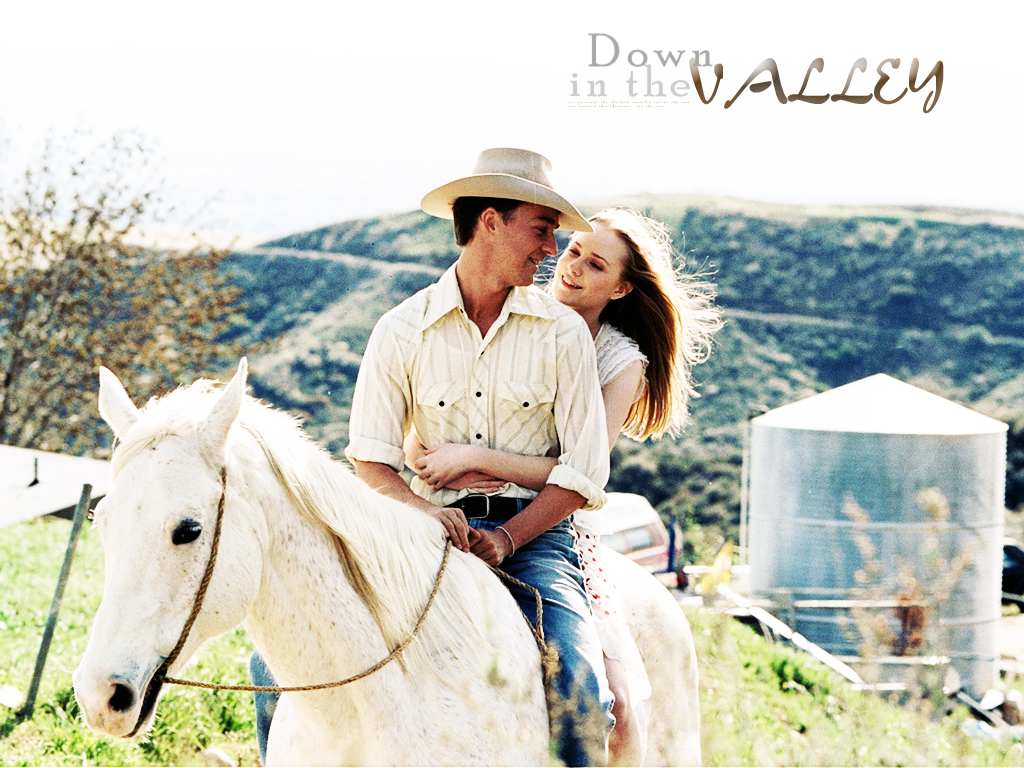
Down in the Valley (David Jacobson, 2005)  A stranger moseys into town and things get all disrupted.  It's the clap-board foundation for lots of westerns, and Jacobson's character study bears a resemblance to the genre, complete with gun-play, white hat/white horse, a girl and a hero-worshipping kid.

Except that it is set in the hard-as-concrete reality of the modern day San Fernando Valley and instead of open plains and buffalo, it's highways and SUV's guzzling from strip-mall to strip-mall.  And The Big Sky is full of jets on final approach to Hope Airport.

Tobe' (short for "October," so you already know her family is dysfunctional), played by Evan Rachel Wood is a bored teenager feeling trapped by her family, her baby-sitting schedule watching her brother (Rory Culkin)—we don't know where Mom is, but Dad is a security guard played by David Morse—and those damn mountains on all sides.  On an outing to the beach where she's a fifth wheel, Tobe' and her friends encounter the older Harlan Fairfax Curruthers (Edward Norton), who sticks out...well, like a cowboy in the San Fernando Valley.  Laconic, unassuming and gentlemanly, Harlan decides to leave his gas-station attendant job and go with the five on their outing, where Harlan and Tobe become fixated on each other and start a torrid affair, unbeknownst to Dad.

That's not good enough for Harlan.  Determined to do right by the lady, he visits her house to take her on a proper date and meet "the old man," who is immediately suspicious of the guy and his folksy ways.  Completely under Harlan's spell, Tobe openly defies her father, and pretty soon he forbids her from ever seeing him again.

Like that's gonna happen, Dad.

Down in the Valley slots right into Western territory (Harlan's the "outlaw" and Dad's the Sheriff) with a stetson tip to the teen romance genre, circa 1950's, as, in some segments Norton seems to be channelling James Dean.  It's another technically proficient, mercurial performance out of Norton who, despite being one of our better actors, never manages to jump into the mainstream or awards competition lists.  This might be due to his choice of projects, but it always seems that he is one likable character away from achieving the audience affection that, say, Robert Downey Jr, has achieved recently.

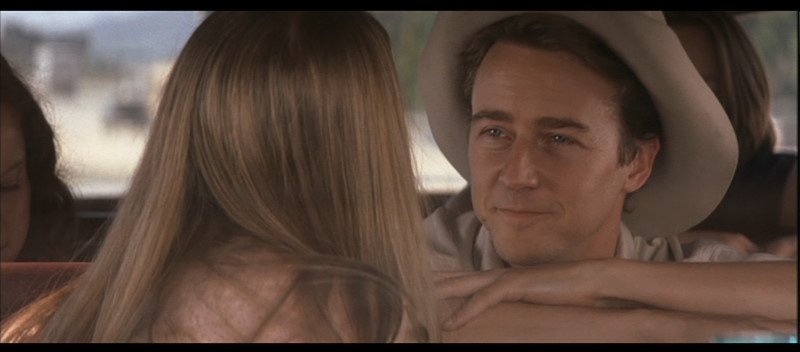
Whatever the reason, Norton's Harlan is the linchpin of this movie, an enigmatic figure around which everything revolves.  Once he enters an occupied frame (or a family situation that has an empty space in it), everything changes and not always for the better, and that begins with the first time Tobe and Harlan share the same frame, separated by car-window glass, suddenly noticing, pulling each other out of each other's minds and into each other's lives.

But, there are wide open spaces and "wide open spaces." For Harlan, his crowded mind has not much to do with reality, so much as fantasy, and the real reality is there is not much difference between the exterior-only movie-sets and and the housing developments under construction that he comes to occupy towards the end of the film.  When reality and fantasy clash, the result can be just the frame of a construction—looks good, but it can't hold up for very long. 

As pretentious and fantasy-driven as some of the mind-sets of his characters are, Jacobson's direction isn't—things happen in a flash and some of the confrontations are staged and executed in as unshowy and pragmatic a way as possible.  A life-long fan of The Movies, Jacobson does a lot of cribbing, from Westerns and Butch Cassidy, specifically, but also from Taxi Driver, which gives the film a dark tone, no matter how scouring the sunlight of Southern California can be.

Interesting film, one that stays with you for awhile before moseying on.


Boom.  Fantasy and reality clash


Friday, July 4, 2008

John Adams

"John Adams" (Tom Hooper, 2008) Tom Hanks' Play-Tone Productions' latest mini-series (after "From the Earth to the Moon" and "Band of Brothers"--both highly recommended) continues with another dissection of an epic topic based on a fine book, this time David McCullough's best-selling biography on John Adams. Adams' life is so full of incident and character that even if he weren't a pedantic, obnoxious little prat, it'd be worth watching. But that Adams is brilliant and his own worst enemy makes for an intriguing series of episodes, as Adams work in Revolutionary America, his stint as an ambassador to France, rubbing Ben Franklin (Tom Wikinson, perpetually peering) the wrong way, and his ambitions towards the Presidency, and then, his post-Presidential trials all make for fine drama (they certainly did back in the day of "The Adams Chronicles"). That John and Abigail are played by Paul Giamatti and Laura Linney, both with an eye towards flintiness only raises the bar of expectation, and their performances are fun to watch. It's history written down-to-earth, so you get to see "The Shot Heard 'Round the World" (it's aftermath, anyway). You get to watch Franklin and Adams editing a somewhat diffident Thomas Jefferson (Stephen Dillane) over The Declaration of Independence (Franklin changes the "We hold these truths to be" from "sacred and undeniable" for "self-evident" as the former "smacks of the pulpit."). We see Franklin as the toast of Paree, George Washington's inaugural (David Morse plays Washington as a quiet, resolute stiff who is only seen angry once, chewing out Alexander Hamilton and Jefferson for their constant bickering).

We also get a hint of life in those times: the sense of how long it took to get anywhere, we see a rather disgusting treatment for pox, and a horrific one for breast-cancer, and how, even in those days of the Nation in its infancy, it was still tough to get things done.

But, there are annoyances. Do we need to see John and Abigail snogging? If you think seeing your parents have sex creeps you out, John Adams humping (geez, even just Giamatti humping) really does.

Then, there's the direction. Tom Hooper's way of shooting at odd angles sometimes can be explained away by architecture, for instance, this shot (used a few times) of a Philadelphia street lets us see the top of the building at upper right:
But, that doesn't explain the "dutch angle" used for this shot of a theater.


You could say that this angle of Adams as Vice-President sitting before Congress, shows him as forceful, or as a man alone and resolute (or, that just in front of him is an anachronistic bit of room-design), but it's a bit clunky and makes you want to look to the right of the television, rather than the figure of Adams, himself...

...but what of this awkward angle for a discussion between Abigail and John that is a bit heated, but, really, is so distracting that you lose the train of what they're discussing.
Glad they filmed this "letter-boxed." I'd have hated to miss any of the blank wall on the sides of that shot. Then there's this angle on Thomas Jefferson sitting in a public house, photographed--for no good reason--through the slats in the backs of the chairs.
The direction is too fusty, too "do-something-different" for its own good, as in the staging of a dinner party held in a tent. How does Hooper approach the scene? How do we enter it? Through the hole in the top of the tent. It's maddeningly confusing, and serves no purpose other than to prove that they had a crane that day to do it. That's swell, but when the result of the shot is disorientation, rather than communication (when disorientation isn't the point of the scene), what's the bloody point? It's needlessly arty. It's nice for a director to showcase his work, but one should tell the story first, rather than pad his "reel" for the next job.

In the meantime, History is passing us by.

The last hour is harrowing, with his days as President behind him, with the Jefferson administration a burr in his side (as Jefferson and he have become feuding politicians), and the vagaries of age and dissipation affecting his entire family, but there is the wonderful compensation of the dramatised segment of Adams and Jefferson, aged men, mending fences in a series of letters that are some of the most celebrated in literature, politics and civics.

And it ends, as it should, with the little bit of a miracle that put a touching finale to their life-work, the type of thing that if it were written as fiction, no one would believe it: the cosmic appropriateness of both men, friends and rivals, then, again, friends, dying on the very same day--July 4th, fifty years after the Declaration of Independence, and 182 years ago, today.

Friday, April 4, 2008

Disturbia

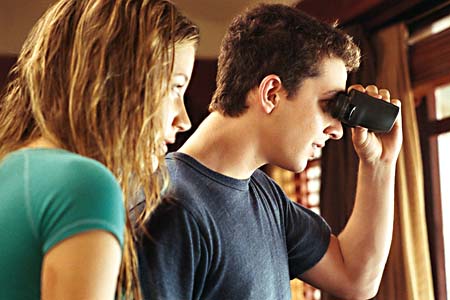
"Disturbia" (DJ Caruso, 2007) Take "Rear Window" and remove any veneer of civility to it and you have "Disturbia." The voyeur this time around is a kid with an ankle bracelet and a three-month house probation. After exploring his boundaries and testing his limits, he grows tired of electronics and junk-food, and begins to spy on his neighbors for thrills. Fortunately there're the new neighbors next door with the comely daughter, and unfortunately, there's the creepy older guy (David Morse, who can play good or bad angels interchangeably) who clubs and routinely brings home one-night-stands with one-too-many.

Did I mention that a lot of young women are routinely disappearing?

Did I mention that said grounded voyeur's recently widowed mom might have "the hots" for this guy? And before you can say "I am thy father's spirit," the kid is thinking she's in danger.

What separates "Disturbia" from Hitchcock's older, wiser film and why Sir Alfred and John Michael Hayes are head and tails better that DJ Caruso and Chris Landon and Charles Ellsworth is that the situation was set up in a way that the windows that James Stewart's character peered into were like mini-movie theaters reflecting his own fears of settling down in a domestic situation (even if it is with Grace Kelly) His voyeur recognized himself in his various targets, but young Kale Brecht (Shia LaBoeuf) has no such depth. True, his vantage point is limited to three houses, but all of them are antagonists of a sort. He's dead set against two of them, and the girl he just WANTS to be against. And being as this is a movie aimed at teens, the resulting Guignol is Grand and then, not so, sort of like "The Silence of the Lambs" without a hint of maid service, designed to merely creep out and punch up the "ick" factor. And, of course, it has to be resolved with the kid taking direct, violent action because, hey, he's a teen-ager--he needs to consciously murder someone to fulfill himself. I advised K. against watching as it was nightmare material. I sent "Disturbia" on its merry little way to infect another household, not unlike the tape in "The Ring."

Friday, March 28, 2008

16 Blocks

"16 Blocks" (Richard Donner, 2006) An odd, efficient little thriller about a broken down cop who gets the bad assignment of driving a police whistle-blower sixteen blocks to the courthouse to testify before the Grand Jury about police corruption. But first he has to run a gauntlet of New York's less-than-finest who all could be sent to the pokey if the kid talks. And after hearing Mos Def's high-pitched, cleft-pallet-patter-way of talking, you start feeling some sympathy for their thinking, too. Cop and whistle-blower have two things in their favor: a populace more suspicious of the police than those running from them, and director Richard Donner, who, though he may have problems with pacing, seems completely incapable of placing his camera in any place but the best position to convey action and meaning, no matter how claustrophobic the surroundings. Bruce Willis is the reliably unreliable cop drinking to retirement, who finds one last thing to fight for, although his persona tends to shift a bit from barely functioning to resembling an older John McClane without a sign of shakes as he draws down on a colleague. Willis is fine, though, as is David Morse as the crooked cop with the most to lose. Of the two endings shot, the one attached to the film is the most "blue sky," and it's not really satisfying. The better down-beat ending, unfortunately, depends on a character turning when he's shown no previous sign of doing so. Neither one works completely, but at least the "Happy" ending strains credulity a bit less. Over all, not bad, really.