Showing posts with label Shia LaBoeuf. Show all posts

Tuesday, July 5, 2011

Cars 2/Transformers 3/Audiences 0

"The Summer of Our Discontent"
or
"Cash for Clunkers"

You almost don't want to go To the Movies this Summer.  Oh, we were warned; so many sequels and comic-book movies, the "experts" pouted and clucked.  But the law of averages were in the audience's favor; there had to be something good in "the numbers."*  But, this Summer has made me a little gun-shy and I hesitate from pulling the trigger on my credit card for a ticket.  Nothing's excited me so far (apart from The Tree of Life**) and it's July already.  Of the comics films, only X-Men: First Class had powers and abilities far beyond most super-hero movies—certainly over the previous "X-Men" entries.  The 3-D "phenomenon" has constricted budgets, pushed opening dates, and the only thing it seems to add is an extra dimension of "suck" to the productions in the end.

Two recent releases left me so completely unmoved—probably because they were manufactured machine-movies about manufactured machines manufacturing fights with each other—that I thought it best to combine them under one article...so I wouldn't have to spend too much time contemplating their existence, and simply move on. They also evoked the same thought of "What do I care what happens to machines? Machines can be re-built!" 

And movies series can be re-booted.  There are a couple I'd like to give the boot to right now.

Ultimately, both films are just long commercials for toys.  Better to buy the toys and make your own adventure than what's being served.


"Spare Parts"

I went into the original Cars with exceptionally low expectations, and found a surprisingly fun little film to appeal to the NASCAR crowd and anyone who had a love for the open road.  Automobile comedy would seem to be the lowest gear for laughs, but Pixar (and its guru/director John Lasseter, this time co-directing with Brad Lewis) managed a fine film that, if it fell short of the other Pixar products, at least managed to land on all four tires...and that's where the rubber meets the road.

But, what do you do for a victory lap?  Go around the field one more time? (Well...yeah).  With the novelty of a talking car universe safely a given, Cars 2 expands the concept, so that everything is talking, cars, boats, planes—although the oil-rigs featured are strangely mute.  It also goes global, with an environmental plot about an oil billionaire car (???) who decides to go "green" and develops a new fuel called "Allinol" (heh) and a promotional World Grand Prix to go with it.  This gives "Lightning" McQueen (voiced by Owen Wilson) to go head-gasket-to-head-gasket with his racing rival, Francesco Bernoulli (John Turturro, who is having fun) for a best two out of three. 

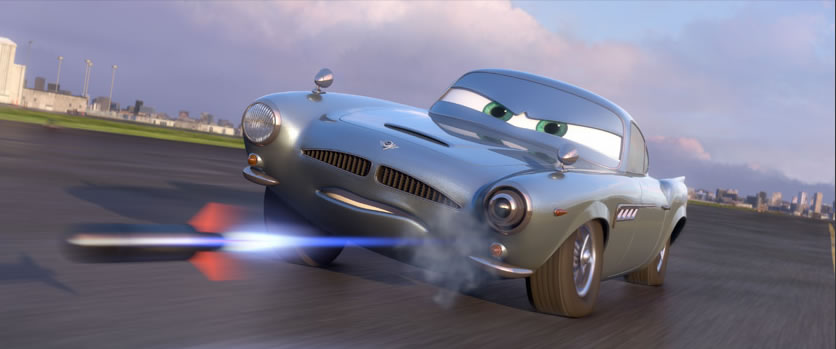
Ah, but there's sand in the gas-tank, when a car-tel of lemon-models (Pacers, Pintos, Gremlins, Ugos) led by an evil genius (my guess it was an Edsel, but I was wrong) wants to exploit a weakness in the gas to destroy the racers in the Grand Prix, and it's up to Special Agent Finn McMissile (voiced by Michael Caine, standing in for a friend, I think)—a gadget-laden Aston Martin/Miata hybrid—and his co-agent Holly Shiftwell (Emily Mortimer) to stop the plot and learn the secret identity of the evil genius behind it all.  In a case of mistaken vin numbers, these crack agents think that Mater, the tow-truck (Larry the Cable Guy) is their American contact with information to stop the  plot in its tire-tracks.  

Now...wait a minute.  I know it's a movie about talking cars (fergawdsake), but it takes a new meaning of the term British Intelligence to make that kind of mistake.  So, the movie shifts its emphasis from the McQueen caracter to Mater very quickly and the movie never really recovers...I mean, there's only so much Larry the Cable Guy a person can take.  The movie's tone has the feel of those '60's films where they used to shoe-horn Rowan and Martin or The Three Stooges into a spy plot because it was "a trend" and they couldn't come up with anything better...or appropriate. So, it's all a little "off," the timing chain a little twisted, not sparking on all cylinders.  It LOOKS good—the city-scapes haven't looked so lovely since Ratatouille (although everything looks a little miniaturized, like a play-set), and the movie has a fairly amusing sequence in Japan—but the film moves way too fast to appreciate all the chrome and options and it's too loud and obnoxious that the impulse is to roll the windows up and ignore it.  Despite a stellar cast (Vanessa Redgrave voices The Queen?  And did I hear Michael Gambon—uncredited—as the disguised voice of the villain?) and despite its emphasis on Mater, nothing matters—there's no conflict, there's no drama—just a hokey plot, some slip-shod comedy, and everything running on auto-pilot. 

As such, it would have been more appropriate to have Roger Moore as the voice of the spy-car.

Cars 2 may be buffed and shined, but its parts are used and worn, and rather than having that "new car" smell, it has a distinct lemon-scent.

Cars 2 is Cable-Watcher.
(Wilhelm Alert @ 01: 24)


"Rock-Em, Suck-in Robots"

You should have no expectations walking into any film, but you really need to lower your guard going into a Michael Bay construction. His early films are such an annihlation of style over substance—to the point where action sequences are a mashugenah mish-mash between what looks like slo-mo Americana commercials for insurance—that you wonder if the guy at that point had any sort of talent whatsoever (I mean, Tony Scott has the same commercial gloss to his films, but at least you can follow them).

Over time, though, Bay's act has gradually gotten better. The action sequences smoothed out without losing any of the kinetic energy the director was striving for. Maybe there was even a good idea or two among the shrapnel flying through the air. But, the emphasis was always, and will always be I suspect, about demolition derby film-making with the occasional "grace note" of grinning nihilism and exploitive misogyny. One suspects that Michael Bay may become a better film-maker, but he will never grow up.

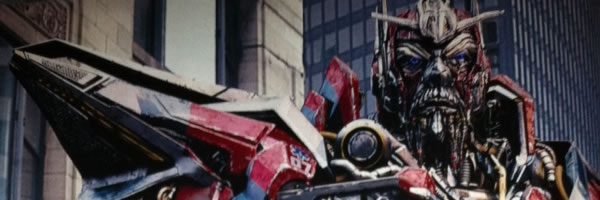
And he's still playing with toys. He directed all three "Transformer" movies, including the latest, Transformers: Dark of the Moon, and before getting into what's wrong with it, here's what's right: the action sequences, particularly a crazed, high-strung highway chase and a mechanical urban brawl fought on three fronts through the high-rises of Chicago*** are marvels of imagination and quite "followable"—in other words, Bay is starting to understand the logistics of a good action sequence involve perspective and relatable occurances—the swooping overhead shots let you see the relationships of what's happening, rather than just presenting a hodge-podge of in-your-face shots.  Yes, they go on too long—the evidence being the kids in the audience who couldn't sit in their seats long enough even when things started to go crash and boom—but at least things made sense, rather than merely noise and rubble.  Now, if he could just have things happen simultaneously—rather than have things stop on the other fronts while he concentrates on one sector—Bay might actually generate something his movies always lack: suspense.

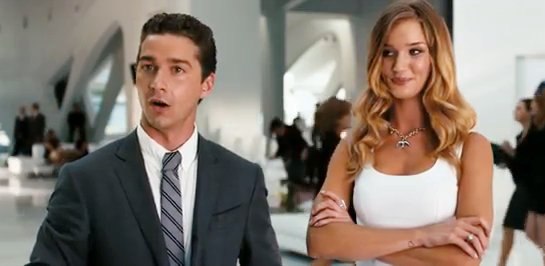
So, the technique is improving, but he's still a far distance from being a mature film-maker.  The few women cast in the film, save Frances McDormand who manages to retain some inventiveness and dignity in her role, are all dressed like hookers with Bay's camera leering over their curves,**** the dialogue attempts double entendre but never gets beyond the singular stage, and the annoying Beavis and Butt-head mini-robots from the last film are back and just as juvenile.  The whole movie has the same air of arrested development, although attempts are made to make it seem like it is happening in something more than a fantasy world where aliens disguise themselves as muscle-cars.  The plot revolves around a derelict Autobot being salvaged from the Moon—its detection being the genesis of Pres. Kennedy's push for a fast lunar landing (and a cameo by "Buzz" Aldrin attempts to lend credibility to the idea).*****  But, there are also "realish-world" cameos by Kennedy (eerily good effects work), Nixon and Robert McNamara (not so much), Walter Cronkite (TV archival footage) and Bill O'Reilly (which negates the credibility factor...a lot).  John Turturro returns, and John Malkovich has a small role as a gung-ho business exec.  Shia LaBeouf is on-hand (much more caffeinated than usual, probably to be better noticed and for good comic effect, as, Unicron knows, the robots are DEADLY serious), and there's just enough of his parents in this one to outwear their welcome, whereas they were one of the best things in the original.  Here, that role is provided by Alan Tudyk, who enlivens the first half of the film before he's made into a functionary.

But, human interaction other than urgently delivered exposition or awkward comedy is rare as human beings become mere flotsam (sometimes literally) in the crushing of gears against gears.  Since I've whined in the past that the "Transformers" movies have suffered from "Saved-by-a-White-Man" Syndrome (where a movie's ethnic entities' problems are solved by the usually-white star), this is actually rather refreshing (in fact, the girl-friend/model is the only one who does anything to influence the fight, by displaying the same kvetching characteristic she does with LaBouef's character, a nice touch if you actually believe it inspires what transpires, rather than her merely being turned into designer-charcoal as an annoyance). 

One looks for small signs of hope wherever one can, when one is dealing with something in so need of repair.

Ultimately, though, for all the metallicrash on the screen, my attention kept returning to my watch...I couldn't wait to get out of there.

One further thought to Bay's detriment: he can't direct 3-D (the format I saw Transformers: DOTM in. On too many ocassions, the illusion was spoiled by Bay's insistance in putting an out-of-focus obstructing "something" in between the viewer and the "focus" of the scene...which in 3-D...DOES NOT WORK! The eye wants to focus on the nearest object and move outward in focus, and with merely a "blur" to look at, gets mixed signals, leading to a frustrating viewing experience. Bad idea. And given that Transformers was designed to be shown in 3-D, some bad direction.


Transformers: Dark of the Moon is a Cable-Watcher, but rent it, instead, so you'll be able to skip places, speed it up, watch it in chunks...it's too long and renting it, you'll have more control over how much time you're wasting..


* Just because there's a number in the movie doesn't mean it's going to be bad—it amuses me that the intro on the Cars 2 poster says "From the Makers of Toy Story 3."  And there are the inevitable jokes—that Ocean's 11 was followed by Ocean's 12, and I remember a comedian saying about Malcolm X: "I never saw Malcolm I-IX!!"  I saw Super and Super 8 this Summer...where're the other 6?


** Meek's Cutoff was interesting, but nobody's going to see that.  So much for blazing trails.


*** You shouldn't take these things too seriously or literally, although Roger Ebert in his nicely disingenuous journal entry "On the Origin of Transformers" wonders why such a global conflict shoukld be limited to "the corner of Michigan Avenue and Wacker Drive in Chicago."  Um...budget?


**** Bay's very first shot of the female lead—Rosie Huntington-Whiteley, a Victoria's Secret Model (but still...) is an up-skirt shot of her walking up a flight of stairs.  This isn't exactly the tradition of women making a "grand entrance."


***** This is the same "Buzz" Aldrin who, when confronted by an Apollo landing-hoax enthusiast, hauled off and punched the guy!  Who's getting the black eye now?

Saturday, October 2, 2010

Wall Street: Money Never Sleeps

"Greed...(For Lack of a Better Movie)...is Good"

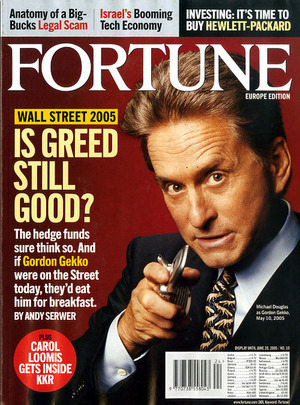
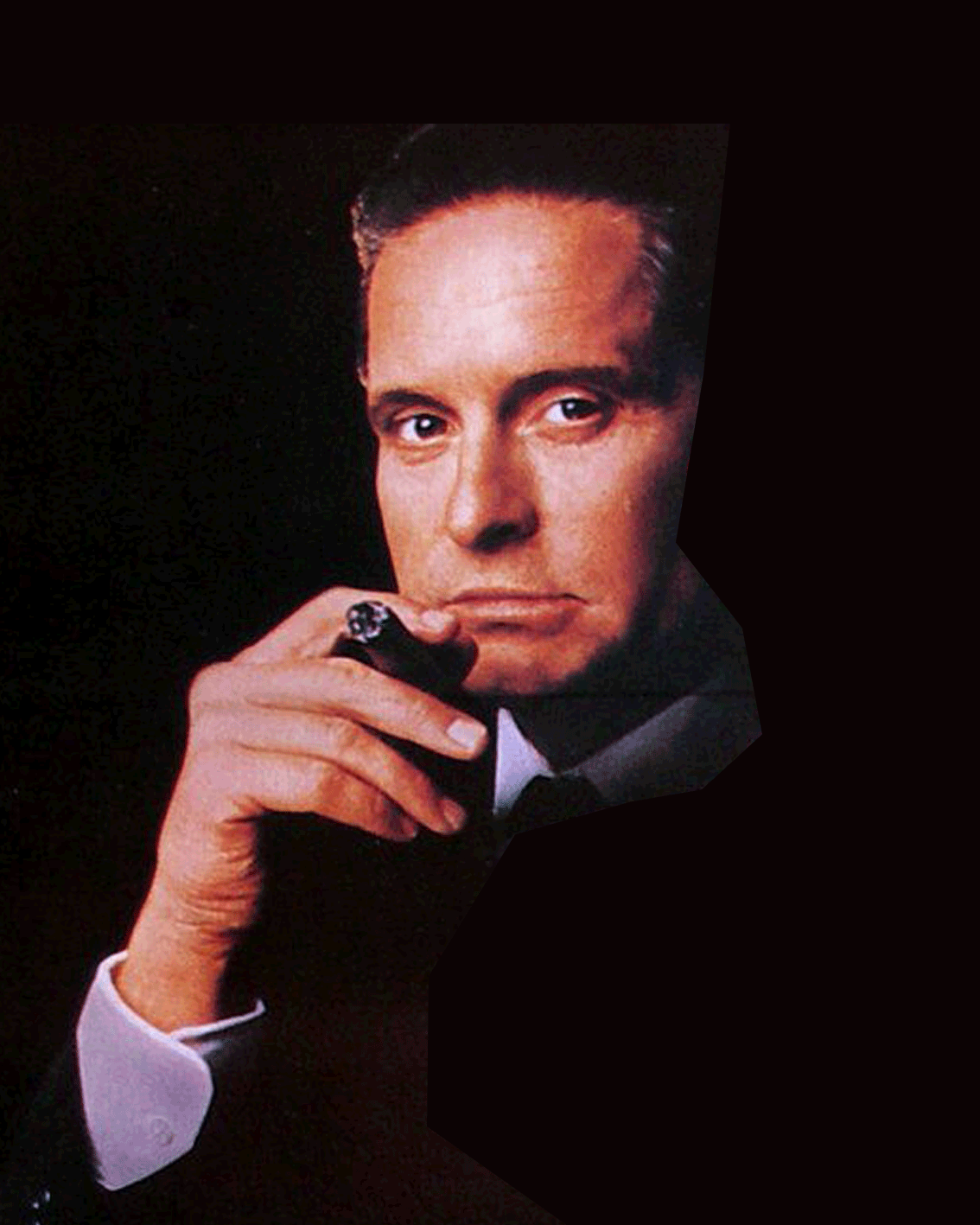
Entering into the third year of the Great Bank Swindle, it was only natural that someone in Hollywood would try and make hay off of it.  Enter Oliver Stone, with a sequel of sorts to his "Wall Street" film of 1987: "Wall Street: Money Never Sleeps" (a rather loopy title, in my eyes).  Wall Street high-roller Gordon Gekko (Michael Douglas) is released from prison to find himself alone, short of cash, and unable to get back into the game—the rules, such as they are, have changed, and prison never looks good on the resumé.

Seven years after Gekko is sprung, young Wall Street investment trader Jake Moore (Shia LaBoeuf) finds himself in the middle of the banking crisis, his company folding and his mentor (Frank Langella) commits suicide as a result.  The rootless Moore is then determined to avenge the death of both his Father Figure and livelihood by taking on the entities that led to his firm's collapse.  It was only a matter of time before he ran into Gekko, on a promotional tour for his new book, describing his life on top and behind bars.  Their stars are due to collide for another reason; is engaged to Gekko's daughter (Carey Mulligan), estranged from her father for his sociopathic wheeling-dealings and the subsequent overdose death of her brother.

Already it starts to feel icky.  Stone's original was, much like his "Platoon," less about their subjects (Vietnam, insider trading) and more about the writer-director's coming to terms with Daddy issues.  His protagonist in both films (played by Charlie Sheen) had to choose between good and bad fathers in both situations (Tom Berenger and Willem Dafoe in the first, and Douglas and Martin Sheen in the second), hovering about his shoulders like angel-demons, prodding him to go one way or the other, making him choose which Father Knows Best.

Everybody has Daddy problems in this one, to the point where that seems to be the only issue concerned.  Oh, there's some touching on of Green Energy and of the Banking conspiracy, but for the most part it is of the characters pin balling between Male Authority Figures, and the Mentor-Protegé thing (right down to Josh Brolin's character's favorite art-piece).  The only thing left is the kinda squeaky relationship between LaBoeuf and Mulligan, with Gecko acting like some Yojimbo playing all sides against each other.  It's a little disappointing to see Douglas' Gekko-monster being soft-pedalled in this manner—like finding out that Darth Vader (another Dark Father figure!) is merely Hayden Christensen in disguise.  Disappointing if one could get a handle on the character at all.  Douglas vacillates between being a tough-as-nails financier with all the answers and vulnerable Fair-Market Father trying to win back his little girl—that transformation gives Douglas and Mulligan a well-played if ultimately hollow scene in which they come to tearful terms.  He has never been better than that scene, and takes chances that recall his father Kirk's fearlessness in hitting for the bleachers.

If only that were true of Oliver Stone.

For the fact of the matter is, despite being one of our more (self-professed)radical film-makers, the once angry young man has made one of the most conventional of movies.  To be fair, he didn't write it, so the personal complications among the characters that one can see coming a mile away are not his fault.  And though he may trick the movie up with visual legerdemain (including a simple use of split-screen that he abandons fairly early on), pervasive songs by David Byrne and Brian Eno (that are banal), and "cuting" it up with several visual and aural "in-jokes," the film couldn't be more "safe," preaching to the choir, and goo-ing the whole thing up in a veneer of soap-scum. 

If one wants to be a truly innovative film-maker, to push the limits of visual story-telling, tell us something we don't already know.

"Wall Street: Money Never Sleeps" is a low-yield Cable-Watcher. 


Saturday, July 25, 2009

Transformers: Revenge of the Fallen

"Boys With Toys"
or
"We Just Dropped Ten Tons of Dead Robot in the Middle of Nowhere."

As I recall, my three biggest beefs with the first "Transformers" movie was a) it was your basic racial bait-and-switch movie where the story of a repressed class is sublimated by having the story told through the eyes of a bankable star not of that class, b) the action sequences were ultimately boring and c) Michael Bay made every woman look like a hooker.

Other than that, I didn't mind it as some things were done quite well, indicating that Bay might actually become a filmmaker some day, as opposed to being a well-organized ring-leader and money evaporator.

But "Transformers: Revenge of the Fallen"* shows no such progression, and is quite a deal worse than the original. The problems with the first film have not been resolved, and the filmmakers have moved on to ignore more weighty problems like coherent writing, clear visual story-telling, or having a point besides making money and providing jobs for friends.

By now, the five-story high Auto-bots have become known to the military (thanks for noticing) if not the public at large, and should be working arm in cog to ward off alien attack, become an early, early warning system, vaporize garbage or at least become part of the motor pool. But it appears their job is to sit in one those ubiquitous governmental underground bunkers, stay out of the way of lucrative weapons manufacturers and kvetch about the government in charge. In other words, they've become part of the legislative branch with the major difference being that they actually go into battle themselves.**

And their nemeses, the evil Decepticons? They're doing much the same thing, except oiling their wounds, going back to the drawing board and plotting revenge. It would appear they have a long-standing grudge against Earth and its inhabitants, which is why this pan-galactic epic battle seems to be centered here, rather than some other arm of the Milky Way. Maybe we really are the Center of the Universe...and it attracts trouble.***

Speaking of self-absorbed monomania, Sam Witwicky (Shia LaBeouf) is off to college, with more beating of breast and patting of wallet by his braying parents (Julie White, Kevin Dunn) who were a welcome relief last time, but are now just wacky walking punch-lines. Then there's the only reason fathers are taking their children—Megan Fox
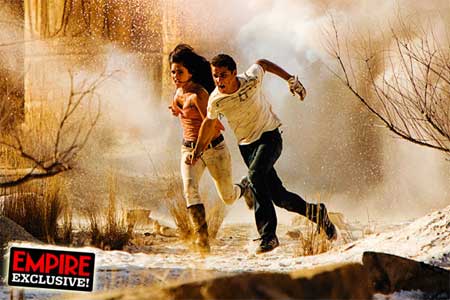
who's achieved a reputation as a Hollywood hottie and probably did a lot of practicing having a cold trying to get out of her contract-mandated participation, and might have done if she were a better actress. Fortunately, she's not required to do much outside of your typical Almay or shampoo commercial, until the latter part of the film where she's required to run in front of large gasoline explosions. I'd be worried for her as her mascara doesn't appear to run at all, but she doesn't lose so much as a false eye-lash.

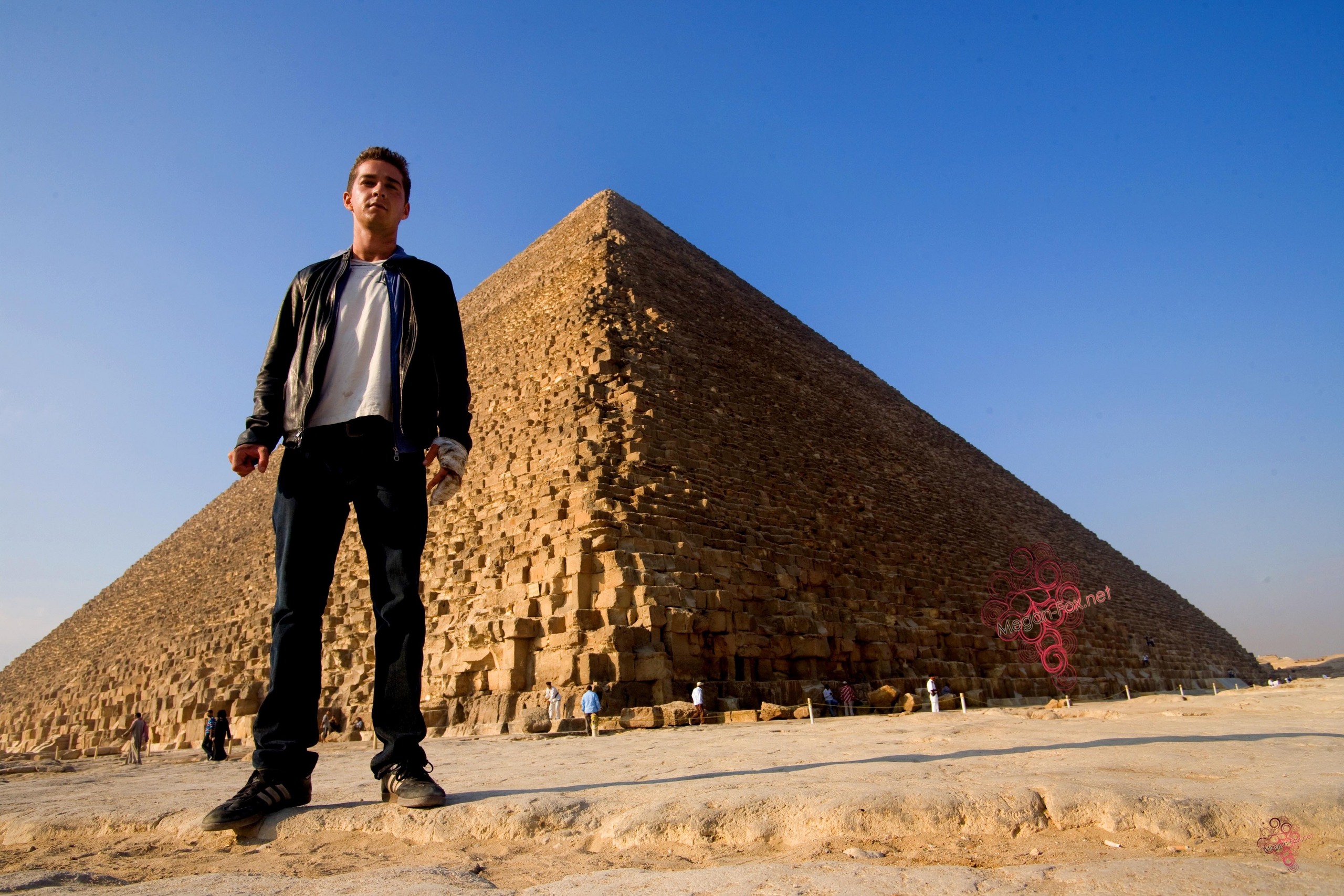
The movie is built of the spare parts of a lot of past Studio franchises, and as with most out-sourcing a lot of the pieces don't fit. The Decepticons have a tier-structure (the Decepticon Overlord at one point even says "And you will, my apprentice"), a magic bling must save the day, Sam has trouble saying the "L" word, and there are magic scribblings that they have to go to an expert (John Turturro returning to good comic effect), in order to stop the evil erector sets from setting off a device hidden in the Pyramids that will stop the sun (I'm not sure what that would be but I suspect it's some triangular Maytag ice-maker). Take "Transformers," strap on "Indiana Jones," plug in "National Treasure," screw on a pneumatic "Star Wars," some "Gremlins," program in some "DaVinci Code," stir a few thousand times to make it incomprehensible and drop it with a huge clank on "Independence Day."

Ultimately, it's a big mess with Bay setting up a swooping crane shot for every line of dialog, and the screenwriters setting up their expositions over explosions so you can't hear all their mumbo-jumbo. The only time the movie comes to life is an extended sequence on campus when Sam, possessed by a piece of the evil Decepticon-maker freaks out in a classroom and goes all "
Beautiful Mind" scrawling encryption's on his dorm-room wall, while also avoiding the predatory come-on's of a sorority sister, who's actually a Decepticon in drag. At that point, the movie becomes giddy and fun with complication piled on complication and LaBoeuf displaying some of the manic energy that makes him interesting to watch.

But that's ten minutes out of two and a half hours of a loud, obnoxious version of "
Rock'em, Sock'em Robots." And that's the bottom line of this mess. It was made for the necessities of the Studio making it, not for any artistic need to tell a story. Just as the Studios plan a few years ahead to make "tent-pole" franchises to strategically shore up dividends in the Summer and Christmas, this movie was constructed of sequences dictated by locations cheap enough to shoot in. That, unfortunately, is how the Bond producers have been manufacturing movies for the past two decades: having run out of Ian Fleming titles, they check to see where they can save the most money and set their movies there, and write the script around the location (Hitchcock would utilize locations for material as well). The problem is there's more to a screenplay than "location, location, location." The Bond series perked up only when they had Fleming's "Casino Royale" to provide that film its spine and heart. But there's no point and no inspiration to "Tranformers: Revenge of the Fallen," there is only contrivance, and the makers were scraping the bottom of the scrap-heap to do that. The old "Transformers" series used to kill off characters to encourage kids to buy their new lines of toys. One can imagine the day when "Revenge of the Fallen" will overcrowd the dumpsters of America, as well.

"Transformers: Revenge of the Fallen" is a Waste of Time.

* Jim Emerson had the foresight to alphabetize it as "Transformers: ROTFL"

** Hey kids! There are new Auto-bots based on Smart-cars, but instead of speaking French, they're street-cred hipsters and are as annoying as a weekend with Jar-Jar Binks. In fact, these characters aren't only annoying they're vaguely racist (!!??), but then there's a major disconnect with this movie about its audience. It's aimed at kids, but amid all the cussing and humping dog jokes, I could see more than a few parents putting their heads in their hands at the questioning upturned faces of their kids. It's also aimed at the kids who played with "Transformers" in the 70's and...haven't evolved. They were the ones "huh-huh-huhing" at off-color humor. Hollywood has yet to learn that the AICN crowd are a fickle bunch and won't necessarily open a movie for you. But then, a goodly number of current directors are fan-boys themselves.

*** At one point at an attempt at depth one of the characters says of the robots: "If God made us in his image, who made them?" Hasbro, Einstein! And probably in China.


Thursday, October 9, 2008

Eagle Eye

"Where's LaBoeuf?"

Jerry Shaw (Shia LaBeouf) has just had $71,500 dropped into his bank account. Giddily, he snatches up the money, runs home, and pays two months rent in advance. The landlady mentions something about all the boxes. Jerry spins inside, turns on the light, and finds he's walked into a nightmare--crates of sensitive materials and bomb-making equipment, pistols, rifles, night-vison goggles, F-16 training manuals...oh, and several tons of ammonium nitrate--enough to level another Oklahoma municipal building.

The moment is so well-staged that it evokes an audience-wide "Woh!"

His cell phone rings. A female voice says, "The FBI will be at your apartment in thirty seconds. Get out now!" He hasn't learned to move fast enough yet.

Dedicated mom Rachel Holloman (Michelle Monaghan) has just shipped her son on a band-trip to Washington D.C. and is relaxing for some girl-talk and a boiler-maker when she gets a phone call. A female voice tells her to go outside and look at the window of the McDonald's across the street. On the promo monitor, she sees a "live" shot of her son en route, and the voice tells her to go to a specific parked car--right now--or her son will be killed. She goes.

Remember the story about the pizza-delivery guy who robbed a bank, got caught, and told the police that he was forced to do it or a necklace he was wearing would explode? And while waiting for the bomb squad, the device went off, killing him? Evidently, so did the screen-writers for much of "Eagle Eye" recalls that bizarre scenario of an innocent forced to commit acts against their will. But that organization attached to that voice must be near-messianic in scope because it can monitor your progress by hacking into security-cams, and eases their near-escapes with constant directions and remote access to reader-boards, cell-networks, automated machinery, traffic lights, military equipment, cranes, high-tension towers, anything electronic or capable of broadcasting, right down to the X-ray machines at the airport check-points. Needless to say, there's a scene at Circuit City where this anonymous group goes to town.

It's a movie that, more than any theater announcement, compels you to turn off your cell-phone in the theater.

Who or what organization is doing this and why? Throughout the movie, I was harboring the suspicion that whatever the reasoning behind the elaborate, sometimes crazy, plot, it would not live up to the preposterous hook of the film. But it almost does, using as it center a security risks that this nation has inscribed in its Constitution--a blunder as big as lining up all your planes at Pearl Harbor. It's a scenario that's been used before in spy/suspense fiction, and "Eagle Eye" owes a lot to those writers, as well as the scribes for such diverse films as "
I, Robot," "The Manchurian Candidate," "Colossus: The Forbin Project," "The Man Who Knew Too Much," "2001: a Space Odyssey," "North By Northwest," "Telefon," "The Lady from Shanghai," and "The Conversation." That's quite a diverse roster of films, paranoia being their common thread.

Director
D.J. Caruso helmed a previous Shia LaBoeuf box-office winner, "Disturbia," and manages to make wide-open landscapes as restrictive as the limited point-of-view of that earlier film. Sometimes too restrictive. Two highway smash-ups are shot so close that one gets no sense of the relationship of mayhem to mayhem--they could be happening in separate states for all we see. However, the strategy benefits a sequence utilizing an airport's baggage conveyorsystem--making it as dizzying as a turn through a carnival fun-house.

LaBoeuf has a bit more energy than he displayed in the "Indiana Jones" film, and Michelle Monaghan (of "Gone Baby Gone") shows she's just as capable doing action work as well. Billy Bob Thornton is wonderfully dry as an FBI agent, Rosario Dawson gets to be taken seriously as an Air Force investigator, and Michael Chiklis makes a fine Secretary of Defense.

It isn't art, but it's a good ride--a pop-corn movie with just as much shelf-life and nutrition-value, while being a nice little tumble through the history of techno-thrillers of the past thirty years.


"Eagle Eye" is a satisfying rental.

Saturday, August 23, 2008

The Greatest Game Ever Played

"The Greatest Game Ever Played" (Bill Paxton, 2005)
Mark Twain said, "Golf is a good walk spoiled."

Director Bill Paxton compouds the error.

Despite the inherent drama of Mark Frost's* account of the David versus Goliath 1913 U.S. Open, Paxton takes the advice to "keep-your-eye-on-the-ball" a bit too literally in order to punch up the movie's visual fireworks. Though Frost has fashioned a good story of contrasts, pitting a renowned British pro--the greatest golfer of his day--against an unseasoned American amateur, Paxton keeps threatening to derail it with fancy camera moves and divot-POV's. It becomes a bit of a crutch; rather than solving the perpetual "make it interesting" challenge of filming golf, the director fashions every power-stroke with a new "fly-away" special effects shot. Once or twice, sure, it is fun. And it's all well and good to try and enliven the proceedings of one of the slowest-moving sports, but the swooshing, spinning flight paths he employs on so many shots become wearying and take away from the human drama, which is where the strength of the story lays.


Fortunately, Paxton's cast couldn't be finer. Shia LaBoeuf's Francis Ouimet is a constant revelation of emotions--he has one of those faces that the camera loves; every thought in his head etches something across his chinless features. By contrast, Stephen Dillane's Harry Vardon is all-laser-beam-intensity, betraying nothing but an iron will. One of Paxton's best moves ** is a shot of Vardon in the gallery, watching Ouimet play.

The faces in the crowd turn their heads following the result of a powerful wood shot, except for the British golfer fixated on the kid's moves. Dillane has been doing more and more impressive work lately...in "The Hours," and as Thomas Jefferson in HBO's "John Adams." If Thames wants to stop playing revolving doors with their Sherlock Holmes series on shorts (Richard Roxburgh, Rupert Everett) they could do worse than trying out Dillane as The Great Detective.

It's a great story--a heart-warming story, made more so by the fact that it's true.*** There was no need to go as overboard as Paxton does. One of the first things you learn in golf is that you do better if you don't try so hard. Grace wins over power.
* Frost more famously co-created "Twin Peaks" with David Lynch, and also co-wrote the screenplay for "The Fantastic Four" proving that no matter how well you've played before you can still occasionally be below par.

*** It's true a lot--but not completely. AND HERE, THERE BE SPOILERS. Highlight no further.


--the final score was actually Oulet - 72, Vardon-77, and Troy-78. It didn't come down to the wire as depicted in the film.

Monday, June 2, 2008

Indiana Jones and the Kingdom of the Crystal Skull

Making Mountains Out of Mole-Hills

I've heard this film being called "critic-proof", and I'm not even sure what that means, but it implies that whatever the reviews say, people are still going to line up to see it, as if it's a critic's job to discourage people from going to see something they want to see, like it's part of the job description to trash something on your "Must-See List." And that if something truly acidic and toxic is written about it (and a Big Tall Wish is made) nobody'll see it (And they call this movie unrealistic!) Even Ford, Lucas and Spielberg were all talking (before the film's premiere at Cannes) that it was going to get savaged, and, since these guys are pros who know their stuff, it has been in some circles, mostly by mouth-breathing fan sites where "sux" dominates the descriptors.

So, despite the lowering of the bar of expectations by the film-makers, does it suck?

No. No, it doesn't.

In fact, I have to say I haven't been this delighted with a film in a long time. I will even go so far as to say that "
Indiana Jones and the Kingdom of the Crystal Skull" fulfills the promises made by the very fine, original "Raiders of the Lost Ark," something that its two sequels, however enjoyable they are in parts and particulars, never did.***

Before we go further, let us go back and recap what happened in the previous chapters...

This series (like I shouldn't have to tell you) is based on pulp serials in the B-movie tradition--episodic, cheesy, toying with History and making it up as it goes along. This one, being set in the late 50's, has to have more of a sci-fi bent than the religious-themed stories of the past set in the 30's and the 40's. It is, after all, the first adventure we've seen of Indiana Jones in a post-nuclear world. Think on that for a moment. "Crystal Skull" fits the period, at least cinematically, however much it messes with folks' expectations of what the film "should be" about (and let's face it, the biggest obstacle Lucas' films have are people's expectations for the "next" installment, and whether it compares to the film they already have in their head--in that case, you can't compete with what they have in mind*). Indiana Jones' timeline has finally caught up with the memories of George Lucas and Steven Spielberg.

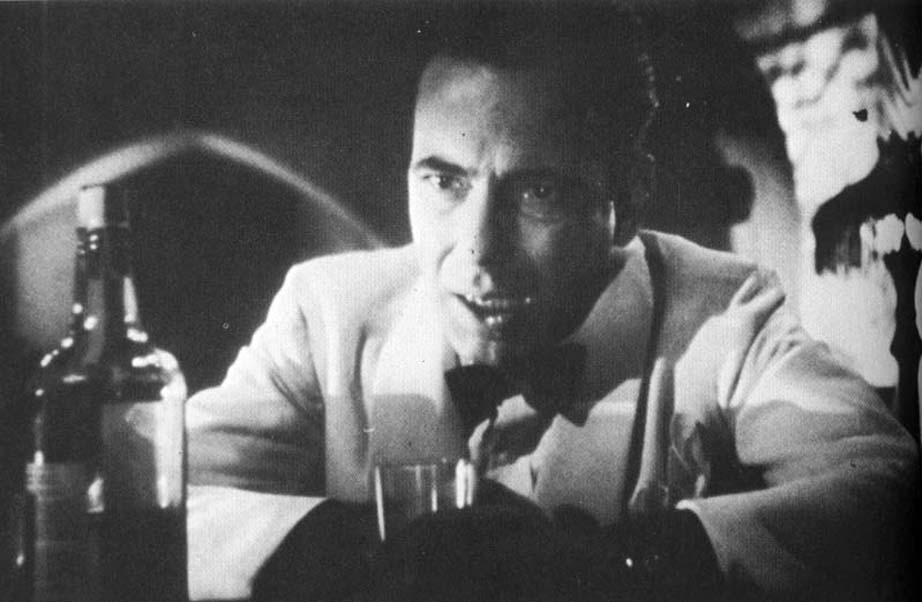
The filmmakers can't escape the fact that it's been 19 years since the last installment (and they've set it nearly twenty since the events of "Last Crusade"), and Harrison Ford's appearance is the nearly-constant reminder of it--he's broader, shlumpfier, more doughy in the face. But something magical happens a couple times in the film (once at a malt shop, once at a Mayan burial ground). Whether it's some CGI-gauze trick, or Ford's sense-memory playing the character kicking in, but once the dialogue turns to ancient civilizations and archaeology, the lines seem to disappear from Ford's face, and he slots back into the old/ young Indiana Jones the same way the camera "slotted" into the Bogart-drinking-his-sorrows "Casablanca" shot in "Raiders" after Jones has seen Marion supposedly killed in a truck explosion. It's eerie, but like the occasional forays into the transcendent in the series, it's a good kind of eerie.

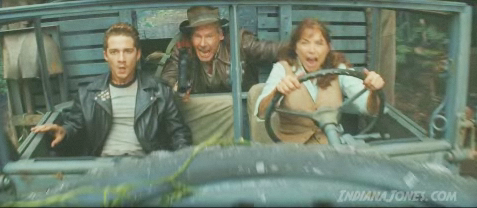
We've mentioned Marion, and, as the posters tell you, Marion Williams nee Ravenwood (Karen Allen) is back, and she's terrific--a breath of fresh air after Kate Capshaw's and Allison Doody's ingenues (the one too high-pitched, and the other tamped-down into irrelevance). The years have treated her far better than Ford, and she still has that incandescent smile and has been given a lot of "Dr. Jones-take-down" dialogue that suddenly snaps Ford's performance into a higher level of energy. Allen has remained well-versed in what Spielberg informed her during the first film was the "Sam Peckinpah School of Acting," something that Cate Blanchett is equally fine at--she's looser and more fun than she's been in years, and just the sight of her Commie commandant standing in a careening jeep during a bumper-cars jeep chase through the Amazon jungle is one of those things you think you'll never see.

So, Shia LaBoeuf. Is he "Short-Round"-irritating, or made too much a thing of? Neither, though he has a prominent role throughout. For some reason, whether it's the magnitude of the project, or Spielberg directing, LaBoeuf's not as energetic or inventive as he's been--maybe we should call his character "Short-Leash"--but, he's a good foil for Ford and their interaction, especially in one pause in a motorcycle chase deliberately recalls the Ford-Sean Connery relationship in "Last Crusade."** One is never sure if he'll be pulling out a comb or a switch-blade when he reaches into his motorcycle jacket (his aping of Marlon Brando's gear in "The Wild One" is a clever 50's variation of Indy's gear), and there is a great visual joke when he confronts an Amazonian resident with the same hair-cut.

As for director Spielberg, he reportedly re-studied his earlier "Indy" films to recall the way "kid-Spielberg" shot films and there are plenty of his early "headlights-into-the-camera" adrenaline shots (and even one of his "Sugarland Express" pans), but the takes are a bit longer-held, he's not quite so anxious to cut away, and his cinematographer Janusz Kaminski brings a new visual beauty that supplants the grit-in-the-lens of the earlier films. The elder Spielberg is also incessantly filling the film with visual ironies--grace-notes--that the younger Spielberg would save for a separate shot. There's an awful lot of stuff going on under the surface of the fire-fights, the explosions--some big ones--that betray the more mature film-maker, and man, Spielberg has become. And unlike the last two, which were short on background, and long on chase sequences, this film is over-stuffed with references, languages and the accustomed meta-recall of the past films.*** Not to say there isn't a lot of action. There is. That Amazon-chase between the particulars (the film is structured like a race--like "Raiders" and "Last Crusade"--with the good-guys and bad-guys all after the same thing and never too-far away from each other) is an invigorating combination of possibilities like a puzzle with every combination of inhabitant in vehicle and opponent in combat possible. It's dizzily constructed. And just when you start to think, "Wait a minute, where's..." your questions are answered.

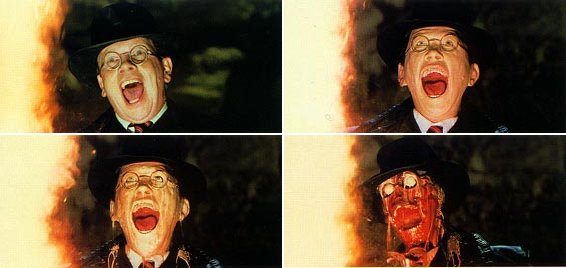
A lot of the action is outlandish, but, surprise! It always has been. How can you complain about verisimilitude when you've had melting Nazi's from the vampire-angels and God's death-ray of the Ark of the Covenant, or Thuggee priests pulling out sacrificial victim's flaming hearts, and how some victims in a lava pit burn, but the heroine-in-diaphenous pants doesn't, or 700-year old Knights Templar still guarding the Holy Grail. Get real, people. Because the movies aren't. Like Indy in "The Last Crusade" film-goers have to make a leap of faith, and it needs to be done with an open heart. Or at least an uncynical one. Or one open to the possibility of enjoying oneself.****

Okay now, go out there and have fun.

"Indiana Jones and the Kingdom of the Crystal Skull" is a full-price ticket.

-------------------------------------------------------------------------------------------------

* Somewhere along the way I've talked about "Mom's Apple Pie Syndrome"--where our memory of a cherished movie runs counter to the actual quality of the work, ie. "Nothing tastes as good as mom's apple pie," but only because that was your first run-in with the concept, and your impression of what "good" apple pie should be like may include a runny interior and scorched crust (I was blessed with a mother--God love her--who was a lousy cook, so I tend to be immune). So, too, the cherished movies of your youth may actually be crap, though we may delude ourselves otherwise, with our 'gee-whiz" innocent first impressions. The phenomenon became real for a few incredulously chagrined "Man from U.N.C.L.E." fans who, seeing the series for the first time in years on DVD last year, endearingly wondered why MGM chose to run the shows through a "crap filter" making the sets look like back-lot soundstages with cheap "foreign" localization, lousy effects, obvious writing and some horrible performances. Ah, deluded youth. Nothing is so sweet as a young man's fancy for a film of their childhood. And nothing is so rancid as the bitterness that follows a fan-boy's crush.

But it's not the film's fault. Ever. Beauty is in the mind of the beholder.

** And if you haven't figured our the "Indiana" Jones-"Mutt" Williams relationship yet, what can I say? You're either a) five years old, b) this is your first movie or c) "denial ain't just a river in Egypy, honey." Look at their names, kids, and remember where Dr. Henry Jones, jr. came up with the name "Indiana." These films are all about clues.

*** Sometime, when Summer is over and there are no more surprises, I'm going to do a big-old analysis of this movie and why it is the natural sequel to "Raiders." (Hint: It involves the clockwork-intricacies of ancient civilizations as well as the conflicts when a Man of Science is confronted with the "hard rain" of spiritual mythology) It's roots go pretty deep--which is refreshing after the previous two--and bear a full airing of the secrets buried within it. To do so now would give away far too much and contain too many spoilers of large and small varieties.

**** Do I have ANY complaints? Yes, the frankly extraneous character of "Mac" McHale played by Ray Winstone. McHale is designed as an untrustworthy character, but he is so untrustworthy that one wonders why he's not just shot by either party at any time during the proceedings. He's so greedy he's a bit reminiscent of Daffy Duck in a hall of treasures: "Mine, Mine, Mine!" The character is such an unnecessary plot contrivance that he might have earned the name "Aringarosa" if the name hadn't already been taken.

Wilhelm Alert: the book-carrying nerd in the library during the motorcycle chase.

Friday, April 4, 2008

Disturbia

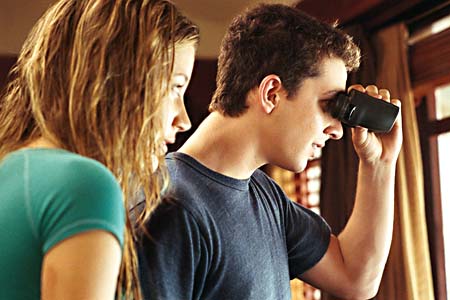
"Disturbia" (DJ Caruso, 2007) Take "Rear Window" and remove any veneer of civility to it and you have "Disturbia." The voyeur this time around is a kid with an ankle bracelet and a three-month house probation. After exploring his boundaries and testing his limits, he grows tired of electronics and junk-food, and begins to spy on his neighbors for thrills. Fortunately there're the new neighbors next door with the comely daughter, and unfortunately, there's the creepy older guy (David Morse, who can play good or bad angels interchangeably) who clubs and routinely brings home one-night-stands with one-too-many.

Did I mention that a lot of young women are routinely disappearing?

Did I mention that said grounded voyeur's recently widowed mom might have "the hots" for this guy? And before you can say "I am thy father's spirit," the kid is thinking she's in danger.

What separates "Disturbia" from Hitchcock's older, wiser film and why Sir Alfred and John Michael Hayes are head and tails better that DJ Caruso and Chris Landon and Charles Ellsworth is that the situation was set up in a way that the windows that James Stewart's character peered into were like mini-movie theaters reflecting his own fears of settling down in a domestic situation (even if it is with Grace Kelly) His voyeur recognized himself in his various targets, but young Kale Brecht (Shia LaBoeuf) has no such depth. True, his vantage point is limited to three houses, but all of them are antagonists of a sort. He's dead set against two of them, and the girl he just WANTS to be against. And being as this is a movie aimed at teens, the resulting Guignol is Grand and then, not so, sort of like "The Silence of the Lambs" without a hint of maid service, designed to merely creep out and punch up the "ick" factor. And, of course, it has to be resolved with the kid taking direct, violent action because, hey, he's a teen-ager--he needs to consciously murder someone to fulfill himself. I advised K. against watching as it was nightmare material. I sent "Disturbia" on its merry little way to infect another household, not unlike the tape in "The Ring."

Wednesday, November 14, 2007

Transformers

"I bought a car--turned out to be an alien robot. Who knew?"

One has always suspected from the evidence that Director Michael Bay likes machines more than he does people. The stunts--the "tent-pole" sequences-- have loving care lavished upon them, but character development is there for laughs...people are more effective as collateral damage than the purpose of the story. And if somebody gets squished along the way...well, who cares? After all, another stunt is on the way, and how cool is that? The epitome of this director-fetish occurred in "Pearl Harbor" (never seen it, for personal reasons) when the "money" shot of the attack was one that followed an air-dropped bomb on its destructive path through the U.S.S. Arizona. Bay said in interviews he did "Pearl Harbor" just so he could do that shot. I've seen that little piece of film numerous times (I keep looking for a CGI version of my father waiting on the dock), and it is impressive. It's also the coldest, most heartless way to present a tragedy I've ever seen. What if Oliver Stone had had a "bullet" shot that travelled from the Texas School Book Depository to the meat of JFK's brain (As cruel as that sounds, I've seen similar things a few times on the CSI shows), wouldn't someone raise a stink about that? It's as if one of these little destructive things is on a hero's quest and we follow it's little travails to its ultimate goal. Boom! "Scoooore!" So I've looked at Bay's career with a jaundiced eye, looking for the day he'd grow up and become a real director.


I don't know that he has, but if he keeps making movies like "Transformers," maybe he shouldn't. One wants to be cynical about a 2 hour 20 minute commercial for Hasbro (the movie is rife with product placement for young and old alike), but damn, if the things isn't as effective an action-comedy that has come down the pike in quite awhile. Aimed directly at where male adolescents live, the movie has the great good sense to cast Shia LaBeouf as its token humanoid.* LaBeouf's fidgety, jittery, always "on" performance is one of those joys to behold in movies-- constantly shifting, feeling like an ad-libbed performance (though the prize for that must go to Julie White as the slightly addled Mrs. Witwicky, always trying to make something positive out of a negative) and holding his own against all comers be they performing veterans or CGI monsters.

The story deals with an invasion of Earth by warring stealth robots, the Autobots and the Decepticons, who hide in plain sight by adapting the forms of the mechana of whatever world they crash-land on. They're decidedly nostalgic, taking on the form of boom-boxes and 70's Camaro's. When we meet hyper high-schooler Sam Witwicky, he is combining a school assignment with a mercenary sales-pitch trying to raise money for wheels. This sets in motion a plot so full of contrivance that it almost knocks your block off (sorry, wrong battling robots), but between the machine gun performances and Bay's constantly moving camera (a bit less shake and quiver than usual), you don't have time to notice, so deeply submerged is the movie in the "now."

Along the way are some interesting performances by Bernie Mac, matching LaBoeuf shift for shift in animation,** Jon Voight, looking florid and dour as the Secretary of Defense, John Turturro, whose agent for the secretive Section 7 ("...never heard of it." "And you never will.") careens into Pacino-like histrionics, and Michael O'Neill from "The West Wing," brings an understated straight-faced gravity in the face of sci-fi mayhem that just allows the movie to survive a lengthy exposition sequence at Hoover Dam. All fit as the tone of the movie is more like the Spielberg-produced "Gremlins," than, say, "The Iron Giant."

After pulling off a good movie for most of its length, it succumbs to the wishes of the toy-clutching fanboys, and turns into 45 minutes of "Rock'em, Sock'em Robots" in the streets of L.A., which is just as boring as it sounds. All the fun just drains right out of the movie while the titular charcters get in each other's grills, kick each other's cans for what seems like an eternity.

That's one of the problems. One can kvell about stereotyping, but I can't thinkl of any minority (or majority, for that matter) not being lampooned (in fact, there's a nice double-shot at white geeks and director Bay when a fan boy reacts to a violent meteor shower--"This is SO cooler than 'Armageddon!'") except for Asians. Didn't "Transformers" start in Japan? Hmmm.

Also, why are two of the more prominent women-roles both made up like 30 year old porn stars? And one's supposed to be in high school? How many grades was she sent down? They may be hawt (I believe the phrase is), but really, the only other person who comes close to having that much make-up caked on them is Jon Voight! And there is the staple of Bay--the slow-motion military shots that look like they've been culled from recruitment ads, and the faux-Hans Zimmer thudding score makes it feel more germanically militaristic than normal.

Still in all, it's the best damned, most entertaining toy commercial I've seen in a long time. Can't wait for "Furby: The Movie."

"Transformers" is a matinee. But ONLY because it'll look pretty dinky-toy on the tv.

* Ever been annoyed at black-themed movies where the stars and main characters are white? This is sort of a mechanoid version of that scenario.

** Though it does cause some of the dialogue editing to be a bit ragged in places.