Showing posts with label George Lucas. Show all posts

Tuesday, March 20, 2012

Red Tails

Why We Fight
or
The Brother Gets It First*

Like Francis Ford Coppola's Tucker: The Man and His Dream (which he also financed), Red Tails is the movie that George Lucas has waited the longest to make.  In development even before the "Star Wars" prequels, the story of the Tuskeegee Airmen has been on Lucas' mainframe for over 20 years.  And as with most director "Dream Projects," this one had the potential to soar into great summits of excellence or tail-spin into an exercise of excess and pretentiousness.
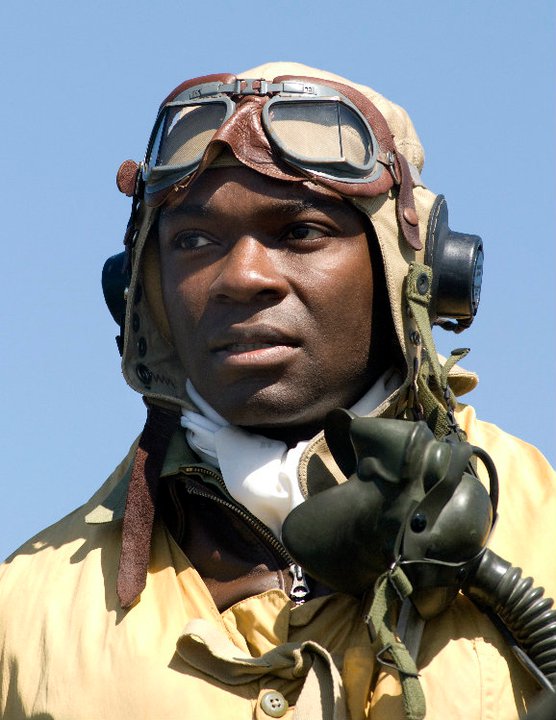
Red Tails is neither one of those, but it does do some interesting things along the way.  Respectful of the airmen, and "gung-ho" enough to end with "America The Beautiful" playing out over the End Titles,  it does remind one, in spirit, of the old war films, that appeared during and immediately after the second world war,** tough, haggard, slightly cranky, and all-too-willing to bring up some risky aspects of the vet's experience that would be tossed under the rug of homilies that later "recruitment" war films would present.  At the same time, it plays things a bit safe, dramatically, while, in subtle ways, taking chances that modern audiences—thank God—might not be aware of.***  It follows a typically diverse group of air-men with defining cliches—the "hot-shot" (David Oyelowo), the alcoholic (Nate Parker), "the kid" (Tristan Wilds"the yokel" (Ne-Yo)—through their story-arcs, fighting on two fronts—against the Nazis and their own brass and fellow soldiers, who, if not wanting to shoot the pilots out of the sky, didn't want them in the air in the first place.

One good thing that sets Red Tails apart from the other "yes, they fought too" films is there's no "white-wash" element (as one finds in a good effort like Glory, where a forgotten story about the participation of black soldiers in the Civil War, has to feature Matthew Broderick and Cary Elwes over Denzel Washington, Morgan Freeman, and Andre Braugher). These guys are on their own. There's no angelic white-devil's advocate that has to make the condescending "these are men" speech and, if anything, here, the white guys are pushing against back, making this film a lot more dramatic than your standard "liberal guilt" trip, where everybody's mind miraculously changes once "they're" "given a chance."****  The pressure never lets up on them and the only time they don't have to be on the defensive is in the air, fighting. Their inclusion in the war effort is a convenience, taking pressure off the other guys, and nothing noble. Doesn't matter to the pilots, though, as long as they're free of Earthly bonds, fingers on the triggers and Nazi Aryans in their sights.

And the battle scenescomplex, nasty and dangerous as the dog-fights are— are where Red Tails excels.  The same visceral energy of the Death Star battles (which were pre-visualized with edited WWII dogfight footage) is here, but with a rougher edge, bumpier, and more of a sense of true danger than a battle in space could provide.

Why'd it take so long?  Probably because Lucas wanted to do this one right (and also because studios were reluctant to finance a movie this black-centric), so he took the back-seat producer job, wrote the frame-work, hired John Ridley to write it and director Anthony Hemingway to film it, then doing some re-shoots (reportedly written with "Boondocks" creator Aaron McGruder) to do some dramatic streamlining.*****  Usually, it works with Lucas projects, especially when the director is strong, like Spielberg; there's a dramatic frisson that happens when it's not a "one-man/one-vision" project—something that was missing from the "Star Wars" Prequels, which suffered from too many "yes-men"—and Lucasfilms always seem to be better when he has to compromise and think off the top of his head...or someone else's.

One still gets a sense, though, of pandering.  The film Tuskeegee's don't need the "hey, these guys are good" comments that drop like leaden bombs throughout the film's second half.  As an audience, we can see it, we don't need to have it re-inforced by the white pilots they're escorting, especially considering those flight sequences are the best thing in the film.  The energy, thrills and derring-do (with their frequent "Yahoo" moments) are far more emotionally satisfying and communicative of the pilots' excellence.  Those sequences make Red Tails reach great heights, when everything else is trying to keep it grounded.  They didn't play it safe.  There's no good reason the film should.

Red Tails is a Rental.

The first wave of Tuskegee pilots

* A variation of the "trope" "Black Dude Dies First," which is a truism in "easy" drama and always struck me as being seminally racist.  In a war situation, with an all-black cast, it isn't true, and feels far less manipulative than in most war films.  In this war film, people die because "war is dangerous and people die in war."  It's random, unfair, and serves no purpose—not even dramatically.  That was an important take-way from this particular war film.

** This was in the 1940's, kids.


*** It's a bit soapish, but there's a romance between "hot-shot" pilot "Lightning" and an Italian girl, where nothing (blissfully) is mentioned about race, making the sequence seem idyllic, but also not clueing modern audiences in to the fact that if the same events happened in the country the pilots were fighting for, he would have stood a good chance of going to prison or being lynched for it.  It passes without comment or explanation, which might be dramatically risky, but sure feels good.  Real progress is made when the un-usual becomes commonplace and antique words like "miscegenation" disappear like disgarded, rusty tools.  Racial prejudice is SO "last century."

**** Even so, there's still a little too much of it, done mostly in voice-over behind masks, as if in post-production after-thought.  The screen-actions speak louder than any number of patronizing words.

***** Not sure where those sequences are—I'd only be speculating—but at one point "the kid" is shot down and put in a Nazi POW camp—the same camp that was the origination of the events and the film of The Great Escape.  Amusingly, there is one sequence that looks shot-for-shot like a sequence from the John Sturges film with "the kid" in the role played by Steve McQueen!  Heh.

Friday, July 16, 2010

Now I've Seen Everything Dept.: George Lucas


It is fan-boyishly pretentious of me to call the career of George Lucas a tragedy:* the man is richer than Croesus; his Lucasfilms production company is completely autonomous; he can, literally, do anything he wants in film-making, and his work bank-rolling the technical aspects of digital creation and photography 
guarantee that he can do anything in film-making.  All hail King George.

And it's not fair to compare his story with that of the other "turks" of his generation who've made their own fortunes with film,** Lucas was a pioneer who struck it rich before anybody and showed them how it was done by being practical and investing in the craft.***  But in so doing, the maverick film-maker he was became lost.  He wanted to be Curt, but became Steve.  He started out as Luke Skywalker, and ended up as his own Dark Father.  In a sense, so do we all.  Lucas knows all about cycles...his third "Star Wars" trilogy was to have been about the fall of the New Republic—we, as an audience, couldn't have handled that, I think—so, maybe the circle will be complete.  Maybe some day the maverick will return.  That is my new hope.


Here are the handful of films directed by George Lucas:


Electronic Labyrinth: THX-1138: 4EB (1967) A virtually silent film (save two words) with a complicated sound overlay, "EL:THX" is a security tape summary of one man's attempt to escape an anti-septic, electronically-monitored society of the future. Performances are uniformly amateurish--it was, after all, Lucas' final student project at USC and everything was volunteer-level. But the ideas are good, and the cumulative effect of watching the story being told visually and aurally is sophisticated and pretty stunning. The one time the sound-track goes into sync actually comes off as pretentious, such is the cumulative effect of the film.

THX-1138 (1971) Lucas' expansion of his student film was the first production of Coppola's American Zoetrope Studios - and nearly sank it. Lucas lucked out being able to use the still-under-construction BART system and tunnels. Good cast headed (baldly) by Robert Duvall and Donald Pleasance. The reverent score by Lalo Schifrin and sound-design/screenplay by Walter Murch all help the look and feel of the production. Lucas' depressive eye for angles and ideas on societal strictures are all an improvement, and if one is bored by the extended sociological tack of the film, they are paid off with an adrenaline-pumping chase, with a suitably triumphant finale. Lucas' "Director's Cut" restores "Buck Rogers" serial footage which over-states the theme of the movie, and adds CGI-enhanced scenes for bigger scale and "coolness" factor, but ultimately they're unnecessary.


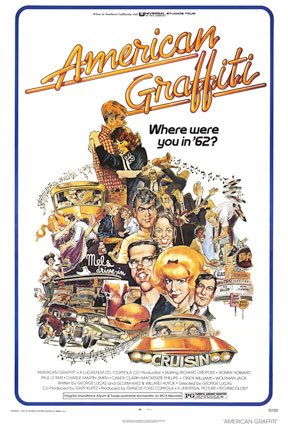
American Graffiti (1973) "A Midsummer Night's Dream" (as produced by AIP) with its mythical quests, sage mentors and feats of daring-do played out on a small-town high school's last night of Summer, it thematically fits snugly and securely into Lucas' other films set in unfamilar locales in the future, and "a long time ago, in a galaxy far, far way." Having been challenged by producer Francis Ford Coppola to make a film "that people will like," it is Lucas' best film, reaching deeply into his own psyche to connect with his audience, and creating a sweet ode to the 50's while bidding them good-bye forever. Smart, funny, sweet and sad, this film, made on a shoe-string, is Lucas' warmest, least pretentious movie. It created a nostalgia craze that never really went away, and launched the careers of a generation of actors. For an extended look at it, you can go here. 


Star Wars (1977) (Later Retitled: "Episode IV: A New Hope") Making a movie he "wanted to see," Lucas cribbed from the movies, myth and classic sci-fi to make a poly-glot "Flash Gordon" serial with better technology and a smart-ass attitude, while also bowing deeply to the tradition of square-jawed, comely-maiden school of B-movie-making. Justifiably spawning an empire of its own, Lucas' original, despite his protestations and tinkerings, still contains more inventive ideas and directorial brio than any of its imitators and sequels. The first three minutes alone are examples of the most bravura film-making (and statement of intentions) than anything seen in the previous 16 years. You'd have to go back to Lean to find anything so exultant in presenting its ideas. And its audience responded in kind. The memory of seeing it the second day of its ultimately two-year run at the UA Cinema 150 (R.I.P.) remains to this day.


Episode I: The Phantom Menace (1999)
Episode II: Attack of the Clones  (2002)
Episode III: Revenge of the Sith (2005) After Lucas' traumatic experiences making "Star Wars" - only to see it become the most successful film ever made - Lucas took a desk-job and only emerged after investing the millions of dollars in "Star Wars" earnings to perfect the techniques of CGI-centered, high-definition video (which would prove to be the wave of the future for film-makers) to make his epic "Star Wars" prequel trilogy. But despite the technological advances from frame 00:00;01 to the last, all the tech services a story that constantly skirts the sophisticated and plays to the cheap seats.

Somewhere along the way, Lucas lost sight of his audience; instead of aiming for the 25-year old geeks like himself, as he originally did, he chose to aim for the kids (his kids, no doubt) to tell the story of Anakin Skywalker's corruption to become the technoid villain Darth Vader (along with the destruction of the democratic and seemingly benign Galactic Republic). A story that dark and depressing he aimed at kids? Kids?


There is a lot to like about the prequels - its sumptuous art design, the abandonment of some of the more black-and-white concepts (the Republic is subverted from within to become the Evil Empire rather than, say, invasion), Lucas' brief flirtation with the "Messiah as Asshole" storyline, the full-scale commitment to the "good-girl/bad-boy" story - but ultimately one has to ask: "With all the time and money invested in the movies, shouldn't they have been better?" Lucas had the unique ability to do everything he wanted, and a tough, dark storyline that could have said so much more and been worth much more. But then, would it have been the B-movie-based "Star Wars?" Would that have been even less a crowd-pleaser? As they were, they were grudgingly watched, grumblingly accepted and Lucas' reputation as a film-maker forever tarnished.

Lucas, in interviews around the time of "Sith," was well-aware of the ironies: He started as a "rebel" film-maker battling the big bad Studio System and, in so doing, managed to create his own Lucasfilm Empire with more power and autonomy than any Studio in Hollywood. He became more of a Studio than they were. And I think he is equally aware that that fate is its own tragedy. His fortunes are tied forever with "Star Wars" and its ancillary marketing products...and he never managed to completely leave his home-town of Modesto, like Ron Howard's Steve Bollander in "American Graffiti."

The young Lucas would hold the older in complete disdain. But that's what happens when one's goals are for power and autonomy above all else. In completing his "Star Wars" prequels, he told a story that paralleled his own.


* I say this because I've been a fan of the man since way back, when I first saw "THX-1138" (on a double-bill with "Suylent Green") at the Crossroads Theater with my brother.  Lucas' springing from that film to "American Graffiti" to "Star Wars," while avoiding the pit-falls of the studio system, amazed me, and his insistence on an enveloping, enriching film sound design is THE reason I pursued a career in audio—He inspired me.  So, it may be fan-boyish of me to rail against what Lucas has become—I'm not, I'm as big a fan as ever—but I note the ironies, and I miss the film-making "kid" he was (but, hey, we all grow up).  I could give a shit that "Han shot Greedo first," but I miss the insouciance of the director who first made that call.

** Spielberg has paralleled Lucas' economic model but not his artistic one—sure, there's Dreamworks SKG, but it isn't completely dependent on films, and Spielberg never turned "E.T." into a film cash-cow—there's never been one sequel.  Francis Coppola, Lucas' mentor, famously had money troubles all through his film-making career, and then found his roots in wine-making and Italian cuisine, made his fortune, and does the occasional experimental hobby-film to keep his hand in.

*** One of my favorite Lucas anecdotes (and quotes) was reported by Coppola's wife in her book on "Apocalypse Now," in which Coppola, Lucas, and another director (Spielberg?) are on a plane and Coppola is pontificating on the director's art: "Directing is like pursuing a beautiful woman, it must be seduced...but the perfection is always out of reach..." (or some such nonsense).  To which Lucas, shlumpily adds: "Making movies is dumb...like chasing girls."  I think that says it all.  That line has always endeared Lucas to me.

Thursday, July 1, 2010

Indiana Jones and the Kingdom of the Crystal Skull (Take Two)

"Indiana Jones and the Terrible Age of Wonders"

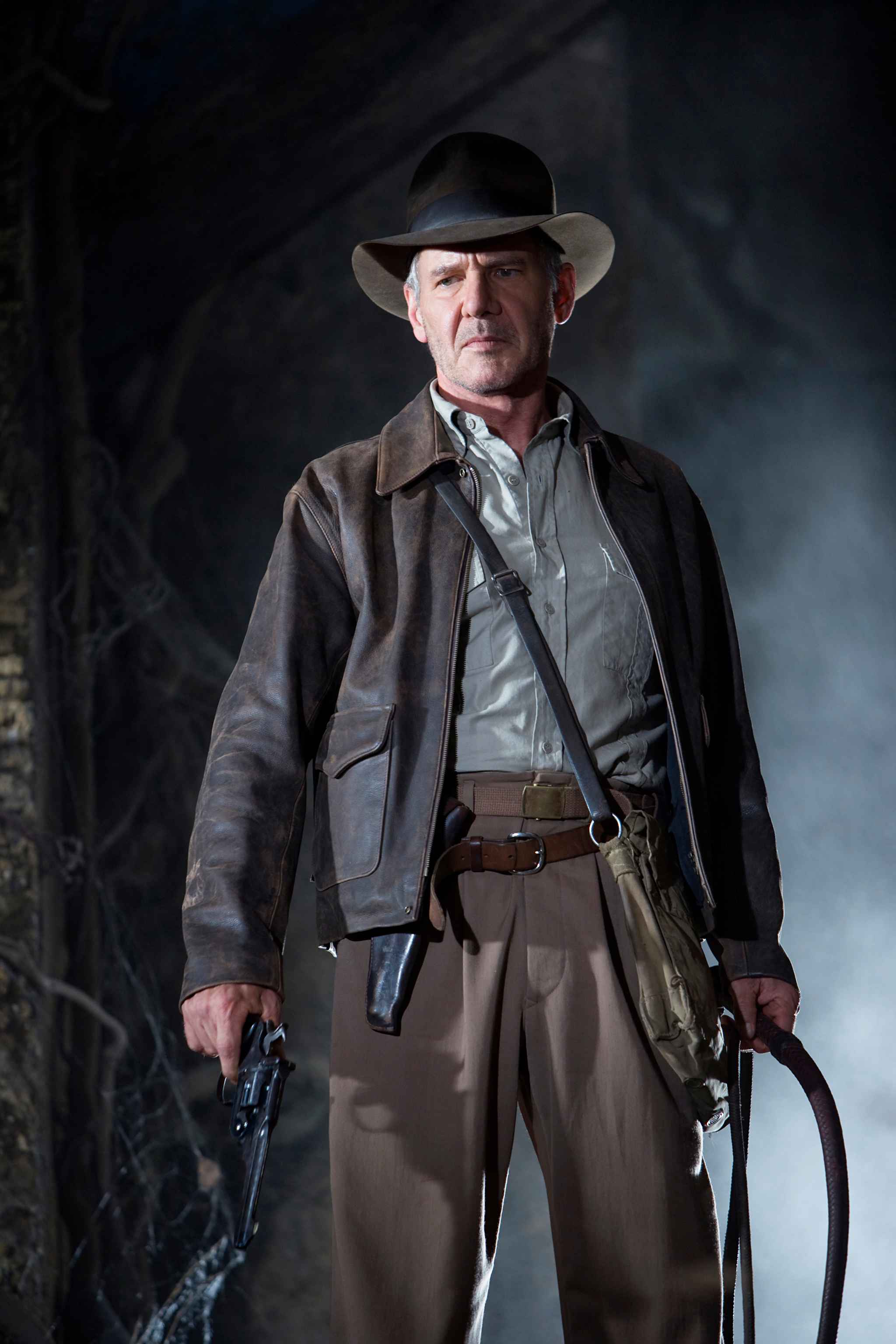
Last year's fourth entry in the "Indiana Jones" saga was met with derision while it raided a diamond mine at the box-office (making it to the top of many lists of 2009's more successful films—including a conservative publication that used its Commie villains to claim that it heralded a surge by the public to right-minded films, despite the fact that the rest of the films mentioned on the list flopped...and flopped badly; Indy 4 alone raised all boats).  There were complaints that it wasn't as good as the first three (a clear case of "Mom's Apple Pie" syndrome* among the fandom in fedoras—I felt it wasn't as good as the first one, but that's it): there was too much "Mutt" (Shia LaBeouf) and CGI, the familial complications too obvious, some characterizations a bit spurious,** and that it "nuked the 'fridge"—which briefly supplanted "jumped the shark" for hitting a false note in the national media (they always chortle when the fan-base eats its own) before they went back to not reporting the news. 

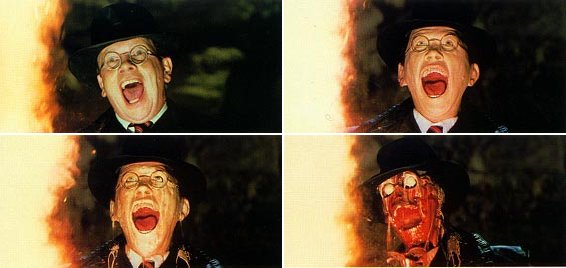
That last one stuck in my craw; it showed that the fan-base didn't "get" what the movies are—a post-modern, hi-tech take on the past and the low-ditch movies' past, in particular.  It didn't have to adhere to "reality"—it never did.  Look at Raiders of the Lost Ark, admittedly the best of the bunch—a 30's film filled with flying flap-jacks, Nazi's (Nazi's everywhere, even melting ones), Hitler myths, and tales of apocalyptic power. Nobody questioned "who" would put the rolling rock back after it crushes an intruder.  Nobody asked why a tomb unopened after centuries would still have live snakes in it.  One or two might have asked how Indy rode the back of a sub all the way to Nazi Island (It didn't submerge?  At all?  Then, why'd they take a SUB?!). Nobody questioned the ark.  It didn't have anything to do with reality, but rather with a mythic age of B-movies and wishful thinking that never existed, a cross-roads ("'X' marks the spot") between gritty, slithering reality and far-fetched fantasy, and the other films in the first trilogy followed that same map of fictional territory. 

But not as well.  Where the other two films, The Temple of Doom and The Last Crusade, failed to engage me were their wholesale abandonment of the what made the first film a Boy's Adventureland, and became a series of drawn-out chases, and half-hearted attempts at Mythos.  The Temple of Doom—a favorite among some film-critics, as it challenged Indy's hero-concepts and went to darker psychological places than mere musty caves—bugged me not so much for its inaccuracies (the long fall from a plane on a life-raft, the ripping out of a sacrificial victim's flaming beating heart to the SV's—and the audience's—disbelief), but it's insistence to present a Disneyland-like "mine-shaft ride" that looked for all the world that it was populated by puppetoons.  Then, there's the small detail of it being a prequel in which Jones "learns" that there's more to his mythic quests than robbing graves for fun and profit—which is intrinsic to the character, and is part of the make-up of the somewhat less-than-honorable "Indiana" Jones we first meet in the chronologically later Raiders.  That lesson must not have "stuck."

But, what they do have in common—what they all do—is slap the stubbornly reality-based Jones into a sense of wonder: Raiders... confronts "Indy" with a full-on-Wrathful presentation of something that he dismissed with a casual "if you believe that sort of thing."  ...The Last Crusade makes him take a literal "leap of faith" to save both his life and his father's, and also smashes his long-held preconceptions about his Dad.  "...Temple of Doom" has that previously mentioned quick-dissolving lesson of the Sankara stones and re-defines what "Fortune and Glory" can be to the doctor.  "Indiana" Jones is a teacher, but in his movies, he must learn things.  His character must start with a cherished "truism" and he must learn that although he may have all the answers, there are more questions that he hasn't even considered.  At one point in ...The Kingdom of the Crystal Skull, "Mutt" asks "Indiana:"  "You're a teacher?"  And Spielberg weights the reply down, as it's an important one: "Part-time."

The rest of the time, he's a student himself, still learning.

In Indiana Jones and the Kingdom of the Crystal Skull, Dean Charles Stanforth (Jim Broadbent), says to Dr. Henry Jones Jr. (Harrison Ford): "We seem to have reached the age where life stops giving us things and starts taking them away."  They have both aged, lost colleagues and parents, and their jobs are on the line.  And "Indy" has just ridden the crest of a nuclear shock-wave in the Nevada desert, where he has seen two amazing things, off and on the Earth: the corpse of an ancient astronaut, and the limit of Man's power in the form of the mushroom cloud of a hydrogen bomb.  This is the extent of our knowledge on Earth and it is a fearsome one, one that could mean our destruction at the hands of our abilities and our arrogance to use it.  Behold the power of knowledge and fear.


This is the first of two images (that Spielberg deliberately composed) of "Indiana" Jones in rapt observation of an unfathomable thing that buttress Indiana Jones and the Kingdom of the Crystal Skull.  In both, he is dwarfed by the event, small and helpless—all he can do is watch.  In the first, he is witness to the extent of Man's knowledge.  In the second, as he watches the launch of an alien race's*** craft to inter-dimensionally travel "the spaces between spaces," something far beyond his ken and catechism. The one represents all that we know, and the other opens up another Chamber of Secrets.  "Indiana" Jones can travel the four corners of the Earth, and there is still so much more territory to explore, and, indeed, more than he can know for certain. 


The personal myth that Jones must resolve is that of age and the taking away (the bomb) and the giving (the new experience).  For the loner Jones, that includes new worlds to conquer...and that is celebrated here...but he also, like The Outlaw Josey Wales, finds himself, in this one, acquiring a family he didn't know he had and never wanted, flying in the face of Stanforth's gloomy assessment of their lives as being "one foot in the grave" (like "Indy" hasn't been there before).  In this terrible age of wonders, there is always more to learn...more "treasure," translated by the Incas to "knowledge" and prized more than gold.  Life, no matter how old we get, never stops giving. 

Not if we're observant, anyway.
For me, ...The Kingdome of the Crystal Skull represented the best, most true, antecedent to the original Raiders of the Lost Ark, fully embracing the era it is set (the 50's) and the B-movie concepts being put out at the time, and it is the strongest presentation of the concept of the "learning teacher" since Raiders...  ...The Kingdome of the Crystal Skull represented, to me, the true sequel, while the others were just regurgitating concepts.  This one, like Raiders, raised the stakes.

MY only disappointment with it was, that if it's set in a 50's B-movie world, where's the giant scorpion that the hydrogen bomb creates—there were all sorts of "nukular monsters" in the films of the time, their own metaphors of the costly nature of Knowledge.  But Lucas and Spielberg's intentions were to turn that metaphor inside out.  Knowledge isn't destructive.  It inspires creation.  And new worlds to explore.

-----------------------------------------

There is talk (and only talk) of a fifth Indiana Jones movie, and while it has moved some to despair, for me it has given me fits of giggling anticipation. Imagine Indiana Jones in the B-movie drive-in 60's, with the good doctor investigating SDS students planning a lysurgic acid dump in a city resevoir, while a Beatle-browed Mutt has joined a Hell's Angels sect that practices Trascendental Meditation, and only an exploration of "The Silver Chord" can save Indy from the Ultimate Bad Trip. Meantime, there are rocket-packs, video-phones, IBM computer-rooms, and ESP experts, all figments of a 1960's that briefly sparked the imaginations of the time, but never seemed to catch on.  We were too busy going to the Moon, at the time.

I think it would be groovy, man.

Call it "Indiana Jones and the Electric Kool-Aid Acid Test."


* "Mom's Apple Pie" syndrome is the one where fan-boys says that the movies they liked as kids were better than anything that had come before or since (like "Mom's Apple Pie"), a clear indication that they have a narrow focus and experience.   The correllary is that expressed when a film-maker changes a movie for whatever reason and the fan can't come to grips with it—"They raped my childhood!"—a despicable sexually ignorant comment that indicates the person hasn't known anyone who has been (or might have been) raped or attacked.

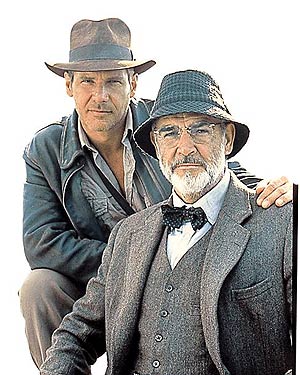
** Admittedly so, with the characters of  "Mac" (Ray Winstone) and Oxley (John Hurt)—the latter a last-minute re-write when a "retired" Sean Connery decided not to reprise his role as Indy's father.  He probably decided there weren't any golf courses near filming, or his dismal experience filming The League of Extraordinary Gentlemen in Prague left such a mark it didn't compensate for his affection for Spielberg, Lucas and Ford.

*** Here's another instance of last-minute tinkering.  Lucas wanted aliens, and Spielberg with three E.T. movies under his belt didn't want to go there.  So, the ancient astronauts became "interdimensional" beings, rather than space-aliens.  It actually works better that way.  Aliens = space.  We know all about space.  But, other dimensions?  That's a concept that expands the mind and the territory we inhabit.  "There are more things in Heaven and Earth..."  And even, in between.

Friday, May 15, 2009

Anytime Movies Reloaded: American Graffiti

It's Spring-Break for me. Times are busy. The Summer Movie Season is already begun (and I'll be writing about the new ones) and the Film Festivals are grinding away like creaky mills separating wheat from chaff. It's as good a time as any to re-boot a feature I started years ago, when it was suggested I do a "Top Ten" List.

I don't like those: they're rather arbitrary; they pit films against each other, and there's always one or two that should be on the list that aren't because something better shoved it down the trash-bin.

So, I came up with this: "Anytime" Movies.

Anytime Movies are the movies I can watch anytime, anywhere. If I see a second of it, I can identify it. If it shows up on television, my attention is focused on it until the conclusion. Sometimes it’s the direction, sometimes it’s the writing, sometimes it’s the acting, sometimes it’s just the idea behind it, but these are the movies I can watch again and again (and again!) and never tire of them. There are ten (kinda). They're not in any particular order, but the #1 movie IS the #1 movie.

What's George Lucas' best film? For most, it's probably "Star Wars" (I'm sure there's some poor soul out there who likes "Radioland Murders"). There's a lot to like about his charmingly scruffy homage to the Buck Rogers serials. But one wonders what direction his career might have gone if he hadn't felt the need to exploit that first "Star Wars" movie as much as he did. It seems the more he explained about his initial concepts the worse the movies got, and the more rich and famous they made him, the more elephantine and fossilized they became.

For me, Lucas has yet to top "
American Graffiti." Made for under a million dollars and filmed mostly at night using a skeleton crew (albeit one headed by Haskell Wexler), it showed just how ingenious Lucas could be when he was strapped for cash. It has the structure and froth of a Shakespeare comedy with the values and budget of an AIP teen flick.

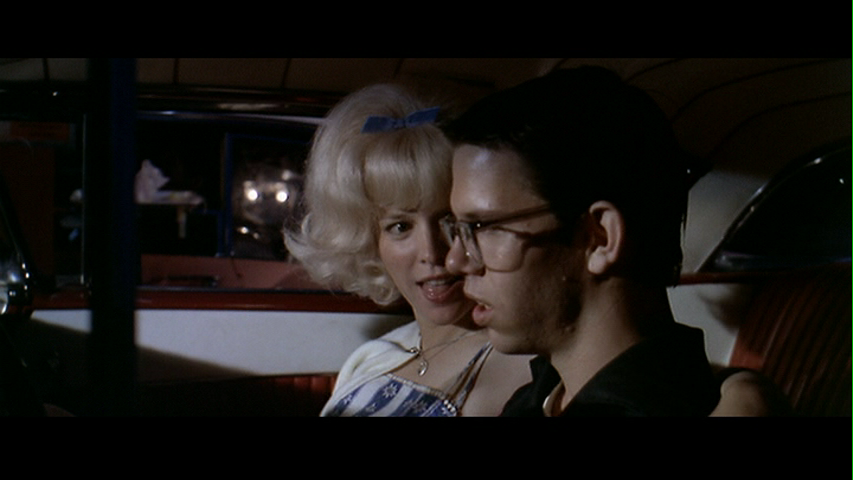
Seemingly aimless, "American Graffiti" follows four storylines of small town kids on the last night of summer before heading to college. Curt (Richard Dreyfuss) has a scholarship to a big university but is reluctant to go, and spends the night bounced around by local toughs, and diverted by his quixotic pursuit of a phantom blonde in a white Thunderbird. Steve and Laurie (Ron "Ronny" Howard and Cindy Williams) are a couple in transition. Class President and Head Cheerleader, they're the Royal Couple of the Sock-Hop. But Steve can't wait to head out of town to conquer new territory, and Laurie-still in high school-knows she'll lose him when he goes. John (Paul LeMat) is a high school drop-out and legendary hot-rodder endlessly cruising the streets of town, looking for the next race. And Terry (Charles Martin Smith) lives a rich fantasy life (that's a kind way of saying he's deluded) where he can imagine himself everything that he's not.

Lives intersect, couples form and break apart, lies are told, misunderstandings abound (to really make it Shakespeare all you'd need is a set of twins), while the majority of kids drive endlessly in circles--not going anywhere, but hoping to, and if not tonight, there's always tomorrow. They're not going anywhere.

In the background are the constant echoes of rock n' roll pouring out of car windows and reverberating down the hallways and back-alleys, broken only by the howls and shrieks of the common thread in their lives,
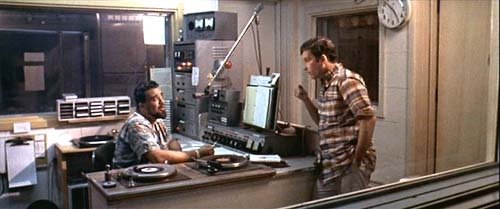
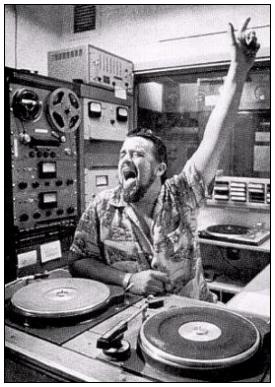
Wolfman Jack. All the kids have their Wolfman myths and he acts as sage, seer, siren and Master of Ceremonies for the evening's adventures. He's also the Fool and "The Man Behind the Curtain." Ultimately the long night's journey leads to his door-step, and, in disguise, dispenses his wisdom to the seeker.

One thing Lucas always knew was how to make a curtain call and "American Graffiti" is his best. As Curt flies off to college, he is left two signs of passage: the white T-bird reappears one last time to remind him what he's giving up, while locked away in his plane, the sounds of the radio station that have buoyed and sustained all the characters throughout the night fades to static. For the first time in the film there is no music and in the silence that creates, broken only by the drone of the plane we're told the rest of the story. Terry "goes missing" in Viet Nam. Steve is an insurance salesman in town. John is killed by a drunk driver. Curt's a writer in Canada. After that punch in the gut, Lucas unsentimentally hammers it home with one of the cheeriest songs in the Beach Boys catalog--"All Summer Long," dismissed earlier in the film as "surfing shit." Lucas turns the future into a sobering fate--the film is set in 1962. The next year would signal the end of the innocence of the 50's and "American Graffiti" is a sweet farewell to trivial concerns and living in the past.

Lucas has said that he based the boys on different aspects of himself in high school--the intellectual, the nerd, the sosh' and the JD. Lucas' lesson in this, and all of his work seems to be "Advance or Die." It's the lesson of "Graffiti." It is certainly the basis of the story of Anakin Skywalker. So what became of Lucas? Did he follow his own advice? Well, you could say he went to the future with "Star Wars," but he set it in the far-away past. Then he
built an Empire of his own...in his hometown.


The Trailer for "American Graffiti"--in the style of Beach Blanket movies


"American Grafitti" touched me two ways. I had already been inspired by Lucas' first film, "THX-1138" with its inventive sound-scape, to seek out his work and the work of his sound editor Walter Murch. "Grafitti" was their second collaboration and pretty much sealed my fate for going into sound work. Listening to it now, it's crude and has a lot of holes and bad edits, but the innovations are just as unique 30 years later and just as inspiring. On top of that, the unglamorous portrayal of a radio disc jockey's life (yet romantic in its anonymous/omnipresent effect on a community) made me think "I could do that!" and I started my sound career spinning discs at a radio station. My last job as such was at a station with a glass window that looked out on the town's "loop." Sort of like watching "American Graffiti" in reverse. That was KEDO-AM in Longview, Washington--long ago bulldozed.


Wolfman Jack explains it all for you, baby!


I'd just done a "Don't Make a Scene" segment for "American Graffiti" and was looking forward to writing new "insights" on this film, but reading it again, no, I pretty much covered them all. Not that "American Graffiti" is that simple—it's just that given Lucas' skimpy out-put, there's not a lot of complexity in his ouvre. It is interesting that Lucas goes the Joseph Campbell route in this film before he actually read "The Hero with a Thousand Faces" and used the "seeker's path" for the construction of "Star Wars." He was already using it here and doing variations of it for the four Lucas-aspects, each with different fates (a cautionary tale, indeed). He also uses the cross-cutting on different fronts that would be his staple in the "Star Wars" films, but interestingly in his first "Star Wars" ("A New Hope") and this film, there is no cross-cutting at the end, everyone is melded into the final story-line, buttoning everything up nice and neat. He wouldn't do that again.

American Graffiti
To Kill a Mockingbird
Goldfinger
Bonus: Edge of Darkness

Tomorrow: The Tropic of Capracorn

Monday, June 2, 2008

Indiana Jones and the Kingdom of the Crystal Skull

Making Mountains Out of Mole-Hills

I've heard this film being called "critic-proof", and I'm not even sure what that means, but it implies that whatever the reviews say, people are still going to line up to see it, as if it's a critic's job to discourage people from going to see something they want to see, like it's part of the job description to trash something on your "Must-See List." And that if something truly acidic and toxic is written about it (and a Big Tall Wish is made) nobody'll see it (And they call this movie unrealistic!) Even Ford, Lucas and Spielberg were all talking (before the film's premiere at Cannes) that it was going to get savaged, and, since these guys are pros who know their stuff, it has been in some circles, mostly by mouth-breathing fan sites where "sux" dominates the descriptors.

So, despite the lowering of the bar of expectations by the film-makers, does it suck?

No. No, it doesn't.

In fact, I have to say I haven't been this delighted with a film in a long time. I will even go so far as to say that "
Indiana Jones and the Kingdom of the Crystal Skull" fulfills the promises made by the very fine, original "Raiders of the Lost Ark," something that its two sequels, however enjoyable they are in parts and particulars, never did.***

Before we go further, let us go back and recap what happened in the previous chapters...

This series (like I shouldn't have to tell you) is based on pulp serials in the B-movie tradition--episodic, cheesy, toying with History and making it up as it goes along. This one, being set in the late 50's, has to have more of a sci-fi bent than the religious-themed stories of the past set in the 30's and the 40's. It is, after all, the first adventure we've seen of Indiana Jones in a post-nuclear world. Think on that for a moment. "Crystal Skull" fits the period, at least cinematically, however much it messes with folks' expectations of what the film "should be" about (and let's face it, the biggest obstacle Lucas' films have are people's expectations for the "next" installment, and whether it compares to the film they already have in their head--in that case, you can't compete with what they have in mind*). Indiana Jones' timeline has finally caught up with the memories of George Lucas and Steven Spielberg.

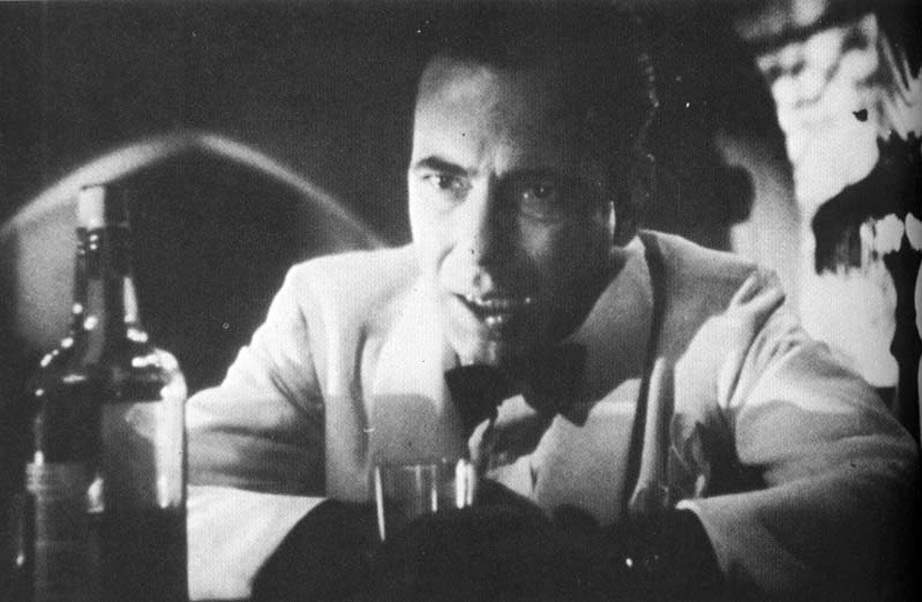
The filmmakers can't escape the fact that it's been 19 years since the last installment (and they've set it nearly twenty since the events of "Last Crusade"), and Harrison Ford's appearance is the nearly-constant reminder of it--he's broader, shlumpfier, more doughy in the face. But something magical happens a couple times in the film (once at a malt shop, once at a Mayan burial ground). Whether it's some CGI-gauze trick, or Ford's sense-memory playing the character kicking in, but once the dialogue turns to ancient civilizations and archaeology, the lines seem to disappear from Ford's face, and he slots back into the old/ young Indiana Jones the same way the camera "slotted" into the Bogart-drinking-his-sorrows "Casablanca" shot in "Raiders" after Jones has seen Marion supposedly killed in a truck explosion. It's eerie, but like the occasional forays into the transcendent in the series, it's a good kind of eerie.

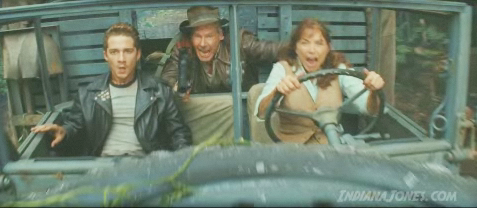
We've mentioned Marion, and, as the posters tell you, Marion Williams nee Ravenwood (Karen Allen) is back, and she's terrific--a breath of fresh air after Kate Capshaw's and Allison Doody's ingenues (the one too high-pitched, and the other tamped-down into irrelevance). The years have treated her far better than Ford, and she still has that incandescent smile and has been given a lot of "Dr. Jones-take-down" dialogue that suddenly snaps Ford's performance into a higher level of energy. Allen has remained well-versed in what Spielberg informed her during the first film was the "Sam Peckinpah School of Acting," something that Cate Blanchett is equally fine at--she's looser and more fun than she's been in years, and just the sight of her Commie commandant standing in a careening jeep during a bumper-cars jeep chase through the Amazon jungle is one of those things you think you'll never see.

So, Shia LaBoeuf. Is he "Short-Round"-irritating, or made too much a thing of? Neither, though he has a prominent role throughout. For some reason, whether it's the magnitude of the project, or Spielberg directing, LaBoeuf's not as energetic or inventive as he's been--maybe we should call his character "Short-Leash"--but, he's a good foil for Ford and their interaction, especially in one pause in a motorcycle chase deliberately recalls the Ford-Sean Connery relationship in "Last Crusade."** One is never sure if he'll be pulling out a comb or a switch-blade when he reaches into his motorcycle jacket (his aping of Marlon Brando's gear in "The Wild One" is a clever 50's variation of Indy's gear), and there is a great visual joke when he confronts an Amazonian resident with the same hair-cut.

As for director Spielberg, he reportedly re-studied his earlier "Indy" films to recall the way "kid-Spielberg" shot films and there are plenty of his early "headlights-into-the-camera" adrenaline shots (and even one of his "Sugarland Express" pans), but the takes are a bit longer-held, he's not quite so anxious to cut away, and his cinematographer Janusz Kaminski brings a new visual beauty that supplants the grit-in-the-lens of the earlier films. The elder Spielberg is also incessantly filling the film with visual ironies--grace-notes--that the younger Spielberg would save for a separate shot. There's an awful lot of stuff going on under the surface of the fire-fights, the explosions--some big ones--that betray the more mature film-maker, and man, Spielberg has become. And unlike the last two, which were short on background, and long on chase sequences, this film is over-stuffed with references, languages and the accustomed meta-recall of the past films.*** Not to say there isn't a lot of action. There is. That Amazon-chase between the particulars (the film is structured like a race--like "Raiders" and "Last Crusade"--with the good-guys and bad-guys all after the same thing and never too-far away from each other) is an invigorating combination of possibilities like a puzzle with every combination of inhabitant in vehicle and opponent in combat possible. It's dizzily constructed. And just when you start to think, "Wait a minute, where's..." your questions are answered.

A lot of the action is outlandish, but, surprise! It always has been. How can you complain about verisimilitude when you've had melting Nazi's from the vampire-angels and God's death-ray of the Ark of the Covenant, or Thuggee priests pulling out sacrificial victim's flaming hearts, and how some victims in a lava pit burn, but the heroine-in-diaphenous pants doesn't, or 700-year old Knights Templar still guarding the Holy Grail. Get real, people. Because the movies aren't. Like Indy in "The Last Crusade" film-goers have to make a leap of faith, and it needs to be done with an open heart. Or at least an uncynical one. Or one open to the possibility of enjoying oneself.****

Okay now, go out there and have fun.

"Indiana Jones and the Kingdom of the Crystal Skull" is a full-price ticket.

-------------------------------------------------------------------------------------------------

* Somewhere along the way I've talked about "Mom's Apple Pie Syndrome"--where our memory of a cherished movie runs counter to the actual quality of the work, ie. "Nothing tastes as good as mom's apple pie," but only because that was your first run-in with the concept, and your impression of what "good" apple pie should be like may include a runny interior and scorched crust (I was blessed with a mother--God love her--who was a lousy cook, so I tend to be immune). So, too, the cherished movies of your youth may actually be crap, though we may delude ourselves otherwise, with our 'gee-whiz" innocent first impressions. The phenomenon became real for a few incredulously chagrined "Man from U.N.C.L.E." fans who, seeing the series for the first time in years on DVD last year, endearingly wondered why MGM chose to run the shows through a "crap filter" making the sets look like back-lot soundstages with cheap "foreign" localization, lousy effects, obvious writing and some horrible performances. Ah, deluded youth. Nothing is so sweet as a young man's fancy for a film of their childhood. And nothing is so rancid as the bitterness that follows a fan-boy's crush.

But it's not the film's fault. Ever. Beauty is in the mind of the beholder.

** And if you haven't figured our the "Indiana" Jones-"Mutt" Williams relationship yet, what can I say? You're either a) five years old, b) this is your first movie or c) "denial ain't just a river in Egypy, honey." Look at their names, kids, and remember where Dr. Henry Jones, jr. came up with the name "Indiana." These films are all about clues.

*** Sometime, when Summer is over and there are no more surprises, I'm going to do a big-old analysis of this movie and why it is the natural sequel to "Raiders." (Hint: It involves the clockwork-intricacies of ancient civilizations as well as the conflicts when a Man of Science is confronted with the "hard rain" of spiritual mythology) It's roots go pretty deep--which is refreshing after the previous two--and bear a full airing of the secrets buried within it. To do so now would give away far too much and contain too many spoilers of large and small varieties.

**** Do I have ANY complaints? Yes, the frankly extraneous character of "Mac" McHale played by Ray Winstone. McHale is designed as an untrustworthy character, but he is so untrustworthy that one wonders why he's not just shot by either party at any time during the proceedings. He's so greedy he's a bit reminiscent of Daffy Duck in a hall of treasures: "Mine, Mine, Mine!" The character is such an unnecessary plot contrivance that he might have earned the name "Aringarosa" if the name hadn't already been taken.

Wilhelm Alert: the book-carrying nerd in the library during the motorcycle chase.

Monday, January 14, 2008

American Graffiti

What's George Lucas' best film? For most, it's probably "Star Wars" (I'm sure there's some poor soul out there who likes "Radioland Murders"). There's a lot to like about his charmingly scruffy homage to the Buck Rogers serials. But one wonders what direction his career might have gone if he hadn't felt the need to exploit that first "Star Wars" movie as much as he did. It seems the more he explained about his initial concepts the worse the movies got, and the more rich and famous they made him, the more elephantine and fossilized they became.

For me, Lucas has yet to top "
American Graffiti." Made for under a million dollars and filmed mostly at night using a skeleton crew (albeit one headed by Haskell Wexler), it showed just how ingenious Lucas could be when he was strapped for cash. It has the structure and froth of a Shakespeare comedy with the values and budget of an AIP teen flick.

Seemingly aimless, "American Graffiti" follows four storylines of small town kids on the last night of summer before heading to college. Curt (Richard Dreyfuss) has a scholarship to a big university but is reluctant to go, and spends the night bounced around by local toughs, and diverted by his quixotic pursuit of a phantom blonde in a white Thunderbird. Steve and Laurie (Ron "Ronny" Howard and Cindy Williams) are a couple in transition. Class President and Head Cheerleader, they're the Royal Couple of the Sock-Hop. But Steve can't wait to head out of town to conquer new territory, and Laurie-still in high school-knows she'll lose him when he goes. John (Paul LeMat) is a high school
drop-out and legendary hot-rodder endlessly cruising the streets of town, looking for the next race. And Terry (Charles Martin Smith) lives a rich fantasy life (that's a kind way of saying he's deluded) where he can imagine himself everything that he's not.

Lives intersect, couples form and break apart, lies are told, misunderstandings abound (to really make it Shakespeare all you'd need is a set of twins), while the majority of kids drive endlessly in circles--not going anywhere, but hoping to, and if not tonight, there's always tomorrow. They're not going anywhere.

In the background are the constant echoes of rock n' roll pouring out of car windows and reverberating down the hallways and back-alleys, broken only by the howls and shrieks of the common thread in their lives,
Wolfman Jack. All the kids have their Wolfman myths and he acts as sage, seer, siren and Master of Ceremonies for the evening's adventures. He's also the Fool and "The Man Behind the Curtain." Ultimately the long night's journey leads to his door-step, and in disguise dispenses his wisdom to the seeker.

One thing Lucas always knew was how to make a curtain call and "American Graffiti" is his best. As Curt flies off to college, he is left two signs of passage: the white T-bird reappears one last time to remind him what he's giving up, while locked away in his plane, the sounds of the radio station that have buoyed and sustained all the characters throughout the night fades to static. For the first time in the film there is no music and in the silence that creates, broken only by the drone of the plane we're told the rest of the story. Terry "goes missing" in Viet Nam. Steve is an insurance salesman in town. John is killed by a drunk driver. Curt's a writer in Canada. After that punch in the gut, Lucas unsentimentally hammers it home with one of the cheeriest songs in the Beach Boys catalog--"All Summer Long," dismissed earlier in the film as "surfing shit." Lucas turns the future into a sobering fate--the film is set in 1962. The next year would signal the end of the innocence of the 50's and "American Graffiti" is a sweet farewell to trivial concerns and living in the past.

Lucas has said that he based the boys on different aspects of himself in high school--the intellectual, the nerd, the sosh' and the JD. Lucas' lesson in this, and all of his work seems to be "Advance or Die." It's the lesson of "Graffiti." It is certainly the basis of the story of Anakin Skywalker. So what became of Lucas? Did he follow his own advice? Well, you could say he went to the future with "Star Wars," but he set it in the far-away past. Then he
built an Empire of his own...in his hometown.


The Trailer for "American Graffiti"--in the style of Beach Blanket movies

"American Grafitti" touched me two ways. I had already been inspired by Lucas' first film, THX-1138 with its inventive sound-scape, to seek out his work and the work of his sound editor Walter Murch. "Grafitti" was their second collaboration and pretty much sealed my fate for going into sound work. Listening to it now, it's crude and has a lot of holes and bad edits, but the innovations are just as unique 30 years later and just as inspiring. On top of that, the unglamorous portrayal of a radio disc jockey's life (yet romantic in its anonymous/ omnipresent effect on a community) made me think "I could do that!" and I started my sound career spinning discs at a radio station. My last job as such was at a station with a glass window that looked out on the town's "loop." Sort of like watching "American Graffiti" in reverse. That was KEDO-AM in Longview, Washington--long ago bulldozed.

Wolfman Jack explains it all for you, baby


Anytime Movies are movies I can watch anytime, anywhere. If I see a second of it, I can identify it. If it shows up on television, my attention is focused on it until the conclusion. Sometimes it's the direction, sometimes it's the writing, sometimes it's the acting, sometimes it's just the idea behind it, but these are the movies I can watch again and again and never tire of them. There are ten. This is Number 8.


IV: -Only Angels Have Wings

V: The Searchers


VIII: American Graffiti

X: Goldfinger