Showing posts with label Cuba Gooding Jr.. Show all posts

Tuesday, March 20, 2012

Red Tails

Why We Fight
or
The Brother Gets It First*

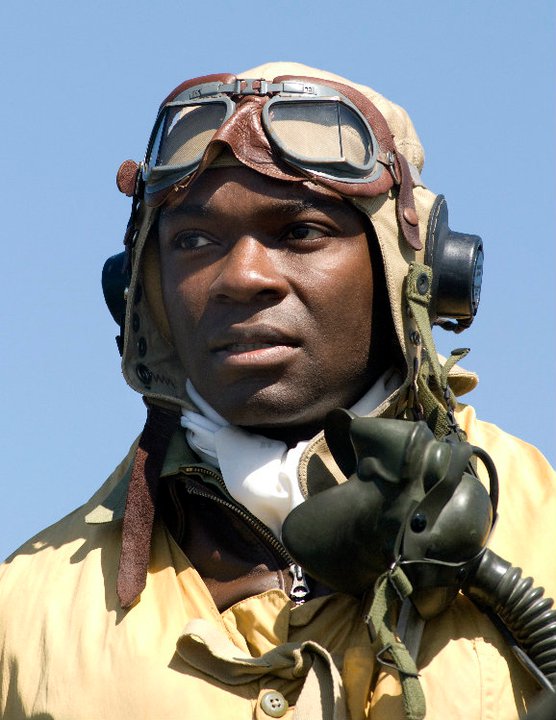
Like Francis Ford Coppola's Tucker: The Man and His Dream (which he also financed), Red Tails is the movie that George Lucas has waited the longest to make.  In development even before the "Star Wars" prequels, the story of the Tuskeegee Airmen has been on Lucas' mainframe for over 20 years.  And as with most director "Dream Projects," this one had the potential to soar into great summits of excellence or tail-spin into an exercise of excess and pretentiousness.
Red Tails is neither one of those, but it does do some interesting things along the way.  Respectful of the airmen, and "gung-ho" enough to end with "America The Beautiful" playing out over the End Titles,  it does remind one, in spirit, of the old war films, that appeared during and immediately after the second world war,** tough, haggard, slightly cranky, and all-too-willing to bring up some risky aspects of the vet's experience that would be tossed under the rug of homilies that later "recruitment" war films would present.  At the same time, it plays things a bit safe, dramatically, while, in subtle ways, taking chances that modern audiences—thank God—might not be aware of.***  It follows a typically diverse group of air-men with defining cliches—the "hot-shot" (David Oyelowo), the alcoholic (Nate Parker), "the kid" (Tristan Wilds"the yokel" (Ne-Yo)—through their story-arcs, fighting on two fronts—against the Nazis and their own brass and fellow soldiers, who, if not wanting to shoot the pilots out of the sky, didn't want them in the air in the first place.

One good thing that sets Red Tails apart from the other "yes, they fought too" films is there's no "white-wash" element (as one finds in a good effort like Glory, where a forgotten story about the participation of black soldiers in the Civil War, has to feature Matthew Broderick and Cary Elwes over Denzel Washington, Morgan Freeman, and Andre Braugher). These guys are on their own. There's no angelic white-devil's advocate that has to make the condescending "these are men" speech and, if anything, here, the white guys are pushing against back, making this film a lot more dramatic than your standard "liberal guilt" trip, where everybody's mind miraculously changes once "they're" "given a chance."****  The pressure never lets up on them and the only time they don't have to be on the defensive is in the air, fighting. Their inclusion in the war effort is a convenience, taking pressure off the other guys, and nothing noble. Doesn't matter to the pilots, though, as long as they're free of Earthly bonds, fingers on the triggers and Nazi Aryans in their sights.

And the battle scenescomplex, nasty and dangerous as the dog-fights are— are where Red Tails excels.  The same visceral energy of the Death Star battles (which were pre-visualized with edited WWII dogfight footage) is here, but with a rougher edge, bumpier, and more of a sense of true danger than a battle in space could provide.

Why'd it take so long?  Probably because Lucas wanted to do this one right (and also because studios were reluctant to finance a movie this black-centric), so he took the back-seat producer job, wrote the frame-work, hired John Ridley to write it and director Anthony Hemingway to film it, then doing some re-shoots (reportedly written with "Boondocks" creator Aaron McGruder) to do some dramatic streamlining.*****  Usually, it works with Lucas projects, especially when the director is strong, like Spielberg; there's a dramatic frisson that happens when it's not a "one-man/one-vision" project—something that was missing from the "Star Wars" Prequels, which suffered from too many "yes-men"—and Lucasfilms always seem to be better when he has to compromise and think off the top of his head...or someone else's.

One still gets a sense, though, of pandering.  The film Tuskeegee's don't need the "hey, these guys are good" comments that drop like leaden bombs throughout the film's second half.  As an audience, we can see it, we don't need to have it re-inforced by the white pilots they're escorting, especially considering those flight sequences are the best thing in the film.  The energy, thrills and derring-do (with their frequent "Yahoo" moments) are far more emotionally satisfying and communicative of the pilots' excellence.  Those sequences make Red Tails reach great heights, when everything else is trying to keep it grounded.  They didn't play it safe.  There's no good reason the film should.

Red Tails is a Rental.

The first wave of Tuskegee pilots

* A variation of the "trope" "Black Dude Dies First," which is a truism in "easy" drama and always struck me as being seminally racist.  In a war situation, with an all-black cast, it isn't true, and feels far less manipulative than in most war films.  In this war film, people die because "war is dangerous and people die in war."  It's random, unfair, and serves no purpose—not even dramatically.  That was an important take-way from this particular war film.

** This was in the 1940's, kids.


*** It's a bit soapish, but there's a romance between "hot-shot" pilot "Lightning" and an Italian girl, where nothing (blissfully) is mentioned about race, making the sequence seem idyllic, but also not clueing modern audiences in to the fact that if the same events happened in the country the pilots were fighting for, he would have stood a good chance of going to prison or being lynched for it.  It passes without comment or explanation, which might be dramatically risky, but sure feels good.  Real progress is made when the un-usual becomes commonplace and antique words like "miscegenation" disappear like disgarded, rusty tools.  Racial prejudice is SO "last century."

**** Even so, there's still a little too much of it, done mostly in voice-over behind masks, as if in post-production after-thought.  The screen-actions speak louder than any number of patronizing words.

***** Not sure where those sequences are—I'd only be speculating—but at one point "the kid" is shot down and put in a Nazi POW camp—the same camp that was the origination of the events and the film of The Great Escape.  Amusingly, there is one sequence that looks shot-for-shot like a sequence from the John Sturges film with "the kid" in the role played by Steve McQueen!  Heh.

Tuesday, February 15, 2011

"What Dreams May Come" and Frequent Cryer Miles

What Dreams May Come (Vincent Ward, 1998) One cannot divorce oneself from who we are when we see a movie.  Our day-to-day existence informs but also colors our perceptions. 

It's like recording a sound in an environment.  My other job is as a sound designer.  Recording a sound takes a certain kind of awareness; you must keep in mind that when you record the sound of something in the world, you are also recording the world it is in.  I can't calculate how many people have approached me with a recording they made and asked "can you take out the echo?"  No.  You can't.  "Where did you record it?"  "My kitchen."  All those reflective surfaces.  It would have been much better and easier (not to mention more possible) to have taken the recording out of the kitchen than to take the kitchen out of the recording.   

So, too, with watching movies.  Our environment, both spatial and emotional, at a particular moment in time in our lives affects the perception of that movie, changing it in our eyes and our minds.  It is another example of the Observer Effect, and one who watches a lot of movies (or writes about them) would do well to try to hit "reset" in one's expectations before seeing a film.

But one can't always do that.  I first encountered What Dreams May Come—an adaptation of Richard Matheson's fantasy/psychological novel by New Zealand director Vincent Ward—on an airplane while on a long polar flight to Copenhagen, the first leg of a trip to Scotland with my wife.  18 hour airplane rides are brutal—you're trapped in a tube mere inches from instant death, doing something humans don't naturally do in an area of space where they don't naturally survive.  If something goes wrong, pffft.  But, things rarely go wrong, in less proportion than highway accidents do, and the vast majority of people get where they want to go.  Competence with small measures of brilliance improve our odds.  So planes, which are constantly in the air, rarely crash...which is what makes it news when it happens.

But the vulnerability must weigh on you. 

So, this film, What Dreams May Come: Dr. Christian Nielsen (Robin Williams), a pediatrician, meets and marries Annie Collins (Annabella Sciorra), a painter.  They have a couple of kids and live an idyllic life, until the children are killed in a car crash, sending Annie into a crippling depression that institutionalizes her and threatens the star-crossed marriage of "soul-mates."  Christy's dedication to her pulls her through, but when he is also killed, she spirals into a suicidal fugue state.  Christy's spirit monitors her for awhile but, sensing he's doing more harm than good, moves on to Heaven...or his version of Heaven.


It is a vision shared between his painter-wife and himself—landscapes that she has created—and, initially at least, it is made of paint. 


It's a vivid sequence* (for no small reason What Dreams May Come won that year's Oscar for Best Visual Effects), a combination of photo-realism and impressionism: flowers are crushed and dissolved into gooey oils, foot-prints smear into mud-consistency rainbows, the sky is filled with moving van Gogh-style clouds.


But one man's Heaven... In the land of the living, Annie cannot cope with the loss.  In a heart-breaking sequence, she paints a single purple-tinged tree with appears in Christy's after-life, then, despairing, she destroys it with solvent, and Christy watches, horrified as the tree sheds its blooms and dies.


Annie ultimately commits suicide, which condemns her to her own Hell, and Christy risks everything to, Orpheus-like, rescue her from her fate.  The smearing of real-life and various after-life myths may have been too many leaps of disbelief for modern audiences to hurdle and the film, despite its many visual splendors, did poorly at the box-office.

Truth is, it's something of a wallow, a morose contemplation of life, death and mythic love.  Seeing it now, one notices the ardent manipulation and contrivance that informs the scenario, however masked it is with wonder and amazing conceptual imagination.  It borders on the hysterical—the sort of film that I usually dismiss with a churlish "Why doesn't everybody get a good night's sleep and start fresh in the morning?"  Or, that's what I say when my feet are planted on terra firma.

But, in the sky, in the lower stratosphere between 29,000 and 39,000 feet, it had a different effect.  Both my wife and I were reduced to choking, burbling sobs as the struggles of the souls on-screen turned us to puddles of goo—not unlike the flowers Christy squeezes in his hands.  You'd think someone had really died as we were inconsolably grieving in our little pity-party in coach, tears streaming down our cheeks, noses running, tissues shredding, and hearts breaking—and this was the last film shown before landing.  We were going to be hollow-eyed, snuffling little woebegones getting off the plane—and, indeed, when the lights came up, a stewardess glanced at us in a way that suggested there wasn't enough glazed peanuts in the world she could give us to cheer us up.

I have been thinking about this off and on the last ten years, wondering why What Dreams May Come was so powerful in-flight and not so much on the ground, when an episode of Chicago Public Radio's "This American Life
" recently offered up some anecdotal evidence of elevated emotionalism on flights in a segment entitled "Contrails of My Tears." In it, frequent flyers talk about the incidents of crying at sentimental movies, making mountains out of mole-hills, and generally acting like they'd just had a hit of steroids...or any performance enhancers.  That may be the answer.  It might not, but I'll take an explanation of why this film had such an effect that one time...and that one time only.

Beautiful movie, though.
Post-script: The issue of emotional movies on flights has not gone unnoticed. Virgin Atlantic now offers "weep warnings" before the showing of "emotional movies." The last time I felt really emotional during a movie was when I realized I'd spent $28.00 on a 3-D double bill of Cars 2 and Transformers: Dark of the Moon. Wonder if that qualifies...

Reminds me of a story of a man who took a flight with his wife who was suffering from Alzheimer's Disease. At one point during the in-flight, she leaned over to her husband. "If you don't like this movie," she said, "we can always leave." I'm just glad they weren't seated near the exits.


* Part of the reason for that vividness is the film stock that Ward used making the film, Fuji
Velvia film, known among photographers for its color reproduction properties.  The colors pop out on the screen and are some of the most beautiful, fanciful images ever to grace a theater screen, an extreme example of what can be accomplished with the twin media of art and science.  Isn't that what photography, boiled down to its basics, is?