Showing posts with label Gene Hackman. Show all posts

Saturday, July 6, 2013

I Never Sang for My Father

I Never Sang for My Father (Gilbert Cates, 1970) Family drama about older kids (Gene Hackman, Estelle Parsons) struggling with what to do with their elderly parents (Melvyn Douglas, Dorothy Stickney) and the way emotional buttresses are formed between generations to prevent "in-home care" for the elderly. 

It's a simple equation: kids want their lives, and parents want their lives back.


Gene Garrison (Hackman) is an author/college professor who's the chief care-taker/"baby-sitter" for his elderly parents, who have just returned to upstate New York from their winter home in Florida.  Mom's frail, as is dad (Douglas), but he won't admit it.


Gilbert Cates produced the play on Broadway (where it starred Hal Holbrook, Alan Webb, Teresa Wright and Lillian Gish), and directed it (such as he did) for film.  It's not great work, hand-held, close-up stuff that basically gets out of the way of the actors, with a bit too much transitory busy-ness—there's a lot of walking out of rooms as if that's going to stop a conversation, but it doesn't.  Cates went on to a career of directing mostly TV movies, but became most famous for producing the annual Oscar telecasts.


One hesitates to come down too hard on I Never Sang... because the issues are familiar if limited to the personalities involved and the selfish motivations of such, but the acting, especially by Douglas, Hackman and Parsons is note-perfect and feels real.

It's just that the film is dully presented, and looks like an after-school special for those going through a mid-life crisis, and it ends, never resolving the issues or presenting any ideas or insights.  To do that would involve compromise and none of the characters are willing to, while the movie itself does so at every stage.

Gene Hackman has retired from films and acting, but it would be nice if he would grace audiences with his take on the Douglas role, just to see what he would do with it.

It is interesting to note that the "Death ends a life" monologue from the play/film is considered one of the most "overdone audition monologues" in theater.


Tuesday, April 26, 2011

The French Connection

The French Connection (William Friedkin, 1971) Peripatetic police thriller with discernible street-grit in the film-emulsion, The French Connection, adapted freely from Robin Cook's "True Crime" book, tells the story of two New York police detectives Eddie "Popeye" Doyle and Buddy Russo (Gene Hackman and Roy Scheider, playing the noms de film of real-life detectives Eddie Egan and "Sonny" Grosso) tracking a high-level cocaine operation from overseas. 

The French Connection won the Best Picture Oscar, which seems like a good choice until you realize it was in contention with A Clockwork Orange and The Last Picture Show (as were Fiddler on the Roof and Nicholas and Alexandra).*  Then, the choice feels as safe and conservative as can be.  Yes, it's gritty.  Yes, it's "edgy," but does it have anything to say, besides that sometimes the good guys have to be rough with the bad guys in order to break even on the law and order scales, and that outlaws have an easier time of it simply because they're outlaws, bending the rules?

Not really.  But The French Connection did take police procedurals in another direction.**  The cops were less formal in their attire and language, and tougher in their asking questions.   Friedkin took a near-documentary approach to the subject matter (with the help of Owen Roizman's inelegant constantly searching subjective cinematography), while conveying the frustration that cops, though maybe not crossing the "T's" and dotting the "i's" on the letter of the law, go through to try to achieve a legitimate, legally-binding collar.  One is left with a morally ambiguous ending in which lines are crossed to merely achieve a semi-positive result, as opposed to the greater good.

And everyone remembers the car chase.


But, the biggest through-line of The French Connection is Friedkin's constant contrasting of the cops and drug-dealers as diametrically opposed in almost every way.  Charnier (Fernando Rey) and his traffickers travel and conspire unimpeded, while the detectives skulk and blend in with the savage streets and observe their targets working out in the open.  The criminals live the high-life, dining and dressing elegantly, while the cops sit in the cold, eating stale sandwiches and swilling bad coffee on their stake-outs, dealing with bureaucracies and competing enforcement agencies, as the bad guys routinely handle such impediments punctually with gun-fire.

It is only at the end when a police road-block stops the conspirators in their tracks that the tables are turned, and the lines blur, and the ambiguities become real.  And what is essentially a police chase has no discernible finish line.


The real-life Eddie "Popeye" Egan with the fictional Sonny Russo  (Roy Scheider)


* It was also the year of Straw Dogs, Dirty Harry, McCabe and Mrs. Miller, Walkabout, Carnal Knowledge, Klute, and Harold and Maude, none of which made the Best Picture category and in some cases, received no nominations, at all.

** Wikipedia has a funny story about Friedkin's behind-the-scenes decision-making.   The director was living with the daughter of legendary director Howard Hawks, who suggested that since Friedkin's pictures were "lousy," he should put a good chase in the movie "better than anyone's ever done."

Friday, January 30, 2009

Olde Review: The Conversation

This was part of a series of reviews of the ASUW Film series back in the '70's. Except for some punctuation, I haven't changed anything from the way it was presented, giving the snarky, clueless kid I was back in the '70's a break. Any stray thoughts and updates I've included with the inevitable asterisked post-scripts.

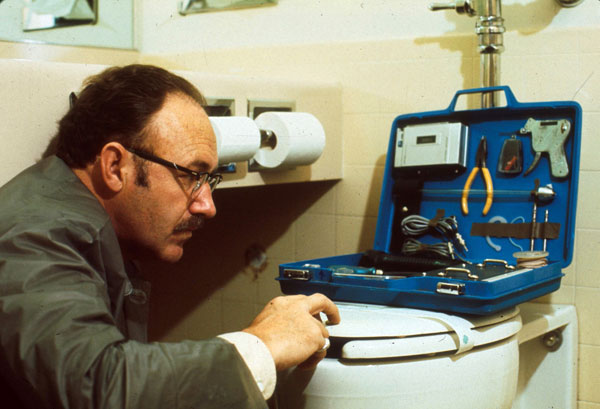
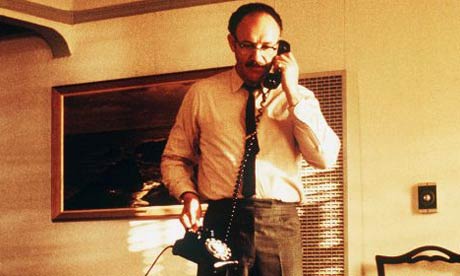
"The Conversation" (Francis Ford Coppola, 1975) Harry Caul (Gene Hackman) is an electronics expert dealing in surveillance. His latest assignment is to record a conversation between two very innocent young people in the park. It's a routine assignment, one that Harry handles with a perfectionist's care. But after he has the raw tape—after he has clarified it and re-channeled it—he hears a whispered fear that these two kids may get killed by Harry's employer. Old haunts plague Harry—past assignments he has carried out that led to his victim's deaths. And so he goes to confession to confess what may be a future sin. Confession—where one's private actions that are considered to be sins are revealed to a priest in order to free the sinner of guilt. But this too, is a surveillance—an invasion of one's privacy—ritualized in the name of religion. Surveillance is a part of our lives, then. And privacy is an illusion.

That scene in the confessional is about as close as
Francis Ford Coppola comes to really dealing with surveillance in his film, "The Conversation." Despite what many critics have said, Coppola makes no judgements on this subject. Surveillance is simply there as a device to be used for the movie. It's neither good nor bad. It's there to provide Coppola with a means of getting into a rather shallow appearances-are-deceiving mystery story—it's a very weak imitation of Antonioni's "Blowup." When Harry Caul is caught in a surveillance trap ala his own devising, are we supposed to feel some satisfaction in this? Just because he's getting screwed, like he screwed all the others? Is surveillance justified in retribution, in other words? No. How can we take satisfaction in that? For surveillance — the ripping open of one's privacy — is being used, and nothing, really, not even revenge should make us condone it.

Awright, already, W______is it a good movie?

Okay, okay. Yeah, it's a good movie. It's...entertaining, in a shock-lull-shock-lull sort of way. Coppola has made a good movie, despite my reservations as to his morality on the subject. It's an o-k script—a little spare at times—with a lot of loose ends, and his direction is always assured. Gene Hackman manages to flesh out Harry Caul enough to make him an interesting person to watch for the couple of hours we do. And there is fine supporting acting from
Allen Garfield, John Cazale (the weak brother, Fredo, in "The Godfather"), Frederic Forrest, Cindy Williams (she's good, despite the fact that she's totally mis-cast) and Robert Duvall (who is on for a very short time and doesn't receive a credit). But, the one thing that is technically outstanding is the sound of the film, produced by the work of its chief editor Walter Murch. Murch also worked on "The Godfathers" for Coppola, and creating what he terms "sound montages" for George Lucas' "THX-1138" and "American Graffiti." His talents with editing and sound mixing are outstanding,and hopefully Murch will, himself, be directing his own films.

Broadcast on KCMU-FM on January 27-28th, 1976

Murch would, indeed, direct one film (so far)—"Return to Oz," in 1985—and it tanked. His intention was to make a genuine adaptation of one of L. Frank Baum's "Oz" books, rather than what the public was expecting—a sequel to the 1939 classic "The Wizard of Oz." And his heart-felt, but scary, recreation of Baum's world didn't click with audiences. One would be sad if Murch didn't then personally supervise the entire post-production process of about one film per year. Films like "Julia," "The Godfather: Part III," "Romeo Is Bleeding," "The Unbearable Lightness of Being," "Ghost," "The English Patient," "First Knight," "The Talented Mr. Ripley," "K-19: The Widowmaker," "Cold Mountain," "Jarhead," and Francis Coppola's latest films. Busy guy. Eclectic talent.

This movie has dogged me my entire career, because it was assumed that, because Harry Caul could electronically filter out steel drums from the background of a murmured recording enough for you to hear what the people were saying that any sound facility could do it, too. No. Not really, you can't. You can tune, you can attenuate, you can try reversing the polarity of a channel to eliminate shared sounds on both channels of a stereo recording, but steel drums? That's a good one. They call that "Movie Magic."

But the kid is right...this is warmed-over "Blowup" without the illusion of film-making, or illusion of illusion that makes that film so compelling. At least it's better than cold, left-over "Blow-Up" like
Brian De Palma's "Blow OUT" (in that, film recordist John Travolta must piece together a Chappaquidick-like incident from his sound-recordings and pictures taken from a "Zapruder"-like film--it doesn't pass the incredulity test). And Coppola has to resort to a "cheat"—he changes the actual recording, the one element in the movie that has to be set in stone, to come up with his conclusions. One could make a case...blah blah blah, the fact is, interpretation or not, he planted a card in the deck.

It is, though, a really good paranoid thriller of the type that seemed to be born of the post-
Watergate era. And Hackman's insulated Caul is another example of how that actor can take an under-written part (deliberately, I should say--Caul doesn't talk much on purpose) and make him a living, breathing human being you can recognize and, despite his many failings, sympathize with. There is one actor I didn't mention because I didn't really know who he was...yet. He'd made a living doing parts on television, and done a small role in "American Graffiti," but after this film he was about to quit acting and go back to carpentry when a role in a sci-fi movie by Coppola's pal George Lucas changed things for him. Harrison Ford has a small role as "The Director's" menacing assistant.

Oh...the reason I made such a big deal of the confessional scene? I used that to start off the recorded version of this review.


In 1995, "The Conversation" was chosen to be a part of the National Film Registry by the Library of Congress seeing it as "culturally, historically, or aesthetically significant."


Monday, August 4, 2008

Night Moves

"Night Moves" (Arthur Penn, 1977) Harry Moseby (Gene Hackman) is your classic detective as tarnished knight. A lone-wolf ex-jock who plays the cards he's dealt and holds them close to the vest. Nobody gets in, not his wife, not his clients, not even his acquaintances. To accentuate the point, Director Arthur Penn surrounds Harry with glass and view-screens. He's a detective--a peeper--and he's always peering through thosee wind-shields, portals, and glass-bottomed boats at the world, though a little filtered, a little distorted. They are part of his job, but as they also provide him a view, they are also a hinderance...and a refuge. He can look through these transparent barriers, but he can't touch. And no one can get through to him. Frequently--so frequently you can't miss their use--the windows have one of those distorting fish-eye aplliques that bend and distort the world in a round, limited circle--a fish-bowl--appropriate for someone so myopic as Harry.

Harry's a loner, so much so that he won't take a job at an information mill because it's "not for him." And he's got a big mouth but just enough suppression instinct that the one it hurts the most is him, and a snide sense of humor that rubs the wrong way. He's so set in his ways that this old dog that won't learn new tricks has begun to chase his own tail. He's investigating himself, or rather, his wife, who's been stepping out on him. When he exposes the affair, everybody involved throws Harry's history back at him, something he avoids at all costs. He's more comfortable analyzing other people's problems to look at his own.

The screenplay is by
Alan Sharp, and Harry is another solitary guy on a "last run," at a cross-roads that he'll turn after he's done one more job. He'll quit while he's ahead. But his timing is a bit off. The movie starts just as this one case begins: a dirt-job for an aging starlet whose slut of a daughter (Melanie Griffith) has run off to the step-father. It's a family in the Chandler-mystery mode, good money can't hide bad blood-lines. Mom wants her back, but not out of some familial bond. She just wants the child-support. So, Moseby takes a long trip to Florida to try and convince the kid to do something neither of them thinks is a good idea: Go back. And, as in Chandler, that case is just the tip of a dangerous ice-berg, one that improves Harry's vision, but only with 20/20 hind-sight.

When I first saw "Night Moves"--back when it played theaters, I was unimpressed. Now, seeing it at an older age, it looks like a masterpiece, the understated classic that some have said it was. The movie hasn't changed...but I have, and I appreciate the issues in it, and see it with a much better clarity than when I was younger. Getting old does that. I'm just lucky enough to be getting
old.

Wednesday, June 4, 2008

Superman II: The Richard Donner Cut

"Superman II: The Richard Donner Cut" (Richard Donner, Richard Lester, Michael Thau, 2006) Call it "The Richard Donner Cut" in name only. Donner had nothing to do with it, except give it his tacit approval--and express amazement that anyone cared so much to find the lost footage that he had shot (simultaneously directing "Superman: the Movie" and "Superman II") and assemble it to make some semblance of the film that Donner and final script-writer Tom Mankiewicz had in mind from the beginning.

But a lot of fan-boys did, noting a slight change of tone in the three years between I and II. A lot had happened: the firing of Richard Donner over "creative differences"(those being he spent too much money, he cared too much about the movie to worry about the budget, and he wasn't a toadie to the producers), and the replacement with Richard Lester, no slouch as a director, but who didn't give a rat's ass about superhero movies. Web-sites had for years been acrueing sightings of bits and pieces of "Donner" grail from International versions and "Expanded" television showings, and Michael Thau who assembled this thing, created new effects (a bit crude), re-edited John Williams' original score and Ken Thorne's work on "II,", and grabbed whatever footage he could (including for one crucial scene only available from Margot Kidder's and Christopher Reeve's auditions) to create this dog's breakfast of a "movie."* It is incomplete with big holes in the narrative, and with only crucial Lester-directed scenes grudgingly included--Donner and Mankiewicz grouse and complain about the changes made to "their" movie in the commentary but do give Lester (never named) and the re-writers some credit once. It makes a one-on-one comparison dodgy and a bit unfair, in both movies' favors.

The first thing one misses (after goggling over alternate takes and a wealth of new Marlon Brando and Gene Hackman footage--all shot by Donner, he only had them for a limited amount of time) is the cracker-jack/spin-on-a-dime editing of Stuart Baird, who cut the first Chris Reeve "Superman" film. The relative pace of this film, by comparison, is slack, alarmingly so. Donner and Baird in the first were far more brutal in their cutting and it made for a dynamic experience.
But I have to give the nod to the Donner cut, first, because they remained faithful to the source, and, second, because they made a far-more interesting two-movie arc than combining the first with
Lester's Version. Let me explain.


Whatever money the Salkinds made, they blew it artistically, because "Superman"/"Superman II" as Donner/Mankiewicz intended, was one of those rare things--a "religious film without Jesus." Yes, there are those direct parallels that Bryan Singer picked up on (and made too much out of in his "Superman Returns") of the Father who bequeaths his Only Son for Mankind. But it goes further. It also makes a direct, dramatic use of that ambiguous phrase Jor-El line "The Son becomes the Father, and The Father, the Son." It brings closure to Superman's ties to his home-planet and abandons him completely to Earth. It also shows why Kal-el deserves the name of "Superman." And it showed a much better performance by Christopher Reeve, than was ever displayed again in the series. The actor in Reeve played Part One, so he could sink his acting chops into Part Two. Not using the Donner segments robbed people of seeing a pretty incredible Reeve performance.

Jor-El, Superman's father--played by Marlon Brando, plays a critical role in Part II. When Lois Lane's movie-length attempt to unmask Clark Kent as Superman comes to fruition, they whisk away to his Fortess of Solitude for some alone-time, and Dad does not approve, chastising Kal-el for hubris and selfishness, telling him his reward is the happiness his good works provides. But Kal wants Lois ("this human," Jor-El dismisses her), and to do that, he must live as one of them, and have his powers removed permanently by a "red-sun generator,"** which will make him an ordinary man. Kal-El steps into the chamber and as the process strips him of his powers, Jor-El casts a disapproving look at Lois Lane.

The human couple, Clark and Lois, leave the Fortress, the diner scene happens where Clark gets beat up, and learns about the Kryptonian villains taking over the U.S. government. Realizing what he's done, and there's no one but him who could stop them. he treks back to the empty Fortress, the crystal controls he used to communicate with Jor-El obliterated. Kal-El breaks down, acknowledges his weakness and mistake and hears nothing in reply. Finally, he cries out "Father!"

Donner (and Thau) cuts to a far-shot as the cry echoes in the crossed beams of the Fortress. And one recalls the words of Christ on the Cross: "My God, My God, why have you abandoned me?"

But there is a shred of hope. Or a shard. Amidst the rubble, the original green, glowing crystal that Kal found in his Exodus-ship is still glowing, and with it, he is able to contact Jor-El one last time.

Jor-El admonishes Kal for his transgression, and tells him that there is only one way to get his powers back, and that is to transfer the final energies that allows them contact; for Superman to regain his powers will destroy the last vestiges of energy that is the Jor-El "program." Kal-El is reluctant, but Jor-El begins the process, appearing to him corporeally to touch as they say goodbye and to transfer his power to his son, destroying himself: The Son becomes the Father, and the Father becomes the Son.

Kal is knocked unconscious, the other crystal conduits are destroyed. There's the battle with the Kryptonian villains (but without the expanding sticky "S"-shields and simulacrum tricks, per Newman and Lester--what? Superman's powers aren't enough?), Luthor is carted away, and then the coda: Superman flies Lois out of the Fortress, turns, gives it one last look, opens his eyes...wide, and destroys the Empty Fortress with his heat-vision. Here are frames from that sequence, without any further explanation--but one more Bible quote:

"When I was a child, I spoke as a child, I felt as a child, I thought as a child. Now that I have become a man, I have put away childish things."
1 Corinthians 13:11


Yeah, I wouldn't call it "The Richard Donner Cut." I'd call it "The Last Temptation of Superman."

For all its patchwork quality, for its holes and inconsistent effects, I'd still have to say I prefer "The Donner Cut," as it maintains the consistent vision of the first movie and brings the story proper to a conclusion. The Lester Version let go of the internal logic for thirty pieces of silver, and undermined the biblical implications to replace it with slapstick and inconsistencies from out of left-field. One is left unsatisfied with both, and pining for the greatest super-hero film ever made.
------------------------------------------------------------------------------------------------
*Okay, some history: Between the first and second films, Donner was let go and Lester was hired. For financial reasons (the producers didn't want to pay him his full salary), all of Marlon Brando's scenes for the second film were scrapped and Susannah York brought in to play Lara, Kal-el's mother (who never appeared post-Krypton explosion in the first film) from beyond the grave. Gene Hackman's footage was used, but cut way down. Why? In order for Lester to recieve the director credit, he must have directed at least 50% of the movie, and so a lot of Donner footage was edited out to bring about that mathematical percentage, thus, Hackman's role of Lex Luthor was greatly reduced. A pity as Hackman is terrific in the movie.

** See, Krypton, Superman's home planet, had a red sun, so bathing him in "red solar energy" takes away all the powers that Earth's "yellow sun" gives him, and at this point everything breaks down because once Kal-el goes outside, he should get his powers back, but let's just go with it, because by the movie's internal logic, he should still have a "dense molecular structure" that makes him invulnerable, and he could still put up a fight with that. But why bring all this up, really? It's all dogma, which, I guess, is appropriate. Comic books, like a religion, require the faith of a child, willing to believe.


Friday, May 30, 2008

Olde Review: French Connection II

This was written November 5, 1975

"French Connection II" (John Frankenheimer, 1975) Fortunately, Friedkin's original "The French Connection" was on television last week, so that I was able to refresh my memory somewhat, as to what was there. As FCII is a sequel, it begs to be compared with its parent film. There isn't much difference alphabetically between Friedkin and Frankenheimer, but they are night and day on the screen. Friedkin in FCI punched the viewer with his action and cutting and forced people to crawl over the backs of their chairs because of it. Frankenheimer ain't no slouch, either, as one can see by his sequence on the Marseilles docks (I wasn't on the edge of my seat, but I was flinching a lot), or "Popeye" Doyle's (Gene Hackman) final chase down of "Frog One" Alain Charnier (Fernando Rey).

But Frankenheimer has a different emphasis in his film. Friedkin's characters are one-dimensional. Even the most fleshed-out character, Doyle, is reduced to quirks: his fetish for boots, his gun holster on his ankle, his "Didja ever pick your feet in Poughkeepsie?" line of questioning. Not so with Frankenheimer. He doesn't dwell on these (why should he, they've been done?), but fleshes them out. "Popeye," a stranger in a strange land, is reduced to having a drink with the only person who weill, the bartender. A sympathy develops for him that was never attained in TFC (just as their was a twinge of disappointment when TFC's famous car-chase ended, so I felt a twinge, again, when Hackman's "cold turkey" scene with Bernard Fresson, where a pitiful "Popeye" talks about his Catholic upbringing and sports--just one of those moments that are instanatly identifiable as "great.") Friedkin's people were there to be "blown away," an excuse for instant action, but Frankenheimer in most cases drags out the killing, allowing the viewer to get to know who's who before they're gone-gone.

Even the subject matter of the films reflect their directors. "The French Connection" was a pursuit film. We knew that "Frog One" was dealing in heroin, but heroin was an abstract term--it was bought and sold like candy--and Charnier could be afforded a little grudging admiration for his plot. Not so with Frankenheimer. In "French Connection II" heroin is no longer just a word. It's effects, its evil, is clearly displayed on the screen in vivid detail. Frankenheimer is a "feeling" director. Even Cathleen Nesbitt's "little old lady" is given sympathy by showing her a sweet, frail little thing, abansoned by her family, and then showing her gnarled hands, decimated arms and thieving habits.

Friedkin was action, with little heroics that weren't bordering on the obsessed. In FCII, even though battling for his life "Popeye" Doyle still has the time to try to save Barthelemy from drowning after being konked by a timber. When actions are obsessive and excessive (as in "Popeye" burning down the Hotel Del C______., as was his elevated train chase). Frankenheimer has the mind to show it as such by using a device common to Houston and Altman--by enveloping his subject in flame. The images that stick in my mind from this film are the ones that evoked a feeling in me from Frankenheimer's "feeling" direction--the ones already mentioned, Barthelemy's look of concern outside a locked door for that irritatinf foreigner jabbering inside the cell as he goes through withdrawal, the agnoy of stiffened limbs that is tangible to the viewer as "Popeye" tries to chin up, push-up, sit-up or jog. Oh, it is to be admired and appreciated.

Wednesday, May 28, 2008

Olde Review: Bonnie and Clyde

This was part of a series of reviews of the ASUW Film series back in the '70's. Except for some punctuation, I haven't changed anything from the way it was presented, giving the kid I was back in the '70's a break. Any stray thoughts and updates I've included with the inevitable asterisked post-scripts.

This Friday's ASUW Films in 130 Kane may comprise the best double-bill, with one notable exception, in the entire series. They are Arthur Penn's "Bonnie and Clyde" and Robert Benton's "Bad Company"


"Bonnie and Clyde" (Arthur Penn, 1967) "Bonnie and Clyde" caused quite a stir when it was released in 1967. It was one of the first gangster movies, at least within most casual movie-goer's memories (which isn't much) to treat these people not as psychopaths, but as ordinary people who were caught in the Depression's whirl-pool and didn't know any other way to fight it. In other words, it attempted to de-mythologize the Barrow Gang. Unfortunately, the film created as many myths as it de-bunked. But then what else can you expect when you have two "beautiful people" like Warren Beatty (who does a fine impression of Warren Oates) and Faye Dunaway (whose acting wasn't equalled here until "Chinatown" in 1974).

William Bayer in his book "The Great Movies"* has said "what is also personal about 'Bonnie and Clyde,' and constitutes its unique flavor is its curious blending of comedy and horror, its romanticization of crime as something that is fun, and that also leads to violent, bloddy death. 'Bonnie and Clyde' is both real and abstract, a gangster-movie and a comedy-romance. It is a comedy that turns dark, a romance that ends with death."

Death in "Bonnie and Clyde" is of an explicit nature. It was the first popular film to use the modern film technology to present a heightened violence that created the trend that is still going on today. Of course, no one forgets the slow-motion slaughter of the two at the end--"the dance of death"--it's dream-like quality, because Death's constant presence in their lives has turned it into a dream. Slo-Mo violence has been used after ad infinitum with no imagination and less effect**

There are other moments: the first violent death of a clerk;*** the performances of Gene Hackman, Estelle Parsons, Michael Pollard, Denver Pyle and Dub Taylor; Bonnie's escape in a corn field; the death of Gene Hackman; the comedic perfection of Evans Evans and Gene Wilder (in his first movie); and probably, best of all, the reunion with Bonnie's parents before their world falls apart.

Yeah, it is Arthur Penn's finest film. Borrowing from the past, but also using his own sense of cinematic imagery, Penn has made a complete, whole film--something that can't be said of his "Little Big Man," "Night Moves," or "The Missouri Breaks" with their only occasional moments of brilliance.

Maybe the reason Penn was so successful with "Bonnie and Clyde" is the material he had to work with--the script by Robert Benton and David Newman.**** Newman and Benton wrote it hoping that Francois Truffaut or Jean-Luc Godard would direct it. Arthur Penn was extremely lucky that they were unavailable. The two later scripted "There was a Crooked Man," and, with Buck Henry, co-scripted "What's Up, Doc?" In 1972, after writing for others and seeing them reap all the laurels, Benton-Newman wrote a script and Benton got to direct it, It was called "Bad Company" and in many ways it's a better film than "Bonnie and Clyde."

Broacdcast on KCMU-FM January 20th, 1977


* Sadly, out of print, and not to be confused with Roger Ebert's "The Great Movies" series of books. Bayer's book was a fairly non-controversial heavy tome with well-written appreciations and beautiful photographs. I've still got it, and still treasure it. I became acquainted with Ebert's two-book series over a weekend, and found them both very enjoyable in Ebert's typically "personal-relationship-with-the-movies" style. He's just increased the number of "must-see" movies by about 50. *Sigh* No rest for the wicked.
** The thing that makes "Bonnie and Clyde's" death in undercranked motion so well-done, as opposed to most that came after is attributable to the editing of DeDeAllen, whose scrupulous work for Penn and Sydney Lumet, raised it above the typical use of slow-motion, which is used for exploitation purposes. I might have been harping on Sam Peckinpah on this point, but even he only used flashes of slow-motion amidst a fast edited sequence to highlight a story-point, or prolong a moment of shock. Nowadays, the sequence looks a little tame.

***Based on a similar shot in Eisenstein's "Battleship Potemkin"--folks were getting into film-school references at this point.

****Benton-Newman also wrote the book for "It's a Bird, It's a Plane, It's Superman" the short-lived Broadway musical, which paved the way for them working on the scripts for "Superman" and "Superman II." Benton went on to direct such great films as "Kramer vs. Kramer," and my favorite of his films "Places in the Heart."

Tomorrow: "Bad Company"