Showing posts with label 1971. Show all posts

Saturday, October 19, 2013

They Might Be Giants (1971)

They Might Be Giants (Anthony Harvey, 1971) It's the same writer/director/composer team as The Lion in Winter, but a decidedly off-kilter product is this out-of-circulation curiosity from the era immediately following George C. Scott's Oscar win for Patton.  Set in the "modern" age, which might be quite a few years too late for it, They Might Be Giants—yes, it did inspire the band's name—tells the story of Justin Playfair (Scott), a retired judge, and in whose grief after the death of his wife, now thinks he's Sherlock Holmes.
That might be useful, actually, but Playfair is now convinced that everything wrong with the world (and there's a lot in New York around 1970) is the work of the infamous Professor Moriarty.  That includes the blackmail being played against Playfair's brother Blevin, who wants to pay up and be done with it, but the Judge, forbids it—and he's the one with all the money—so the brother decides to have him committed.  He picks the worst person in the world to examine the Judge in order to declare him insane, a psychiatrist named Watson (Joanne Woodward).

In the course of her examination, Playfair leads her on the wildest of goose-chases, trying to track down Moriarty, finding random clues in the detritus of the city, and introducing her to his own version of The Irregulars, the niche-dwellers all but abandoned by the hustle-bustling population and see nothing wrong in Playfair's behavior.  In fact, they marvel at it, admire it, and wish to emulate it.  Meanwhile, Holmes and Watson run the gamut of scenes of crimes displaying apathy, greed, gracelessness, and rampant consumerism in Society while Playfair rails against Moriarty's presence behind it.  Watson serves as the Doubting Thomas (Scully to Scott's Mulder?), but eventually succumbs to Playfair's way of thinking.

The writer is James Goldman, brother of William (The Princess Bride, Butch Cassidy and the Sundance Kid, The Marathon Man), writer of the afore-mentioned The Lion in Winter, as well as Robin and Marian, Nicholas and Alexandra, and...White Nights.  And the problems with the movie is in James' screenplay, full of wonderful detail and dialog, but precious (to the point of cloying) in scene concepts relating to the larger point.  The mystery's good, but the clues suck.  Fortunately, he's got actors like Scott, Woodward, Jack Gilford, Rue McClanahan, F. Murray Abraham, Al Lewis, Gene Roche, Paul Benedict, and Emmet Walsh, all of whom can spin gold from cotton candy, but can only go so far to improve the material.

The film is as twee as twee can be, more in keeping with—Vincent Canby had a good idea in his negative review—the time of You Can't Take it With You and Arsenic and Old Lace and the sunny-side-up attitude (despite eyes being open to the negative) of Frank Capra.  But it's not Capra, it's Anthony Harvey, terrific editor and Hepburn-favorite director.  Harvey's really good at designing a film, its ambience and lighting, but he's not the best at forming image to idea, which the best directors can do merely by having empathy with the material.  Harvey doesn't judge in his projects, but he also rarely comments at all, good at staging, but not at direction...that is, direction of you, the audience to a feeling the material should provoke.  For a former editor, his weakness as a director is editorial. Odd.

The analyst in me cringes at the movie in its romantic notion of insanity—I've long wanted to do an "out there" version of "Harvey" where Elwood P. Dowd self-medicates in all sorts of ways besides booze—but, the wide eyed moon-calf who first saw this film (probably to hear the score, as I am a Barry fan and will see anything with Scott in it), still has an affection for it, guarded though it has become, and probably for its ending, which drives audience members looking for answers crazy and let down, but for me, is a perfect little nugget of an ending whose power (the acting,** the lighting effects, the music?) one can't explain away.  I'd put a spoiler alert here, but, really, this ending spoils nothing—it only enhances.


Sadly, John Barry's score for this film (conducted by Ken Thorne) has never been released.


* Here's two examples, both out of the mouth of Playfair:
"Because, you see, we live in Eden. Genesis has got it all wrong — we never left the Garden. Look about you. This is paradise. It's hard to find, I'll grant you, but it is here. Under our feet, beneath the surface, all around us is everything we want. The earth is shining under the soot. We are all fools."
and
 "Well [Don Quixote] had a point. Of course, he carried it a bit too far. He thought that every windmill was a giant. That's insane. But, thinking that they might be... well… all the best minds used to think the world was flat. — But, what if it isn't? — It might be round — and bread mold might be medicine. If we never looked at things and thought of what they might be, why, we'd all still be out there in the tall grass with the apes."
** Scott's feral growl and playing of "Now!  Do you see him now?" always gives me chills.

Saturday, February 2, 2013

The Anderson Tapes

The Anderson Tapes (Sidney Lumet, 1971) The second of five films Sean Connery made with Sidney Lumet, an unlikely pairing of the Scots actor and the New York director, but the two obviously enjoyed working together, as Connery's next project with him (The Offencewas one of the "vanity" projects he was allowed to make for returning to the role of James Bond in Diamonds Are Forever, and Lumet was Connery-picked to direct, no doubt in loyalty to the director, as their first project, The Hill, allowed the world to see that the star of the "007" films had a range that extended outside the spy field.

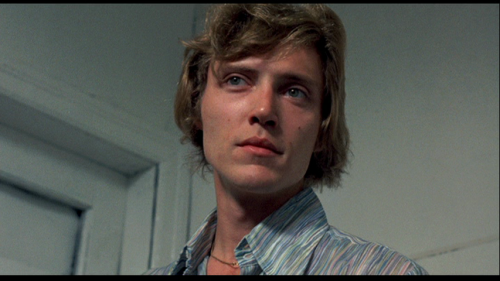
The Anderson Tapes, however, was a different creature, entirely.  An extended heist film, in which Connery, Martin Balsam, and (introducing) Christopher Walken participate in what must be the slowest caper in history, the casing of a luxury apartment building in New York City.  Connery plays Duke Anderson, a con just released from a ten year stretch in prison, who can't wait to do another score. The inspiration is his girlfriend Ingrid (Dyan Cannon), a high-end call-girl, who has been set up in a luxury apartment by another man.


But, things have changed in the ten years since Anderson was free.  Unbeknownst to him, he is under constant surveillance by three different agencies: Ingrid's apartment is bugged by a private detective hired by her "keeper;" the FBI is tracking Black activists, whose headquarters is at a flop where the thieves meet; the IRS is phone-tapping the Mafia Boss (Alan King), who is funding the heist; and the Bureau of Narcotics is keeping tabs on one of the group's members.  All of these groups are keeping a running record of the planning of the break-in...but none of them are coordinated or sharing information,  and the surveillance work is so concentrated on their individual subjects, that nothing is put together to prevent it from happening.  It's hard to determine exactly what is being decried here—that our privacies are being invaded to such an extent, or that this intelligence isn't being cross-referenced to prevent actual crimes and is...dumb.  One gets the impression that there is no stance being taken, rather it's to present A Big Irony, that undercuts how events play out, eventually.  But, that was Lumet's specialty—he frequently spaced his flat-out movie drama assignmnents with "Ironies," (as opposed to "Comedies") that, their point having been made half-way through the movie, wear out their welcome by the often dissatisfying end of the tale.  Everybody looks a little stupid here: the agencies, for their tunnel-vision, the crooks for their own utter lack of surveillance as the crime goes about, and the NYPD, whose very elaborate storming of the apartment complex is literally over-the-top.

Lumet was not the best director for comedy as he had a tendency to sledge-hammer things—like Martin Balsam's mincing interior decorator/antiques smuggler (yeah, yeah, "it was the times," I suppose), but there are some joys to be had, besides Connery doing something different and Walken's debut: appearances by Max Showalter, Margaret Hamilton (her last role), and "crazy old lady" Judith Lowry, as well as Ralph Meeker and SNL pioneer Garrett Morris as Gotham police.  

Lumet would hit his stride later in the decade (with the sure editorial hand of Dede Allen), but this one is only moderately successful.

Tuesday, July 10, 2012

Directed by John Ford

Directed by John Ford (Peter Bogdanovich, 1971, 2006) Bogdanovich's primer is a "viewer's digest" of some big things that that made John Ford such a powerful director not only in individual films, but also across a career of experience.  Generous clips from throughout his acreer illustrate points, punctuated by talking head clips from the '71 version including Ford himself (who is not very helpful, to say the least—by saying the least*—and is deliberately dismissive of the doing the whole critical analysis thing, much like a comedian hates to explain a joke, or a magician a trick), John Wayne, Henry Fonda, and James Stewart.  The 2006 update folds in Harry Carey, Jr., Maureen O'Hara, and analysis from Clint Eastwood, Martin Scorsese, Walter Hill, and Steven Spielberg, as well as Bogdanovich.  

The update has everything from the original re-jiggered to add more points, but there's more of a "legacy" feel to the thing, now, as the casts Ford depended on have dwindled—Ford was still alive during the first version—and so the next generation who grew up and learned their craft sitting in the theater watching Ford's images talk about "what John Ford means to me."  Also, as the man is gone now, there's a bit more psychological analysis and more delving into the man's irascible personality, already on full display in his interview.


But there is one troubling aspect to this "new" version, something that stuck in my craw when I saw it (and no doubt would result in Ford caning Bogdanovich if he got wind of it).  There is a brief (very brief) examination of Mary of Scotland, Ford's only film with Katherine Hepburn, and the subject of much speculation over what their relationship was.  A sound clip is played of Hepburn's visit to Ford days before his death.  The tape was allowed to run continuously, and their parting words to each other are played, words that they had no way of knowing were being recorded, and words that might not have been said if known they'd been overheard (Ford specifically asks her "Are they gone?").  It's nothing scandalous or huge.  Ford merely says "I love you," and Hepburn says "it's mutual."  But it feels like a violation of the departed by the parties that recorded it and who have re-presented it.  And far too much is made of it (Really?  It was the inspiration for the names of O'Hara's and Wayne's characters in The Quiet Man?) in a gossipy, speculative fashion. These were, after all, words from people who must have known they'd never see each other again, and it's nice and it's lovely. But it's beneath the film, beneath Bogdanovich, and undercuts whatever scholarly impact the film might otherwise enjoy to make anything more of than the sweet parting gesture it is.  The worst part is...there's no one to rebut, no one to protest, no one to defend...or even better yet, to correct the speculation. Even Ford's maxim of "When the legend becomes fact, print the legend" doesn't cover this.

That aside (and it's my quibble, really), it's an invaluable first toe-dip into the films of Ford, and enriches the experience and appreciation of every film of his seen afterwards.  One thing Bogdanovich did right (besides getting Turner Classic Movies to bank-roll it, so more people would see it, the various clips from many sources being very expensive) is he kept the original's essential narration by Orson Welles, Ford fan and student.   The voices and faces and memories out of the past have as much weight and bearing as the films do, reverberating throughout history and time, feeling immortal and universal.


*

Tuesday, April 26, 2011

The French Connection

The French Connection (William Friedkin, 1971) Peripatetic police thriller with discernible street-grit in the film-emulsion, The French Connection, adapted freely from Robin Cook's "True Crime" book, tells the story of two New York police detectives Eddie "Popeye" Doyle and Buddy Russo (Gene Hackman and Roy Scheider, playing the noms de film of real-life detectives Eddie Egan and "Sonny" Grosso) tracking a high-level cocaine operation from overseas. 

The French Connection won the Best Picture Oscar, which seems like a good choice until you realize it was in contention with A Clockwork Orange and The Last Picture Show (as were Fiddler on the Roof and Nicholas and Alexandra).*  Then, the choice feels as safe and conservative as can be.  Yes, it's gritty.  Yes, it's "edgy," but does it have anything to say, besides that sometimes the good guys have to be rough with the bad guys in order to break even on the law and order scales, and that outlaws have an easier time of it simply because they're outlaws, bending the rules?

Not really.  But The French Connection did take police procedurals in another direction.**  The cops were less formal in their attire and language, and tougher in their asking questions.   Friedkin took a near-documentary approach to the subject matter (with the help of Owen Roizman's inelegant constantly searching subjective cinematography), while conveying the frustration that cops, though maybe not crossing the "T's" and dotting the "i's" on the letter of the law, go through to try to achieve a legitimate, legally-binding collar.  One is left with a morally ambiguous ending in which lines are crossed to merely achieve a semi-positive result, as opposed to the greater good.

And everyone remembers the car chase.


But, the biggest through-line of The French Connection is Friedkin's constant contrasting of the cops and drug-dealers as diametrically opposed in almost every way.  Charnier (Fernando Rey) and his traffickers travel and conspire unimpeded, while the detectives skulk and blend in with the savage streets and observe their targets working out in the open.  The criminals live the high-life, dining and dressing elegantly, while the cops sit in the cold, eating stale sandwiches and swilling bad coffee on their stake-outs, dealing with bureaucracies and competing enforcement agencies, as the bad guys routinely handle such impediments punctually with gun-fire.

It is only at the end when a police road-block stops the conspirators in their tracks that the tables are turned, and the lines blur, and the ambiguities become real.  And what is essentially a police chase has no discernible finish line.


The real-life Eddie "Popeye" Egan with the fictional Sonny Russo  (Roy Scheider)


* It was also the year of Straw Dogs, Dirty Harry, McCabe and Mrs. Miller, Walkabout, Carnal Knowledge, Klute, and Harold and Maude, none of which made the Best Picture category and in some cases, received no nominations, at all.

** Wikipedia has a funny story about Friedkin's behind-the-scenes decision-making.   The director was living with the daughter of legendary director Howard Hawks, who suggested that since Friedkin's pictures were "lousy," he should put a good chase in the movie "better than anyone's ever done."

Wednesday, September 2, 2009

Cold Turkey

"Cold Turkey" (Norman Lear, 1971) One of the first movies I saw under my own power and financial resources* at the late, lamented John Danz Theatre (Rest in "UnderHills Furniture"—I wonder what they did with the dolphin sculpture in the lobby?). It's one of the clutch of semi-satirical social comedies that wasn't radical enough to offend the oldsters or attract the kids, and took on its subject in a style reminiscent of a soft-core "It's a Mad, Mad, Mad, Mad World."** It also gave TV-sit-com writers a chance to stretch their writing arms with less restrictive material and work during the summer hiatus.

In a PR move, an exec
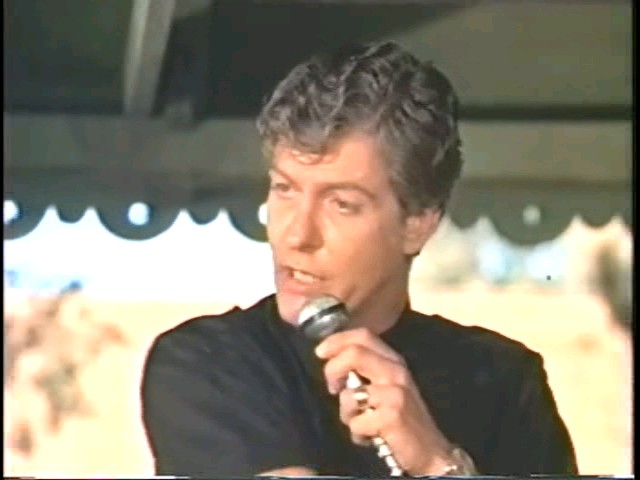
(Bob Newhart) at the Valiant Tobacco Company pushes through a 25 million (!!) dollar incentive to any American city that can quit smoking for a month, in a deal reminiscent of the Nobel Peace Prize. For the depressed community of Eagle Rock, Iowa, that's just lost a military base and is struggling through tough economic times, it's a chance to pull itself up by its filter-tips. And so with the activism of Reverend Clayton Brooks (Dick Van Dyke), the entire town pledges to give up smoking...or die trying.

Low-brow Hi-jinks ensue.
The national press (all in the dry forms of Bob and Ray) begin focusing on Eagle Rock, as the nervous population goes through withdrawal and panic attacks and the Valiant executive, fearing that they actually may have to pay up, travels to Iowa to try to sabotage their efforts. There's a lot of soft-ball satire going on from director Norman Lear (who'd go on to create "All in the Family" and a long string of shows that would require a large book-case to collect all the box-sets), and some low comedy as the Eagle Rockians begin to crack: the mayor's wife (Jean Stapleton) eats pickles (although she calls them "gherkins" ...because it's funnier) to fight the cravings, the town-surgeon (Barnard Hughes) who depended on a relaxing smoke to calm his nerves before surgery is losing his patients, the Reverend turns to the evils of intercourse, of course, (should we call that "taking communion?") and, in the most common sight-gag in the film, any stray animal is kicked and sent flying through the air. It's a sure laugh, but some of the kicks are just brutal. ***

It's a nail-biter for audiences and towns-people alike as the month-clock counts down, but rest assured it ends quite ironically, with some nice cutting jabs at
then-President Richard Nixon.

It also boasted the first music score by
Randy Newman (years and years before "The Natural" and Pixar) who wrote a pleasant soundtrack and a positively mordant theme song "He gives us all His love," that left audiences walking out of the theater, perplexed.

* Come to think of it, the first movie I saw without parent, guardian or hand-out was probably "On Her Majesty's Secret Service," the not-so-lucky double-o-seventh in the "official" James Bond series and the first not to star Sean Connery. The vacancy was temporarily filled—like wood-glue—with the unfortunate George Lazenby. They say that the first "007" actor you see becomes your favorite. I was fortunate enough to start with Lazenby and remain objective!

** "Cold Turkey" was on a double bill with a 1969 comedy called "Viva Max" directed by Dick Van Dyke Show director Jerry Paris (he also played the Petries' next-door neighbor...Jerry). It starred Peter Ustinov as a Mexican General determined to re-take the Alamo, despite U.S. resistance. Hilarity ensues. It was based on a novel by Jim Lehrer—yes, the anchorman of PBS's "The NewsHour," and frequent presidential debate moderator.

***To this day, I find the fast yelp of a dog or a spitting squeal from a cat a sure laugh-getter whenever I do sound design work—PETA be damned.

Wednesday, February 11, 2009

Walkabout

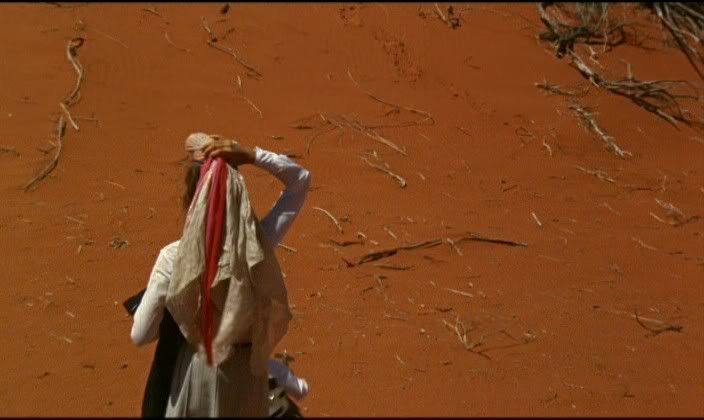
"Walkabout" (Nicolas Roeg, 1971) The clash of civilizations has long been a staple of film-drama, and many of the most thoughtful films on the subject have come out of the Australian wave of the 1970's and such film-makers as Peter Weir, Philip Noyce and George Miller. But, anticipating the emergence of Aussinema to the world-screens was this Australian-set fable of children stranded in the outback, and their rescue and immersion into the aboriginal, directed by radical cinematographer Nicolas Roeg. Told mostly without a narrative thread, with circumspect dialogue in a frequently non-linear manner, the film is a lushly photographed quilt of styles and methods, flashing forward and back, seemingly made up of fantasy and memory; indeed, one can't be sure after the film is over, that the whole thing isn't a dream...or a wish...a false memory...or an act of contrition.

Two children (
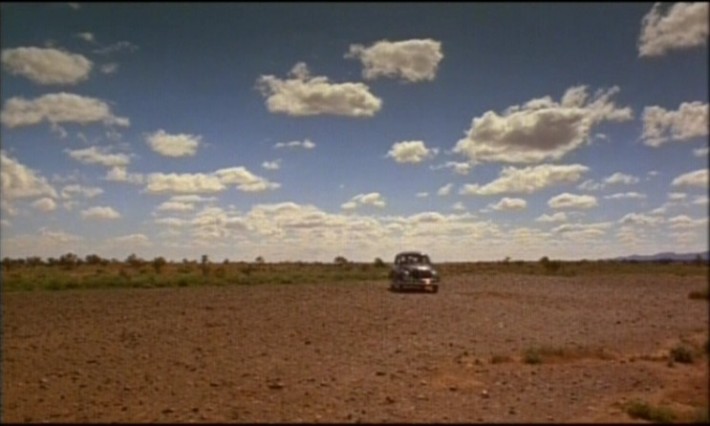
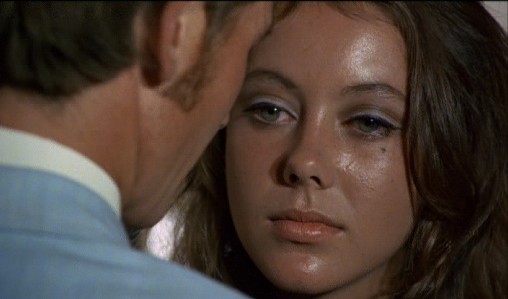
Jenny Agutter and Lucien John--son of the director), never named, are picked up by their brooding father after school. She is in middle grades, and he in grade school. Father drives them outside of Sydney, far out to the desert interior of Australia, pulls out a gun and attempts to kill them. They flee for their lives, as the man douses his VW bug in gasoline, sets it ablaze and shoots himself.

The children are stranded in the desert, in their school-clothes, with no shelter, food or water. Worse still, they're city-children in the wild with no survival skills to fall back on. The only thing they can do is walk, and keep walking. Eventually, hopefully, they'll reach civilization.

But Civilization may not be what they need.

They come across an aborigine (David Gulpilil) on a walkabout as a rite of passage, and the three children form an alliance of survival in the desert. The younger child is "okay" with everything, the closest to nature and accepting of everything. The girl is a teenager caught between innocence and societal regimentation, sexually curious of the aborigine but already mindful of her place in the strata of society. The aborigine simply is. As provider for the children, his intentions become conflicting as his relationship to the two grows. It may be that he never intends to take the boy and girl back to civilization.


As one can expect with Roeg, there are distractions: a sequence with a team of desert climatologists plays like a combination of Fellini and Keystone Cops; shots of the native boy killing for meat are intercut with scenes from a butcher shop; a group of aborigine's forced to make kitsch art by a brutal overseer; a hunting scene is interspersed with an extended skinny-dipping swim by Agutter. The images transition from majestic nature-scapes to 8 millimeter scratchiness and back again. John Barry's lush score supports it all with over-arching brass and mixed choirs.

Roeg has never been a meek film-maker. His films are charged with adult themes and subject matter, brutality and sexuality, and unblinking presentations of that material. Compared to such diverse films of Roeg's as "
Performance," "The Man Who Fell to Earth," and "Eureka," "Walkabout" is pretty tame. But it is brutal. When I first saw it, soon after its premiere in 1972, I did not know that there were sections stripped out of it to give it a PG rating (or GP, as it was known then). Those sequences involved the killing and cleaning of animals by aborigines, shot in a grainy, washed out, home-movie-ish style. Those sensitive to those images would do well to stay clear...or hide your eyes. But its part of the make-up of the film and the story. Roeg could have left them out, as the original distributing company did, but it would have eliminated an essential element of the brutal circumstances the kids are surviving, and how it contrasts with the plastic-packaged meat departments their parents travel through. We are left at the end with an idealized version of events--a romanticized dream, a false memory, and these final words spoken on the soundtrack.


Into my heart an air that kills
From yon far country blows:
What are those blue remembered hills,
What spires, what farms are those?

That is the land of lost content,
I see it shining plain,
The happy highways where I went
And cannot come again.


"A Shropshire Lad" (Part 40) by A.E. Houseman

Friday, February 6, 2009

Olde Review: The Emigrants/The New Land

This was part of a series of reviews of the ASUW Film series back in the '70's. Except for some punctuation, I haven't changed anything from the way it was presented, giving the snarky, clueless kid I was back in the '70's a break. Any stray thoughts and updates I've included with the inevitable asterisked post-scripts.

This Saturday's ASUW film program is something very special: Jan Troell's "The Emigrants" and "The New Land"—an unglossed, beautifully done look at a Swedish community's emigration to America.

"The Emigrants"/"The New Land" aka "Utvandrarna"/"Nybyggarna" (Jan Troell, 1971) When it was released in Sweden, Jan Troell's film was all of a piece—a several hours epic called "The Emigrants." Americans are notorious for not being able to sit that long to watch one movie, and so for American distribution, it was cut into two parts (as was Richard Lester's "The Three Musketeers"). Fortunately, the film had a natural break in the middle, as Troell's film was based on two books in a trilogy* by Vilhelm Moberg, so there was little, if any, damage to the story as far as continuity.

And it is quite a story: the tales of how the emigrants left everything they had, searching for a nirvana they heard about called America, and then, when arriving, found the stories were stories and that their struggles had to continue...as there was no way back. (These stories) have always had a special place in the history of film, especially American film. Audiences have long taken an interest in the struggles of their forebears—one of the reasons why ABC's "Roots" has gone through the ratings roof this week. One can possibly attribute this to a kind of lazy pride, clutching the courage and struggles of our ancestors to ourselves. And if so, so what? We're all entitled to a little pride in their accomplishments. It might provide the springboard for some equally courageous acts in our lives. And this pride in the past struggles reaches across racial/religious lines: we can feel proud at the struggle of other peoples' against their misfortunes. Hence, the great popularity displayed by "Roots" this week.

What about the movie, huh?)**

Oh...yeah. Jan Troell's treatment of the sometimes gentle, sometimes violent story of "The Emigrants" is to treat it gently, "matter-of-factly." He has compassion for his community, but that compassion will not allow him to prevent the cruelties of the journey, the country and the people of America. And there is a poetry in this style. Stanley Kubrick found it in "2001: A Space Odyssey," and "Barry Lyndon," and Troell has it throughout "The Emigrants" and "The New Land," with only one exception in the latter.

The film starts in Sweden as Karl-Oskar Nillsson is pressured by family needs to take a wife and we are presented with Kristina. It is
Liv Ullmann and her life previous to the marriage to Karl-Oskar is presented to us in a brief, languorous series of shots that entail an entire life of child-like freedom—sheltered, playful and entirely composed of little incidents, little insignificant moments, that thoroughly define her character and will stay with us throughout both movies as we see her struggle and grow old too early with her husband. Those moments remained in my mind through the films, and I saw them a year apart.

Those few moments of insignificance that tell the story are what define Troell's style of story-telling. It means that
the actors are put under a great strain to present authentic portraits of people, and the cast led by Max von Sydow and Ullmann come through with a total feeling of lived-in performances. You believe every one of the actors are who they are, that the relationships are real, (and) they are a community. There's not a false moment there in a film that is totally composed of moments suspended in time.

I'm not going to go through a list of favorite moments—there are too many that they are a jumble in my mind. but there us one: Karl-Oskar hacking his way through foliage—surveying—walking through this alien country. He pauses, takes his axe and hacks into a tree. He writes his name on the unbarked portion and then, in a way summarizing the whole of what has gone before, lies under the tree and tips his hat over his eyes, his back supported by the tree—his land. It's a scene of total satisfaction. And you felt that satisfaction with him because you've been through it with him. That scene ends "The Emigrants" and begins "The New Land" and I envy anyone who enters 130 Kane
Saturday night and can experience—in one sitting—this epic that is only small in scale.

Broadcast on KCMU-FM on January 28-29th, 1977

Thirty-two years on, if you mention "The Emigrants" to me, that scene is the one that pops up—of Max Von Sydow silently lying under the tree, his hat over his eyes, in a moment of peace and solitude that it has taken an entire movie to achieve. It is remembered fondly. "The Emigrants" was nominated for four Academy Awards including Best Picture and it's hard to imagine it making its way through the rabble in this day and age to become one of The Five. It's narrative structure (what I was painfully trying to explain here) is supported by its images, rather than a straight-ahead narration. The camera sits back and observes, making no editorial comment, picking up telling details by accident as if it was a documentary—a documentary where the light is just right and everything is extremely picturesque.

But it is no more oblique because of it, and it is presented without pretension or artifice, except to make it all look as good as can be. There was a market for this kind of of film in the 60's and early 70's, although one doubts that one could convince today's casual movie-goer of making plans to see these two films about the emigrant experience in early America—that field's been plowed in the minds of today's audience, and it might not be an evening's entertainment to see people working hard to build a life out of the dirt.

But it's worth it, if only to see von Sydow and Ullmann—two of Ingmar Bergman's stökk company—in a couple of their best roles. But there are benefits in seeing a good story well-told.

A couple of observations: "Roots" was on everybody's collective mind when this review was written, so it was probably natural to stem off of it, but there's a bit too much made of it, the review is about "The Emigrants," after all; The comparison to "2001" is apt as far as story-telling style, but not "Barry Lydon"—"Lyndon" has an omniscient Narrator, while "The Emigrants" does not. The review really doesn't do much service to the films, which are marvellous. Troell went "Hollywood" for an ill-advised remake of John Ford's "The Hurricane" (starring Mia Farrow!), then returned to Sweden, where he continues to work today.

* Actually a tetralogy: "The Emigrants" (1951), "Unto a Good Land" (1954), "The Settlers" (1961), and "The Last Letter Home" (1961). (or is it a "quadrilogy?")

** ABT***

*** "About Bloody Time"

Saturday, January 10, 2009

Olde Review: The Devils

This was part of a series of reviews of the ASUW Film series back in the '70's. Except for some punctuation, I haven't changed anything from the way it was presented, giving the snarky, clueless kid I was back in the '70's a break. Any stray thoughts and updates I've included with the inevitable asterisked post-scripts.

"The Devils" (Ken Russell, 1971) Ken's Russell's film of "The Devils" is what it is called. The quarter's only a week old and already in a Psychology class I have been told that the difference between an artist and a madman is that the artist can sift the good ideas from the bad.

So this leads me to believe that Ken Russell is a total madman. I don't like his films...at all. Some can accuse Russell of outlandishness beyong taste—but I think it can safely be said that Russell conducts outlandishness beyond sense. Even when he is at his most self-controlled, as "
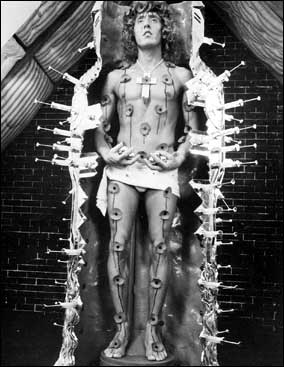
The Boy Friend " and "Tommy," we are presented such things as a harkening back to the mindless musical days of Busby Berkley in the former, and a chutch that worships the effigy of Marilyn Monroe and a hypodermic filled sarcophagus in the latter. Well, those films were rated "G" and "PG," respectively, and "The Devils" was rated "X." "Presented" becomes "assaulted."

I'm not going to list the excesses out of context, but it involves lecherous priests, mad nuns, and you can take it from there...if you can take it. And as far as I care you can take it and do anything you want with it.

I do have to say, however, that the stars of the thing,
Vanessa Redgrave and Oliver Reed give fascinating performances—I wish they were in another movie— and there is an alright trial scene, but that's it for me to recommend, folks! But you can do a lot of jerky people do during a Ken Russell movie, keep repeating over and over "Ken Russell is a genius—Ken Russell is a genius" You may begin to believe it, and while you're concentrating on saying this, you may be fortunate enough to miss the movie. I didn't.

This was broadcast on KCMU-FM on January 8, 1976

Reading this throws me into all kinds of murky thinking. If you've read my reviews of, say, "Deliver Us from Evil," and "Doubt," you know my issues with the Catholic Church. I am, as I like to say, a recovering Catholic. My final break with "The Papists" came with the scandal of priests molesting kids in their charge and the hierarchy then sweeping the charges under the rug, ignoring the pain of the victims and sending the vioating priests to other parishes..to do exactly the same thing somewhere else. Given that scenario, Aldous Huxley's "The Devils" merely sounds like a party. "Lecherous priests and mad nuns" sounds a bit like this season's "Doubt." We know longer burn people at the stake for witchcraft, but an Alaskan evangelist did pray to keep Gov. Sarah Palin from the sins of witchcraft.

We've come a long way.

So, has the film. So controversial, so over-the-top, "The Devils" had to have several cuts just to get an "X" rating at the time of its release! A restored version was shown at festivals in 2004, and Warners announced a DVD release for 2009, but plans for that have apparently been shelved. I would like to think that my hostility towards the film was based purely on my latent Catholicism, but I doubt it. I've never been a fan of Russell's, whose aim has seemed to be not so much creating art as causing as big a stink as possible. He's taken a lot of peculiar material, and pitched them as fever-dreams rather than straight-ahead narrative, and he's been quite guilty of burying his points in pretension and obfuscation. And Russell's film of "The Devils" freely adapted from the Huxley novel is heavy on that and high-pitched histrionics.

That's probably what I wanted to say in this review, where I criticized with only faint damnation. The most interesting part of the whole thing is the quote at the beginning, of the difference between a madman and an artist. Really? So Ed Wood, David Lynch, Michael Bay, Tom Cruise...are all mad? The difference between a madman and an artist boils down to "Good Taste?" I think I believe that less now than I did back then. Ed Wood had a lot of problems, to be sure, but I'm not sure he was crazy. Deluded, yes, and we celebrate that blinkerdly delusion. But it was useful as an entree to Ken Russell. I did end up liking his film of "Altered States ," though.

Wednesday, August 27, 2008

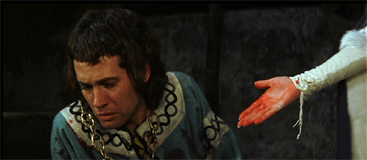
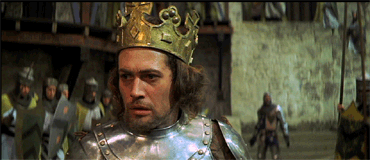
Olde Review: MacBeth (1971)

This was part of a series of reviews of the ASUW Film series back in the '70's. Except for some punctuation, I haven't changed anything from the way it was presented, giving the kid I was back in the '70's a bit of a break. Any stray thoughts and updates I've included with the inevitable asterisked post-scripts.

"MacBeth" (Roman Polanski, 1971) (Peter Brook's) "King Lear" is brutal, and so, too, is Roman Polanski's "MacBeth," probably excessively so. There is much graphic carnage in "MacBeth," and I would recommend that if you are disturbed by such substance that you think twice before going. But it is healthy to keep in mind that "MacBeth" is a play filled with violence. All Shakespeare's tragedies are; one need only to leaf through the last acts of them to prove itself out.

But there is much to praise in Polanski's version; it is a fuller version of the play it is based on than "King Lear." Peter Brook cut out a voluminous amount of Shakespeare's original prose. The cinematography and Polanski's camera placements are all very assured, and very fine in detail.* The acting of Jon Finch and Francesca Annis as MacBeth and his Lady are fine for what Polanski's interpretation is. But it is my view that MacBeth should be older (and) probably less crude than is Finch's portrayal; an older man could speak the "out, out brief candle" speech with more of a knowing world-weariness than the young MacBeth here could manage.**


Both these films are hard (and) tough with a gritty interpretation.*** The beauties of Shakespeare--his words--are still there to be enjoyed and marveled over, but the madness, the savagery, and the evil inherent in those words are presented with such ferocity, that one's view of the words on the page will be forever altered. Those sensitive enough to see the beauty of the words may not be able to stand up to what is graphically presented within them.


Broadcast on KCMU-FM November 18th and 19th, 1975.

* I was smirking at that sentence, thinking: "What would an unassured shot look like?" and immediately came up with an answer: shaky-cam!

** But one should also remember this film was in production soon after Franco Zeffirelli's hit film of "Romeo and Juliet," which did something radical--actually portray R & J as being still in their late teens, rather than, say, Liz and Dick. The tragedy is a bit more keenly felt when it's kids' lives that are being cut short so soon. Plus, to have the cast young and attractive might bring in audiences (it didn't). The film was a "Hugh M. Hefner Production" financed with "Playboy" money, so there's another reason for young attractive people in the leads. But, I always imagine "MacBeth" as a brute, not very political, and passed over to advancement because of it. Fatally ambitious, MacBeth enters into an arrangement with the witches ro ascend to the throne. It plays a bit better for me if MacBeth is older, and a bit desperate to achieve his life's ambitions (and his wife's) at last.

*** This review is a companion piece to yesterday's review of Peter Brook's King Lear.

Tuesday, August 26, 2008

Olde Review: King Lear (1971)

This was part of a series of reviews of the ASUW Film series back in the '70's. Except for some punctuation, I haven't changed anything from the way it was presented, giving the kid I was back in the '70's a bit of a break. Any stray thoughts and updates I've included with the inevitable asterisked post-scripts.

This Friday's films in 130 Kane are the Northwest Premiere of Peter Brook's "King Lear" and Roman Polanski's "MacBeth," and for those of you who have never had an English course cross your academic path, these are recently filmed interpretations of two of Shakespeare's tragedies.

"King Lear" (Peter Brook, 1971) Peter Brook is one of those eccentric geniuses in our artistic society of whom it is supposedly required to say that "if he had never been born, we would've had to invent him." That's something of an easy out for critics who don't know enough to know what to praise about the man.

What there is to praise in the film is the play, of course. That's a given. Also a given is the fact that film has abandoned its formerly sterile view of past conditions* to show us the squalor of the times we have left behind us. Brook's interpretation of the squalor of "
King Lear's" time is to set it in the dead of winter and the snow mixing with mud and sand sets the dramatic mood and provides a proper backdrop for the icy acting by the principles.

In the initial stages of the film, Brook keeps the direction rigidly under control, leaving little room for the actors to full express their characters, giving the audience a feeling of claustrophobia--such is the confinement of Brook's images. But, as those familiar with "Lear" know, Lear's on-coming madness brings on a steady deterioration of that control; the camera can't contain the performers or the characters, and the onslaught of Lear's insanity is a thorough ripping apart of the control, cataclysmic in intensity, totally destroying what was before. And though it is certainly different from my expectations--my ideas--of how that scene should be handled, my gut reaction to the sequence is that it is right, for we tangibly feel the ripping of Lear's psyche for the film and the film's techniques we have seen before are also ripped apart and we are taken to new territory, just as Lear is.

When studying Shakespeare--when appreciating Shakespeare--I find the best thing I can do is to read it line by line, concentrating on each, finding its independent meaning and then its contextual meaning. Brook does something similar here. In a monologue he will (editorially) isolate phrases, though at times it is distracting, and cuts the flow of the total speech. I am sure it is something of a help to those unfamiliar with "Lear." Overall, it is an eccentric version of (the play), but one, at least, that I can live with.


Broadcast on KCMU-FM November 18th and 19th, 1975

Weird review. It smacks of insecurity being hidden by brio. But I had seen a couple versions of "Lear" and had read it in High School and College, so I was "familiar" with it, probably more so than the other plays, with the exception of "Julius Caesar." Still, it's an odd tone to set for a review--there's too much "me" in it. I was no Shakespeare expert then, nor am I now.

And Brook's technique for "Lear" was very much in keeping with his stage style. He famously said, "I can take any empty space and call it a bare stage." Even more so with film. Take any expanse of space and put a frame around it and you have a film, even if it's nothing but a black background with a face in front of it. And the thing about film is, there doesn't have to be a strict adherence to the concept of "stage."
Olivier staged his "Hamlet" in a labyrinth of stages. He started his film of "Henry V" on a stage and opened it up to the outside world later in the film. Welles ignored any rules: his "Othello" was filmed in such a catch-as-catch-can manner (finaciers bailing) that he would shoot one side of a conversation in one country and shoot the over-the-shoulder reply in another. "All the world's a stage," indeed.

The other thing about Brook's "Lear" is the pedigree of the actors. One of those actors I always enjoy watching is
Paul Scofield--winner of the Oscar for playing Sir Thomas More in "A Man for All Seasons"--he'll show up later this week in another reviewed Shakespeare film. He plays Lear here; first, as a cruel, unfeeling martinet of a King, and lastly, as a pathetic, broken old man--off-putting and sad, but always with great stores of power. Scofield never lets you forget that though Lear is many things, he was always King for a reason. Jack McGowran plays The Fool. Cyral Cusack plays Albany and Patrick Magee plays Cornwall. Great cast. Maybe not stars, but extraordinarily powerful stage actors.

Someone's always staging "Lear;" it's the K2 of parts for older actors. Next year we're going to be seeing two productions: PBS will (supposedly, at this point)
show a video production of Sir Ian McKellan's Lear, and a new filmed version is due in a year, with Sir Anthony Hopkins as Lear...and as his daughters, the triple threat of Keira Knightley, Gwyneth Paltrow, and Naomi Watts. I hope they have enough sense to have Paltrow play Cordelia and Knightley one of the cruel sisters. (Update: No, Knightley will play Cordelia, Regan will be played by Paltrow, and Watts will play Goneril--ah, well!)

* A throw-back to the stage-origins of the plays. Lately, Shakespeare has been getting gritty and grimey.

Friday, June 13, 2008

The Andromeda Strain (1971)

"The Andromeda Strain" (Robert Wise, 1971) Robert Wise's return to sci-fi (The Day the Earth Stood Still) after years in the musical field (West Side Story, The Sound of Music, Star!) proved that he was just as effective a gritty story teller as he was a choreographer. Michael Crichton's first best-seller (he'd paid his way through medical school writing pulp novels and thrillers, then abandoned a medical career to write) hit the wave of nervousness fearing "moon-germs" infesting Earth from the first Apollo moon-landings. Crichton had a fascinating little gambit--he filled the book with graphs and text and bibliography sitings that gave the book the air of legitimacy, when, in fact, he made everything up whole cloth, even the citations. Nobody cried "fowl," or hauled him before Oprah to be pilloried. He merely went on to write his series of oddly-cautionary fast-reads of the dangers of current technology, all like prose-screenplays waiting to be filmed, only occasionally departing from the formula to write something interesting ("The Great Train Robbery," "Eaters of the Dead"). His characters were largely cyphers, until after a brief flirtation with movie-making, all of his leads seemd to be based on Sean Connery (who starred in Crichton's film of his own The Great Train Robbery).

But, that's the future. For The Andromeda Strain, Wise pulled off a similar cinematic trick--he didn't cast stars, just good character actors (and a couple of formidable stage actors) for the leads, filmed what was essentially a "bottle show" (mostly taken place in a contained space with few exteriors in an unfussy, clean style in wide panavision and split-screen, and maybe the first instance of on-screen date/time/location computer updates graphicked across the screen to orient ourselves. It's played out in as unmelodramatic a way as was possible with minimum effects.


Wise and screenwriter Nelson Giddings do a thorough job of negotiating Crichton's juggled narrative and technical jargon, not withholding anything essential to the investigation no matter how arcane, and boil it down like a detective story to the central puzzle of why two disparate survivors escaped having their blood crystallized, which is, how is a perfectly healthy squawling baby similar to a decrepit vagabond with a bleeding ulcer and a taste for drinking sterno. Obvious answers are discarded and it's a neat exercise in re-thinking a problem. The examination of Andromeda is not dumbed down and a casual observer with no history of medicine or biology will learn a lot about organisms and infections and how they function, as well as the odd lesson in decision-making, the prejudice against epilepsy-sufferers and feng shui as related to color.

It's smart. And it assumes the viewer is smart enough to follow along, and that's refreshing (especially compared to its mouth-breathing, knuckle-dragging remake-see below), and it's core cast (the irreplaceable Arthur Hill and Kate Reid, David Wayne and James Olsen) does a terrific job of underplaying the drama (the smaller, more bureaucratic roles have a tendency to drift towards melodrama and easy caricature), and it has a smashing pay-off with one of the best cliff-hangers in sci-fi history (as did the book, and you'd have to be pretty incompetent (see below) to keep it from being a nail-biter.


Arthur Hill and James Olsen in the relatively safe "red" zone of the Wildfire Complex.

It's a neglected techno-thriller from two of the masters of the craft at the top of their game.


_________________________________________________________________________________


A & E just aired a two-part miniseries that "updates" "The Andromeda Strain." "Updates" must be Hollywood code for "screwing up." As Produced by the Scotts brothers (Ridley and Tony), directed by Mikael Solomon (cinematographer for Ron Howard and James Cameron, so he's done hazard-duty), and scripted by Robert Schenkkan (Pulitzer Prize winner for "The Kentucky Cycle"), this botched version of the novel by "J. Michael Crichton" (As he's listed in the credits. He's never gone by that name, ever) takes the biological warfare angle from Wise's film and makes it the central subject ofthe movie. The Wildfire crew is expanded from four experts to five ethnically and discipline-diverse researchers (to make it CSI-familiar--how novel), and they're all sniping unpleasant people--Jeremy Stone (Benjamin Bratt) is a fairweather father/absent husband, who's had a past affair with one of the other crew, and chooses to revive it while the world is supposedly coming to an end--just the kind of guy I want in a crisis. The film-makers play up the ick factor with "Andromeda" expanding its field to drive low inhabitants crazy, and work its way up the food-chain, although the special effects boys peter out at the end and become content to represent the infection as a red optical smudge. The President of the United States becomes a major figure, albeit one who sits around being befuddled, but always has a sage bit of wisdom for each new development. And there's the creepy, snarky reporter who's looking for The Big Story (no matter who it hurts) and he's played by Eric McCormack (Will & Grace) with vacillating priorities.

The central theme—what does a baby have in common with a sterno-drinking bum—is tossed off, ignored, and rendered irrelevent (as are the survivors) in favor of new-science voodoo of worm-holes, time-discrepancies and other space-rot, that, if anybody sat down and thought about it, makes the Andromeda bacillus completely devoid of a point of origin. But hey, if you can combine the original with "
CSI," and plot-elements of Contact, and, yes, Star Trek IV: The Voyage Home, it should be good enough for an unchoosy Sci-Fi Channel subscriber, one who's happy with the sub-par "original movies" along the lines of "T-REX Mutants!" Somewhere along the way, the broadcast channel got upped to A & E (that stands for "Arts and Entertainment"--it's where you can see "Dog the Bounty Hunter" and "Gene Simmons' Family Jewels," and they must feel snookered.*

It's a nasty, stupid piece of work, done with little care for its viewers or source material. Hopefully, Crichton got some money out of it (he had nothing to do with it, not even producing), so hopefully he can find out why he has a "J" in front of his name now.

With all this new tachnology why do these schmoes insist on re-making GOOD science fiction films (they're also "updating" "The Day The Earth Stood still.")? Why don't they make a better version of "
Damnation Alley," or "Saturn 3," or even Crichton's "Terminal Man?" Those might be worth a try.


* They don't. Trade ads are crowing that ten million souls watched this drek.