Showing posts with label Peter Bogdanovich. Show all posts

Thursday, October 18, 2012

Targets

Targets (Peter Bogdanovich, 1968) The day after the insane shootings at the midnight showing of The Dark Knight Rises in Aurora, Colorado, Glenn Kenny, in his fine blog Some Came Running, made a comment on it, without making a comment.  He simply took frame-grabs from Peter Bogdanovich's directorial debut, Targets.  One could only nod one's head in acknowledgement of the aptness.

The project started out as the most bizarre of industry favor-granting. Bogdanovich had done some work for B-movie king Roger Corman, and the AIP producer emeritus granted the writer an opportunity to direct his first project—with some stipulations: he had some work due from Boris Karloff by contract, and the aging horror star had to be worked into the storyline, and there were some left-over scenes from a past Karloff movie The Terror (featuring as well, a pre-star Jack Nicholson) that Bogdanovich could avail himself of.  Other than that, Bogdanovich could do whatever he wanted, as long as he stayed on-time and under budget—about $125,000.  With then-wife Polly Platt, who also served as production designer, Bogdanovich came up with a twisted storyline that followed two storylines that would come together at a drive-in theater, the favored venue of most AIP releases.  In his commentary for the film, Bogdanovich goes out of his way to acknowledge the considerable help he had in fashioning the script from director-writer Samuel Fuller, who fleshed out and added resonances to the story.


One of the stories follows Bobby Thompson (Tim O'Kelly), as typical a young American as can be.  He's sells insurance after having toured in Vietnam, wife's a nurse, and the young couple lives with the Thompson parents, where they have a normal domestic life of communal dinners (with grace said beforehand), and a family evening of television.  Son and Dad have a hobby of target practice, in which the son takes great pride in his accuracy, no matter the caliber, no matter the weapon.  Before the day is out, he'll grow weary of stationary targets.

Meanwhile, across town Byron Orlok (Karloff) is souring on the movie business.  He's just screened his latest low budget horror flick, directed by a kid, Sammy Michaels (played by Bogdanovich), who's pressuring him to star in his next film, while the studio is assuming that the star will keep churning the  stuff out.  But Orlok announces he's retiring—oh, he'll do publicity for this one, but, really, with the very real horrors going on in the world meted out by tin-gods and commonsters, what relevance is the costume theatrics he's appearing in.  He feels old, quaint, and antiquated, pretending horror when the world shows a proclivity for it with no bounds.

The two, Bobby and Byron, cross paths twice in the film, one completely unbeknownst the older star, and the other at a moment of destiny, when the two meet again at the world premiere of Orlok's new picture.  Both reveal their true selves at the drive-in, and the film ends, as Bogdanovich is wont to do, on a note of ambivalence.

The film was so good that Corman was able to sell it (at a profit) to Paramount Studios for release.  Bogdanovich fills it with telling cold-blooded details, especially in the planning and fulfillment of Bobby's activities, which become more and more erratic as things go astray from his plans, and those touches, some ironic, some despairing, are rich and feel like a tribute to the director the film is most in the style of—Alfred Hitchcock.  Hitchcock is always a good primer for film-makers starting out in the low-budget fields, as his films are like blueprints in basic film-making techniques—direct, bald, and effective.  But Hitchcock's subtleties—the stuff that fills the frame of the cutting scheme—are tougher to match.  And it takes a better breed of film-maker—like Spielberg, Bogdanovich, and DePalma—to take the Master's schematics and improvise with the form.  One can do all the planning one wants, but it's in the finishing touches that make a house a home, and a movie a film.


Tuesday, July 10, 2012

Directed by John Ford

Directed by John Ford (Peter Bogdanovich, 1971, 2006) Bogdanovich's primer is a "viewer's digest" of some big things that that made John Ford such a powerful director not only in individual films, but also across a career of experience.  Generous clips from throughout his acreer illustrate points, punctuated by talking head clips from the '71 version including Ford himself (who is not very helpful, to say the least—by saying the least*—and is deliberately dismissive of the doing the whole critical analysis thing, much like a comedian hates to explain a joke, or a magician a trick), John Wayne, Henry Fonda, and James Stewart.  The 2006 update folds in Harry Carey, Jr., Maureen O'Hara, and analysis from Clint Eastwood, Martin Scorsese, Walter Hill, and Steven Spielberg, as well as Bogdanovich.  

The update has everything from the original re-jiggered to add more points, but there's more of a "legacy" feel to the thing, now, as the casts Ford depended on have dwindled—Ford was still alive during the first version—and so the next generation who grew up and learned their craft sitting in the theater watching Ford's images talk about "what John Ford means to me."  Also, as the man is gone now, there's a bit more psychological analysis and more delving into the man's irascible personality, already on full display in his interview.


But there is one troubling aspect to this "new" version, something that stuck in my craw when I saw it (and no doubt would result in Ford caning Bogdanovich if he got wind of it).  There is a brief (very brief) examination of Mary of Scotland, Ford's only film with Katherine Hepburn, and the subject of much speculation over what their relationship was.  A sound clip is played of Hepburn's visit to Ford days before his death.  The tape was allowed to run continuously, and their parting words to each other are played, words that they had no way of knowing were being recorded, and words that might not have been said if known they'd been overheard (Ford specifically asks her "Are they gone?").  It's nothing scandalous or huge.  Ford merely says "I love you," and Hepburn says "it's mutual."  But it feels like a violation of the departed by the parties that recorded it and who have re-presented it.  And far too much is made of it (Really?  It was the inspiration for the names of O'Hara's and Wayne's characters in The Quiet Man?) in a gossipy, speculative fashion. These were, after all, words from people who must have known they'd never see each other again, and it's nice and it's lovely. But it's beneath the film, beneath Bogdanovich, and undercuts whatever scholarly impact the film might otherwise enjoy to make anything more of than the sweet parting gesture it is.  The worst part is...there's no one to rebut, no one to protest, no one to defend...or even better yet, to correct the speculation. Even Ford's maxim of "When the legend becomes fact, print the legend" doesn't cover this.

That aside (and it's my quibble, really), it's an invaluable first toe-dip into the films of Ford, and enriches the experience and appreciation of every film of his seen afterwards.  One thing Bogdanovich did right (besides getting Turner Classic Movies to bank-roll it, so more people would see it, the various clips from many sources being very expensive) is he kept the original's essential narration by Orson Welles, Ford fan and student.   The voices and faces and memories out of the past have as much weight and bearing as the films do, reverberating throughout history and time, feeling immortal and universal.


*

Friday, September 19, 2008

They All Laughed

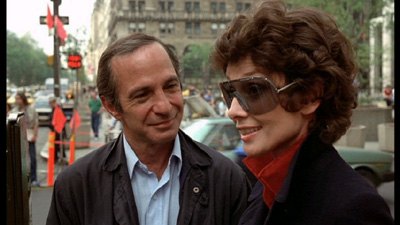
"They All Laughed" (Peter Bogdanovich, 1981) There's something sweet and low-down about Peter Bogdanovich's "They All Laughed," a mid-summer night's urban romance-a-thon set to country music in the heart of New York City. Part detective story, part romance, part Altman-esque roundelay, part screwball comedy, it's another of those Bogdanovich love-letters to the style of old movies that reflected life through a rose-colored filter. It isn't life as it is, or life as it should be, but life as you'd want it to be, suffused with the pangs and dangers that new love energizes into life and makes it crisp. New York has never looked better, because it's seen through the eyes of a hopeless romantic--all of the excitement with none of the hassles. Would that the same were true of the various trysts and liaisons zipping through the movie.

"They All Laughed" also has a fresh feel to it, with a mix of movie veterans and spry new-comers (and some of the production crew) all intermingling and bringing some zing to the proceedings.
Ben Gazzara proves himself the best heir to Bogart for portraying tough guys with a tarnished heart of gold, and Audrey Hepburn is indescribably Audrey Hepburn, coquettishness shimmering through the worry-lines of experience. John Ritter fulfills the promise of a leading man capable of grace and ungraceful slapstick that was only hinted at in the leering farce of "Three's Company." Then there's the trio of model-actresses in various stages of crossing that dash--Colleen Camp, Patti Hansen, and the doomed Dorothy Stratten. Of the production staff, Blaine Novak, the film's co-screenwriter makes for an entertaining odd-ball/voice of reason, and producer George Morfogen plays, appropriately, a harried boss.


Gazzara, Ritter and Novak are all investigators for a Big Apple detective agency, and the first two are sent to trail two supposedly errant wives in the city, and before you can sing "Laura is the face in the misty light," the stalking has turned to love...completely the opposite from what you'd expect in New York City.

Put aside the on-set intrigues and backstage stories, "They All Laughed" is a sweet-spirited romp. The country-western music dates it a bit, and a sad nostalgia permeates it now. But it's one of the best of Peter Bogdanovich's productions that doesn't retreat into the past to garner its graces. And with his mixed cast of professionally-minded veterans and star-crossed amateurs, he probably felt more freedom working on this film than three of his previous elephantine-proportioned ones ("Daisy Miller," "At Long Last Love" and "Nickelodeon"). Certainly with his guerrilla crew (working without permits) led by Wim Wenders DP Robby Muller, the film has the energy and snap of what one would consider an indie hit these days. But in 1981, critics and industry folk had the knives out for Bogdanovich, making this an overlooked gem--a true labor of love in a medium that held a lot of heart-break for the director.