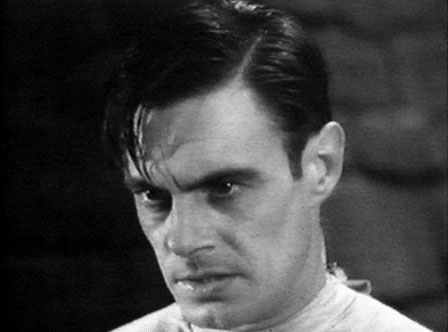
Targets (Peter Bogdanovich, 1968) The day after the insane shootings at the midnight showing of The Dark Knight Rises in Aurora, Colorado, Glenn Kenny, in his fine blog Some Came Running, made a comment on it, without making a comment. He simply took frame-grabs from Peter Bogdanovich's directorial debut, Targets. One could only nod one's head in acknowledgement of the aptness.
The project started out as the most bizarre of industry favor-granting. Bogdanovich had done some work for B-movie king Roger Corman, and the AIP producer emeritus granted the writer an opportunity to direct his first project—with some stipulations: he had some work due from Boris Karloff by contract, and the aging horror star had to be worked into the storyline, and there were some left-over scenes from a past Karloff movie The Terror (featuring as well, a pre-star Jack Nicholson) that Bogdanovich could avail himself of. Other than that, Bogdanovich could do whatever he wanted, as long as he stayed on-time and under budget—about $125,000. With then-wife Polly Platt, who also served as production designer, Bogdanovich came up with a twisted storyline that followed two storylines that would come together at a drive-in theater, the favored venue of most AIP releases. In his commentary for the film, Bogdanovich goes out of his way to acknowledge the considerable help he had in fashioning the script from director-writer Samuel Fuller, who fleshed out and added resonances to the story.
One of the stories follows Bobby Thompson (Tim O'Kelly), as typical a young American as can be. He's sells insurance after having toured in Vietnam, wife's a nurse, and the young couple lives with the Thompson parents, where they have a normal domestic life of communal dinners (with grace said beforehand), and a family evening of television. Son and Dad have a hobby of target practice, in which the son takes great pride in his accuracy, no matter the caliber, no matter the weapon. Before the day is out, he'll grow weary of stationary targets.
Meanwhile, across town Byron Orlok (Karloff) is souring on the movie business. He's just screened his latest low budget horror flick, directed by a kid, Sammy Michaels (played by Bogdanovich), who's pressuring him to star in his next film, while the studio is assuming that the star will keep churning the stuff out. But Orlok announces he's retiring—oh, he'll do publicity for this one, but, really, with the very real horrors going on in the world meted out by tin-gods and commonsters, what relevance is the costume theatrics he's appearing in. He feels old, quaint, and antiquated, pretending horror when the world shows a proclivity for it with no bounds.
The two, Bobby and Byron, cross paths twice in the film, one completely unbeknownst the older star, and the other at a moment of destiny, when the two meet again at the world premiere of Orlok's new picture. Both reveal their true selves at the drive-in, and the film ends, as Bogdanovich is wont to do, on a note of ambivalence.
The film was so good that Corman was able to sell it (at a profit) to Paramount Studios for release. Bogdanovich fills it with telling cold-blooded details, especially in the planning and fulfillment of Bobby's activities, which become more and more erratic as things go astray from his plans, and those touches, some ironic, some despairing, are rich and feel like a tribute to the director the film is most in the style of—Alfred Hitchcock. Hitchcock is always a good primer for film-makers starting out in the low-budget fields, as his films are like blueprints in basic film-making techniques—direct, bald, and effective. But Hitchcock's subtleties—the stuff that fills the frame of the cutting scheme—are tougher to match. And it takes a better breed of film-maker—like Spielberg, Bogdanovich, and DePalma—to take the Master's schematics and improvise with the form. One can do all the planning one wants, but it's in the finishing touches that make a house a home, and a movie a film.
"Frankenstein" (James Whale, 1931)
"We are about to unfold the story of Frankenstein, a man of science who sought to create a man after his own image without reckoning upon God. It is one of the strangest tales ever told. It deals with the two great mysteries of creation – life and death. I think it will thrill you. It may shock you. It might even – horrify you. So if any of you feel that you do not care to subject your nerves to such a strain, now's your chance to – uh, well, we warned you."
Every young boy's horror touchstone—and if we're to believe Víctor Erice's "El Espíritu de la colmena" every little girl's, too. One of Carl Laemmle Jr.'s ghoul gallery of public domain necromancy movies that spawned dozens of sequels and dozens of imitators, all inferior to the craft of these primitive films, made at the fog-shrouded dawn of the Sound era.
But towering above them all in the pounding hearts, toad-squirming minds, and knocking knees of horror fan-dom is the story of "The Modern Prometheus" and the Monster to whom the public bequeathed his name.
"Frankenstein" boasts odd beginnings. Written by Percy Bysshe Shelley's frail flower of a wife, aged 18 when she conceived it, during a Gothic night's creativity, "Frankenstein's" story and it's several graves-deep inner meanings had been a classic for decades. It had been filmed before (even by Thomas Edison), but Laemmle's production, directed by James Whale has emerged as the one with the biggest boots to fill.
It might be because of its introduction (reproduced above). Edward Van Sloan walks out onto the filmed stage and warns us of the subject matter to come and the blasphemous implications of a man not "reckoning upon God." It's a good tactic—a carnival barker's come-on—for rather than warn us away, it whets the audience's appetite for the terrors to come.
And James Whale doesn't disappoint. Whale's life has merged with Legend (the movie "Gods and Monsters"), but his German-expressionism-influenced eye and sense of the absurd (which would come to full flower in the follow-up, "The Bride of Frankenstein") created a sinister world of vast-shadowed hallways, spitting whirling laboratories, and castle chambers that resembled gargantuan funeral homes.
Before going on to the actors, homage must be paid to the craftsmen: Art Director Charles D. Hall, whose bizarre designs for the film give it its scale and majestic decay; and, of course, make-up artist Jack Pierce, who transformed a slight British actor named Karloff into a 7-foot, barrel-chested, electrode-studded,* flat-skulled (and copyrighted) hulk. There have been many subsequent designs for Frankenstein's piece-meal monster, but none have been so iconic as the Whale-Pierce-Karloff version.
Karloff's contribution cannot be slighted—including his removal of an upper dental plate to give the Monster a dented, off-kilter face. But mention should be made of Colin Clive's hyper-bi-polar doctor (he was a wayward medical student in Shelley's tale), prone to manic exultation or fainting dead away in emotional extremis. The good doctor's a bad drama queen. As his house-keeper would say in the sequel, he's a queer fellow.
There's another reason to celebrate the longtime classic-ness of James Whale's "Frankenstein." It and it's sequel "The Bride of Frankenstein" may be two of the greatest gay-themed movies to come out of straight, Hayes Code mainstream Hollywood. I had a film professor who was studying "Bride" and told of his curiosity about the air of exoticism in the first two "Frankenstein" films, when that "queer" line came out it was the lightning-bolt that was the key. What is "Frankenstein" and "The Bride of Frankenstein" except the story of a man (or two men in "Bride," with Frankenstein and Professor Pretorius collaborating) trying to give birth.** The melancholy cruelty of Nature and mob-hysteria towards the different permeates both of Whale's "Frankenstein" films,*** and turns Monster into mirror, a figure of identity rather than horror, and occurs whether the audience is gay or straight. There's a reason the shunned figure of Frankenstein's Monster resonates: he's an outcast, yearning but misunderstood, tortured, but sympathetic. And though kept prisoner in a castle dungeon rather than a closet, he would emerge sequel after sequel, never vanquished—indomitable—his super-human will-to-live allowing him to see another day. As they say in "Jurassic Park," "Life will find a way."
Frankenstein" is one gifted director's roaring protest against the Nature of Things ... and man's intolerance.
* One of the basic copy-rights of the Universal design are the electrodes sticking out pf the Monster's neck. Though "Frankenstein," the story, is in the public domain--one of the main reasons Francis Ford Coppola produced a version years ago--and anyone can do a re-make, those electrodes, and the rest of the make-up design, are the commodity of Universal Pictures. When Mel Brooks made his "Young Frankenstein" in the 70's, he by-passed the neck-studs...with zippers.
*** Christopher Isherwood also used Frankenstein and Pretorius (dubbed "Polidori") to create a more homo-erotic version of the story...for NBC television...when he wrote the teleplay for "Frankenstein: The True Story
**When he presented his theory in class, one of the students remarked "That's kind of mind-blowing..." to which he replied, "I'm glad you said 'mind...'"