Showing posts with label 1931. Show all posts

Thursday, June 20, 2013

The Maltese Falcon (1931)

The Maltese Falcon (Roy Del Ruth, 1931) One of the "other" "Maltese Falcon" adaptations (the other is the Falcon-less Satan Met a Lady starring Bette Davis, which we'll look at tomorrow), before John Huston got it right and turned the Hammett story into a classic of the detective genre in 1941.

This one follows the story-line well enough—Brigid O'Shaunessy, the death of detective partner Miles Archer, rumors of a legendary jewel-encrusted black bird statue, and the motley trio of swindlers, Cairo and Guttman and Wilmer, a shade more flamboyant in this version. The story runs its course.

Where it differs—and all the "Falcon" versions differ—is in the character of Sam Spade, of Spade and Archer Detective Agency, soon to be "Sam Spade, Detective." The Bogart persona is familiar: tough guy, cynical, has the image of disrepute, but a resolute moral compass—like the Falcon itself, you have to scrape away layers of hardened lacquer before you get to the stuff that's valuable. That's Bogart, imprinting Spade and the image of detectives—but movie detectives—with the same template ever since.  

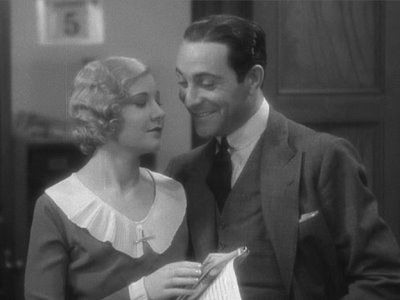
But, the first version of The Maltese Falcon was this pre-Code version starring Ricardo Cortez, and the top-billed Bebe Daniels as client "Ruth Wonderly." Don't let Cortez's latin name fool you; he was born Jacob Krantz, raised in the Bronx, but his name was changed to attract audiences during the "Rudolph Vaentino" phase of leading men. His Sam Spade is openly a lothario, a charmer and ladies' man, quick with a leering smile and altogether too happy in his work. You have no sense of Spade actually thinking, but going through false motions among other finaglers. He's unreadable to the audience except he's the guy "in charge," and enjoying himself.

There's much more sexuality to this one, featuring a scene with Bebe Daniels talking on the phone in the bath, and when a thousand dollar bill goes missing in the exchange scene, Daniels is forced to strip-search before Spade concludes that Caspar Guttman might have withheld it. This Sam Spade, one has the impression of making her do it just for the "fun" of it.

And the trio of con-men/murderers after the black bird?  When Spade's secretary, Effie, introduces a new walk-in as "gorgeous," Spade assumes it's a woman, but it's "Dr." Joel Cairo (Otto Matieson) in the first allusion to the veiled homosexuality of Cairo, Guttman and Wilmer.  The latter is openly referred to as Guttman's "boyfriend" and is played by Dwight Frye, the manic character actor from so many of the Universal horror films, including Frankenstein and Dracula. 

The film includes a coda of Spade visiting O'Shaunessy, making it known that Spade has gone "legit," working for the D.A.'s office which, although it may be intended to show Spade more in a "good guy" role, it paints a rather poor picture of the San Francisco district attorney (especially considering the police's earlier suspicions about Spade).

The steamy elements forced Warners to shelve this Maltese Falcon once the Hays Office opened its doors. The studio then made another version, Satan Met a Lady, played with a lighter tone, but which met the newly-imposed standards of the Motion Picture "Code." That's tomorrow.
Ricardo Cortez as the first Sam Spade

Thursday, June 13, 2013

Smart Money

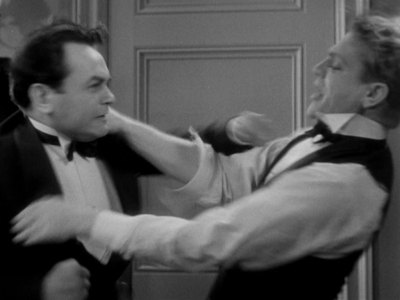
Smart Money (Alfred E. Green, 1931) Done-on-the-cheap Warner Bros. programmer made the year after Edward G. Robinson's star-turn in Little Ceasar and the same year as Cagney's in The Public Enemy and is an version of the studios' series of spare, street-tough films that would dominate their output in the 30's and 40's, glamorizing the life of a gangster, but making sure that they came to a bad end.

Robinson plays Nick the barber, a lucky Greek son of a gun, who runs a gambling joint in the back-room of his tonsorial parlor (thus making both ends of his establishment a "clip-joint.") Nick is king of his own gambling castle, and while its good to be the king,there's the tendency to want to expand the fiefdom by conquering new territory.


With a stake firmly established from his cronies back home, he takes off for New York to take on the big city gamblers, wished well by all the lovable mooks he's already taken for a ride at the train station.  But, what he learns is its a whole new game in the tony high rises, where only part of the bluffing and double-dealing occurs at the table.  Why, even the hat-check girl is looking to separate you from your cash.  Nick learns to trust no one, and to bluff his way out of any situation with a cock-sure patter of platitudes.  But, that's a slippery slope, and he soon finds that success costs.  


Its a treat to see Robinson and Cagney play off each other, the only time they did so—Robinson all-voice and punchy delivery, and Cagney sly and bantamy, physically, in one of his rare supporting roles.  They're all chummy at the beginning, but when success shows up, they start to have territory issues, its murder.  This one is all performance, in varying styles, between character actors fresh out of the silent era, and the leads who were blazing new trails, and the director's hand is almost invisible.


Green is known, but mostly unknown, as the director of The Jolson Story, The Jackie Robinson Story, The Eddie Cantor Story...making that a "storied" career.  He was a fine director of women and coaxed terrific performances from Bette Davis and Barbara Stanwyck early in their careers—and they were already formidable.  He was fast, versatile and would direct up to five pictures a year.  He didn't shy away from racy material in the pre-Code era and would tackle it directly with shameless brio.  And he's remarkably free of the sort of Hollywood white-wash that was prevalent at the time.  Minorities were cast, and not caricatured or minstrelled in his films, but treated like any other character actor, which is quite remarkable to see in that day and age.  His output was undistinguished when you look at the titles (and there are 111 of them), but individually, it would be interesting to see a few more of them (I've seen this one, The Jackie Robinson Story and Baby Face) to see if that liberal sensibility is maintained throughout.


Wednesday, October 31, 2012

Dr. Jekyll and Mr. Hyde (Twinned)

Private Joker: I think I was trying to suggest something about the duality of man, sir. 
Pogue Colonel: The what? 
Private Joker: The duality of man. The Jungian thing, sir. 
Pogue Colonel: ...Whose side are you on, son? 
Full Metal Jacket

"(Cocaine) enhances your personality!"  "Well, what if you're an asshole!?"
Bill Cosby from Bill Cosby, Himself

Better living through chemistry?  And whose side, indeed?  This Hallowe'en season we haven't been looking at monsters, and creatures and other outside forces that threaten us and make us come face to face with horror (as we have in the past).  We've been looking at those that attack us from within.  Not at the monsters that peer at us from outside our bedroom window, but the ones that look at us indoors in our very own mirrors.  What special horror it is, when we come face to face with our enemy, and it's our own.  No better example of that came from the pen of Robert Louis Stevenson in the year 1861.

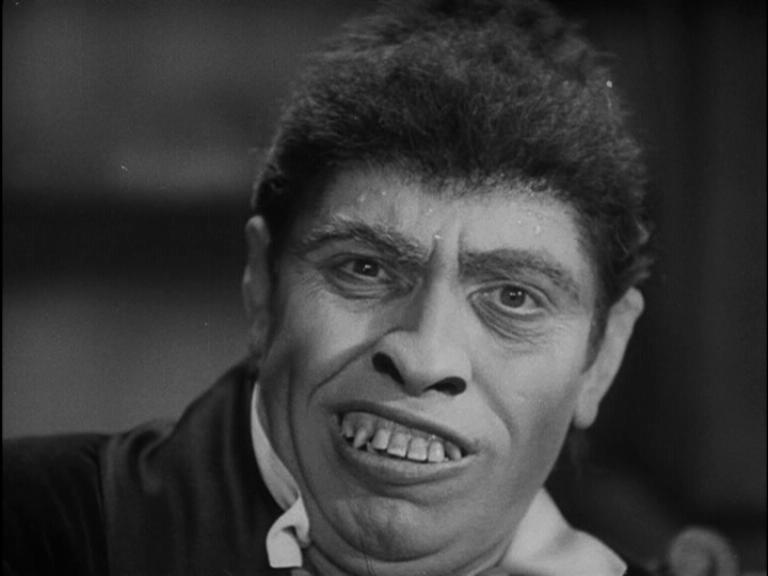
 Dr. Jekyll and Mr. Hyde (Rouben Mamoulian, 1931) A new version of Stevenson's "Strange Case of Dr. Jekyll and Mr. Hyde" seems to crop up every few years.  There've been versions with John Barrymore, Basil Rathbone, Christopher Lee, Spencer Tracy (see below), and TV versions with Jack Palance and even one with Lionel Bart musical numbers that featured Kirk Douglas.  But, this is the one people remember, for many reasons—first being Frederic March's portrayal (which won him an Oscar for Best Actor...in a Horror film, mind you), the effects, the outright sexiness of it (as the film was "Pre-Code,") and for director Mamoulian's stylish treatment—full of straight-on shots of the actors facing the audience, mirrored shots, and all the transformations, each one staged differently (and in a couple of instances using a combination of make-up that only becomes apparent in monochrome when struck by lights colored by different gels—with "Hyde" finally appearing as an ape-like creature in need of radical orthodentia.  March turns in an incredible performance (and he won an Oscar for it, the first actor to do so for a lead in a horror film—the second being Anthony Hopkins in The Silence of the Lambs), his Jekyll (pronounced Jee-kull as the Scottish Stevenson would have it) clearly conflicted but held in check and completely invisible in the form of the obstreperous Hyde, leaping over parapets and loudly enunciating (through those big false teeth) his intentions in a husked gravel.  When first confronting his new image in the mirror he cries "Free!  Free!  At last!"


Now, in Dr. Jekyll and Mr. Hyde (Victor Fleming, 1941) the Dr. Jekyll (pronounced Jeh-kull) played by Spencer Tracy, is far more considering: "So, this is evil, then"  he observes staring at his new countenance in the mirror.

Yes. Yes, it is. Tracy's Jekyll is a thinking, decent man with dark undertones, far less egocentric than the stentorian performance of March; his Hyde is shaggy dark eyebrows and hair, with a curled upper lip like a scar and a direct gaze and uncouthness, despite his pretensions of refinement.  March's Hyde is a proto-human; Tracy's is just a sadistic sociopath.  Jekyll's frustrations with his straight-laced potential father-in-law (Halliwell Hobbs in the first, Donald Crisp in the latter) are buried deep and Hyde releases that pent-up rage.  In the Tracy version, the intelligence is still there (as opposed to March's gleeful monkey-man) but used malevolently—the words are erudite and evenly spoken, but his actions are quick-silver and savage.  


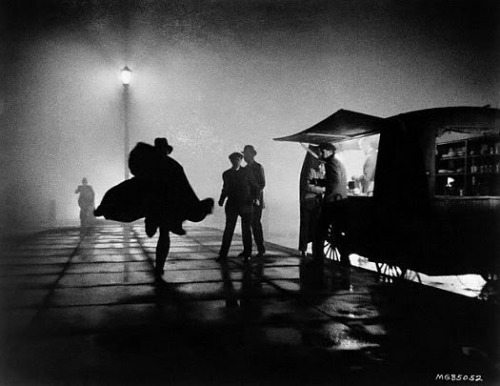
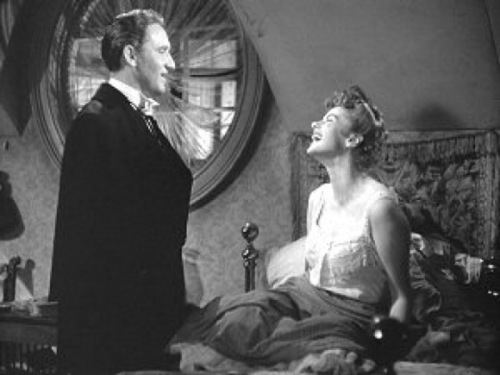
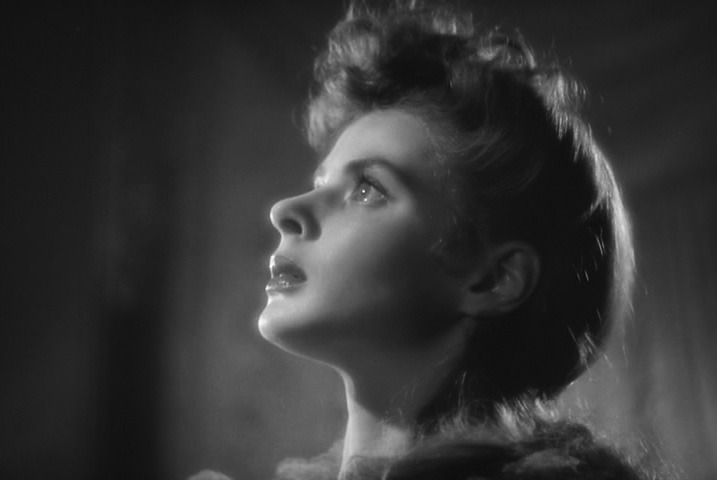
The Tracy version of the character depends less on make-up than the actor's own inventiveness (not that March was any slouch, far from it).  Directed by Victor Fleming, with more emphasis on thick fog effects (where Hyde seems to be allowed to be swallowed in the thick mists, until he disappears like so much water vapor) and the psychology of evil, it is sumptuously produced and veers into the surreal during the transformation sequences.  These are weirdly disturbing, shifting from surfacing lily-pads to Jekyll whipping a team of horses...which then turn into the two women in his life: his faithful fiance (played by a never-lovelier Lana Turner) and a bar-maid (a very early role for Ingrid Bergman, this one preceded Casablanca).  One can only imagine the direction that the director gave his actresses for this sequence and the others ("Okay, Ingrid, you're a wine-cork, but a happy wine-cork!").  Whereas March's Hyde is all simian actions and attitudes, Tracy's is psychologically, adroitly cool, a genuinely mean bastard gleefully tripping up theater managers with his walking stick, and setting up Bergman's Ivy Petersen as a kept woman, scarring her physically and mentally.  Both films stray from Stevenson's narrative, which only implies Hyde's actions, which seem to stay only in the realm of violence, but both Mamoulian's and Fleming's films features the story of the two women who suffer at the man's hands and split personalities.  Bergman's performance is raw and heartbreaking, subtly letting emotions percolate under the surface of her skin, a luminous smile capable of dropping precipitously and tremulously, then escalating into hysteria.  Turner's performance is pitch-perfect, but merely an ingénue role and she's not required too much of the tortured complexity she would display later in her career.


Mamoulian's film is fancy; Fleming's is fanciful, each taking different approaches to what is essentially the same screen-story, deviating just as far off the cobblestone streets of the novella, and each one coming to the same conclusion—different from the story's where Jekyll's fate is left in the air, seemingly condemned to live out his life as the evil Hyde—to satisfy the moralists in the audience, pre-Code or not.  Interesting to see them back-to-back (to-back-to-back) and explore the similarities and differences—a bit like Jekyll and Hyde themselves.


Interestingly, these two Jekyll's, Tracy and March, squared off against each other in the courtroom drama Inherit the Wind.*


* And another parallel: March received his first Oscar nomination for playing the part of actor Tony Cavendish in The Royal Family of Broadway.  The role of Cavendish was based on John Barrymore who had a big success...playing Dr. Jekyll/Mr. Hyde in the 1920 film version.

"...Room for one more, honey?"


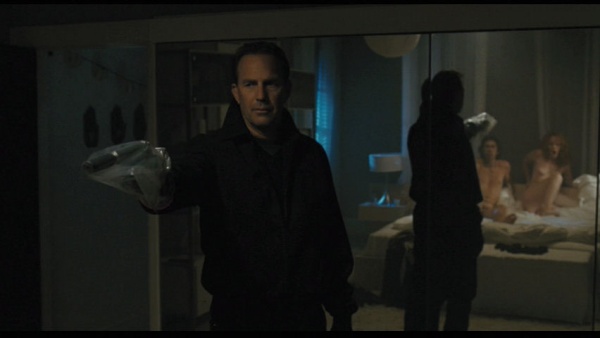
Mr. Brooks (Bruce A. Evans, 2007) A more modern take on the Jekyll/Hyde-in-plain-sight story (we won't talk about the various "Hulk" movies—the superhero version of it) is this creepy psychological thriller about another upstanding citizen and pillar of the community, Earl Brooks (Kevin Costner), CEO of a thriving box-making business.  Brooks has a seemingly normal nuclear family: a loving, doting gorgeous wife (Marg Helgenberger) and a slightly spinning-out-of-orbit daughter (Danielle Panabaker), but the fourth member of the clan is the one with the most fission—the other voice in Brooks' head, Marshall, played by an on-screen William Hurt.  The performances of the two men couldn't be more different: Hurt has the easier one—the all-leering, cackling, lip-smacking Id, while Costner (being in the "real" world) is restrained, cerebral, and calculating on the inside.  Costner really is a fine actor, and his Brooks, in control of most situations unless Marshall convinces him otherwise, every so often goes on a killing binge that satisfies a weird craving.  One entertaining aspect is that Brooks is self-aware enough of his situation to go to AA meetings.  He's an addict and he knows it.  But there aren't enough steps in any program to cure his issues.  He's made enough of a blood-splash to attract the attention of local detectives (Demi Moore leading the investigation) and one fan-boy (Dane Cook) who wants in on the action.  Earl and Marshall are caught in the middle (and with two personalities it gets very crowded in there), yinging and yanging between their two points of view and calculations.  But the creepiest moments—the genuinely chilling ones—are when they combine, joining each other in a sick, twisted laugh for a shared joke, between the two personalities in the one man.  For all the gruesome murders and gouts of blood on display, that's when Mr. Brooks gets really scary.


Thursday, September 27, 2012

The Public Enemy

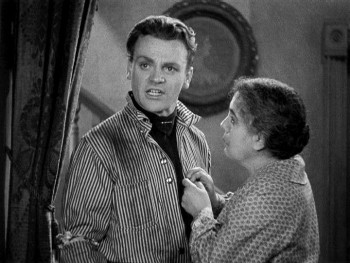
The Public Enemy (William Wellman, 1931) "Learn your lines, find your mark, look 'em in the eye and tell 'em the truth."  That was James Cagney's recipe for good acting, succinct, humble, with plenty of lee-way to find your own path, and completely shy of the mark when it came to talking about how he did it.  This gangster film was Cagney's first starring role—in fact, up until two weeks before filming, Edward Woods (who plays Tom Powers' best friend) was going to play the lead.  But, there was something about the little guy with the bantam rooster's brio that made director William Wellman turn the tables on the roles.

It's the story of a rotten kid from a good family with all the contrary instincts to look out for a number one—himself—who has no moral compunctions about anybody else, that leads him down a precariously slippery slope at a time in history when society was providing an excellent opportunity for taking advantages of loop-holes in the law and morality.  Pretty soon, "Tommy" is a booze-runner during Prohibition, and anybody getting in his way, even some he'd pledged loyalty to earlier, would find their way on the wrong end of his fist or the business end of his gun (and curiously, Cagney's Powers employs both the same way, with a forward thrust of the arm, as if fist and firearm were interchangeable).

It's a pretty standard morality—or immorality—tale.  But, you watch Cagney do it his way and you never forget it.  He's extremely charismatic, and like James Dean, does so in a way that separates him from everybody else.  Where the rest of the cast—in one of the early talkies—is ramrod-stiff and talking with fine e-lo-cu-tion, Cagney is loose in everything, wrapping himself around furniture, spitting out his slang dialogue, and if there's a little dead-air, throws in a little wise-crack in word or gesture for good measure.  He's encouraged by Wellman, who takes a lot of chances in this pre-Code drama ("Did he just say what I think he said?"  "Is that gesture in the credits what I think it means?"), and who sets up the tenor of the times in one masterful shot from a street corner's vantage-point, moving from a distillery to a corner-bar, following a pole of beer-buckets that crosses the path of a Salvation Army band.  Wellman liked to play it rough—they used real bullets in a shot where masonry is picked off close to Cagney's head, and when Cagney is hit by the actor playing his sanctimonious brother, Cagney goes down like a ton of bricks—because Wellman told the other actor to clobber him, breaking a tooth in the process.  And there's the famous grapefruit-in-the-face shot (making Mae Clarke something of a legend extending far beyond her career), that Wellman came up with—because he always imagined doing that to his own wife, who habitually ate half a grapefruit in the morning.

But, it's Cagney that's the Big Show.  Watch the scene where he stands in the rain, luxuriantly eyeing his next targets, the guys who gunned down his buddy in the street.  With murder on his mind, a smirk comes over his face, that turns into a fierce grin, then disappears into a grimace as he moves forward and walks right into the camera, like a ball of fire that can never be put out. 

Cagney's so good, he's scary.  


Cagney's Tom Powers with murder on his mind—that not even a downpour can douse.


Wednesday, October 29, 2008

Dracula (1931)

"Dracula" (Tod Browning, 1931) Filmed version of the stage-play* featuring its matinee-idol, Bela Lugosi. As with "Frankenstein," there had been other versions of Count Dracula's British Invasion, including one ("Nosferatu" by F.W. Murnau) that got around copyright issues by calling its "vampyre" "Count Orlok."** As with Universal Picture's earlier productions of "The Phantom of the Opera," "The Hunchback of Notre Dame" and "The Man Who Laughs," the film is heavy on theatrics, but, this time, is a bit lean in the make-up department, although Lugosi did wear painful silvered contact lenses to enhance his seductive glare. Lugosi's elegant monster, with his slash of a mouth, and eyes wide open while balefully squinting with a laser-like intensity manages to still evoke "the creeps" to this day.

Tod Browning's direction is full of subtle touches--the sudden appearance of the Count's "brides," for example--and not-so-subtle--a shot of Jonathan Harker on Dracula's staircase is shot through a spider web, and Dwight Frye's performance as Renfield is babblingly over-the-top, as is required of so many actors in the horror genre.

As we wrote of the primal homosexual aspects of "Frankenstein," "Dracula" is the straighter blood-brother--the heterosexual aspect of humanity gone hysterical. Dracula's attacks start as seductions, but his acts are akin to rape--animalistic and savage--and linked to sexuality--penetrative, taking blood and passing on the disease of vampirism to his victims. sapping life-strength and energy. And it's all under the guise of civility and position, of manners and societal restraint. But underneath throbs the bestial urges--hidden by day, and only alive at night. Sure, it's nice to bask in the glow of celebrity, but make sure the smile isn't hiding fangs.

Count Dracula, then, is one big hard-on, that by light of day, crumbles to dust. That his bane are religious icons and his own lack of reflection (self-knowledge) only reinforces the metaphor. He's never gone out of style, no matter how straight-laced or free-loving the times. Dracula is one popular "playa."

With the times, the incarnations of "Dracula" have become increasingly sexual over the years, *** only making more obvious what Bram Stoker and Tod Browning buried in the sub-text. "Dracula" is, and always has been, the personification of serial criminal sexuality--which can only be curbed by the light of day. Dracula is The Forbidden, and carries the risk of damnation for seeking it. Besides the purifying rays of the sun, the surest way to kill a vampire is a blessed stake...through the heart.

"Frankenstein"-homosexuality. Dracula-heterosexuality. Of course, these haunts were conjured during the repressed Victorian era. But what horrified them, still carried a tingle, just as their stories intrigue us and our children, thrill us, and haunt our dreams. No wonder the Religious Right condemn them, or any aspect of the occult.

Hollywood makes a vain attempt (or stab) at killing them, but these monsters of the Id keep coming back, rising from the grave (or the ashes) to stalk another day...er...night. How do you handle these monsters/urges?

The answer on Friday.

But tomorrow, a horror favorite of mine from a Master Director.

*Adapted from Bram Stoker's 1897 novel by Hamilton Deane and John L. Baderston.


** "Dracula" did not go into the public domain until April, 1962.

*** A guided tour of coffin-dwellers (please, no flash pictures): Christopher Lee's athletic, animal "Dracula" in the heaving Hammer films, Frank Langella oozing Byronesque charm in the 70's stage version and 80's film version, Barnabas Collins, cutting a swath through the ladies of daytime soap-opera on "Dark Shadows," Anne Rice's tortured, damned rock-star vampires, and right on up to current day with the throbbing vampiric (though chaste) teen romances of the "Twilight" series.

Tuesday, October 28, 2008

Frankenstein (1931)

"Frankenstein" (James Whale, 1931)

"We are about to unfold the story of Frankenstein, a man of science who sought to create a man after his own image without reckoning upon God. It is one of the strangest tales ever told. It deals with the two great mysteries of creation – life and death. I think it will thrill you. It may shock you. It might even – horrify you. So if any of you feel that you do not care to subject your nerves to such a strain, now's your chance to – uh, well, we warned you."

Every young boy's horror touchstone—and if we're to believe Víctor Erice's "El Espíritu de la colmena" every little girl's, too. One of Carl Laemmle Jr.'s ghoul gallery of public domain necromancy movies that spawned dozens of sequels and dozens of imitators, all inferior to the craft of these primitive films, made at the fog-shrouded dawn of the Sound era.

But towering above them all in the pounding hearts, toad-squirming minds, and knocking knees of horror fan-dom is the story of "The Modern Prometheus" and the Monster to whom the public bequeathed his name.

"
Frankenstein" boasts odd beginnings. Written by Percy Bysshe Shelley's frail flower of a wife, aged 18 when she conceived it, during a Gothic night's creativity, "Frankenstein's" story and it's several graves-deep inner meanings had been a classic for decades. It had been filmed before (even by Thomas Edison), but Laemmle's production, directed by James Whale has emerged as the one with the biggest boots to fill.

It might be because of its introduction (reproduced above).
Edward Van Sloan walks out onto the filmed stage and warns us of the subject matter to come and the blasphemous implications of a man not "reckoning upon God." It's a good tactic—a carnival barker's come-on—for rather than warn us away, it whets the audience's appetite for the terrors to come.

And
James Whale doesn't disappoint. Whale's life has merged with Legend (the movie "Gods and Monsters"), but his German-expressionism-influenced eye and sense of the absurd (which would come to full flower in the follow-up, "The Bride of Frankenstein") created a sinister world of vast-shadowed hallways, spitting whirling laboratories, and castle chambers that resembled gargantuan funeral homes.

Before going on to the actors, homage must be paid to the craftsmen: Art Director
Charles D. Hall, whose bizarre designs for the film give it its scale and majestic decay; and, of course, make-up artist
Jack Pierce, who transformed a slight British actor named Karloff into a 7-foot, barrel-chested, electrode-studded,* flat-skulled (and copyrighted) hulk. There have been many subsequent designs for Frankenstein's piece-meal monster, but none have been so iconic as the Whale-Pierce-Karloff version.

Karloff's contribution cannot be slighted—including his removal of an upper dental plate to give
the Monster a dented, off-kilter face. But mention should be made of Colin Clive's hyper-bi-polar doctor (he was a wayward medical student in Shelley's tale), prone to manic exultation or fainting dead away in emotional extremis. The good doctor's a bad drama queen. As his house-keeper would say in the sequel, he's a queer fellow.

There's another reason to celebrate the longtime classic-ness of James Whale's "Frankenstein." It and it's sequel "
The Bride of Frankenstein" may be two of the greatest gay-themed movies to come out of straight, Hayes Code mainstream Hollywood. I had a film professor who was studying "Bride" and told of his curiosity about the air of exoticism in the first two "Frankenstein" films, when that "queer" line came out it was the lightning-bolt that was the key. What is "Frankenstein" and "The Bride of Frankenstein" except the story of a man (or two men in "Bride," with Frankenstein and Professor Pretorius collaborating) trying to give birth.** The melancholy cruelty of Nature and mob-hysteria towards the different permeates both of Whale's "Frankenstein" films,*** and turns Monster into mirror, a figure of identity rather than horror, and occurs whether the audience is gay or straight. There's a reason the shunned figure of Frankenstein's Monster resonates: he's an outcast, yearning but misunderstood, tortured, but sympathetic. And though kept prisoner in a castle dungeon rather than a closet, he would emerge sequel after sequel, never vanquished—indomitable—his super-human will-to-live allowing him to see another day. As they say in "Jurassic Park," "Life will find a way."

Frankenstein" is one gifted director's roaring protest against the Nature of Things ... and man's intolerance.


* One of the basic copy-rights of the Universal design are the electrodes sticking out pf the Monster's neck. Though "Frankenstein," the story, is in the public domain--one of the main reasons Francis Ford Coppola produced a version years ago--and anyone can do a re-make, those electrodes, and the rest of the make-up design, are the commodity of Universal Pictures. When Mel Brooks made his "Young Frankenstein" in the 70's, he by-passed the neck-studs...with zippers.

*** Christopher Isherwood also used Frankenstein and Pretorius (dubbed "Polidori") to create a more homo-erotic version of the story...for NBC television...when he wrote the teleplay for "Frankenstein: The True Story

**When he presented his theory in class, one of the students remarked "That's kind of mind-blowing..." to which he replied, "I'm glad you said 'mind...'"