Showing posts with label Jean Harlow. Show all posts

Thursday, September 27, 2012

The Public Enemy

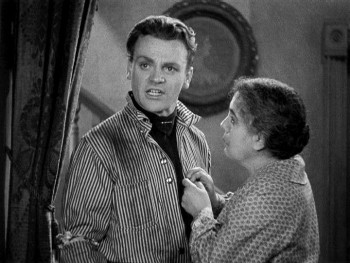
The Public Enemy (William Wellman, 1931) "Learn your lines, find your mark, look 'em in the eye and tell 'em the truth."  That was James Cagney's recipe for good acting, succinct, humble, with plenty of lee-way to find your own path, and completely shy of the mark when it came to talking about how he did it.  This gangster film was Cagney's first starring role—in fact, up until two weeks before filming, Edward Woods (who plays Tom Powers' best friend) was going to play the lead.  But, there was something about the little guy with the bantam rooster's brio that made director William Wellman turn the tables on the roles.

It's the story of a rotten kid from a good family with all the contrary instincts to look out for a number one—himself—who has no moral compunctions about anybody else, that leads him down a precariously slippery slope at a time in history when society was providing an excellent opportunity for taking advantages of loop-holes in the law and morality.  Pretty soon, "Tommy" is a booze-runner during Prohibition, and anybody getting in his way, even some he'd pledged loyalty to earlier, would find their way on the wrong end of his fist or the business end of his gun (and curiously, Cagney's Powers employs both the same way, with a forward thrust of the arm, as if fist and firearm were interchangeable).

It's a pretty standard morality—or immorality—tale.  But, you watch Cagney do it his way and you never forget it.  He's extremely charismatic, and like James Dean, does so in a way that separates him from everybody else.  Where the rest of the cast—in one of the early talkies—is ramrod-stiff and talking with fine e-lo-cu-tion, Cagney is loose in everything, wrapping himself around furniture, spitting out his slang dialogue, and if there's a little dead-air, throws in a little wise-crack in word or gesture for good measure.  He's encouraged by Wellman, who takes a lot of chances in this pre-Code drama ("Did he just say what I think he said?"  "Is that gesture in the credits what I think it means?"), and who sets up the tenor of the times in one masterful shot from a street corner's vantage-point, moving from a distillery to a corner-bar, following a pole of beer-buckets that crosses the path of a Salvation Army band.  Wellman liked to play it rough—they used real bullets in a shot where masonry is picked off close to Cagney's head, and when Cagney is hit by the actor playing his sanctimonious brother, Cagney goes down like a ton of bricks—because Wellman told the other actor to clobber him, breaking a tooth in the process.  And there's the famous grapefruit-in-the-face shot (making Mae Clarke something of a legend extending far beyond her career), that Wellman came up with—because he always imagined doing that to his own wife, who habitually ate half a grapefruit in the morning.

But, it's Cagney that's the Big Show.  Watch the scene where he stands in the rain, luxuriantly eyeing his next targets, the guys who gunned down his buddy in the street.  With murder on his mind, a smirk comes over his face, that turns into a fierce grin, then disappears into a grimace as he moves forward and walks right into the camera, like a ball of fire that can never be put out. 

Cagney's so good, he's scary.  


Cagney's Tom Powers with murder on his mind—that not even a downpour can douse.


Tuesday, May 27, 2008

Wife Versus Secretary

"Wife vs. Secretary" (Clarence Brown, 1936) One of those forays off "The Rock" allowed me an evening of cable TV, and when I have a choice I head straight for Turner Classic Movies-easily the best channel for watching movies on the television dial. TCM treats the movies they show with respect--without commercial interruption, and in the proper theatrical aspect (widescreen if its a widescreen movie). They also show rare films, silent films, foreign films, things that any other channel with "movie" in its name wouldn't dare show in their efforts to cram as many commercials into each film as possible (Hello, AMC, you whore!)

So, that night I had the chance to catch a movie I'd never heard of, called "Wife vs. Secretary," which starred Clark Gable, Myrna Loy (as the "Wife") and Jean Harlow (as the "Secretary"). It was an M-G-M programmer, designed to exploit three of its biggest stars, and particularly Gable--the man is given so many loving close-ups, you actually begin to think he was being shot through gauze. Anyway, his V.S. Stanhope is a publishing tycoon, seeking to expand his properties--he's aggressive, a "man's man," and keeps terrible office-hours, seeing his loving, trusting wife only for an early breakfast and a late formal dinner party. His "Girl Friday" is Helen "Whitey" Wilson, a career-girl who keeps pace with Stanhope for the sheer exhilaration of seeing how fast the company can grow. That leaves her boy-friend a bit mopey, and considering he's played by a proto-Jimmy Stewart, that's saying quite a bit. An extended business trip to Cuba that leaves the Stanhope and Wilson drunk and in the same hotel rom almost sparks a romance, but both of them are just sober enough to think it's a dumb idea. But that doesn't keep the wife and boyfriend from suspecting the worse. It's interesting to see a pretty standard melodrama done with such snap--the timing of the stars crackles.

Now, I said this was a programmer, Gable had been in three previous films with Loy and four with Harlow, so they were all old veterans, and the movie sails by with quick dialog, impossibly rich surroundings (it's M-G-M), quite a few sophisticated laughs, and a very old school lesson in morality and suspicions gone awry. But it all turns out right in the end, as long as the career-girl gives up her job and "settles down," that is. Retro-chauvenism aside, though, it's a fascinating look at a typical night at the movies from 1936, cranked out like an automobile, but with obvious care, a nice sheen, and only the best parts.