Showing posts with label Victor Fleming. Show all posts

Wednesday, October 31, 2012

Dr. Jekyll and Mr. Hyde (Twinned)

Private Joker: I think I was trying to suggest something about the duality of man, sir. 
Pogue Colonel: The what? 
Private Joker: The duality of man. The Jungian thing, sir. 
Pogue Colonel: ...Whose side are you on, son? 
Full Metal Jacket

"(Cocaine) enhances your personality!"  "Well, what if you're an asshole!?"
Bill Cosby from Bill Cosby, Himself

Better living through chemistry?  And whose side, indeed?  This Hallowe'en season we haven't been looking at monsters, and creatures and other outside forces that threaten us and make us come face to face with horror (as we have in the past).  We've been looking at those that attack us from within.  Not at the monsters that peer at us from outside our bedroom window, but the ones that look at us indoors in our very own mirrors.  What special horror it is, when we come face to face with our enemy, and it's our own.  No better example of that came from the pen of Robert Louis Stevenson in the year 1861.

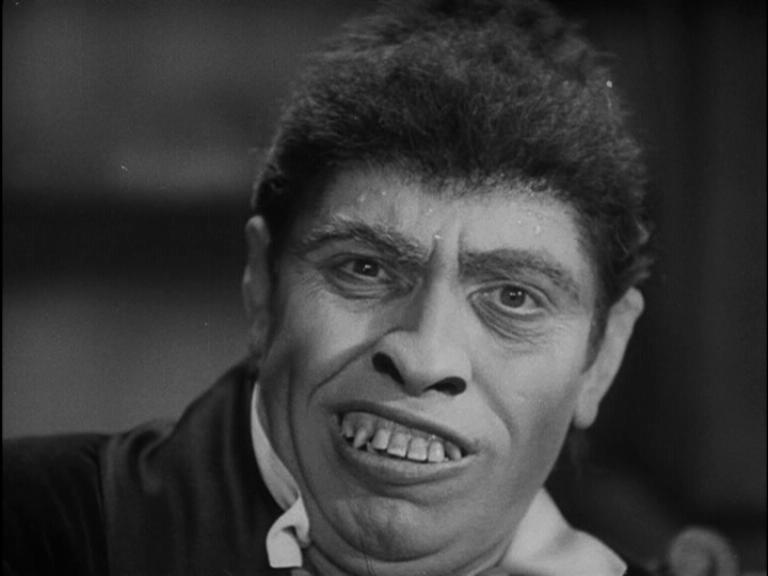
 Dr. Jekyll and Mr. Hyde (Rouben Mamoulian, 1931) A new version of Stevenson's "Strange Case of Dr. Jekyll and Mr. Hyde" seems to crop up every few years.  There've been versions with John Barrymore, Basil Rathbone, Christopher Lee, Spencer Tracy (see below), and TV versions with Jack Palance and even one with Lionel Bart musical numbers that featured Kirk Douglas.  But, this is the one people remember, for many reasons—first being Frederic March's portrayal (which won him an Oscar for Best Actor...in a Horror film, mind you), the effects, the outright sexiness of it (as the film was "Pre-Code,") and for director Mamoulian's stylish treatment—full of straight-on shots of the actors facing the audience, mirrored shots, and all the transformations, each one staged differently (and in a couple of instances using a combination of make-up that only becomes apparent in monochrome when struck by lights colored by different gels—with "Hyde" finally appearing as an ape-like creature in need of radical orthodentia.  March turns in an incredible performance (and he won an Oscar for it, the first actor to do so for a lead in a horror film—the second being Anthony Hopkins in The Silence of the Lambs), his Jekyll (pronounced Jee-kull as the Scottish Stevenson would have it) clearly conflicted but held in check and completely invisible in the form of the obstreperous Hyde, leaping over parapets and loudly enunciating (through those big false teeth) his intentions in a husked gravel.  When first confronting his new image in the mirror he cries "Free!  Free!  At last!"


Now, in Dr. Jekyll and Mr. Hyde (Victor Fleming, 1941) the Dr. Jekyll (pronounced Jeh-kull) played by Spencer Tracy, is far more considering: "So, this is evil, then"  he observes staring at his new countenance in the mirror.

Yes. Yes, it is. Tracy's Jekyll is a thinking, decent man with dark undertones, far less egocentric than the stentorian performance of March; his Hyde is shaggy dark eyebrows and hair, with a curled upper lip like a scar and a direct gaze and uncouthness, despite his pretensions of refinement.  March's Hyde is a proto-human; Tracy's is just a sadistic sociopath.  Jekyll's frustrations with his straight-laced potential father-in-law (Halliwell Hobbs in the first, Donald Crisp in the latter) are buried deep and Hyde releases that pent-up rage.  In the Tracy version, the intelligence is still there (as opposed to March's gleeful monkey-man) but used malevolently—the words are erudite and evenly spoken, but his actions are quick-silver and savage.  


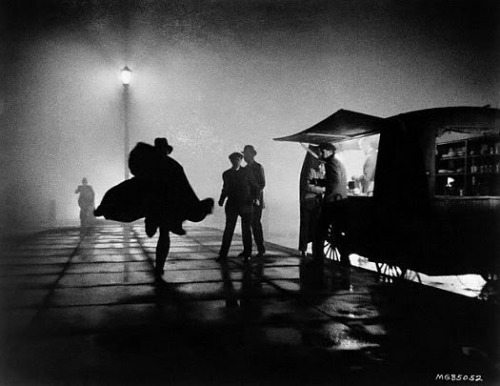
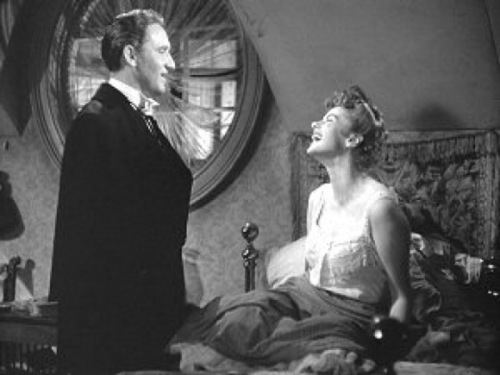
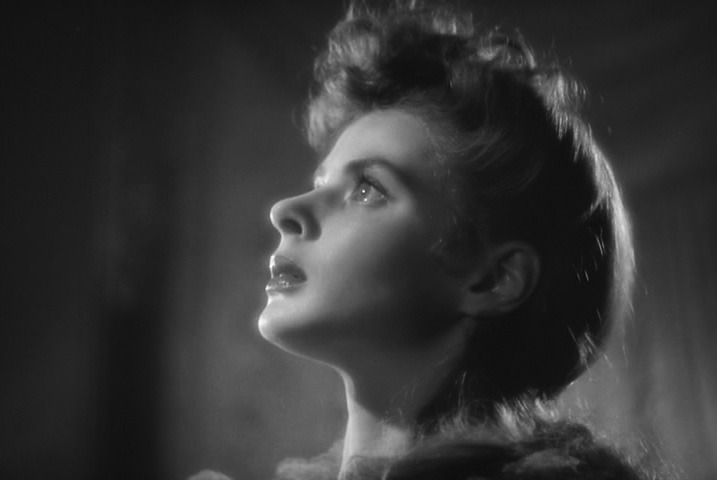
The Tracy version of the character depends less on make-up than the actor's own inventiveness (not that March was any slouch, far from it).  Directed by Victor Fleming, with more emphasis on thick fog effects (where Hyde seems to be allowed to be swallowed in the thick mists, until he disappears like so much water vapor) and the psychology of evil, it is sumptuously produced and veers into the surreal during the transformation sequences.  These are weirdly disturbing, shifting from surfacing lily-pads to Jekyll whipping a team of horses...which then turn into the two women in his life: his faithful fiance (played by a never-lovelier Lana Turner) and a bar-maid (a very early role for Ingrid Bergman, this one preceded Casablanca).  One can only imagine the direction that the director gave his actresses for this sequence and the others ("Okay, Ingrid, you're a wine-cork, but a happy wine-cork!").  Whereas March's Hyde is all simian actions and attitudes, Tracy's is psychologically, adroitly cool, a genuinely mean bastard gleefully tripping up theater managers with his walking stick, and setting up Bergman's Ivy Petersen as a kept woman, scarring her physically and mentally.  Both films stray from Stevenson's narrative, which only implies Hyde's actions, which seem to stay only in the realm of violence, but both Mamoulian's and Fleming's films features the story of the two women who suffer at the man's hands and split personalities.  Bergman's performance is raw and heartbreaking, subtly letting emotions percolate under the surface of her skin, a luminous smile capable of dropping precipitously and tremulously, then escalating into hysteria.  Turner's performance is pitch-perfect, but merely an ingĂ©nue role and she's not required too much of the tortured complexity she would display later in her career.


Mamoulian's film is fancy; Fleming's is fanciful, each taking different approaches to what is essentially the same screen-story, deviating just as far off the cobblestone streets of the novella, and each one coming to the same conclusion—different from the story's where Jekyll's fate is left in the air, seemingly condemned to live out his life as the evil Hyde—to satisfy the moralists in the audience, pre-Code or not.  Interesting to see them back-to-back (to-back-to-back) and explore the similarities and differences—a bit like Jekyll and Hyde themselves.


Interestingly, these two Jekyll's, Tracy and March, squared off against each other in the courtroom drama Inherit the Wind.*


* And another parallel: March received his first Oscar nomination for playing the part of actor Tony Cavendish in The Royal Family of Broadway.  The role of Cavendish was based on John Barrymore who had a big success...playing Dr. Jekyll/Mr. Hyde in the 1920 film version.

"...Room for one more, honey?"


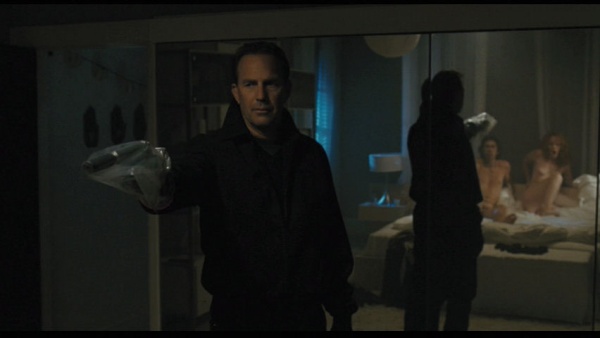
Mr. Brooks (Bruce A. Evans, 2007) A more modern take on the Jekyll/Hyde-in-plain-sight story (we won't talk about the various "Hulk" movies—the superhero version of it) is this creepy psychological thriller about another upstanding citizen and pillar of the community, Earl Brooks (Kevin Costner), CEO of a thriving box-making business.  Brooks has a seemingly normal nuclear family: a loving, doting gorgeous wife (Marg Helgenberger) and a slightly spinning-out-of-orbit daughter (Danielle Panabaker), but the fourth member of the clan is the one with the most fission—the other voice in Brooks' head, Marshall, played by an on-screen William Hurt.  The performances of the two men couldn't be more different: Hurt has the easier one—the all-leering, cackling, lip-smacking Id, while Costner (being in the "real" world) is restrained, cerebral, and calculating on the inside.  Costner really is a fine actor, and his Brooks, in control of most situations unless Marshall convinces him otherwise, every so often goes on a killing binge that satisfies a weird craving.  One entertaining aspect is that Brooks is self-aware enough of his situation to go to AA meetings.  He's an addict and he knows it.  But there aren't enough steps in any program to cure his issues.  He's made enough of a blood-splash to attract the attention of local detectives (Demi Moore leading the investigation) and one fan-boy (Dane Cook) who wants in on the action.  Earl and Marshall are caught in the middle (and with two personalities it gets very crowded in there), yinging and yanging between their two points of view and calculations.  But the creepiest moments—the genuinely chilling ones—are when they combine, joining each other in a sick, twisted laugh for a shared joke, between the two personalities in the one man.  For all the gruesome murders and gouts of blood on display, that's when Mr. Brooks gets really scary.


Saturday, April 28, 2012

A Guy Named Joe

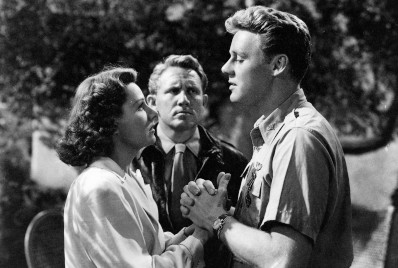
A Guy Named Joe (Victor Fleming, 1943) Wartime fantasy film that was such a favorite of Steven Spielberg's that he remade it as Always in 1989.  One can see why, despite the torturous transition from changing the milieu from World War II bombers to forest fire-fighting.  It has a lot of diverse plot elements and crosses many genres: love story, war story, fantasy, action.  Yet it's also a personal story with a character arc close to Spielberg's heart: a man-child has to learn to grow up.  But, instead of committing to something, here the key to maturity is letting go...making the sacrifice.  Of course, that story is only one dangerous mission away from being told in any war film.  In a story about fire-fighting, not so much.

But, back to Spielbergian motivations—the best reason to remake this movie? The love story doesn't work. Whatever passes between Spencer Tracy and Irene Dunne in this movie feels more like mere tolerance than a quickening flame.  One hesitates to bring Hollywood gossip into discussing the results on film; what is on-screen should be taken at face value, and the situations  and logistics on-set should, if all goes well, be invisible to the casual movie-goer (and Fleming, a yeoman director who skirted the complexities of Gone with the Wind and The Wizard of Oz is better than most at surmounting them).  But, the chemistry between Tracy and Dunne, that is so important to making the rest of the film work is not there.  The two did not get along during filming, and Tracy's entire performance comes off as aloof and "above-it-all," not heartfelt as it should be.  In his update, Spielberg overcompensated, going the other way, Richard Dreyfuss' work being a little too smiley and treacly and trying too hard to be "winning," making his character seem petty and destructively selfish during Always' dark passages.

But, the story's a compelling one: Pete Sandidge (Tracy) is a chances-taking bomber pilot in the European theater of WWII.  He's best buddies with Al Yackey (Ward Bond) and sweet on Durinda (Dunne), a pilot in her own right.  During one mission, Pete is killed, and finding himself in the after-life, is tasked by "The General" (Lionel Barrymore) with helping to train a young pilot, Ted Randall (Van Johnson in his first major screen role) in the Japanese theater.  Durinda comes back into the picture, still shattered by Pete's death, but at the urging of Yackey, she ends up nearby, and, though reluctant, finds herself falling for Ted.

For Pete, this is agony, watching their budding romance, and leaves him conflicted about his "mission" and his feelings, and only an extremely melodramatic act of sacrifice forces him to "see the light," as it were.  

The screenplay is by Dalton Trumbo, and he works hard—maybe a might too hard—to balance the conflicting emotions in Pete, and as good as Tracy is, he can't seem to find the right balance to give Pete the depth of character integration to keep the different aspects of his personality together.  The motivations are there in the script, but Tracy, fine in individual scenes, can't seem to make Pete a whole human being, giving a slightly disinterested air to the character.  Some scenes were re-shot later in the studio to find a better balance (which, ironically, might have led to the problem), but the results on-screen don't pay off.  Maybe it's the integration of fantasy elements with a war film that causes the conflict, and although the film comes to a resolution satisfyingly, it leaves one feeling a little melancholy, as if something more could be done.  Partially, that's the film and how its elements might have more fully gelled.  But, it's also the resolution of the film, too.  Realistically (and bear in mind we're talking about a fantasy film here) the proper resolution is to face facts and accept and let go, for spirits on both sides of the astral plane...to accept grief and move on, parting.  A bitter pill, even if for a greater good (which is always suspect).  In the end, it comes down to making the best out of loss, and given the time of strife in which the film was made, that's a heartening statement to make, if superfluous, given the very real individual losses the world was producing during that war.

Interesting film, if not completely successful.  However, three years later, Michael Powell and Emeric Pressburger would take similar themes and turn it into the far superior, and more fantastical, A Matter of Life and Death


Thursday, August 12, 2010

The Good Earth

"The Good Earth" (Sidney Franklin, Victor Fleming, George W. Hill, Sam Wood and Gustav MachatĂ˝, 1936) This is a film (as Leonard Maltin would say) "very much of its time"—Hollywood critical code for saying that if it was made this way today it would be picketed and protested and denounced on the Senate floor (well, maybe not the last one). So, let's just get it out of the way. There's a lot of racism in "The Good Earth," from the casting of Paul Muni* and Luise Rainer (and many of the principals, including Walter Connolly and...Charley Grapewin?!), all Caucasians, as Asians,** which is unfortunate, the music is Hong-Kong china-gong cliche-ridden, the pigeon-English of the screenplay insulting. Absolutely true.

Give them points for trying in bloody 1936, though. The original plan for the film, as envisioned by author
Pearl Buck and M-G-M honcho Irving Thalberg was to create an all-Chinese film, but studio pressure for "better profits with bigger stars" from M-G-M head Louis B. Mayer (who didn't want to make the film, whether it was profitable or not) compromised the plan—Paul Muni was cast as farmer Wang Lung. And, because of anti-miscegenation language built into the Hays Code, as Wang was being played by a white guy, a Chinese actress could therefore not be cast as Mrs. Wang. So the part went to Luise Rainer, who had won the Oscar for Best Actress for "The Great Ziegfeld."***

Original director
George W. Hill traveled to China to film location footage that was supplemented by California locations and sets. Hill died before principal photography could take place and Sidney Franklin was hired as director—but as, with other big M-G-M productions, other directors stepped in for some sequences, including the ubiquitous Victor Fleming (of "Gone with the Wind" and "The Wizard of Oz" fame), and Sam Wood, who directed the genuinely frightening scenes of the looting at The Great House.  This one tears the "auteur" theory to shreds as it was, very much, a Producer's picture. Thalberg (fictionalized in "The Last Tycoon" by F. Scott Fitzgerald), oversaw the whole thing, picking directors from his stable of them to maximize the thrill of specific sequences to enhance the spectacle of his "prestige" picture, and despite the clashing styles, the thing seems to work rather seamlessly.

Beyond the piece-meal approach and industrial racism, though, "The Good Earth" is frequently thrilling with production value and subtle in its politics. In it, we see a lower-caste family go through the travails of living off the soil. When "The Good Earth" turns against them and a drought threatens the family, they're forced to movie "to the city" to look for work. Glossy this production may be, but it doesn't turn a blind eye to tragedy, with surprisingly dire consequences for the family. Their fortunes turn—through theft—and they prosper, but that good fortune corrupts, distancing the family from the community. Only when the future is threatened with a devastating invasion (and it literally looks like it) of locusts—through a combination of M-G-M effects wizardry and micro-photography—does the village, now a small city, band together and defeat a Nature they can beat back with sticks and fire.


As I stated, the film is worrisome for its attempts at political correctness and political duplicity at the expense of caricature and wrong-headed casting, but it does deliver an unblinking look at the havoc that can be wrought on people caught between the gales of Nature and their own natures.  Rainer is fairly luminous throughout, and it is particularly heart-warming to see Keye Luke, whom I'd only known as an old man, young and strapping as the best educated (and thus least respected) of the farmer's sons.

"The Good Earth" should be seen in the spirit of "The Big Epic" (with all the frothing, high dudgeon and drama inherent in such enterprises).   It is best, flaws known and forgiven...if not ignored.


* I'm as Chinese as Herbert Hoover" was Muni's retort to his suggested casting.


** And, look, as sure as Anthony Quinn was Arabian, you can bet that box-office potential wins out over authenticity every day.  Only a couple of years ago, there was a furor that Chinese actress Zang Ziyi was cast in the lead of "Memoirs of a Geisha."  Of course, authenticity and cultural sensitivity should be the basis of casting (along with such minor considerations as talent and ability to pull off the role...), but...Zhang Ziyi?  If you could land her for a movie...wouldn't you?

*** Rainer at this writing is alive and well and celebrated her 100th birthday January 10th, 2010. She won back-to-back Oscars in 1935 and 1936, which she stated was "the worst possible thing" for her career. She has mostly stayed out of the lime-light, but occasionally does acting jobs that have struck her fancy--like a dual-role on "The Love Boat," in 1983.