Showing posts with label 1943. Show all posts

Tuesday, July 17, 2012

The Sea of Grass

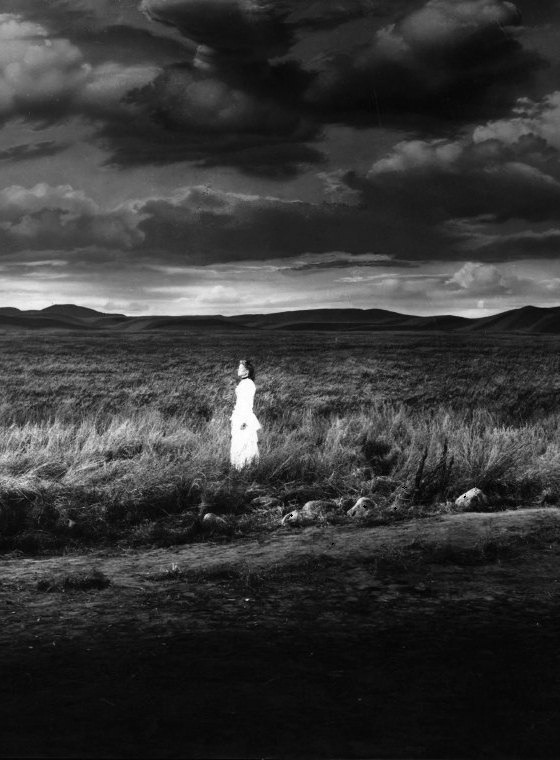
The Sea of Grass (Elia Kazan, 1943) It's Kazan's third feature as a director, playing in Louis B. Mayer's sandbox (literally—the film is shot in-studio at M-G-M, making use of stock-footage of rolling fields already in the can, with some location back-projection), and the founding member of The Actor's Studio has a cast of anybody but—Spencer Tracy and Katherine Hepburn (in their third film together), Melvyn Douglas, Harry Carey Sr. and Edgar Buchanan, all pro movie actors who'd already figured out the best way to project on film, without having to rely on sense-memory for it.

Kazan hated this film and discouraged anybody who'd listen from seeing it.  But, despite its soap-ish tendencies as a romance, it has an underlying ecological message.  Colonel Jim Brewton (Tracy) is a very well-landed cattle baron and resists any efforts by the "guv'mint" towards granting homesteading rights or development on the open range.  For him, its a matter of keeping it unspoiled.  "God's work," as he calls it.  That's his purpose, but he's a might surly, mulish and uncommunicative.  Along comes city-girl Lutie (Hepburn) into his life, and he bends slightly, like the trees she insists be planted at the entrance to their estate, as they sway in the harsh prairie winds. He'll bend with a "wait-and-see" attitude, as in "Wait—you'll see."  He yields to Lutie on her friends's homesteading near his property.  But, a clash is inevitable.  "Fences are a curse word in these parts, he informs her.

There are other complications.  She's a city girl on the prairie and distances between people are daunting.  Then, there's the town lawyer, Chamberlain (Douglas) who has two strikes against him in Brewton's suspicious eyes—he wants the land open to homesteading, and he has his own eyes for Lutie, waiting to pounce whenever there's a crack in the Brewton marriage, which is inevitable.  What his motivations are in both areas are suspect—Brewton Chamberlain are bitter enemies, politically and socially.  Chamberlain just might be making the fight personal and can't help himself.  With both the open fields and Lutie, he can't leave well enough alone.

The rise in Chamberlain's political career (becoming a judge in the district) dooms Brewton's ecological dreams, and soon the prairie becomes home to sodbusters, dependent on weather for their success, and when the rains stop, the crops fail and the farmers leave, the countryside becoming a barren dust-bowl.  It's a hollow, dry victory for Brewton—he's proven right (which no one will admit) and the land goes to waste.  And, in the meantime, Lutie has left, leaving Brewton and cook Jeff (Buchanan) to raise the kids: loyal but neglected Sara Beth (Phyllis Thaxter), and black sheep son Brock (Robert Walker), who it is more than suggested may be Chambelain's child.

One can see why Kazan, Tracy and Hepburn were attracted to the material.  The ecology theme (even if espoused by a bull-headed "protect-what's-mine" cattle rancher) should have been close to the sod of anybody who'd come out of the depression, and the "unbranded scarlet letter" theme must have been attractive to Hepburn who enjoyed tilting at societal windmills.  At this point, Tracy and Hepburn knew each other's tricks on-set.  And it's interesting to see that their personal back-and-forth's in this film are much the same as they are in Guess Who's Coming to Dinner decades later.  She's adoringly passive with a steel spine, and he's remote until his face collapses with emotion.  Kazan would come out of this film feeling compromised—and, indeed, this film about the vastness of open land and the prairie feels like it was filmed inside a glass ball—and would explore other ways to make movies, as opposed to being stuck on the sound-stage.  He'd start insisting on location work and even filming with a documentarian's eye.  His search for authenticity in artifice could not be held behind stage-doors and artificial light.

Saturday, April 28, 2012

A Guy Named Joe

A Guy Named Joe (Victor Fleming, 1943) Wartime fantasy film that was such a favorite of Steven Spielberg's that he remade it as Always in 1989.  One can see why, despite the torturous transition from changing the milieu from World War II bombers to forest fire-fighting.  It has a lot of diverse plot elements and crosses many genres: love story, war story, fantasy, action.  Yet it's also a personal story with a character arc close to Spielberg's heart: a man-child has to learn to grow up.  But, instead of committing to something, here the key to maturity is letting go...making the sacrifice.  Of course, that story is only one dangerous mission away from being told in any war film.  In a story about fire-fighting, not so much.

But, back to Spielbergian motivations—the best reason to remake this movie? The love story doesn't work. Whatever passes between Spencer Tracy and Irene Dunne in this movie feels more like mere tolerance than a quickening flame.  One hesitates to bring Hollywood gossip into discussing the results on film; what is on-screen should be taken at face value, and the situations  and logistics on-set should, if all goes well, be invisible to the casual movie-goer (and Fleming, a yeoman director who skirted the complexities of Gone with the Wind and The Wizard of Oz is better than most at surmounting them).  But, the chemistry between Tracy and Dunne, that is so important to making the rest of the film work is not there.  The two did not get along during filming, and Tracy's entire performance comes off as aloof and "above-it-all," not heartfelt as it should be.  In his update, Spielberg overcompensated, going the other way, Richard Dreyfuss' work being a little too smiley and treacly and trying too hard to be "winning," making his character seem petty and destructively selfish during Always' dark passages.

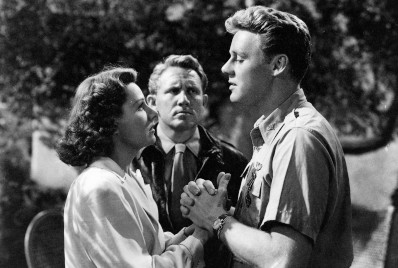
But, the story's a compelling one: Pete Sandidge (Tracy) is a chances-taking bomber pilot in the European theater of WWII.  He's best buddies with Al Yackey (Ward Bond) and sweet on Durinda (Dunne), a pilot in her own right.  During one mission, Pete is killed, and finding himself in the after-life, is tasked by "The General" (Lionel Barrymore) with helping to train a young pilot, Ted Randall (Van Johnson in his first major screen role) in the Japanese theater.  Durinda comes back into the picture, still shattered by Pete's death, but at the urging of Yackey, she ends up nearby, and, though reluctant, finds herself falling for Ted.

For Pete, this is agony, watching their budding romance, and leaves him conflicted about his "mission" and his feelings, and only an extremely melodramatic act of sacrifice forces him to "see the light," as it were.  

The screenplay is by Dalton Trumbo, and he works hard—maybe a might too hard—to balance the conflicting emotions in Pete, and as good as Tracy is, he can't seem to find the right balance to give Pete the depth of character integration to keep the different aspects of his personality together.  The motivations are there in the script, but Tracy, fine in individual scenes, can't seem to make Pete a whole human being, giving a slightly disinterested air to the character.  Some scenes were re-shot later in the studio to find a better balance (which, ironically, might have led to the problem), but the results on-screen don't pay off.  Maybe it's the integration of fantasy elements with a war film that causes the conflict, and although the film comes to a resolution satisfyingly, it leaves one feeling a little melancholy, as if something more could be done.  Partially, that's the film and how its elements might have more fully gelled.  But, it's also the resolution of the film, too.  Realistically (and bear in mind we're talking about a fantasy film here) the proper resolution is to face facts and accept and let go, for spirits on both sides of the astral plane...to accept grief and move on, parting.  A bitter pill, even if for a greater good (which is always suspect).  In the end, it comes down to making the best out of loss, and given the time of strife in which the film was made, that's a heartening statement to make, if superfluous, given the very real individual losses the world was producing during that war.

Interesting film, if not completely successful.  However, three years later, Michael Powell and Emeric Pressburger would take similar themes and turn it into the far superior, and more fantastical, A Matter of Life and Death


Thursday, April 5, 2012

The Ox-Bow Incident

The Ox-Bow Incident (William A. Wellman, 1943)  Guy (Henry Fonda) walks into a bar with his buddy (Henry—nee Harry—Morgan).  He just came off the trail and is a might ornery.  His girl's left town, without a word, he hasn't had a bath in...well, he can't remember...but, the whiskey's good, even if the company ain't.  Then the fight happens; before too long, Fonda's character is just full enough of piss and vinegar (and whiskey, which from the looks of the bar, could be the same thing) that he picks a fight with a local tough (Marc Lawrence) using the bar to support him while delivering a nasty double kick to his head, until the barkeep clobbers him with with a bottle which shatters over his thick skull, and sends him (rather blissfully) into the arms of Morgan, who drags him like a sack of potatoes to a waiting cane-chair.


Welcome to the rough-and-tumble world of "Wild" Bill Wellman, a director of such sensibilities that you can practically smell the sweat coming off the denizens of Bridger's Wells, Nevada.  In a simple scene, Wellman differentiates himself from the more genteel sensibilities of Ford and Hawks, and into his own greasier, meaner, no-nonsense view of the West.  He's the better choice to present an immorality tale like The Ox-Bow Incident. about rough, western "justice" being meted out for the murder of a local rancher by a team of cattle rustlers.  The Sheriff's out of town, the deputy's itching for action, the local judge is ineffective blow-hard, and the posse-in-lynch-mob clothing have motivations, diverse but petty, such as false moral rectitude, mean-spiritedness, opportunism, and just plain boredom.  Truth to tell, they're a pack of wolves waiting for prey to abuse.


They find three mena new rancher nobody knows (Dana Andrews), who's had recent dealings with the dead man, an old, demented hand (Francis Ford, John's brother), and a Latino tough (Anthony Quinn) just corrupt enough to know not to play along...with anybody.  Lip-service is paid to justice, process, and prayers, but ultimately the purpose is to string the three up and get revenge as quickly as possible.  In this court by mob rule, the flimsiest of circumstantial evidence is not as important as the sturdiness of the rope, and waiting for facts just gets in the way of the excitement—it's a necktie party in all senses, except common ones.  The cooler heads are seen as weak, obstructing, or just plain kill-joys.


No good can come of it and Wellman (working with Lamar Trotti from Walter Van Tilburg Clark's 1940 novel) writes a case for due process whatever the cost, even if the only thing wasted is time.  Vigilance is not the same as vigilantism and the two should be frequently opposed.  And if one were to be so foolish to think that Westerns are no longer relevent to the issues of today, you haven't been reading the papers.


This was one of Henry Fonda's favorite films he appeared in, and in 1998, became part of the National Film Registry.

Thursday, October 27, 2011

Walking Kurosawa's Road: Sanshiro Sugata

The inability to write about the films of Akira Kurosawa to my satisfaction led me to to take a different path: start at the beginning, take each film in sequence, one after the other, and watch the progression of the man from film-maker to Master. I'm hoping I can write more intelligently and more knowledgeably about his work by, step by step, Walking Kurosawa's Road.


Sanshiro Sugata (aka: 姿三四郎; aka Judo Saga) (Akira Kurosawa, 1943) Every hero's journey begins with the first step; it is true in this film's story and in reel life, this being the first full-length feature of legendary film director and stylist Akira Kurosawa.  One already sees reflections and echoes of the Master's work and influence rippling out from this one, even as it, itself, builds on the reverberations of Western film-making traditions.

Made during the Second World War and heavily cut by the Japanese government for sentiments that some petty bureaucrat probably imagined might hurt the war effort, Kurosawa's first big effort and first success has never recovered from the sword of the censor—the missing pieces have never been found. 

But, what there is proves enlightening...and telling.

It is a hero's journey.  Sugata (Susumu Fujita) is a novice fighter who wants to learn jujitsu, but is given short shrift by the school of martial artists he joins.  When they hear a master of the rival judo order is in town, the entire group decides to confront the man, Shogoro Yano (Denjirô Ôkôchi).  In a fight at a canal's edge, Yano takes on all comers, dispatching them into the frigid water—the first of many examples of the "last man standing" scenes that would dominate Kurosawa's film and his students, Sergio Leone (and also Clint Eastwood).  Those impressive results are all Sugata needs to switch disciplines, studying the ways of judo with Yano.

But, what the apprentice gains in skill he lacks in discipline, squandering his unfocused talents getting into sporadic street-fights that disappoint his Master.  In a desperate bid to win Yano's respect, Sugata dives into the freezing waters at the judo temple, risking his life, but also gaining an understanding of "satori," represented by the sight of a single blooming flower, growing straight and tall in the frigid waters.  The strength of Nature is revealed to him, and the apprentice has found the inner truth to master his craft. 

At that point, Sugata becomes renowned as the toughest fighter in town to beat, and he is challenged by jujitsu fighters determined to best him.  One can't help seeing the "gunslinger" analogy here, as the new guns and old challenge the now-humble, wiser Sugata to matches of skill to the death, like he was the "fastest draw."  Just as, no doubt, Kurosawa drew on Westerns for his martial arts saga, his work would come full-circle, inspiring Westernized versions of his work—specifically, The Magnificent 7 and A Fistful of Dollars.

It's an analogy to life itself—you make your way through it, and you may have what it takes, but it is only by knowing oneself and seeing the Bigger Picture that one can truly make a success of life.  Already, Kurosawa is tackling big themes.  But, you can already see his command of staging with Nature acting as an emotional well-storm, culminating in a passionate fight between two rivals for one woman's hand, on a wind-swept hill of violently whipping tall grass.

I have so many Kurosawa film reviews sitting in various drafts here at LNTAM, never feeling secure in my grasp of his work, so I've decided I'm going to start at the beginning and work my way through his career.  In the next few weeks, you'll be seeing more and more of his films cropping up here, a result of my own faltering tentative journey observing his remarkable work.  Hopefully, somewhere along the path, focusing on his work, I can achieve some wisdom about it.


Tuesday, January 27, 2009

The Raven

"The Raven" aka "Le Corbeau" (Henri-Georges Clouzot, 1943) Made during the occupation of France by the Nazis, and released by a German production company, its director and crew came under attack after the liberation, and despite the film's popularity with the public, right and left wing factions both denounced the film and barred the participants from film-making for years.

As usual, the idealogues missed the point completely. Clouzot (the director of future classics, "Les Diaboliques" and "The Wages of Fear") made a movie about bearing false witness—a trademark of the German regime—and about hanging together, or hanging separately.

The plot revolves around the rather decadent life-styles of prominent physicians in a small French town. One by one, they receive anonymous "poison-pen letters" (signed only as "Le Corbeau" accusing them of adultery, abortions and all manner of poor behavior. They are outraged! Never mind that the accusations are, by and large, true! Who could be doing such an outrageous thing? Soon suspicions and speculations crop up about who might be the anonymous poster, and the learned citizens begin to turn on each other like a pack of wolves.

The emphasis is on psychological tension, as with Clouzot's finest films, and by the "Fin" card, enough damage has been done that there is no turning back. Character, or the lack of it, determines fate for good or not. And the complexity of the plot lends no easy answers, except for the complacent.

"Le Corbeau" has changed the French vernacular to mean, not only a raven or crow, but an anonymous letter-sender.

Friday, December 12, 2008

Sahara

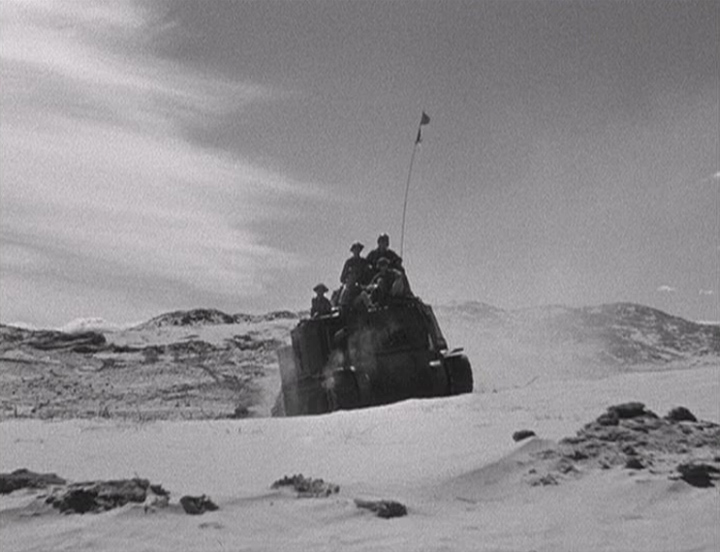
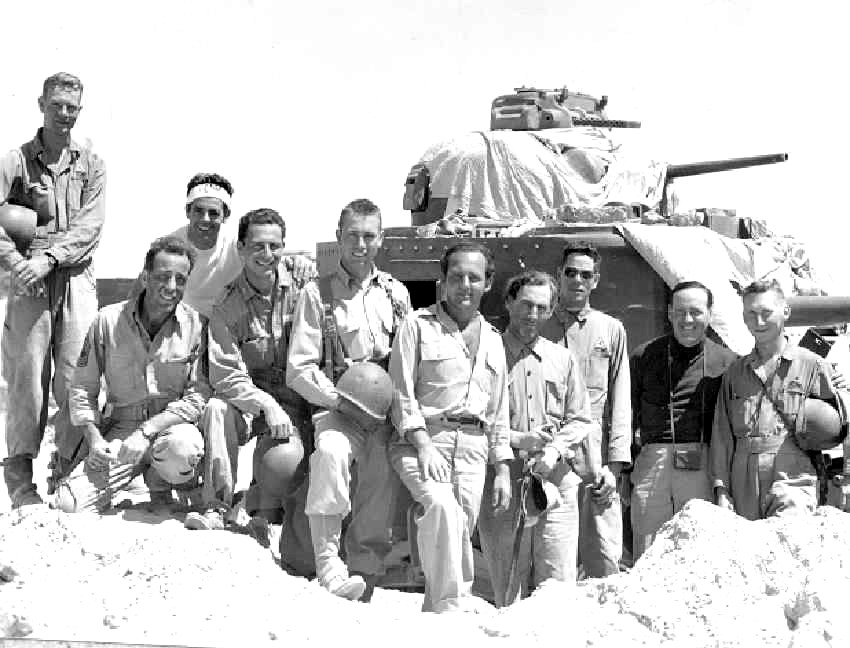
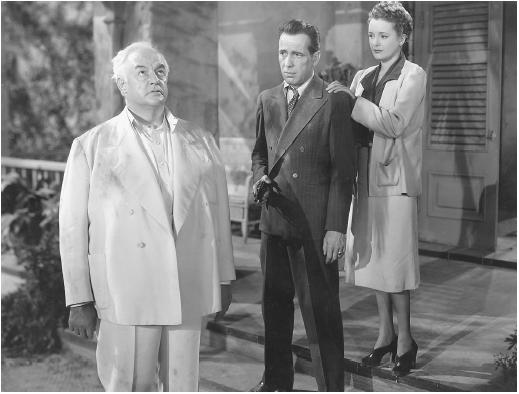
"Sahara" *(Zoltan Korda, 1943) Columbia Pictures propaganda film (based on "an incident" in a Russian screenplay) disguised as a war-time action picture. Humphrey Bogart stars as Sgt. Joe Gunn,** a cranky old Yank in a clanky old tank, the LuluBelle, who, making his way back to a friendly base, gathers together a rag-tag crew of Allies (French, British, Australian, South African, Italian and Sudanese) in North Africa. Voted in charge of the make-shift troop, he makes priorities—keep LuluBelle running, find water, deal with the Nazi troops nearby, stay alive. Along the way, through the collective effort, manage to sustain a stronghold against a large Nazi desert-troop. Filmed in the California desert, it still feels like rough duty for the actors amid the sand, the flies and the sweat. Director Korda and multiple screenwriters, including John Howard Lawson and Sidney Buchman keep the surprises and the intrigue sustained through the entire picture, while promoting brotherhood and cooperation between the lines.

Bogart really has the least interesting part, but he excels at being the crux of the movie and meriting being the guy to whom all eyes turn. It's an effective, oddball role. Of all the films with people of obvious ethnicity pulling together whether in American or Japanese war films, "Sahara" succeeds brilliantly, betraying neither the prejudices of the period, nor moving too far into caricature. The movie even takes a stab at trashing the "master race" theories of the Nazi's.

Amidst the water retrieval methods and the tense negotiations and full-on battle scenes featuring big guns and deceiving trench-warfare, the stranded Allies still have time to compare cultures and rememberances of home. "The things you learn in the Army," says a smiling Texan to the Sudanese in conversation.

There's your recruitment headline right there.


* Not to be confused (as if it could be) with the 1983 Brooks Shields vehicle, or the 2005 Clive Cussler adaptation with Matthew McConaughey and Penelope Cruz.


** Presumably Luger being too German, and Beretta to be used in a 70's cop show and Joe Rifle...sounding as dumb as Joe Gunn, frankly.

Saturday, November 29, 2008

Across the Pacific

"Across the Pacific" (John Huston, 1943) An attempt by some of the principals of "The Maltese Falcon" to make lightning strike twice...and failing miserably. Director John Huston, stars Humphrey Bogart, Mary Astor and Sydney Greenstreet re-unite to make this larky propaganda film about Japanese collaborators during the Second World War. Bogart plays a disgraced Navy man, but it's a ruse so he can work undercover to infiltrate Japanese spy units (If so, why then do we go through the exercise of seeing him turn in his uniform and being shunned by fellow sailors? Because it's a "movie!") Bogart and Astor meet cute, and then turn all lovey-dovey robbing the two actors of any of the frisson (and resulting sparks) that the Spade-O'Shaughnessy relationship did in "Falcon."

And, look: One has to view films through the lens of the times in which it was made. It's only fair to the movie to acknowledge the attitudes of the time. But the racial stereotyping in this film is beyond the pale, with the one Japanese-American speaking perfect English obviously being a spy. One would think seeing this film that it was a necessary precaution to intern Japanese citizens. That's enough reason to jeer this film. And did one of the Chinatown residents really have to say "theater tickee?"* Huston was a fine craftsman of screenplays; did he really pass muster on this script with all its hackery? To be fair (or fair-er) to Huston, though he directed this thing, he abandoned this film to join the military's photographic unit where he did his splendid documentaries about the the Italian front. One can see why Huston was in a hurry to leave. A disappointing little "programmer" to get the American blood up, the only thing "Across the Pacific" proves is that a movie can be too cute and despicable at the same time.


* I may be stretching this so far it'll snap, but the director John Milius is a conservative with a droll sense of the ironic. He is also a film-student. He's seen a lot of movies. A lot. Conceivably, he might even have seen "Across the Pacific." So, in 1975, he had cast John Huston (the director of "Across the Pacific") as Secretary of State John Hay to Brian Keith's Theodore Roosevelt in his very fine "The Wind and the Lion." At a state banquet, Hay is seated next to the Chinese ambassador, and says to him (about the cutlery) "You likee knif-ee? You likee fork-ee?" and had the cinema-recall to use a joke from "The Searchers" ("You speak good Commanch'. Someone teach you?") after the Chinese Ambassador sits down from making an eloquent, metaphoric toast. He turns pointedly to Haye amd says "You likee speak-ee?," to Hay's evident embarrassment.

Anyway, I like to think he did. I have my own prejudices that way.

Thursday, September 25, 2008

Action in the North Atlantic

"Action in the North Atlantic" (Lloyd Bacon, 1943) Rousing war-time propaganda film about the Merchant Marines and their attempts to distribute supplies for the war effort while fighting off Nazi air and sub attacks. Directed by Lloyd Bacon whose experience in the WWI Navy lends an undisputed air of authenticity to the scenario, if the visuals don't exactly hold up due to some sub-par model work mixed with chock-a-block stock footage (expertly shuffled by soon-to-be director Don Siegel). Still, the opening sub attack on the vessel Northern Star is impressive for its brutality and its dangerous looking fire work. The actors look convincingly too close for comfort, and the sense of peril is very real. And that's just the beginning of the film. After that first explosive set-piece, there is a lull as the survivors get back to the home front (Skipper Raymond Massey goes home to a young Ruth Gordon, who's a treat to watch). Then it's back to sea as part of an intricately planned flotilla, delivering supplies to...Murmansk, Russia. We're all in this together, comrade.

Massey's the skipper, but the star is
Humphrey Bogart, two steps away from gangsterism, and cracking wise. He's First Mate Rossi, whose "too easy-going to be a skipper," but given a chance could be a cracker-jack commander. Bacon sets up the rules and procedures for the vast convoy, but an attack in the mid-Atlantic separates the "Sea Witch" from the rest of the ships, and the rule-book goes overboard as the ship plays a cat-and-mouse game with a lone sub determined to sink it. While the flotilla attack is dependent on that unconvincing model-work, there's a later Luftwaffe attack on the ship that features amazing wire-work effects, not only on the planes maneuvering through the clouds, but also of bodies being blown from their stations when the ship takes a direct hit. There's no sugar-coating the dangers of war, but the difference between the sides seem to be that the Nazi's scream when they go their watery grave, while the Americans merely have their quips halted. Various strategies are employed to evade the sub, including "going quiet," thanks to the Scottish engine-man who will remind any watcher of a certain star-ship engineer willing to eke out "a wee bit more."

The action doesn't slacken as Bogart's Rossi makes a bold move setting the "Sea Witch" on fire to draw in the sub, and the film ends with a Rooseveltian declaration of solidarity (probably voiced by Stan Freberg), which would prove to be problematic in the 50's when McCarthy went after Hollywood. All in all, an interesting film for all sorts of historical reasons beyond the propaganda factor.

Bogart has a great speech about bravery mid-way through the flick that's worth noting:

"Let me tell ya something about my "iron nerve," son. It's made of rubber, just like everybody else's, so it'll stretch when you need
it. Ya know, people got a funny idea that being brave is not being
scared. I dunno, I always figured if ya weren't scared, there's nothin' to be brave about. The trick is...how much scarin' you can take?"