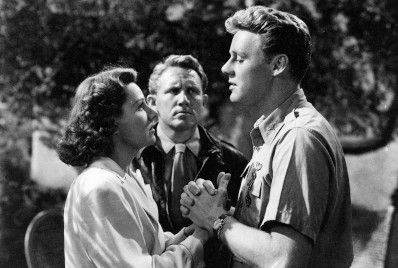
A Guy Named Joe (Victor Fleming, 1943) Wartime fantasy film that was such a favorite of Steven Spielberg's that he remade it as Always in 1989. One can see why, despite the torturous transition from changing the milieu from World War II bombers to forest fire-fighting. It has a lot of diverse plot elements and crosses many genres: love story, war story, fantasy, action. Yet it's also a personal story with a character arc close to Spielberg's heart: a man-child has to learn to grow up. But, instead of committing to something, here the key to maturity is letting go...making the sacrifice. Of course, that story is only one dangerous mission away from being told in any war film. In a story about fire-fighting, not so much.
But, back to Spielbergian motivations—the best reason to remake this movie? The love story doesn't work. Whatever passes between Spencer Tracy and Irene Dunne in this movie feels more like mere tolerance than a quickening flame. One hesitates to bring Hollywood gossip into discussing the results on film; what is on-screen should be taken at face value, and the situations and logistics on-set should, if all goes well, be invisible to the casual movie-goer (and Fleming, a yeoman director who skirted the complexities of Gone with the Wind and The Wizard of Oz is better than most at surmounting them). But, the chemistry between Tracy and Dunne, that is so important to making the rest of the film work is not there. The two did not get along during filming, and Tracy's entire performance comes off as aloof and "above-it-all," not heartfelt as it should be. In his update, Spielberg overcompensated, going the other way, Richard Dreyfuss' work being a little too smiley and treacly and trying too hard to be "winning," making his character seem petty and destructively selfish during Always' dark passages.
But, the story's a compelling one: Pete Sandidge (Tracy) is a chances-taking bomber pilot in the European theater of WWII. He's best buddies with Al Yackey (Ward Bond) and sweet on Durinda (Dunne), a pilot in her own right. During one mission, Pete is killed, and finding himself in the after-life, is tasked by "The General" (Lionel Barrymore) with helping to train a young pilot, Ted Randall (Van Johnson in his first major screen role) in the Japanese theater. Durinda comes back into the picture, still shattered by Pete's death, but at the urging of Yackey, she ends up nearby, and, though reluctant, finds herself falling for Ted.
For Pete, this is agony, watching their budding romance, and leaves him conflicted about his "mission" and his feelings, and only an extremely melodramatic act of sacrifice forces him to "see the light," as it were.
The screenplay is by Dalton Trumbo, and he works hard—maybe a might too hard—to balance the conflicting emotions in Pete, and as good as Tracy is, he can't seem to find the right balance to give Pete the depth of character integration to keep the different aspects of his personality together. The motivations are there in the script, but Tracy, fine in individual scenes, can't seem to make Pete a whole human being, giving a slightly disinterested air to the character. Some scenes were re-shot later in the studio to find a better balance (which, ironically, might have led to the problem), but the results on-screen don't pay off. Maybe it's the integration of fantasy elements with a war film that causes the conflict, and although the film comes to a resolution satisfyingly, it leaves one feeling a little melancholy, as if something more could be done. Partially, that's the film and how its elements might have more fully gelled. But, it's also the resolution of the film, too. Realistically (and bear in mind we're talking about a fantasy film here) the proper resolution is to face facts and accept and let go, for spirits on both sides of the astral plane...to accept grief and move on, parting. A bitter pill, even if for a greater good (which is always suspect). In the end, it comes down to making the best out of loss, and given the time of strife in which the film was made, that's a heartening statement to make, if superfluous, given the very real individual losses the world was producing during that war.
Interesting film, if not completely successful. However, three years later, Michael Powell and Emeric Pressburger would take similar themes and turn it into the far superior, and more fantastical, A Matter of Life and Death.