Showing posts with label Lana Turner. Show all posts

Tuesday, February 5, 2013

The Three Musketeers (1948)

The Three Musketeers (George Sidney, 1948) Every few years, a new generation has to put their imprint on Alexander Dumas' adventure tale on the chicaneries and hidden agendas during the rule of King Louis XIII and Cardinal Richelieu, when it seems everyone was challenging the rule of theocracy masquerading as monarchy.  Every time, a group of four actors can be found to collaborate rather than hog the show, a new version is produced and a different spin is put on the first part of the d'Artagnan Romances, telling of a sword-skilled Gascony bumpkin who goes to Paris to join the King's Musketeers of the Guard—knights on the cusp of a new technology who prefer their battles to be sharp and personal—and learns the ways of the world in love, loss, and politics and how they all cross swords.

My favorite version is still Richard Lester's one-and-a-half film epic The Three Musketeers: The Queen's Diamonds and The Four Musketeers: Milady's Revenge for their bawdy humor, down and dirty sword fights and occasional stunt-casting, breezily written by George MacDonald Fraser, lovingly photographed by David Watkin, and (for the first one) cheekily scored by Michele LeGrand in his mock heroic style.

But there have been so many others, going back to the silent era.  One of the oddest, despite being a fairly straight adaptation is the Technicolor M-G-M version from 1948, starring Gene Kelly as d'Artagnan, high in the step and long in the tooth, where the fights are choreographed more as dance in natural settings.  All movie fights are choreographed to some extent, but the '48 version of "3M" has a particularly dancerly feel with Kelly.  There's a "lark" aspect to the whole thing, with a winking feel as if to say "isn't this all preposterous?"  It feels even more so in Kelly's love scenes with June Allyson playing Constance, confidante to the Queen (Angela Lansbury) and daughter (in this one) of his landlord.  Their scenes have a campy, artificial leaning, layered over with a version of Tchaikovsky's "Romeo and Juliet" theme, which was probably a cliche for love in '48.  It makes any emotional investment in the romance so much embarrassing vapor.

Impressive cast, though, with Lana Turner top-lined (probably to assuage her fears that it was a secondary role) as the villanous Milady deWinter, Vincent Price is finely oily as Prime Minister Richelieu (evidently he was defrocked for the film, owing to pressure from the Catholic Church), Van Heflin a good, but not great Athos, Gig Young as Porthos, and Keenan Wynn providing comedy as d'Artagnan's servant Planchet.

And it has one scene that makes the highlight reels—Kelly's tribute to Douglas Fairbanks, vaulting over French roof-tops to rescue his lady-love.  It's nicely staged athleticism, marking a sharp contrast to the play-acting of the rest of the film.

Wednesday, October 31, 2012

Dr. Jekyll and Mr. Hyde (Twinned)

Private Joker: I think I was trying to suggest something about the duality of man, sir. 
Pogue Colonel: The what? 
Private Joker: The duality of man. The Jungian thing, sir. 
Pogue Colonel: ...Whose side are you on, son? 
Full Metal Jacket

"(Cocaine) enhances your personality!"  "Well, what if you're an asshole!?"
Bill Cosby from Bill Cosby, Himself

Better living through chemistry?  And whose side, indeed?  This Hallowe'en season we haven't been looking at monsters, and creatures and other outside forces that threaten us and make us come face to face with horror (as we have in the past).  We've been looking at those that attack us from within.  Not at the monsters that peer at us from outside our bedroom window, but the ones that look at us indoors in our very own mirrors.  What special horror it is, when we come face to face with our enemy, and it's our own.  No better example of that came from the pen of Robert Louis Stevenson in the year 1861.

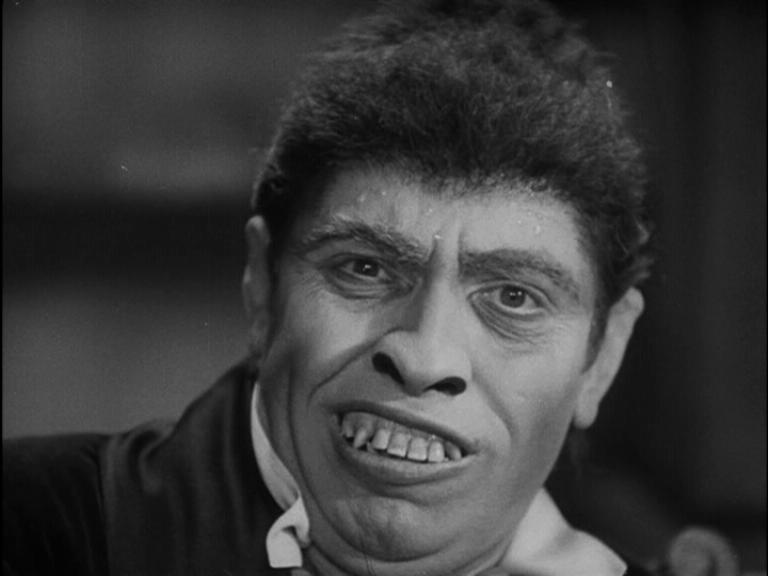
 Dr. Jekyll and Mr. Hyde (Rouben Mamoulian, 1931) A new version of Stevenson's "Strange Case of Dr. Jekyll and Mr. Hyde" seems to crop up every few years.  There've been versions with John Barrymore, Basil Rathbone, Christopher Lee, Spencer Tracy (see below), and TV versions with Jack Palance and even one with Lionel Bart musical numbers that featured Kirk Douglas.  But, this is the one people remember, for many reasons—first being Frederic March's portrayal (which won him an Oscar for Best Actor...in a Horror film, mind you), the effects, the outright sexiness of it (as the film was "Pre-Code,") and for director Mamoulian's stylish treatment—full of straight-on shots of the actors facing the audience, mirrored shots, and all the transformations, each one staged differently (and in a couple of instances using a combination of make-up that only becomes apparent in monochrome when struck by lights colored by different gels—with "Hyde" finally appearing as an ape-like creature in need of radical orthodentia.  March turns in an incredible performance (and he won an Oscar for it, the first actor to do so for a lead in a horror film—the second being Anthony Hopkins in The Silence of the Lambs), his Jekyll (pronounced Jee-kull as the Scottish Stevenson would have it) clearly conflicted but held in check and completely invisible in the form of the obstreperous Hyde, leaping over parapets and loudly enunciating (through those big false teeth) his intentions in a husked gravel.  When first confronting his new image in the mirror he cries "Free!  Free!  At last!"


Now, in Dr. Jekyll and Mr. Hyde (Victor Fleming, 1941) the Dr. Jekyll (pronounced Jeh-kull) played by Spencer Tracy, is far more considering: "So, this is evil, then"  he observes staring at his new countenance in the mirror.

Yes. Yes, it is. Tracy's Jekyll is a thinking, decent man with dark undertones, far less egocentric than the stentorian performance of March; his Hyde is shaggy dark eyebrows and hair, with a curled upper lip like a scar and a direct gaze and uncouthness, despite his pretensions of refinement.  March's Hyde is a proto-human; Tracy's is just a sadistic sociopath.  Jekyll's frustrations with his straight-laced potential father-in-law (Halliwell Hobbs in the first, Donald Crisp in the latter) are buried deep and Hyde releases that pent-up rage.  In the Tracy version, the intelligence is still there (as opposed to March's gleeful monkey-man) but used malevolently—the words are erudite and evenly spoken, but his actions are quick-silver and savage.  


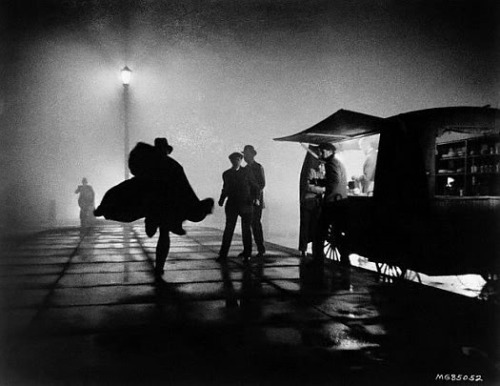
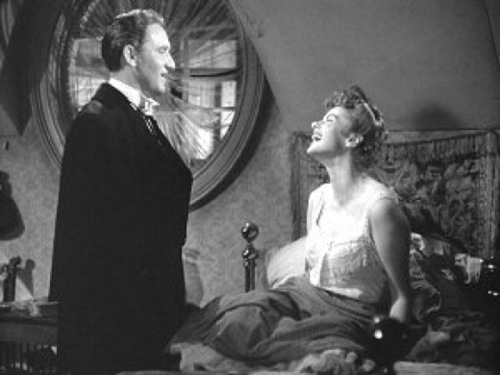
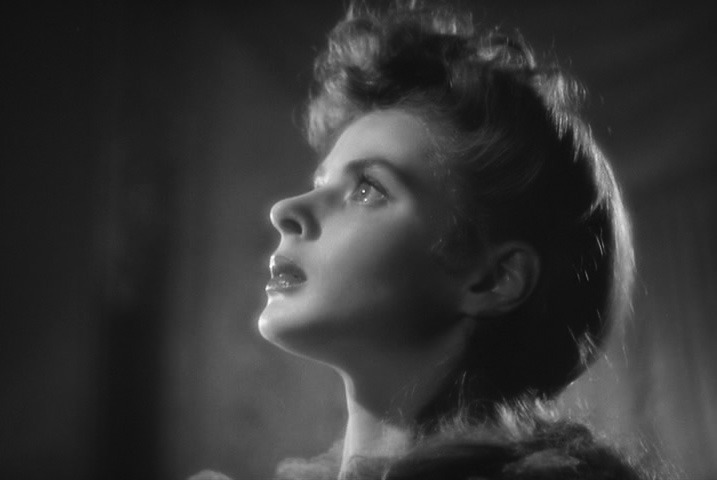
The Tracy version of the character depends less on make-up than the actor's own inventiveness (not that March was any slouch, far from it).  Directed by Victor Fleming, with more emphasis on thick fog effects (where Hyde seems to be allowed to be swallowed in the thick mists, until he disappears like so much water vapor) and the psychology of evil, it is sumptuously produced and veers into the surreal during the transformation sequences.  These are weirdly disturbing, shifting from surfacing lily-pads to Jekyll whipping a team of horses...which then turn into the two women in his life: his faithful fiance (played by a never-lovelier Lana Turner) and a bar-maid (a very early role for Ingrid Bergman, this one preceded Casablanca).  One can only imagine the direction that the director gave his actresses for this sequence and the others ("Okay, Ingrid, you're a wine-cork, but a happy wine-cork!").  Whereas March's Hyde is all simian actions and attitudes, Tracy's is psychologically, adroitly cool, a genuinely mean bastard gleefully tripping up theater managers with his walking stick, and setting up Bergman's Ivy Petersen as a kept woman, scarring her physically and mentally.  Both films stray from Stevenson's narrative, which only implies Hyde's actions, which seem to stay only in the realm of violence, but both Mamoulian's and Fleming's films features the story of the two women who suffer at the man's hands and split personalities.  Bergman's performance is raw and heartbreaking, subtly letting emotions percolate under the surface of her skin, a luminous smile capable of dropping precipitously and tremulously, then escalating into hysteria.  Turner's performance is pitch-perfect, but merely an ingĂ©nue role and she's not required too much of the tortured complexity she would display later in her career.


Mamoulian's film is fancy; Fleming's is fanciful, each taking different approaches to what is essentially the same screen-story, deviating just as far off the cobblestone streets of the novella, and each one coming to the same conclusion—different from the story's where Jekyll's fate is left in the air, seemingly condemned to live out his life as the evil Hyde—to satisfy the moralists in the audience, pre-Code or not.  Interesting to see them back-to-back (to-back-to-back) and explore the similarities and differences—a bit like Jekyll and Hyde themselves.


Interestingly, these two Jekyll's, Tracy and March, squared off against each other in the courtroom drama Inherit the Wind.*


* And another parallel: March received his first Oscar nomination for playing the part of actor Tony Cavendish in The Royal Family of Broadway.  The role of Cavendish was based on John Barrymore who had a big success...playing Dr. Jekyll/Mr. Hyde in the 1920 film version.

"...Room for one more, honey?"


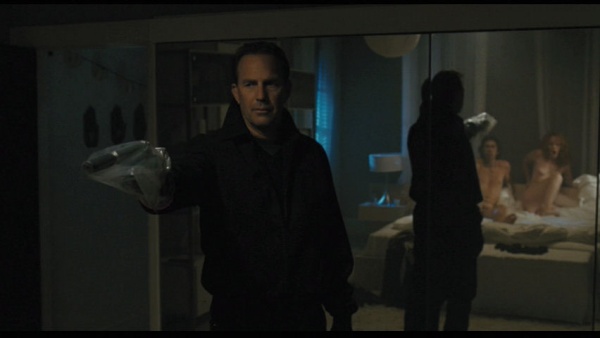
Mr. Brooks (Bruce A. Evans, 2007) A more modern take on the Jekyll/Hyde-in-plain-sight story (we won't talk about the various "Hulk" movies—the superhero version of it) is this creepy psychological thriller about another upstanding citizen and pillar of the community, Earl Brooks (Kevin Costner), CEO of a thriving box-making business.  Brooks has a seemingly normal nuclear family: a loving, doting gorgeous wife (Marg Helgenberger) and a slightly spinning-out-of-orbit daughter (Danielle Panabaker), but the fourth member of the clan is the one with the most fission—the other voice in Brooks' head, Marshall, played by an on-screen William Hurt.  The performances of the two men couldn't be more different: Hurt has the easier one—the all-leering, cackling, lip-smacking Id, while Costner (being in the "real" world) is restrained, cerebral, and calculating on the inside.  Costner really is a fine actor, and his Brooks, in control of most situations unless Marshall convinces him otherwise, every so often goes on a killing binge that satisfies a weird craving.  One entertaining aspect is that Brooks is self-aware enough of his situation to go to AA meetings.  He's an addict and he knows it.  But there aren't enough steps in any program to cure his issues.  He's made enough of a blood-splash to attract the attention of local detectives (Demi Moore leading the investigation) and one fan-boy (Dane Cook) who wants in on the action.  Earl and Marshall are caught in the middle (and with two personalities it gets very crowded in there), yinging and yanging between their two points of view and calculations.  But the creepiest moments—the genuinely chilling ones—are when they combine, joining each other in a sick, twisted laugh for a shared joke, between the two personalities in the one man.  For all the gruesome murders and gouts of blood on display, that's when Mr. Brooks gets really scary.


Wednesday, April 28, 2010

The Bad and the Beautiful

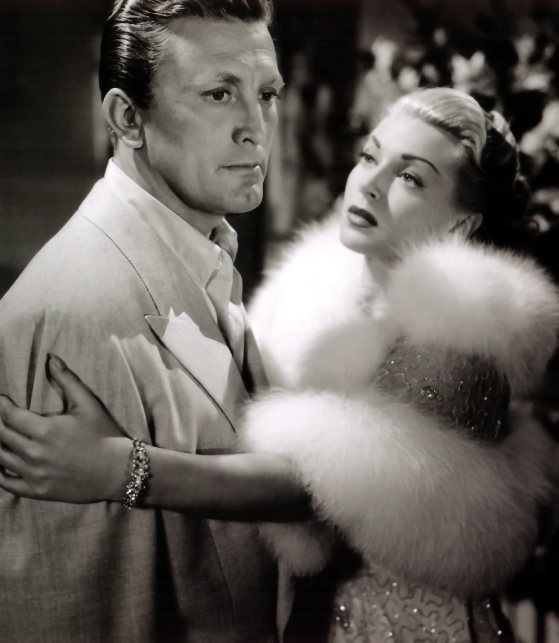
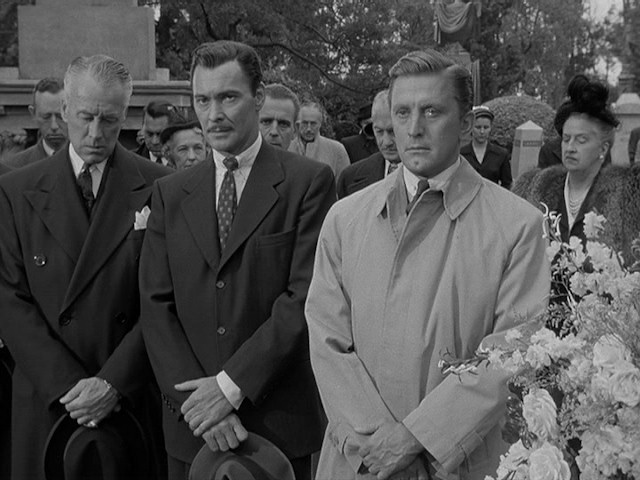
"The Bad and the Beautiful" (Vincente Minelli, 1952) Hollywood movies about Hollywood generally stink; the best ones (and they're usually by Howard Hawks) make their odd collections of professionals in a field of endeavor working toward a single goal act as a metaphor for a film-team. But, when Hollywood hits the nail on the head it's usually with a gilt sledge-hammer, giving off the air of bitterness and back-stabbing lit by klieg lights—as opposed to merely doing it behind the scenes. "The Bad and the Beautiful," produced by John Houseman, could be about many Hollywood inmates, one can see allusions to Houseman's old partner (and bitter enemy) Orson Welles here—the structure is basically that of "Citizen Kane," (also produced by Houseman) with the story told by the principals in multiple flash-backs. Louis B. Mayer (the former head of the studio that produced "The Bad and the Beautiful" seems familiar in the penny-pinching sanctimony of studio head Harry Pebbel (Walter Pidgeon), Irving Thalberg (who would be the model of F. Scott Fitzgerald's "The Last Tycoon") could be part of the personality of demon-producer Jonathan Shields (Kirk Douglas), but it's also a bit of Darryl F. Zanuck. You could drive yourself gossipy in this guessing game.

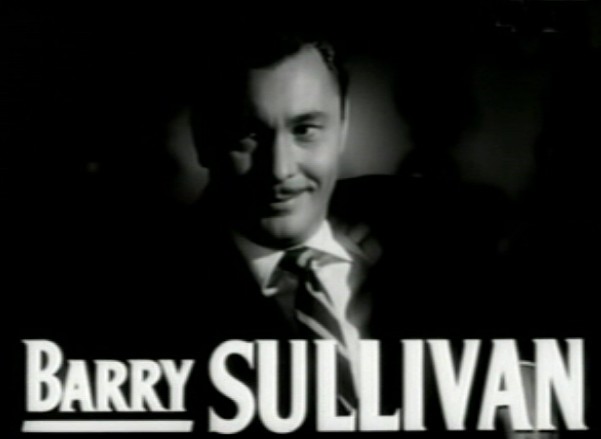
Three toilers in the Hollywood Valley—director Fred Amiel (Barry Sullivan), box-office sensation Georgia Lorrison (Lana Turner) and screen writer James Lee Bartlow (Dick Powell) are summoned to Shields Productions by studio head Pebbel. He wants to take them to task for avoiding the phone-calls of Shields, whom they've all had run-ins with. Shields is responsible for their success, but it has always come at a cost. Amiel had a dream-project taken from him by Shields, Lorrison was promoted and prepped for stardom by him, but rejected becoming romantically involved with her, and Bartlow still blames Shields for the death of his lusty wife (Gloria Grahame), while he and Shields were on a screen-writing retreat.

All of these stories are told in flashback sequences that recall the ones in "Kane" by the surviving partners and wives. But where the "Kane" stories interlock and enhance each other, the ones in "The Bad and the Beautiful" sir apart with little connective tissue between them. It plays like "The Three Faces of Jonathan Shields" as opposed to the stories being facets of the same character, building to a whole. In "Kane," the stories are all aspects of Kane's quest for love. In "Bad..." what unites them is that
Shields is a manipulative producer—one would think that would go without saying. Amiel's story hints that Shields has "Daddy" issues owing to his Father's resentment in Hollywood ("I'm going to take the name of Shields and ram it down their throats!"—you can hear Douglas saying that). There may be something of the "sins of the Father" storyline here, but even that is undercut by the film's ending, a contrivance that makes a mockery of everybody's motivations.

"The Bad and the Beautiful" won five Academy Awards: best Supporting Actress for
Grahame's fine work, and for the Black-and-White categories of Costuming, Art Direction and Cinematography (Robert Surtee's work is amazing in this), as well as a screenplay award for writer Charles Schnee (presumably in black and white, as well). Why this ad hominem pot-boiler would win Best Screenplay is beyond me.

But, that's me. "The Bad and the Beautiful" was one of the 2002 selections for inclusion in the
National Film Registry.