Showing posts with label Edward G. Robinson. Show all posts

Thursday, June 13, 2013

Smart Money

Smart Money (Alfred E. Green, 1931) Done-on-the-cheap Warner Bros. programmer made the year after Edward G. Robinson's star-turn in Little Ceasar and the same year as Cagney's in The Public Enemy and is an version of the studios' series of spare, street-tough films that would dominate their output in the 30's and 40's, glamorizing the life of a gangster, but making sure that they came to a bad end.

Robinson plays Nick the barber, a lucky Greek son of a gun, who runs a gambling joint in the back-room of his tonsorial parlor (thus making both ends of his establishment a "clip-joint.") Nick is king of his own gambling castle, and while its good to be the king,there's the tendency to want to expand the fiefdom by conquering new territory.


With a stake firmly established from his cronies back home, he takes off for New York to take on the big city gamblers, wished well by all the lovable mooks he's already taken for a ride at the train station.  But, what he learns is its a whole new game in the tony high rises, where only part of the bluffing and double-dealing occurs at the table.  Why, even the hat-check girl is looking to separate you from your cash.  Nick learns to trust no one, and to bluff his way out of any situation with a cock-sure patter of platitudes.  But, that's a slippery slope, and he soon finds that success costs.  


Its a treat to see Robinson and Cagney play off each other, the only time they did so—Robinson all-voice and punchy delivery, and Cagney sly and bantamy, physically, in one of his rare supporting roles.  They're all chummy at the beginning, but when success shows up, they start to have territory issues, its murder.  This one is all performance, in varying styles, between character actors fresh out of the silent era, and the leads who were blazing new trails, and the director's hand is almost invisible.


Green is known, but mostly unknown, as the director of The Jolson Story, The Jackie Robinson Story, The Eddie Cantor Story...making that a "storied" career.  He was a fine director of women and coaxed terrific performances from Bette Davis and Barbara Stanwyck early in their careers—and they were already formidable.  He was fast, versatile and would direct up to five pictures a year.  He didn't shy away from racy material in the pre-Code era and would tackle it directly with shameless brio.  And he's remarkably free of the sort of Hollywood white-wash that was prevalent at the time.  Minorities were cast, and not caricatured or minstrelled in his films, but treated like any other character actor, which is quite remarkable to see in that day and age.  His output was undistinguished when you look at the titles (and there are 111 of them), but individually, it would be interesting to see a few more of them (I've seen this one, The Jackie Robinson Story and Baby Face) to see if that liberal sensibility is maintained throughout.


Tuesday, July 7, 2009

The Stranger

"The Stranger" (Orson Welles, 1946) Fairly conventional film from Orson Welles, which means it's a surrealist experiment in style for everyone else. Welles did this one under a time-constraint (which might be why the thing looks lush and complicated at the beginning and a might skimpy towards the end). It's Welles' least favorite of his films and the only film he directed that turned a profit at the time of its release.

Here, Welles is having fun with the idea of a Nazi war criminal hiding in plain sight in a small American college town. He's become a professor—college prof's being allowed certain eccentricities, like a secret allegiance to Der Fuehrer
—and he has wooed and become engaged to a Supreme Court Justice's daughter (Loretta Young with her "deer-in-the-headlights" look). But for Nazi's it's safety in numbers, usually in concentric patterns. So when another war criminal is allowed to escape as bait by a War Crimes Commission, he heads straight for Harper, Connecticutt, picturesque in Fall, and his superior, Franz Kindler (Welles), hiding as Professor Charles Rankin, hoping to start a Fourth Reich. As the professor is a clock-hobbyist, Kindler's precise deceptions begin to ungear. His current project, the old school clock tower with its carouseling angels and demons in pursuit high above the town is his refuge.

He should be keeping his eyes on the ground and the dogged—one might say pugged—pursuit by War Crimes investigator Wilson (Edward G. Robinson, whose good "badness" is used to great effect). Welles and his screenwriters (with an assist by John Huston) have a lot of fun with the global affairs effecting a small town and its eccentric collection of rubes, who prove to be inconveniently adept at things: the busy-body checkers hustler has a good memory and the town gossips are good sources of information, especially when they're in the dark about what secrets they have. Pretty soon, suspicion is sewn and in a small town, word gets around.

Welles manages to make a propaganda film, a detective story, a woman-in-jeopardy tale, with elements of comedy, AND show concentration camp footage all in one storyline (filmed in 1946!), couched in a popular entertainment (for George Schaefer who brought Welles to Hollywood) and knock it out before heading to Rio De Janeiro to film "The Lady from Shanghai."

It's lower-tier pulp Welles, which still puts it far above Hollywood's average.


Shadows of "The Stranger"
Loretta Young's shadow of a doubt about her new husband (Welles) who's just come home.

"Use Gym Equipment at Your Own Risk" says a sign.
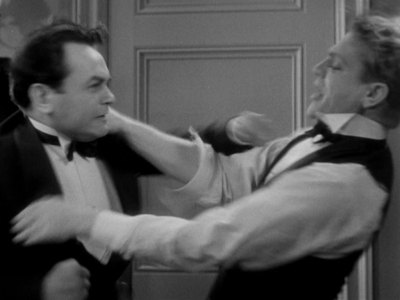
Edward G. Robinson is about to get clocked with a ring.

An informant is faceless and anonymous.

A Nazi criminal is on the run, and gets his picture taken for a fake passport.

Welles' shadows turn that same Nazi...into Adolph Hitler?

But don't take my word for it! As "The Stranger" is in the Public Domain,
you can watch it or download it here
.

Wednesday, June 24, 2009

The Woman in the Window

"The Woman in the Window" (Fritz Lang, 1944) The ex-patriate German film-stylist ("Metropolis") makes the first of his "love-is-a-trap" film noirs with Edward G. Robinson, Joan Bennett, and Dan Duryea. The second, "Scarlet Street" (Lang's next film) will be a nightmarish tale of lust, betrayal and greed that will skirt the Hays Code of having one of the triangle getting away with murder, but "The Woman in the Window" will be a bit more sedate...almost text-book.

Richard Wanley (
Robinson) is a professor of criminal psychology, so you'd think he'd knows his stuff, but it seems he's only good at the theory. While his wife and kids are out of town for the Summer, Wanley becomes enamored with a portrait of a young woman in a store window (theory), and after a club-night with the boys (among whom is detective Raymond Massey), he comes across the woman in the flesh and accepts an invitation to her apartment. Turns out she's the moll of a notorious money-changer, see? And N.M.C. shows up at the apartment, looking to serve Wanley a Harvey Wallbanger.

Things get ugly and somebody gets dead.
It's up to the Good Professor to do some Bad Things to keep his reputation intacto, not to mention his corpus.

The wonderful thing about Lang is he kept making his scary German films (like "
M," his "Mabuse" spy-fantasies) in Hollywood, with a budget that would make glossier his mouse-trap films. Lang knew how to tell his stories in shadow, and even include the vast area outside the frame in the mix to keep audiences guessing as to what would happen next—his protagonists (and they're not always heroes) have to run his maze of ever-tightening traps that will mean loss of freedom or death ("or worse!" as they used to say on the "Batman" TV show—which employed some Lang techniques—with this director you couldn't be sure if Death was the end of it).

Here, Lang dips his toe into the dark murky water that he will dive in head-first with "
Scarlet Street," sketching a nightmare scenario and cautionary tale, preparing for the final deadly masterpiece of his next film.

Provocative, stylish and downright cruel, the cinema of
Fritz Lang spoke of high themes and low instincts and if he's not the father of "film-noir," he's certainly a very close uncle.*


* According to Wikipedia the term "film noir"—"black cinema"—was coined by the French Press—they also make damn fine coffee—in 1946, after the post-war arrival of American films "The Maltese Falcon,""Double Indemnity," "Laura," "Murder, My Sweet," and..."The Woman in the Window." So, the five fathers of "Noir" are John Huston, Billy Wilder, Otto Preminger, Edward Dmytryk, and Fritz Lang—three Germans and two Americans (shudder!)