Showing posts with label Fritz Lang. Show all posts

Tuesday, November 12, 2013

Rancho Notorious

Rancho Notorious (Fritz Lang, 1952)  Hate!  Murder!  and Revenge!

After hearing about this one for oh-so-many years, I finally got a chance to sit down and luxuriate a while with Rancho Notorious, a film that offers so many surprises—subtleties and Big Statements—that work-outs were had by both my jaw (dropping) and the remote, which afforded me the essential ability to go back and "look at that again."

Rancho Notorious offers opportunities a-plenty for both.  You don't see very many movies where people are actively snarling at each other, but then there aren't many movies like this wildly expressionistic main-stream Western directed by the master of German Expressionism Fritz Lang. Preceding High Noon by a matter of months, it also has a song-based score, but an odd one, not so "on the nose" as "Do Not Forsake Me...", but one's that's haunting and echoes through your head like a warning (as it did mine) for days.

The song is "The Ballad of Chuck-a-Luck," (that was supposed to be the movie's title and there's a story for ya*) written by Ken Darby and plays over the titles and interstitially during the murder investigation that lasts the entire movie, each stanza ending with those words "Hate.  Murder.  And revenge."

So, what's the story, pilgrim?


Vern Haskell (Arthur Kennedy) is a ranch-hand in a small town in Wyoming and he only has eyes for Beth Forbes (Gloria Henry**), the girl who runs the counter at the dry-goods store.  But, right after he comes a-courtin' two strangers come into town, with an eye to robbing the store, and when the one sees Beth, things go too far.  She's raped and murdered by the outlaw when she screams and the two cowards escape.


Vern Haskell (Arthur Kennedy) doesn't like you

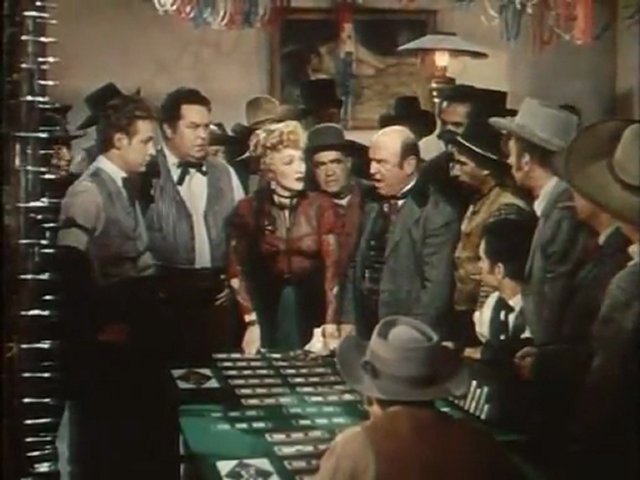
All Haskell wants is revenge, so he quits the ranch and, with a posse, heads in the direction the bastards left town.  After hours of riding, the posse gives up, but Haskell refuses to stop, and soon comes across one of the men, Whitey, shot in the back by the other desperado, who only says the words "Chuck-a-Luck" to Haskell with his dying breath.  Haskell travels on, gathering clues about the mysterious word that refers to a spinning "wheel of fortune" in gambling houses and a former dance hall girl named Altar Keane (Marlene Dietrich), who made a fortune on her departing spin of the wheel, and left town on the arm of the outlaw "Frenchy" Fairmont (Mel Ferrer), never to be heard of again.

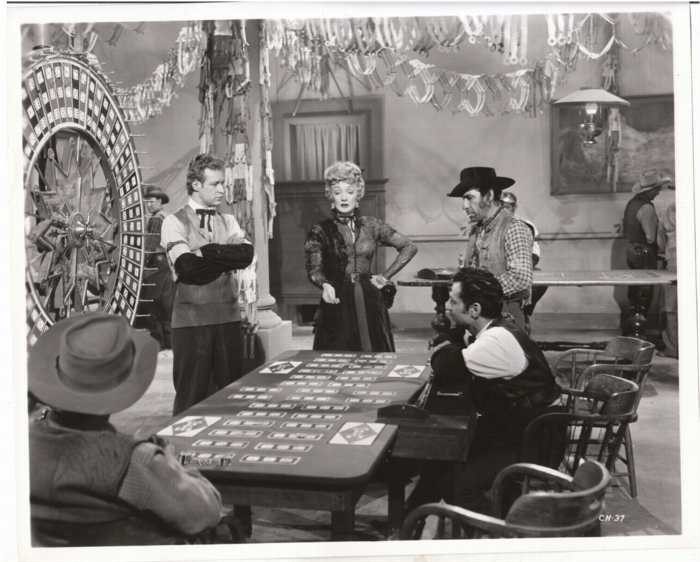
But, "Frenchy's" in jail, so Haskell gets himself arrested, and once behind bars, ingratiates himself with Fairmont, and gets sprung on his coat-tails. The two make their way to the Flying C Ranch, also known...as "Chuck-a-Luck," a working ranch legitimate to the world, but in secret is actually a hideout-for-hire for any outlaw willing to offer up a 10% share of their loot to Altar Keane. Quite the little operation the lady has there, and at the moment, she's full up.


But she makes room for Haskell, whom she describes as "a man who stands in doorways." All the better to survey the room, looking for clues.  Is it the guy who's fast with the ladies (George Reeves) with those tell-tale scars on his face?  Is it the guy who keeps looking at him funny (Lloyd Gough, not credited due to The Black List), or the guy who's just funny-looking (wall-eyed Jack Elam in an early role, looking lean and mean).  He decides to hang out at Chuck-a-Luck, picking up clues, laying low, making himself handy while not necessarily doing anything...illegal, until he can determine who's the right (by saying the wrong) man.  It's a little bit like Poirot in spurs with a nasty disposition.  Of course, today, Haskell would be expected to lay waste to the room and let God deal with the details.  Here, revenge is tempered by justice and not hormones.


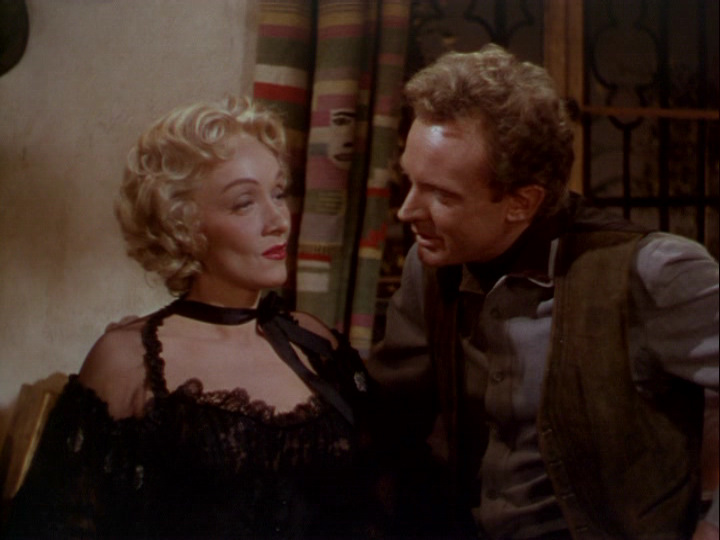
Russell Johnson and Marlene Dietrich in Rancho Notorious

Before we get onto the subject of Marlene Dietrich, we should probably discuss the wealth of character actors on the verge of hitting their defining roles: William Frawley, right before "I Love Lucy," George Reeves before "The Adventures of Superman," Mel Ferrer, only his fifth film and right before Scaramouche, Russell Johnson (Happy Birthday, sir), only his second movie, Jack Elam, Dan Seymour, John Doucette, the movie is top-heavy with great veteran character actors with recognizable faces.


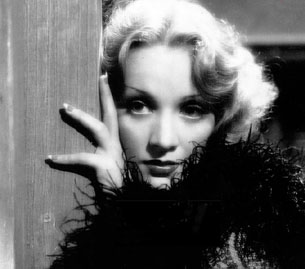
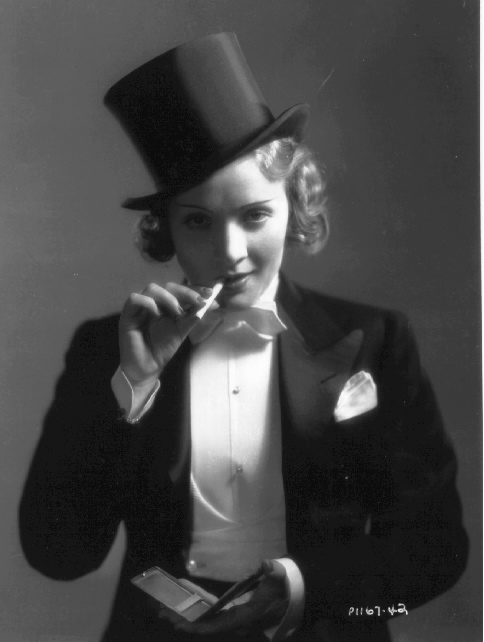
Then there's Dietrich.  For those of a certain age (anyone born post-Blazing Saddles), one may not recognize what a force she was and continued to be throughout her career.  She was the preternatural "other" woman, capable of seducing men and (pre-Code) women, one is always hesitant to call her the first feminist, but she might have been in movies, and she certainly was before it became "cool," (and she always was in the role).  Put it this way, you'd never see Dietrich in a western riding side-saddle.  Rancho Notorious is her slightly softened (although barely—when was the last time you saw a dance-hall girl riding the town sheriff like a horse?), in partnership with a man, and acting out of love or loyalty (always hard to say which with her), but it's her ranch and her operation, and that's something you rarely see in even the most hard-core of Westerns.   And it's weird, but, in Westerns, Dietrich (sorry but it's a spoiler) always seems to take a bullet, as if the genre won't accept her (or any woman) as ruling the ranch.  That would change, as film-makers got more bold.**

Rancho Notorious is one of those odd Westerns of the Mainstream that took a decided bend in the river to do something else with the form.  There's no pretense at naturalism (Lang wouldn't toy with that until Clash By Night), but used the familiarity of westerns to work out some interesting conflicts about gender roles (Others on that list are Nicholas Ray's Johnny Guitar, Samuel Fuller's Forty Guns, and, to a lesser extent, Hawks' Red River).


It's not your usual oater.  It's something different and it's recognizable from the first watch.


* The story goes that Howard Hughes wanted to change the title from "Chuck-a-Luck" and Lang wanted to know why.  "Nobody'll understand it" was the reply, even though it was a familiar gambling game in the Southwest.  "Okay, so what's your alternative?" Lang asked.  "Rancho Notorious." came the reply.  "Rancho Notorious?!  Nothing's called 'Rancho Notorious' in this movie!  You think anybody'll understand THAT?!"

** There was a shock for me: I remember Gloria Henry as the mother of "Dennis the Menace" on TV.  Her presence was only the first of a long line of TV stalwarts who were paraded throughout Rancho Notorious—"Hey! there's...fill in the blank..."

*** Ford's frontier women usually ran the ranch, but let the men think they did.

Wednesday, July 3, 2013

Ministry of Fear

Ministry of Fear (Fritz Lang, 1944) So, here's the joke: a man walks out of an insane asylum and finds the world is crazier than he is.  

But, then, it usually is in Lang's films.  The forces of evil or nature are such that we don't stand a chance unless our own better natures or our just plain "stick-to-it-ive-ness" allows us to survive and move through.  And in Lang's directorial vision, the film frame is as much a trap as anything else, one that can be violated by unseen dangers that will drop into frame as if materialized by a malicious God out of nowhere to threaten those within it.


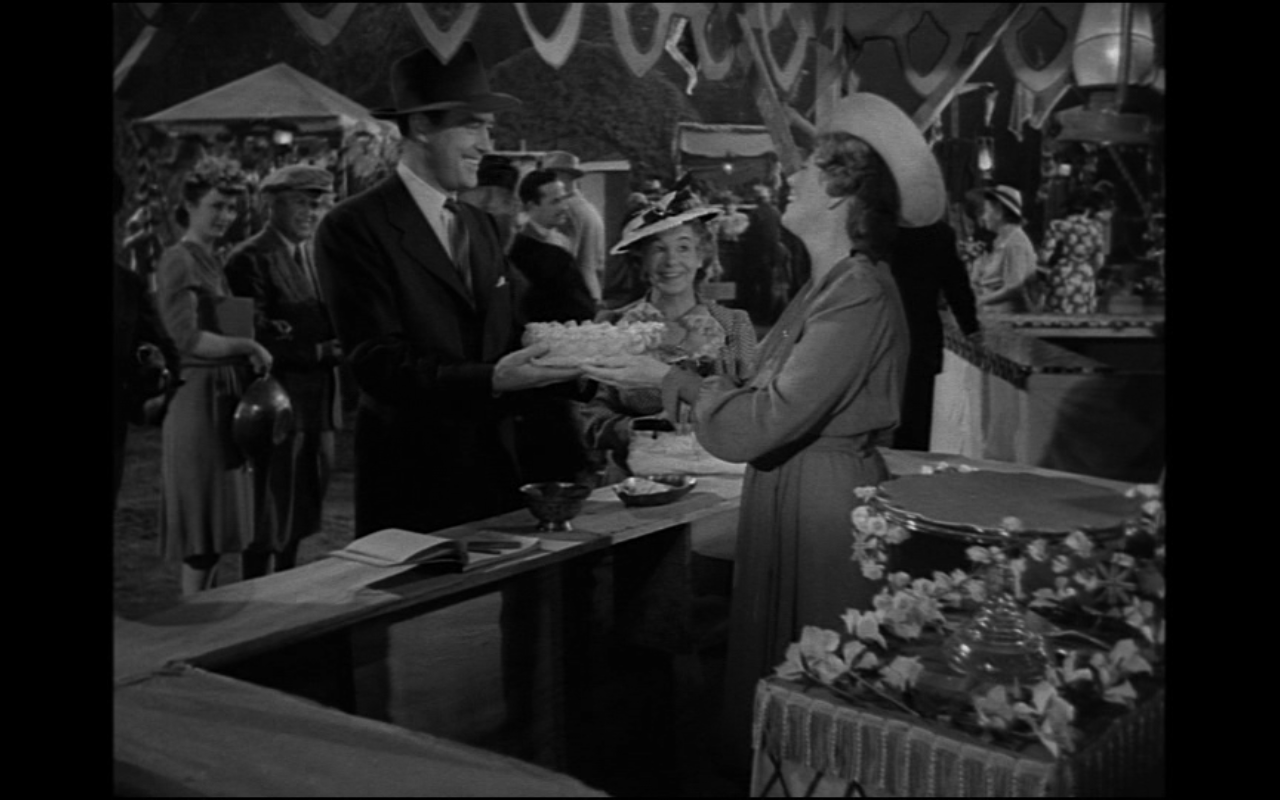
Ministry of Fear, based on a Graham Greene novel published the previous year, follows the dogged tracks of Stephen Neale (Ray Milland) as, having been released from Lembridge Asylum, he awaits a train to London and decides to pass the time at a charity fĂȘte supporting "The Mothers of Free Nations" where there is a booth for guessing the weights of cakes.  After dropping a shilling on a wrong guess, his next stop is a fortune teller's booth, where he's astonished to find the woman giving him the exact weight of one of the cakes at the booth across the way.  Neale can't resist using his knowledge (and testing the medium's prediction) and is astonished to find that he's guessed correctly and won.  


Everything's a little off-kilter in Fritz Lang's world.

Off to his train he goes, not knowing that his taking the cake has caused a commotion back at the tents and exhibits.  The cake has "gone" to the wrong man, intended for another (Dan Duryea).  On the train, Neale's cabin-mate is a blind man to whom he offers a slice.  But, Neale is astonished to find that instead of eating his portion, he's crumbling it in his hands.  The blind man is no blind man, and he attacks Neale, steals the cake and jumps off the train, pursued by Neale.  But it is the time of the Blitz, and as the two chase through a field in the night, bombs begin dropping, targetting their train.

Okay.  We'll stop there.  But, already, things are not what they seem, people are not who they say they are, and nobody can be trusted...not even a damn pastry.  It's not a cake, at all.  It's a MacGuffin, the movie-making slang for the object that the players in a movie seek (and has a sliding scale of relevance and importance*). 

The subsequent fandango has Neale involved with "The Mothers of Free Nations," a seance, dodging bullets with the police and secret service, and all sorts who pretend to be something they're not.  It's enough to drive a sane man crazy—if one hadn't already left an asylum.  That time in crazy-land might actually have steeled Neale for his subsequent adventure, which is no piece of cake.  Lang was the master of the paranoid thriller (at least until Alan J. Pakula teamed up with Gordon Willis in the post-Watergate 70's) and his ordinary man caught in the extraordinary is the very DNA of a Hitchcock thriller—in fact, Ministry of Fear might have been one of those that "got away" from The Master of Suspense.  With its seances, wolves in bureaucratic clothing and things that go boom in the night, all it needs is a national monument to be pure Hitchcock.  It's a fun, terrible ride, well worth seeking out.


*

Wednesday, June 12, 2013

Clash By Night

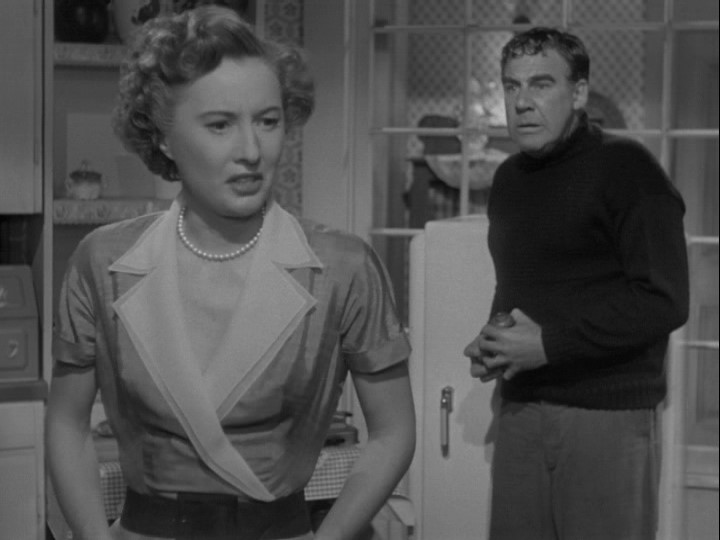
Clash By Night (Fritz Lang, 1952) Interesting. Fritz Lang directing Barbara Stanwyck, Paul Douglas, Robert Ryan and Marilyn Monroe in an adaptation of a play by Clifford Odets (produced on stage by Billy Rose!).  Talk about clashes.  The events take place in a fishing town and Lang gets a lot of mileage with shots of Nature—seals, gulls and a violently crashing surf—drawing parallels between the various top-feeders trying to take advantage of the spoils of the fishing fleet's daily labors.  They're scavengers of opportunities and Lang keeps the beasts on land and sea in the same universe, making a more direct and poetic pictorial comment on the squalid life in town than any amount of purple Odets prose can provide.

Mae Doyle (Stanwyck) comes back to Monterey, after years on the road, to move back into the family house with her brother (Keith Andes).  "Home is where you come when you run out of other places," she snarls.  But her purpose is not to settle down so much as to lick wounds.  Her search for a better, easier life than working in a cannery (like Monroe's Peggy) or marrying a fisherman and raising kids has proven a bitter disappointment.  She slinks back into town ("Home is where you go when you run out of places") and word gets 'round that Joe's sister's back, which attracts the attention of Jerry D'Amato (Douglas), a bachelor-fisherman living with his widowed father (Silvio Minciotti) and sleazy Uncle Vince (J. Carroll Naish).  Mae and Jerry start seeing each other, but she rejects any advances he makes, telling him he doesn't even know her, "what kind of animal I am.  Do I have fangs?  Do I purr?"  


He takes her to meet his friend Earl (Robert Ryan), whom Jerry describes as "in the movie business;" He runs the projector at the local bijou.  Earl's one piece of work.  A sour drinker, married to a vaudeville dancer, he'll tell you all about what's wrong with women to your date.  "Take any six of them.  Throw them up in the air.  The one who sticks to the ceiling, I like."*  Mae is repulsed, but Jerry is still loyal to Earl, even though he'll talk bad about his friend behind his back.  "Jerry's the salt of the Earth—but he's not the right seasoning for you." (Ugh. Odets) Again, Mae's reaction to Earl is to be repulsed, which sends her right into the arms of Jerry, and any previous objections she had to marrying him are suddenly forgotten.  Before long, they're hitched and have a daughter, which is upsetting to Jerry's opportunistic Uncle Vince, who will never put up with anything that interrupts his mooching lifestyle.  Jerry ends up throwing him out.

But, Mae is still restless, and complications ensue that tie back to life in the animal kingdom, and the charm of aggressive males.  Because the movie then starts to take place solely at night, there are those that will call this a "film noir," the genre most commonly associated with gangsters, surly private eyes, never-spoken-of family secrets, and the evil impulses of men.   Got the last one right, as the worst of people gets the better of others.  But, the film noir genre is less prominent than the soap opera one, and it doesn't help that the material is sometimes eye-rollingly colorful.  Still, the cast is uniformly excellent, and Lang's hand is sure, and makes puts everything in the proper perspective.


* This is one of the problems I have with Odets as a writer: that sentiment must mean something—at least to Odets—but it makes no sense to the rest of humanity, which is supposed to be his audience.  I suppose it means that Earl doesn't like any woman; there's a better way to say it, I'm sure.  But then I don't like Odets much—take any six of his works.  Throw them up in the air.  The one that sticks to reality, I like.

Friday, December 31, 2010

Man Hunt/Rogue Male

If, when talking about movies, someone at this year's New Year party (or at a film blog) pontificates the blanket statement "there's never been a remake of a film better than the original," here's a rebuttal (besides, say, True Grit) you can have at the ready:


Man Hunt (Fritz Lang, 1941) Dudley Nichols' adaptation of the 1939 Geoffrey Household novel that begins with a sure-fire set-up: a big game hunter, Captain Alan Thorndike (Walter Pidgeon), travels to Berchtesgaden to shoot Adolf Hitler right in the Berghof with a long-range rifle.  He "takes the shot," but then, on second thought loads a bullet into the chamber...too late.  He's discovered, taken prisoner and tortured for information by Major Quive-Smith (George Sanders, at his most impenetrably cold).  The Major wants the Captain to admit that his intent was to kill Der Fuhrer (something he understands being an avid sportsman himself) and sign a confession to that effect, saying that he was doing it for the British government.  Thorndike refuses, is beaten, then dumped over a cliff to make his death appear an accident.

But Thorndike survives, and makes his way back to England, barely ahead of his Nazi pursuers.  With the aid of a cockney lass, Jerry Stokes (Joan Bennett), he manages to elude his pursuers, going, literally, underground by living in a makeshift cave and living off the land.  But a cave has one drawback—it only has one exit, and this proves to be a weakness in Thorndike's cat-and-mouse with the Nazis.

It's a corker of a story, told with the visual paranoia that Lang excelled at.  It's one long chase that finally goes elementally one-on-one.  Where Nichols diverges from Household (aside from actually naming the dictator the author's anonymous hunter aims for, no doubt with the approval of the director, a German exile*) is in a neat insertion of a "woman's part," through the extended English city section, which becomes a deus ex machina for the final confrontations.  "Jerry Stokes" was a Nichols creation, it being thought that giving Thorndike a visible love interest for the audience to identify with, would more humanize Thorndike and his quest.  "Jerry" has her origins in the book, but was only suggested.  Nichols, Lang, and Bennett made flesh what Household only used as a back-story.   


Rogue Male (Clive Donner, 1976) BBC film of the Household novel that keeps the original more in its sights.  Where Man Hunt is urban, has a love interest, and is quite light-hearted at times, Rogue Male is more to the point, quite brutal (the shots of Peter O'Toole's Thordyke after being beaten to a bloody pulp are tough to watch) and extends the cave scenes, making them much more a part of the story (Pidgeon spends barely 20 minutes in the cave in Man Hunt) as they are in the book.

But it is the character of Thorndyke where the two most diverge—Pidgeon's captain does what he does to survive.  That's certainly true of O'Toole's characterization (it has to be!), but one also gets the sense that this hunter prefers life in a cave to one in the aristocracy.  Any hint of romance is purely prologue, giving an ethereal quality to the unnamed woman, that O'Toole merely suggests with a melancholy cast of his eyes.  Written with 20/20 hindsight by Frederic Raphael, the film is far more political than either the book or first film could ever hope to be at the time they were written, given the historical perspective nearly forty years can bring.  Smart, intelligent, unwavering, the BBC version of Household's novel is an adaptation worthy of the anonymous Hunter.

The Lang version is more stylish and romantic, but Donner's TV-version has the novel down cold.  O'Toole has stated that it is the favorite of all films.


* This supposedly worried 20th Century Fox exec Darryl F. Zanuck, as well as The Breen Office, as America, at the time, was neutral in the European War, not entering the fray until the attack on Pearl Harbor.

Wednesday, June 24, 2009

The Woman in the Window

"The Woman in the Window" (Fritz Lang, 1944) The ex-patriate German film-stylist ("Metropolis") makes the first of his "love-is-a-trap" film noirs with Edward G. Robinson, Joan Bennett, and Dan Duryea. The second, "Scarlet Street" (Lang's next film) will be a nightmarish tale of lust, betrayal and greed that will skirt the Hays Code of having one of the triangle getting away with murder, but "The Woman in the Window" will be a bit more sedate...almost text-book.

Richard Wanley (
Robinson) is a professor of criminal psychology, so you'd think he'd knows his stuff, but it seems he's only good at the theory. While his wife and kids are out of town for the Summer, Wanley becomes enamored with a portrait of a young woman in a store window (theory), and after a club-night with the boys (among whom is detective Raymond Massey), he comes across the woman in the flesh and accepts an invitation to her apartment. Turns out she's the moll of a notorious money-changer, see? And N.M.C. shows up at the apartment, looking to serve Wanley a Harvey Wallbanger.

Things get ugly and somebody gets dead.
It's up to the Good Professor to do some Bad Things to keep his reputation intacto, not to mention his corpus.

The wonderful thing about Lang is he kept making his scary German films (like "
M," his "Mabuse" spy-fantasies) in Hollywood, with a budget that would make glossier his mouse-trap films. Lang knew how to tell his stories in shadow, and even include the vast area outside the frame in the mix to keep audiences guessing as to what would happen next—his protagonists (and they're not always heroes) have to run his maze of ever-tightening traps that will mean loss of freedom or death ("or worse!" as they used to say on the "Batman" TV show—which employed some Lang techniques—with this director you couldn't be sure if Death was the end of it).

Here, Lang dips his toe into the dark murky water that he will dive in head-first with "
Scarlet Street," sketching a nightmare scenario and cautionary tale, preparing for the final deadly masterpiece of his next film.

Provocative, stylish and downright cruel, the cinema of
Fritz Lang spoke of high themes and low instincts and if he's not the father of "film-noir," he's certainly a very close uncle.*


* According to Wikipedia the term "film noir"—"black cinema"—was coined by the French Press—they also make damn fine coffee—in 1946, after the post-war arrival of American films "The Maltese Falcon,""Double Indemnity," "Laura," "Murder, My Sweet," and..."The Woman in the Window." So, the five fathers of "Noir" are John Huston, Billy Wilder, Otto Preminger, Edward Dmytryk, and Fritz Lang—three Germans and two Americans (shudder!)

Sunday, February 3, 2008

The Testament of Dr. Mabuse

The Testament of Dr. Mabuse (Fritz Lang, 1933) Professor Moriarty, Fu Manchu, Ernst Stavro Blofeld, Hugo Strange, Hannibal Lecter--all master-minds of crime. But they don't hold a suddenly-snuffed-out candle to Dr. Mabuse, Fritz Lang's "man behind the curtain," so powerful he can control his vast drug, counterfeiting, terrorism, assassination and extortion rings from his near catatonic state inside a Berlin mental institution. Lang made three movies about Mabuse--one in 1922 "Mabuse, Der Spieler," and in 1960, "The Thousand Eyes of Dr. Mabuse," his last film. This one, the middle of the trilogy (or actually tetrology if you count "Inferno") , was made under the unapproving gaze of the Nazis, and subsequently banned by Goebbels, prompting Lang, one of the stellar visionaries of German cinema ("M," "Metropolis") to flee the country for Hollywood. And what a vision it is, reflecting the paranoia of National Socialist Germany. Men are sniped while trapped in traffic jams, or nearly blown to bits with barrels of gasoline. Lang even uses the limitations of film to keep you on edge, as lethal chunks of concrete fall from out of frame to threaten those trapped inside. No one is safe, and little is what it seems in the web that Mabuse spins, even unconsciously. One sees in this, the inspirations for Hitchcock and 007** (the film ends with an impressive series of chain-explosions), that not only evolved the thriller genre, but the action film as well. But leave it to Lang to take Mabuse's evil and take it to a supernatural level, as well. No one's safe, in reality or beyond. Now, that is genuine creepiness.

** For those of the comic set, one can look at Steve Englehart's collaborations with Marshall Rogers in "Detective Comics" and see that he drew the inspiration for the supernatural abilities of Dr. Hugo Strange from this very Mabuse film.