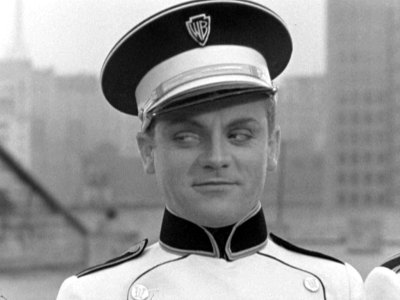
Lady-Killer (Roy Del Ruth, 1933) Light-hearted gangster picture in the same manner as the Humphrey Bogart All Through the Night. Cagney plays Dan Quigley, an entrepreneur of sorts, who when we first see him is "in the picture business"—he's an usher in a Big Apple movie theater, in trouble for disappearing and running crap games on the side. He gets fired for telling a patron what she can do with her toy poodle, and out on the street, notices a dame (Mae Clarke) losing her billfold. Nice guy Dan follows her to her apartment, returns it and finds a nickle-ante poker game in the back. He helps himself, gets cleaned out and on his way out the hall, runs into a rube...returning another billfold. It's a racket, but rather than getting sore, Dan laughs it off, and uses it to parlay himself in on the deal.
Before long, he and the girl, Myra, and the four poker grifters are running a crooked speak-easy, the 7-11 Club, while also doing some knockovers of ritzy swells from the casino on the side. Dan stages traffic accidents outside the manses, gets himself taken inside to case the joint, then gets taken out on a stretcher and the other four do the same for the loot. But, during one of the capers a maid gets her skull caved in and eventually (as they say in the movie) "croaks." The Club gets raided on the word of a stoolie and soon the whole bunch is on the lam.
Quigley and Myra high-tail it to L.A., only to have Dan picked up on suspicion by the LAPD, and when he calls Myra to cough up his bail, she's skipped, along with gang-leader Spade Maddock (Douglass Dumbrille). With nothing to hold him on, the cops release Quigley and eventually he finds work as an extra in the movie business, at which point, life starts to get good, especially with frequent co-star Lois Underwood (Margaret Lindsay), until his old partners start making trouble for him.
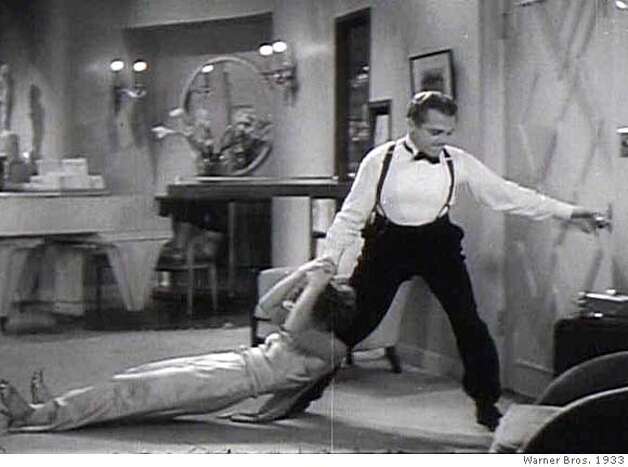
Very fanciful, but Cagney is lighter on his feet here than he is playing his "heavies," in fact, this movie is full of wise-acre slang and a lot of good laugh-lines, most of them coming from Cagney's Quigley, who laughs at every joke. He's a good-time charlie, not meaning any harm, but not wanting to do too much good, either. And Cagney's paired with his co-star from The Public Enemy, Mae Clarke, who gets more than a grapefruit pushed in her face here. At one point, Cagney alarmingly grabs her by her hair and drags her out of his room and throws her bodily into the hallway. The makers also have a lot of fun at Hollywood's expense, sending up the movie business and the extravagant lifestyle. It's almost a romp for Cagney, only a couple years removed from The Public Enemy, and goes some way—but not too much—in rehabilitating his public image. Still a tough guy, but not pure evil, either.
The Testament of Dr. Mabuse (Fritz Lang, 1933) Professor Moriarty, Fu Manchu, Ernst Stavro Blofeld, Hugo Strange, Hannibal Lecter--all master-minds of crime. But they don't hold a suddenly-snuffed-out candle to Dr. Mabuse, Fritz Lang's "man behind the curtain," so powerful he can control his vast drug, counterfeiting, terrorism, assassination and extortion rings from his near catatonic state inside a Berlin mental institution. Lang made three movies about Mabuse--one in 1922 "Mabuse, Der Spieler," and in 1960, "The Thousand Eyes of Dr. Mabuse," his last film. This one, the middle of the trilogy (or actually tetrology if you count "Inferno") , was made under the unapproving gaze of the Nazis, and subsequently banned by Goebbels, prompting Lang, one of the stellar visionaries of German cinema ("M," "Metropolis") to flee the country for Hollywood. And what a vision it is, reflecting the paranoia of National Socialist Germany. Men are sniped while trapped in traffic jams, or nearly blown to bits with barrels of gasoline. Lang even uses the limitations of film to keep you on edge, as lethal chunks of concrete fall from out of frame to threaten those trapped inside. No one is safe, and little is what it seems in the web that Mabuse spins, even unconsciously. One sees in this, the inspirations for Hitchcock and 007** (the film ends with an impressive series of chain-explosions), that not only evolved the thriller genre, but the action film as well. But leave it to Lang to take Mabuse's evil and take it to a supernatural level, as well. No one's safe, in reality or beyond. Now, that is genuine creepiness. ** For those of the comic set, one can look at Steve Englehart's collaborations with Marshall Rogers in "Detective Comics" and see that he drew the inspiration for the supernatural abilities of Dr. Hugo Strange from this very Mabuse film.